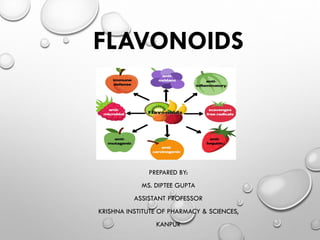
FLAVONOIDS
PREPARED BY:
MS. DIPTEE GUPTA
ASSISTANT PROFESSOR
KRISHNA INSTITUTE OF PHARMACY & SCIENCES,
KANPUR
INTRODUCTION
• Phytochemical compounds present in many plants, fruits,
vegetables, and leaves.
• They are typically yellow pigments found in the majority of
plant species.
• Approximately 4000 flavonoids have been isolated and
identified.
• These are products of secondary metabolites of plants, which
mainly consist of a benzopyrone ring having phenolic or
polyphenolic groups at different positions.
GENERAL STRUCTURE OF FLAVONOID
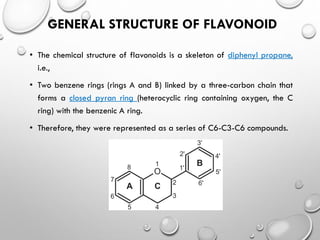
• The chemical structure of flavonoids is a skeleton of diphenyl propane,
i.e.,
• Two benzene rings (rings A and B) linked by a three-carbon chain that
forms a closed pyran ring (heterocyclic ring containing oxygen, the C
ring) with the benzenic A ring.
• Therefore, they were represented as a series of C6-C3-C6 compounds.
PHYSICAL PROPERTIES OF FLAVONOIDS
• Crystalline substances with definite melting point.
• Some are colourless crystal such as catechins, flavanes, isoflavanes, flavanones,
flavanonoles whereas flavones, flavonols, chalcones are yellow coloured
crystals.
• Anthocyanidins are red in acidic media and blue in alkaline media.
• Flavonoid glycosides are generally soluble in water and alcohol but insoluble in
organic solvents. Aglycone parts of flavonoids are soluble in diethyl ether,
acetone, alcohols etc.
• Optically active.
• Under the UV light flavonoids shows fluorescence of different colours (yellow,
orange, brown, red).
CLASSIFICATION OF FLAVONOIDS
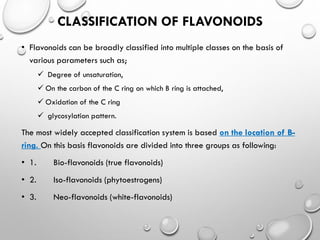
• Flavonoids can be broadly classified into multiple classes on the basis of
various parameters such as;
✓ Degree of unsaturation,
✓ On the carbon of the C ring on which B ring is attached,
✓ Oxidation of the C ring
✓ glycosylation pattern.
The most widely accepted classification system is based on the location of B-
ring. On this basis flavonoids are divided into three groups as following:
• 1. Bio-flavonoids (true flavonoids)
• 2. Iso-flavonoids (phytoestrogens)
• 3. Neo-flavonoids (white-flavonoids)
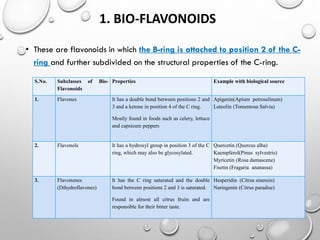
1. BIO-FLAVONOIDS
• These are flavonoids in which the B-ring is attached to position 2 of the C-
ring and further subdivided on the structural properties of the C-ring.
S.No. Subclasses of Bio-
Flavonoids
Properties Example with biological source
1. Flavones It has a double bond between positions 2 and
3 and a ketone in position 4 of the C ring.
Mostly found in foods such as celery, lettuce
and capsicum peppers
Apigenin(Apium petroselinum)
Luteolin (Tomentosa Salvia)
2. Flavonols It has a hydroxyl group in position 3 of the C
ring, which may also be glycosylated.
Quercetin (Quercus alba)
Kaempferol(Pinus sylvestris)
Myricetin (Rosa damascene)
Fisetin (Fragaria ananassa)
3. Flavonones
(Dihydroflavones)
It has the C ring saturated and the double
bond between positions 2 and 3 is saturated.
Found in almost all citrus fruits and are
responsible for their bitter taste.
Hesperidin (Citrus sinensis)
Naringenin (Citrus paradise)
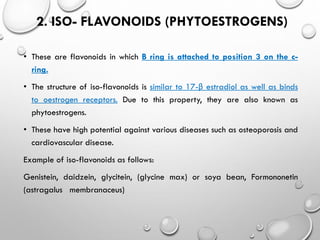
2. ISO- FLAVONOIDS (PHYTOESTROGENS)
• These are flavonoids in which B ring is attached to position 3 on the c-
ring.
• The structure of iso-flavonoids is similar to 17-β estradiol as well as binds
to oestrogen receptors. Due to this property, they are also known as
phytoestrogens.
• These have high potential against various diseases such as osteoporosis and
cardiovascular disease.
Example of iso-flavonoids as follows:
Genistein, daidzein, glycitein, (glycine max) or soya bean, Formononetin
(astragalus membranaceus)
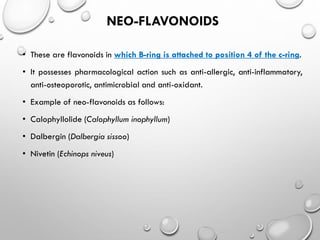
NEO-FLAVONOIDS
• These are flavonoids in which B-ring is attached to position 4 of the c-ring.
• It possesses pharmacological action such as anti-allergic, anti-inflammatory,
anti-osteoporotic, antimicrobial and anti-oxidant.
• Example of neo-flavonoids as follows:
• Calophyllolide (Calophyllum inophyllum)
• Dalbergin (Dalbergia sissoo)
• Nivetin (Echinops niveus)
IDENTIFICATION TEST
1. Shinoda test:
Alcoholic solution of flavone or flavonol treated with metallic magnesium (or
zinc) and HCl gives an orange, red or violet colour. This test is also known as
cyanidin reaction.
2. Lead subacetate test:
To small quantity of residue, add lead subacetate solution. Yellow coloured
precipitate is formed. Addition of increasing amount of sodium hydroxide to
the residue shows yellow colouration, which decolouration after addition of
acid.
CONTI….
3. Wilson’s reaction:
Flavonoids form complexes with boric acid which is not destroyed by addition
of citric acid alcoholic solution (or oxalic acid).
4. Antimony pentachloride test:
Alcoholic solution of sample reacts with antimony pentachloride. The solution
produces red or violet colour.
FUNCTIONS OF FLAVONOIDS
• They are responsible for color and aroma of flowers.
• They attract insects for pollination and help in seed dispersion
• They protect plants from different biotic and abiotic stresses and act as unique
UV filters.
• They act as powerful antioxidants like quercetin, xanthohumol, isoxanthohumol
etc.
• They act as plant growth regulator.
• They also function as fungicides to protect the plant from fungal infection.
Thank You

A brief details on flavonoids

  • 1.
    FLAVONOIDS PREPARED BY: MS. DIPTEEGUPTA ASSISTANT PROFESSOR KRISHNA INSTITUTE OF PHARMACY & SCIENCES, KANPUR
  • 2.
    INTRODUCTION • Phytochemical compoundspresent in many plants, fruits, vegetables, and leaves. • They are typically yellow pigments found in the majority of plant species. • Approximately 4000 flavonoids have been isolated and identified. • These are products of secondary metabolites of plants, which mainly consist of a benzopyrone ring having phenolic or polyphenolic groups at different positions.
  • 3.
    GENERAL STRUCTURE OFFLAVONOID • The chemical structure of flavonoids is a skeleton of diphenyl propane, i.e., • Two benzene rings (rings A and B) linked by a three-carbon chain that forms a closed pyran ring (heterocyclic ring containing oxygen, the C ring) with the benzenic A ring. • Therefore, they were represented as a series of C6-C3-C6 compounds.
  • 4.
    PHYSICAL PROPERTIES OFFLAVONOIDS • Crystalline substances with definite melting point. • Some are colourless crystal such as catechins, flavanes, isoflavanes, flavanones, flavanonoles whereas flavones, flavonols, chalcones are yellow coloured crystals. • Anthocyanidins are red in acidic media and blue in alkaline media. • Flavonoid glycosides are generally soluble in water and alcohol but insoluble in organic solvents. Aglycone parts of flavonoids are soluble in diethyl ether, acetone, alcohols etc. • Optically active. • Under the UV light flavonoids shows fluorescence of different colours (yellow, orange, brown, red).
  • 5.
    CLASSIFICATION OF FLAVONOIDS •Flavonoids can be broadly classified into multiple classes on the basis of various parameters such as; ✓ Degree of unsaturation, ✓ On the carbon of the C ring on which B ring is attached, ✓ Oxidation of the C ring ✓ glycosylation pattern. The most widely accepted classification system is based on the location of B- ring. On this basis flavonoids are divided into three groups as following: • 1. Bio-flavonoids (true flavonoids) • 2. Iso-flavonoids (phytoestrogens) • 3. Neo-flavonoids (white-flavonoids)
  • 6.
    1. BIO-FLAVONOIDS • Theseare flavonoids in which the B-ring is attached to position 2 of the C- ring and further subdivided on the structural properties of the C-ring. S.No. Subclasses of Bio- Flavonoids Properties Example with biological source 1. Flavones It has a double bond between positions 2 and 3 and a ketone in position 4 of the C ring. Mostly found in foods such as celery, lettuce and capsicum peppers Apigenin(Apium petroselinum) Luteolin (Tomentosa Salvia) 2. Flavonols It has a hydroxyl group in position 3 of the C ring, which may also be glycosylated. Quercetin (Quercus alba) Kaempferol(Pinus sylvestris) Myricetin (Rosa damascene) Fisetin (Fragaria ananassa) 3. Flavonones (Dihydroflavones) It has the C ring saturated and the double bond between positions 2 and 3 is saturated. Found in almost all citrus fruits and are responsible for their bitter taste. Hesperidin (Citrus sinensis) Naringenin (Citrus paradise)
  • 7.
    2. ISO- FLAVONOIDS(PHYTOESTROGENS) • These are flavonoids in which B ring is attached to position 3 on the c- ring. • The structure of iso-flavonoids is similar to 17-β estradiol as well as binds to oestrogen receptors. Due to this property, they are also known as phytoestrogens. • These have high potential against various diseases such as osteoporosis and cardiovascular disease. Example of iso-flavonoids as follows: Genistein, daidzein, glycitein, (glycine max) or soya bean, Formononetin (astragalus membranaceus)
  • 8.
    NEO-FLAVONOIDS • These areflavonoids in which B-ring is attached to position 4 of the c-ring. • It possesses pharmacological action such as anti-allergic, anti-inflammatory, anti-osteoporotic, antimicrobial and anti-oxidant. • Example of neo-flavonoids as follows: • Calophyllolide (Calophyllum inophyllum) • Dalbergin (Dalbergia sissoo) • Nivetin (Echinops niveus)
  • 9.
    IDENTIFICATION TEST 1. Shinodatest: Alcoholic solution of flavone or flavonol treated with metallic magnesium (or zinc) and HCl gives an orange, red or violet colour. This test is also known as cyanidin reaction. 2. Lead subacetate test: To small quantity of residue, add lead subacetate solution. Yellow coloured precipitate is formed. Addition of increasing amount of sodium hydroxide to the residue shows yellow colouration, which decolouration after addition of acid.
  • 10.
    CONTI…. 3. Wilson’s reaction: Flavonoidsform complexes with boric acid which is not destroyed by addition of citric acid alcoholic solution (or oxalic acid). 4. Antimony pentachloride test: Alcoholic solution of sample reacts with antimony pentachloride. The solution produces red or violet colour.
  • 11.
    FUNCTIONS OF FLAVONOIDS •They are responsible for color and aroma of flowers. • They attract insects for pollination and help in seed dispersion • They protect plants from different biotic and abiotic stresses and act as unique UV filters. • They act as powerful antioxidants like quercetin, xanthohumol, isoxanthohumol etc. • They act as plant growth regulator. • They also function as fungicides to protect the plant from fungal infection.
  • 12.