Flavonoids are groupof polyphenolic compounds produced in
plants as secondary metabolite. They are widely distributed and
found in fruits, vegetables, herbs, stems, cereals, nuts, flowers,
and seeds. They are known for their diverse biological activities,
including antioxidant, anti-inflammatory, antimicrobial, and
anticancer properties. Flavonoids contribute to the pigmentation
in fruits, flowers, and vegetables and play a crucial role in plant
defense mechanisms against environmental stressors. So far,
over 10,000 flavonoid compounds have been isolated and
identified
FLAVONOIDS
3.
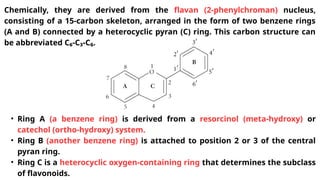
Chemically, they arederived from the flavan (2-phenylchroman) nucleus,
consisting of a 15-carbon skeleton, arranged in the form of two benzene rings
(A and B) connected by a heterocyclic pyran (C) ring. This carbon structure can
be abbreviated C₆-C₃-C₆.
• Ring A (a benzene ring) is derived from a resorcinol (meta-hydroxy) or
catechol (ortho-hydroxy) system.
• Ring B (another benzene ring) is attached to position 2 or 3 of the central
pyran ring.
• Ring C is a heterocyclic oxygen-containing ring that determines the subclass
of flavonoids.
4.
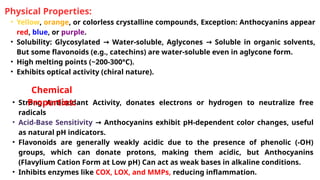
Physical Properties:
• Yellow,orange, or colorless crystalline compounds, Exception: Anthocyanins appear
red, blue, or purple.
• Solubility: Glycosylated Water-soluble, Aglycones Soluble in organic solvents,
→ →
But some flavonoids (e.g., catechins) are water-soluble even in aglycone form.
• High melting points (~200-300°C).
• Exhibits optical activity (chiral nature).
• Strong Antioxidant Activity, donates electrons or hydrogen to neutralize free
radicals
• Acid-Base Sensitivity Anthocyanins exhibit pH-dependent color changes, useful
→
as natural pH indicators.
• Flavonoids are generally weakly acidic due to the presence of phenolic (-OH)
groups, which can donate protons, making them acidic, but Anthocyanins
(Flavylium Cation Form at Low pH) Can act as weak bases in alkaline conditions.
• Inhibits enzymes like COX, LOX, and MMPs, reducing inflammation.
Chemical
Properties:
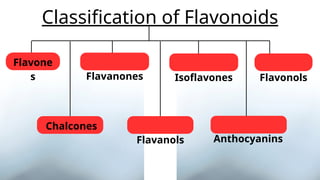
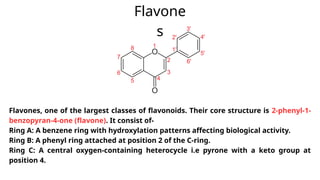
Flavone
s
Flavones, one ofthe largest classes of flavonoids. Their core structure is 2-phenyl-1-
benzopyran-4-one (flavone). It consist of-
Ring A: A benzene ring with hydroxylation patterns affecting biological activity.
Ring B: A phenyl ring attached at position 2 of the C-ring.
Ring C: A central oxygen-containing heterocycle i.e pyrone with a keto group at
position 4.
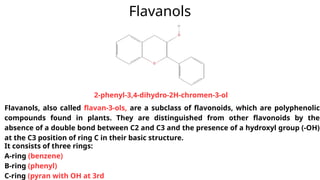
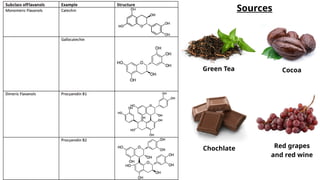
Flavanols
Flavanols, also calledflavan-3-ols, are a subclass of flavonoids, which are polyphenolic
compounds found in plants. They are distinguished from other flavonoids by the
absence of a double bond between C2 and C3 and the presence of a hydroxyl group (-OH)
at the C3 position of ring C in their basic structure.
It consists of three rings:
A-ring (benzene)
B-ring (phenyl)
C-ring (pyran with OH at 3rd
2-phenyl-3,4-dihydro-2H-chromen-3-ol
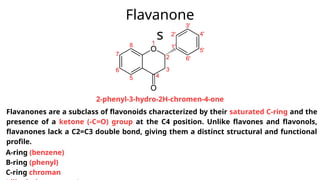
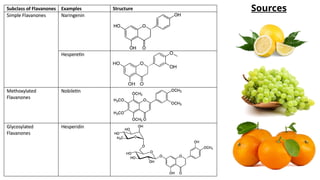
Flavanone
s
Flavanones are asubclass of flavonoids characterized by their saturated C-ring and the
presence of a ketone (-C=O) group at the C4 position. Unlike flavones and flavonols,
flavanones lack a C2=C3 double bond, giving them a distinct structural and functional
profile.
A-ring (benzene)
B-ring (phenyl)
C-ring chroman
2-phenyl-3-hydro-2H-chromen-4-one
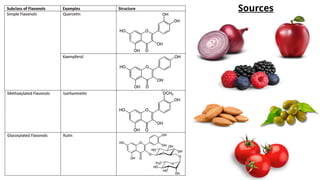
Flavonols are asubclass of flavonoids characterized by the presence of a hydroxyl (-OH)
group at the C3 position and a C4 ketone (-C=O) in their core structure. They also have a
C2=C3 double bond in the C-ring, distinguishing them from flavanols and flavanones.
Flavonols
A-Ring → Benzoyl Ring (Benzopyran Fused Part)
B-Ring → Phenyl Ring (Aryl Substituent at C2)
C-Ring → Chromone Ring (α-Pyrone Fused with
Benzene)
3-Hydroxy-2-phenylchromen-4-one
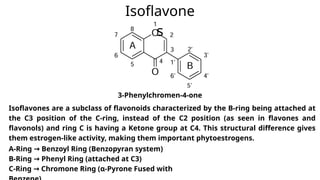
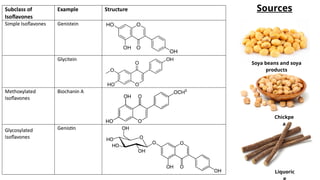
Isoflavones are asubclass of flavonoids characterized by the B-ring being attached at
the C3 position of the C-ring, instead of the C2 position (as seen in flavones and
flavonols) and ring C is having a Ketone group at C4. This structural difference gives
them estrogen-like activity, making them important phytoestrogens.
Isoflavone
s
A-Ring Benzoyl Ring (Benzopyran system)
→
B-Ring Phenyl Ring (attached at C3)
→
C-Ring Chromone Ring (α-Pyrone Fused with
→
3-Phenylchromen-4-one
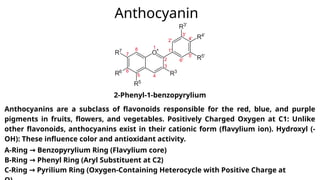
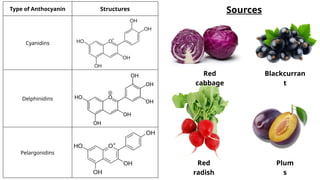
Anthocyanins are asubclass of flavonoids responsible for the red, blue, and purple
pigments in fruits, flowers, and vegetables. Positively Charged Oxygen at C1: Unlike
other flavonoids, anthocyanins exist in their cationic form (flavylium ion). Hydroxyl (-
OH): These influence color and antioxidant activity.
Anthocyanin
A-Ring Benzopyrylium Ring (Flavylium core)
→
B-Ring Phenyl Ring (Aryl Substituent at C2)
→
C-Ring Pyrilium Ring (Oxygen-Containing Heterocycle with Positive Charge at
→
2-Phenyl-1-benzopyrylium
17.
Type of AnthocyaninStructures
Cyanidins
Delphinidins
Pelargonidins
Sources
Red
cabbage
Plum
s
Blackcurran
t
Red
radish
18.
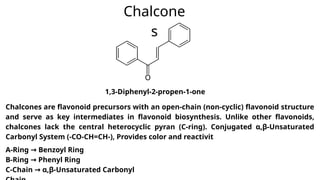
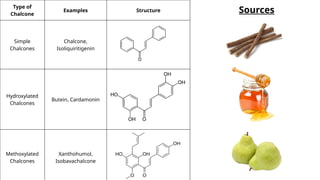
Chalcones are flavonoidprecursors with an open-chain (non-cyclic) flavonoid structure
and serve as key intermediates in flavonoid biosynthesis. Unlike other flavonoids,
chalcones lack the central heterocyclic pyran (C-ring). Conjugated α,β-Unsaturated
Carbonyl System (-CO-CH=CH-), Provides color and reactivit
A-Ring Benzoyl Ring
→
B-Ring Phenyl Ring
→
C-Chain α,β-Unsaturated Carbonyl
→
Chalcone
s
1,3-Diphenyl-2-propen-1-one