PES PLANUS
Dr. Priyanka
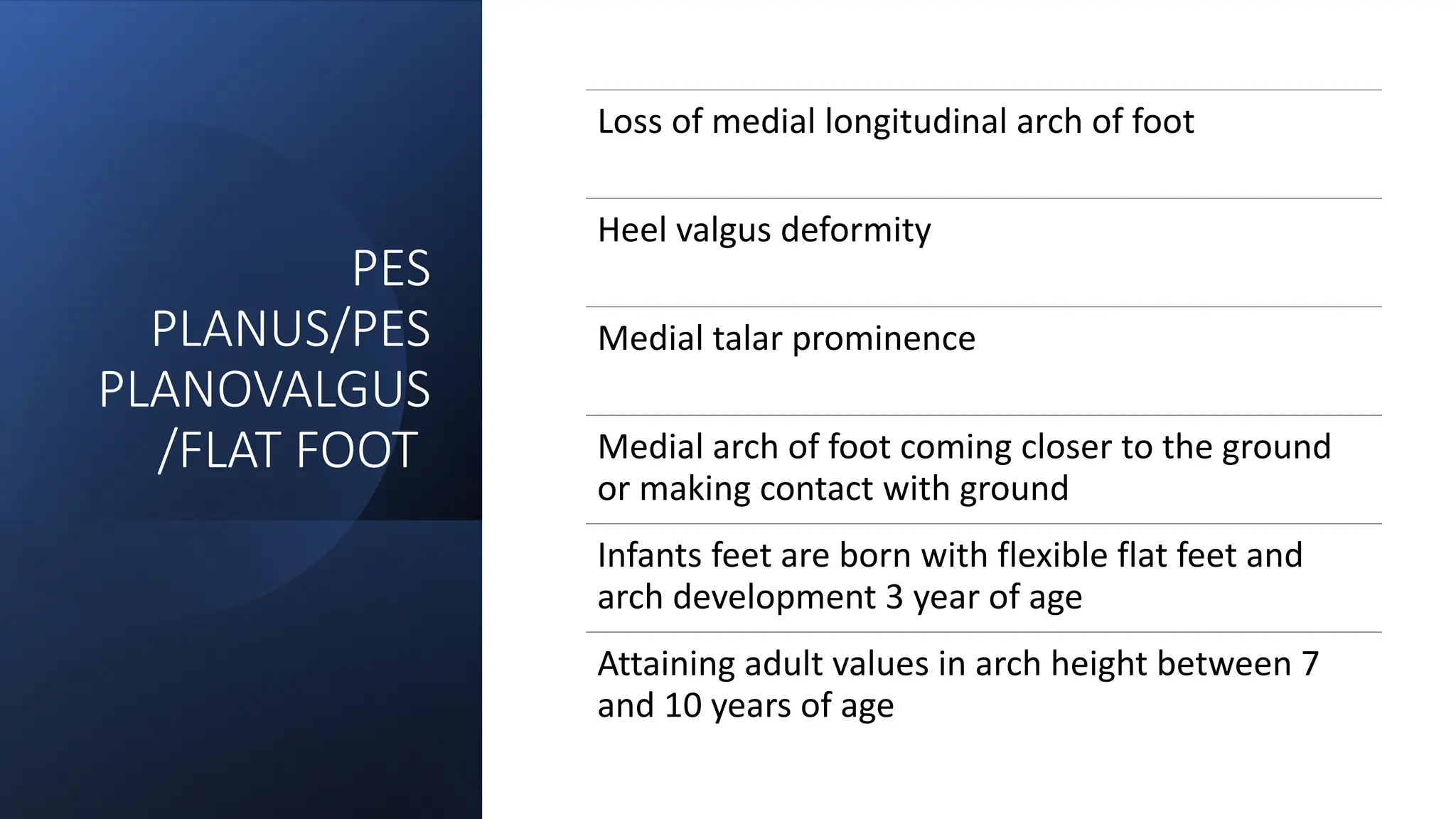
PES
PLANUS/PES
PLANOVALGUS
/FLAT FOOT
Loss of medial longitudinal arch of foot
Heel valgus deformity
Medial talar prominence
Medial arch of foot coming closer to the ground
or making contact with ground
Infants feet are born with flexible flat feet and
arch development 3 year of age
Attaining adult values in arch height between 7
and 10 years of age
Classification
Two types :
1. Arch of height
2. Heel eversion angle
Arch height
• medial longitudinal arch structure was
found to be a ratio of navicular height to
foot length .
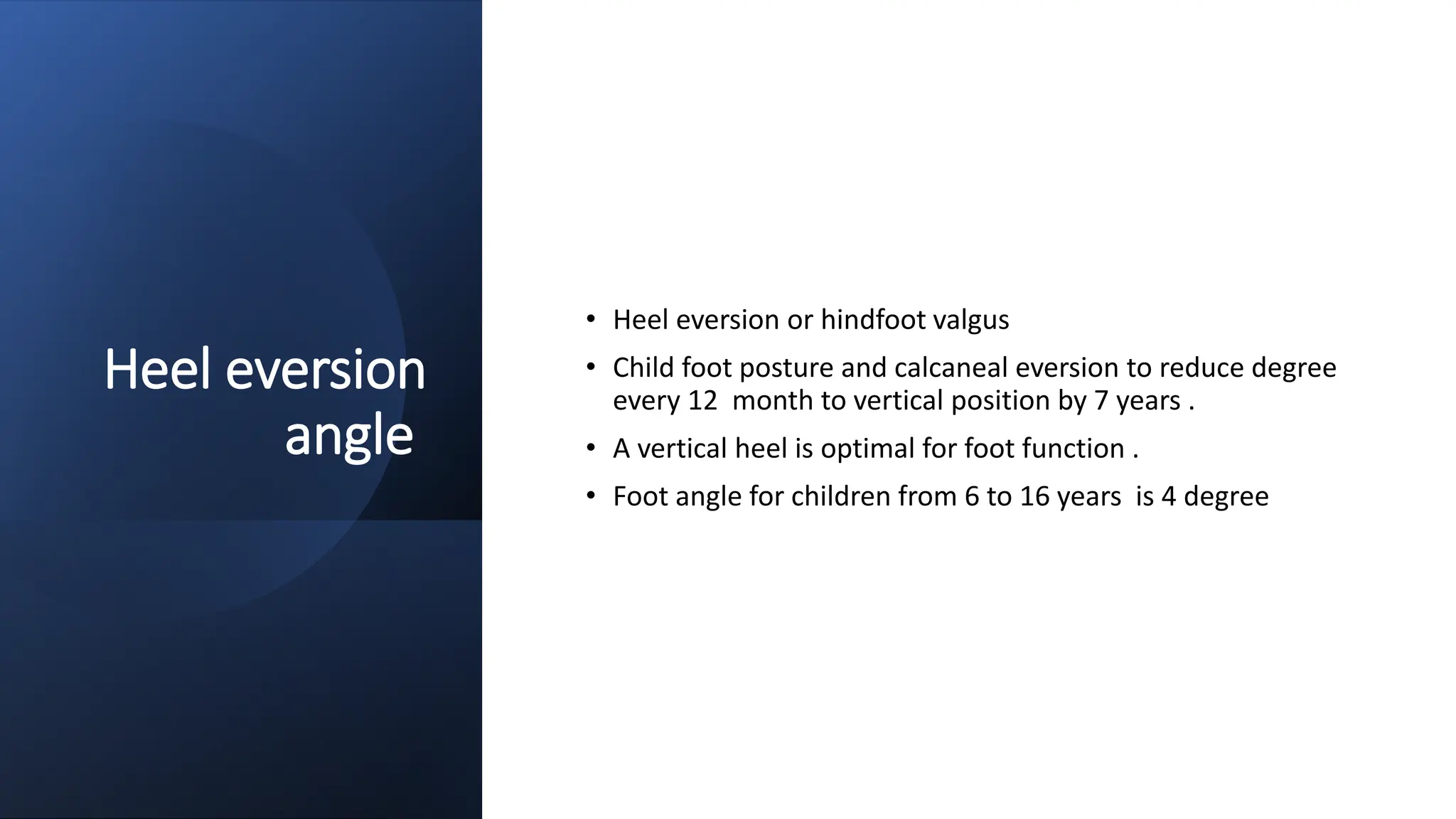
Heel eversion
angle
• Heel eversion or hindfoot valgus
• Child foot posture and calcaneal eversion to reduce degree
every 12 month to vertical position by 7 years .
• A vertical heel is optimal for foot function .
• Foot angle for children from 6 to 16 years is 4 degree
Foot structure type
FLEXIBLE FLAT FOOT RIGID FLAT FOOT
Flexible flat
foot
• The longitudinal arches of foot are present on heel
elevation and non- bearing but disapper with full weight
bearing on the foot
Rigid flat foot
• The longitudinal arch of foot are absent in both heel
elevation and weight bearing
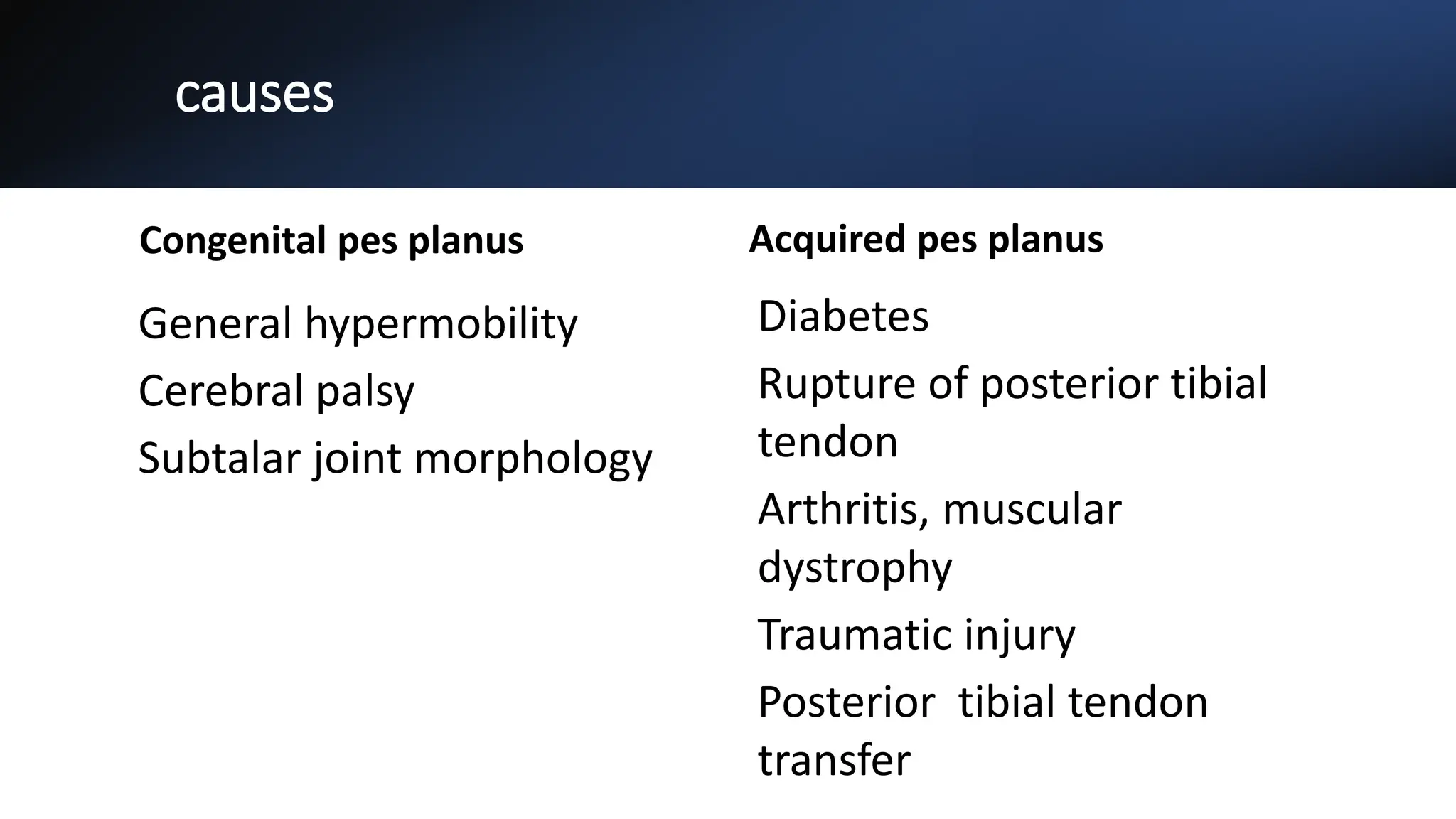
causes
Congenital pes planus
General hypermobility
Cerebral palsy
Subtalar joint morphology
Acquired pes planus
Diabetes
Rupture of posterior tibial
tendon
Arthritis, muscular
dystrophy
Traumatic injury
Posterior tibial tendon
transfer
Other
condition of
congenital pes
planus
• Peroneal spasm
• Congenital Vertical talus
• CTEV
• Ligament laxity
• Down syndrome and marfan syndrome
Pathophysiology
The arch fails to develop result if tightness in calf muscles
,laxity in the achilles tendon or poor core stability in other
areas around of hips
Dynamic
factors
• Soft tissue factors:
1.Insufficency of posterior tibial tendon
2.Peroneal spastic flat foot
3.Muscle weakness by poor posture
• Neurology factors:
1.Myelination of the pyramidal fibers to the foot is
incomplete at birth .
STATIC
FACTORS
• Bony architecture of the medial longitudinal arch .
• Fixed or rigid pes planus is due to structural abnormality.
Clinical
presentation
History :
1. In adult frequent ankle rolling /ankle sprains
2. Children presenting with pes planus asymptomatic
3. Pain (mid foot ,heel, lower leg, knee, hip, back )
Observation:
1. Foot may flat or rocker bottom
2. In standing –calcaneal valgus and foot eversion
3. Gait : walking on heel
4. Viewed from posteriorly looking for the 'too many toes
sign '
5. Look at running or walking shoes uneven distribution of
body weight with resultant one sided wear of shoes
leading to further injuries
Palpation :
 Contracted achilles tendon may show limitation of
dorsiflexion
 Test subtalar and transverse tarsal motion
 Subtalar motion : stabilises ankle with one hand
, calcaneus other hand. The calcaneus is then inverted
and everted .Normal range of motion is between 20
degree and 60 degree. Inversion being 2x the ROM of
eversion
 Tarsal motion : grasp the calcaneus is one hand and
forefoot in other . The normal adduction of forefoot is
about 30 degree ,abduction about 15 degree
Diagnosis :
Footprints
X-rays
Supination resistance test
Foot –posture index
Jacks test and Feiss angle
Tip-toe
Ankle range
Supination
resistance test
Test used to estimate the mangnitude
of pronatory moments
The foot is manually supinated
The higher force required , the greater
the supination resistance and the
stronger the pronatory force
Jacks test and feiss angle
• Hallux is manually dorsiflexed while child is standing
• If medial longitudinal arch rise due to dorsiflexion of hallux the foot is considered
flexible flat foot
• If medial longitudinal arch unchanged the considered rigid flat foot
• Purpose this test to check the flexibility of foot
• Feiss line is the line interconnecting malleolus medialis ,navicular, and first
metatarsal head
• The inclination of this line with ground increases when the first
metatarsophalangeal joint is dorsiflexed ( jack test )
• Dorsiflexion activates forefoot supination and rises the arch height ( 140degree
plus and minus 6 degree )
Ankle range
Children ankle range assessment
generally an unreliable measure
typically assessed when child non
weight bearing
So it is suggested that therapists look
at child ability to squat ,heel walk and
increase stride length
Management
Flexible pes planus :
1. Foot orthoses produces improvement in
children with pes planus
2. The child should be fitted with flat lace up
shoe with a firm heel and MLA , a broad and
deep toe box and the ' toe break' at the
junction between the anterior third and
posterior two third of the shoe .
3. In children 10 years old , flexible flat foot is
considered permanent ,therefore long term
orthotics can be used to prevent secondary
problems
Management
Rigid flat foot:
1. Surgery is required
2. Tendon transfer , osteotomies , arthrodesis
3. Others surgery fails then , triple arthrodesis is
performed
PHYSIOTHERAPY MANAGEMENT
AIM: 1. TO REDUCE PAIN 2. TO INCREASE
FLEXIBILITY
3. STRENGTHEN
WEAK MUSCLES
4. PATIENT
EDUCATION AND
REASSURANCE
Pain management
Rest
Activity modification
Cryotherapy
Massage
Nonsteroidal anti-inflammatory drugs
Ultrasound
Pulsed electrical stimulation
Exercises
• Walking bear foot
• Flexibility exercises are passive ROM exercises
of all ankle and all foot joints
• Stretching of gastrocnemius soleus complex
and peroneus brevis muscles to facilitate varus
and foot adduction
• Heel cord stretch for the achilles tendon and
calf muscles to relief tight heel cord
Strengthening
• Strengthening exercises are given to anterior and
posterior tibialis muscle and the flexor hallucis
longus , intrinsic, interosseus plantaris muscles
and abductor hallucis to prevent valgus and
flattening of anterior arch .
• Arch muscle strengthening exercises with
theraband
• Global activation of the muscles known to
support the medial longitudinal arch and the
varus with and without resistance
• Single leg weight bearing
• Toe walking
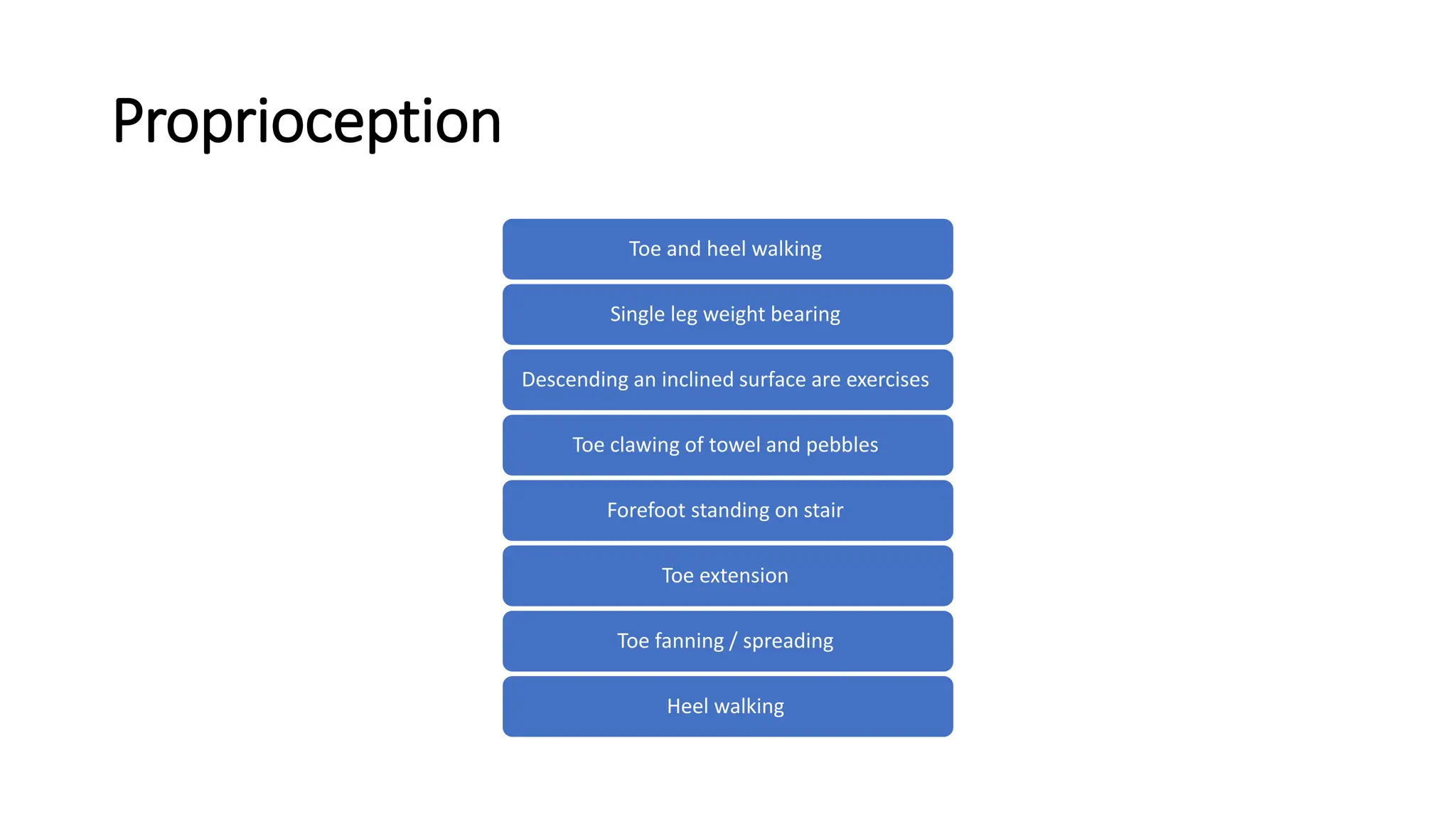
Proprioception
Toe and heel walking
Single leg weight bearing
Descending an inclined surface are exercises
Toe clawing of towel and pebbles
Forefoot standing on stair
Toe extension
Toe fanning / spreading
Heel walking

flat foot.ppt [pes planus ] #physio.# rehabilitation

  • 1.
  • 2.
    PES PLANUS/PES PLANOVALGUS /FLAT FOOT Loss ofmedial longitudinal arch of foot Heel valgus deformity Medial talar prominence Medial arch of foot coming closer to the ground or making contact with ground Infants feet are born with flexible flat feet and arch development 3 year of age Attaining adult values in arch height between 7 and 10 years of age
  • 3.
    Classification Two types : 1.Arch of height 2. Heel eversion angle
  • 4.
    Arch height • mediallongitudinal arch structure was found to be a ratio of navicular height to foot length .
  • 5.
    Heel eversion angle • Heeleversion or hindfoot valgus • Child foot posture and calcaneal eversion to reduce degree every 12 month to vertical position by 7 years . • A vertical heel is optimal for foot function . • Foot angle for children from 6 to 16 years is 4 degree
  • 6.
    Foot structure type FLEXIBLEFLAT FOOT RIGID FLAT FOOT
  • 7.
    Flexible flat foot • Thelongitudinal arches of foot are present on heel elevation and non- bearing but disapper with full weight bearing on the foot
  • 8.
    Rigid flat foot •The longitudinal arch of foot are absent in both heel elevation and weight bearing
  • 9.
    causes Congenital pes planus Generalhypermobility Cerebral palsy Subtalar joint morphology Acquired pes planus Diabetes Rupture of posterior tibial tendon Arthritis, muscular dystrophy Traumatic injury Posterior tibial tendon transfer
  • 10.
    Other condition of congenital pes planus •Peroneal spasm • Congenital Vertical talus • CTEV • Ligament laxity • Down syndrome and marfan syndrome
  • 11.
    Pathophysiology The arch failsto develop result if tightness in calf muscles ,laxity in the achilles tendon or poor core stability in other areas around of hips
  • 12.
    Dynamic factors • Soft tissuefactors: 1.Insufficency of posterior tibial tendon 2.Peroneal spastic flat foot 3.Muscle weakness by poor posture • Neurology factors: 1.Myelination of the pyramidal fibers to the foot is incomplete at birth .
  • 13.
    STATIC FACTORS • Bony architectureof the medial longitudinal arch . • Fixed or rigid pes planus is due to structural abnormality.
  • 14.
    Clinical presentation History : 1. Inadult frequent ankle rolling /ankle sprains 2. Children presenting with pes planus asymptomatic 3. Pain (mid foot ,heel, lower leg, knee, hip, back ) Observation: 1. Foot may flat or rocker bottom 2. In standing –calcaneal valgus and foot eversion 3. Gait : walking on heel 4. Viewed from posteriorly looking for the 'too many toes sign ' 5. Look at running or walking shoes uneven distribution of body weight with resultant one sided wear of shoes leading to further injuries
  • 15.
    Palpation :  Contractedachilles tendon may show limitation of dorsiflexion  Test subtalar and transverse tarsal motion  Subtalar motion : stabilises ankle with one hand , calcaneus other hand. The calcaneus is then inverted and everted .Normal range of motion is between 20 degree and 60 degree. Inversion being 2x the ROM of eversion  Tarsal motion : grasp the calcaneus is one hand and forefoot in other . The normal adduction of forefoot is about 30 degree ,abduction about 15 degree
  • 16.
    Diagnosis : Footprints X-rays Supination resistancetest Foot –posture index Jacks test and Feiss angle Tip-toe Ankle range
  • 17.
    Supination resistance test Test usedto estimate the mangnitude of pronatory moments The foot is manually supinated The higher force required , the greater the supination resistance and the stronger the pronatory force
  • 18.
    Jacks test andfeiss angle • Hallux is manually dorsiflexed while child is standing • If medial longitudinal arch rise due to dorsiflexion of hallux the foot is considered flexible flat foot • If medial longitudinal arch unchanged the considered rigid flat foot • Purpose this test to check the flexibility of foot • Feiss line is the line interconnecting malleolus medialis ,navicular, and first metatarsal head • The inclination of this line with ground increases when the first metatarsophalangeal joint is dorsiflexed ( jack test ) • Dorsiflexion activates forefoot supination and rises the arch height ( 140degree plus and minus 6 degree )
  • 19.
    Ankle range Children anklerange assessment generally an unreliable measure typically assessed when child non weight bearing So it is suggested that therapists look at child ability to squat ,heel walk and increase stride length
  • 20.
    Management Flexible pes planus: 1. Foot orthoses produces improvement in children with pes planus 2. The child should be fitted with flat lace up shoe with a firm heel and MLA , a broad and deep toe box and the ' toe break' at the junction between the anterior third and posterior two third of the shoe . 3. In children 10 years old , flexible flat foot is considered permanent ,therefore long term orthotics can be used to prevent secondary problems
  • 21.
    Management Rigid flat foot: 1.Surgery is required 2. Tendon transfer , osteotomies , arthrodesis 3. Others surgery fails then , triple arthrodesis is performed
  • 22.
    PHYSIOTHERAPY MANAGEMENT AIM: 1.TO REDUCE PAIN 2. TO INCREASE FLEXIBILITY 3. STRENGTHEN WEAK MUSCLES 4. PATIENT EDUCATION AND REASSURANCE
  • 23.
    Pain management Rest Activity modification Cryotherapy Massage Nonsteroidalanti-inflammatory drugs Ultrasound Pulsed electrical stimulation
  • 24.
    Exercises • Walking bearfoot • Flexibility exercises are passive ROM exercises of all ankle and all foot joints • Stretching of gastrocnemius soleus complex and peroneus brevis muscles to facilitate varus and foot adduction • Heel cord stretch for the achilles tendon and calf muscles to relief tight heel cord
  • 25.
    Strengthening • Strengthening exercisesare given to anterior and posterior tibialis muscle and the flexor hallucis longus , intrinsic, interosseus plantaris muscles and abductor hallucis to prevent valgus and flattening of anterior arch . • Arch muscle strengthening exercises with theraband • Global activation of the muscles known to support the medial longitudinal arch and the varus with and without resistance • Single leg weight bearing • Toe walking
  • 26.
    Proprioception Toe and heelwalking Single leg weight bearing Descending an inclined surface are exercises Toe clawing of towel and pebbles Forefoot standing on stair Toe extension Toe fanning / spreading Heel walking