ANKLE &
FOOT COMPLEX
DR . PRIYANKA RANAWAT { PHYSIOTHERAPIST }
ANKLE JOINT
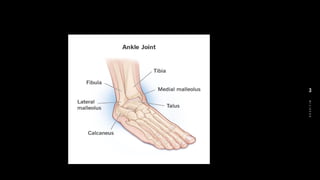
• TYPE :- synovial joint of the hinge variety .
• ARTICULAR SURFACE : -
• Proximal :- Distal end of tibia , Medial malleolus of the
tibia ,Lateral malleolus of fibula
• Distal :- body of talus
• The inferior transverse tibiofibular ligament
8
/
1
/
2
0
2
4
2
8
/
1
/
2
0
2
4
3
F IB RO U S CAPS UL E
• Its attached to all around articular margins with 2 exception .
• 1 . Posterior superiorly :- its attached to inferior transverse tibiofibular
ligament .
• 2. Antero inferiorly :- its attached to dorsum of neck of talus .
• The anterior and posterior parts of capsule are loose and thin, loose to
allow hinge movement.
• Its supported by strong collateral ligament .
8
/
1
/
2
0
2
4
4
STAB IL IT Y O F JO INT
• Close interlocking of the articular surfaces .
• Strong collateral ligaments on the sides .
• The tendon that cross the joint , four in front , and
three on posteromedial side and two on
posterolateral side .
8
/
1
/
2
0
2
4
5
F U NCTIO N O F AN KL E J O INT
8
/
1
/
2
0
2
4
6
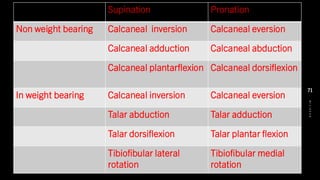
• Acts as a support base that provides the necessary
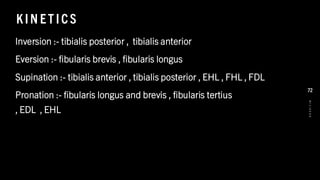
stability for upright posture with minimal muscle effort
• Provides a mechanism for rotation of the tibia and
fibula during the stance phase of gait
• Provides flexibility to adapt to uneven terrain
• Provides flexibility for absorption of shock
• Acts as a lever during push-off
L IG AM E NTS
• Deltoid ligaments { medial ligament }
• Lateral ligament
8
/
1
/
2
0
2
4
7
DE LTO ID L IG AM EN T
origin :- border of tibial malleolus
• Insertion :- Anterior to posterior on talus. Navicular and
calcaneus.
• Very strong triangular ligament and
excessive tensile forces on the ligament result in an
avulsion fracture rather a tear of ligament .
• The ligament is prone to injuries in inversion .
8
/
1
/
2
0
2
4
8
DE LTO ID L IG AM EN T
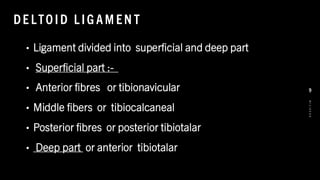
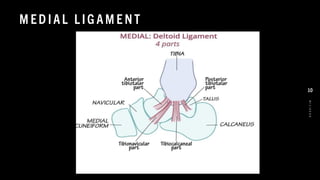
• Ligament divided into superficial and deep part
• Superficial part :-
• Anterior fibres or tibionavicular
• Middle fibers or tibiocalcaneal
• Posterior fibres or posterior tibiotalar
• Deep part or anterior tibiotalar
8
/
1
/
2
0
2
4
9
M ED IAL L IG AM E NT
8
/
1
/
2
0
2
4
10
L AT ER A L L IG AM EN T
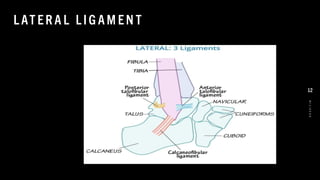
• Anterior talofibular ligament
• Posterior talofibular ligament
• Calcaneofibular ligament
• Interosseous tibiofibular ligament , inferior
retinaculum , inferior and superior peroneal retinacula also
contribute to the stability of ankle joint .
8
/
1
/
2
0
2
4
11
L AT ER A L L IG AM EN T
8
/
1
/
2
0
2
4
12
R E L ATIO N O F A NKL E J O INT
• Anterior :- tibialis anterior , Extensor hallucis longus ,
Extensor digitorum longus , peroneus tertius
• Posterior medially :-
tibialis posterior, flexor digitorum longus , flexor hallucis
• Posterior laterally :- peroneus longus , peroneus brevis
8
/
1
/
2
0
2
4
13
MUSCLES ATTACHMENT
OF ANKLE JOINT
8
/
1
/
2
0
2
4
14
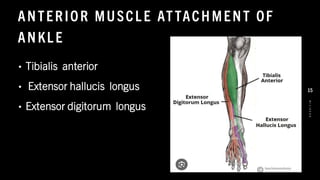
ANTERIOR MUSCLE ATTACHMENT OF
ANKLE
• Tibialis anterior
• Extensor hallucis longus
• Extensor digitorum longus
8
/
1
/
2
0
2
4
15
T BIA L IS A NT ER IO R
• ORIGIN :- Lateral condyle and
superior 2/3 of anterolateral surface of tibia .
• INSERTION :- Medial and inferior surface of
medial cuneiform and base of 1st metatarsal
.
• NERVE SUPPLY :- Peroneal nerve { L4 , L5 ]
• ACTION : - Dorsiflexion of ankle .
8
/
1
/
2
0
2
4
16
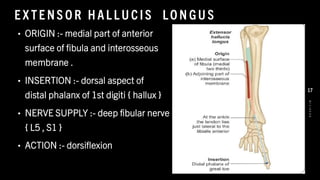
E X TE NS O R HAL L U CIS LO N GU S
• ORIGIN :- medial part of anterior
surface of fibula and interosseous
membrane .
• INSERTION :- dorsal aspect of
distal phalanx of 1st digiti { hallux }
• NERVE SUPPLY :- deep fibular nerve
{ L5 , S1 }
• ACTION :- dorsiflexion
8
/
1
/
2
0
2
4
17
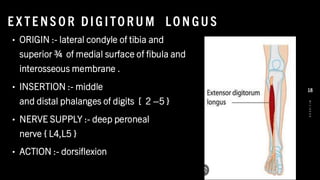
E X TE NS O R DIG ITO R U M LO N GU S
• ORIGIN :- lateral condyle of tibia and
superior ¾ of medial surface of fibula and
interosseous membrane .
• INSERTION :- middle
and distal phalanges of digits [ 2 –5 }
• NERVE SUPPLY :- deep peroneal
nerve { L4,L5 }
• ACTION :- dorsiflexion
8
/
1
/
2
0
2
4
18
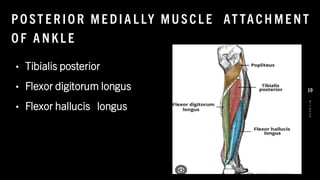
PO ST E R IO R ME DIA L LY MU SCL E AT TACH ME NT
O F A NKL E
• Tibialis posterior
• Flexor digitorum longus
• Flexor hallucis longus
8
/
1
/
2
0
2
4
19
T IBIA L IS PO ST E R IO R
• ORIGIN :- Posterior superior face of
tibia inferior to soleal line , posterior
surface of fibula .
• INSERTION :- Tuberosity of navicular ,
cuneiform , cuboid and
Sustanticulum Tali of calcaneus , base of
2nd , 3rd and 4th MT
• NERVE SUPPLY :- Tibial nerve [ L4 , L5 ]
• ACTION :- Plantar flexion
8
/
1
/
2
0
2
4
20
F E X LO R DIG ITO R U M L O NG US
• ORIGIN :- Medial part of posterior
surface of tibia inferior to soleal line .
• INSERTION :- Base
of distal phalanges of digits 2- 5
• NERVE SUPPLY :- Tibial nerve [ L5
, S1 & S2 ]
• ACTION l:- Plantar flexion
8
/
1
/
2
0
2
4
21
F L E XO R H AL L U CIS LO N GU S
• ORIGIN :- Inferior 2/3 of
posterior surface of fibula and
interosseous membrane .
• INSERTION :- base of distal phalanx of
digit 1 [ hallux ]
• NERVE SUPPLY :- Tibial nerve [ L4,
L5 ,S1,S2 & S3 ]
• ACTION :- Plantar flexion
8
/
1
/
2
0
2
4
22
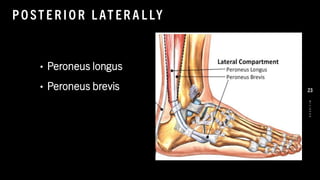
PO ST E R IO R L AT ER A L LY
• Peroneus longus
• Peroneus brevis
8
/
1
/
2
0
2
4
23
PE RO N E US [ F IBU L A R IS ] LO N GU S
• ORGIN :- Head and superior 2/3 of
lateral surface of tibia .
• INSERTION :- Base of 1st
metatarsal and medial cuneiform .
• NERVE SUPPLY :- peroneal
nerve [ L5 , S1 ]
• ACTION : - Plantar flexion
8
/
1
/
2
0
2
4
24
PE RO N E US [ F IB UL A R IS ] B R E V IS
• ORIGIN :- inferior 2/3 of lateral surface of
fibula
• INSERTION :- dorsal surface of
tuberosity on lateral side of base of
5th metatarsal .
• NERVE SUPPLY :- superficial peroneal
nerve
• ACTION :- plantar flexion of ankle
8
/
1
/
2
0
2
4
25
T IBIO F IB U L AR JO IN T
• Superior Tibiofibular joint
• Middle Tibiofibular joint
• Inferior Tibiofibular joint
8
/
1
/
2
0
2
4
26
BIOMECHANICS
8
/
1
/
2
0
2
4
27
TA LO CR U R AL JO IN T / T IBIOTAL A R J O INT
/ F IB UL O TA L AR JO INT
• Type :- synovial joint
• Degree of freedom :- one degree of freedom
• Articulating surface :- proximal :- distal end of tibia , medial malleolus of tibia , lateral
malleolus of fibula
• Distal : - body of talus
• Resting position :- 10 degree plantar flexion midway between inversion and eversion
• Close packed position :- maximum dorsiflexion
• Loose pack position :- plantar flexion
• Capsular pattern :- plantar flexion , dorsiflexion
8
/
1
/
2
0
2
4
28
STAB IL IT Y
• Joint design :- proximal articulating surface together form a
rectangular arch called as mortise and talus forms tendon .
• Talus widens anteriorly due to
which wedge into mortise during dorsiflexion , there
for improving the joint stability.
8
/
1
/
2
0
2
4
29
CAPS UL E
• Weak and thin capsule attached proximally to margins of
medial and lateral malleolus , distally to surface of talus .
• Collateral ligament reinforce the capsule medially
and laterally
• Ligaments :- anterior , posterior talofibular
ligament , calcaneofibular ligament ,deltoid ligament
, lateral collateral ligament
8
/
1
/
2
0
2
4
30
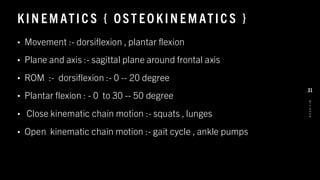
KIN EM ATIC S { OST EO KIN EM ATIC S }
• Movement :- dorsiflexion , plantar flexion
• Plane and axis :- sagittal plane around frontal axis
• ROM :- dorsiflexion :- 0 -- 20 degree
• Plantar flexion : - 0 to 30 -- 50 degree
• Close kinematic chain motion :- squats , lunges
• Open kinematic chain motion :- gait cycle , ankle pumps
8
/
1
/
2
0
2
4
31
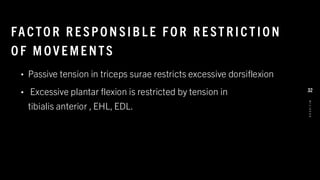
FACTO R R E SPO N SIB L E FO R R E ST R ICT IO N
O F M OV E ME NTS
• Passive tension in triceps surae restricts excessive dorsiflexion
• Excessive plantar flexion is restricted by tension in
tibialis anterior , EHL, EDL.
8
/
1
/
2
0
2
4
32
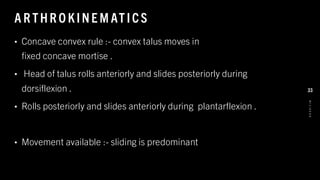
A R THR O KINE M AT ICS
• Concave convex rule :- convex talus moves in
fixed concave mortise .
• Head of talus rolls anteriorly and slides posteriorly during
dorsiflexion .
• Rolls posteriorly and slides anteriorly during plantarflexion .
• Movement available :- sliding is predominant
8
/
1
/
2
0
2
4
33
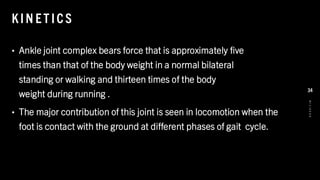
KIN ET ICS
• Ankle joint complex bears force that is approximately five
times than that of the body weight in a normal bilateral
standing or walking and thirteen times of the body
weight during running .
• The major contribution of this joint is seen in locomotion when the
foot is contact with the ground at different phases of gait cycle.
8
/
1
/
2
0
2
4
34
CO N T...
• The dorsiflexion eccentrically contract to control the
movement of foot onto the ground preventing it from slapping in
the initial contact .
• During the loading response , the
dorsiflexion contract eccentrically to allow
forward progression and in the midstance the plantar
flexors concentrically contract progressing itself to the
next phases of gait cycle .,
8
/
1
/
2
0
2
4
35
CO N T...
• When the speed of walking progresses the kinetic pattern of the
ankle increases with magnitude .
• Almost 83 percent of load is transmitted via tibiotalar
joint and remainder of 17 percent via fibula .
• The load is distributed effectively due to the function of ligaments
as well as structural impact , while ankle sharing high level of
congruency when subjected to stress.
8
/
1
/
2
0
2
4
36
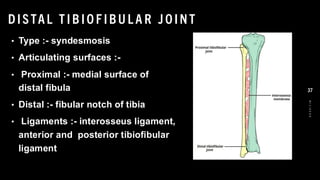
DISTAL T IB IO F IBU L A R JO INT
• Type :- syndesmosis
• Articulating surfaces :-
• Proximal :- medial surface of
distal fibula
• Distal :- fibular notch of tibia
• Ligaments :- interosseus ligament,
anterior and posterior tibiofibular
ligament
8
/
1
/
2
0
2
4
37
CLINICAL TESTS
8
/
1
/
2
0
2
4
38
T E STS O F A NKL E J O INT
1. Achilles tendon test
2. Squeeze test
3. Thompson’s test
4. Ankle anterior drawer test
5. External rotation test
6. Talar tilt test
7. Plantar fasciitis test
8. Tarsal tunnel test ( Tinel’s Sign of Tibial Nerve at Ankle)
8
/
1
/
2
0
2
4
39
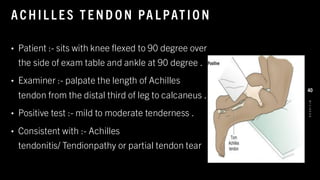
ACHIL L E S T E ND O N PA L PAT IO N
• Patient :- sits with knee flexed to 90 degree over
the side of exam table and ankle at 90 degree .
• Examiner :- palpate the length of Achilles
tendon from the distal third of leg to calcaneus .
• Positive test :- mild to moderate tenderness .
• Consistent with :- Achilles
tendonitis/ Tendionpathy or partial tendon tear
8
/
1
/
2
0
2
4
40
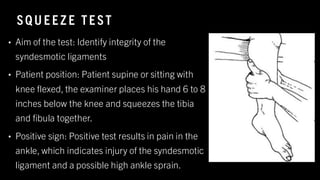
SQ U E E Z E TE ST
• Aim of the test: Identify integrity of the
syndesmotic ligaments
• Patient position: Patient supine or sitting with
knee flexed, the examiner places his hand 6 to 8
inches below the knee and squeezes the tibia
and fibula together.
• Positive sign: Positive test results in pain in the
ankle, which indicates injury of the syndesmotic
ligament and a possible high ankle sprain.
8
/
1
/
2
0
2
4
41
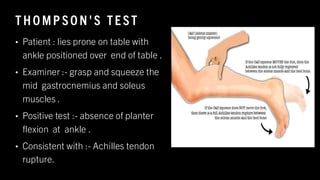
T HO MP SO N'S TE ST
• Patient : lies prone on table with
ankle positioned over end of table .
• Examiner :- grasp and squeeze the
mid gastrocnemius and soleus
muscles .
• Positive test :- absence of planter
flexion at ankle .
• Consistent with :- Achilles tendon
rupture.
8
/
1
/
2
0
2
4
42
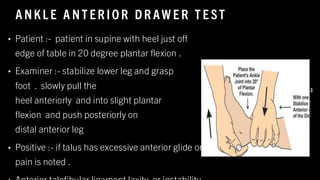
A NKL E A NT ER IO R DR AW E R T E ST
• Patient :- patient in supine with heel just off
edge of table in 20 degree plantar flexion .
• Examiner :- stabilize lower leg and grasp
foot . slowly pull the
heel anteriorly and into slight plantar
flexion and push posteriorly on
distal anterior leg
• Positive :- if talus has excessive anterior glide or
pain is noted .
8
/
1
/
2
0
2
4
43
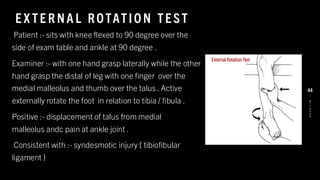
E X TE R NA L ROTATIO N TE ST
Patient :- sits with knee flexed to 90 degree over the
side of exam table and ankle at 90 degree .
Examiner :- with one hand grasp laterally while the other
hand grasp the distal of leg with one finger over the
medial malleolus and thumb over the talus . Active
externally rotate the foot in relation to tibia / fibula .
Positive :- displacement of talus from medial
malleolus andc pain at ankle joint .
Consistent with :- syndesmotic injury [ tibiofibular
ligament }
8
/
1
/
2
0
2
4
44
TA L AR T ILT TE ST [ KL E IG E R ]
• Patient :- sits with leg hanging freely over
exam table .
• Examiner :- stabilize the leg medially with
one hand and cup the hind foot with other
hand . Inversion force applied to the hind foot
• Positive :-- tilt occurs at tibiotalar joint .
• Consistent with :- sprain or tear of the
anterior talofibular ligament
and calcaneofibular ligament
8
/
1
/
2
0
2
4
45
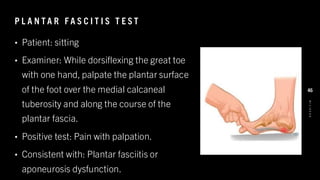
P L A N T A R F A S C I T I S T E S T
• Patient: sitting
• Examiner: While dorsiflexing the great toe
with one hand, palpate the plantar surface
of the foot over the medial calcaneal
tuberosity and along the course of the
plantar fascia.
• Positive test: Pain with palpation.
• Consistent with: Plantar fasciitis or
aponeurosis dysfunction.
8
/
1
/
2
0
2
4
46
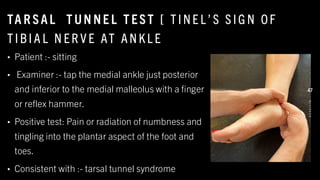
TA R SAL T UN NE L T EST [ T I NE L’ S S I G N OF
T I BI A L N ER V E AT ANK L E
• Patient :- sitting
• Examiner :- tap the medial ankle just posterior
and inferior to the medial malleolus with a finger
or reflex hammer.
• Positive test: Pain or radiation of numbness and
tingling into the plantar aspect of the foot and
toes.
• Consistent with :- tarsal tunnel syndrome
8
/
1
/
2
0
2
4
47
HO M AN 'S T E ST
8
/
1
/
2
0
2
4
48
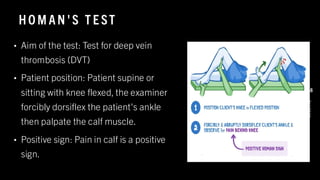
• Aim of the test: Test for deep vein
thrombosis (DVT)
• Patient position: Patient supine or
sitting with knee flexed, the examiner
forcibly dorsiflex the patient's ankle
then palpate the calf muscle.
• Positive sign: Pain in calf is a positive
sign.
PAR TS O F F O OT
• Hindfoot [ rear foot ] [ talus , calcaneus }
• Midfoot [ mid tarsal joint ] [ cuboid , navicular
, three cuneiform bone ]
• Forefoot [metatarsals , phalanges ]
8
/
1
/
2
0
2
4
49
F L E X IO N AN D E X TE NS IO N O F M TP J O INT
• Lumbricals
• Flexor hallucis brevis
• Extensor
digitorum longus { digits 2
–5 ]
• Extensor digitorum brevis
• Extensor hallucis longus {
digit 1 }
8
/
1
/
2
0
2
4
50
F L E X IO N AN D E X TE NS IO N O F PIP JO INT
• Flexor digitorum longus [ digits
2- 5 ]
• Flexor digitorum brevis [digits
2 –5 ]
• Flexor hallucis longus [ digit 1]
Extensor digitorum longus [
digits 2- 5 ]
Extensor digitorum brevis
Extensor hallucis longus [
digit 1]
8
/
1
/
2
0
2
4
51
F L E X IO N AN D E X TE NS IO N O F DIP JO IN T
• Flexor digitorum longus {
digits 2 – 5}
• Extensor digitorum longus
{ digits 2 –5 ]
• Extensor digitorum brevis
8
/
1
/
2
0
2
4
52
INV E R SIO N AND E VE R SIO N O F FO OT
• Tibialis anterior
• Tibialis posterior
• Fibularis longus
• Fibularis brevis
8
/
1
/
2
0
2
4
53
SU BTAL A R J O INT
• There three joints , anterior , posterior and medial between the
talus and calcaneum .
• Posterior joint is named the talocalcanean or subtalar
joint where concave of body of
talus articulates with convex posterior facet of the calcaneum .
• Anterior joint are parts of the talocalcaneonavicular joint .
• Movement :- inversion , eversion
•
8
/
1
/
2
0
2
4
54
CO N T .. .
• On the anterior or medial side of head of talus , the
surface are convex and articulate with
concave articulating surface of calcaneum.
• Three joints form a single functional unit .
• The sinus tarsi separates the
posterior articulation from anterior and medial articulations .
8
/
1
/
2
0
2
4
55
CO N T...
• The greater part of talocalcaneonavicular joint lies in
front of the head of talus and not below it .
• The talocalcanean joint plane synovial
joint between concave facet on the inferior surface of the
body of talus and the convex facet on middle one –
third of the superior surface of calcaneum .
8
/
1
/
2
0
2
4
56
L IG AM E NTS O F SU BTAL A R J O INT
• Fibrous capsule
• Lateral and medial talocalcanean ligaments
• Interosseous talocalcanean ligament
• Cervical ligament
8
/
1
/
2
0
2
4
57
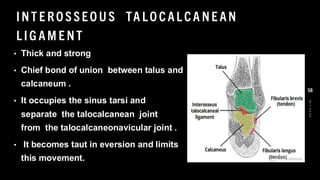
INT E RO SSEO U S TA LO CAL CA NE AN
L IG AM E NT
• Thick and strong
• Chief bond of union between talus and
calcaneum .
• It occupies the sinus tarsi and
separate the talocalcanean joint
from the talocalcaneonavicular joint .
• It becomes taut in eversion and limits
this movement.
8
/
1
/
2
0
2
4
58
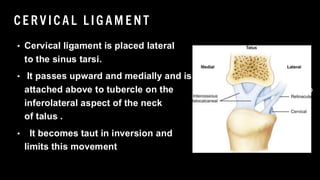
CE R V ICAL L IG AM E NT
• Cervical ligament is placed lateral
to the sinus tarsi.
• It passes upward and medially and is
attached above to tubercle on the
inferolateral aspect of the neck
of talus .
• It becomes taut in inversion and
limits this movement
8
/
1
/
2
0
2
4
59
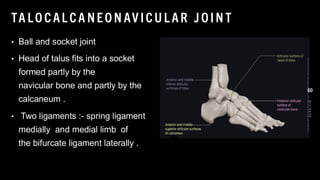
TA LO CAL CA NEO N AV ICU L AR J O IN T
• Ball and socket joint
• Head of talus fits into a socket
formed partly by the
navicular bone and partly by the
calcaneum .
• Two ligaments :- spring ligament
medially and medial limb of
the bifurcate ligament laterally .
8
/
1
/
2
0
2
4
60
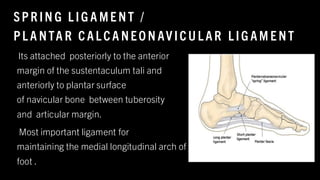
SPR IN G L IG A ME NT /
PL A NTA R CAL CA NEO N AV ICU L AR L IG AM E NT
Its attached posteriorly to the anterior
margin of the sustentaculum tali and
anteriorly to plantar surface
of navicular bone between tuberosity
and articular margin.
Most important ligament for
maintaining the medial longitudinal arch of
foot .
8
/
1
/
2
0
2
4
61
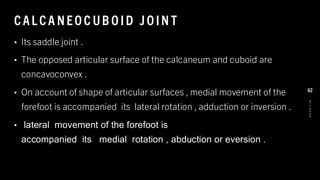
CAL CA NEO C UB O ID J O IN T
• Its saddle joint .
• The opposed articular surface of the calcaneum and cuboid are
concavoconvex .
• On account of shape of articular surfaces , medial movement of the
forefoot is accompanied its lateral rotation , adduction or inversion .
• lateral movement of the forefoot is
accompanied its medial rotation , abduction or eversion .
8
/
1
/
2
0
2
4
62
L IG AM E NTS
• A fibrous capsule
• Lateral limb of the bifurcate ligament
• The long plantar ligament
• The short plantar ligament
8
/
1
/
2
0
2
4
63
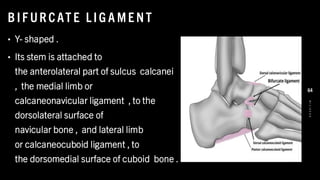
B IF UR CAT E L IG A ME NT
• Y- shaped .
• Its stem is attached to
the anterolateral part of sulcus calcanei
, the medial limb or
calcaneonavicular ligament , to the
dorsolateral surface of
navicular bone , and lateral limb
or calcaneocuboid ligament , to
the dorsomedial surface of cuboid bone .
8
/
1
/
2
0
2
4
64
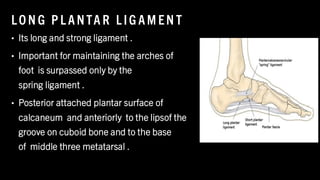
LO N G P L ANTA R L IG AM EN T
• Its long and strong ligament .
• Important for maintaining the arches of
foot is surpassed only by the
spring ligament .
• Posterior attached plantar surface of
calcaneum and anteriorly to the lipsof the
groove on cuboid bone and to the base
of middle three metatarsal .
8
/
1
/
2
0
2
4
65
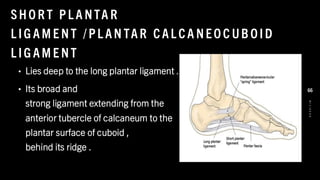
SHO R T PL A NTA R
L IG AM E NT / PL AN TAR CAL CA NEO C UB O ID
L IG AM E NT
• Lies deep to the long plantar ligament .
• Its broad and
strong ligament extending from the
anterior tubercle of calcaneum to the
plantar surface of cuboid ,
behind its ridge .
8
/
1
/
2
0
2
4
66
SU BTAL A R JO INT
• Type ;- plane synovial joint
• Degree of freedom :- one
• Articulating surface :- proximal :- anterior , middle , and
posterior facet of calcaneus .
• Distal :- anterior , posterior and middle facet of talus
• Close packed position :- supination
• Open packed position :- neutral
• Capsular pattern :- limitation of varus movement
8
/
1
/
2
0
2
4
67
STAB IL IT Y
• Joint design :- excessive mobility is prevented
due to alternating concave - convex facet .
• Capsule :- a loose capsule enclosing the entire joint ,
which thickness to form medial , lateral and
posterior talocalcaneal ligament that stabilize the capsule .
• Ligaments :- talocalcaneal [ all three
parts] talocalcaneal interosseous , cervical ligament .
8
/
1
/
2
0
2
4
68
A R THR O KINE M AT ICS
• Screwlike movement or complex twisting movement is observed
when talus moves over calcaneus .
• At anterior and middle articulation , talus glide in opposite direction ,
while it slides in same direction at posterior articulation .
• In frontal plane , tilting of talus :- inversion / eversion
• In transverse plane , rotation of talus :- dorsiflexion / plantar flexion
8
/
1
/
2
0
2
4
69
KIN EM ATIC S [ OST EO KIN EM ATIC S ]
• Movement available :- supination :- inversion + adduction + plantarflexion
• Pronation :- eversion + abduction + dorsiflexion
• Plane and axis :- Triplanar movements occurring around a unique axis which is
obliquely oriented { 42 degree from transverse plane , 16 degree from sagittal plane }
• Inversion :- sagittal axis , frontal plane , ROM { 0 -- 30 degree }
• Eversion :- sagittal axis , frontal plane , ROM { 0 –10 degree }
• Abduction :- vertical axis , transverse plane , ROM { 0 –30 degree }
• Adduction :- vertical axis , frontal plane , ROM { 0 –1 0 degree }
8
/
1
/
2
0
2
4
70
Supination Pronation
Non weight bearing Calcaneal inversion Calcaneal eversion
Calcaneal adduction Calcaneal abduction
Calcaneal plantarflexion Calcaneal dorsiflexion
In weight bearing Calcaneal inversion Calcaneal eversion
Talar abduction Talar adduction
Talar dorsiflexion Talar plantar flexion
Tibiofibular lateral
rotation
Tibiofibular medial
rotation
8
/
1
/
2
0
2
4
71
KIN ET ICS
Inversion :- tibialis posterior , tibialis anterior
Eversion :- fibularis brevis , fibularis longus
Supination :- tibialis anterior , tibialis posterior , EHL , FHL , FDL
Pronation :- fibularis longus and brevis , fibularis tertius
, EDL , EHL
8
/
1
/
2
0
2
4
72
T R AN SV ER S E TA R SAL O R M IDTAR S AL J O INT
• This include the calcaneocuboid and the talonavicular joints .
• The talonavicular joint is part of the
talocalcaneonavicular joint , made up of only one and half joints .
• In any case , the two joints do no form a functional unit.
• They have different axes of movement .
• Its movement help in inversion and eversion of foot .
8
/
1
/
2
0
2
4
73
INV E R SIO N AND E VE R SIO N O F TH E F O OT
• Inversion movement in which medial border of foot elevated , the sole
faces medially .
• Inversion is accompanied by plantar flexion of foot and adduction
of forefoot .
• Eversion movement in which the lateral border of foot elevated , sole
faces laterally .
• Eversion accompanied by dorsiflexion of foot and abduction of
forefoot .
8
/
1
/
2
0
2
4
74
SU PINAT IO N A ND P RO NAT IO N O F F O OT
• These are really component of the movement of inversion and
eversion .
• In pronation and supination of fore foot [ tarsus and
metatarsus ] moves on the calcaneum and talus .
• The medial border or fore foot elevated in supination [ part of
inversion ] and lateral border elevated in pronation .
8
/
1
/
2
0
2
4
75
CO N T...
• These movement take place chiefly at
the transverse tarsal joint and partly at
smaller intertarsal , tarsometatarsal and
intertarsal joints .
• Difference when supination or pronation in weight
bearing and non-weight bearing situations . In weight
bearing supination and pronation the calcaneum is not
free to move in all directions
8
/
1
/
2
0
2
4
76
L IM ITIN G FACTO R S
• Inversion limited by :-
1 . tension of peronei
2 . Tension of cervical ligament
Eversion is limited by :-
1. tension of tibialis anterior
2 . tension of tibialis posterior
3. tension of deltoid ligament
8
/
1
/
2
0
2
4
77
F U NCTIO N AL SIG NIF ICA NCE
• Inversion and eversion greatly help the foot in adjusting to
uneven and slippery ground .
• When feet are supporting the body weight , these
movement occur in a modified called supination and
pronation .
8
/
1
/
2
0
2
4
78
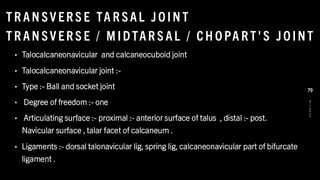
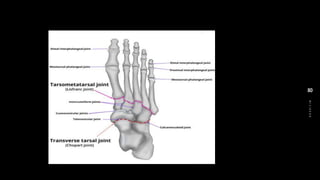
T R AN SV ER S E TA R SAL J O IN T
T R AN SV ER S E / M IDTAR S AL / CH O PA R T' S J O INT
• Talocalcaneonavicular and calcaneocuboid joint
• Talocalcaneonavicular joint :-
• Type :- Ball and socket joint
• Degree of freedom :- one
• Articulating surface :- proximal :- anterior surface of talus , distal :- post.
Navicular surface , talar facet of calcaneum .
• Ligaments :- dorsal talonavicular lig, spring lig, calcaneonavicular part of bifurcate
ligament .
8
/
1
/
2
0
2
4
79
8
/
1
/
2
0
2
4
80
CAL CA NEO C UB O ID J O IN T
• Synovial saddle type
• Degree of freedom :- one
• Articulating surface :- proximal :- anterior surface of
calcaneus
• Distal :- posterior surface of cuboid
• Ligaments :- `calcaneocuboid part of bifurcate ligament ,
dorsal calcaneocuboid ligament , long and short plantar
ligament
8
/
1
/
2
0
2
4
81
PR O NATIO N TW IST
• It is the combination of outward rotation at ankle , abduction of hind foot
,eversion of forefoot and medial arch depression .
• In weight bearing position , the hind foot and transverse tarsal joints are
locked in supination , the fore foot lifts off ground from the medial side
and loads to the ground at the lateral side .
• The first and second rays maintain the contact with the ground de the
contraction of plantar flexors .
• The fourth and fifth rays forced into dorsiflexion .
8
/
1
/
2
0
2
4
82
CO N T .. .
• This combined of eversion Accompained with
plantarflexion of first and second rays and dorsiflexion of
fourth and fifth ray along a hypothetical axis .
8
/
1
/
2
0
2
4
83
SU PINAT IO N T WIST
• Its combination of inward rotation at ankle , adduction of hind foot ,
inversion of hind foot and medial arch elevation .
• In weight bearing position , the hind foot pronates , the transverse
tarsal joints supinate to counter rotates and place the plantar
aspect of foot on the ground .
• When the transverse tarsal joint is unable to complete the demand
imposed while loading result in pronation of hind foot , the forefoot
lifts the ground from lateral side and loads to the ground at medial
side
8
/
1
/
2
0
2
4
84
CO N T .. .
• The first and second rays are pushed into dorsiflexion
due to ground reaction force and the fourth and fifth rays
attempt to maintain contact with the ground by plantar
flexion of tarsometatarsal joint
• The combined movement of inversion accompanied with
dorsiflexion of first and second rays and plantar flexion
of fourth sand fifth ray along a hpothetical axis .
8
/
1
/
2
0
2
4
85
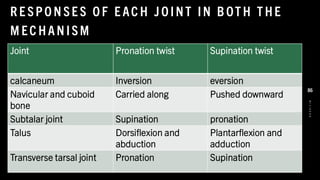
R E SPO N SE S O F E AC H J O INT IN B OT H T HE
M EC HAN ISM
Joint Pronation twist Supination twist
calcaneum Inversion eversion
Navicular and cuboid
bone
Carried along Pushed downward
Subtalar joint Supination pronation
Talus Dorsiflexion and
abduction
Plantarflexion and
adduction
Transverse tarsal joint Pronation Supination
8
/
1
/
2
0
2
4
86
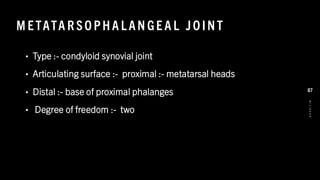
M ETATA R SO PHA L AN GE A L JO INT
• Type :- condyloid synovial joint
• Articulating surface :- proximal :- metatarsal heads
• Distal :- base of proximal phalanges
• Degree of freedom :- two
8
/
1
/
2
0
2
4
87
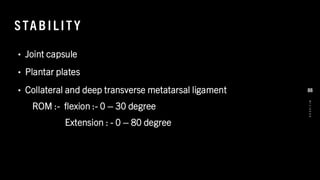
STAB IL IT Y
• Joint capsule
• Plantar plates
• Collateral and deep transverse metatarsal ligament
ROM :- flexion :- 0 – 30 degree
Extension : - 0 – 80 degree
8
/
1
/
2
0
2
4
88
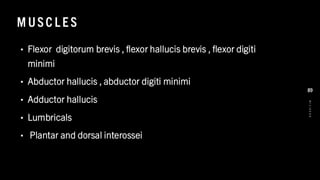
M USC L E S
• Flexor digitorum brevis , flexor hallucis brevis , flexor digiti
minimi
• Abductor hallucis , abductor digiti minimi
• Adductor hallucis
• Lumbricals
• Plantar and dorsal interossei
8
/
1
/
2
0
2
4
89
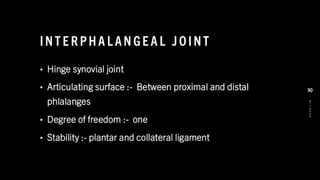
INT E R PHA L AN GE A L J O INT
• Hinge synovial joint
• Articulating surface :- Between proximal and distal
phlalanges
• Degree of freedom :- one
• Stability :- plantar and collateral ligament
8
/
1
/
2
0
2
4
90

ANKLE JOINT (2) (1).pdf ppt. physiotherapist

  • 1.
    ANKLE & FOOT COMPLEX DR. PRIYANKA RANAWAT { PHYSIOTHERAPIST }
  • 2.
    ANKLE JOINT • TYPE:- synovial joint of the hinge variety . • ARTICULAR SURFACE : - • Proximal :- Distal end of tibia , Medial malleolus of the tibia ,Lateral malleolus of fibula • Distal :- body of talus • The inferior transverse tibiofibular ligament 8 / 1 / 2 0 2 4 2
  • 3.
  • 4.
    F IB ROU S CAPS UL E • Its attached to all around articular margins with 2 exception . • 1 . Posterior superiorly :- its attached to inferior transverse tibiofibular ligament . • 2. Antero inferiorly :- its attached to dorsum of neck of talus . • The anterior and posterior parts of capsule are loose and thin, loose to allow hinge movement. • Its supported by strong collateral ligament . 8 / 1 / 2 0 2 4 4
  • 5.
    STAB IL ITY O F JO INT • Close interlocking of the articular surfaces . • Strong collateral ligaments on the sides . • The tendon that cross the joint , four in front , and three on posteromedial side and two on posterolateral side . 8 / 1 / 2 0 2 4 5
  • 6.
    F U NCTION O F AN KL E J O INT 8 / 1 / 2 0 2 4 6 • Acts as a support base that provides the necessary stability for upright posture with minimal muscle effort • Provides a mechanism for rotation of the tibia and fibula during the stance phase of gait • Provides flexibility to adapt to uneven terrain • Provides flexibility for absorption of shock • Acts as a lever during push-off
  • 7.
    L IG AME NTS • Deltoid ligaments { medial ligament } • Lateral ligament 8 / 1 / 2 0 2 4 7
  • 8.
    DE LTO IDL IG AM EN T origin :- border of tibial malleolus • Insertion :- Anterior to posterior on talus. Navicular and calcaneus. • Very strong triangular ligament and excessive tensile forces on the ligament result in an avulsion fracture rather a tear of ligament . • The ligament is prone to injuries in inversion . 8 / 1 / 2 0 2 4 8
  • 9.
    DE LTO IDL IG AM EN T • Ligament divided into superficial and deep part • Superficial part :- • Anterior fibres or tibionavicular • Middle fibers or tibiocalcaneal • Posterior fibres or posterior tibiotalar • Deep part or anterior tibiotalar 8 / 1 / 2 0 2 4 9
  • 10.
    M ED IALL IG AM E NT 8 / 1 / 2 0 2 4 10
  • 11.
    L AT ERA L L IG AM EN T • Anterior talofibular ligament • Posterior talofibular ligament • Calcaneofibular ligament • Interosseous tibiofibular ligament , inferior retinaculum , inferior and superior peroneal retinacula also contribute to the stability of ankle joint . 8 / 1 / 2 0 2 4 11
  • 12.
    L AT ERA L L IG AM EN T 8 / 1 / 2 0 2 4 12
  • 13.
    R E LATIO N O F A NKL E J O INT • Anterior :- tibialis anterior , Extensor hallucis longus , Extensor digitorum longus , peroneus tertius • Posterior medially :- tibialis posterior, flexor digitorum longus , flexor hallucis • Posterior laterally :- peroneus longus , peroneus brevis 8 / 1 / 2 0 2 4 13
  • 14.
    MUSCLES ATTACHMENT OF ANKLEJOINT 8 / 1 / 2 0 2 4 14
  • 15.
    ANTERIOR MUSCLE ATTACHMENTOF ANKLE • Tibialis anterior • Extensor hallucis longus • Extensor digitorum longus 8 / 1 / 2 0 2 4 15
  • 16.
    T BIA LIS A NT ER IO R • ORIGIN :- Lateral condyle and superior 2/3 of anterolateral surface of tibia . • INSERTION :- Medial and inferior surface of medial cuneiform and base of 1st metatarsal . • NERVE SUPPLY :- Peroneal nerve { L4 , L5 ] • ACTION : - Dorsiflexion of ankle . 8 / 1 / 2 0 2 4 16
  • 17.
    E X TENS O R HAL L U CIS LO N GU S • ORIGIN :- medial part of anterior surface of fibula and interosseous membrane . • INSERTION :- dorsal aspect of distal phalanx of 1st digiti { hallux } • NERVE SUPPLY :- deep fibular nerve { L5 , S1 } • ACTION :- dorsiflexion 8 / 1 / 2 0 2 4 17
  • 18.
    E X TENS O R DIG ITO R U M LO N GU S • ORIGIN :- lateral condyle of tibia and superior ¾ of medial surface of fibula and interosseous membrane . • INSERTION :- middle and distal phalanges of digits [ 2 –5 } • NERVE SUPPLY :- deep peroneal nerve { L4,L5 } • ACTION :- dorsiflexion 8 / 1 / 2 0 2 4 18
  • 19.
    PO ST ER IO R ME DIA L LY MU SCL E AT TACH ME NT O F A NKL E • Tibialis posterior • Flexor digitorum longus • Flexor hallucis longus 8 / 1 / 2 0 2 4 19
  • 20.
    T IBIA LIS PO ST E R IO R • ORIGIN :- Posterior superior face of tibia inferior to soleal line , posterior surface of fibula . • INSERTION :- Tuberosity of navicular , cuneiform , cuboid and Sustanticulum Tali of calcaneus , base of 2nd , 3rd and 4th MT • NERVE SUPPLY :- Tibial nerve [ L4 , L5 ] • ACTION :- Plantar flexion 8 / 1 / 2 0 2 4 20
  • 21.
    F E XLO R DIG ITO R U M L O NG US • ORIGIN :- Medial part of posterior surface of tibia inferior to soleal line . • INSERTION :- Base of distal phalanges of digits 2- 5 • NERVE SUPPLY :- Tibial nerve [ L5 , S1 & S2 ] • ACTION l:- Plantar flexion 8 / 1 / 2 0 2 4 21
  • 22.
    F L EXO R H AL L U CIS LO N GU S • ORIGIN :- Inferior 2/3 of posterior surface of fibula and interosseous membrane . • INSERTION :- base of distal phalanx of digit 1 [ hallux ] • NERVE SUPPLY :- Tibial nerve [ L4, L5 ,S1,S2 & S3 ] • ACTION :- Plantar flexion 8 / 1 / 2 0 2 4 22
  • 23.
    PO ST ER IO R L AT ER A L LY • Peroneus longus • Peroneus brevis 8 / 1 / 2 0 2 4 23
  • 24.
    PE RO NE US [ F IBU L A R IS ] LO N GU S • ORGIN :- Head and superior 2/3 of lateral surface of tibia . • INSERTION :- Base of 1st metatarsal and medial cuneiform . • NERVE SUPPLY :- peroneal nerve [ L5 , S1 ] • ACTION : - Plantar flexion 8 / 1 / 2 0 2 4 24
  • 25.
    PE RO NE US [ F IB UL A R IS ] B R E V IS • ORIGIN :- inferior 2/3 of lateral surface of fibula • INSERTION :- dorsal surface of tuberosity on lateral side of base of 5th metatarsal . • NERVE SUPPLY :- superficial peroneal nerve • ACTION :- plantar flexion of ankle 8 / 1 / 2 0 2 4 25
  • 26.
    T IBIO FIB U L AR JO IN T • Superior Tibiofibular joint • Middle Tibiofibular joint • Inferior Tibiofibular joint 8 / 1 / 2 0 2 4 26
  • 27.
  • 28.
    TA LO CRU R AL JO IN T / T IBIOTAL A R J O INT / F IB UL O TA L AR JO INT • Type :- synovial joint • Degree of freedom :- one degree of freedom • Articulating surface :- proximal :- distal end of tibia , medial malleolus of tibia , lateral malleolus of fibula • Distal : - body of talus • Resting position :- 10 degree plantar flexion midway between inversion and eversion • Close packed position :- maximum dorsiflexion • Loose pack position :- plantar flexion • Capsular pattern :- plantar flexion , dorsiflexion 8 / 1 / 2 0 2 4 28
  • 29.
    STAB IL ITY • Joint design :- proximal articulating surface together form a rectangular arch called as mortise and talus forms tendon . • Talus widens anteriorly due to which wedge into mortise during dorsiflexion , there for improving the joint stability. 8 / 1 / 2 0 2 4 29
  • 30.
    CAPS UL E •Weak and thin capsule attached proximally to margins of medial and lateral malleolus , distally to surface of talus . • Collateral ligament reinforce the capsule medially and laterally • Ligaments :- anterior , posterior talofibular ligament , calcaneofibular ligament ,deltoid ligament , lateral collateral ligament 8 / 1 / 2 0 2 4 30
  • 31.
    KIN EM ATICS { OST EO KIN EM ATIC S } • Movement :- dorsiflexion , plantar flexion • Plane and axis :- sagittal plane around frontal axis • ROM :- dorsiflexion :- 0 -- 20 degree • Plantar flexion : - 0 to 30 -- 50 degree • Close kinematic chain motion :- squats , lunges • Open kinematic chain motion :- gait cycle , ankle pumps 8 / 1 / 2 0 2 4 31
  • 32.
    FACTO R RE SPO N SIB L E FO R R E ST R ICT IO N O F M OV E ME NTS • Passive tension in triceps surae restricts excessive dorsiflexion • Excessive plantar flexion is restricted by tension in tibialis anterior , EHL, EDL. 8 / 1 / 2 0 2 4 32
  • 33.
    A R THRO KINE M AT ICS • Concave convex rule :- convex talus moves in fixed concave mortise . • Head of talus rolls anteriorly and slides posteriorly during dorsiflexion . • Rolls posteriorly and slides anteriorly during plantarflexion . • Movement available :- sliding is predominant 8 / 1 / 2 0 2 4 33
  • 34.
    KIN ET ICS •Ankle joint complex bears force that is approximately five times than that of the body weight in a normal bilateral standing or walking and thirteen times of the body weight during running . • The major contribution of this joint is seen in locomotion when the foot is contact with the ground at different phases of gait cycle. 8 / 1 / 2 0 2 4 34
  • 35.
    CO N T... •The dorsiflexion eccentrically contract to control the movement of foot onto the ground preventing it from slapping in the initial contact . • During the loading response , the dorsiflexion contract eccentrically to allow forward progression and in the midstance the plantar flexors concentrically contract progressing itself to the next phases of gait cycle ., 8 / 1 / 2 0 2 4 35
  • 36.
    CO N T... •When the speed of walking progresses the kinetic pattern of the ankle increases with magnitude . • Almost 83 percent of load is transmitted via tibiotalar joint and remainder of 17 percent via fibula . • The load is distributed effectively due to the function of ligaments as well as structural impact , while ankle sharing high level of congruency when subjected to stress. 8 / 1 / 2 0 2 4 36
  • 37.
    DISTAL T IBIO F IBU L A R JO INT • Type :- syndesmosis • Articulating surfaces :- • Proximal :- medial surface of distal fibula • Distal :- fibular notch of tibia • Ligaments :- interosseus ligament, anterior and posterior tibiofibular ligament 8 / 1 / 2 0 2 4 37
  • 38.
  • 39.
    T E STSO F A NKL E J O INT 1. Achilles tendon test 2. Squeeze test 3. Thompson’s test 4. Ankle anterior drawer test 5. External rotation test 6. Talar tilt test 7. Plantar fasciitis test 8. Tarsal tunnel test ( Tinel’s Sign of Tibial Nerve at Ankle) 8 / 1 / 2 0 2 4 39
  • 40.
    ACHIL L ES T E ND O N PA L PAT IO N • Patient :- sits with knee flexed to 90 degree over the side of exam table and ankle at 90 degree . • Examiner :- palpate the length of Achilles tendon from the distal third of leg to calcaneus . • Positive test :- mild to moderate tenderness . • Consistent with :- Achilles tendonitis/ Tendionpathy or partial tendon tear 8 / 1 / 2 0 2 4 40
  • 41.
    SQ U EE Z E TE ST • Aim of the test: Identify integrity of the syndesmotic ligaments • Patient position: Patient supine or sitting with knee flexed, the examiner places his hand 6 to 8 inches below the knee and squeezes the tibia and fibula together. • Positive sign: Positive test results in pain in the ankle, which indicates injury of the syndesmotic ligament and a possible high ankle sprain. 8 / 1 / 2 0 2 4 41
  • 42.
    T HO MPSO N'S TE ST • Patient : lies prone on table with ankle positioned over end of table . • Examiner :- grasp and squeeze the mid gastrocnemius and soleus muscles . • Positive test :- absence of planter flexion at ankle . • Consistent with :- Achilles tendon rupture. 8 / 1 / 2 0 2 4 42
  • 43.
    A NKL EA NT ER IO R DR AW E R T E ST • Patient :- patient in supine with heel just off edge of table in 20 degree plantar flexion . • Examiner :- stabilize lower leg and grasp foot . slowly pull the heel anteriorly and into slight plantar flexion and push posteriorly on distal anterior leg • Positive :- if talus has excessive anterior glide or pain is noted . 8 / 1 / 2 0 2 4 43
  • 44.
    E X TER NA L ROTATIO N TE ST Patient :- sits with knee flexed to 90 degree over the side of exam table and ankle at 90 degree . Examiner :- with one hand grasp laterally while the other hand grasp the distal of leg with one finger over the medial malleolus and thumb over the talus . Active externally rotate the foot in relation to tibia / fibula . Positive :- displacement of talus from medial malleolus andc pain at ankle joint . Consistent with :- syndesmotic injury [ tibiofibular ligament } 8 / 1 / 2 0 2 4 44
  • 45.
    TA L ART ILT TE ST [ KL E IG E R ] • Patient :- sits with leg hanging freely over exam table . • Examiner :- stabilize the leg medially with one hand and cup the hind foot with other hand . Inversion force applied to the hind foot • Positive :-- tilt occurs at tibiotalar joint . • Consistent with :- sprain or tear of the anterior talofibular ligament and calcaneofibular ligament 8 / 1 / 2 0 2 4 45
  • 46.
    P L AN T A R F A S C I T I S T E S T • Patient: sitting • Examiner: While dorsiflexing the great toe with one hand, palpate the plantar surface of the foot over the medial calcaneal tuberosity and along the course of the plantar fascia. • Positive test: Pain with palpation. • Consistent with: Plantar fasciitis or aponeurosis dysfunction. 8 / 1 / 2 0 2 4 46
  • 47.
    TA R SALT UN NE L T EST [ T I NE L’ S S I G N OF T I BI A L N ER V E AT ANK L E • Patient :- sitting • Examiner :- tap the medial ankle just posterior and inferior to the medial malleolus with a finger or reflex hammer. • Positive test: Pain or radiation of numbness and tingling into the plantar aspect of the foot and toes. • Consistent with :- tarsal tunnel syndrome 8 / 1 / 2 0 2 4 47
  • 48.
    HO M AN'S T E ST 8 / 1 / 2 0 2 4 48 • Aim of the test: Test for deep vein thrombosis (DVT) • Patient position: Patient supine or sitting with knee flexed, the examiner forcibly dorsiflex the patient's ankle then palpate the calf muscle. • Positive sign: Pain in calf is a positive sign.
  • 49.
    PAR TS OF F O OT • Hindfoot [ rear foot ] [ talus , calcaneus } • Midfoot [ mid tarsal joint ] [ cuboid , navicular , three cuneiform bone ] • Forefoot [metatarsals , phalanges ] 8 / 1 / 2 0 2 4 49
  • 50.
    F L EX IO N AN D E X TE NS IO N O F M TP J O INT • Lumbricals • Flexor hallucis brevis • Extensor digitorum longus { digits 2 –5 ] • Extensor digitorum brevis • Extensor hallucis longus { digit 1 } 8 / 1 / 2 0 2 4 50
  • 51.
    F L EX IO N AN D E X TE NS IO N O F PIP JO INT • Flexor digitorum longus [ digits 2- 5 ] • Flexor digitorum brevis [digits 2 –5 ] • Flexor hallucis longus [ digit 1] Extensor digitorum longus [ digits 2- 5 ] Extensor digitorum brevis Extensor hallucis longus [ digit 1] 8 / 1 / 2 0 2 4 51
  • 52.
    F L EX IO N AN D E X TE NS IO N O F DIP JO IN T • Flexor digitorum longus { digits 2 – 5} • Extensor digitorum longus { digits 2 –5 ] • Extensor digitorum brevis 8 / 1 / 2 0 2 4 52
  • 53.
    INV E RSIO N AND E VE R SIO N O F FO OT • Tibialis anterior • Tibialis posterior • Fibularis longus • Fibularis brevis 8 / 1 / 2 0 2 4 53
  • 54.
    SU BTAL AR J O INT • There three joints , anterior , posterior and medial between the talus and calcaneum . • Posterior joint is named the talocalcanean or subtalar joint where concave of body of talus articulates with convex posterior facet of the calcaneum . • Anterior joint are parts of the talocalcaneonavicular joint . • Movement :- inversion , eversion • 8 / 1 / 2 0 2 4 54
  • 55.
    CO N T.. . • On the anterior or medial side of head of talus , the surface are convex and articulate with concave articulating surface of calcaneum. • Three joints form a single functional unit . • The sinus tarsi separates the posterior articulation from anterior and medial articulations . 8 / 1 / 2 0 2 4 55
  • 56.
    CO N T... •The greater part of talocalcaneonavicular joint lies in front of the head of talus and not below it . • The talocalcanean joint plane synovial joint between concave facet on the inferior surface of the body of talus and the convex facet on middle one – third of the superior surface of calcaneum . 8 / 1 / 2 0 2 4 56
  • 57.
    L IG AME NTS O F SU BTAL A R J O INT • Fibrous capsule • Lateral and medial talocalcanean ligaments • Interosseous talocalcanean ligament • Cervical ligament 8 / 1 / 2 0 2 4 57
  • 58.
    INT E ROSSEO U S TA LO CAL CA NE AN L IG AM E NT • Thick and strong • Chief bond of union between talus and calcaneum . • It occupies the sinus tarsi and separate the talocalcanean joint from the talocalcaneonavicular joint . • It becomes taut in eversion and limits this movement. 8 / 1 / 2 0 2 4 58
  • 59.
    CE R VICAL L IG AM E NT • Cervical ligament is placed lateral to the sinus tarsi. • It passes upward and medially and is attached above to tubercle on the inferolateral aspect of the neck of talus . • It becomes taut in inversion and limits this movement 8 / 1 / 2 0 2 4 59
  • 60.
    TA LO CALCA NEO N AV ICU L AR J O IN T • Ball and socket joint • Head of talus fits into a socket formed partly by the navicular bone and partly by the calcaneum . • Two ligaments :- spring ligament medially and medial limb of the bifurcate ligament laterally . 8 / 1 / 2 0 2 4 60
  • 61.
    SPR IN GL IG A ME NT / PL A NTA R CAL CA NEO N AV ICU L AR L IG AM E NT Its attached posteriorly to the anterior margin of the sustentaculum tali and anteriorly to plantar surface of navicular bone between tuberosity and articular margin. Most important ligament for maintaining the medial longitudinal arch of foot . 8 / 1 / 2 0 2 4 61
  • 62.
    CAL CA NEOC UB O ID J O IN T • Its saddle joint . • The opposed articular surface of the calcaneum and cuboid are concavoconvex . • On account of shape of articular surfaces , medial movement of the forefoot is accompanied its lateral rotation , adduction or inversion . • lateral movement of the forefoot is accompanied its medial rotation , abduction or eversion . 8 / 1 / 2 0 2 4 62
  • 63.
    L IG AME NTS • A fibrous capsule • Lateral limb of the bifurcate ligament • The long plantar ligament • The short plantar ligament 8 / 1 / 2 0 2 4 63
  • 64.
    B IF URCAT E L IG A ME NT • Y- shaped . • Its stem is attached to the anterolateral part of sulcus calcanei , the medial limb or calcaneonavicular ligament , to the dorsolateral surface of navicular bone , and lateral limb or calcaneocuboid ligament , to the dorsomedial surface of cuboid bone . 8 / 1 / 2 0 2 4 64
  • 65.
    LO N GP L ANTA R L IG AM EN T • Its long and strong ligament . • Important for maintaining the arches of foot is surpassed only by the spring ligament . • Posterior attached plantar surface of calcaneum and anteriorly to the lipsof the groove on cuboid bone and to the base of middle three metatarsal . 8 / 1 / 2 0 2 4 65
  • 66.
    SHO R TPL A NTA R L IG AM E NT / PL AN TAR CAL CA NEO C UB O ID L IG AM E NT • Lies deep to the long plantar ligament . • Its broad and strong ligament extending from the anterior tubercle of calcaneum to the plantar surface of cuboid , behind its ridge . 8 / 1 / 2 0 2 4 66
  • 67.
    SU BTAL AR JO INT • Type ;- plane synovial joint • Degree of freedom :- one • Articulating surface :- proximal :- anterior , middle , and posterior facet of calcaneus . • Distal :- anterior , posterior and middle facet of talus • Close packed position :- supination • Open packed position :- neutral • Capsular pattern :- limitation of varus movement 8 / 1 / 2 0 2 4 67
  • 68.
    STAB IL ITY • Joint design :- excessive mobility is prevented due to alternating concave - convex facet . • Capsule :- a loose capsule enclosing the entire joint , which thickness to form medial , lateral and posterior talocalcaneal ligament that stabilize the capsule . • Ligaments :- talocalcaneal [ all three parts] talocalcaneal interosseous , cervical ligament . 8 / 1 / 2 0 2 4 68
  • 69.
    A R THRO KINE M AT ICS • Screwlike movement or complex twisting movement is observed when talus moves over calcaneus . • At anterior and middle articulation , talus glide in opposite direction , while it slides in same direction at posterior articulation . • In frontal plane , tilting of talus :- inversion / eversion • In transverse plane , rotation of talus :- dorsiflexion / plantar flexion 8 / 1 / 2 0 2 4 69
  • 70.
    KIN EM ATICS [ OST EO KIN EM ATIC S ] • Movement available :- supination :- inversion + adduction + plantarflexion • Pronation :- eversion + abduction + dorsiflexion • Plane and axis :- Triplanar movements occurring around a unique axis which is obliquely oriented { 42 degree from transverse plane , 16 degree from sagittal plane } • Inversion :- sagittal axis , frontal plane , ROM { 0 -- 30 degree } • Eversion :- sagittal axis , frontal plane , ROM { 0 –10 degree } • Abduction :- vertical axis , transverse plane , ROM { 0 –30 degree } • Adduction :- vertical axis , frontal plane , ROM { 0 –1 0 degree } 8 / 1 / 2 0 2 4 70
  • 71.
    Supination Pronation Non weightbearing Calcaneal inversion Calcaneal eversion Calcaneal adduction Calcaneal abduction Calcaneal plantarflexion Calcaneal dorsiflexion In weight bearing Calcaneal inversion Calcaneal eversion Talar abduction Talar adduction Talar dorsiflexion Talar plantar flexion Tibiofibular lateral rotation Tibiofibular medial rotation 8 / 1 / 2 0 2 4 71
  • 72.
    KIN ET ICS Inversion:- tibialis posterior , tibialis anterior Eversion :- fibularis brevis , fibularis longus Supination :- tibialis anterior , tibialis posterior , EHL , FHL , FDL Pronation :- fibularis longus and brevis , fibularis tertius , EDL , EHL 8 / 1 / 2 0 2 4 72
  • 73.
    T R ANSV ER S E TA R SAL O R M IDTAR S AL J O INT • This include the calcaneocuboid and the talonavicular joints . • The talonavicular joint is part of the talocalcaneonavicular joint , made up of only one and half joints . • In any case , the two joints do no form a functional unit. • They have different axes of movement . • Its movement help in inversion and eversion of foot . 8 / 1 / 2 0 2 4 73
  • 74.
    INV E RSIO N AND E VE R SIO N O F TH E F O OT • Inversion movement in which medial border of foot elevated , the sole faces medially . • Inversion is accompanied by plantar flexion of foot and adduction of forefoot . • Eversion movement in which the lateral border of foot elevated , sole faces laterally . • Eversion accompanied by dorsiflexion of foot and abduction of forefoot . 8 / 1 / 2 0 2 4 74
  • 75.
    SU PINAT ION A ND P RO NAT IO N O F F O OT • These are really component of the movement of inversion and eversion . • In pronation and supination of fore foot [ tarsus and metatarsus ] moves on the calcaneum and talus . • The medial border or fore foot elevated in supination [ part of inversion ] and lateral border elevated in pronation . 8 / 1 / 2 0 2 4 75
  • 76.
    CO N T... •These movement take place chiefly at the transverse tarsal joint and partly at smaller intertarsal , tarsometatarsal and intertarsal joints . • Difference when supination or pronation in weight bearing and non-weight bearing situations . In weight bearing supination and pronation the calcaneum is not free to move in all directions 8 / 1 / 2 0 2 4 76
  • 77.
    L IM ITING FACTO R S • Inversion limited by :- 1 . tension of peronei 2 . Tension of cervical ligament Eversion is limited by :- 1. tension of tibialis anterior 2 . tension of tibialis posterior 3. tension of deltoid ligament 8 / 1 / 2 0 2 4 77
  • 78.
    F U NCTION AL SIG NIF ICA NCE • Inversion and eversion greatly help the foot in adjusting to uneven and slippery ground . • When feet are supporting the body weight , these movement occur in a modified called supination and pronation . 8 / 1 / 2 0 2 4 78
  • 79.
    T R ANSV ER S E TA R SAL J O IN T T R AN SV ER S E / M IDTAR S AL / CH O PA R T' S J O INT • Talocalcaneonavicular and calcaneocuboid joint • Talocalcaneonavicular joint :- • Type :- Ball and socket joint • Degree of freedom :- one • Articulating surface :- proximal :- anterior surface of talus , distal :- post. Navicular surface , talar facet of calcaneum . • Ligaments :- dorsal talonavicular lig, spring lig, calcaneonavicular part of bifurcate ligament . 8 / 1 / 2 0 2 4 79
  • 80.
  • 81.
    CAL CA NEOC UB O ID J O IN T • Synovial saddle type • Degree of freedom :- one • Articulating surface :- proximal :- anterior surface of calcaneus • Distal :- posterior surface of cuboid • Ligaments :- `calcaneocuboid part of bifurcate ligament , dorsal calcaneocuboid ligament , long and short plantar ligament 8 / 1 / 2 0 2 4 81
  • 82.
    PR O NATION TW IST • It is the combination of outward rotation at ankle , abduction of hind foot ,eversion of forefoot and medial arch depression . • In weight bearing position , the hind foot and transverse tarsal joints are locked in supination , the fore foot lifts off ground from the medial side and loads to the ground at the lateral side . • The first and second rays maintain the contact with the ground de the contraction of plantar flexors . • The fourth and fifth rays forced into dorsiflexion . 8 / 1 / 2 0 2 4 82
  • 83.
    CO N T.. . • This combined of eversion Accompained with plantarflexion of first and second rays and dorsiflexion of fourth and fifth ray along a hypothetical axis . 8 / 1 / 2 0 2 4 83
  • 84.
    SU PINAT ION T WIST • Its combination of inward rotation at ankle , adduction of hind foot , inversion of hind foot and medial arch elevation . • In weight bearing position , the hind foot pronates , the transverse tarsal joints supinate to counter rotates and place the plantar aspect of foot on the ground . • When the transverse tarsal joint is unable to complete the demand imposed while loading result in pronation of hind foot , the forefoot lifts the ground from lateral side and loads to the ground at medial side 8 / 1 / 2 0 2 4 84
  • 85.
    CO N T.. . • The first and second rays are pushed into dorsiflexion due to ground reaction force and the fourth and fifth rays attempt to maintain contact with the ground by plantar flexion of tarsometatarsal joint • The combined movement of inversion accompanied with dorsiflexion of first and second rays and plantar flexion of fourth sand fifth ray along a hpothetical axis . 8 / 1 / 2 0 2 4 85
  • 86.
    R E SPON SE S O F E AC H J O INT IN B OT H T HE M EC HAN ISM Joint Pronation twist Supination twist calcaneum Inversion eversion Navicular and cuboid bone Carried along Pushed downward Subtalar joint Supination pronation Talus Dorsiflexion and abduction Plantarflexion and adduction Transverse tarsal joint Pronation Supination 8 / 1 / 2 0 2 4 86
  • 87.
    M ETATA RSO PHA L AN GE A L JO INT • Type :- condyloid synovial joint • Articulating surface :- proximal :- metatarsal heads • Distal :- base of proximal phalanges • Degree of freedom :- two 8 / 1 / 2 0 2 4 87
  • 88.
    STAB IL ITY • Joint capsule • Plantar plates • Collateral and deep transverse metatarsal ligament ROM :- flexion :- 0 – 30 degree Extension : - 0 – 80 degree 8 / 1 / 2 0 2 4 88
  • 89.
    M USC LE S • Flexor digitorum brevis , flexor hallucis brevis , flexor digiti minimi • Abductor hallucis , abductor digiti minimi • Adductor hallucis • Lumbricals • Plantar and dorsal interossei 8 / 1 / 2 0 2 4 89
  • 90.
    INT E RPHA L AN GE A L J O INT • Hinge synovial joint • Articulating surface :- Between proximal and distal phlalanges • Degree of freedom :- one • Stability :- plantar and collateral ligament 8 / 1 / 2 0 2 4 90