


Image: Mathias Krumbholz (wikipedia commons)
Plan for Today
Recap: Unix System 5 File System
Creating a File
Better File Systems: ZFS, RAID
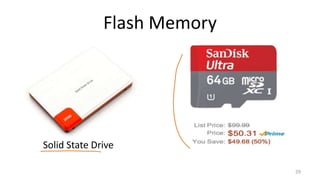
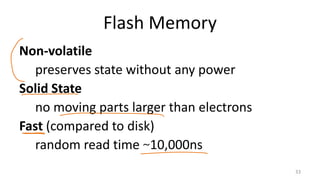
Flash Memory
1
PS4 is due
11:59pm
Sunday, 6 April
Exam 2 Redo: posted on
course site, due 11:69pm
2
0
1
2
…
9
10
11
12 Disk Block
(1K bytes)
Indirect
Disk Block
(1K bytes)
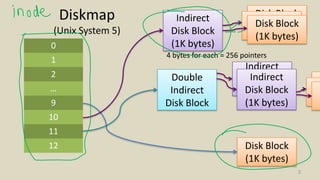
4 bytes for each = 256 pointers
Disk Block
(1K bytes)
Disk Block
(1K bytes)
Disk Block
(1K bytes)
Double
Indirect
Disk Block
Indirect
Disk Block
(1K bytes)
Indirect
Disk Block
(1K bytes)
D
(
D
(1
D
(
Diskmap
(Unix System 5)
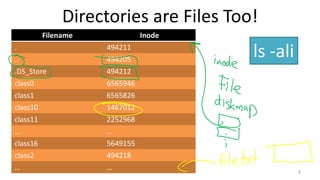
Directories are Files Too!
3
Filename Inode
. 494211
.. 494205
.DS_Store 494212
class0 6565946
class1 6565826
class10 1467012
class11 2252968
… …
class16 5649155
class2 494218
… …
ls -ali
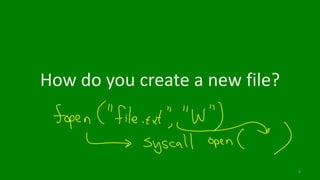
How do you create a new file?
4
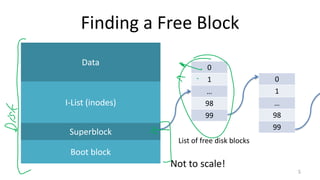
Finding a Free Block
5
Data
I-List (inodes)
Superblock
Boot block
Not to scale!
0
1
…
98
99
List of free disk blocks
0
1
…
98
99
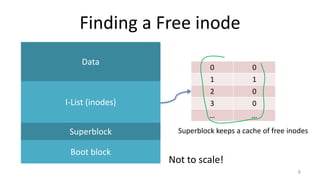
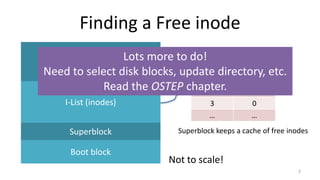
Finding a Free inode
6
Data
I-List (inodes)
Superblock
Boot block
Not to scale!
0 0
1 1
2 0
3 0
… …
Superblock keeps a cache of free inodes
Finding a Free inode
7
Data
I-List (inodes)
Superblock
Boot block
Not to scale!
0 0
1 1
2 0
3 0
… …
Superblock keeps a cache of free inodes
Lots more to do!
Need to select disk blocks, update directory, etc.
Read the OSTEP chapter.
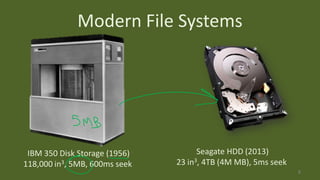
Modern File Systems
8
IBM 350 Disk Storage (1956)
118,000 in3, 5MB, 600ms seek
Seagate HDD (2013)
23 in3, 4TB (4M MB), 5ms seek
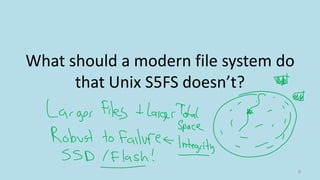
What should a modern file system do
that Unix S5FS doesn’t?
9
10
11
ZFSDeveloped for Solaris, 2005
Now open source:
http://open-zfs.org/
12
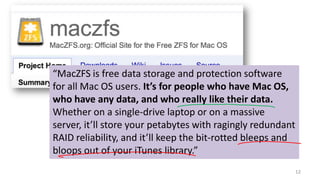
“MacZFS is free data storage and protection software
for all Mac OS users. It’s for people who have Mac OS,
who have any data, and who really like their data.
Whether on a single-drive laptop or on a massive
server, it’ll store your petabytes with ragingly redundant
RAID reliability, and it’ll keep the bit-rotted bleeps and
bloops out of your iTunes library.”
Handling Failures
13
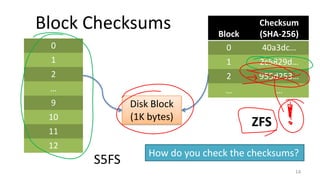
Block Checksums
14
0
1
2
…
9
10
11
12
Disk Block
(1K bytes)
S5FS
Block
Checksum
(SHA-256)
0 40a3dc…
1 2c5829d…
2 955d253…
… …
ZFS
How do you check the checksums?
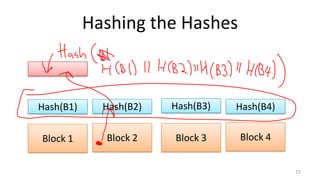
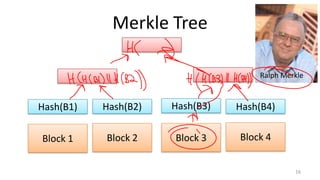
Hashing the Hashes
15
Block 1 Block 2 Block 3 Block 4
Hash(B1) Hash(B2) Hash(B3) Hash(B4)
Merkle Tree
16
Ralph Merkle
Block 1 Block 2 Block 3 Block 4
Hash(B1) Hash(B2) Hash(B3) Hash(B4)
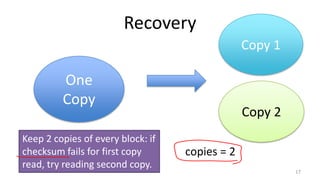
Recovery
17
copies = 2
One
Copy
Copy 1
Copy 2
Keep 2 copies of every block: if
checksum fails for first copy
read, try reading second copy.
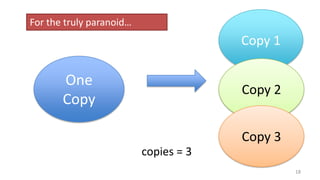
18
copies = 3
One
Copy
Copy 1
Copy 2
For the truly paranoid…
Copy 3
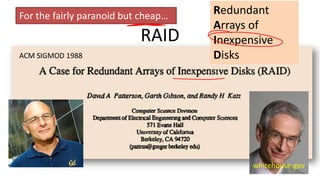
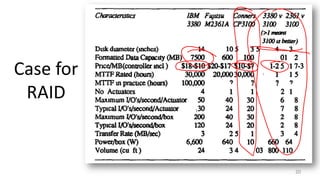
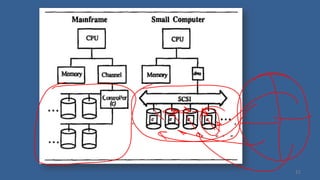
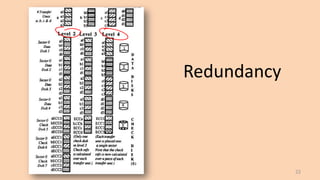
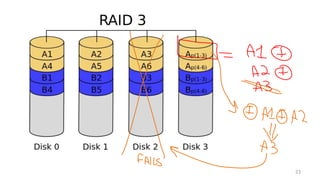
RAID
19
For the fairly paranoid but cheap… Redundant
Arrays of
Inexpensive
DisksACM SIGMOD 1988
whitehouse.gov
Case for
RAID
20
21
Redundancy
22
23
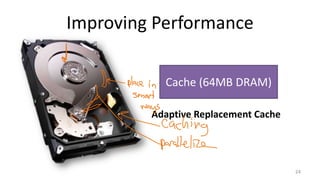
Improving Performance
24
Cache (64MB DRAM)
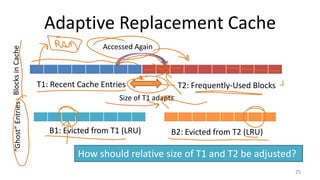
Adaptive Replacement Cache
25
T1: Recent Cache Entries
Accessed Again
T2: Frequently-Used Blocks
Size of T1 adapts
B1: Evicted from T1 (LRU) B2: Evicted from T2 (LRU)
How should relative size of T1 and T2 be adjusted?
BlocksinCache“Ghost”Entries
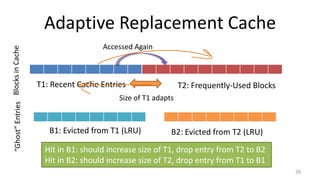
Adaptive Replacement Cache
26
T1: Recent Cache Entries
Accessed Again
T2: Frequently-Used Blocks
Size of T1 adapts
B1: Evicted from T1 (LRU) B2: Evicted from T2 (LRU)
BlocksinCache“Ghost”Entries
Hit in B1: should increase size of T1, drop entry from T2 to B2
Hit in B2: should increase size of T2, drop entry from T1 to B1
27
IBM Almaden Research Center
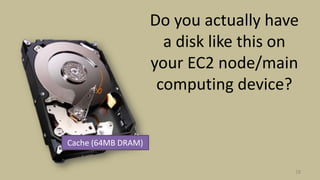
Do you actually have
a disk like this on
your EC2 node/main
computing device?
28
Cache (64MB DRAM)
Flash Memory
29
Solid State Drive
30
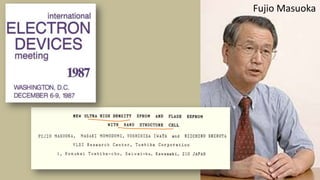
Fujio Masuoka
Drain
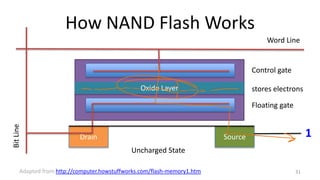
How NAND Flash Works
31
Oxide Layer
Adapted from http://computer.howstuffworks.com/flash-memory1.htm
Word Line
BitLine
Control gate
Floating gate
stores electrons
Source 1
Uncharged State
Drain
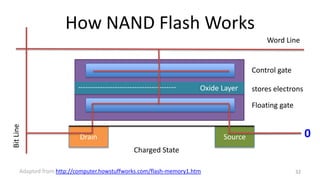
How NAND Flash Works
32
Oxide Layer
Adapted from http://computer.howstuffworks.com/flash-memory1.htm
Word Line
BitLine
Control gate
Floating gate
stores electrons
Source 0
Charged State
----------------------------------------
Flash Memory
Non-volatile
preserves state without any power
Solid State
no moving parts larger than electrons
Fast (compared to disk)
random read time ~10,000ns
33
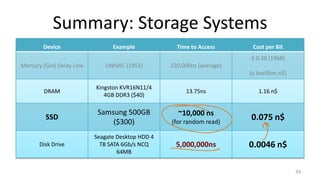
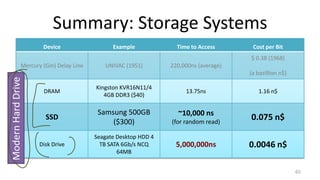
Summary: Storage Systems
34
Device Example Time to Access Cost per Bit
Mercury (Gin) Delay Line UNIVAC (1951) 220,000ns (average)
$ 0.38 (1968)
(a bazillion n$)
DRAM
Kingston KVR16N11/4
4GB DDR3 ($40)
13.75ns 1.16 n$
SSD
Samsung 500GB
($300)
~10,000 ns
(for random read)
0.075 n$
Disk Drive
Seagate Desktop HDD 4
TB SATA 6Gb/s NCQ
64MB
5,000,000ns 0.0046 n$
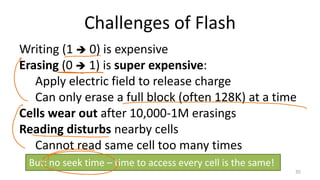
Challenges of Flash
Writing (1  0) is expensive
Erasing (0  1) is super expensive:
Apply electric field to release charge
Can only erase a full block (often 128K) at a time
Cells wear out after 10,000-1M erasings
Reading disturbs nearby cells
Cannot read same cell too many times
35
But: no seek time – time to access every cell is the same!
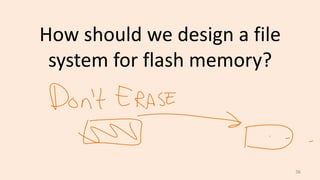
How should we design a file
system for flash memory?
36
37
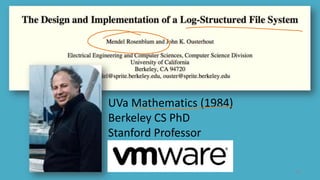
UVa Mathematics (1984)
Berkeley CS PhD
Stanford Professor
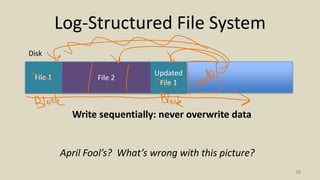
Log-Structured File System
38
Write sequentially: never overwrite data
File 1 File 2
Updated
File 1
Disk
April Fool’s? What’s wrong with this picture?
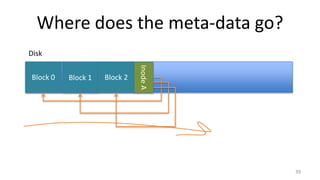
Where does the meta-data go?
39
Block 0
Disk
Block 1 Block 2
InodeA
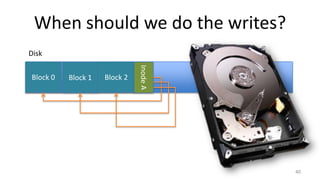
When should we do the writes?
40
Block 0
Disk
Block 1 Block 2
InodeA
When should we do the writes?
41
Block 0
Disk
Block 1 Block 2
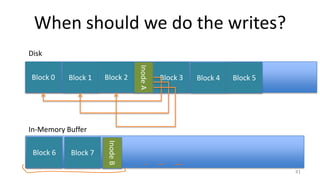
InodeA
Block 3 Block 4 Block 5
In-Memory Buffer
Block 6 Block 7
InodeB
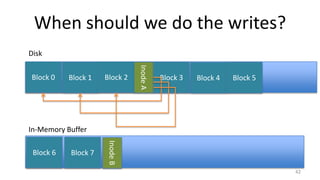
When should we do the writes?
42
Block 0
Disk
Block 1 Block 2
InodeA
Block 3 Block 4 Block 5
In-Memory Buffer
Block 6 Block 7
InodeB
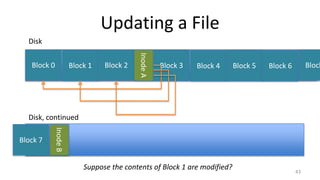
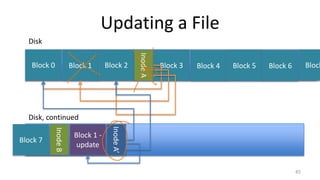
Updating a File
43
Block 0
Disk
Block 1 Block 2
InodeA
Block 3 Block 4 Block 5
Disk, continued
Block 6 Block
InodeB
Block 7
Suppose the contents of Block 1 are modified?
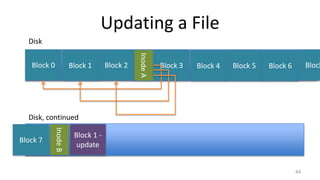
Updating a File
44
Block 0
Disk
Block 1 Block 2
InodeA
Block 3 Block 4 Block 5
Disk, continued
Block 6 Block
InodeB
Block 7
Block 1 -
update
Updating a File
45
Block 0
Disk
Block 1 Block 2
InodeA
Block 3 Block 4 Block 5
Disk, continued
Block 6 Block
InodeB
Block 7
Block 1 -
update
InodeA’
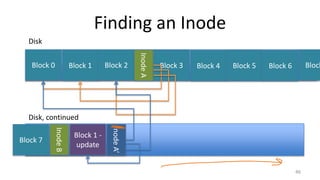
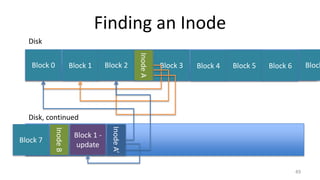
Finding an Inode
46
Block 0
Disk
Block 1 Block 2
InodeA
Block 3 Block 4 Block 5
Disk, continued
Block 6 Block
InodeB
Block 7
Block 1 -
update
InodeA’
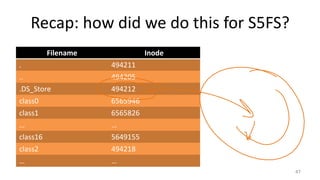
Recap: how did we do this for S5FS?
47
Filename Inode
. 494211
.. 494205
.DS_Store 494212
class0 6565946
class1 6565826
… …
class16 5649155
class2 494218
… …
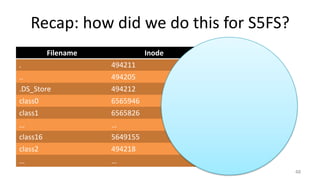
Recap: how did we do this for S5FS?
48
Filename Inode
. 494211
.. 494205
.DS_Store 494212
class0 6565946
class1 6565826
… …
class16 5649155
class2 494218
… …
Finding an Inode
49
Block 0
Disk
Block 1 Block 2
InodeA
Block 3 Block 4 Block 5
Disk, continued
Block 6 Block
InodeB
Block 7
Block 1 -
update
InodeA’
50
Block 0
Disk
Block 1 Block 2
InodeA
Block 3 Block 4 Block 5
Disk, continued
Block 6 Block
InodeB
Block 7
Block 1 -
update
InodeA’
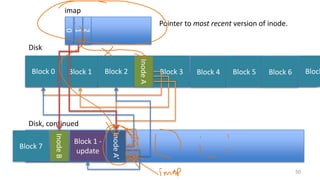
imap
0
1
2
Pointer to most recent version of inode.
51
Block 0
Disk
Block 1 Block 2
InodeA
Block 3 Block 4 Block 5
Disk, continued
Block 6 Block
InodeB
Block 7
Block 1 -
update
InodeA’
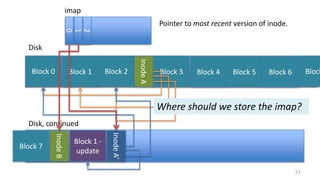
imap
0
1
2
Pointer to most recent version of inode.
Where should we store the imap?
52
Block 0
Disk
Block 1 Block 2
InodeA
Block 3 Block 4 Block 5
Disk, continued
Block 6 Block
InodeB
Block 7
Block 1 -
update
InodeA’
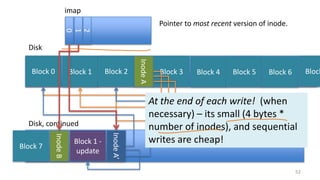
imap
0
1
2
Pointer to most recent version of inode.
At the end of each write! (when
necessary) – its small (4 bytes *
number of inodes), and sequential
writes are cheap!
53
Block 0
Disk
Block 1 Block 2
InodeA
Block 3 Block 4 Block 5
Disk, continued
Block 6 Block 7InodeB
Block 7
Block 1 -
update
InodeA’
imap
Block 8
Block 0 -
update
…
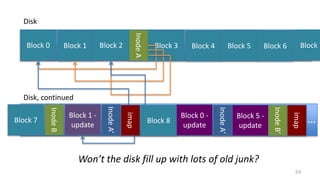
Won’t the disk fill up with lots of old junk?
Block 5 -
update
InodeA’
InodeB’
imap
54
Class 8:
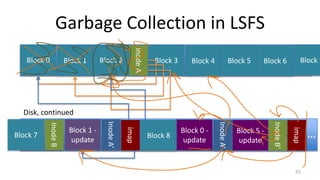
Garbage Collection in LSFS
55
Block 0 Block 1 Block 2
InodeA
Block 3 Block 4 Block 5
Disk, continued
Block 6 Block 7
InodeB
Block 7
Block 1 -
update
InodeA’
imap
Block 8
Block 0 -
update
…Block 5 -
update
InodeA’
InodeB’
imap
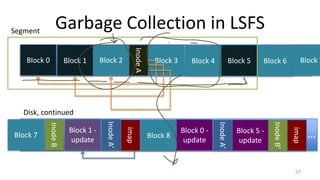
Garbage Collection in LSFS
56
Block 0 Block 1 Block 2
InodeA
Block 3 Block 4 Block 5
Disk, continued
Block 6 Block 7
InodeB
Block 7
Block 1 -
update
InodeA’
imap
Block 8
Block 0 -
update
…Block 5 -
update
InodeA’
InodeB’
imap
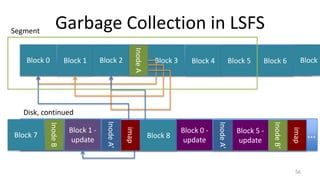
Segment
Garbage Collection in LSFS
57
Block 0 Block 1 Block 2
InodeA
Block 3 Block 4 Block 5
Disk, continued
Block 6 Block 7
InodeB
Block 7
Block 1 -
update
InodeA’
imap
Block 8
Block 0 -
update
…Block 5 -
update
InodeA’
InodeB’
imap
Segment
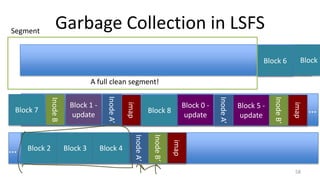
Garbage Collection in LSFS
58
Block 6 Block 7
InodeB
Block 7
Block 1 -
update
InodeA’
imap
Block 8
Block 0 -
update
…Block 5 -
update
InodeA’
InodeB’
imap
Segment
A full clean segment!
Block 2 Block 3 Block 4
InodeA’
InodeB’
imap
…
59
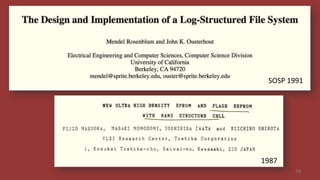
SOSP 1991
1987
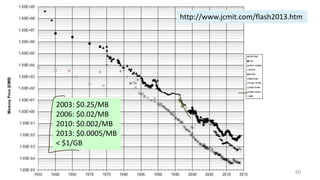
60
http://www.jcmit.com/flash2013.htm
2003: $0.25/MB
2006: $0.02/MB
2010: $0.002/MB
2013: $0.0005/MB
< $1/GB
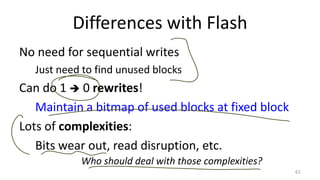
Differences with Flash
No need for sequential writes
Just need to find unused blocks
Can do 1  0 rewrites!
Maintain a bitmap of used blocks at fixed block
Lots of complexities:
Bits wear out, read disruption, etc.
61
Who should deal with those complexities?
62
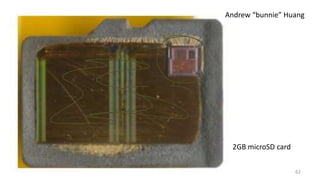
2GB microSD card
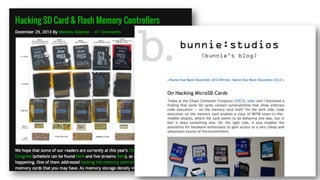
Andrew “bunnie” Huang
63
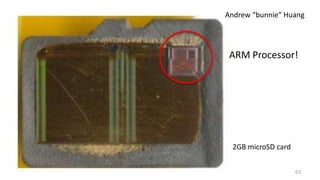
2GB microSD card
Andrew “bunnie” Huang
ARM Processor!
64
Summary: Storage Systems
65
Device Example Time to Access Cost per Bit
Mercury (Gin) Delay Line UNIVAC (1951) 220,000ns (average)
$ 0.38 (1968)
(a bazillion n$)
DRAM
Kingston KVR16N11/4
4GB DDR3 ($40)
13.75ns 1.16 n$
SSD
Samsung 500GB
($300)
~10,000 ns
(for random read)
0.075 n$
Disk Drive
Seagate Desktop HDD 4
TB SATA 6Gb/s NCQ
64MB
5,000,000ns 0.0046 n$
ModernHardDrive
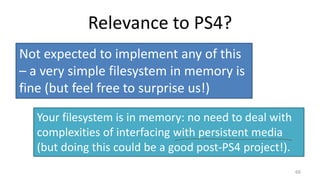
Relevance to PS4?
66
Not expected to implement any of this
– a very simple filesystem in memory is
fine (but feel free to surprise us!)
Your filesystem is in memory: no need to deal with
complexities of interfacing with persistent media
(but doing this could be a good post-PS4 project!).
FlashKernel?
67
by shamserg
PS4 Due
Sunday,
11:59pm

Flash! (Modern File Systems)

  • 1.
    Image: Mathias Krumbholz(wikipedia commons)
  • 2.
    Plan for Today Recap:Unix System 5 File System Creating a File Better File Systems: ZFS, RAID Flash Memory 1 PS4 is due 11:59pm Sunday, 6 April Exam 2 Redo: posted on course site, due 11:69pm
  • 3.
    2 0 1 2 … 9 10 11 12 Disk Block (1Kbytes) Indirect Disk Block (1K bytes) 4 bytes for each = 256 pointers Disk Block (1K bytes) Disk Block (1K bytes) Disk Block (1K bytes) Double Indirect Disk Block Indirect Disk Block (1K bytes) Indirect Disk Block (1K bytes) D ( D (1 D ( Diskmap (Unix System 5)
  • 4.
    Directories are FilesToo! 3 Filename Inode . 494211 .. 494205 .DS_Store 494212 class0 6565946 class1 6565826 class10 1467012 class11 2252968 … … class16 5649155 class2 494218 … … ls -ali
  • 5.
    How do youcreate a new file? 4
  • 6.
    Finding a FreeBlock 5 Data I-List (inodes) Superblock Boot block Not to scale! 0 1 … 98 99 List of free disk blocks 0 1 … 98 99
  • 7.
    Finding a Freeinode 6 Data I-List (inodes) Superblock Boot block Not to scale! 0 0 1 1 2 0 3 0 … … Superblock keeps a cache of free inodes
  • 8.
    Finding a Freeinode 7 Data I-List (inodes) Superblock Boot block Not to scale! 0 0 1 1 2 0 3 0 … … Superblock keeps a cache of free inodes Lots more to do! Need to select disk blocks, update directory, etc. Read the OSTEP chapter.
  • 9.
    Modern File Systems 8 IBM350 Disk Storage (1956) 118,000 in3, 5MB, 600ms seek Seagate HDD (2013) 23 in3, 4TB (4M MB), 5ms seek
  • 10.
    What should amodern file system do that Unix S5FS doesn’t? 9
  • 11.
  • 12.
    11 ZFSDeveloped for Solaris,2005 Now open source: http://open-zfs.org/
  • 13.
    12 “MacZFS is freedata storage and protection software for all Mac OS users. It’s for people who have Mac OS, who have any data, and who really like their data. Whether on a single-drive laptop or on a massive server, it’ll store your petabytes with ragingly redundant RAID reliability, and it’ll keep the bit-rotted bleeps and bloops out of your iTunes library.”
  • 14.
  • 15.
    Block Checksums 14 0 1 2 … 9 10 11 12 Disk Block (1Kbytes) S5FS Block Checksum (SHA-256) 0 40a3dc… 1 2c5829d… 2 955d253… … … ZFS How do you check the checksums?
  • 16.
    Hashing the Hashes 15 Block1 Block 2 Block 3 Block 4 Hash(B1) Hash(B2) Hash(B3) Hash(B4)
  • 17.
    Merkle Tree 16 Ralph Merkle Block1 Block 2 Block 3 Block 4 Hash(B1) Hash(B2) Hash(B3) Hash(B4)
  • 18.
    Recovery 17 copies = 2 One Copy Copy1 Copy 2 Keep 2 copies of every block: if checksum fails for first copy read, try reading second copy.
  • 19.
    18 copies = 3 One Copy Copy1 Copy 2 For the truly paranoid… Copy 3
  • 20.
    RAID 19 For the fairlyparanoid but cheap… Redundant Arrays of Inexpensive DisksACM SIGMOD 1988 whitehouse.gov
  • 21.
  • 22.
  • 23.
  • 24.
  • 25.
    Improving Performance 24 Cache (64MBDRAM) Adaptive Replacement Cache
  • 26.
    Adaptive Replacement Cache 25 T1:Recent Cache Entries Accessed Again T2: Frequently-Used Blocks Size of T1 adapts B1: Evicted from T1 (LRU) B2: Evicted from T2 (LRU) How should relative size of T1 and T2 be adjusted? BlocksinCache“Ghost”Entries
  • 27.
    Adaptive Replacement Cache 26 T1:Recent Cache Entries Accessed Again T2: Frequently-Used Blocks Size of T1 adapts B1: Evicted from T1 (LRU) B2: Evicted from T2 (LRU) BlocksinCache“Ghost”Entries Hit in B1: should increase size of T1, drop entry from T2 to B2 Hit in B2: should increase size of T2, drop entry from T1 to B1
  • 28.
  • 29.
    Do you actuallyhave a disk like this on your EC2 node/main computing device? 28 Cache (64MB DRAM)
  • 30.
  • 31.
  • 32.
    Drain How NAND FlashWorks 31 Oxide Layer Adapted from http://computer.howstuffworks.com/flash-memory1.htm Word Line BitLine Control gate Floating gate stores electrons Source 1 Uncharged State
  • 33.
    Drain How NAND FlashWorks 32 Oxide Layer Adapted from http://computer.howstuffworks.com/flash-memory1.htm Word Line BitLine Control gate Floating gate stores electrons Source 0 Charged State ----------------------------------------
  • 34.
    Flash Memory Non-volatile preserves statewithout any power Solid State no moving parts larger than electrons Fast (compared to disk) random read time ~10,000ns 33
  • 35.
    Summary: Storage Systems 34 DeviceExample Time to Access Cost per Bit Mercury (Gin) Delay Line UNIVAC (1951) 220,000ns (average) $ 0.38 (1968) (a bazillion n$) DRAM Kingston KVR16N11/4 4GB DDR3 ($40) 13.75ns 1.16 n$ SSD Samsung 500GB ($300) ~10,000 ns (for random read) 0.075 n$ Disk Drive Seagate Desktop HDD 4 TB SATA 6Gb/s NCQ 64MB 5,000,000ns 0.0046 n$
  • 36.
    Challenges of Flash Writing(1  0) is expensive Erasing (0  1) is super expensive: Apply electric field to release charge Can only erase a full block (often 128K) at a time Cells wear out after 10,000-1M erasings Reading disturbs nearby cells Cannot read same cell too many times 35 But: no seek time – time to access every cell is the same!
  • 37.
    How should wedesign a file system for flash memory? 36
  • 38.
    37 UVa Mathematics (1984) BerkeleyCS PhD Stanford Professor
  • 39.
    Log-Structured File System 38 Writesequentially: never overwrite data File 1 File 2 Updated File 1 Disk April Fool’s? What’s wrong with this picture?
  • 40.
    Where does themeta-data go? 39 Block 0 Disk Block 1 Block 2 InodeA
  • 41.
    When should wedo the writes? 40 Block 0 Disk Block 1 Block 2 InodeA
  • 42.
    When should wedo the writes? 41 Block 0 Disk Block 1 Block 2 InodeA Block 3 Block 4 Block 5 In-Memory Buffer Block 6 Block 7 InodeB
  • 43.
    When should wedo the writes? 42 Block 0 Disk Block 1 Block 2 InodeA Block 3 Block 4 Block 5 In-Memory Buffer Block 6 Block 7 InodeB
  • 44.
    Updating a File 43 Block0 Disk Block 1 Block 2 InodeA Block 3 Block 4 Block 5 Disk, continued Block 6 Block InodeB Block 7 Suppose the contents of Block 1 are modified?
  • 45.
    Updating a File 44 Block0 Disk Block 1 Block 2 InodeA Block 3 Block 4 Block 5 Disk, continued Block 6 Block InodeB Block 7 Block 1 - update
  • 46.
    Updating a File 45 Block0 Disk Block 1 Block 2 InodeA Block 3 Block 4 Block 5 Disk, continued Block 6 Block InodeB Block 7 Block 1 - update InodeA’
  • 47.
    Finding an Inode 46 Block0 Disk Block 1 Block 2 InodeA Block 3 Block 4 Block 5 Disk, continued Block 6 Block InodeB Block 7 Block 1 - update InodeA’
  • 48.
    Recap: how didwe do this for S5FS? 47 Filename Inode . 494211 .. 494205 .DS_Store 494212 class0 6565946 class1 6565826 … … class16 5649155 class2 494218 … …
  • 49.
    Recap: how didwe do this for S5FS? 48 Filename Inode . 494211 .. 494205 .DS_Store 494212 class0 6565946 class1 6565826 … … class16 5649155 class2 494218 … …
  • 50.
    Finding an Inode 49 Block0 Disk Block 1 Block 2 InodeA Block 3 Block 4 Block 5 Disk, continued Block 6 Block InodeB Block 7 Block 1 - update InodeA’
  • 51.
    50 Block 0 Disk Block 1Block 2 InodeA Block 3 Block 4 Block 5 Disk, continued Block 6 Block InodeB Block 7 Block 1 - update InodeA’ imap 0 1 2 Pointer to most recent version of inode.
  • 52.
    51 Block 0 Disk Block 1Block 2 InodeA Block 3 Block 4 Block 5 Disk, continued Block 6 Block InodeB Block 7 Block 1 - update InodeA’ imap 0 1 2 Pointer to most recent version of inode. Where should we store the imap?
  • 53.
    52 Block 0 Disk Block 1Block 2 InodeA Block 3 Block 4 Block 5 Disk, continued Block 6 Block InodeB Block 7 Block 1 - update InodeA’ imap 0 1 2 Pointer to most recent version of inode. At the end of each write! (when necessary) – its small (4 bytes * number of inodes), and sequential writes are cheap!
  • 54.
    53 Block 0 Disk Block 1Block 2 InodeA Block 3 Block 4 Block 5 Disk, continued Block 6 Block 7InodeB Block 7 Block 1 - update InodeA’ imap Block 8 Block 0 - update … Won’t the disk fill up with lots of old junk? Block 5 - update InodeA’ InodeB’ imap
  • 55.
  • 56.
    Garbage Collection inLSFS 55 Block 0 Block 1 Block 2 InodeA Block 3 Block 4 Block 5 Disk, continued Block 6 Block 7 InodeB Block 7 Block 1 - update InodeA’ imap Block 8 Block 0 - update …Block 5 - update InodeA’ InodeB’ imap
  • 57.
    Garbage Collection inLSFS 56 Block 0 Block 1 Block 2 InodeA Block 3 Block 4 Block 5 Disk, continued Block 6 Block 7 InodeB Block 7 Block 1 - update InodeA’ imap Block 8 Block 0 - update …Block 5 - update InodeA’ InodeB’ imap Segment
  • 58.
    Garbage Collection inLSFS 57 Block 0 Block 1 Block 2 InodeA Block 3 Block 4 Block 5 Disk, continued Block 6 Block 7 InodeB Block 7 Block 1 - update InodeA’ imap Block 8 Block 0 - update …Block 5 - update InodeA’ InodeB’ imap Segment
  • 59.
    Garbage Collection inLSFS 58 Block 6 Block 7 InodeB Block 7 Block 1 - update InodeA’ imap Block 8 Block 0 - update …Block 5 - update InodeA’ InodeB’ imap Segment A full clean segment! Block 2 Block 3 Block 4 InodeA’ InodeB’ imap …
  • 60.
  • 61.
  • 62.
    Differences with Flash Noneed for sequential writes Just need to find unused blocks Can do 1  0 rewrites! Maintain a bitmap of used blocks at fixed block Lots of complexities: Bits wear out, read disruption, etc. 61 Who should deal with those complexities?
  • 63.
    62 2GB microSD card Andrew“bunnie” Huang
  • 64.
    63 2GB microSD card Andrew“bunnie” Huang ARM Processor!
  • 65.
  • 66.
    Summary: Storage Systems 65 DeviceExample Time to Access Cost per Bit Mercury (Gin) Delay Line UNIVAC (1951) 220,000ns (average) $ 0.38 (1968) (a bazillion n$) DRAM Kingston KVR16N11/4 4GB DDR3 ($40) 13.75ns 1.16 n$ SSD Samsung 500GB ($300) ~10,000 ns (for random read) 0.075 n$ Disk Drive Seagate Desktop HDD 4 TB SATA 6Gb/s NCQ 64MB 5,000,000ns 0.0046 n$ ModernHardDrive
  • 67.
    Relevance to PS4? 66 Notexpected to implement any of this – a very simple filesystem in memory is fine (but feel free to surprise us!) Your filesystem is in memory: no need to deal with complexities of interfacing with persistent media (but doing this could be a good post-PS4 project!).
  • 68.