Plan for Today
Microkernels
L4
Exokernels
1
Reminder: don’t forget
to sign up for your
project
submission/presentati
on option
2
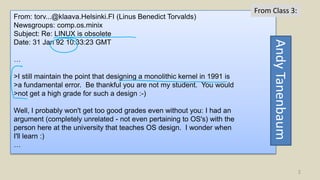
From: torv...@klaava.Helsinki.FI (Linus Benedict Torvalds)
Newsgroups: comp.os.minix
Subject: Re: LINUX is obsolete
Date: 31 Jan 92 10:33:23 GMT
…
>I still maintain the point that designing a monolithic kernel in 1991 is
>a fundamental error. Be thankful you are not my student. You would
>not get a high grade for such a design :-)
Well, I probably won't get too good grades even without you: I had an
argument (completely unrelated - not even pertaining to OS's) with the
person here at the university that teaches OS design. I wonder when
I'll learn :)
…
AndyTanenbaum
From Class 3:
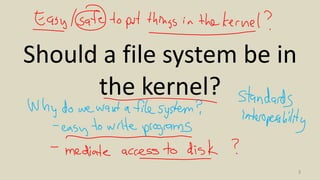
Should a file system be in
the kernel?
3
4
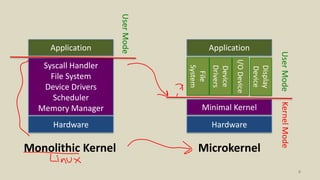
Monolithic Kernel
Hardware
Application
Syscall Handler
File System
Device Drivers
Scheduler
Memory Manager
KernelMode
UserMode
Microkernel
Hardware
Minimal Kernel
Application
UserMode
File
System
Device
Drivers
I/ODevice
Display
Device
5
KernelMode
Microkernel
Hardware
Minimal Kernel
Application
UserMode
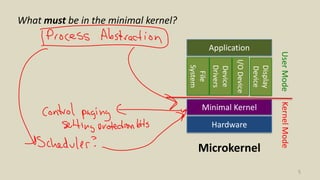
What must be in the minimal kernel?
File
System
Device
Drivers
I/ODevice
Display
Device
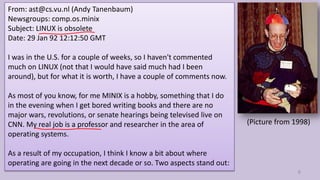
From: ast@cs.vu.nl (Andy Tanenbaum)
Newsgroups: comp.os.minix
Subject: LINUX is obsolete
Date: 29 Jan 92 12:12:50 GMT
I was in the U.S. for a couple of weeks, so I haven't commented
much on LINUX (not that I would have said much had I been
around), but for what it is worth, I have a couple of comments now.
As most of you know, for me MINIX is a hobby, something that I do
in the evening when I get bored writing books and there are no
major wars, revolutions, or senate hearings being televised live on
CNN. My real job is a professor and researcher in the area of
operating systems.
As a result of my occupation, I think I know a bit about where
operating are going in the next decade or so. Two aspects stand out:
6
(Picture from 1998)
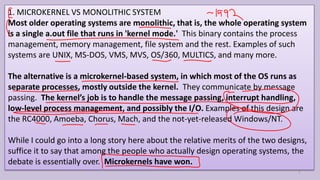
1. MICROKERNEL VS MONOLITHIC SYSTEM
Most older operating systems are monolithic, that is, the whole operating system
is a single a.out file that runs in 'kernel mode.' This binary contains the process
management, memory management, file system and the rest. Examples of such
systems are UNIX, MS-DOS, VMS, MVS, OS/360, MULTICS, and many more.
The alternative is a microkernel-based system, in which most of the OS runs as
separate processes, mostly outside the kernel. They communicate by message
passing. The kernel’s job is to handle the message passing, interrupt handling,
low-level process management, and possibly the I/O. Examples of this design are
the RC4000, Amoeba, Chorus, Mach, and the not-yet-released Windows/NT.
While I could go into a long story here about the relative merits of the two designs,
suffice it to say that among the people who actually design operating systems, the
debate is essentially over. Microkernels have won.
7
8
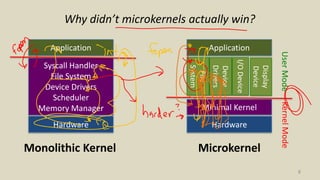
KernelMode
Microkernel
Hardware
Minimal Kernel
Application
File
System
Device
Drivers
I/ODevice
UserMode
Why didn’t microkernels actually win?
Monolithic Kernel
Hardware
Application
Syscall Handler
File System
Device Drivers
Scheduler
Memory Manager
Display
Device
9
KernelMode
Microkernel
Hardware
Minimal Kernel
Application
UserMode
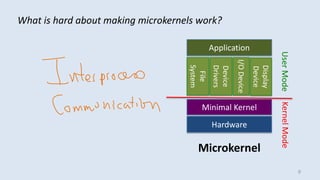
What is hard about making microkernels work?
File
System
Device
Drivers
I/ODevice
Display
Device
10
KernelMode
Microkernel
Hardware
Minimal Kernel
Application
UserMode
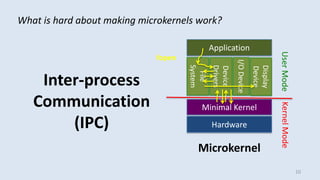
What is hard about making microkernels work?
File
System
Device
Drivers
I/ODevice
Display
Device
fopen
Inter-process
Communication
(IPC)
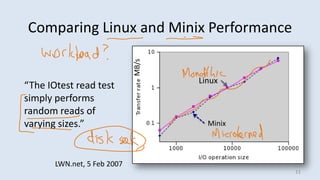
Comparing Linux and Minix Performance
11
“The IOtest read test
simply performs
random reads of
varying sizes.”
MB/s
Minix
Linux
LWN.net, 5 Feb 2007
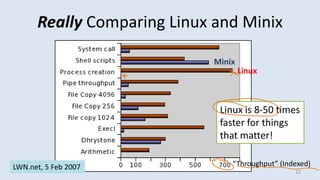
Really Comparing Linux and Minix
12
LWN.net, 5 Feb 2007 “Throughput” (Indexed)
Linux
Minix
Linux is 8-50 times
faster for things
that matter!
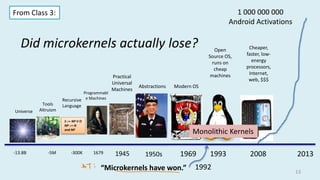
Did microkernels actually lose?
13
2008 2013
1 000 000 000
Android Activations
-13.8B
Universe
Tools
Altruism
-5M 1679
Programmabl
e Machines
S ::= NP V O
NP ::= N
and NP
Recursive
Language
-300K 1945
Practical
Universal
Machines
1950s
Abstractions
1969
Modern OS
1993
Open
Source OS,
runs on
cheap
machines
Cheaper,
faster, low-
energy
processors,
Internet,
web, $$$
From Class 3:
Monolithic Kernels
“Microkernels have won.” 1992
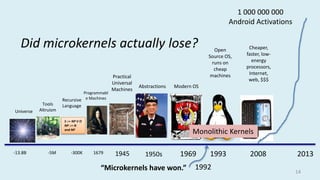
Did microkernels actually lose?
14
2008 2013
1 000 000 000
Android Activations
-13.8B
Universe
Tools
Altruism
-5M 1679
Programmabl
e Machines
S ::= NP V O
NP ::= N
and NP
Recursive
Language
-300K 1945
Practical
Universal
Machines
1950s
Abstractions
1969
Modern OS
1993
Open
Source OS,
runs on
cheap
machines
Cheaper,
faster, low-
energy
processors,
Internet,
web, $$$
Monolithic Kernels
“Microkernels have won.” 1992
15
2008 2013
1B Android Activations
Sep 2013
-13.8B
Universe
Tools
Altruism
-5M 1679
Programmable
Machines
S ::= NP V O
NP ::= N and
NP
Recursive
Language
-300K 1945
Practical Universal
Machines
1950s
Abstractions
1969
Modern OS
1993
Open Source
OS, runs on
cheap
machines
Cheaper,
faster, low-
energy
processors,
Internet,
web, $$$
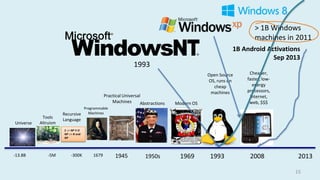
1993
> 1B Windows
machines in 2011
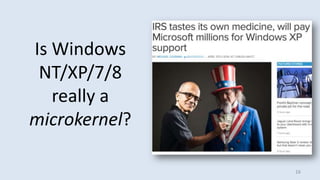
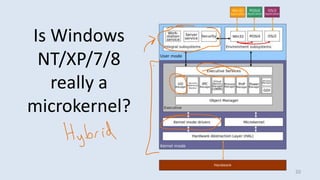
Is Windows
NT/XP/7/8
really a
microkernel?
16
Is Windows
NT/XP/7/8
really a
microkernel?
17
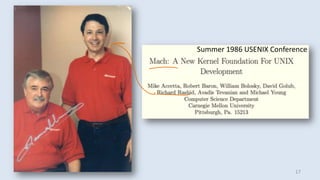
Summer 1986 USENIX Conference
18
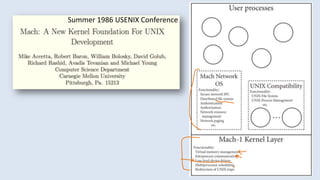
Summer 1986 USENIX Conference
19
Is Windows
NT/XP/7/8
really a
microkernel?
20
21
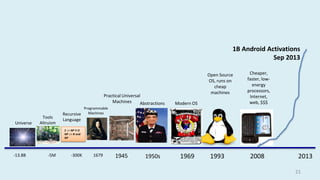
2008 2013
1B Android Activations
Sep 2013
-13.8B
Universe
Tools
Altruism
-5M 1679
Programmable
Machines
S ::= NP V O
NP ::= N and
NP
Recursive
Language
-300K 1945
Practical Universal
Machines
1950s
Abstractions
1969
Modern OS
1993
Open Source
OS, runs on
cheap
machines
Cheaper,
faster, low-
energy
processors,
Internet,
web, $$$
22
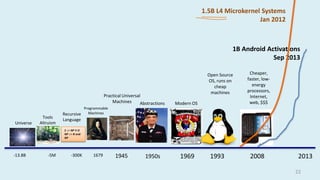
2008 2013
1B Android Activations
Sep 2013
-13.8B
Universe
Tools
Altruism
-5M 1679
Programmable
Machines
S ::= NP V O
NP ::= N and
NP
Recursive
Language
-300K 1945
Practical Universal
Machines
1950s
Abstractions
1969
Modern OS
1993
Open Source
OS, runs on
cheap
machines
Cheaper,
faster, low-
energy
processors,
Internet,
web, $$$
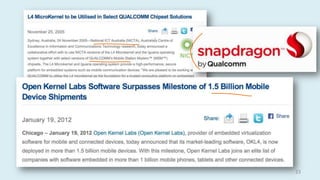
1.5B L4 Microkernel Systems
Jan 2012
23
24
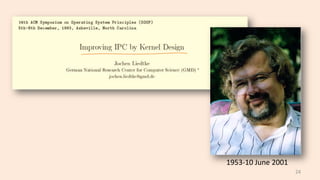
1953-10 June 2001
25
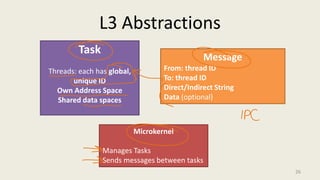
L3 Abstractions
26
Task
Threads: each has global,
unique ID
Own Address Space
Shared data spaces
Message
From: thread ID
To: thread ID
Direct/Indirect String
Data (optional)
Microkernel
Manages Tasks
Sends messages between tasks
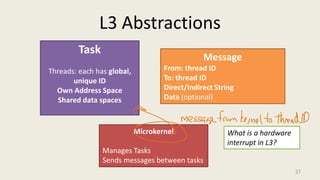
L3 Abstractions
27
Task
Threads: each has global,
unique ID
Own Address Space
Shared data spaces
Message
From: thread ID
To: thread ID
Direct/Indirect String
Data (optional)
Microkernel
Manages Tasks
Sends messages between tasks
What is a hardware
interrupt in L3?
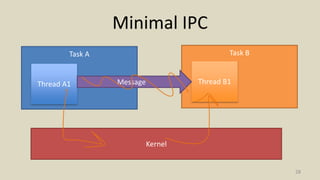
Minimal IPC
28
Task A Task B
Kernel
Thread A1 Thread B1Message
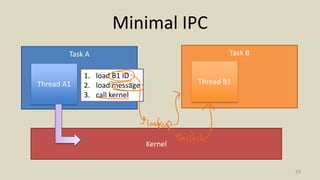
Minimal IPC
29
Task A Task B
Kernel
Thread A1 Thread B1
1. load B1 ID
2. load message
3. call kernel
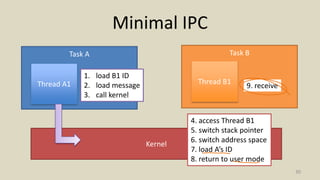
Minimal IPC
30
Task A Task B
Kernel
Thread A1 Thread B1
1. load B1 ID
2. load message
3. call kernel
4. access Thread B1
5. switch stack pointer
6. switch address space
7. load A’s ID
8. return to user mode
9. receive
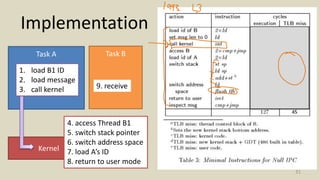
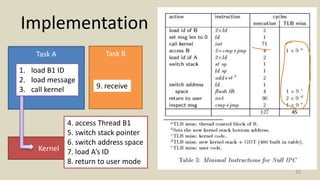
Implementation
31
Task A Task B
Kernel
1. load B1 ID
2. load message
3. call kernel
4. access Thread B1
5. switch stack pointer
6. switch address space
7. load A’s ID
8. return to user mode
9. receive
Implementation
32
Task A Task B
Kernel
1. load B1 ID
2. load message
3. call kernel
4. access Thread B1
5. switch stack pointer
6. switch address space
7. load A’s ID
8. return to user mode
9. receive
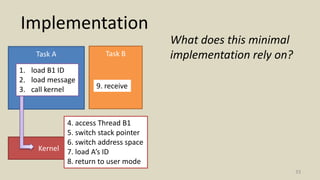
Implementation
33
Task A Task B
Kernel
1. load B1 ID
2. load message
3. call kernel
4. access Thread B1
5. switch stack pointer
6. switch address space
7. load A’s ID
8. return to user mode
9. receive
What does this minimal
implementation rely on?
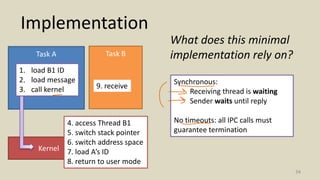
Implementation
34
Task A Task B
Kernel
1. load B1 ID
2. load message
3. call kernel
4. access Thread B1
5. switch stack pointer
6. switch address space
7. load A’s ID
8. return to user mode
9. receive
What does this minimal
implementation rely on?
Synchronous:
Receiving thread is waiting
Sender waits until reply
No timeouts: all IPC calls must
guarantee termination
35
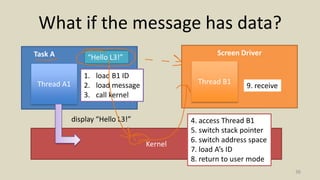
What if the message has data?
36
Task A Screen Driver
Kernel
Thread A1 Thread B1
1. load B1 ID
2. load message
3. call kernel
4. access Thread B1
5. switch stack pointer
6. switch address space
7. load A’s ID
8. return to user mode
9. receive
display “Hello L3!”
“Hello L3!”
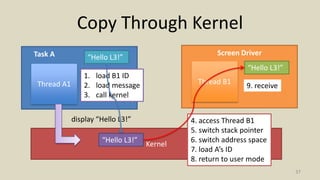
Copy Through Kernel
37
Task A Screen Driver
Kernel
Thread A1 Thread B1
1. load B1 ID
2. load message
3. call kernel
4. access Thread B1
5. switch stack pointer
6. switch address space
7. load A’s ID
8. return to user mode
9. receive
display “Hello L3!”
“Hello L3!”
“Hello L3!”
“Hello L3!”
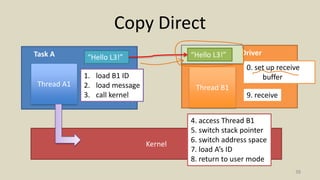
Screen Driver
Copy Direct
38
Task A
Kernel
Thread A1 Thread B1
1. load B1 ID
2. load message
3. call kernel
4. access Thread B1
5. switch stack pointer
6. switch address space
7. load A’s ID
8. return to user mode
9. receive
“Hello L3!” “Hello L3!”
0. set up receive
buffer
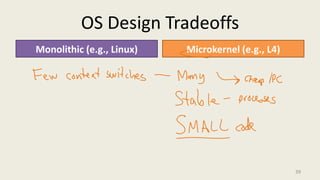
OS Design Tradeoffs
Monolithic (e.g., Linux) Microkernel (e.g., L4)
39
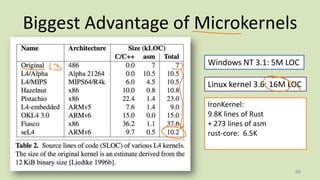
Biggest Advantage of Microkernels
40
IronKernel:
9.8K lines of Rust
+ 273 lines of asm
rust-core: 6.5K
Windows NT 3.1: 5M LOC
Linux kernel 3.6: 16M LOC
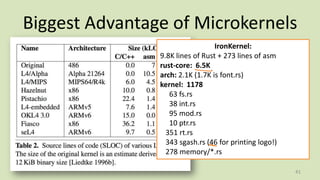
Biggest Advantage of Microkernels
41
IronKernel:
9.8K lines of Rust + 273 lines of asm
rust-core: 6.5K
arch: 2.1K (1.7K is font.rs)
kernel: 1178
63 fs.rs
38 int.rs
95 mod.rs
10 ptr.rs
351 rt.rs
343 sgash.rs (46 for printing logo!)
278 memory/*.rs
42
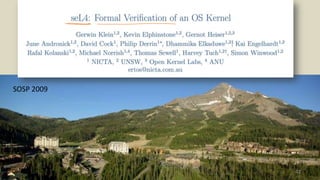
SOSP 2009
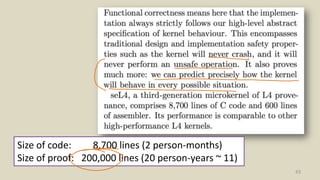
43
Size of code: 8,700 lines (2 person-months)
Size of proof: 200,000 lines (20 person-years ~ 11)
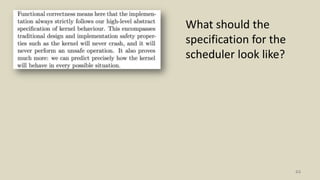
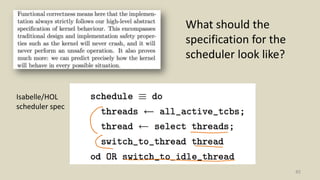
44
What should the
specification for the
scheduler look like?
45
What should the
specification for the
scheduler look like?
Isabelle/HOL
scheduler spec
46
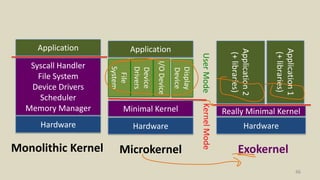
KernelMode
Microkernel
Hardware
Minimal Kernel
Application
File
System
Device
Drivers
I/ODevice
UserMode
Monolithic Kernel
Hardware
Application
Syscall Handler
File System
Device Drivers
Scheduler
Memory Manager
Display
Device
Exokernel
Hardware
Really Minimal Kernel
Application2
(+libraries)
Application1
(+libraries)
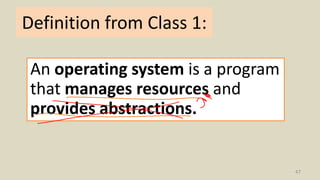
Definition from Class 1:
47
An operating system is a program
that manages resources and
provides abstractions.
48
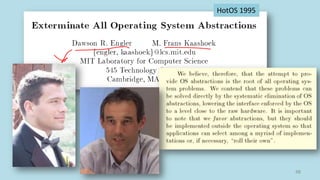
HotOS 1995
49
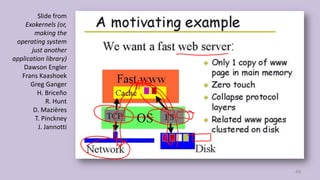
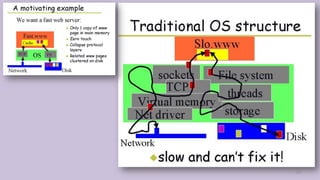
Slide from
Exokernels (or,
making the
operating system
just another
application library)
Dawson Engler
Frans Kaashoek
Greg Ganger
H. Briceño
R. Hunt
D. Mazières
T. Pinckney
J. Jannotti
50
51
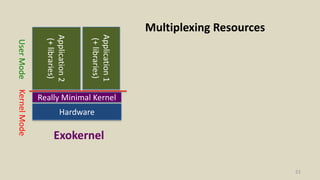
KernelModeUserMode
Exokernel
Hardware
Really Minimal Kernel
Application2
(+libraries)
Application1
(+libraries)
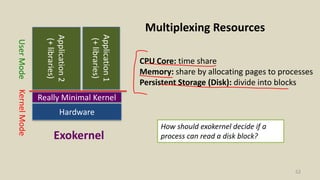
Multiplexing Resources
52
KernelModeUserMode
Exokernel
Hardware
Really Minimal Kernel
Application2
(+libraries)
Application1
(+libraries)
Multiplexing Resources
CPU Core: time share
Memory: share by allocating pages to processes
Persistent Storage (Disk): divide into blocks
How should exokernel decide if a
process can read a disk block?
53
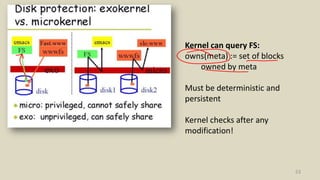
Kernel can query FS:
owns(meta) := set of blocks
owned by meta
Must be deterministic and
persistent
Kernel checks after any
modification!
54
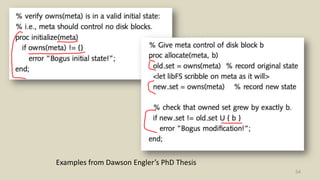
Examples from Dawson Engler’s PhD Thesis
55
2008 2013
1B Android Activations
Sep 2013
-13.8B
Universe
Tools
Altruism
-5M 1679
Programmable
Machines
S ::= NP V O
NP ::= N and
NP
Recursive
Language
-300K 1945
Practical Universal
Machines
1950s
Abstractions
1969
Modern OS
1993
Open Source
OS, runs on
cheap
machines
Cheaper,
faster, low-
energy
processors,
Internet,
web, $$$
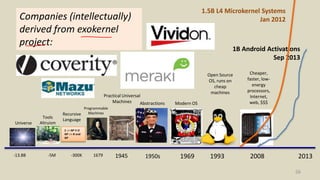
1.5B L4 Microkernel Systems
Jan 2012
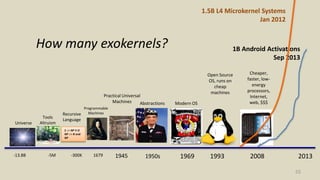
How many exokernels?
56
2008 2013
1B Android Activations
Sep 2013
-13.8B
Universe
Tools
Altruism
-5M 1679
Programmable
Machines
S ::= NP V O
NP ::= N and
NP
Recursive
Language
-300K 1945
Practical Universal
Machines
1950s
Abstractions
1969
Modern OS
1993
Open Source
OS, runs on
cheap
machines
Cheaper,
faster, low-
energy
processors,
Internet,
web, $$$
1.5B L4 Microkernel Systems
Jan 2012Companies (intellectually)
derived from exokernel
project:
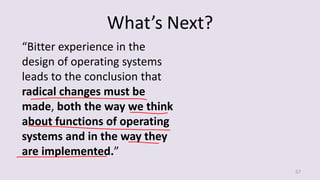
What’s Next?
57
“Bitter experience in the
design of operating systems
leads to the conclusion that
radical changes must be
made, both the way we think
about functions of operating
systems and in the way they
are implemented.”
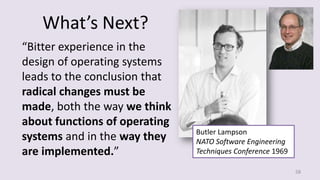
What’s Next?
58
“Bitter experience in the
design of operating systems
leads to the conclusion that
radical changes must be
made, both the way we think
about functions of operating
systems and in the way they
are implemented.”
Butler Lampson
NATO Software Engineering
Techniques Conference 1969
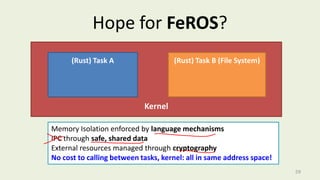
Kernel
Hope for FeROS?
59
(Rust) Task A (Rust) Task B (File System)
Memory Isolation enforced by language mechanisms
IPC through safe, shared data
External resources managed through cryptography
No cost to calling between tasks, kernel: all in same address space!
Charge!
Tanenbaum was wrong about microkernels
having won in 1992
Prevailing wisdom is wrong about
microkernels having lost in 2014
60
Butler is still right: The real OS of the
future should be something radically
different and you should help build it!
Remember
to sign up
for your
project
submission
option!

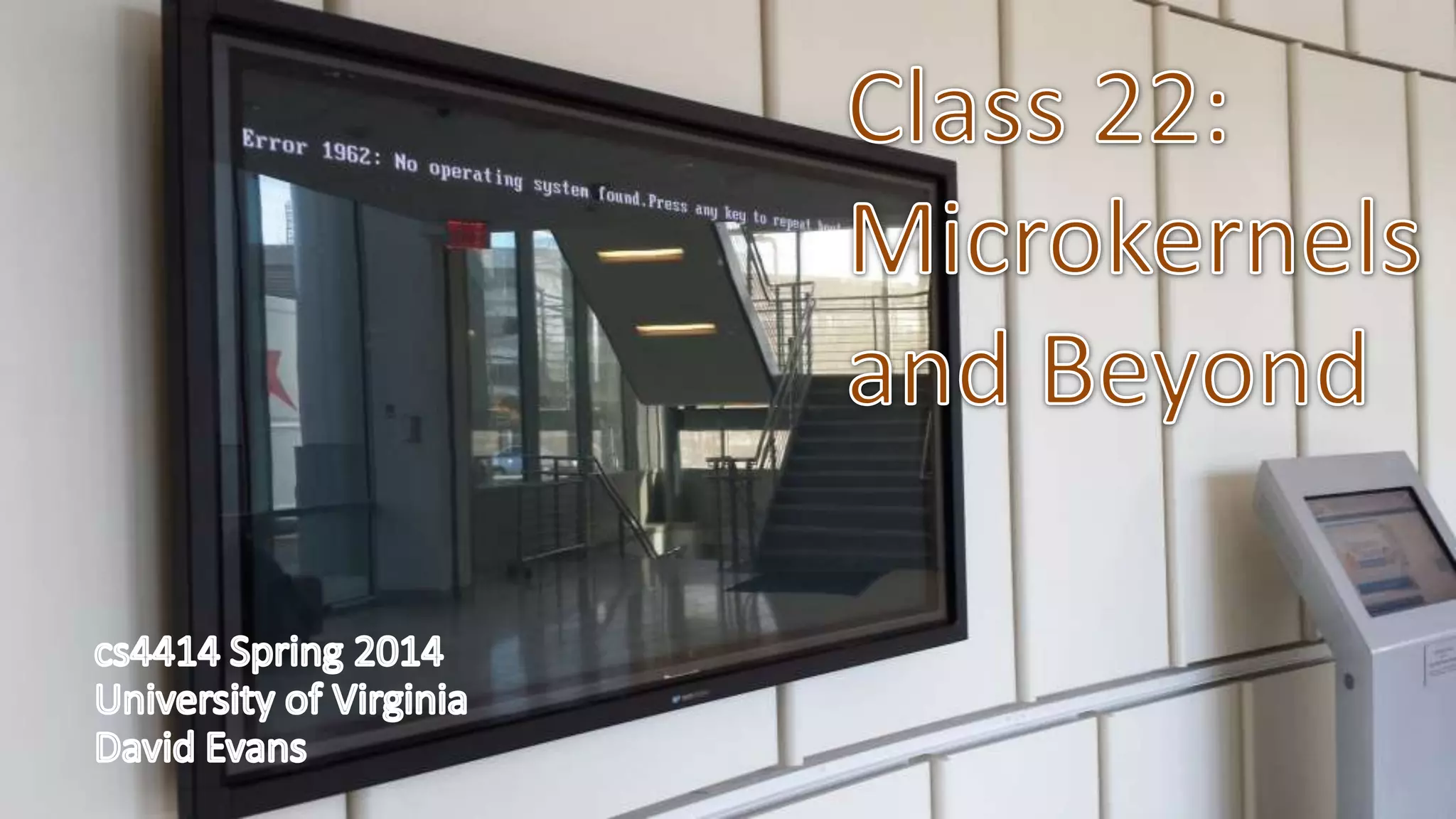
Microkernels and Beyond

  • 2.
    Plan for Today Microkernels L4 Exokernels 1 Reminder:don’t forget to sign up for your project submission/presentati on option
  • 3.
    2 From: torv...@klaava.Helsinki.FI (LinusBenedict Torvalds) Newsgroups: comp.os.minix Subject: Re: LINUX is obsolete Date: 31 Jan 92 10:33:23 GMT … >I still maintain the point that designing a monolithic kernel in 1991 is >a fundamental error. Be thankful you are not my student. You would >not get a high grade for such a design :-) Well, I probably won't get too good grades even without you: I had an argument (completely unrelated - not even pertaining to OS's) with the person here at the university that teaches OS design. I wonder when I'll learn :) … AndyTanenbaum From Class 3:
  • 4.
    Should a filesystem be in the kernel? 3
  • 5.
    4 Monolithic Kernel Hardware Application Syscall Handler FileSystem Device Drivers Scheduler Memory Manager KernelMode UserMode Microkernel Hardware Minimal Kernel Application UserMode File System Device Drivers I/ODevice Display Device
  • 6.
    5 KernelMode Microkernel Hardware Minimal Kernel Application UserMode What mustbe in the minimal kernel? File System Device Drivers I/ODevice Display Device
  • 7.
    From: ast@cs.vu.nl (AndyTanenbaum) Newsgroups: comp.os.minix Subject: LINUX is obsolete Date: 29 Jan 92 12:12:50 GMT I was in the U.S. for a couple of weeks, so I haven't commented much on LINUX (not that I would have said much had I been around), but for what it is worth, I have a couple of comments now. As most of you know, for me MINIX is a hobby, something that I do in the evening when I get bored writing books and there are no major wars, revolutions, or senate hearings being televised live on CNN. My real job is a professor and researcher in the area of operating systems. As a result of my occupation, I think I know a bit about where operating are going in the next decade or so. Two aspects stand out: 6 (Picture from 1998)
  • 8.
    1. MICROKERNEL VSMONOLITHIC SYSTEM Most older operating systems are monolithic, that is, the whole operating system is a single a.out file that runs in 'kernel mode.' This binary contains the process management, memory management, file system and the rest. Examples of such systems are UNIX, MS-DOS, VMS, MVS, OS/360, MULTICS, and many more. The alternative is a microkernel-based system, in which most of the OS runs as separate processes, mostly outside the kernel. They communicate by message passing. The kernel’s job is to handle the message passing, interrupt handling, low-level process management, and possibly the I/O. Examples of this design are the RC4000, Amoeba, Chorus, Mach, and the not-yet-released Windows/NT. While I could go into a long story here about the relative merits of the two designs, suffice it to say that among the people who actually design operating systems, the debate is essentially over. Microkernels have won. 7
  • 9.
    8 KernelMode Microkernel Hardware Minimal Kernel Application File System Device Drivers I/ODevice UserMode Why didn’tmicrokernels actually win? Monolithic Kernel Hardware Application Syscall Handler File System Device Drivers Scheduler Memory Manager Display Device
  • 10.
    9 KernelMode Microkernel Hardware Minimal Kernel Application UserMode What ishard about making microkernels work? File System Device Drivers I/ODevice Display Device
  • 11.
    10 KernelMode Microkernel Hardware Minimal Kernel Application UserMode What ishard about making microkernels work? File System Device Drivers I/ODevice Display Device fopen Inter-process Communication (IPC)
  • 12.
    Comparing Linux andMinix Performance 11 “The IOtest read test simply performs random reads of varying sizes.” MB/s Minix Linux LWN.net, 5 Feb 2007
  • 13.
    Really Comparing Linuxand Minix 12 LWN.net, 5 Feb 2007 “Throughput” (Indexed) Linux Minix Linux is 8-50 times faster for things that matter!
  • 14.
    Did microkernels actuallylose? 13 2008 2013 1 000 000 000 Android Activations -13.8B Universe Tools Altruism -5M 1679 Programmabl e Machines S ::= NP V O NP ::= N and NP Recursive Language -300K 1945 Practical Universal Machines 1950s Abstractions 1969 Modern OS 1993 Open Source OS, runs on cheap machines Cheaper, faster, low- energy processors, Internet, web, $$$ From Class 3: Monolithic Kernels “Microkernels have won.” 1992
  • 15.
    Did microkernels actuallylose? 14 2008 2013 1 000 000 000 Android Activations -13.8B Universe Tools Altruism -5M 1679 Programmabl e Machines S ::= NP V O NP ::= N and NP Recursive Language -300K 1945 Practical Universal Machines 1950s Abstractions 1969 Modern OS 1993 Open Source OS, runs on cheap machines Cheaper, faster, low- energy processors, Internet, web, $$$ Monolithic Kernels “Microkernels have won.” 1992
  • 16.
    15 2008 2013 1B AndroidActivations Sep 2013 -13.8B Universe Tools Altruism -5M 1679 Programmable Machines S ::= NP V O NP ::= N and NP Recursive Language -300K 1945 Practical Universal Machines 1950s Abstractions 1969 Modern OS 1993 Open Source OS, runs on cheap machines Cheaper, faster, low- energy processors, Internet, web, $$$ 1993 > 1B Windows machines in 2011
  • 17.
  • 18.
  • 19.
  • 20.
  • 21.
  • 22.
    21 2008 2013 1B AndroidActivations Sep 2013 -13.8B Universe Tools Altruism -5M 1679 Programmable Machines S ::= NP V O NP ::= N and NP Recursive Language -300K 1945 Practical Universal Machines 1950s Abstractions 1969 Modern OS 1993 Open Source OS, runs on cheap machines Cheaper, faster, low- energy processors, Internet, web, $$$
  • 23.
    22 2008 2013 1B AndroidActivations Sep 2013 -13.8B Universe Tools Altruism -5M 1679 Programmable Machines S ::= NP V O NP ::= N and NP Recursive Language -300K 1945 Practical Universal Machines 1950s Abstractions 1969 Modern OS 1993 Open Source OS, runs on cheap machines Cheaper, faster, low- energy processors, Internet, web, $$$ 1.5B L4 Microkernel Systems Jan 2012
  • 24.
  • 25.
  • 26.
  • 27.
    L3 Abstractions 26 Task Threads: eachhas global, unique ID Own Address Space Shared data spaces Message From: thread ID To: thread ID Direct/Indirect String Data (optional) Microkernel Manages Tasks Sends messages between tasks
  • 28.
    L3 Abstractions 27 Task Threads: eachhas global, unique ID Own Address Space Shared data spaces Message From: thread ID To: thread ID Direct/Indirect String Data (optional) Microkernel Manages Tasks Sends messages between tasks What is a hardware interrupt in L3?
  • 29.
    Minimal IPC 28 Task ATask B Kernel Thread A1 Thread B1Message
  • 30.
    Minimal IPC 29 Task ATask B Kernel Thread A1 Thread B1 1. load B1 ID 2. load message 3. call kernel
  • 31.
    Minimal IPC 30 Task ATask B Kernel Thread A1 Thread B1 1. load B1 ID 2. load message 3. call kernel 4. access Thread B1 5. switch stack pointer 6. switch address space 7. load A’s ID 8. return to user mode 9. receive
  • 32.
    Implementation 31 Task A TaskB Kernel 1. load B1 ID 2. load message 3. call kernel 4. access Thread B1 5. switch stack pointer 6. switch address space 7. load A’s ID 8. return to user mode 9. receive
  • 33.
    Implementation 32 Task A TaskB Kernel 1. load B1 ID 2. load message 3. call kernel 4. access Thread B1 5. switch stack pointer 6. switch address space 7. load A’s ID 8. return to user mode 9. receive
  • 34.
    Implementation 33 Task A TaskB Kernel 1. load B1 ID 2. load message 3. call kernel 4. access Thread B1 5. switch stack pointer 6. switch address space 7. load A’s ID 8. return to user mode 9. receive What does this minimal implementation rely on?
  • 35.
    Implementation 34 Task A TaskB Kernel 1. load B1 ID 2. load message 3. call kernel 4. access Thread B1 5. switch stack pointer 6. switch address space 7. load A’s ID 8. return to user mode 9. receive What does this minimal implementation rely on? Synchronous: Receiving thread is waiting Sender waits until reply No timeouts: all IPC calls must guarantee termination
  • 36.
  • 37.
    What if themessage has data? 36 Task A Screen Driver Kernel Thread A1 Thread B1 1. load B1 ID 2. load message 3. call kernel 4. access Thread B1 5. switch stack pointer 6. switch address space 7. load A’s ID 8. return to user mode 9. receive display “Hello L3!” “Hello L3!”
  • 38.
    Copy Through Kernel 37 TaskA Screen Driver Kernel Thread A1 Thread B1 1. load B1 ID 2. load message 3. call kernel 4. access Thread B1 5. switch stack pointer 6. switch address space 7. load A’s ID 8. return to user mode 9. receive display “Hello L3!” “Hello L3!” “Hello L3!” “Hello L3!”
  • 39.
    Screen Driver Copy Direct 38 TaskA Kernel Thread A1 Thread B1 1. load B1 ID 2. load message 3. call kernel 4. access Thread B1 5. switch stack pointer 6. switch address space 7. load A’s ID 8. return to user mode 9. receive “Hello L3!” “Hello L3!” 0. set up receive buffer
  • 40.
    OS Design Tradeoffs Monolithic(e.g., Linux) Microkernel (e.g., L4) 39
  • 41.
    Biggest Advantage ofMicrokernels 40 IronKernel: 9.8K lines of Rust + 273 lines of asm rust-core: 6.5K Windows NT 3.1: 5M LOC Linux kernel 3.6: 16M LOC
  • 42.
    Biggest Advantage ofMicrokernels 41 IronKernel: 9.8K lines of Rust + 273 lines of asm rust-core: 6.5K arch: 2.1K (1.7K is font.rs) kernel: 1178 63 fs.rs 38 int.rs 95 mod.rs 10 ptr.rs 351 rt.rs 343 sgash.rs (46 for printing logo!) 278 memory/*.rs
  • 43.
  • 44.
    43 Size of code:8,700 lines (2 person-months) Size of proof: 200,000 lines (20 person-years ~ 11)
  • 45.
    44 What should the specificationfor the scheduler look like?
  • 46.
    45 What should the specificationfor the scheduler look like? Isabelle/HOL scheduler spec
  • 47.
    46 KernelMode Microkernel Hardware Minimal Kernel Application File System Device Drivers I/ODevice UserMode Monolithic Kernel Hardware Application SyscallHandler File System Device Drivers Scheduler Memory Manager Display Device Exokernel Hardware Really Minimal Kernel Application2 (+libraries) Application1 (+libraries)
  • 48.
    Definition from Class1: 47 An operating system is a program that manages resources and provides abstractions.
  • 49.
  • 50.
    49 Slide from Exokernels (or, makingthe operating system just another application library) Dawson Engler Frans Kaashoek Greg Ganger H. Briceño R. Hunt D. Mazières T. Pinckney J. Jannotti
  • 51.
  • 52.
  • 53.
    52 KernelModeUserMode Exokernel Hardware Really Minimal Kernel Application2 (+libraries) Application1 (+libraries) MultiplexingResources CPU Core: time share Memory: share by allocating pages to processes Persistent Storage (Disk): divide into blocks How should exokernel decide if a process can read a disk block?
  • 54.
    53 Kernel can queryFS: owns(meta) := set of blocks owned by meta Must be deterministic and persistent Kernel checks after any modification!
  • 55.
    54 Examples from DawsonEngler’s PhD Thesis
  • 56.
    55 2008 2013 1B AndroidActivations Sep 2013 -13.8B Universe Tools Altruism -5M 1679 Programmable Machines S ::= NP V O NP ::= N and NP Recursive Language -300K 1945 Practical Universal Machines 1950s Abstractions 1969 Modern OS 1993 Open Source OS, runs on cheap machines Cheaper, faster, low- energy processors, Internet, web, $$$ 1.5B L4 Microkernel Systems Jan 2012 How many exokernels?
  • 57.
    56 2008 2013 1B AndroidActivations Sep 2013 -13.8B Universe Tools Altruism -5M 1679 Programmable Machines S ::= NP V O NP ::= N and NP Recursive Language -300K 1945 Practical Universal Machines 1950s Abstractions 1969 Modern OS 1993 Open Source OS, runs on cheap machines Cheaper, faster, low- energy processors, Internet, web, $$$ 1.5B L4 Microkernel Systems Jan 2012Companies (intellectually) derived from exokernel project:
  • 58.
    What’s Next? 57 “Bitter experiencein the design of operating systems leads to the conclusion that radical changes must be made, both the way we think about functions of operating systems and in the way they are implemented.”
  • 59.
    What’s Next? 58 “Bitter experiencein the design of operating systems leads to the conclusion that radical changes must be made, both the way we think about functions of operating systems and in the way they are implemented.” Butler Lampson NATO Software Engineering Techniques Conference 1969
  • 60.
    Kernel Hope for FeROS? 59 (Rust)Task A (Rust) Task B (File System) Memory Isolation enforced by language mechanisms IPC through safe, shared data External resources managed through cryptography No cost to calling between tasks, kernel: all in same address space!
  • 61.
    Charge! Tanenbaum was wrongabout microkernels having won in 1992 Prevailing wisdom is wrong about microkernels having lost in 2014 60 Butler is still right: The real OS of the future should be something radically different and you should help build it! Remember to sign up for your project submission option!