


Smarter
Scheduling
(Priorities)
Plan for Today
Recap: Scheduling
First Come, First Served / Round-Robin
Priorities
Lottery and Stride Scheduling
Scheduling in Linux
1
Wil Thomason

2
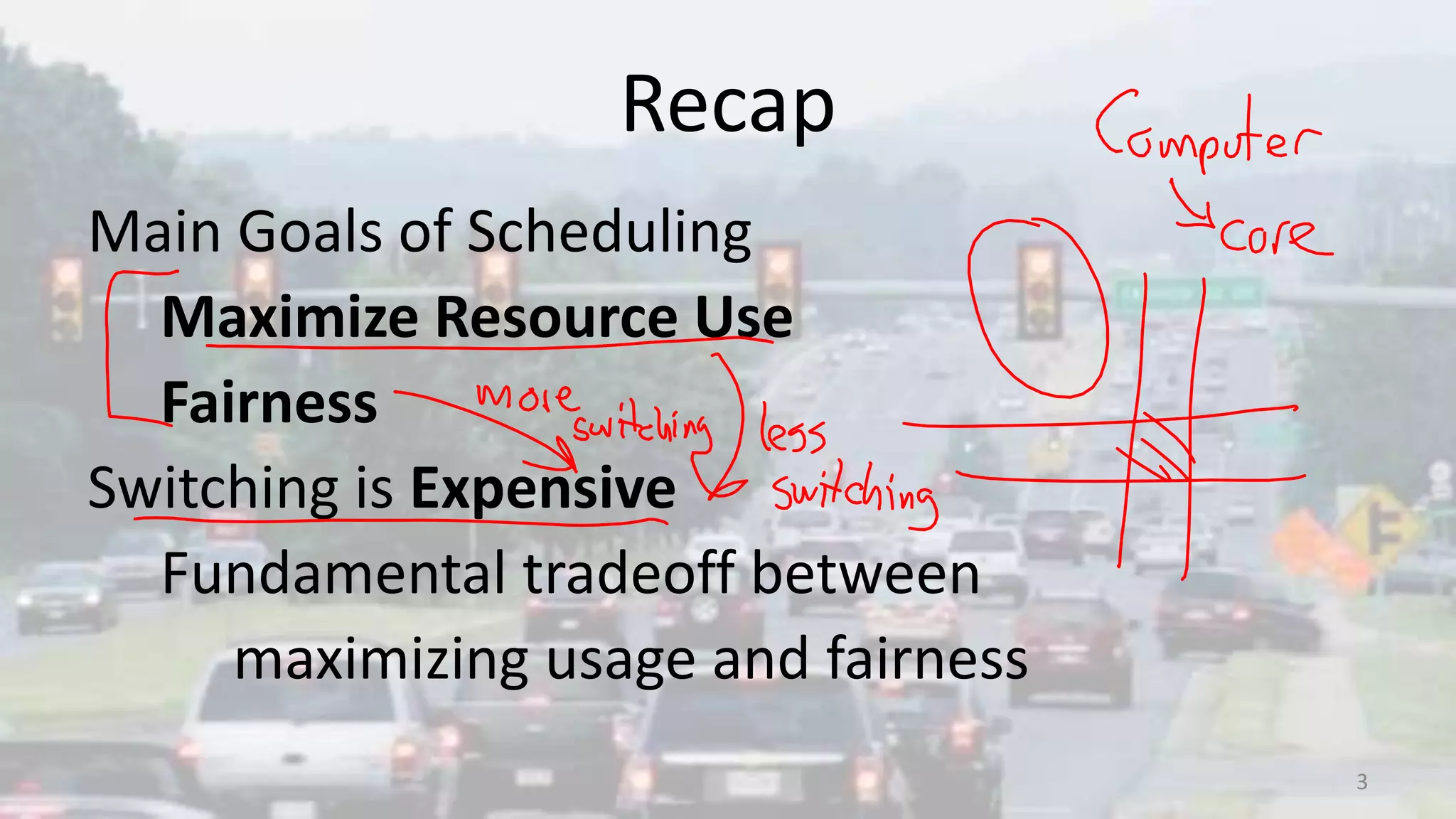
Recap
Main Goals of Scheduling
Maximize Resource Use
Fairness
Switching is Expensive
Fundamental tradeoff between
maximizing usage and fairness
3
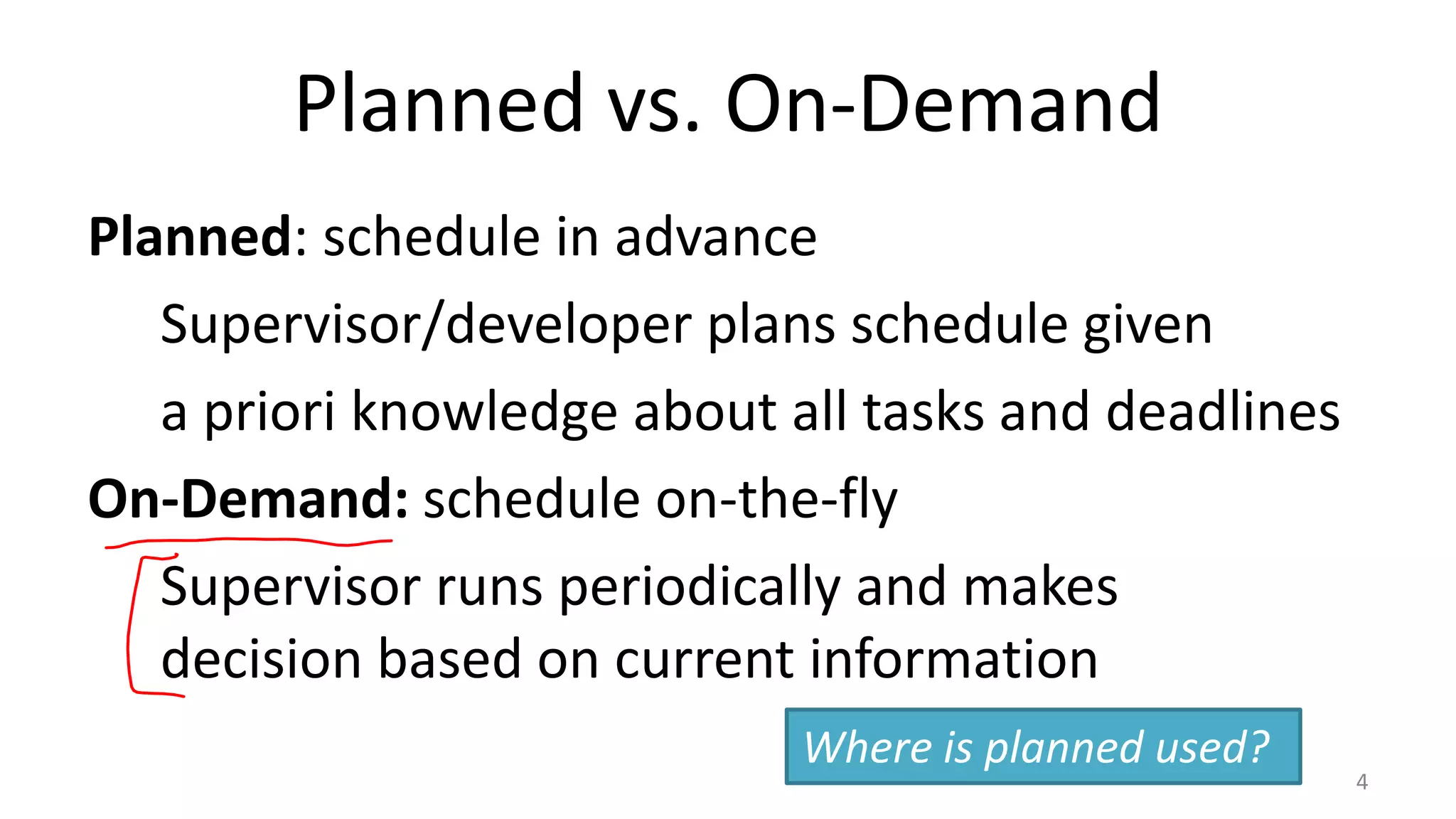
Planned vs. On-Demand
Planned: schedule in advance
Supervisor/developer plans schedule given
a priori knowledge about all tasks and deadlines
On-Demand: schedule on-the-fly
Supervisor runs periodically and makes
decision based on current information
Where is planned used?

4
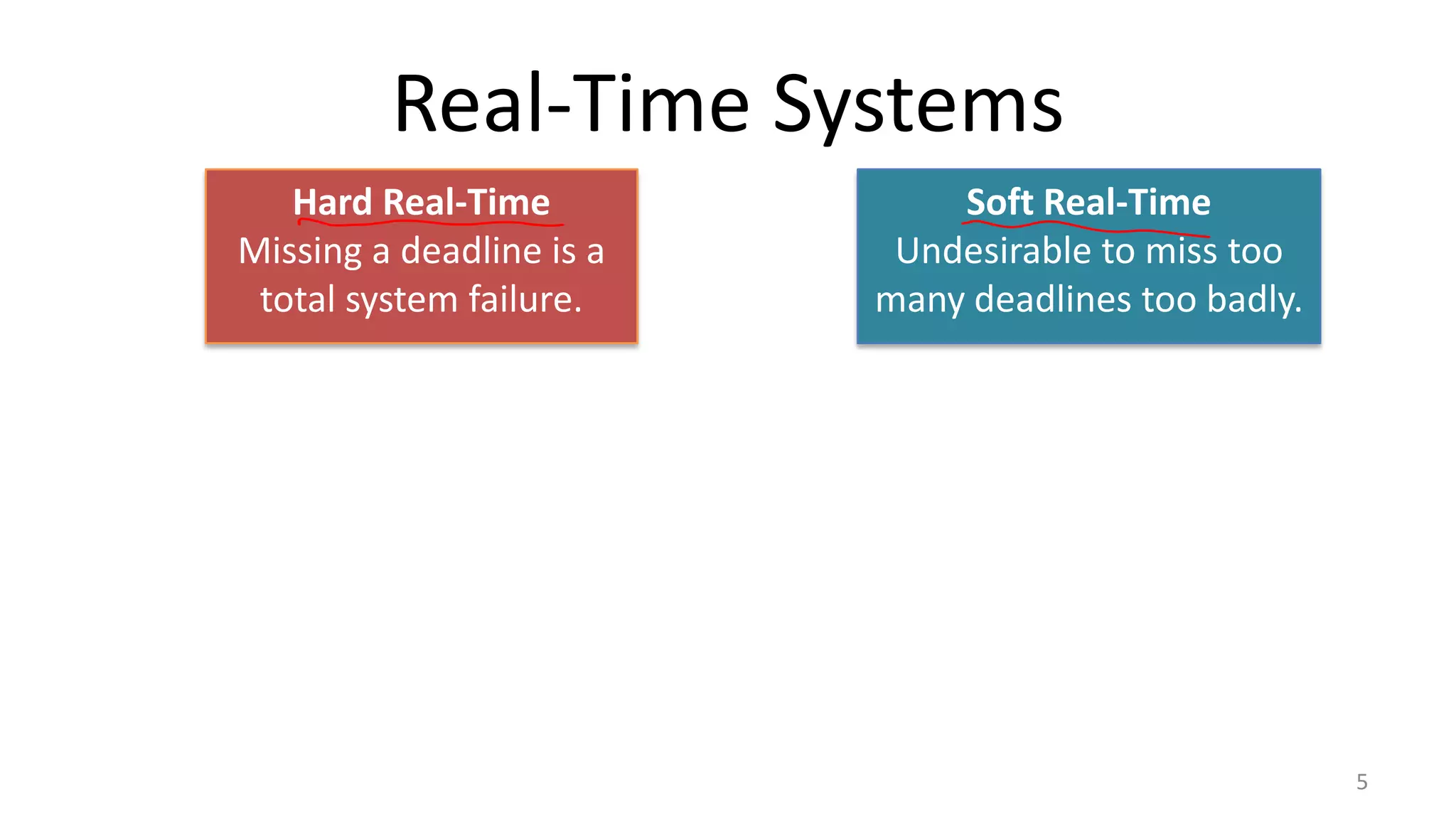
Real-Time Systems
Hard Real-Time
Missing a deadline is a
total system failure.

Soft Real-Time
Undesirable to miss too
many deadlines too badly.

5
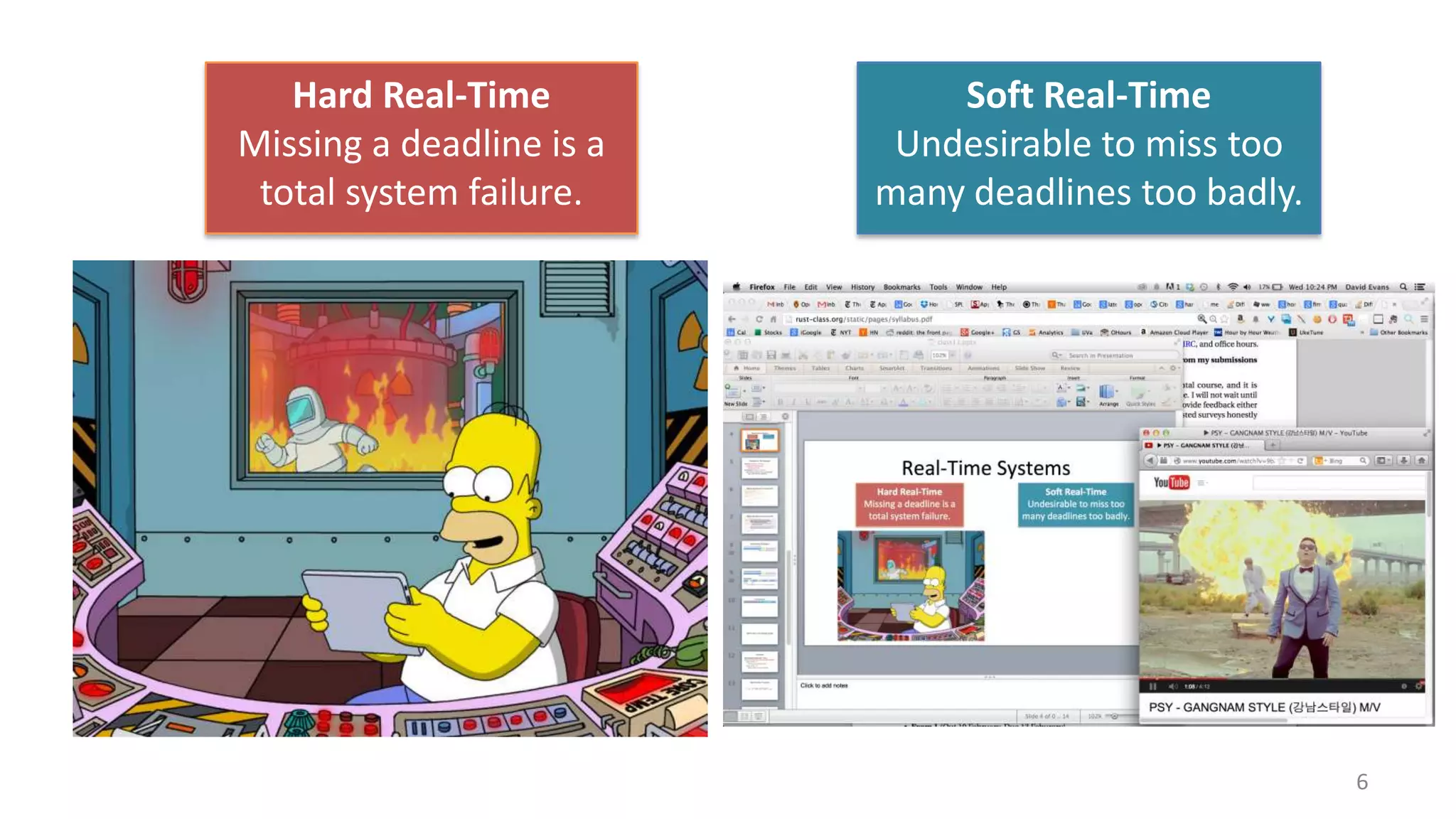
Hard Real-Time
Missing a deadline is a
total system failure.

Soft Real-Time
Undesirable to miss too
many deadlines too badly.

6
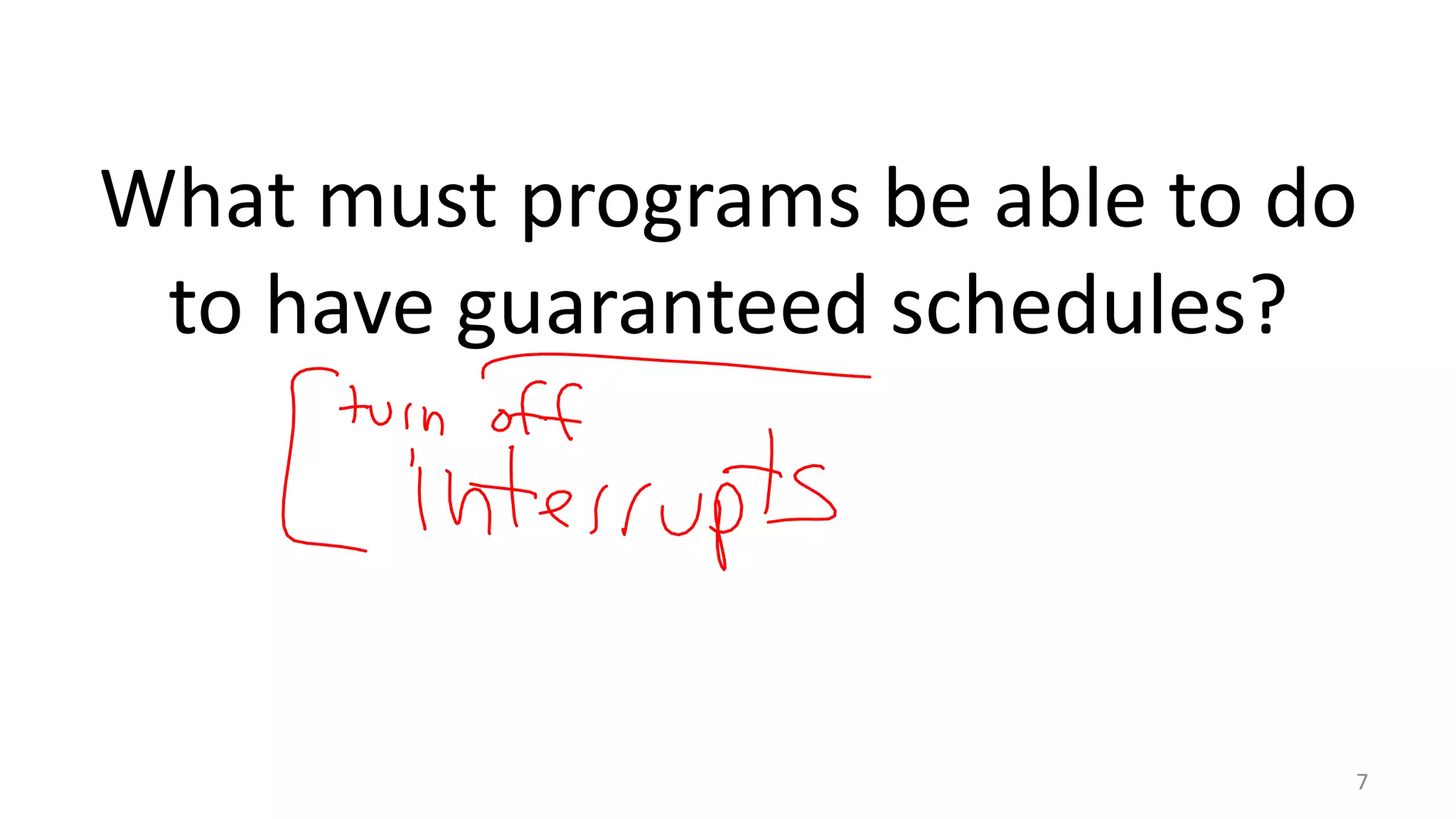
What must programs be able to do
to have guaranteed schedules?

7
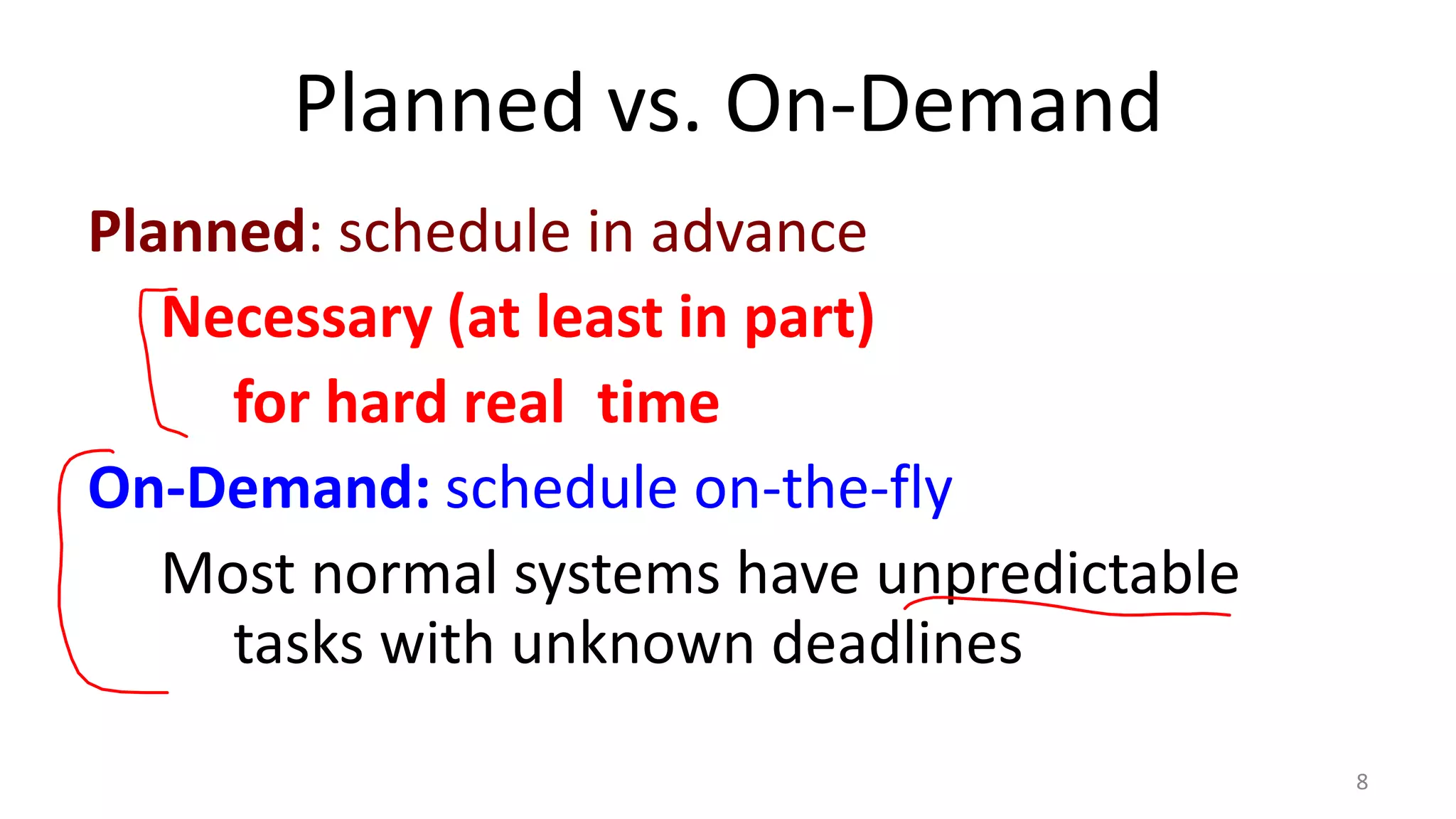
Planned vs. On-Demand
Planned: schedule in advance
Necessary (at least in part)
for hard real time
On-Demand: schedule on-the-fly
Most normal systems have unpredictable
tasks with unknown deadlines
8
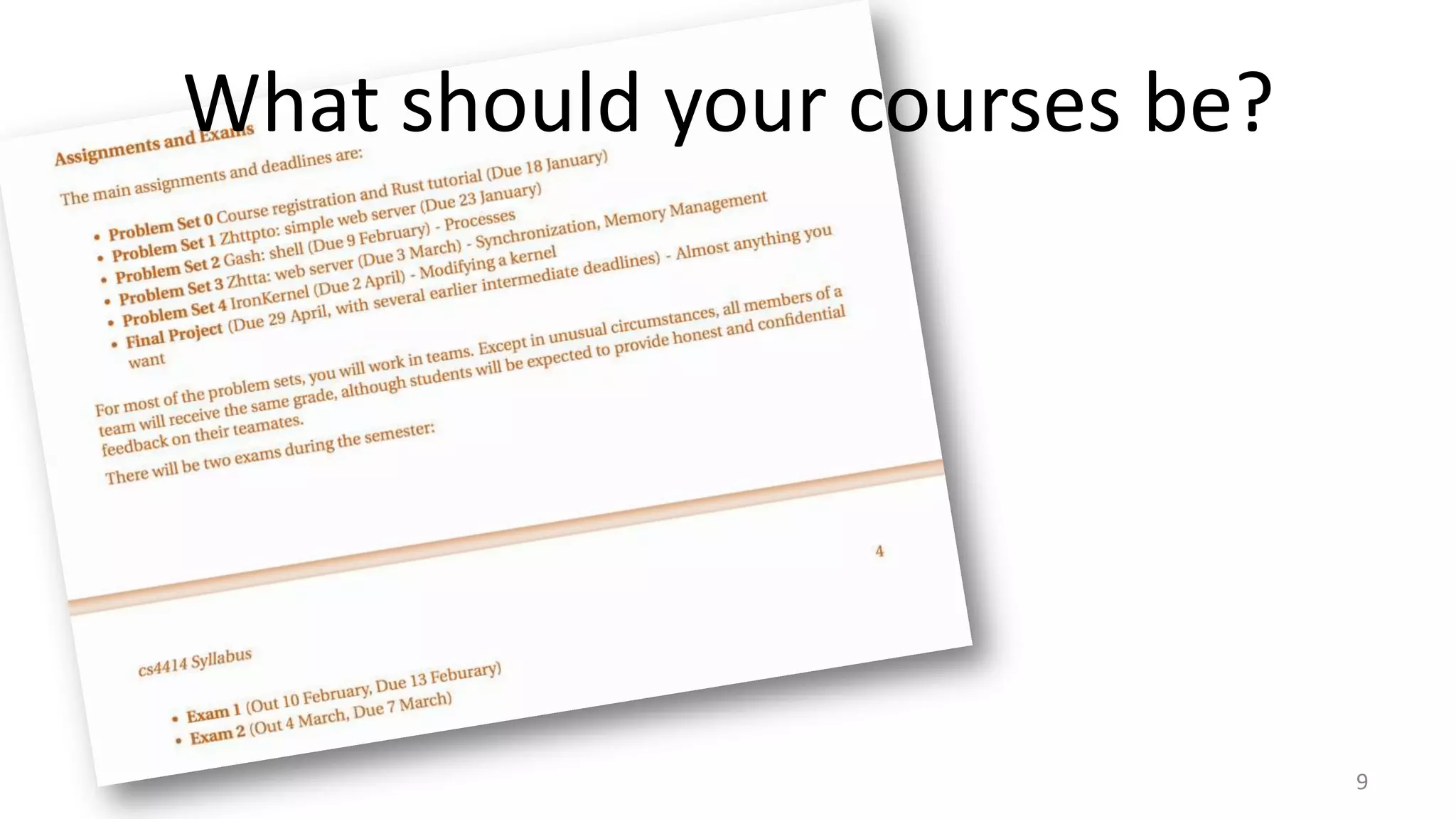
What should your courses be?

9
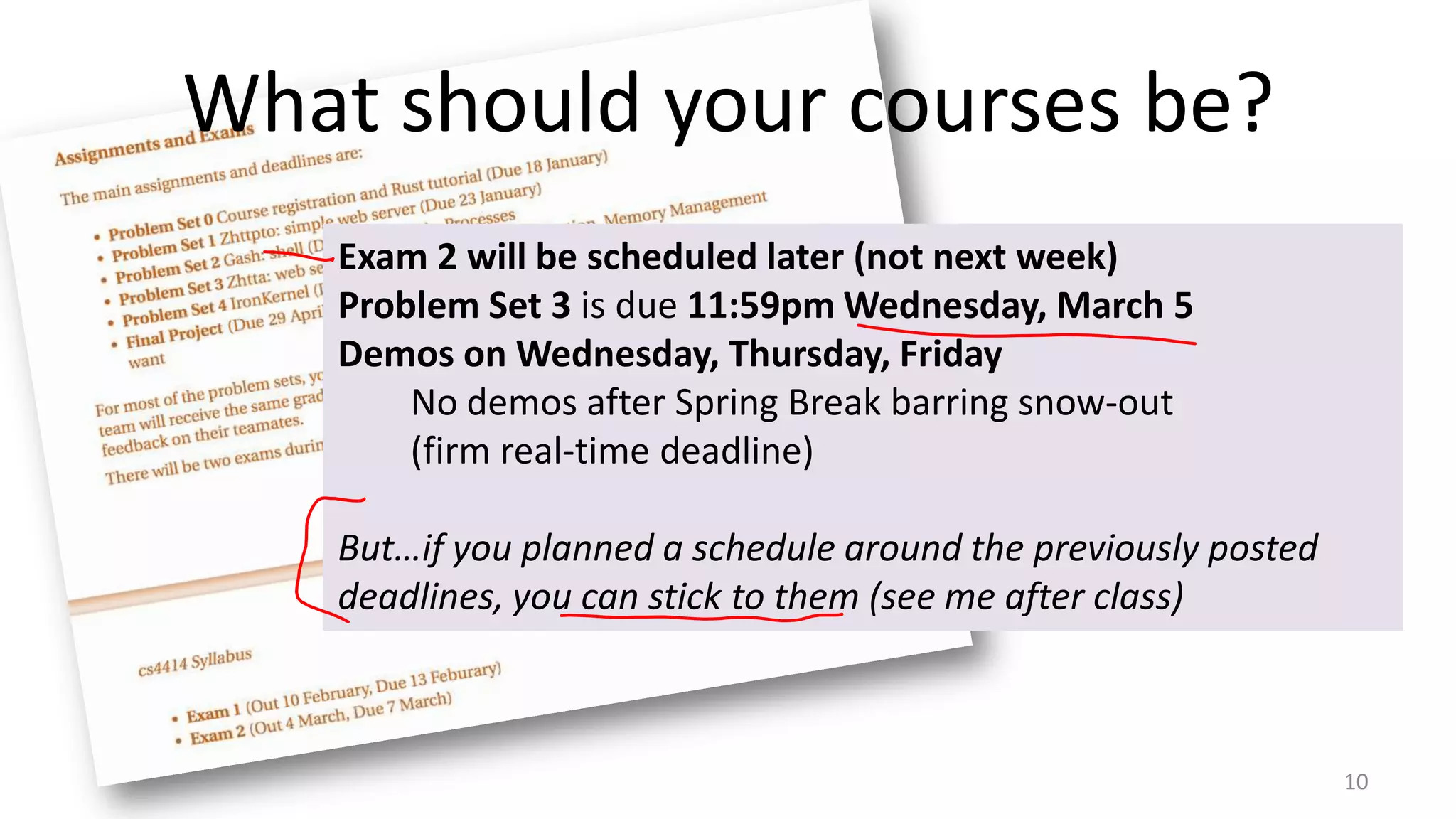
What should your courses be?
Exam 2 will be scheduled later (not next week)
Problem Set 3 is due 11:59pm Wednesday, March 5
Demos on Wednesday, Thursday, Friday
No demos after Spring Break barring snow-out
(firm real-time deadline)
But…if you planned a schedule around the previously posted
deadlines, you can stick to them (see me after class)

10
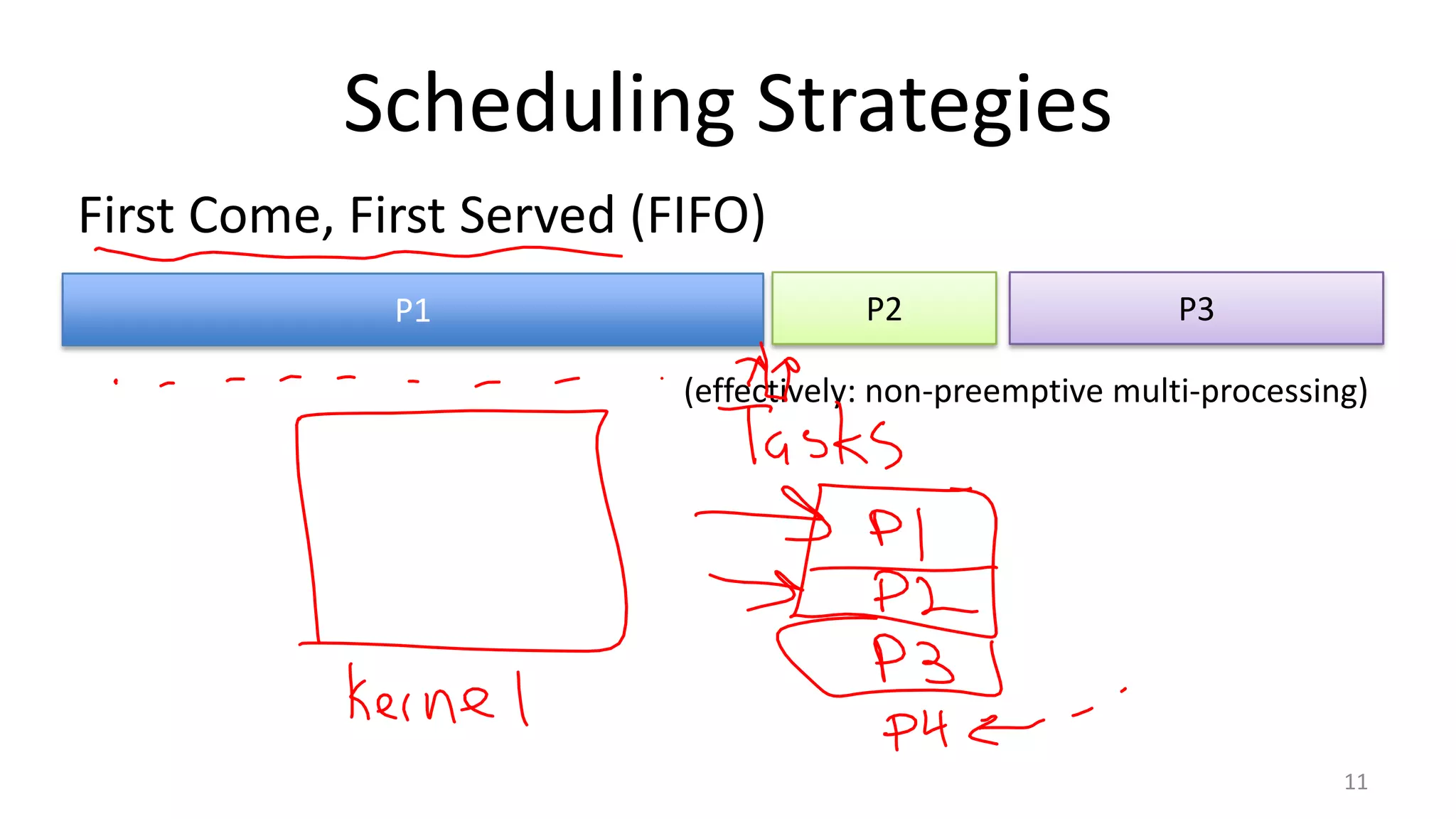
Scheduling Strategies
First Come, First Served (FIFO)
P1

P2

P3

(effectively: non-preemptive multi-processing)

11
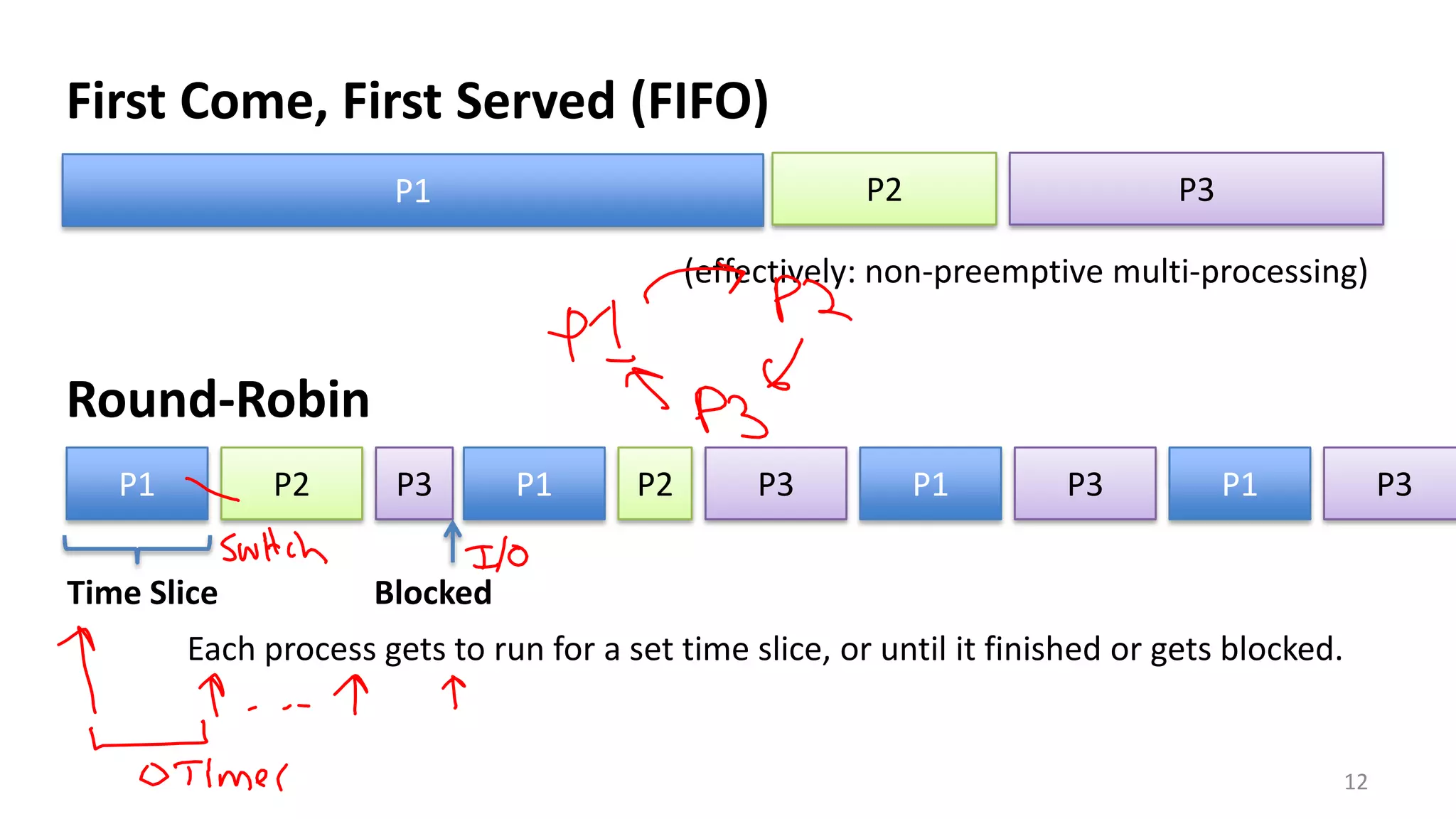
First Come, First Served (FIFO)
P2

P1

P3

(effectively: non-preemptive multi-processing)

Round-Robin
P1

P2

Time Slice

P3

P1

P2

P3

P1

P3

P1

P3

Blocked

Each process gets to run for a set time slice, or until it finished or gets blocked.

12
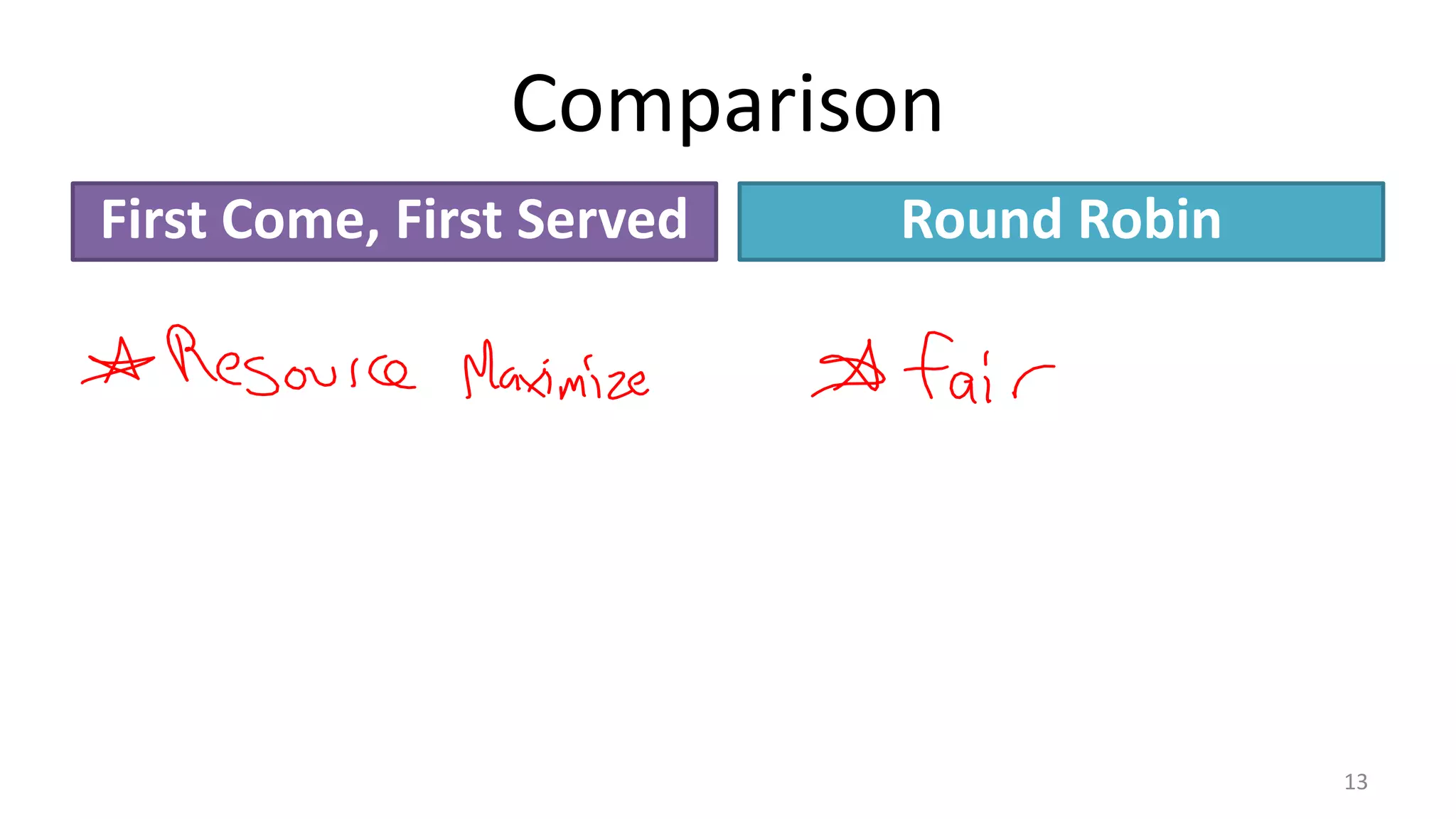
Comparison
First Come, First Served

Round Robin

13
Which one is my laptop using?

14
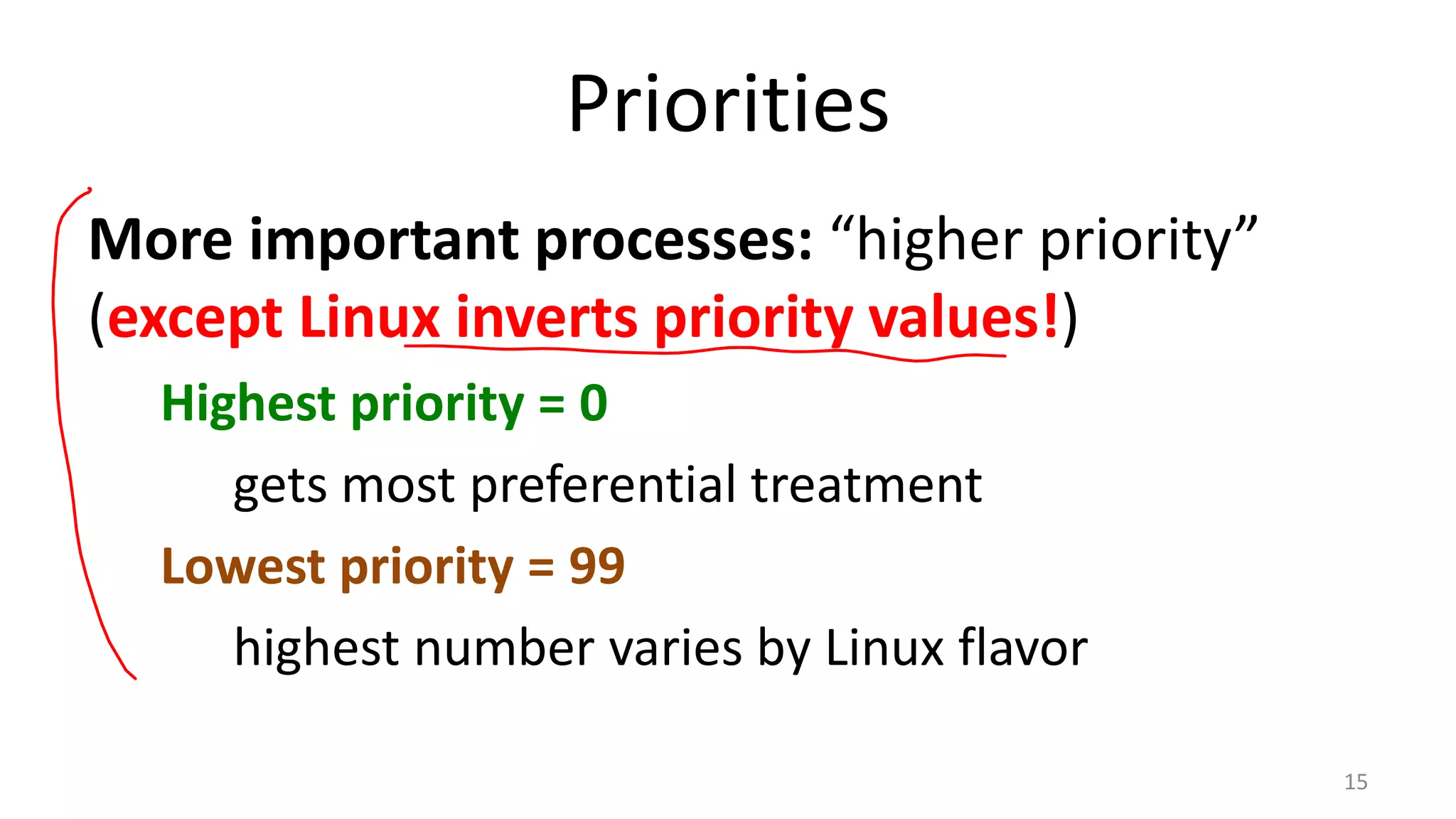
Priorities
More important processes: “higher priority”
(except Linux inverts priority values!)
Highest priority = 0
gets most preferential treatment
Lowest priority = 99
highest number varies by Linux flavor
15
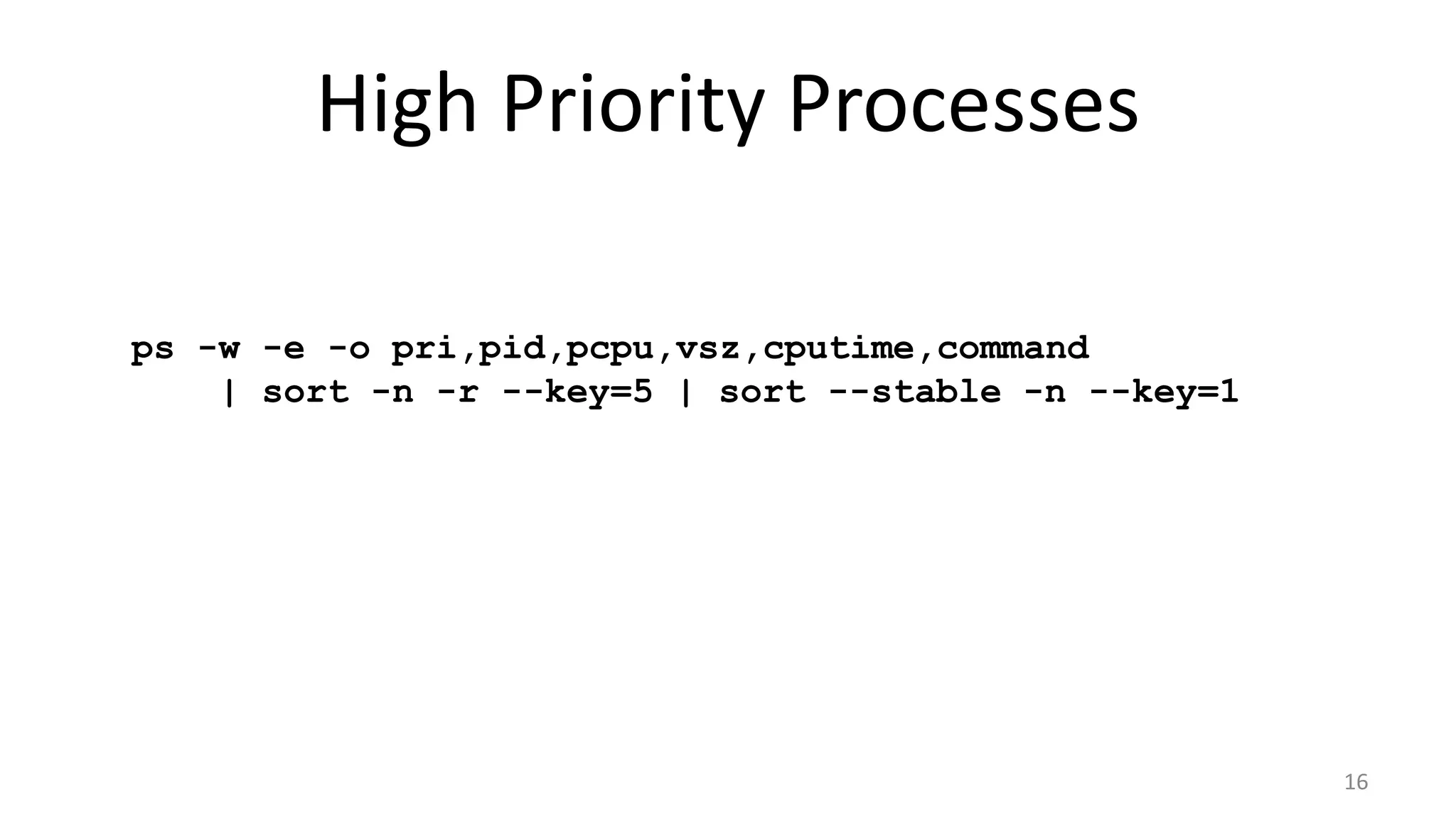
High Priority Processes
ps -w -e -o pri,pid,pcpu,vsz,cputime,command
| sort -n -r --key=5 | sort --stable -n --key=1

16
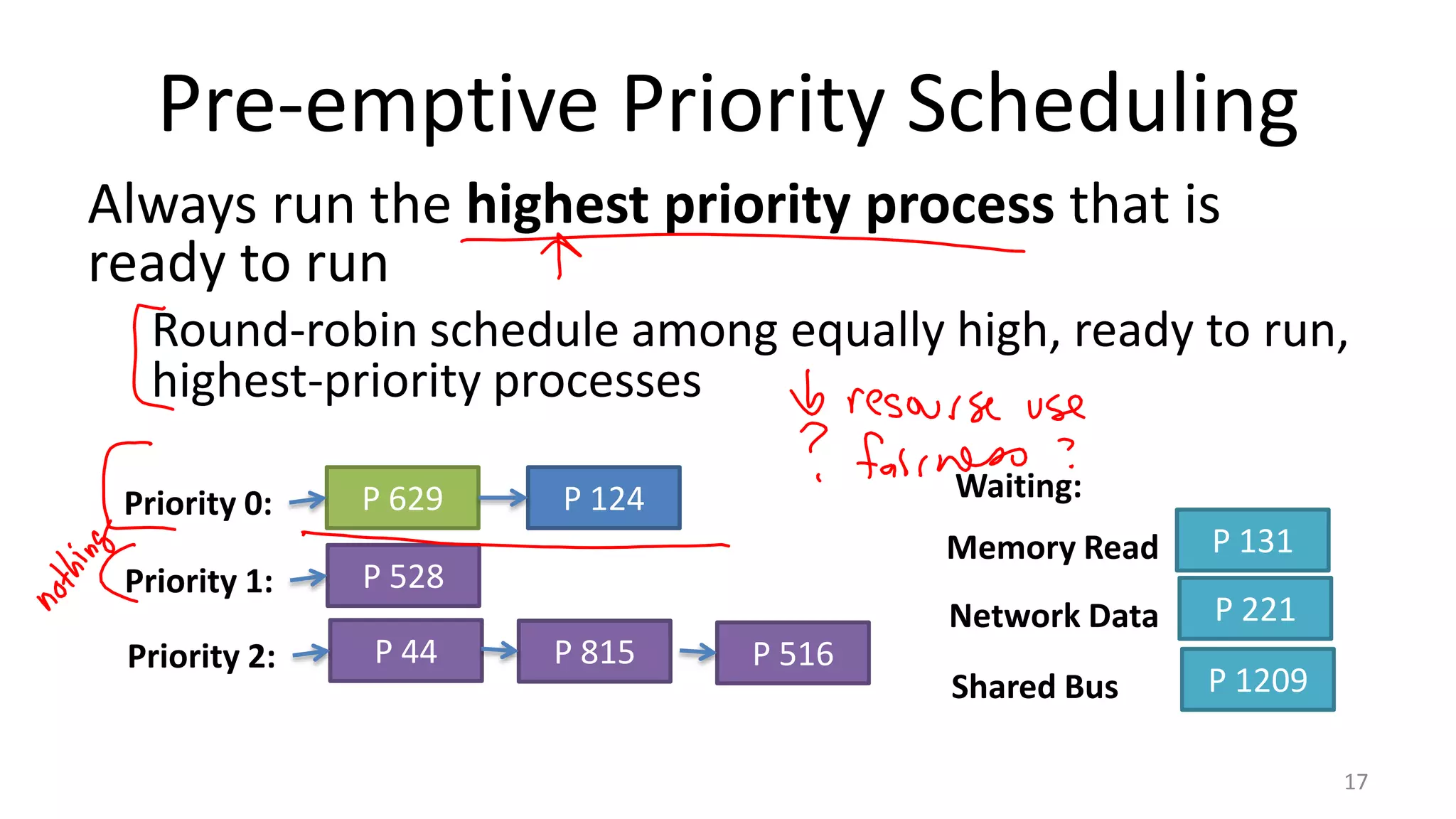
Pre-emptive Priority Scheduling
Always run the highest priority process that is
ready to run
Round-robin schedule among equally high, ready to run,
highest-priority processes
Priority 0:

P 629

Priority 1:

P 44

Memory Read

P 815

P 516

P 131

Network Data

P 528

Priority 2:

Waiting:

P 124

P 221

Shared Bus

P 1209
17
Mars Curiosity (2012)

18
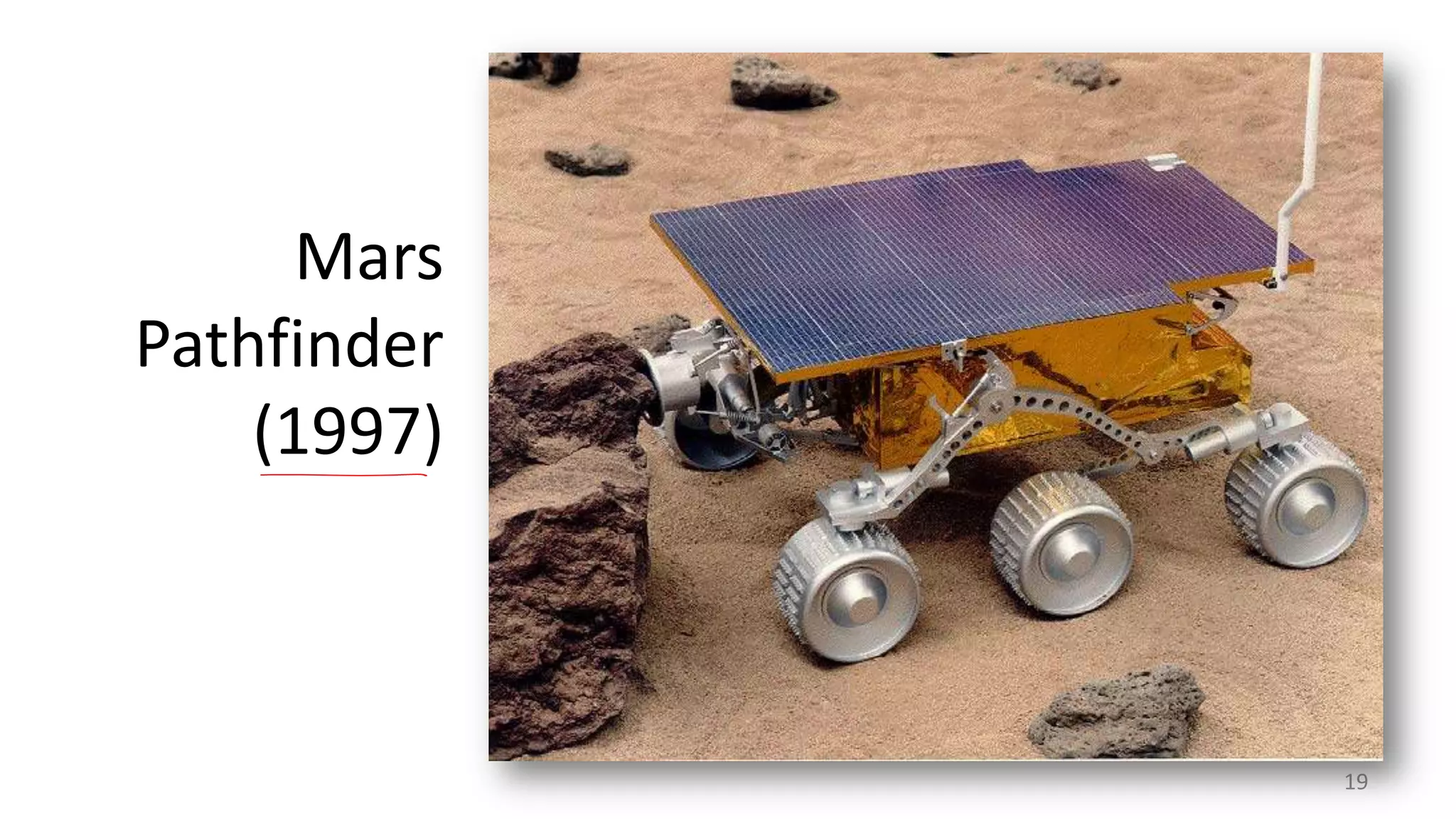
Mars
Pathfinder
(1997)

19
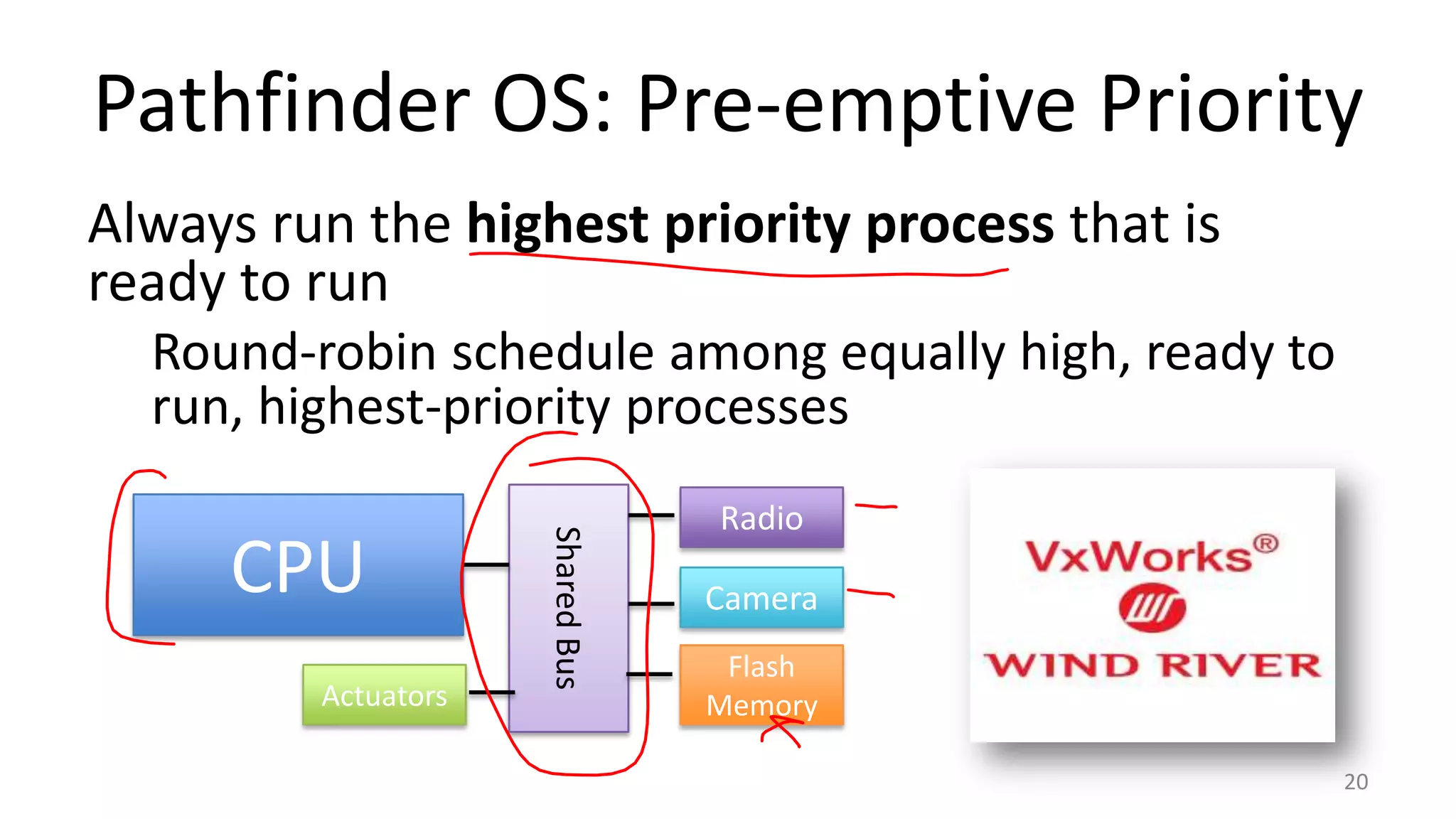
Pathfinder OS: Pre-emptive Priority
Always run the highest priority process that is
ready to run
Round-robin schedule among equally high, ready to
run, highest-priority processes

Actuators

Shared Bus

CPU

Radio
Camera
Flash
Memory
20
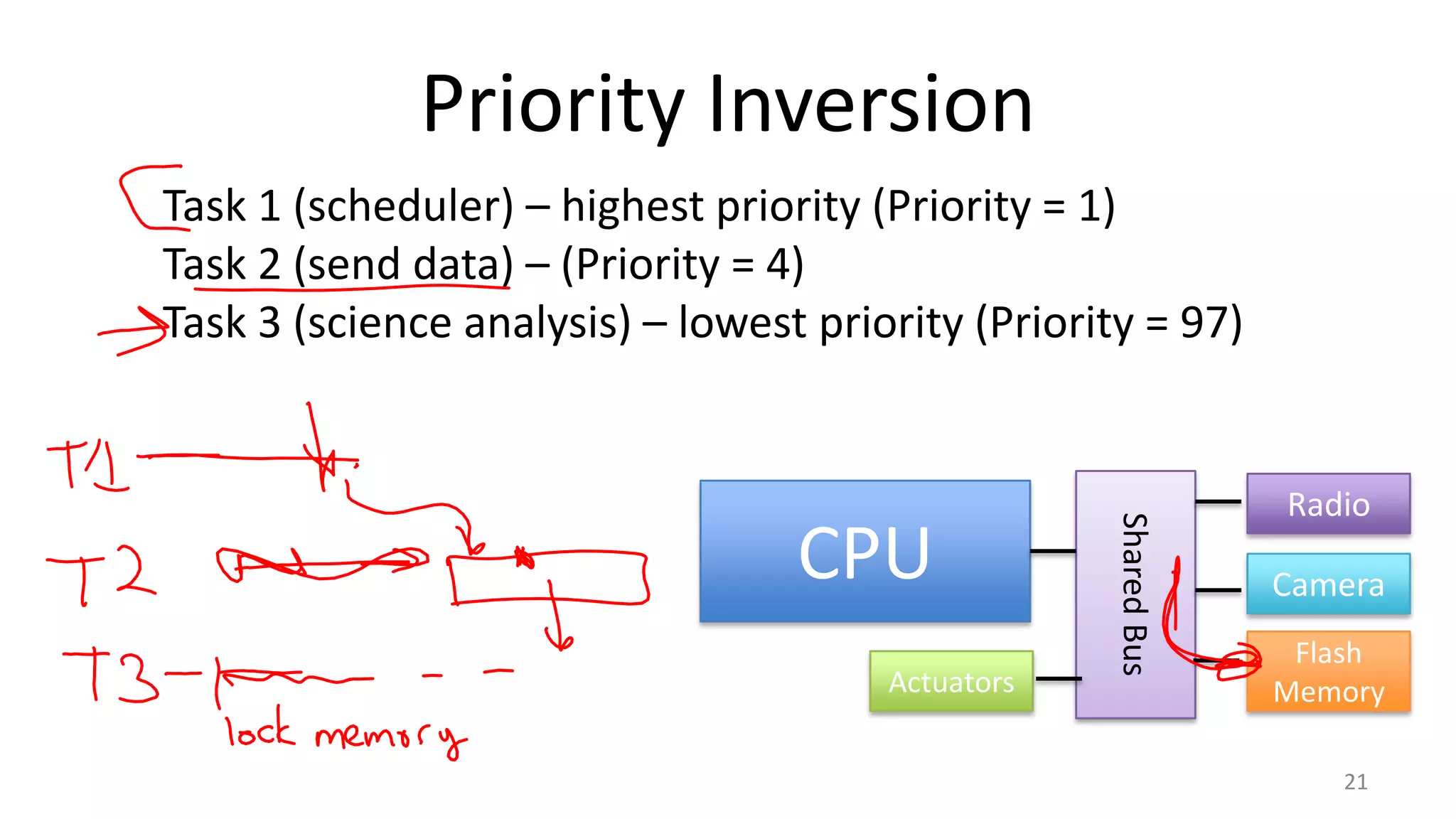
Priority Inversion
Task 1 (scheduler) – highest priority (Priority = 1)
Task 2 (send data) – (Priority = 4)
Task 3 (science analysis) – lowest priority (Priority = 97)

Actuators

Shared Bus

CPU

Radio
Camera
Flash
Memory
21
How should we solve
priority inversion?

22
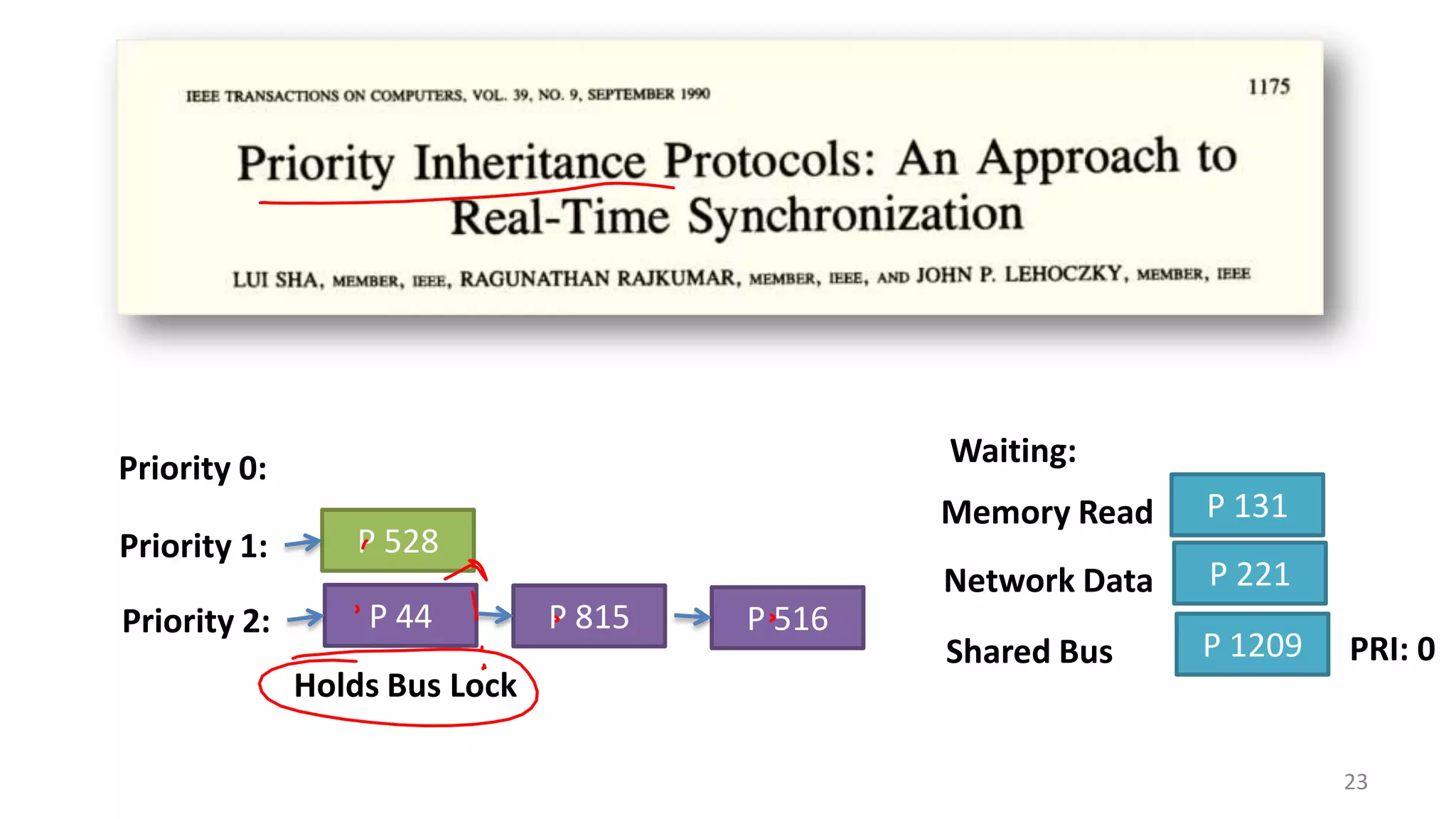
Waiting:

Priority 0:

Priority 1:

P 44
Holds Bus Lock

P 815

P 516

P 131

Network Data

P 528

Priority 2:

Memory Read

P 221

Shared Bus

P 1209

PRI: 0

23
Should my MacBook use a priority pre-emptive scheduler with priority inheritance?

24
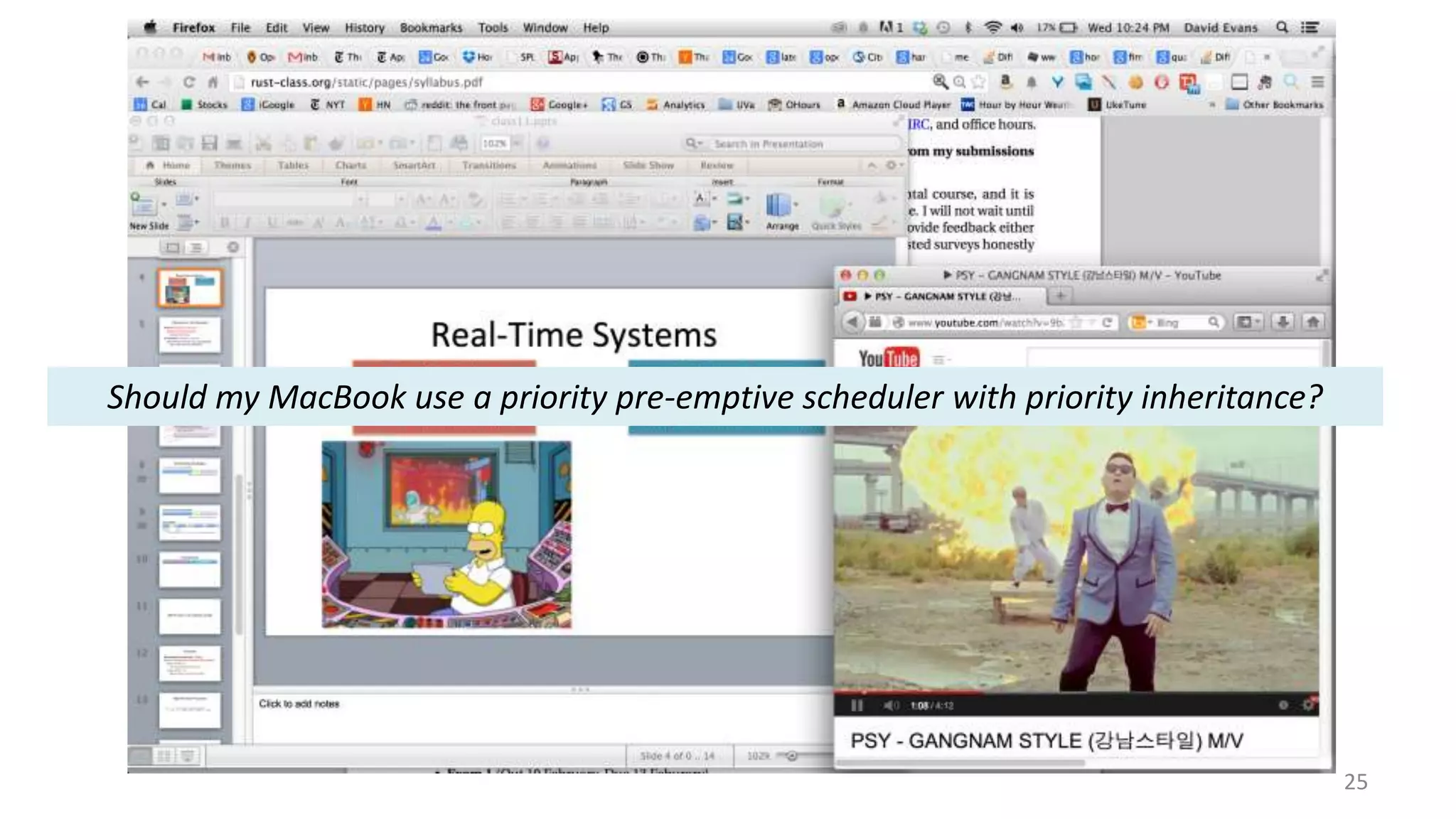
Should my MacBook use a priority pre-emptive scheduler with priority inheritance?

25
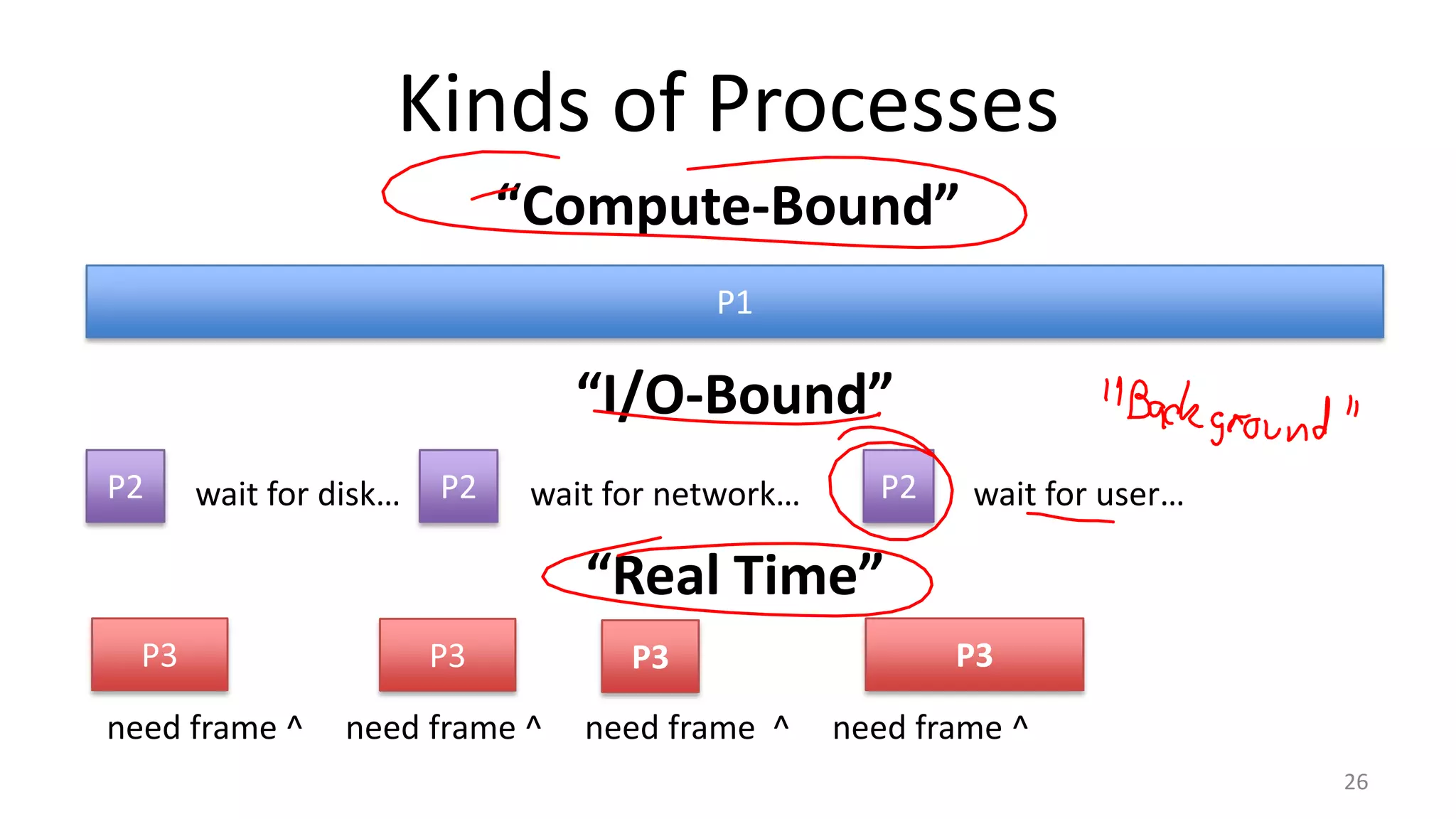
Kinds of Processes
“Compute-Bound”
P1

“I/O-Bound”
P2

wait for disk…

P2

wait for network…

P2

wait for user…

“Real Time”
P3
need frame ^

P3
need frame ^

P3
need frame ^

P3
need frame ^
26
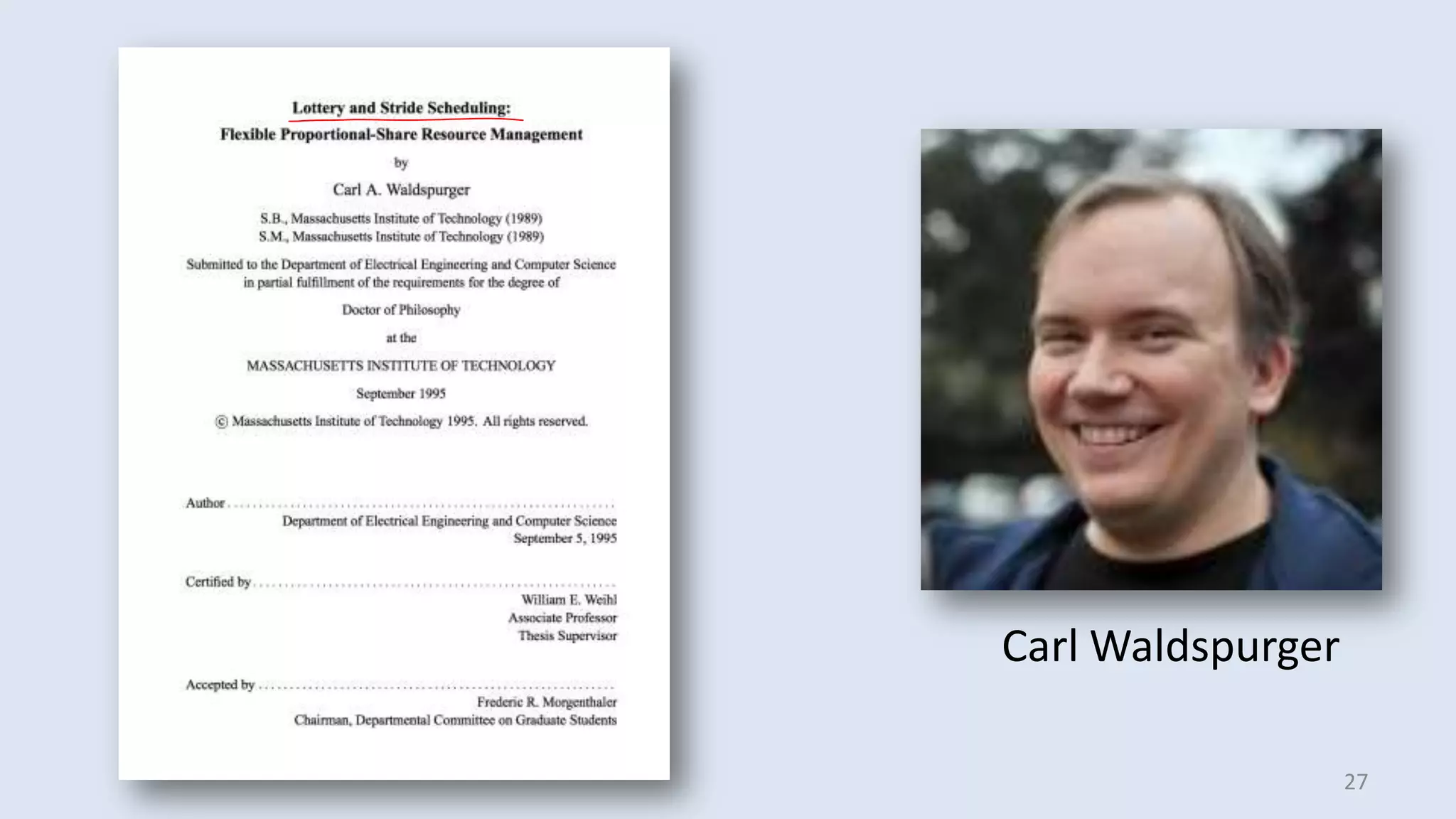
Carl Waldspurger
27
Lottery Scheduling

28
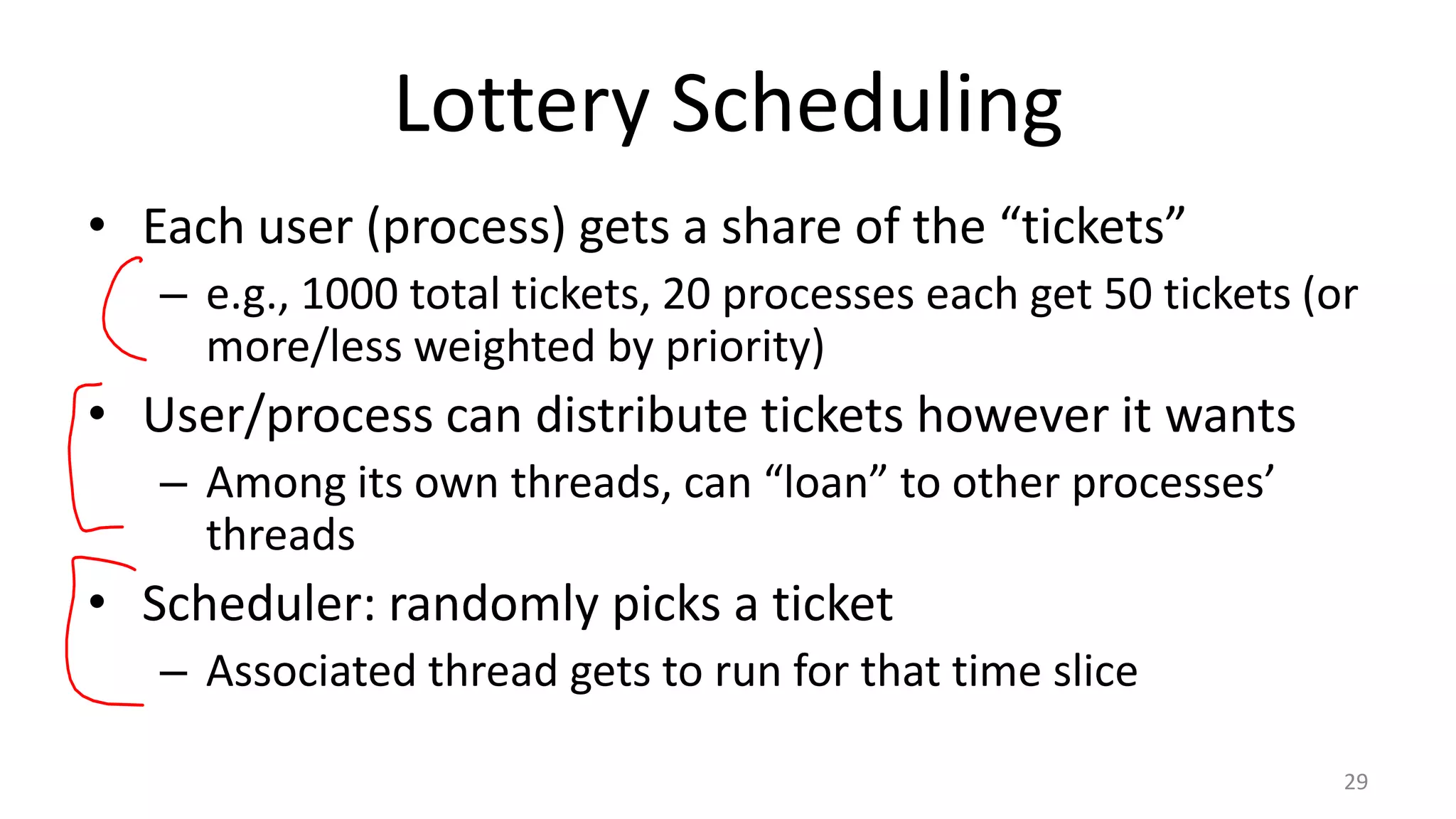
Lottery Scheduling
• Each user (process) gets a share of the “tickets”
– e.g., 1000 total tickets, 20 processes each get 50 tickets (or
more/less weighted by priority)

• User/process can distribute tickets however it wants
– Among its own threads, can “loan” to other processes’
threads

• Scheduler: randomly picks a ticket
– Associated thread gets to run for that time slice
29
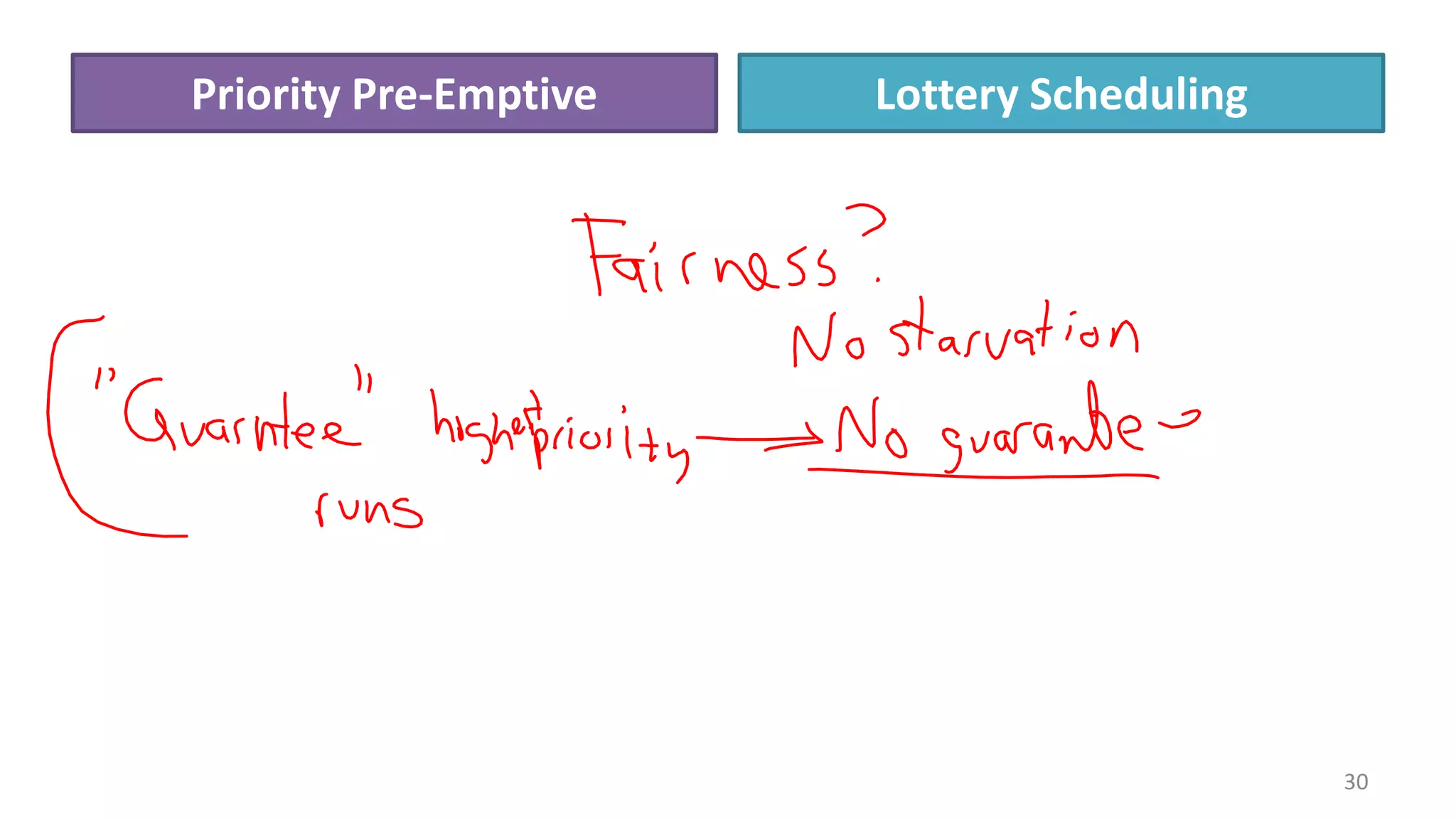
Priority Pre-Emptive

Lottery Scheduling

30
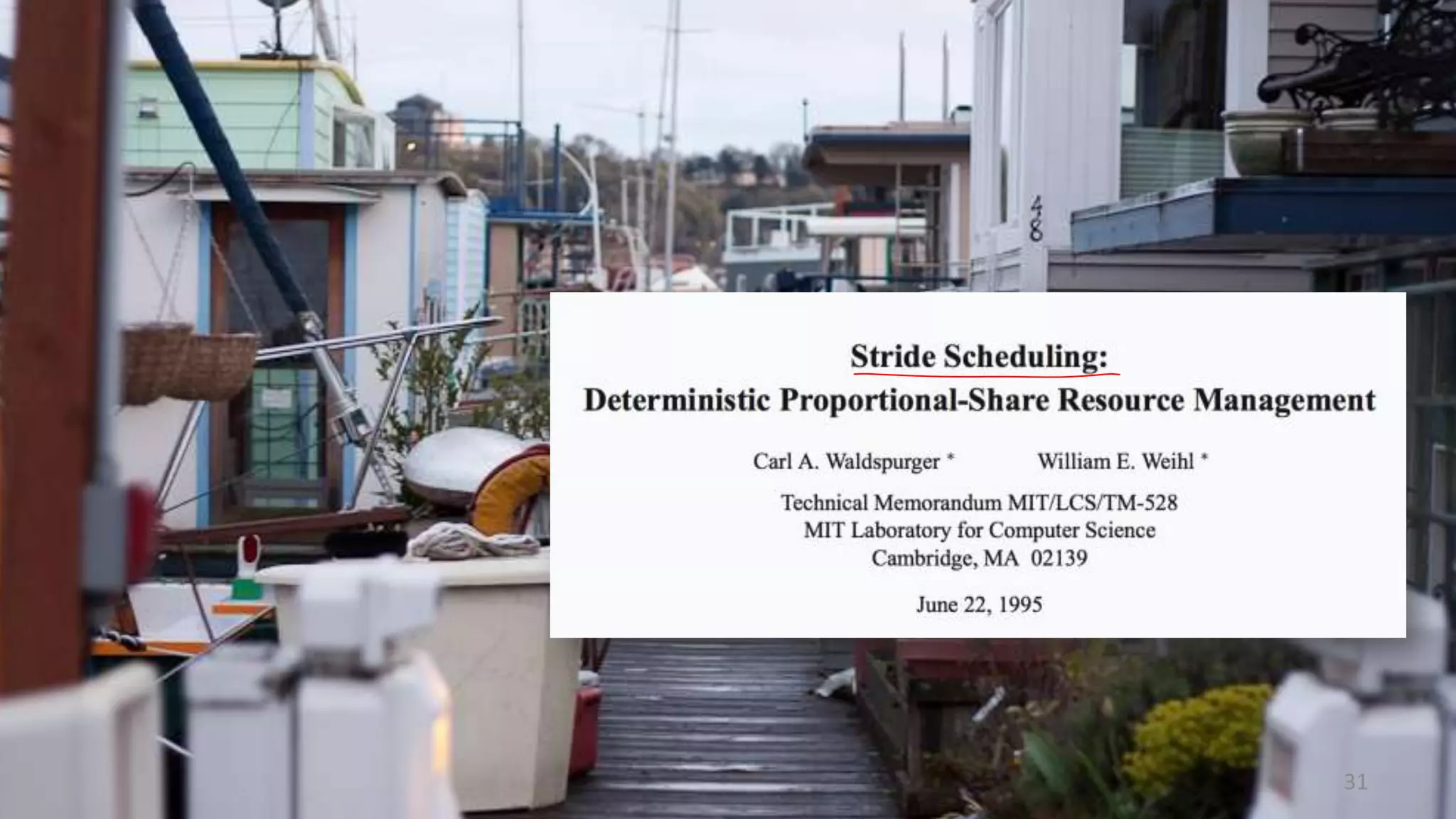
31
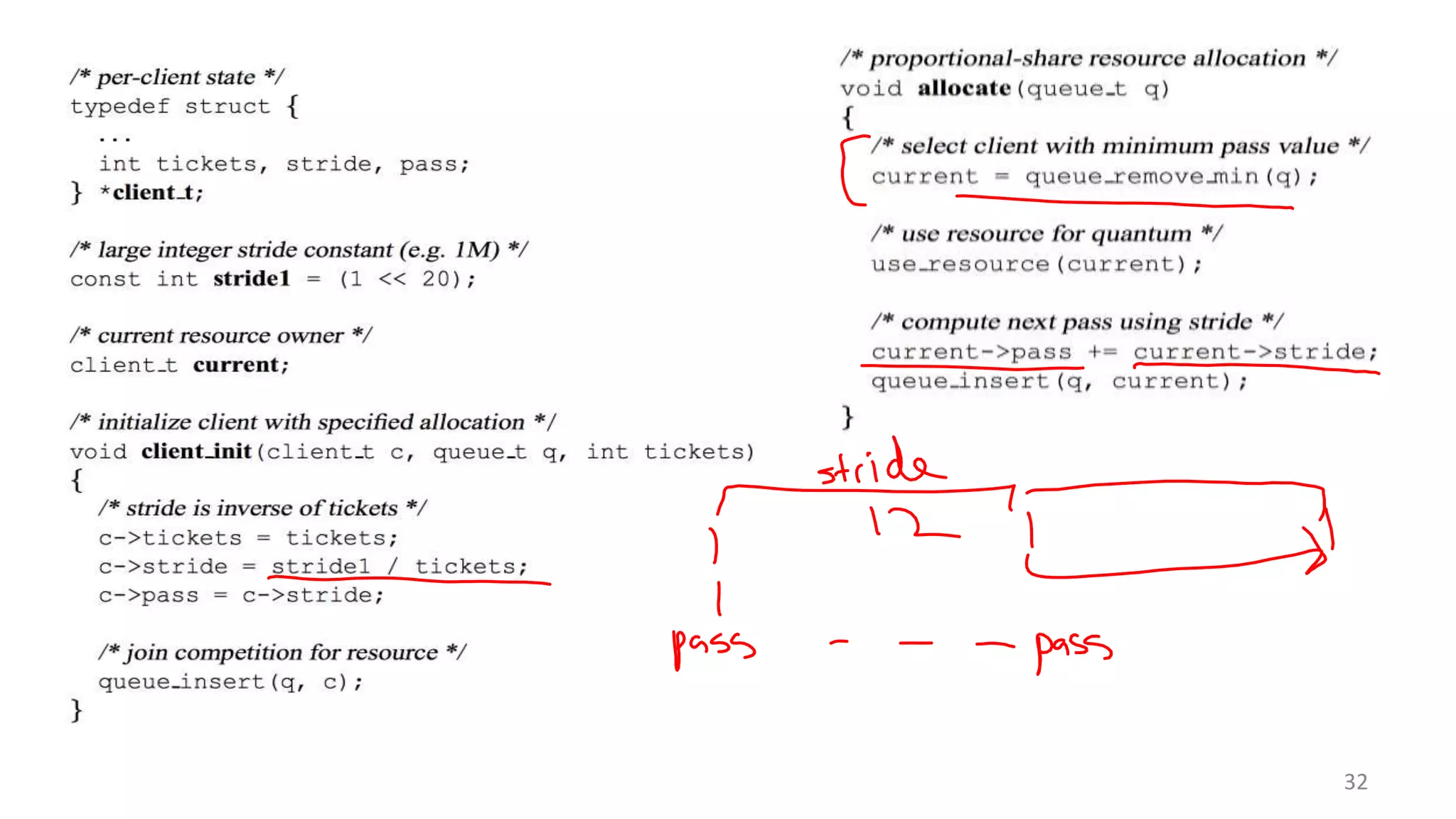
32
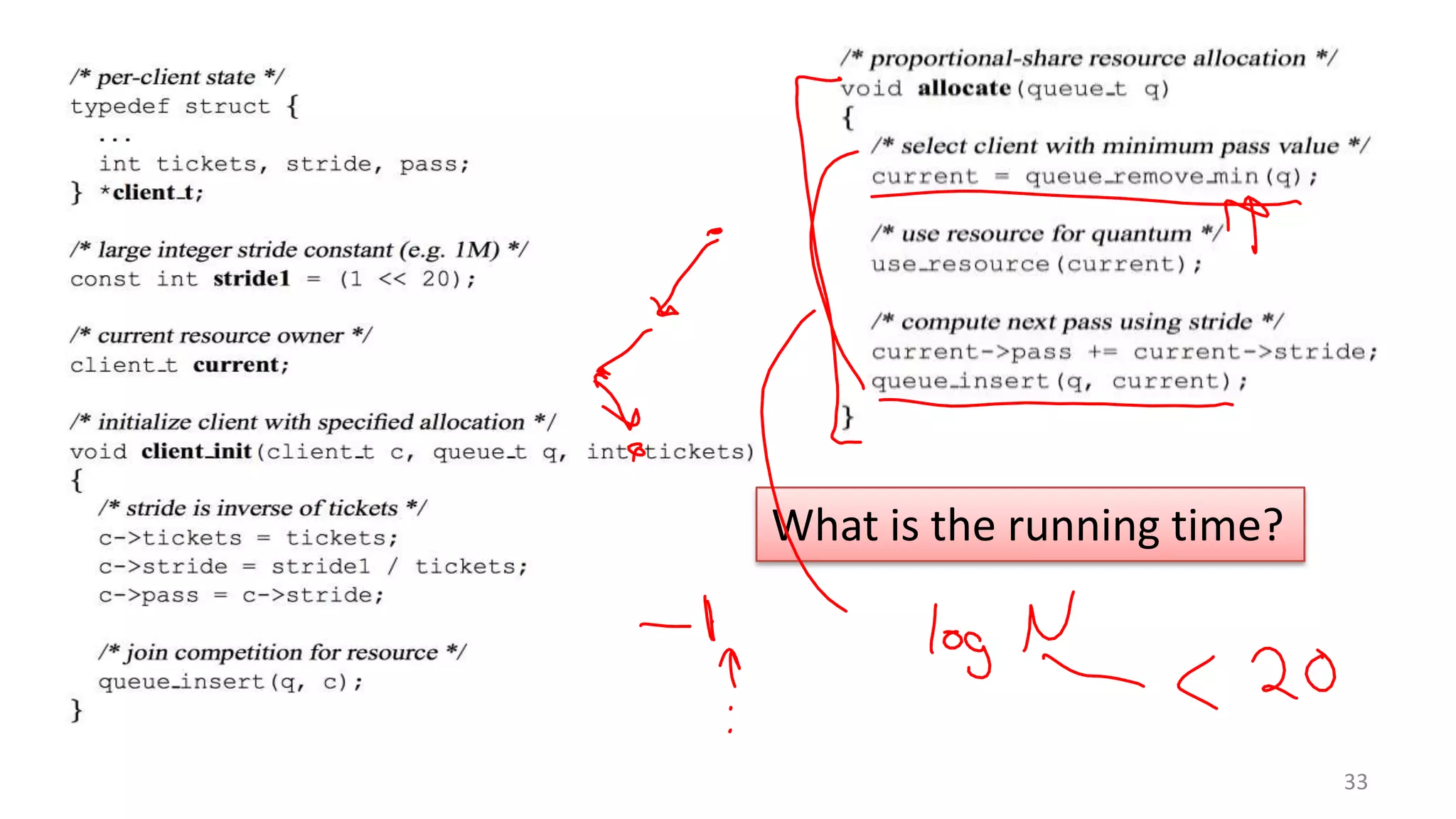
What is the running time?

33
> uname -a
Linux power2 3.2.0-49-generic #75-Ubuntu SMP Tue Jun 18 17:39:32
UTC 2013 x86_64 x86_64 x86_64 GNU/Linux
> sysctl kernel.pid_max
kernel.pid_max = 32768

What is the running time?

34
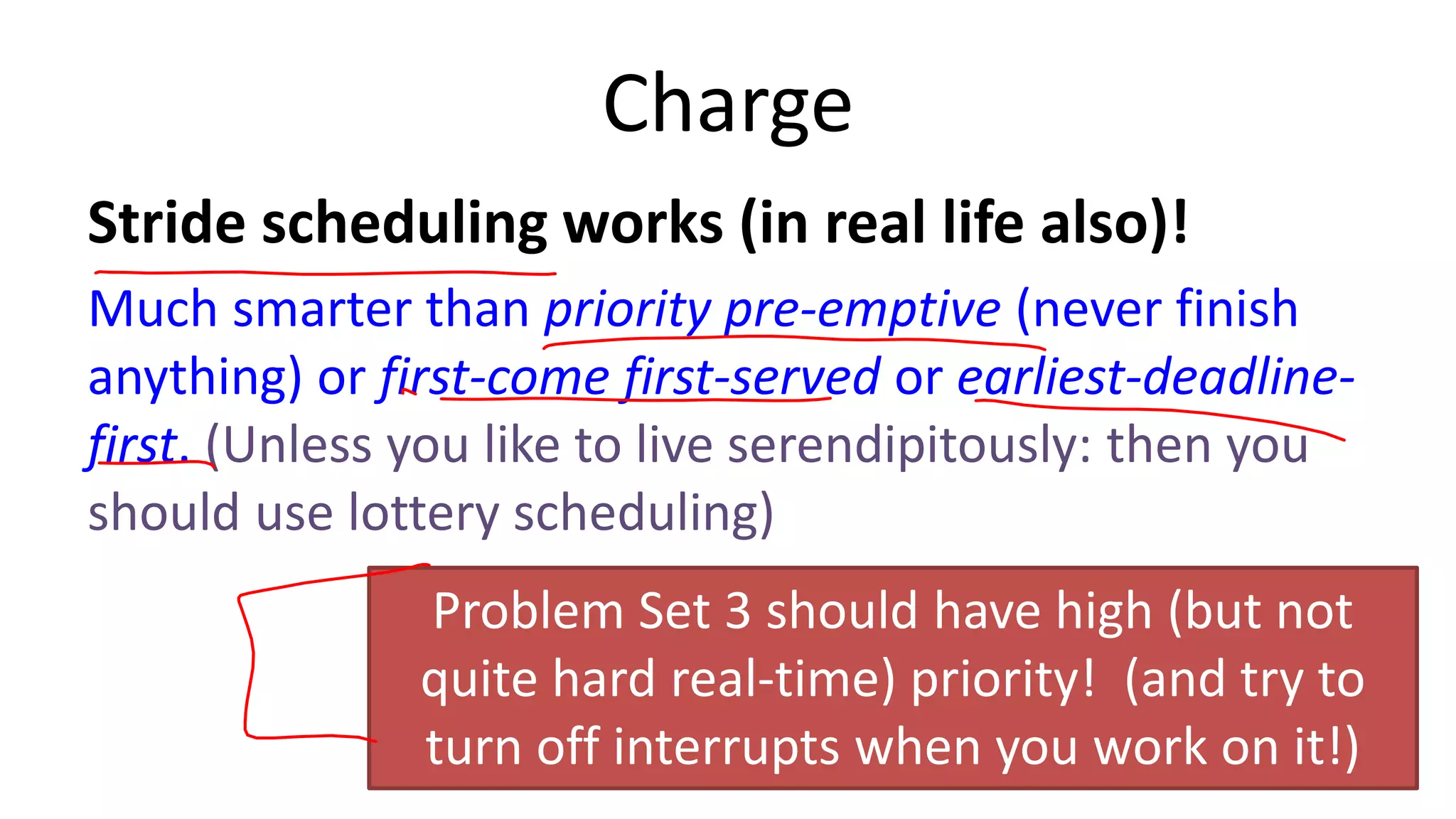
Charge
Stride scheduling works (in real life also)!
Much smarter than priority pre-emptive (never finish
anything) or first-come first-served or earliest-deadlinefirst. (Unless you like to live serendipitously: then you
should use lottery scheduling)
Problem Set 3 should have high (but not
quite hard real-time) priority! (and try to
turn off interrupts when you work on it!)
35

Smarter Scheduling (Priorities, Preemptive Priority Scheduling, Lottery and Stride Scheduling)

  • 1.
  • 2.
    Plan for Today Recap:Scheduling First Come, First Served / Round-Robin Priorities Lottery and Stride Scheduling Scheduling in Linux 1
  • 3.
  • 4.
    Recap Main Goals ofScheduling Maximize Resource Use Fairness Switching is Expensive Fundamental tradeoff between maximizing usage and fairness 3
  • 5.
    Planned vs. On-Demand Planned:schedule in advance Supervisor/developer plans schedule given a priori knowledge about all tasks and deadlines On-Demand: schedule on-the-fly Supervisor runs periodically and makes decision based on current information Where is planned used? 4
  • 6.
    Real-Time Systems Hard Real-Time Missinga deadline is a total system failure. Soft Real-Time Undesirable to miss too many deadlines too badly. 5
  • 7.
    Hard Real-Time Missing adeadline is a total system failure. Soft Real-Time Undesirable to miss too many deadlines too badly. 6
  • 8.
    What must programsbe able to do to have guaranteed schedules? 7
  • 9.
    Planned vs. On-Demand Planned:schedule in advance Necessary (at least in part) for hard real time On-Demand: schedule on-the-fly Most normal systems have unpredictable tasks with unknown deadlines 8
  • 10.
    What should yourcourses be? 9
  • 11.
    What should yourcourses be? Exam 2 will be scheduled later (not next week) Problem Set 3 is due 11:59pm Wednesday, March 5 Demos on Wednesday, Thursday, Friday No demos after Spring Break barring snow-out (firm real-time deadline) But…if you planned a schedule around the previously posted deadlines, you can stick to them (see me after class) 10
  • 12.
    Scheduling Strategies First Come,First Served (FIFO) P1 P2 P3 (effectively: non-preemptive multi-processing) 11
  • 13.
    First Come, FirstServed (FIFO) P2 P1 P3 (effectively: non-preemptive multi-processing) Round-Robin P1 P2 Time Slice P3 P1 P2 P3 P1 P3 P1 P3 Blocked Each process gets to run for a set time slice, or until it finished or gets blocked. 12
  • 14.
    Comparison First Come, FirstServed Round Robin 13
  • 15.
    Which one ismy laptop using? 14
  • 16.
    Priorities More important processes:“higher priority” (except Linux inverts priority values!) Highest priority = 0 gets most preferential treatment Lowest priority = 99 highest number varies by Linux flavor 15
  • 17.
    High Priority Processes ps-w -e -o pri,pid,pcpu,vsz,cputime,command | sort -n -r --key=5 | sort --stable -n --key=1 16
  • 18.
    Pre-emptive Priority Scheduling Alwaysrun the highest priority process that is ready to run Round-robin schedule among equally high, ready to run, highest-priority processes Priority 0: P 629 Priority 1: P 44 Memory Read P 815 P 516 P 131 Network Data P 528 Priority 2: Waiting: P 124 P 221 Shared Bus P 1209 17
  • 19.
  • 20.
  • 21.
    Pathfinder OS: Pre-emptivePriority Always run the highest priority process that is ready to run Round-robin schedule among equally high, ready to run, highest-priority processes Actuators Shared Bus CPU Radio Camera Flash Memory 20
  • 22.
    Priority Inversion Task 1(scheduler) – highest priority (Priority = 1) Task 2 (send data) – (Priority = 4) Task 3 (science analysis) – lowest priority (Priority = 97) Actuators Shared Bus CPU Radio Camera Flash Memory 21
  • 23.
    How should wesolve priority inversion? 22
  • 24.
    Waiting: Priority 0: Priority 1: P44 Holds Bus Lock P 815 P 516 P 131 Network Data P 528 Priority 2: Memory Read P 221 Shared Bus P 1209 PRI: 0 23
  • 25.
    Should my MacBookuse a priority pre-emptive scheduler with priority inheritance? 24
  • 26.
    Should my MacBookuse a priority pre-emptive scheduler with priority inheritance? 25
  • 27.
    Kinds of Processes “Compute-Bound” P1 “I/O-Bound” P2 waitfor disk… P2 wait for network… P2 wait for user… “Real Time” P3 need frame ^ P3 need frame ^ P3 need frame ^ P3 need frame ^ 26
  • 28.
  • 29.
  • 30.
    Lottery Scheduling • Eachuser (process) gets a share of the “tickets” – e.g., 1000 total tickets, 20 processes each get 50 tickets (or more/less weighted by priority) • User/process can distribute tickets however it wants – Among its own threads, can “loan” to other processes’ threads • Scheduler: randomly picks a ticket – Associated thread gets to run for that time slice 29
  • 31.
  • 32.
  • 33.
  • 34.
    What is therunning time? 33
  • 35.
    > uname -a Linuxpower2 3.2.0-49-generic #75-Ubuntu SMP Tue Jun 18 17:39:32 UTC 2013 x86_64 x86_64 x86_64 GNU/Linux > sysctl kernel.pid_max kernel.pid_max = 32768 What is the running time? 34
  • 36.
    Charge Stride scheduling works(in real life also)! Much smarter than priority pre-emptive (never finish anything) or first-come first-served or earliest-deadlinefirst. (Unless you like to live serendipitously: then you should use lottery scheduling) Problem Set 3 should have high (but not quite hard real-time) priority! (and try to turn off interrupts when you work on it!) 35