


Guided by Sankar K. M.E Academic Project Review  Compiled by  Linux Professionals   Team
Topics of Discussion Recap of our Project  Project Scheduled  Kernel Compilation  Lookup State  Configuration of DNS  Cross Platform Access  Conclusion
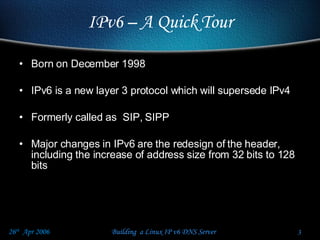
Born on December 1998  IPv6 is a new layer 3 protocol which will supersede IPv4 Formerly called as  SIP, SIPP Major changes in IPv6 are the redesign of the header, including the increase of address size from 32 bits to 128 bits  IPv6 – A Quick Tour
IPv6 Features Increased address space 128 bits = 340 trillion trillion trillion addresses (2 128  = 340,282,366,920,938,463,463,374,607,431,768,211,456) = 67 billion billion addresses per cm 2  of the planet surface Hierarchical address architecture Improved address aggregation More efficient header architecture Integrated security features
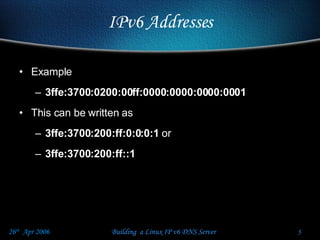
IPv6 Addresses Example 3ffe:3700:0200:00ff:0000:0000:0000:0001 This can be written as  3ffe:3700:200:ff:0:0:0:1  or 3ffe:3700:200:ff::1
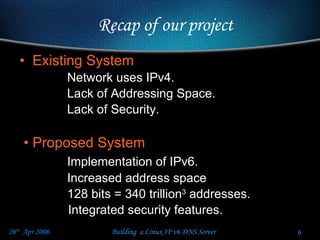
Recap of our project Existing System  Network uses IPv4. Lack of Addressing Space. Lack of Security. Proposed System Implementation of IPv6. Increased address space 128 bits = 340 trillion 3  addresses. Integrated security features.
Topics of Discussion Recap of our Project  Project Scheduled  Kernel Compilation  Lookup State  Configuration of DNS  Cross Platform Access  Conclusion
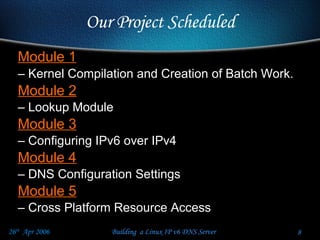
Our Project Scheduled Module 1   Kernel Compilation and Creation of Batch Work.  Module 2   Lookup Module Module 3 Configuring IPv6 over IPv4 Module 4 DNS Configuration Settings Module 5 Cross Platform Resource Access
Topics of Discussion Recap of our Project  Project Scheduled  Kernel Compilation  Lookup State  Configuration of DNS  Cross Platform Access  Conclusion
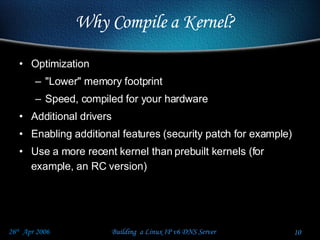
Why Compile a Kernel? Optimization "Lower" memory footprint Speed, compiled for your hardware Additional drivers Enabling additional features (security patch for example) Use a more recent kernel than prebuilt kernels (for example, an RC version)
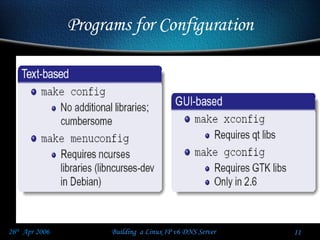
Programs for Configuration
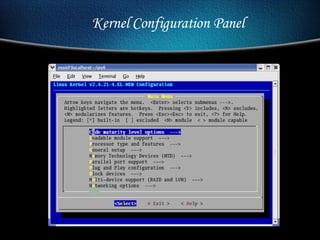
Kernel Configuration Panel
Before Kernel Compilation  (Screen shot of /etc/grub.conf)
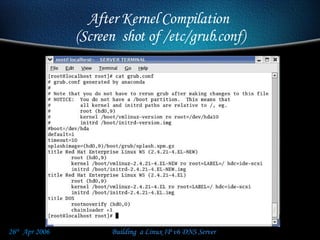
After Kernel Compilation  (Screen  shot of /etc/grub.conf)
Topics of Discussion Recap of our Project  Project Scheduled  Kernel Compilation  Lookup State  Configuration of DNS  Cross Platform Access  Conclusion
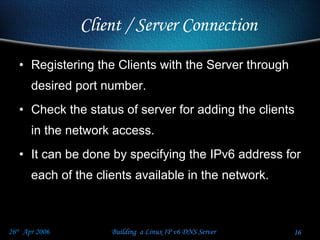
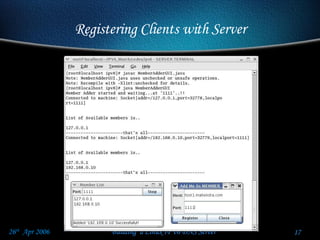
Registering the Clients with the Server through desired port number.  Check the status of server for adding the clients in the network access. It can be done by specifying the IPv6 address for each of the clients available in the network. Client / Server Connection
Registering Clients with Server
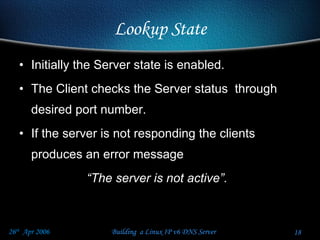
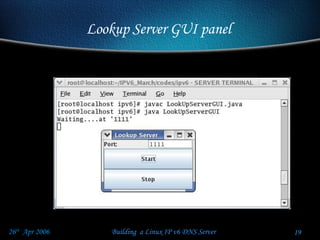
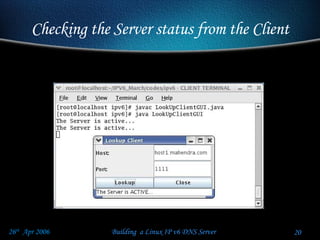
Lookup State Initially the Server state is enabled. The Client checks the Server status  through desired port number. If the server is not responding the clients produces an error message  “ The server is not active”.
Lookup Server GUI panel
Checking the Server status from the Client
Topics of Discussion Recap of our Project  Project Scheduled  Kernel Compilation  Lookup State  Configuration of DNS  Cross Platform Access  Conclusion
DNS in Nut Shell DNS is the Domain Name System It translates (or "maps" as the jargon would have it) from name to address and from address to name, and some other things. Allow machines to be logically grouped by name  Domains Provides email routing Information
Graphical Representation  DNS Configuration
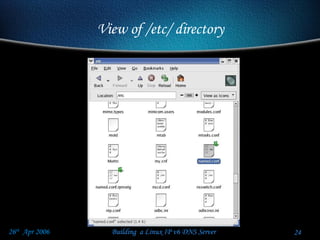
View of /etc/ directory
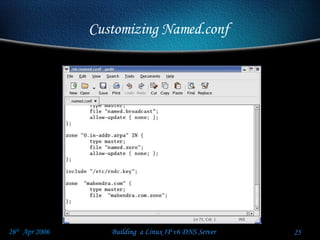
Customizing Named.conf
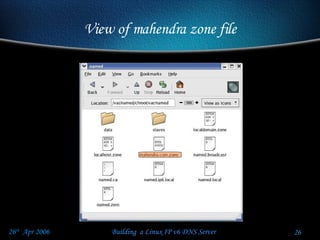
View of mahendra zone file
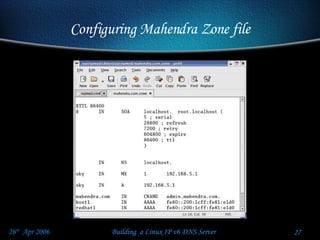
Configuring Mahendra Zone file
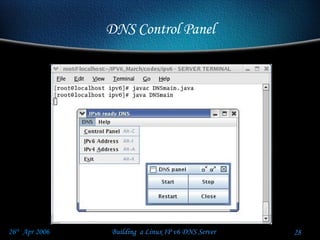
DNS Control Panel
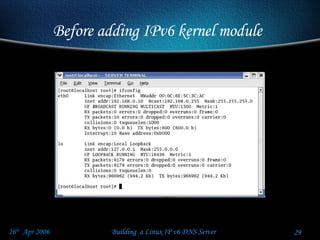
Before adding IPv6 kernel module
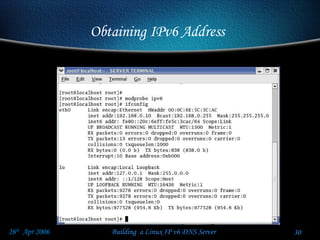
Obtaining IPv6 Address
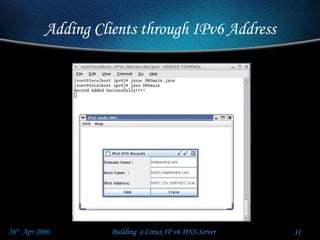
Adding Clients through IPv6 Address
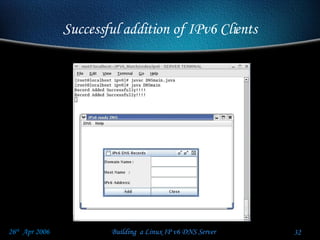
Successful addition of IPv6 Clients
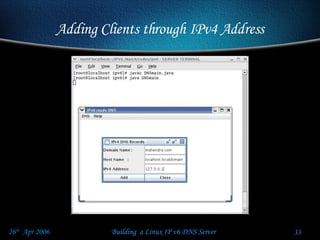
Adding Clients through IPv4 Address
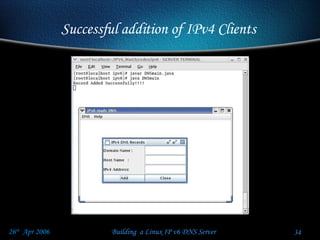
Successful addition of IPv4 Clients
Quitting DNS Panel
Topics of Discussion Recap of our Project  Project Scheduled  Kernel Compilation  Lookup State  Configuration of DNS  Cross Platform Access  Conclusion
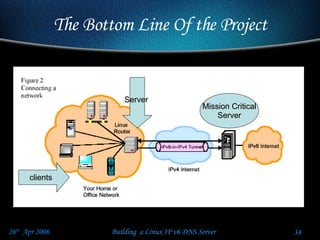
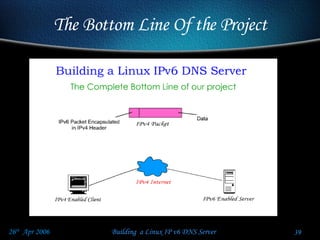
Server is under RedHat Linux with IPv6 Support. Client may be Windows / Linux family with IPv4 support. Enabling the IPV6 Support in Client / Server Machines by service packs or kernel Modules. Finally, Messages and Files can be Transferred regardless of the platform. Cross Platform Resource Access
The Bottom Line Of the Project Mission Critical Server Server  clients
The Bottom Line Of the Project
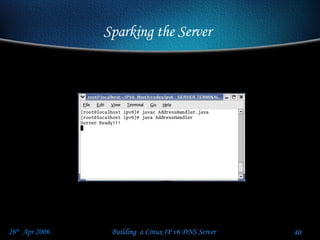
Sparking the Server
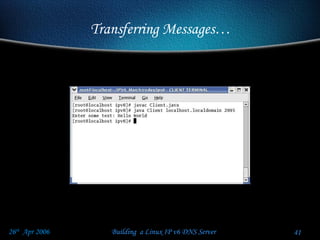
Transferring Messages…
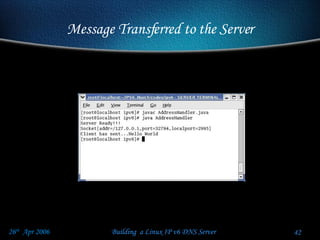
Message Transferred to the Server
Topics of Discussion Recap of our Project  Project Scheduled  Kernel Compilation  Lookup State  Configuration of DNS  Cross Platform Access  Conclusion
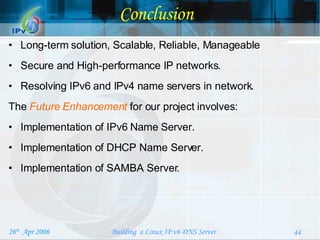
Conclusion Long-term solution, Scalable, Reliable, Manageable Secure and High-performance IP networks.  Resolving IPv6 and IPv4 name servers in network. The  Future Enhancement   for our project involves: Implementation of IPv6 Name Server. Implementation of DHCP Name Server. Implementation of SAMBA Server.
Questions? Thanks for your attention Questions?
<<<<< Thanks to u all >>>>>

Building Linux IPv6 DNS Server (Complete Presentation)

  • 1.
    Guided by SankarK. M.E Academic Project Review Compiled by Linux Professionals Team
  • 2.
    Topics of DiscussionRecap of our Project Project Scheduled Kernel Compilation Lookup State Configuration of DNS Cross Platform Access Conclusion
  • 3.
    Born on December1998 IPv6 is a new layer 3 protocol which will supersede IPv4 Formerly called as SIP, SIPP Major changes in IPv6 are the redesign of the header, including the increase of address size from 32 bits to 128 bits IPv6 – A Quick Tour
  • 4.
    IPv6 Features Increasedaddress space 128 bits = 340 trillion trillion trillion addresses (2 128 = 340,282,366,920,938,463,463,374,607,431,768,211,456) = 67 billion billion addresses per cm 2 of the planet surface Hierarchical address architecture Improved address aggregation More efficient header architecture Integrated security features
  • 5.
    IPv6 Addresses Example3ffe:3700:0200:00ff:0000:0000:0000:0001 This can be written as 3ffe:3700:200:ff:0:0:0:1 or 3ffe:3700:200:ff::1
  • 6.
    Recap of ourproject Existing System Network uses IPv4. Lack of Addressing Space. Lack of Security. Proposed System Implementation of IPv6. Increased address space 128 bits = 340 trillion 3 addresses. Integrated security features.
  • 7.
    Topics of DiscussionRecap of our Project Project Scheduled Kernel Compilation Lookup State Configuration of DNS Cross Platform Access Conclusion
  • 8.
    Our Project ScheduledModule 1 Kernel Compilation and Creation of Batch Work. Module 2 Lookup Module Module 3 Configuring IPv6 over IPv4 Module 4 DNS Configuration Settings Module 5 Cross Platform Resource Access
  • 9.
    Topics of DiscussionRecap of our Project Project Scheduled Kernel Compilation Lookup State Configuration of DNS Cross Platform Access Conclusion
  • 10.
    Why Compile aKernel? Optimization &quot;Lower&quot; memory footprint Speed, compiled for your hardware Additional drivers Enabling additional features (security patch for example) Use a more recent kernel than prebuilt kernels (for example, an RC version)
  • 11.
  • 12.
  • 13.
    Before Kernel Compilation (Screen shot of /etc/grub.conf)
  • 14.
    After Kernel Compilation (Screen shot of /etc/grub.conf)
  • 15.
    Topics of DiscussionRecap of our Project Project Scheduled Kernel Compilation Lookup State Configuration of DNS Cross Platform Access Conclusion
  • 16.
    Registering the Clientswith the Server through desired port number. Check the status of server for adding the clients in the network access. It can be done by specifying the IPv6 address for each of the clients available in the network. Client / Server Connection
  • 17.
  • 18.
    Lookup State Initiallythe Server state is enabled. The Client checks the Server status through desired port number. If the server is not responding the clients produces an error message “ The server is not active”.
  • 19.
  • 20.
    Checking the Serverstatus from the Client
  • 21.
    Topics of DiscussionRecap of our Project Project Scheduled Kernel Compilation Lookup State Configuration of DNS Cross Platform Access Conclusion
  • 22.
    DNS in NutShell DNS is the Domain Name System It translates (or &quot;maps&quot; as the jargon would have it) from name to address and from address to name, and some other things. Allow machines to be logically grouped by name Domains Provides email routing Information
  • 23.
    Graphical Representation DNS Configuration
  • 24.
    View of /etc/directory
  • 25.
  • 26.
  • 27.
  • 28.
  • 29.
    Before adding IPv6kernel module
  • 30.
  • 31.
  • 32.
  • 33.
  • 34.
  • 35.
  • 36.
    Topics of DiscussionRecap of our Project Project Scheduled Kernel Compilation Lookup State Configuration of DNS Cross Platform Access Conclusion
  • 37.
    Server is underRedHat Linux with IPv6 Support. Client may be Windows / Linux family with IPv4 support. Enabling the IPV6 Support in Client / Server Machines by service packs or kernel Modules. Finally, Messages and Files can be Transferred regardless of the platform. Cross Platform Resource Access
  • 38.
    The Bottom LineOf the Project Mission Critical Server Server clients
  • 39.
    The Bottom LineOf the Project
  • 40.
  • 41.
  • 42.
  • 43.
    Topics of DiscussionRecap of our Project Project Scheduled Kernel Compilation Lookup State Configuration of DNS Cross Platform Access Conclusion
  • 44.
    Conclusion Long-term solution,Scalable, Reliable, Manageable Secure and High-performance IP networks. Resolving IPv6 and IPv4 name servers in network. The Future Enhancement for our project involves: Implementation of IPv6 Name Server. Implementation of DHCP Name Server. Implementation of SAMBA Server.
  • 45.
    Questions? Thanks foryour attention Questions?
  • 46.
    <<<<< Thanks tou all >>>>>