INTRODUCTION
      &                          Extra-coronal
 TERMINOLOGY                      restorations


               Part I: General                   Full coverage
               considerations                     restorations
 Full   coverage restorations
   as we said before, these are restorations used
 to restore the all surfaces of the clinical crown.
 And are classified according to the material used
 in their construction, as:
 1. Metal crowns (or restorations)
 2. Non-metal crowns (or restorations).          Full
                                                 veneer
 3. Combination of both of the two above.        crowns
 Called also :
   - Full metal crowns,
   - Complete metal crowns,
   - Full cast crowns,
   - Complete cast crowns,
   - All metal crowns
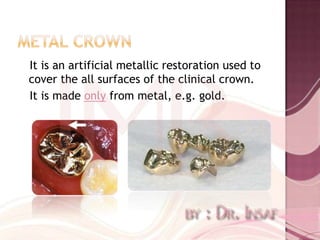
It is an artificial metallic restoration used to
cover the all surfaces of the clinical crown.
It is made only from metal, e.g. gold.
Metal
     crowns              •Indications

The metal crowns are used:
 1. as single crown or as a bridge (retainer for FPD).
 2. only for posterior teeth (where there is a sever occlusal
  stress).
 3. in patient with high caries index.
 4. for an endodontically treated tooth/or teeth (as
  protection).
 5. for malalignment tooth/or teeth.
 6. for teeth with a short occluso-gingival height.
 7. for a badly broken clinical crown.
 8. in a long span bridge.
Metal          • Contraindications
    crowns

The metal crowns are contraindicated:
 1. in case of anterior teeth, for esthetic reasons.
 2. in a situation where anther conservative
  preparation can be use (e.g. partial coverage).
 3. when less than maximum resistance and
  retention is needed.
 4. when caries extend gingivally, as that the
  finish line cannot be made.
 5. in case of uncontrolled caries.
Metal             • Advantages
   crowns
1. great resistance form.
2. great retention.
3. high strength.
4. good protection for a tooth to be
  restored.
5. can modify occlusion in case of overeruption.
6. can modify tooth contour in case of open contact or in
   buccal or lingual contour in a tooth used as a retainer
   for FPD.
7. Ideal restorations for teeth with developmental defects.
Metal          • Disadvantages
   crowns
 DISADVANTAGES    :
  1. bad esthetics (especially for anterior
    teeth).
  2. pulp vitality can not be detected.
  3. incipient* caries can not be detected.
  4. extensive amount of tooth reduction.


                  *Incipient: which is just beginning or which is in its early stage.
 Called  also :
   - Jacket crowns
   - all ceramic crowns


 It is an artificial non metallic restoration
 used to cover the all surfaces of the clinical
 crown.
 It is made only from porcelain or acryl.
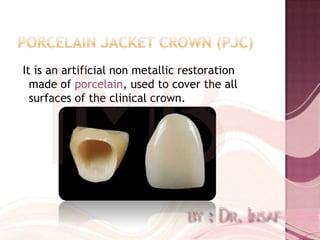
It is an artificial non metallic restoration
  made of porcelain, used to cover the all
  surfaces of the clinical crown.
PJC             •Indications

The PJC are used:
 1. for anterior teeth (especially incisors).
 2. for severely discolored anterior teeth.
 3. over an existing post and core substructure.
PJC             • Contraindications


The PJC are contraindicated:
 1. in Posterior teeth (when maximum resistance
   and retention is needed).
 2. in case of tooth with short clinical crown (no
   enough tooth structure to support the porcelain).
 3. in case of edge to edge or overbite* occlusion.
 4. as a retainer for FPD.

                   *Overbite: is the vertical overlap of the upper incisor teeth over
                   the lower ones.
PJC               • Advantages
 The PJC:
1. have the best cosmetic effect of all dental restorations.
2. are very strong.
3. are the best to use on the incisors.


     PJC               • Disadvantage
 The PJC:
   Have high risk of fracture (because they are brittle)!
Have 2 types:
  1. Full veneered crowns, and
  2. Veneered crowns.
Known  as :
  - Porcelain Fused to Metal
    crowns (PFM), or
  - Metal ceramic crowns.
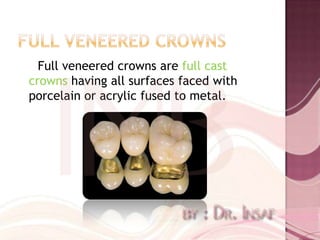
Full veneered crowns are full cast
crowns having all surfaces faced with
porcelain or acrylic fused to metal.
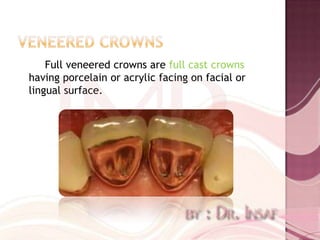
Full veneered crowns are full cast crowns
having porcelain or acrylic facing on facial or
lingual surface.
Metal ceramic
   crowns           •Indications
The metal ceramic crowns are used:
 1. on teeth require esthetic.
 2. in case of extensive tooth destruction
    as a result of caries, trauma, or existing
    previous restorations.
 3. when there is a repeated failure of PJC.
 4. when superior retention and resistance
   is needed.
 5. in case of an endodontically treated tooth.
 6. to recontour axial surfaces or correct minor
  malinclinations of teeth.
Metal ceramic
   crowns     • Contraindications

The metal ceramic crowns are
 contraindicated:
 1. in patient with active caries or
 untreated periodontal disease.
 2. in young patient with large pulp
 chamber because of the high risk of pulp
 exposure.
 3. where a more conservative restoration
 can be made.
Metal ceramic
   crowns     • Advantages

 The metal ceramic crowns :
1. have the strength of cast metal crowns
with the esthetic of the all ceramic
crowns
2. have good retention.
3. permit easy correction of the axial
walls.
Metal ceramic • Disadvantages
   crowns

1. their preparation requires more tooth
   reduction to provide sufficient space for the
   restorative materials.
2. their facial margins for anterior teeth, is often
   placed subgingivally which increase the risk for
   periodontal disease.
3. the laboratory casts are expensive.
4. a frequent problem is the difficulty of
 accurate shade selection.
Define the following terms:
      - Porcelain Jacket crown
      - Full veneered crown

What are the indications for metal crowns?

 What are the different types of full
coverage restorations? Write the advantages
of one of the them.

Fixed prosthodontics lesson 3

  • 1.
    INTRODUCTION & Extra-coronal TERMINOLOGY restorations Part I: General Full coverage considerations restorations
  • 2.
     Full coverage restorations as we said before, these are restorations used to restore the all surfaces of the clinical crown. And are classified according to the material used in their construction, as: 1. Metal crowns (or restorations) 2. Non-metal crowns (or restorations). Full veneer 3. Combination of both of the two above. crowns
  • 3.
     Called also: - Full metal crowns, - Complete metal crowns, - Full cast crowns, - Complete cast crowns, - All metal crowns
  • 4.
    It is anartificial metallic restoration used to cover the all surfaces of the clinical crown. It is made only from metal, e.g. gold.
  • 5.
    Metal crowns •Indications The metal crowns are used: 1. as single crown or as a bridge (retainer for FPD). 2. only for posterior teeth (where there is a sever occlusal stress). 3. in patient with high caries index. 4. for an endodontically treated tooth/or teeth (as protection). 5. for malalignment tooth/or teeth. 6. for teeth with a short occluso-gingival height. 7. for a badly broken clinical crown. 8. in a long span bridge.
  • 6.
    Metal • Contraindications crowns The metal crowns are contraindicated: 1. in case of anterior teeth, for esthetic reasons. 2. in a situation where anther conservative preparation can be use (e.g. partial coverage). 3. when less than maximum resistance and retention is needed. 4. when caries extend gingivally, as that the finish line cannot be made. 5. in case of uncontrolled caries.
  • 7.
    Metal • Advantages crowns 1. great resistance form. 2. great retention. 3. high strength. 4. good protection for a tooth to be restored. 5. can modify occlusion in case of overeruption. 6. can modify tooth contour in case of open contact or in buccal or lingual contour in a tooth used as a retainer for FPD. 7. Ideal restorations for teeth with developmental defects.
  • 8.
    Metal • Disadvantages crowns  DISADVANTAGES : 1. bad esthetics (especially for anterior teeth). 2. pulp vitality can not be detected. 3. incipient* caries can not be detected. 4. extensive amount of tooth reduction. *Incipient: which is just beginning or which is in its early stage.
  • 9.
     Called also : - Jacket crowns - all ceramic crowns It is an artificial non metallic restoration used to cover the all surfaces of the clinical crown. It is made only from porcelain or acryl.
  • 10.
    It is anartificial non metallic restoration made of porcelain, used to cover the all surfaces of the clinical crown.
  • 11.
    PJC •Indications The PJC are used: 1. for anterior teeth (especially incisors). 2. for severely discolored anterior teeth. 3. over an existing post and core substructure.
  • 12.
    PJC • Contraindications The PJC are contraindicated: 1. in Posterior teeth (when maximum resistance and retention is needed). 2. in case of tooth with short clinical crown (no enough tooth structure to support the porcelain). 3. in case of edge to edge or overbite* occlusion. 4. as a retainer for FPD. *Overbite: is the vertical overlap of the upper incisor teeth over the lower ones.
  • 13.
    PJC • Advantages The PJC: 1. have the best cosmetic effect of all dental restorations. 2. are very strong. 3. are the best to use on the incisors. PJC • Disadvantage The PJC: Have high risk of fracture (because they are brittle)!
  • 14.
    Have 2 types: 1. Full veneered crowns, and 2. Veneered crowns.
  • 15.
    Known as: - Porcelain Fused to Metal crowns (PFM), or - Metal ceramic crowns.
  • 16.
    Full veneered crownsare full cast crowns having all surfaces faced with porcelain or acrylic fused to metal.
  • 17.
    Full veneered crownsare full cast crowns having porcelain or acrylic facing on facial or lingual surface.
  • 18.
    Metal ceramic crowns •Indications The metal ceramic crowns are used: 1. on teeth require esthetic. 2. in case of extensive tooth destruction as a result of caries, trauma, or existing previous restorations. 3. when there is a repeated failure of PJC. 4. when superior retention and resistance is needed. 5. in case of an endodontically treated tooth. 6. to recontour axial surfaces or correct minor malinclinations of teeth.
  • 19.
    Metal ceramic crowns • Contraindications The metal ceramic crowns are contraindicated: 1. in patient with active caries or untreated periodontal disease. 2. in young patient with large pulp chamber because of the high risk of pulp exposure. 3. where a more conservative restoration can be made.
  • 20.
    Metal ceramic crowns • Advantages The metal ceramic crowns : 1. have the strength of cast metal crowns with the esthetic of the all ceramic crowns 2. have good retention. 3. permit easy correction of the axial walls.
  • 21.
    Metal ceramic •Disadvantages crowns 1. their preparation requires more tooth reduction to provide sufficient space for the restorative materials. 2. their facial margins for anterior teeth, is often placed subgingivally which increase the risk for periodontal disease. 3. the laboratory casts are expensive. 4. a frequent problem is the difficulty of accurate shade selection.
  • 22.
    Define the followingterms: - Porcelain Jacket crown - Full veneered crown What are the indications for metal crowns? What are the different types of full coverage restorations? Write the advantages of one of the them.