Copyright © 2001 Houghton Mifflin Company. All rights reserved.StrategicCharles W. L. HillManagementGareth R. JonesPowerPoint Presentation by Charlie CookAn Integrated ApproachFifth EditionChapter 1The Strategic Management Process
Copyright © 2001 Houghton Mifflin Company. All rights reserved.1-2OverviewWhy do some firms succeed while others fail?A central objective of strategic management is to learn why this happens.What is strategy?An action a company takes to attain superior performance.What is the strategic management process?The process by which managers choose a set of strategies for the enterprise to pursue its vision.
Copyright © 2001 Houghton Mifflin Company. All rights reserved.1-3Rational planning by top management?Basic Strategic Planning  ModelDefining the Mission and Setting Top-Level GoalsExternal Analysis of Opportunities and ThreatsInternal Analysis of Strengths and WeaknessesSelection of Appropriate StrategiesImplementation of Chosen StrategiesStrategic Planning
Copyright © 2001 Houghton Mifflin Company. All rights reserved.1-4The Main Components of the Strategic Planning ProcessFIGURE 1.1
Copyright © 2001 Houghton Mifflin Company. All rights reserved.1-5Mission and GoalsMissionSets out why the organization exists and what it should be doing.Major goalsSpecify what the organization hopesto fulfill in the medium to long term.Secondary goalsAre objectives to be attained that lead to superior performance.
Copyright © 2001 Houghton Mifflin Company. All rights reserved.1-6External AnalysisIdentify strategic opportunities and threats in the operating environment.Immediate (Industry)MacroenvironmentNational
Copyright © 2001 Houghton Mifflin Company. All rights reserved.1-7Internal AnalysisIdentify strengthsQuality and quantity of resources availableDistinctive competenciesIdentify weaknessesInadequate resourcesManagerial and organizational deficiencies
Copyright © 2001 Houghton Mifflin Company. All rights reserved.1-8Strengths and WeaknessesOpportunities and Threats(SWOT Analysis)Strategic ChoiceBusinessFunctionalGlobalCorporateSWOT and Strategic Choice
Copyright © 2001 Houghton Mifflin Company. All rights reserved.1-9Business-Level StrategiesCost leadershipAttaining, then using the lowest total cost basis as a competitive advantage.DifferentiationUsing product features or services to distinguish the firm’s offerings from its competitors.Market niche focusConcentrating competitively on a specific market segment.
Copyright © 2001 Houghton Mifflin Company. All rights reserved.1-10Functional-Level StrategiesFocus is on improving the effectiveness of operations within a company.ManufacturingMarketingMaterials managementResearch and developmentHuman resources
Copyright © 2001 Houghton Mifflin Company. All rights reserved.1-11Global-Level StrategiesMultidomesticInternationalGlobalTransnational
Copyright © 2001 Houghton Mifflin Company. All rights reserved.1-12Corporate-Level StrategiesVertical integrationDiversificationStrategic alliancesAcquisitionsNew venturesBusiness portfolio restructuring
Copyright © 2001 Houghton Mifflin Company. All rights reserved.1-13Strategy ImplementationDesigning organizational structureDesigning control systemsMarket and output controlsBureaucratic controlsControl through organizational cultureRewards and incentivesMatching strategy, structure, and controlsCongruence (fit) among strategy, structure, and controlsStructureControlsStrategy
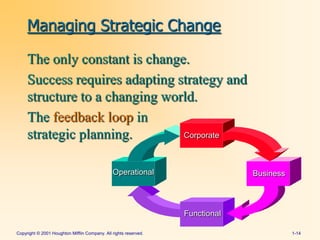
Copyright © 2001 Houghton Mifflin Company. All rights reserved.1-14Managing Strategic ChangeThe only constant is change.Success requires adapting strategy and structure to a changing world.The feedback loop in strategic planning.CorporateOperationalBusinessFunctional
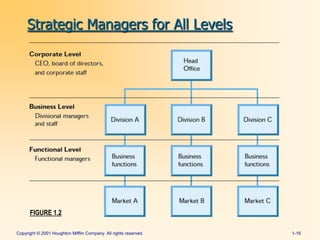
Copyright © 2001 Houghton Mifflin Company. All rights reserved.1-15Strategic ManagersGeneral managersResponsible for the overall (strategic) performance and health of the total organization.Operations managersResponsible for specific businessfunctions or operations.
Copyright © 2001 Houghton Mifflin Company. All rights reserved.1-16Strategic Managers for All LevelsFIGURE 1.2
Copyright © 2001 Houghton Mifflin Company. All rights reserved.1-17Strategic LeadershipVision, eloquence, and consistencyCommitment to the visionBeing well informedWillingness to delegate and empowerAstute use of powerEmotional intelligence
Copyright © 2001 Houghton Mifflin Company. All rights reserved.1-18Strategy as an Emergent ProcessStrategy making in an unpredictable worldCreates the necessity for flexible strategic approaches.Strategy making by lower-level managersStrategy evolves through autonomous action.Serendipity and strategyAccidental discoveries and happenstances can have dramatic effects on strategic direction.Intended and emergent strategiesRealized strategies are combinations of intended and emergent strategies.
Copyright © 2001 Houghton Mifflin Company. All rights reserved.1-19FIGURE 1.3Intended and Emergent StrategiesSource: Reprinted from “Strategy Formation in an Adhocracy,” by Henry Mintzberg and Alexandra McGugh, published in Administrative Science Quarterly, Vol. 30, No. 2, June 1985, by permission of Administrative Science Quarterly.
Copyright © 2001 Houghton Mifflin Company. All rights reserved.1-20The Strategic Management Process for Intended and Emergent StrategiesFIGURE 1.4
Copyright © 2001 Houghton Mifflin Company. All rights reserved.1-21Strategic Planning in PracticePlanning under uncertaintyScenario planning for dynamic environmental changeIvory tower planningLack of contact with operational realitiesThe importance of involving operating managersProcedural justice in the decision-making processEngagement, explanation, and expectationsPlanning for the present: Strategic IntentRecognition of the static nature of the strategic fit modelStrategic intent in focusing the organization on winning by achieving stretch goals
Copyright © 2001 Houghton Mifflin Company. All rights reserved.1-22Improving Strategic Decision MakingCognitive biases systematically influence the rationality of decision makers.FIGURE 1.5
Copyright © 2001 Houghton Mifflin Company. All rights reserved.1-23Groupthink and Strategic DecisionsPitfalls of groupthinkFailing to question underlying assumptions.Coalescing around a single person or policy.Filtering out conflicting information.Developing after-the-fact rationalizations.Having an emotional (nonobjective) commitment to an action.
Copyright © 2001 Houghton Mifflin Company. All rights reserved.1-24Techniques for Improving Decision MakingTwo decision-making processesthat counteractcognitive biases and groupthink.FIGURE 1.6

Strategy Management Process

  • 1.
    Copyright © 2001Houghton Mifflin Company. All rights reserved.StrategicCharles W. L. HillManagementGareth R. JonesPowerPoint Presentation by Charlie CookAn Integrated ApproachFifth EditionChapter 1The Strategic Management Process
  • 2.
    Copyright © 2001Houghton Mifflin Company. All rights reserved.1-2OverviewWhy do some firms succeed while others fail?A central objective of strategic management is to learn why this happens.What is strategy?An action a company takes to attain superior performance.What is the strategic management process?The process by which managers choose a set of strategies for the enterprise to pursue its vision.
  • 3.
    Copyright © 2001Houghton Mifflin Company. All rights reserved.1-3Rational planning by top management?Basic Strategic Planning ModelDefining the Mission and Setting Top-Level GoalsExternal Analysis of Opportunities and ThreatsInternal Analysis of Strengths and WeaknessesSelection of Appropriate StrategiesImplementation of Chosen StrategiesStrategic Planning
  • 4.
    Copyright © 2001Houghton Mifflin Company. All rights reserved.1-4The Main Components of the Strategic Planning ProcessFIGURE 1.1
  • 5.
    Copyright © 2001Houghton Mifflin Company. All rights reserved.1-5Mission and GoalsMissionSets out why the organization exists and what it should be doing.Major goalsSpecify what the organization hopesto fulfill in the medium to long term.Secondary goalsAre objectives to be attained that lead to superior performance.
  • 6.
    Copyright © 2001Houghton Mifflin Company. All rights reserved.1-6External AnalysisIdentify strategic opportunities and threats in the operating environment.Immediate (Industry)MacroenvironmentNational
  • 7.
    Copyright © 2001Houghton Mifflin Company. All rights reserved.1-7Internal AnalysisIdentify strengthsQuality and quantity of resources availableDistinctive competenciesIdentify weaknessesInadequate resourcesManagerial and organizational deficiencies
  • 8.
    Copyright © 2001Houghton Mifflin Company. All rights reserved.1-8Strengths and WeaknessesOpportunities and Threats(SWOT Analysis)Strategic ChoiceBusinessFunctionalGlobalCorporateSWOT and Strategic Choice
  • 9.
    Copyright © 2001Houghton Mifflin Company. All rights reserved.1-9Business-Level StrategiesCost leadershipAttaining, then using the lowest total cost basis as a competitive advantage.DifferentiationUsing product features or services to distinguish the firm’s offerings from its competitors.Market niche focusConcentrating competitively on a specific market segment.
  • 10.
    Copyright © 2001Houghton Mifflin Company. All rights reserved.1-10Functional-Level StrategiesFocus is on improving the effectiveness of operations within a company.ManufacturingMarketingMaterials managementResearch and developmentHuman resources
  • 11.
    Copyright © 2001Houghton Mifflin Company. All rights reserved.1-11Global-Level StrategiesMultidomesticInternationalGlobalTransnational
  • 12.
    Copyright © 2001Houghton Mifflin Company. All rights reserved.1-12Corporate-Level StrategiesVertical integrationDiversificationStrategic alliancesAcquisitionsNew venturesBusiness portfolio restructuring
  • 13.
    Copyright © 2001Houghton Mifflin Company. All rights reserved.1-13Strategy ImplementationDesigning organizational structureDesigning control systemsMarket and output controlsBureaucratic controlsControl through organizational cultureRewards and incentivesMatching strategy, structure, and controlsCongruence (fit) among strategy, structure, and controlsStructureControlsStrategy
  • 14.
    Copyright © 2001Houghton Mifflin Company. All rights reserved.1-14Managing Strategic ChangeThe only constant is change.Success requires adapting strategy and structure to a changing world.The feedback loop in strategic planning.CorporateOperationalBusinessFunctional
  • 15.
    Copyright © 2001Houghton Mifflin Company. All rights reserved.1-15Strategic ManagersGeneral managersResponsible for the overall (strategic) performance and health of the total organization.Operations managersResponsible for specific businessfunctions or operations.
  • 16.
    Copyright © 2001Houghton Mifflin Company. All rights reserved.1-16Strategic Managers for All LevelsFIGURE 1.2
  • 17.
    Copyright © 2001Houghton Mifflin Company. All rights reserved.1-17Strategic LeadershipVision, eloquence, and consistencyCommitment to the visionBeing well informedWillingness to delegate and empowerAstute use of powerEmotional intelligence
  • 18.
    Copyright © 2001Houghton Mifflin Company. All rights reserved.1-18Strategy as an Emergent ProcessStrategy making in an unpredictable worldCreates the necessity for flexible strategic approaches.Strategy making by lower-level managersStrategy evolves through autonomous action.Serendipity and strategyAccidental discoveries and happenstances can have dramatic effects on strategic direction.Intended and emergent strategiesRealized strategies are combinations of intended and emergent strategies.
  • 19.
    Copyright © 2001Houghton Mifflin Company. All rights reserved.1-19FIGURE 1.3Intended and Emergent StrategiesSource: Reprinted from “Strategy Formation in an Adhocracy,” by Henry Mintzberg and Alexandra McGugh, published in Administrative Science Quarterly, Vol. 30, No. 2, June 1985, by permission of Administrative Science Quarterly.
  • 20.
    Copyright © 2001Houghton Mifflin Company. All rights reserved.1-20The Strategic Management Process for Intended and Emergent StrategiesFIGURE 1.4
  • 21.
    Copyright © 2001Houghton Mifflin Company. All rights reserved.1-21Strategic Planning in PracticePlanning under uncertaintyScenario planning for dynamic environmental changeIvory tower planningLack of contact with operational realitiesThe importance of involving operating managersProcedural justice in the decision-making processEngagement, explanation, and expectationsPlanning for the present: Strategic IntentRecognition of the static nature of the strategic fit modelStrategic intent in focusing the organization on winning by achieving stretch goals
  • 22.
    Copyright © 2001Houghton Mifflin Company. All rights reserved.1-22Improving Strategic Decision MakingCognitive biases systematically influence the rationality of decision makers.FIGURE 1.5
  • 23.
    Copyright © 2001Houghton Mifflin Company. All rights reserved.1-23Groupthink and Strategic DecisionsPitfalls of groupthinkFailing to question underlying assumptions.Coalescing around a single person or policy.Filtering out conflicting information.Developing after-the-fact rationalizations.Having an emotional (nonobjective) commitment to an action.
  • 24.
    Copyright © 2001Houghton Mifflin Company. All rights reserved.1-24Techniques for Improving Decision MakingTwo decision-making processesthat counteractcognitive biases and groupthink.FIGURE 1.6