
Competitive Business Environment According to Michael Porter the nature and degree of competition in an industry depends on Five Forces. ULSAH T.N
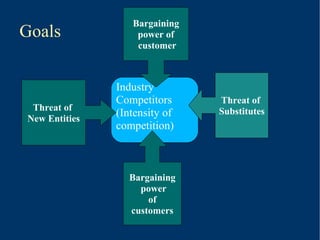
Goals Industry Competitors (Intensity of competition)‏ Threat of  New Entities Bargaining power of customer Threat of  Substitutes Bargaining power of customers
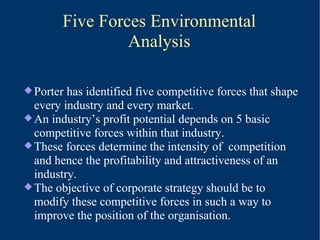
Five Forces Environmental Analysis Porter has identified five competitive forces that shape every industry and every market. An industry’s profit potential depends on 5 basic competitive forces within that industry. These forces determine the intensity of  competition and hence the profitability and attractiveness of an industry. The objective of corporate strategy should be to modify these competitive forces in such a way to improve the position of the organisation.
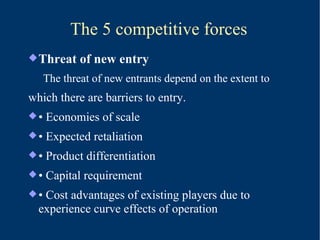
The 5 competitive forces Threat of new entry The threat of new entrants depend on the extent to which there are barriers to entry. •  Economies of scale •  Expected retaliation •  Product differentiation •  Capital requirement •  Cost advantages of existing players due to experience curve effects of operation
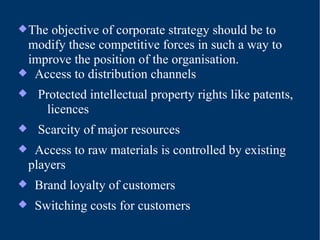
The objective of corporate strategy should be to modify these competitive forces in such a way to improve the position of the organisation. Access to distribution channels Protected intellectual property rights like patents,    licences Scarcity of major resources Access to raw materials is controlled by existing  players Brand loyalty of customers Switching costs for customers
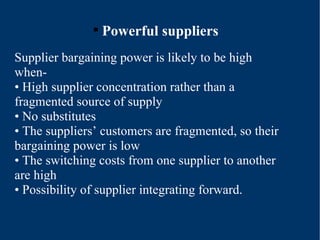
Powerful suppliers Supplier bargaining power is likely to be high when- •  High supplier concentration rather than a fragmented source of supply •  No substitutes •  The suppliers’ customers are fragmented, so their bargaining power is low •  The switching costs from one supplier to another are high •  Possibility of supplier integrating forward.
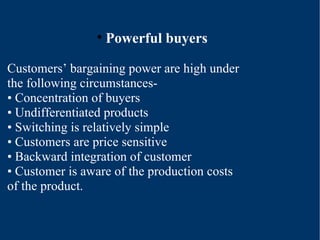
Powerful buyers Customers’ bargaining power are high under the following circumstances- •  Concentration of buyers •  Undifferentiated products •  Switching is relatively simple •  Customers are price sensitive •  Backward integration of customer •  Customer is aware of the production costs of the product.
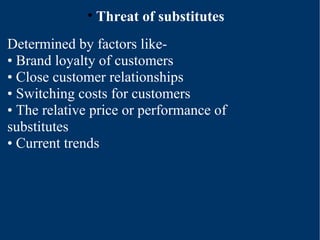
Threat of substitutes Determined by factors like- •  Brand loyalty of customers •  Close customer relationships •  Switching costs for customers •  The relative price or performance of substitutes •  Current trends
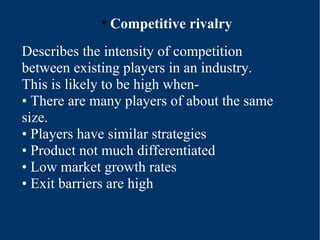
Competitive rivalry Describes the intensity of competition between existing players in an industry. This is likely to be high when- •  There are many players of about the same size. •  Players have similar strategies •  Product not much differentiated •  Low market growth rates •  Exit barriers are high
THANK YOU

Five force

  • 1.
    Competitive Business EnvironmentAccording to Michael Porter the nature and degree of competition in an industry depends on Five Forces. ULSAH T.N
  • 2.
    Goals Industry Competitors(Intensity of competition)‏ Threat of New Entities Bargaining power of customer Threat of Substitutes Bargaining power of customers
  • 3.
    Five Forces EnvironmentalAnalysis Porter has identified five competitive forces that shape every industry and every market. An industry’s profit potential depends on 5 basic competitive forces within that industry. These forces determine the intensity of competition and hence the profitability and attractiveness of an industry. The objective of corporate strategy should be to modify these competitive forces in such a way to improve the position of the organisation.
  • 4.
    The 5 competitiveforces Threat of new entry The threat of new entrants depend on the extent to which there are barriers to entry. • Economies of scale • Expected retaliation • Product differentiation • Capital requirement • Cost advantages of existing players due to experience curve effects of operation
  • 5.
    The objective ofcorporate strategy should be to modify these competitive forces in such a way to improve the position of the organisation. Access to distribution channels Protected intellectual property rights like patents, licences Scarcity of major resources Access to raw materials is controlled by existing players Brand loyalty of customers Switching costs for customers
  • 6.
    Powerful suppliers Supplierbargaining power is likely to be high when- • High supplier concentration rather than a fragmented source of supply • No substitutes • The suppliers’ customers are fragmented, so their bargaining power is low • The switching costs from one supplier to another are high • Possibility of supplier integrating forward.
  • 7.
    Powerful buyers Customers’bargaining power are high under the following circumstances- • Concentration of buyers • Undifferentiated products • Switching is relatively simple • Customers are price sensitive • Backward integration of customer • Customer is aware of the production costs of the product.
  • 8.
    Threat of substitutesDetermined by factors like- • Brand loyalty of customers • Close customer relationships • Switching costs for customers • The relative price or performance of substitutes • Current trends
  • 9.
    Competitive rivalry Describesthe intensity of competition between existing players in an industry. This is likely to be high when- • There are many players of about the same size. • Players have similar strategies • Product not much differentiated • Low market growth rates • Exit barriers are high
  • 10.