Five Approaches to TESOL: 
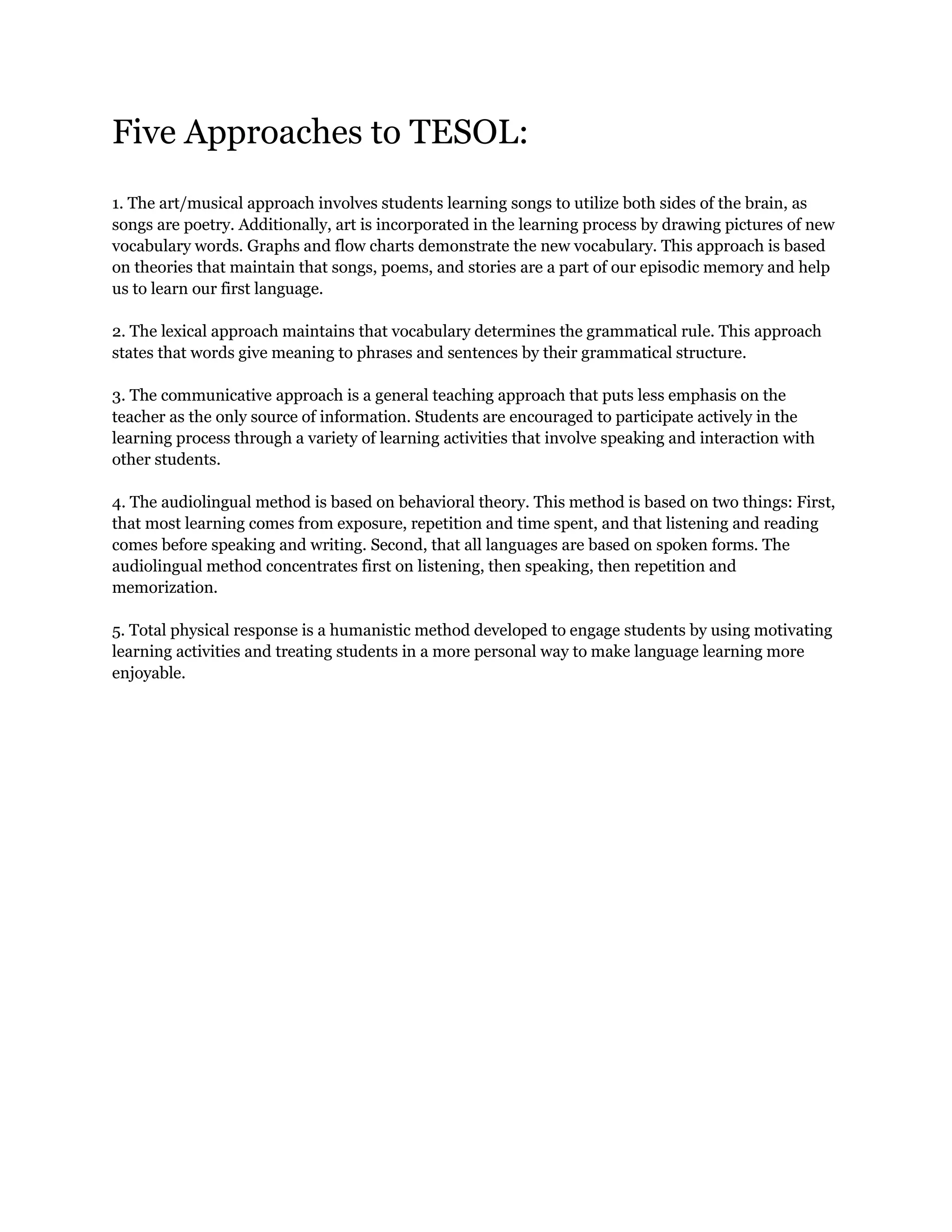
1. The art/musical approach involves students learning songs to utilize both sides of the brain, as songs are poetry. Additionally, art is incorporated in the learning process by drawing pictures of new vocabulary words. Graphs and flow charts demonstrate the new vocabulary. This approach is based on theories that maintain that songs, poems, and stories are a part of our episodic memory and help us to learn our first language. 2. The lexical approach maintains that vocabulary determines the grammatical rule. This approach states that words give meaning to phrases and sentences by their grammatical structure. 3. The communicative approach is a general teaching approach that puts less emphasis on the teacher as the only source of information. Students are encouraged to participate actively in the learning process through a variety of learning activities that involve speaking and interaction with other students. 4. The audiolingual method is based on behavioral theory. This method is based on two things: First, that most learning comes from exposure, repetition and time spent, and that listening and reading comes before speaking and writing. Second, that all languages are based on spoken forms. The audiolingual method concentrates first on listening, then speaking, then repetition and memorization. 5. Total physical response is a humanistic method developed to engage students by using motivating learning activities and treating students in a more personal way to make language learning more enjoyable.

Five approaches to TESOL

  • 1.
    Five Approaches toTESOL: 1. The art/musical approach involves students learning songs to utilize both sides of the brain, as songs are poetry. Additionally, art is incorporated in the learning process by drawing pictures of new vocabulary words. Graphs and flow charts demonstrate the new vocabulary. This approach is based on theories that maintain that songs, poems, and stories are a part of our episodic memory and help us to learn our first language. 2. The lexical approach maintains that vocabulary determines the grammatical rule. This approach states that words give meaning to phrases and sentences by their grammatical structure. 3. The communicative approach is a general teaching approach that puts less emphasis on the teacher as the only source of information. Students are encouraged to participate actively in the learning process through a variety of learning activities that involve speaking and interaction with other students. 4. The audiolingual method is based on behavioral theory. This method is based on two things: First, that most learning comes from exposure, repetition and time spent, and that listening and reading comes before speaking and writing. Second, that all languages are based on spoken forms. The audiolingual method concentrates first on listening, then speaking, then repetition and memorization. 5. Total physical response is a humanistic method developed to engage students by using motivating learning activities and treating students in a more personal way to make language learning more enjoyable.