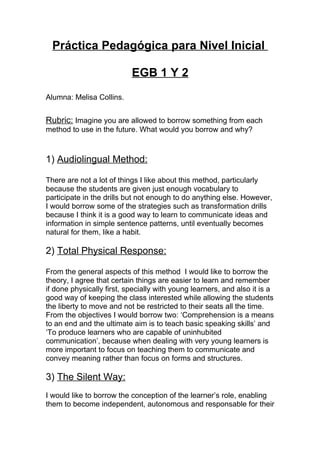
Práctica Pedagógica para Nivel Inicial

                           EGB 1 Y 2
Alumna: Melisa Collins.


Rubric: Imagine you are allowed to borrow something from each
method to use in the future. What would you borrow and why?


1) Audiolingual Method:

There are not a lot of things I like about this method, particularly
because the students are given just enough vocabulary to
participate in the drills but not enough to do anything else. However,
I would borrow some of the strategies such as transformation drills
because I think it is a good way to learn to communicate ideas and
information in simple sentence patterns, until eventually becomes
natural for them, like a habit.

2) Total Physical Response:

From the general aspects of this method I would like to borrow the
theory, I agree that certain things are easier to learn and remember
if done physically first, specially with young learners, and also it is a
good way of keeping the class interested while allowing the students
the liberty to move and not be restricted to their seats all the time.
From the objectives I would borrow two: ‘Comprehension is a means
to an end and the ultimate aim is to teach basic speaking skills’ and
‘To produce learners who are capable of uninhubited
communication’, because when dealing with very young learners is
more important to focus on teaching them to communicate and
convey meaning rather than focus on forms and structures.

3) The Silent Way:
I would like to borrow the conception of the learner’s role, enabling
them to become independent, autonomous and responsable for their
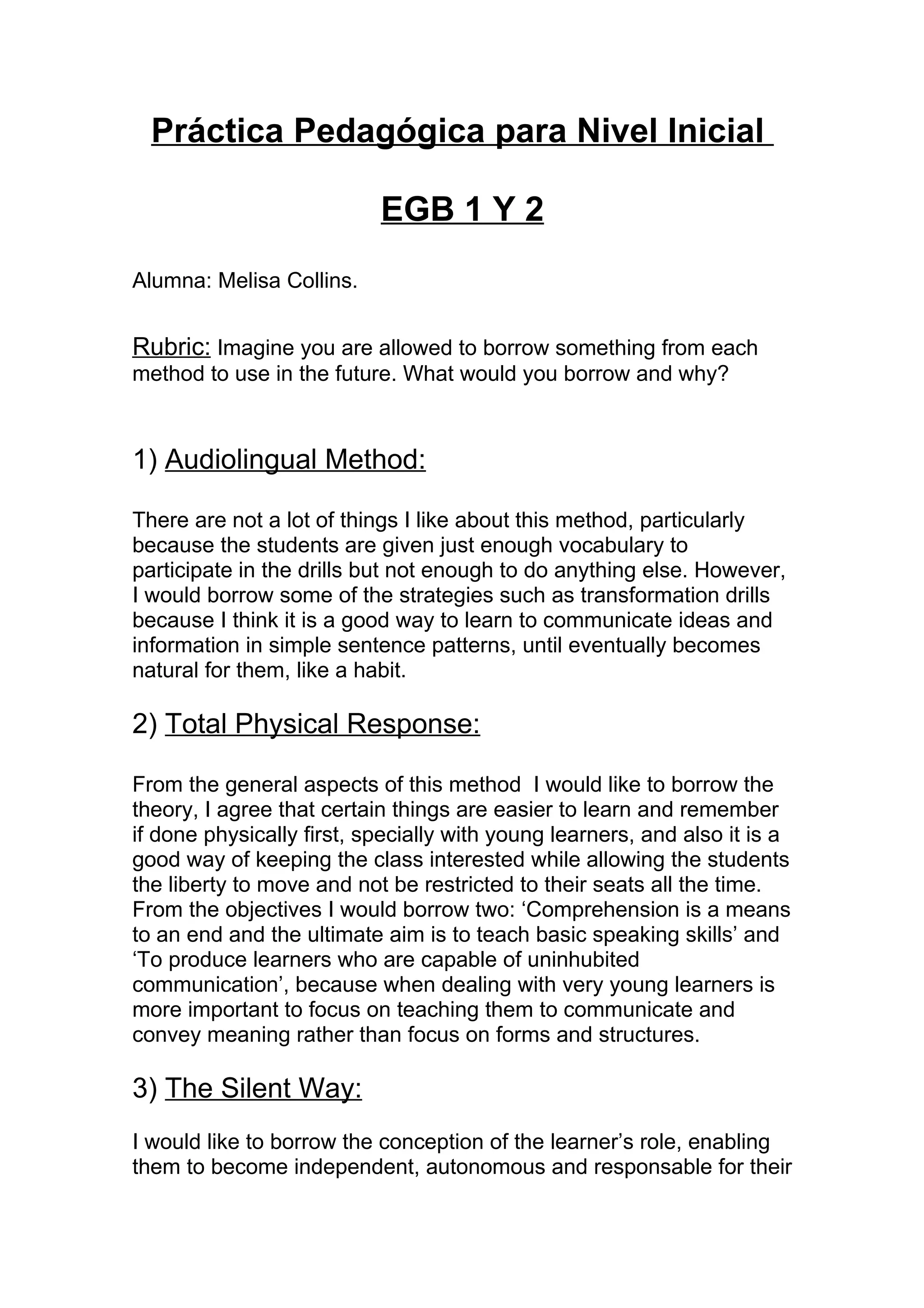
own learning. Also, the materials used, such as colored charts,
because of they uniqueness and the appealing they have to the
students.

4) Community Language Learning

From this method I would borrrow the teacher’s and student’s role.
The teacher’s role as a counselor, because they respond to the
students needs in an detached, yet considerate manner in order to
make the experience a meaningful one. The learner’s role because
being a member of a community and acting as a collaborator by
helping their peers to acomplish learning is motivating for the
students, it helps them feel secure and accepted. They build a
relashionship with their classmates interacting with them and they
learn to cooperate instead of compete, accomplishing success as a
group and not individually.

5) The Natural Approach

From this I would borrow the students’ role and the teacher’s role,
being the primary source of comprehensible imput while involving
the studens in meaningful communication, creating a positive
climate and providing the students with a variety of activities. I think
is very important for students to have a teacher as a permanent
source, in order for them to get accustumed to the imput inside the
classroom and they should take every possible advantage of that
because outside the classroom is nearly impossible to use and
receive imput from a second language. Last, I would borrow the
techniques and activities.

6) Suggestopedia

From this method I would borrow the use of art, Baroque music and
similar techniques to relax the students, because I agree with the
theory that its very difficult for students to learn if their affective filter
is too high or too low, and by providing them with a harmonious
enviroment we regulate that filter, helping the students to feel free,
confortable and confidente. What I also like about this method is that
it has favorable effects on health, social and psychological relations.
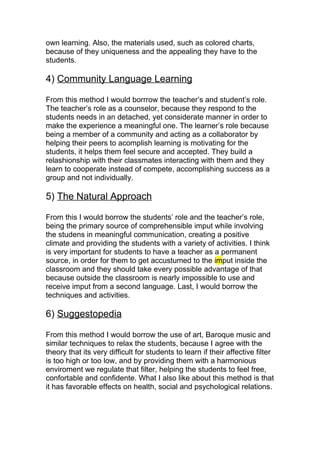
7) Communicative Language Teaching

From this method I would borrow the most, like the learner’s role as
an interactor, participating and receiving. The teacher’s role, not as
the main element, but as an importan one, a facilitator of the
communication process, a counselor and a manager. The fact that
meaning is paramount and they use real-life situations is something
I like about this method, because this motivates students to learn in
order to be able to communicate meaningfully and they can
experiment freely with the language without fear to be mistaken
because they learn from trial and error and they are encouraged to
communicate from the beginning. I also think that using translation
when needed is important, specially with young learners who are not
accustomed with the second language, because students can
benefit from that if some things are explained in their own language,
and they may find it difficult to follow an entire class in another
language. I also believe it to be a good strategy to recapture the
stundents attention and check if they understood. I would also
borrow the materials because they have great appealing to students
and at the same time, allow them to involve in communicative
situations with their peers where they use the language, situations
such as building, painting, drawing, etc.

8) The Lexical Approach

From the teacher’s role I would borrow the notion of the teacher not
as a ‘knower’, but as a creator of an enviroment where learners can
operate effectively and then help them manage their own learning,
building autonomy and assisting through the different stages.

9) Practice, Presentation and Production

From this approach I would borrow the entire procedure, since it
allows the teacher to use a wide variety of materials and elements
and the learning process develops gradually, from a teacher-
centered stage to a learner-centered stage, where the teacher does
not gets involved or corrects any mistakes, allowing the students to
apply and practice the language they have been practicing. Students
also have the oportunity to interact with their peers in active pair and
group work. I like this approach because it’s concentrated in the
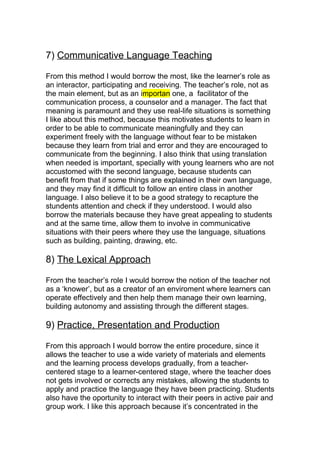
‘functions’ and the purposes to which we apply the language, and
gives more importance to communicate and convey meaning than
learning apropiate grammatical forms.

10) Task-Based Learning

From this method I like the notion of communication as
‘understanding and conveying meaning’ and the need to provide the
learner an enviroment with favourable conditions because language
is not the result of ‘isolated’ learning, as we build inside our mind
what we want to communicate to the world. The teacher’s role as a
creator of the conditions to engage students in meaningful
situations, and the use of real-life situations, where every task is
goal-oriented, allowing the students to focus in that particular
situation and finding the right way to build a correct discourse. Why I
would also borrow this method is because task are usually
something that students are more likely to be engaged in, and
therefore, they will be motivated enough to interact with their
classmates and communicating freely with the language.


Excellent Work
10 (ten)

Methods Melisa

  • 1.
    Práctica Pedagógica paraNivel Inicial EGB 1 Y 2 Alumna: Melisa Collins. Rubric: Imagine you are allowed to borrow something from each method to use in the future. What would you borrow and why? 1) Audiolingual Method: There are not a lot of things I like about this method, particularly because the students are given just enough vocabulary to participate in the drills but not enough to do anything else. However, I would borrow some of the strategies such as transformation drills because I think it is a good way to learn to communicate ideas and information in simple sentence patterns, until eventually becomes natural for them, like a habit. 2) Total Physical Response: From the general aspects of this method I would like to borrow the theory, I agree that certain things are easier to learn and remember if done physically first, specially with young learners, and also it is a good way of keeping the class interested while allowing the students the liberty to move and not be restricted to their seats all the time. From the objectives I would borrow two: ‘Comprehension is a means to an end and the ultimate aim is to teach basic speaking skills’ and ‘To produce learners who are capable of uninhubited communication’, because when dealing with very young learners is more important to focus on teaching them to communicate and convey meaning rather than focus on forms and structures. 3) The Silent Way: I would like to borrow the conception of the learner’s role, enabling them to become independent, autonomous and responsable for their
  • 2.
    own learning. Also,the materials used, such as colored charts, because of they uniqueness and the appealing they have to the students. 4) Community Language Learning From this method I would borrrow the teacher’s and student’s role. The teacher’s role as a counselor, because they respond to the students needs in an detached, yet considerate manner in order to make the experience a meaningful one. The learner’s role because being a member of a community and acting as a collaborator by helping their peers to acomplish learning is motivating for the students, it helps them feel secure and accepted. They build a relashionship with their classmates interacting with them and they learn to cooperate instead of compete, accomplishing success as a group and not individually. 5) The Natural Approach From this I would borrow the students’ role and the teacher’s role, being the primary source of comprehensible imput while involving the studens in meaningful communication, creating a positive climate and providing the students with a variety of activities. I think is very important for students to have a teacher as a permanent source, in order for them to get accustumed to the imput inside the classroom and they should take every possible advantage of that because outside the classroom is nearly impossible to use and receive imput from a second language. Last, I would borrow the techniques and activities. 6) Suggestopedia From this method I would borrow the use of art, Baroque music and similar techniques to relax the students, because I agree with the theory that its very difficult for students to learn if their affective filter is too high or too low, and by providing them with a harmonious enviroment we regulate that filter, helping the students to feel free, confortable and confidente. What I also like about this method is that it has favorable effects on health, social and psychological relations.
  • 3.
    7) Communicative LanguageTeaching From this method I would borrow the most, like the learner’s role as an interactor, participating and receiving. The teacher’s role, not as the main element, but as an importan one, a facilitator of the communication process, a counselor and a manager. The fact that meaning is paramount and they use real-life situations is something I like about this method, because this motivates students to learn in order to be able to communicate meaningfully and they can experiment freely with the language without fear to be mistaken because they learn from trial and error and they are encouraged to communicate from the beginning. I also think that using translation when needed is important, specially with young learners who are not accustomed with the second language, because students can benefit from that if some things are explained in their own language, and they may find it difficult to follow an entire class in another language. I also believe it to be a good strategy to recapture the stundents attention and check if they understood. I would also borrow the materials because they have great appealing to students and at the same time, allow them to involve in communicative situations with their peers where they use the language, situations such as building, painting, drawing, etc. 8) The Lexical Approach From the teacher’s role I would borrow the notion of the teacher not as a ‘knower’, but as a creator of an enviroment where learners can operate effectively and then help them manage their own learning, building autonomy and assisting through the different stages. 9) Practice, Presentation and Production From this approach I would borrow the entire procedure, since it allows the teacher to use a wide variety of materials and elements and the learning process develops gradually, from a teacher- centered stage to a learner-centered stage, where the teacher does not gets involved or corrects any mistakes, allowing the students to apply and practice the language they have been practicing. Students also have the oportunity to interact with their peers in active pair and group work. I like this approach because it’s concentrated in the
  • 4.
    ‘functions’ and thepurposes to which we apply the language, and gives more importance to communicate and convey meaning than learning apropiate grammatical forms. 10) Task-Based Learning From this method I like the notion of communication as ‘understanding and conveying meaning’ and the need to provide the learner an enviroment with favourable conditions because language is not the result of ‘isolated’ learning, as we build inside our mind what we want to communicate to the world. The teacher’s role as a creator of the conditions to engage students in meaningful situations, and the use of real-life situations, where every task is goal-oriented, allowing the students to focus in that particular situation and finding the right way to build a correct discourse. Why I would also borrow this method is because task are usually something that students are more likely to be engaged in, and therefore, they will be motivated enough to interact with their classmates and communicating freely with the language. Excellent Work 10 (ten)