 INTRODUCTION
 RATIONAL OF IFS
 GOALS OF IFS
 ADVANTAGES OF INTEGRATED FISH FARMING (IFF)
 FISH CULTURE PRACTICES
 POULTRY FARMING PRACTICES
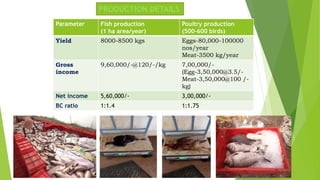
 PRODUCTION DETAILS
 CONCLUSION
 KVK ACTIVITIES
 DOCUMENTATION OF IFS FARMER SUCCESS STORY
 FUTURE THRUST
INTRODUCTION
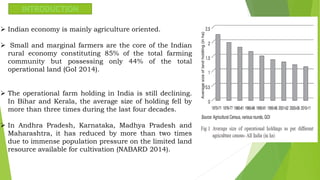
 Indian economy is mainly agriculture oriented.
 Small and marginal farmers are the core of the Indian
rural economy constituting 85% of the total farming
community but possessing only 44% of the total
operational land (GoI 2014).
 The operational farm holding in India is still declining.
In Bihar and Kerala, the average size of holding fell by
more than three times during the last four decades.
 In Andhra Pradesh, Karnataka, Madhya Pradesh and
Maharashtra, it has reduced by more than two times
due to immense population pressure on the limited land
resource available for cultivation (NABARD 2014).
 The declining trend of per capita land availability poses a serious challenge to the
sustainability and profitability of farming.
 Due to ever increasing population and shrinking land resources in the country.
 The rationale behind integrated farming is to minimize wastes from the various
subsystems on the farm.
 Wastes or by-products from each subsystem are used as inputs to other subsystems to
improve the productivity and lower the cost of production of the outputs of the various
subsystems
RATIONALE OF INTEGRATED FARMING SYSTEM
GOALS OF IFS
 To provide a steady and stable income and
rejuvenation of the system’s productivity.
 To provide environmentally sustainable and
economically viable technology that encompasses
rational utilization of available resources of the
region.
 To conserve natural resource base, protect the
environment and enhance prosperity for a longer
period of time.
ADVANTAGES OF INTEGRATED FISH FARMING (IFF)
 Save fertilizer cost and also supplementary feed cost(60%)
 Provides quality protein food, resource utilisation, recycling of
farm waste.
 Maximum return per unit area per unit time in terms of
produce and money.
 Increased productivity, profitability and sustainability are
ensured with protective food and environmental safety.
 Employment generation and ultimately increasing the
standard of living of the farmers are other major benefits of
integrated farming system.
 Obtaining food and nutritional security at farm level and can
also generate rural employment, thus preventing excessive
migration to urban areas.
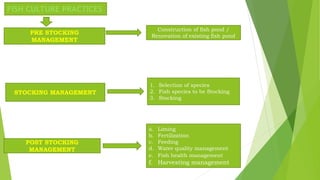
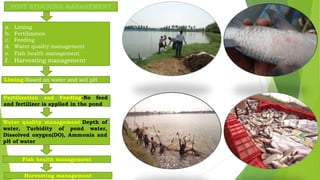
FISH CULTURE PRACTICES
PRE STOCKING
MANAGEMENT
STOCKING MANAGEMENT
POST STOCKING
MANAGEMENT
Construction of fish pond /
Renovation of existing fish pond
1. Selection of species
2. Fish species to be Stocking
3. Stocking
a. Liming
b. Fertilization
c. Feeding
d. Water quality management
e. Fish health management
f. Harvesting management
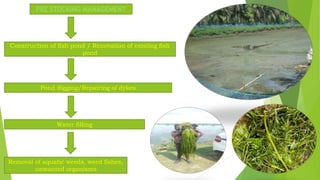
PRE STOCKING MANAGEMENT
Pond digging/Repairing of dykes
Construction of fish pond / Renovation of existing fish
pond
Water filling
Removal of aquatic weeds, weed fishes,
unwanted organisms
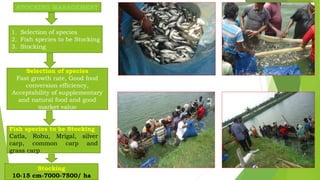
STOCKING MANAGEMENT
1. Selection of species
2. Fish species to be Stocking
3. Stocking
Selection of species
Fast growth rate, Good food
conversion efficiency,
Acceptability of supplementary
and natural food and good
market value
Fish species to be Stocking
Catla, Rohu, Mrigal, silver
carp, common carp and
grass carp
Stocking
10-15 cm-7000-7500/ ha
POST STOCKING MANAGEMENT
a. Liming
b. Fertilization
c. Feeding
d. Water quality management
e. Fish health management
f. Harvesting management
Liming-Based on water and soil pH
Fertilization and Feeding-No feed
and fertilizer is applied in the pond
Water quality management-Depth of
water, Turbidity of pond water,
Dissolved oxygen(DO), Ammonia and
pH of water
Fish health management
Harvesting management
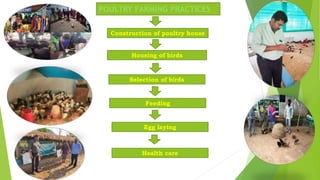
Construction of poultry house
Housing of birds
Selection of birds
POULTRY FARMING PRACTICES
Feeding
Egg laying
Health care
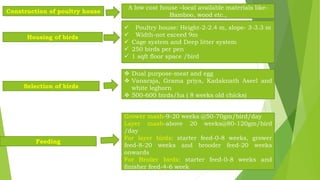
 Poultry house: Height-2-2.4 m, slope- 3-3.3 m
 Width-not exceed 9m
 Cage system and Deep litter system
 250 birds per pen
 1 sqft floor space /bird
A low cost house –local available materials like-
Bamboo, wood etc.,
Construction of poultry house
Housing of birds
Selection of birds
 Dual purpose-meat and egg
 Vanaraja, Grama priya, Kadaknath Aseel and
white leghorn
 500-600 birds/ha ( 8 weeks old chicks)
Feeding
Grower mash-9-20 weeks @50-70gm/bird/day
Layer mash-above 20 weeks@80-120gm/bird
/day
For layer birds: starter feed-0-8 weeks, grower
feed-8-20 weeks and brooder feed-20 weeks
onwards
For Broiler birds: starter feed-0-8 weeks and
finisher feed-4-6 week
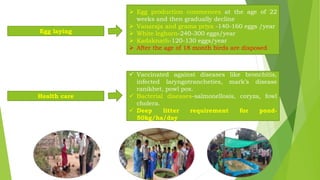
Egg laying
 Egg production commences at the age of 22
weeks and then gradually decline
 Vanaraja and grama priya -140-160 eggs /year
 White leghorn-240-300 eggs/year
 Kadaknath-120-130 eggs/year
 After the age of 18 month birds are disposed
Health care
 Vaccinated against diseases like bronchitis,
infected laryngotrancheties, mark’s disease
ranikhet, powl pox.
 Bacterial diseases-salmonellosis, coryza, fowl
cholera.
 Deep litter requirement for pond-
50kg/ha/day
PRODUCTION DETAILS
Parameter Fish production
(1 ha area/year)
Poultry production
(500-600 birds)
Yield 8000-8500 kgs Eggs-80,000-100000
nos/year
Meat-3500 kg/year
Gross
income
9,60,000/-@120/-/kg 7,00,000/-
(Egg-3,50,000@3.5/-
Meat-3,50,000@100 /-
kg)
Net income 5,60,000/- 3,00,000/-
BC ratio 1:1.4 1:1.75
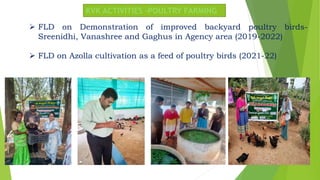
KVK ACTIVITIES –POULTRY FARMING
 FLD on Demonstration of improved backyard poultry birds-
Sreenidhi, Vanashree and Gaghus in Agency area (2019-2022)
 FLD on Azolla cultivation as a feed of poultry birds (2021-22)
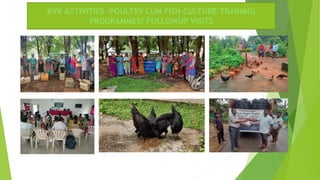
KVK ACTIVITIES -POULTRY CUM FISH CULTURE-TRAINING
PROGRAMMES/ FOLLOWUP VISITS
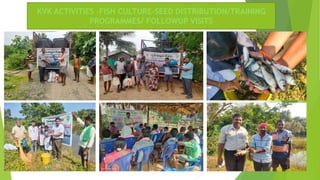
KVK ACTIVITIES -FISH CULTURE-SEED DISTRIBUTION/TRAINING
PROGRAMMES/ FOLLOWUP VISITS
CONCLUSION
 To provide food security, nutritional benefits, employment generation
and providing additional income to resource poor small farmers.
 This approach is a location specific, technically skill based, play
multidimensional role in fulfilling the domestic requirement,
employment avenues, rational use of resources, sustaining productivity,
invest ability and economic ability of the systems.
 Enhances the net return, generates employment, conserves natural
resources, reduces the cost of production and increases the overall
income by minimizing risk.
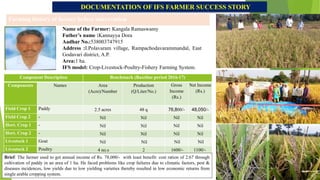
Farming history of farmer before intervention
DOCUMENTATION OF IFS FARMER SUCCESS STORY
Component Description Benchmark (Baseline period 2016-17)
Components Names Area
(Acre)/Number
Production
(Q/Liter/No.)
Gross
Income
(Rs.)
Net Income
(Rs.)
Field Crop 1 Paddy 2.5 acres 48 q 76,800/- 48,050/-
Field Crop 2 - Nil Nil Nil Nil
Hort. Crop 1 - Nil Nil Nil Nil
Hort. Crop 2 - Nil Nil Nil Nil
Livestock 1 Goat Nil Nil Nil Nil
Livestock 2 Poultry 4 no.s 2 1600/- 1100/-
Other
enterprise
Fisheries
Nil Nil Nil Nil
Total 2 components 2.5 acres 48q 78,400/- 49,150/-
Name of the Farmer: Kangala Ramaswamy
Father’s name :Kannayya Dora
Aadhar No.:538003747915
Address :I.Polavaram village, Rampachodavarammandal, East
Godavari district, A.P.
Area:1 ha.
IFS model: Crop-Livestock-Poultry-Fishery Farming System.
Brief: The farmer used to get annual income of Rs. 78,000/- with least benefit: cost ration of 2.67 through
cultivation of paddy in an area of 1 ha. He faced problems like crop failures due to climatic factors, pest &
diseases incidences, low yields due to low yielding varieties thereby resulted in low economic returns from
single arable cropping system.
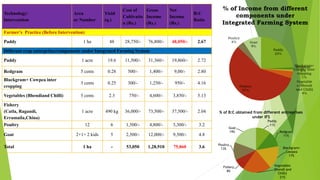
Technology/
Intervention
Area
or Number
Yield
(q.)
Cost of
Cultivatio
n (Rs.)
Gross
Income
(Rs.)
Net
Income
(Rs.)
B:C
Ratio
Farmer’s Practice (Before Intervention)
Paddy 1 ha 48 28,750/- 76,800/- 48,050/- 2.67
Different crop enterprises/components under Integrated Farming System
Paddy 1 acre 19.6 11,500/- 31,360/- 19,860/- 2.72
Redgram 5 cents 0.28 500/- 1,400/- 9,00/- 2.80
Blackgram+ Cowpea inter
cropping
3 cents 0.25 300/- 1,250/- 950/- 4.16
Vegetables (Bhendiand Chilli) 5 cents 2.3 750/- 4,600/- 3,850/- 5.13
Fishery
(Catla, Ragandi,
Erramaila,China)
1 acre 490 kg 36,000/- 73,500/- 37,500/- 2.04
Poultry 12 6 1,500/- 4,800/- 3,300/- 3.2
Goat 2+1+ 2 kids 5 2,500/- 12,000/- 9,500/- 4.8
Total 1 ha - 53,050 1,28,910 75,860 3.6
Paddy
24%
Redgram
1%
Blackgram+
Cowpea inter
cropping
1%
Vegetable
s (Bhendi
and Chilli)
4%
Fishery
57%
Poultry
4% Goat
9%
% of Income from different
components under
Integrated Farming System
Paddy
11%
Redgram
11%
Blackgram+
Cowpea
17%
Vegetables
(Bhendi and
Chilli)
21%
Fishery
8%
Poultry
13%
Goat
19%
% of B:C obtained from different entreprises
under IFS
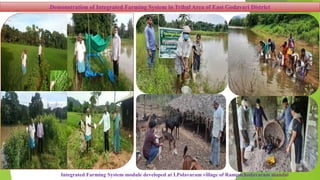
Integrated Farming System module developed at I.Polavaram village of Rampachodavaram mandal
Demonstration of Integrated Farming System in Tribal Area of East Godavari District
 Creation of database on IFS throughout the country in relation to type and size of
integrated farming systems, enterprise selected and their way of allocation,
infrastructure, economics, economic sustainability of the system etc. under different
ecological situations.
 Development of ecologically stable, environmentally sound and location specific low
cost viable IFS modules for different holding sizes which are socially acceptable is
required.
 On –farm testing and refinement of the developed modules according to the farmers’
need and requirement as it is a continuous process i.e. addition of profitable
components and replacement of less profitable components with time, choice of the
farmers and availability of market.
FUTURE THRUST
Need to identify the constraints in adoption of identified integrated
farming systems for particular area or locality.
Documentation of ITKs of IFS in the farming community and its scientific
validation.
Need to prepare a strong policy draft for the consideration of planners for
its promotion and creating awareness at large scale with some pity
financial assistance either through loans or subsidy.
fish integrated farming.pptx

fish integrated farming.pptx

  • 1.
     INTRODUCTION  RATIONALOF IFS  GOALS OF IFS  ADVANTAGES OF INTEGRATED FISH FARMING (IFF)  FISH CULTURE PRACTICES  POULTRY FARMING PRACTICES  PRODUCTION DETAILS  CONCLUSION  KVK ACTIVITIES  DOCUMENTATION OF IFS FARMER SUCCESS STORY  FUTURE THRUST
  • 2.
    INTRODUCTION  Indian economyis mainly agriculture oriented.  Small and marginal farmers are the core of the Indian rural economy constituting 85% of the total farming community but possessing only 44% of the total operational land (GoI 2014).  The operational farm holding in India is still declining. In Bihar and Kerala, the average size of holding fell by more than three times during the last four decades.  In Andhra Pradesh, Karnataka, Madhya Pradesh and Maharashtra, it has reduced by more than two times due to immense population pressure on the limited land resource available for cultivation (NABARD 2014).
  • 3.
     The decliningtrend of per capita land availability poses a serious challenge to the sustainability and profitability of farming.  Due to ever increasing population and shrinking land resources in the country.  The rationale behind integrated farming is to minimize wastes from the various subsystems on the farm.  Wastes or by-products from each subsystem are used as inputs to other subsystems to improve the productivity and lower the cost of production of the outputs of the various subsystems RATIONALE OF INTEGRATED FARMING SYSTEM
  • 4.
    GOALS OF IFS To provide a steady and stable income and rejuvenation of the system’s productivity.  To provide environmentally sustainable and economically viable technology that encompasses rational utilization of available resources of the region.  To conserve natural resource base, protect the environment and enhance prosperity for a longer period of time.
  • 5.
    ADVANTAGES OF INTEGRATEDFISH FARMING (IFF)  Save fertilizer cost and also supplementary feed cost(60%)  Provides quality protein food, resource utilisation, recycling of farm waste.  Maximum return per unit area per unit time in terms of produce and money.  Increased productivity, profitability and sustainability are ensured with protective food and environmental safety.  Employment generation and ultimately increasing the standard of living of the farmers are other major benefits of integrated farming system.  Obtaining food and nutritional security at farm level and can also generate rural employment, thus preventing excessive migration to urban areas.
  • 6.
    FISH CULTURE PRACTICES PRESTOCKING MANAGEMENT STOCKING MANAGEMENT POST STOCKING MANAGEMENT Construction of fish pond / Renovation of existing fish pond 1. Selection of species 2. Fish species to be Stocking 3. Stocking a. Liming b. Fertilization c. Feeding d. Water quality management e. Fish health management f. Harvesting management
  • 7.
    PRE STOCKING MANAGEMENT Ponddigging/Repairing of dykes Construction of fish pond / Renovation of existing fish pond Water filling Removal of aquatic weeds, weed fishes, unwanted organisms
  • 8.
    STOCKING MANAGEMENT 1. Selectionof species 2. Fish species to be Stocking 3. Stocking Selection of species Fast growth rate, Good food conversion efficiency, Acceptability of supplementary and natural food and good market value Fish species to be Stocking Catla, Rohu, Mrigal, silver carp, common carp and grass carp Stocking 10-15 cm-7000-7500/ ha
  • 9.
    POST STOCKING MANAGEMENT a.Liming b. Fertilization c. Feeding d. Water quality management e. Fish health management f. Harvesting management Liming-Based on water and soil pH Fertilization and Feeding-No feed and fertilizer is applied in the pond Water quality management-Depth of water, Turbidity of pond water, Dissolved oxygen(DO), Ammonia and pH of water Fish health management Harvesting management
  • 10.
    Construction of poultryhouse Housing of birds Selection of birds POULTRY FARMING PRACTICES Feeding Egg laying Health care
  • 11.
     Poultry house:Height-2-2.4 m, slope- 3-3.3 m  Width-not exceed 9m  Cage system and Deep litter system  250 birds per pen  1 sqft floor space /bird A low cost house –local available materials like- Bamboo, wood etc., Construction of poultry house Housing of birds Selection of birds  Dual purpose-meat and egg  Vanaraja, Grama priya, Kadaknath Aseel and white leghorn  500-600 birds/ha ( 8 weeks old chicks) Feeding Grower mash-9-20 weeks @50-70gm/bird/day Layer mash-above 20 weeks@80-120gm/bird /day For layer birds: starter feed-0-8 weeks, grower feed-8-20 weeks and brooder feed-20 weeks onwards For Broiler birds: starter feed-0-8 weeks and finisher feed-4-6 week
  • 12.
    Egg laying  Eggproduction commences at the age of 22 weeks and then gradually decline  Vanaraja and grama priya -140-160 eggs /year  White leghorn-240-300 eggs/year  Kadaknath-120-130 eggs/year  After the age of 18 month birds are disposed Health care  Vaccinated against diseases like bronchitis, infected laryngotrancheties, mark’s disease ranikhet, powl pox.  Bacterial diseases-salmonellosis, coryza, fowl cholera.  Deep litter requirement for pond- 50kg/ha/day
  • 13.
    PRODUCTION DETAILS Parameter Fishproduction (1 ha area/year) Poultry production (500-600 birds) Yield 8000-8500 kgs Eggs-80,000-100000 nos/year Meat-3500 kg/year Gross income 9,60,000/-@120/-/kg 7,00,000/- (Egg-3,50,000@3.5/- Meat-3,50,000@100 /- kg) Net income 5,60,000/- 3,00,000/- BC ratio 1:1.4 1:1.75
  • 14.
    KVK ACTIVITIES –POULTRYFARMING  FLD on Demonstration of improved backyard poultry birds- Sreenidhi, Vanashree and Gaghus in Agency area (2019-2022)  FLD on Azolla cultivation as a feed of poultry birds (2021-22)
  • 15.
    KVK ACTIVITIES -POULTRYCUM FISH CULTURE-TRAINING PROGRAMMES/ FOLLOWUP VISITS
  • 16.
    KVK ACTIVITIES -FISHCULTURE-SEED DISTRIBUTION/TRAINING PROGRAMMES/ FOLLOWUP VISITS
  • 17.
    CONCLUSION  To providefood security, nutritional benefits, employment generation and providing additional income to resource poor small farmers.  This approach is a location specific, technically skill based, play multidimensional role in fulfilling the domestic requirement, employment avenues, rational use of resources, sustaining productivity, invest ability and economic ability of the systems.  Enhances the net return, generates employment, conserves natural resources, reduces the cost of production and increases the overall income by minimizing risk.
  • 18.
    Farming history offarmer before intervention DOCUMENTATION OF IFS FARMER SUCCESS STORY Component Description Benchmark (Baseline period 2016-17) Components Names Area (Acre)/Number Production (Q/Liter/No.) Gross Income (Rs.) Net Income (Rs.) Field Crop 1 Paddy 2.5 acres 48 q 76,800/- 48,050/- Field Crop 2 - Nil Nil Nil Nil Hort. Crop 1 - Nil Nil Nil Nil Hort. Crop 2 - Nil Nil Nil Nil Livestock 1 Goat Nil Nil Nil Nil Livestock 2 Poultry 4 no.s 2 1600/- 1100/- Other enterprise Fisheries Nil Nil Nil Nil Total 2 components 2.5 acres 48q 78,400/- 49,150/- Name of the Farmer: Kangala Ramaswamy Father’s name :Kannayya Dora Aadhar No.:538003747915 Address :I.Polavaram village, Rampachodavarammandal, East Godavari district, A.P. Area:1 ha. IFS model: Crop-Livestock-Poultry-Fishery Farming System. Brief: The farmer used to get annual income of Rs. 78,000/- with least benefit: cost ration of 2.67 through cultivation of paddy in an area of 1 ha. He faced problems like crop failures due to climatic factors, pest & diseases incidences, low yields due to low yielding varieties thereby resulted in low economic returns from single arable cropping system.
  • 19.
    Technology/ Intervention Area or Number Yield (q.) Cost of Cultivatio n(Rs.) Gross Income (Rs.) Net Income (Rs.) B:C Ratio Farmer’s Practice (Before Intervention) Paddy 1 ha 48 28,750/- 76,800/- 48,050/- 2.67 Different crop enterprises/components under Integrated Farming System Paddy 1 acre 19.6 11,500/- 31,360/- 19,860/- 2.72 Redgram 5 cents 0.28 500/- 1,400/- 9,00/- 2.80 Blackgram+ Cowpea inter cropping 3 cents 0.25 300/- 1,250/- 950/- 4.16 Vegetables (Bhendiand Chilli) 5 cents 2.3 750/- 4,600/- 3,850/- 5.13 Fishery (Catla, Ragandi, Erramaila,China) 1 acre 490 kg 36,000/- 73,500/- 37,500/- 2.04 Poultry 12 6 1,500/- 4,800/- 3,300/- 3.2 Goat 2+1+ 2 kids 5 2,500/- 12,000/- 9,500/- 4.8 Total 1 ha - 53,050 1,28,910 75,860 3.6 Paddy 24% Redgram 1% Blackgram+ Cowpea inter cropping 1% Vegetable s (Bhendi and Chilli) 4% Fishery 57% Poultry 4% Goat 9% % of Income from different components under Integrated Farming System Paddy 11% Redgram 11% Blackgram+ Cowpea 17% Vegetables (Bhendi and Chilli) 21% Fishery 8% Poultry 13% Goat 19% % of B:C obtained from different entreprises under IFS
  • 20.
    Integrated Farming Systemmodule developed at I.Polavaram village of Rampachodavaram mandal Demonstration of Integrated Farming System in Tribal Area of East Godavari District
  • 21.
     Creation ofdatabase on IFS throughout the country in relation to type and size of integrated farming systems, enterprise selected and their way of allocation, infrastructure, economics, economic sustainability of the system etc. under different ecological situations.  Development of ecologically stable, environmentally sound and location specific low cost viable IFS modules for different holding sizes which are socially acceptable is required.  On –farm testing and refinement of the developed modules according to the farmers’ need and requirement as it is a continuous process i.e. addition of profitable components and replacement of less profitable components with time, choice of the farmers and availability of market. FUTURE THRUST
  • 22.
    Need to identifythe constraints in adoption of identified integrated farming systems for particular area or locality. Documentation of ITKs of IFS in the farming community and its scientific validation. Need to prepare a strong policy draft for the consideration of planners for its promotion and creating awareness at large scale with some pity financial assistance either through loans or subsidy.