INTEGRATED FARMING
SYSTEM
presenter
Mr. Rahul Choudhary
Rollno.-2101101048
Course tittle:-livestockandpoultrymanagement
B.Sc. Hons. (Agri.),
TCA Dholi
Dr.RPCAU PUSA
• Integrated Farming (IF) is
management system which
a whole farm
aims to deliver
more sustainable agriculture
• Farming is process of harnessing solar energy in
the form of economic plant and animal
products.
• System implies a set of practices and processes
organized into functional entity.
• It is based on concept that ‘there is no waste’ and
‘waste is only a misplaced resource.’ which
become valuable material for another product.
Introduction:
The IFS is defined as the biologically integrated
farming system which integrate natural resources
regulation mechanisms into farming activities to
achieve:
• maximum replacement of off farm inputs
• secure sustainable production of high quality food and
other products through ecologically proffered
technologies
• sustain farm income
• reduce sources of present environment pollutions
generated by agriculture and sustains the multiple
function of agriculture.
Problems of present day agriculture
1) decline in factor productivity
2) Static or decline in food production
3) Increasing malnutrition
4) Shrinkage in net cultivable area
5) Increasing environmental pollution
6) Depleting ground water table
7) Increasing cost of production
8) Low farm income
9) Increasing unemployment
10)decline in agriculture growth rate
Primary goals of IFS are
• Maximization of yield of all component
enterprises to provide steady and stable income.
• Rejuvenation of systems productivity and
achieve agro-ecological equilibrium.
• Avoid build up of insect pests, diseases and
weed population through natural cropping
system and keep them at low level of intensity.
• Reducing use of chemicals.
Objectives of integrated forming
• Should be area specific, formulate models involving main and
allied enterprises for different farming situations.
• It should ensure optimal utilization and conservation of
available resources with efficient recycling within each
system included.
• It should raise the net return of the farm household by
complementing main activity with allied enterprises.
• It should address the nutritional insecurity of resource poor
farmers vulnerability and poverty of landless laborers.
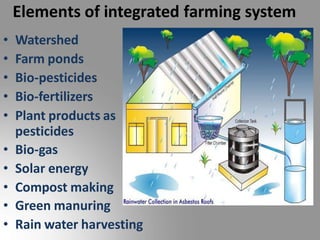
Elements of integrated farming system
• Watershed
• Farm ponds
• Bio-pesticides
• Bio-fertilizers
• Plant products as
pesticides
• Bio-gas
• Solar energy
• Compost making
• Green manuring
• Rain water harvesting
integrated farming system models :-
• Agricultural + livestock
• Agricultural + livestock + poultry
• Horticulture + fish culture + poultry
• Pig cum fish culture
• Agricultural + silvipasture
• Sericulture + fish culture
• fish culture + sericulture
• Agricultural(rice) + fish+ mushroom cultivation
• Agricultural + duckery + poultry
• Poultry + fish culture
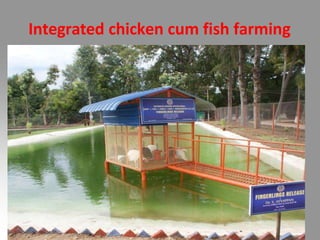
Integrated chicken cum fish farming
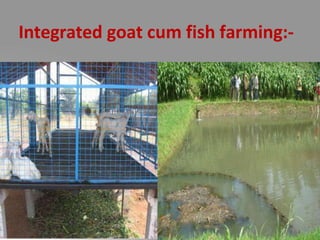
Integrated goat cum fish farming:-
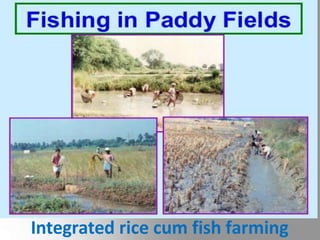
Rice-fish-prawn culture:
• Fish cultured in trench or
canal dugs in paddy fields
in low lying areas yielded
700kg/ha fish along with
5.5ton/ha of paddy.
• There as greater potential
for culture of air
breathing fish in paddy
fields as they can with
stand low water and
oxygen levels.
Integrated rice cum fish farming
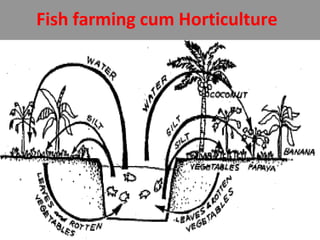
Fish farming cum Horticulture
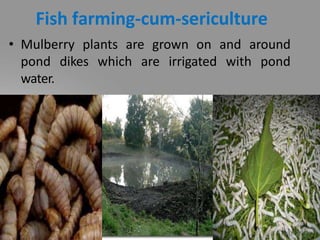
Fish farming-cum-sericulture
• Mulberry plants are grown on and around
pond dikes which are irrigated with pond
water.
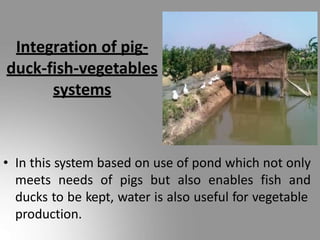
Integration of pig-
duck-fish-vegetables
systems
• In this system based on use of pond which not only
meets needs of pigs but also enables fish and
ducks to be kept, water is also useful for vegetable
production.
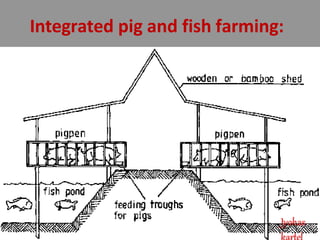
Integrated pig and fish farming:
Jyohas
Advantages of IFS
• Increased productivity through increased economic
yield per unit area per time.
• Improved profitability achieved due to recycling of
waste of enterprise as energy inputs for other system
• Greater sustainability in production.
• Integration of different production systems.(solve
malnutrition)
Conclusion:-
• The integration of fish with livestock and
agriculture needs to be viewed because this
activity can go long way in the uplift of rural
life through manifold increase in return on
investment.
• Integrated farming system seems to be the
answer to the problems of increasing food
production, for increasing income and for
improving nutrition of the small scale
farmers with limited resources without any
adverse effect on environment and agro- eco-
system.
integrated farm management system agriculture

integrated farm management system agriculture

  • 1.
    INTEGRATED FARMING SYSTEM presenter Mr. RahulChoudhary Rollno.-2101101048 Course tittle:-livestockandpoultrymanagement B.Sc. Hons. (Agri.), TCA Dholi Dr.RPCAU PUSA
  • 2.
    • Integrated Farming(IF) is management system which a whole farm aims to deliver more sustainable agriculture • Farming is process of harnessing solar energy in the form of economic plant and animal products. • System implies a set of practices and processes organized into functional entity. • It is based on concept that ‘there is no waste’ and ‘waste is only a misplaced resource.’ which become valuable material for another product. Introduction:
  • 3.
    The IFS isdefined as the biologically integrated farming system which integrate natural resources regulation mechanisms into farming activities to achieve: • maximum replacement of off farm inputs • secure sustainable production of high quality food and other products through ecologically proffered technologies • sustain farm income • reduce sources of present environment pollutions generated by agriculture and sustains the multiple function of agriculture.
  • 4.
    Problems of presentday agriculture 1) decline in factor productivity 2) Static or decline in food production 3) Increasing malnutrition 4) Shrinkage in net cultivable area 5) Increasing environmental pollution 6) Depleting ground water table 7) Increasing cost of production 8) Low farm income 9) Increasing unemployment 10)decline in agriculture growth rate
  • 5.
    Primary goals ofIFS are • Maximization of yield of all component enterprises to provide steady and stable income. • Rejuvenation of systems productivity and achieve agro-ecological equilibrium. • Avoid build up of insect pests, diseases and weed population through natural cropping system and keep them at low level of intensity. • Reducing use of chemicals.
  • 6.
    Objectives of integratedforming • Should be area specific, formulate models involving main and allied enterprises for different farming situations. • It should ensure optimal utilization and conservation of available resources with efficient recycling within each system included. • It should raise the net return of the farm household by complementing main activity with allied enterprises. • It should address the nutritional insecurity of resource poor farmers vulnerability and poverty of landless laborers.
  • 8.
    Elements of integratedfarming system • Watershed • Farm ponds • Bio-pesticides • Bio-fertilizers • Plant products as pesticides • Bio-gas • Solar energy • Compost making • Green manuring • Rain water harvesting
  • 9.
    integrated farming systemmodels :- • Agricultural + livestock • Agricultural + livestock + poultry • Horticulture + fish culture + poultry • Pig cum fish culture • Agricultural + silvipasture • Sericulture + fish culture • fish culture + sericulture • Agricultural(rice) + fish+ mushroom cultivation • Agricultural + duckery + poultry • Poultry + fish culture
  • 10.
  • 11.
    Integrated goat cumfish farming:-
  • 12.
    Rice-fish-prawn culture: • Fishcultured in trench or canal dugs in paddy fields in low lying areas yielded 700kg/ha fish along with 5.5ton/ha of paddy. • There as greater potential for culture of air breathing fish in paddy fields as they can with stand low water and oxygen levels. Integrated rice cum fish farming
  • 13.
    Fish farming cumHorticulture
  • 14.
    Fish farming-cum-sericulture • Mulberryplants are grown on and around pond dikes which are irrigated with pond water.
  • 15.
    Integration of pig- duck-fish-vegetables systems •In this system based on use of pond which not only meets needs of pigs but also enables fish and ducks to be kept, water is also useful for vegetable production.
  • 16.
    Integrated pig andfish farming: Jyohas
  • 17.
    Advantages of IFS •Increased productivity through increased economic yield per unit area per time. • Improved profitability achieved due to recycling of waste of enterprise as energy inputs for other system • Greater sustainability in production. • Integration of different production systems.(solve malnutrition)
  • 18.
    Conclusion:- • The integrationof fish with livestock and agriculture needs to be viewed because this activity can go long way in the uplift of rural life through manifold increase in return on investment. • Integrated farming system seems to be the answer to the problems of increasing food production, for increasing income and for improving nutrition of the small scale farmers with limited resources without any adverse effect on environment and agro- eco- system.