INTEGRATED FARMING
SYSTEM
-V. Swathi (RC/11-49)
B.Sc.,(Commercial Agriculture and Business management)
College of Agriculture , Rajendranagar
Prof. Jaishankar Telangana State Agriculture University
10/9/2014 ©vakitiswathi49@gmail.com 1
Introduction
 “Farming system” designates a set of agricultural
activities organized while preserving land productivity,
environmental quality and maintaining desirable level
of biological diversity and ecological stability. (Lal and
Millar 1990)
 Farming system consist of several enterprises like Cropping system,
Dairying, Piggery, Poultry, Fishery, Bee keeping etc. these enterprises are
interrelated. The end product and wastes of one enterprise are used as
inputs in others
10/9/2014 ©vakitiswathi49@gmail.com 2
Objectives
 To identify existing farming systems in specific areas and
access their relative viability
 To formulate farming system. Model involving main and allied
enterprises for different farming situations
 To ensure optional utilization and conservation of available
resources and effective recycling of farm residues within
system
 To maintain sustainable production system without damaging
resources/environment
 To rise over all profitability of farmhouse hold by
complementing main/allied enterprises with other
10/9/2014 ©vakitiswathi49@gmail.com 3
Factors Affecting IFS
 Soil and climatic features of the selected area
 Availability of the resources, land, labour & capital
 Present level of utilization of resources
 Economics of proposed integrated farming system
 Managerial skill of farmer
10/9/2014 ©vakitiswathi49@gmail.com 4
Components of Farming System
• In the integrated farming system, it is always emphasized to
combine cropping with other enterprises/ activities, many
enterprises are available and these includes cattle maintenance sheep
or goat rearing, poultry, piggery, rabbit rearing, bee keeping etc. Any
one or more can be combined with the cropping.
Buffaloes
Sheep rearing
Goat rearing
10/9/2014 ©vakitiswathi49@gmail.com 5
Contd…
 Cattle
 Poultry
 Duck rearing
 Turkey rearing
 Piggery
 Rabbit rearing
 Bee keeping
 Sericulture
 Mushroom cultivation
 Biogas plant
•
10/9/2014 ©vakitiswathi49@gmail.com 6
Integration of Enterprises
 Farming System Under Lowland: Common cropping system in
agro climatic condition of south India are following:
• Maize, Groundnut, Sesamum, Rice – Fish – Poultry culture
 Upland Irrigated Farming Systems: Additional income can be
generated by enterprises like Dairy , Biogas and Silvi culture to the
usual cropping systems.
 Rainfed Farming Systems: Agronomic practices of conservation,
tillage and mulch farming, rotational cropping use of legumes and
cover crops for improving soil fertility and suppressing weeds and
efficient use of cattle manure are some of the components of
sustainable farming systems.
10/9/2014 ©vakitiswathi49@gmail.com 7
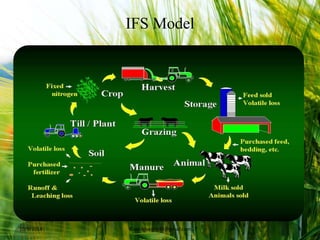
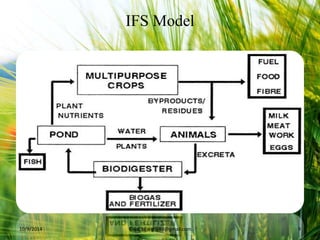
IFS Model
10/9/2014 ©vakitiswathi49@gmail.com 8
IFS Model
10/9/2014 ©vakitiswathi49@gmail.com 9
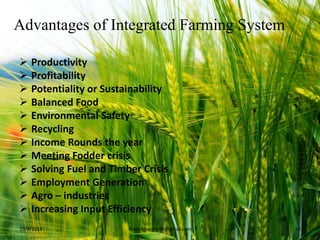
Advantages of Integrated Farming System
 Productivity
 Profitability
 Potentiality or Sustainability
 Balanced Food
 Environmental Safety
 Recycling
 Income Rounds the year
 Meeting Fodder crisis
 Solving Fuel and Timber Crisis
 Employment Generation
 Agro – industries
 Increasing Input Efficiency
10/9/2014 ©vakitiswathi49@gmail.com 10
Conclusion
Integrated farming system seems to be the
answer to the problems of increasing food
production , for increasing income and for
improving nutrition of the small scale farmers
with limited resources without any adverse
effect on environment and agro- eco-system
10/9/2014 ©vakitiswathi49@gmail.com 11
THANK YOU 
10/9/2014 ©vakitiswathi49@gmail.com 12

Integrated Farming System

  • 1.
    INTEGRATED FARMING SYSTEM -V. Swathi(RC/11-49) B.Sc.,(Commercial Agriculture and Business management) College of Agriculture , Rajendranagar Prof. Jaishankar Telangana State Agriculture University 10/9/2014 ©vakitiswathi49@gmail.com 1
  • 2.
    Introduction  “Farming system”designates a set of agricultural activities organized while preserving land productivity, environmental quality and maintaining desirable level of biological diversity and ecological stability. (Lal and Millar 1990)  Farming system consist of several enterprises like Cropping system, Dairying, Piggery, Poultry, Fishery, Bee keeping etc. these enterprises are interrelated. The end product and wastes of one enterprise are used as inputs in others 10/9/2014 ©vakitiswathi49@gmail.com 2
  • 3.
    Objectives  To identifyexisting farming systems in specific areas and access their relative viability  To formulate farming system. Model involving main and allied enterprises for different farming situations  To ensure optional utilization and conservation of available resources and effective recycling of farm residues within system  To maintain sustainable production system without damaging resources/environment  To rise over all profitability of farmhouse hold by complementing main/allied enterprises with other 10/9/2014 ©vakitiswathi49@gmail.com 3
  • 4.
    Factors Affecting IFS Soil and climatic features of the selected area  Availability of the resources, land, labour & capital  Present level of utilization of resources  Economics of proposed integrated farming system  Managerial skill of farmer 10/9/2014 ©vakitiswathi49@gmail.com 4
  • 5.
    Components of FarmingSystem • In the integrated farming system, it is always emphasized to combine cropping with other enterprises/ activities, many enterprises are available and these includes cattle maintenance sheep or goat rearing, poultry, piggery, rabbit rearing, bee keeping etc. Any one or more can be combined with the cropping. Buffaloes Sheep rearing Goat rearing 10/9/2014 ©vakitiswathi49@gmail.com 5 Contd…
  • 6.
     Cattle  Poultry Duck rearing  Turkey rearing  Piggery  Rabbit rearing  Bee keeping  Sericulture  Mushroom cultivation  Biogas plant • 10/9/2014 ©vakitiswathi49@gmail.com 6
  • 7.
    Integration of Enterprises Farming System Under Lowland: Common cropping system in agro climatic condition of south India are following: • Maize, Groundnut, Sesamum, Rice – Fish – Poultry culture  Upland Irrigated Farming Systems: Additional income can be generated by enterprises like Dairy , Biogas and Silvi culture to the usual cropping systems.  Rainfed Farming Systems: Agronomic practices of conservation, tillage and mulch farming, rotational cropping use of legumes and cover crops for improving soil fertility and suppressing weeds and efficient use of cattle manure are some of the components of sustainable farming systems. 10/9/2014 ©vakitiswathi49@gmail.com 7
  • 8.
  • 9.
  • 10.
    Advantages of IntegratedFarming System  Productivity  Profitability  Potentiality or Sustainability  Balanced Food  Environmental Safety  Recycling  Income Rounds the year  Meeting Fodder crisis  Solving Fuel and Timber Crisis  Employment Generation  Agro – industries  Increasing Input Efficiency 10/9/2014 ©vakitiswathi49@gmail.com 10
  • 11.
    Conclusion Integrated farming systemseems to be the answer to the problems of increasing food production , for increasing income and for improving nutrition of the small scale farmers with limited resources without any adverse effect on environment and agro- eco-system 10/9/2014 ©vakitiswathi49@gmail.com 11
  • 12.
    THANK YOU  10/9/2014©vakitiswathi49@gmail.com 12