For XII Fisheries
*
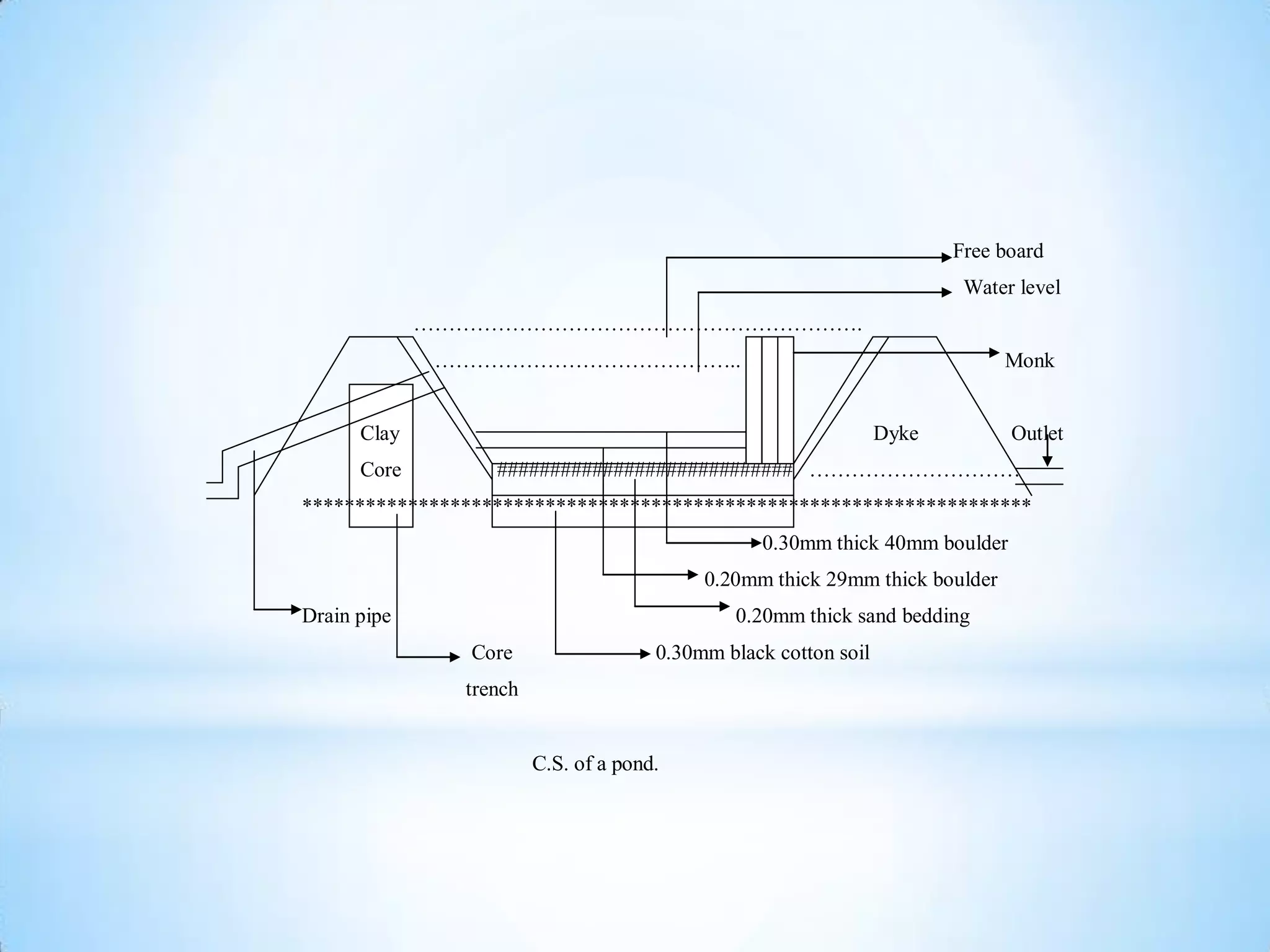
Free board
Water level
……………………………………………………….
…………………………………….. Monk
Clay Dyke Outlet
Core ############################ …………………………
*********************************************************************
0.30mm thick 40mm boulder
0.20mm thick 29mm thick boulder
Drain pipe 0.20mm thick sand bedding
Core 0.30mm black cotton soil
trench
C.S. of a pond.
Site selection
Site selection for a fish farm is one of the important things. For site selection rocky,
sandy and sites having limestone must be avoided.
If a pond is constricted in rocky sites excessive heat of summer makes rock hot
thereby heating the water of a pond and causing fish mortality. Secondly no
plankton production takes place in absence of soil bottom, even if soil is sprayed
at bottom it will be of no use.
If pond is constructed in sand, firstly it will be difficult to construct a pond in
sand. Secondly, during summer heating of sand hot up water excessively causing
fish mortality and since sand retains heat it takes time to cool down. No plankton
formation in absence of fertile soil.
Ponds in limestone sites are also not productive. Excessive alkalinity causes
alkosity in fish causing their mortality. pH above 9 is not suitable for fish and is
harmful for fish.
Site having the mixture of sand and clay are excellent for fish culture. Such sites
are also good for the breeding purpose of fish. Soil should have humus contents in
it. In Russia pond bottom is covered first with soil then with animal humus and
followed by the vegetation to improve soil quality. This type of soil can retain
water.
Field experiment for determining seepage of soil: Determination of soil
compactness can be calculated by a simple field method. In this method earthen
pot having a hole at the bottom is filled by soil of which compactness is to be
determined. In this earthen pot then water is poured and time to drain water
through bottom hole is calculated. More the time required more the compact is
soil less the time required soil should not be used for fish culture.
Construction
While constructing a pond, construction of dyke, slope of a pond, water inlet, water outlet
and mechanical spillway are to be taken care of.
Pond bottom must be cleared of from all types of vegetation, rocks and
other material which will hinder netting operations and may results in tearing it. It
also gives escape route to fish during harvesting it. Pond bottom should be
slightly sloping towards drainage. Loose soil must be removed from the ponds. If
pond has sandy or gravel soil then such pond permits water leakage and therefore
it should be sealed by adding clay over it.
Slope of the pond should be 1:2 i.e. for every 2mtrs. There is a change of
1mtr height i.e. slope of 1mtr. If pond has slope then it is easy to drain it
completely and therefore ponds built on slopes are cheaper and easy to drain.
Pond dyke is a protective structure pf the pond and hence be carefully
constructed. Sandy, gravel or marshy soil is not suitable for dykes instead a
mixture of sand, clay and silt in the ratio 3:2:1 is best for the construction of dyke.
Dykes should be well compacted for it is a protection of ponds.
| | - - - - - - - -Total depth - - - - - - - - - - - - - -
| | ------------Water level--------------------
| Slope 1:1:5 |
Cross section of a dyke
Trees should not be planted on the dyke for it make dyke weak. Top of the dyke
should be wide sufficiently for passage of vehicle to facilitate materials transport
for fisheries operation.
Monk performs two important functions one it prevents fish escape secondly it
prevents water overflowing by controlling it. Monk is nothing but a concrete or
brick structure in concrete. It has three lateral grooves one fitted with screen and
between two fitted with wooden boards. Between wooden boards is tightly filled
clay ensuring perfect water tightness.
Screen permits water flow but prevent fish escape. Monk is provided with water
outlet i.e. drainage pipe provided with a valve for regulating outflow of water.
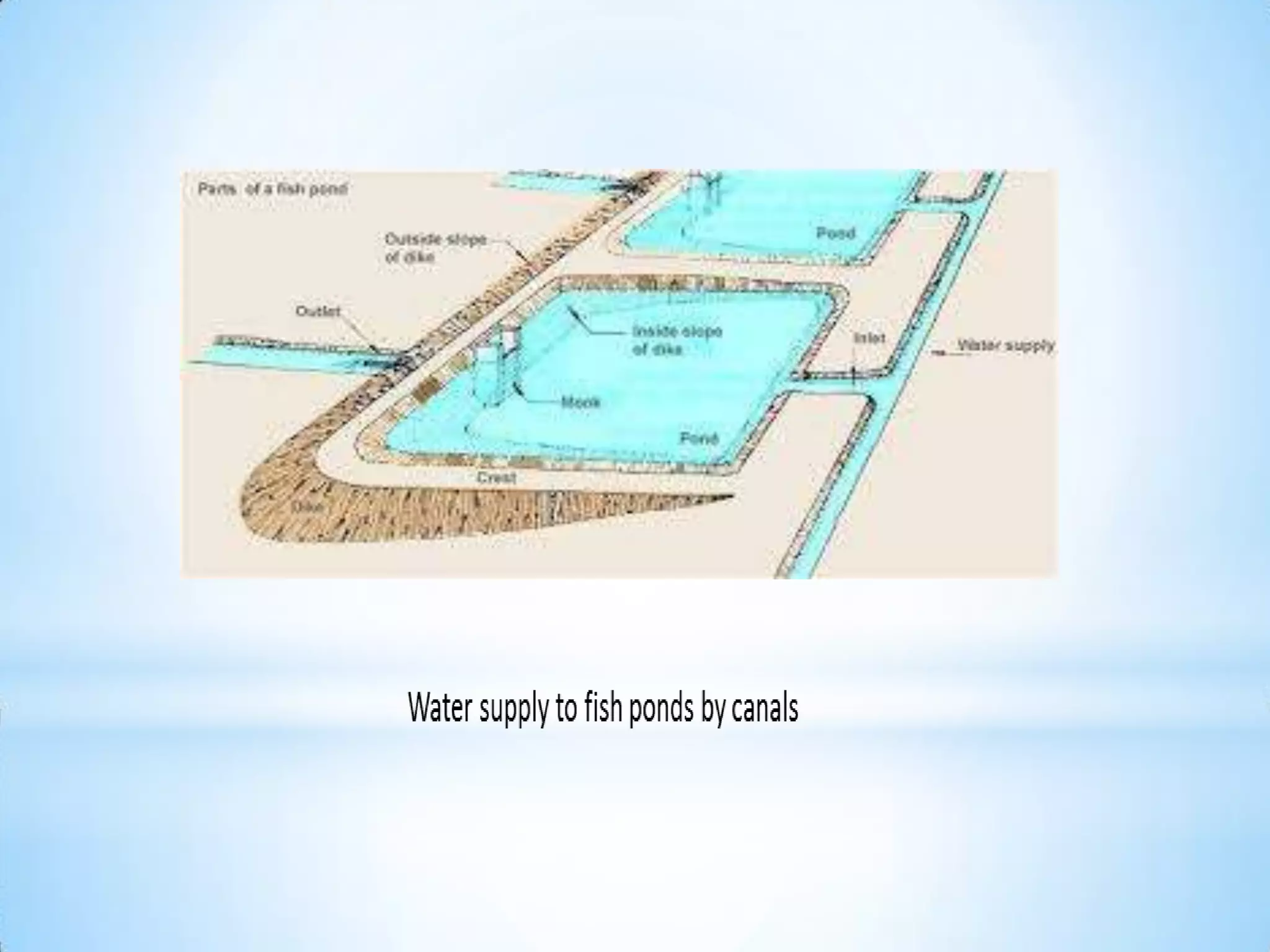
Water inlet is by canal system connecting to each and every pond of a farm or it
may be of pipelines opening in each and every pond. Pipeline may be of cast iron,
plastic pipes, cement pipes etc. Generally cement pipeline is preferred for it is
long lasting and durable.
If water is supplied through canal then it is controlled by a sluice gate. Sluice gate
can be of iron, wooden, cement or brick. The opening and closing of it supply
water to desired ponds. It also acts as filter for unwanted fish.
Lining of ponds can be of RCC, bricks, stone, HDPE, LDPE etc. Lining prevents
weeds and also make it easy to clean ponds.
Pond Lining
Different materials are used to line the ponds. Pond lining controls the weeds and also
make it easy to clean ponds. It is not necessary to line the ponds; however natural
surface adds soil to the pond bottom having impact on its depth. Also fish
predators live in it making burrows. It also invites weeds and other vegetation to
grow, hence lining of a pond is recommended. Following are the pond lining.
1] R.C.C.: Ponds can be lined by reinforced cement concrete. All the four sides of
the pond are covered with RCC. This is costly, however RCC lining of pond does
not allow fish predator to make burrow and live in it.
2] Brick lining: Ponds can also be lined with bricks using cement. It is cost effective
for it does not required skilled person and even a mason can fix the bricks. Bricks
can be laid in a single or double layer.
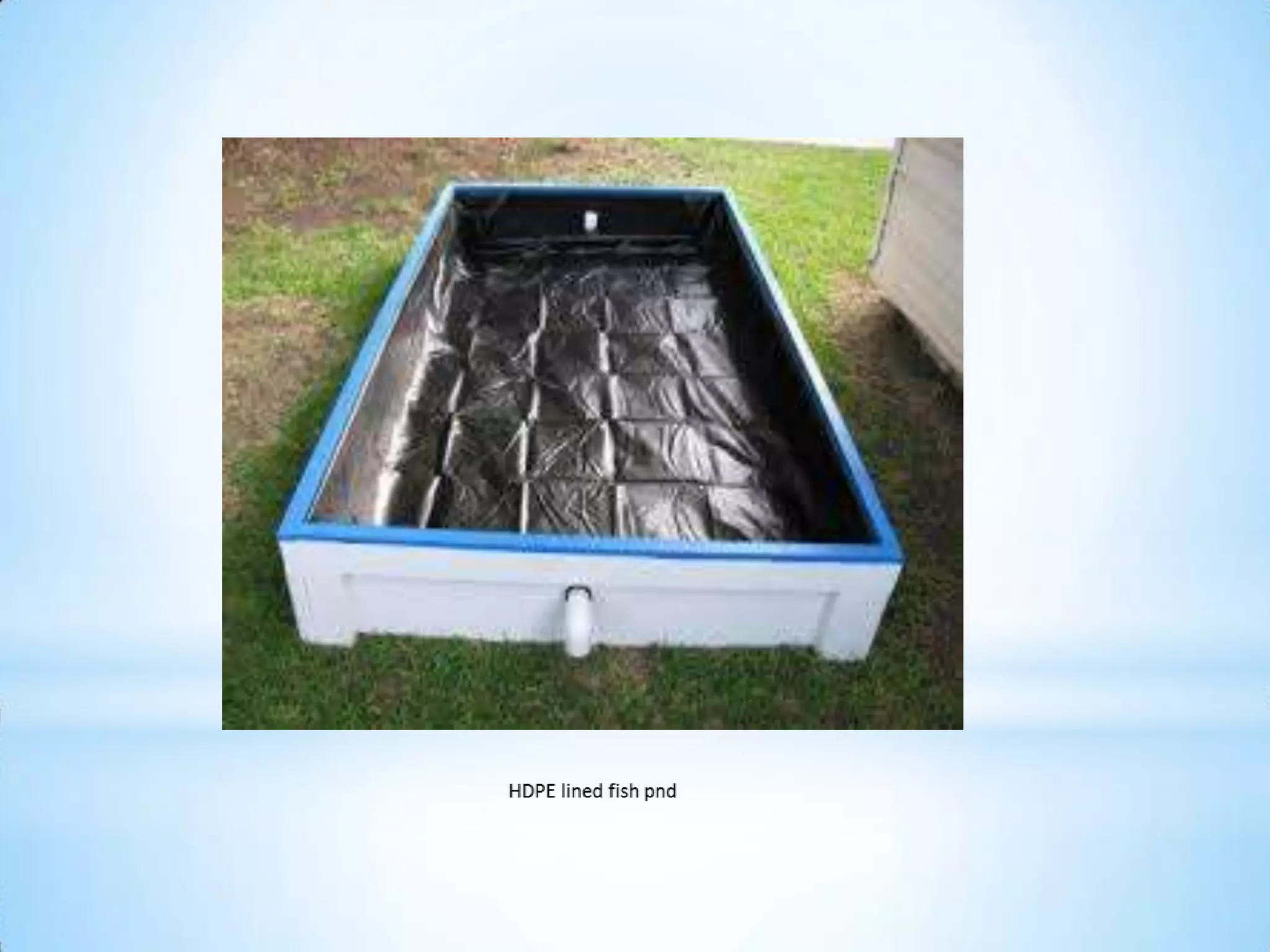
3] HDPE: HDPE or high density poly ethylene can be used for lining the pond. In
Russia this is practiced if a pond is having seepage problem.
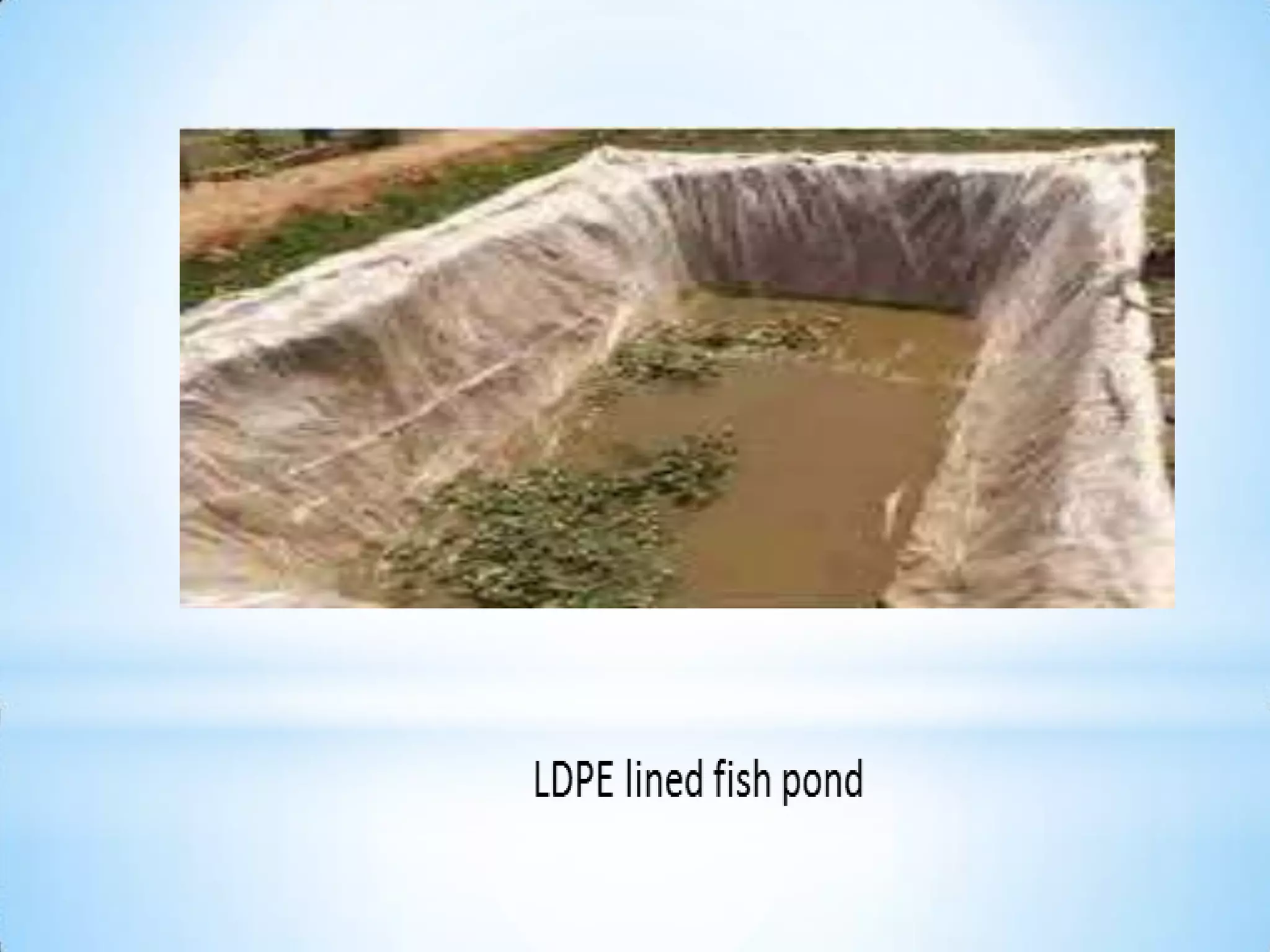
4] LDPE: Low density poly ethylene can be used for lining the pond.
Water inlet of ponds
Ponds are constructed in series to facilitate water supply to them. It is therefore that a
canal of water having sluice gates at the supply to pond can be ideal. A sluice gate
is constructed of iron, wooden, cement or brick. It allows water to particular
desired pond when it is open, blocking water to other ponds.
Pipelines are used to supply water to the ponds. Pipes used can be made of cast
iron which serves the purpose for many years; however after some year they rust
and has to be replaced.
Plastic pipes can also be used for the purpose, however they are delicate and can
be broken easily if excessive weight is given on them.
Cement pipes can also be used to provide water to the ponds. Cement pipes are
the best of all for they are sturdy and can be used for years without having any
problem.
Cross section of a fish pond

Cross section of a fish pond

  • 1.
  • 2.
    Free board Water level ………………………………………………………. ……………………………………..Monk Clay Dyke Outlet Core ############################ ………………………… ********************************************************************* 0.30mm thick 40mm boulder 0.20mm thick 29mm thick boulder Drain pipe 0.20mm thick sand bedding Core 0.30mm black cotton soil trench C.S. of a pond.
  • 3.
    Site selection Site selectionfor a fish farm is one of the important things. For site selection rocky, sandy and sites having limestone must be avoided. If a pond is constricted in rocky sites excessive heat of summer makes rock hot thereby heating the water of a pond and causing fish mortality. Secondly no plankton production takes place in absence of soil bottom, even if soil is sprayed at bottom it will be of no use. If pond is constructed in sand, firstly it will be difficult to construct a pond in sand. Secondly, during summer heating of sand hot up water excessively causing fish mortality and since sand retains heat it takes time to cool down. No plankton formation in absence of fertile soil. Ponds in limestone sites are also not productive. Excessive alkalinity causes alkosity in fish causing their mortality. pH above 9 is not suitable for fish and is harmful for fish. Site having the mixture of sand and clay are excellent for fish culture. Such sites are also good for the breeding purpose of fish. Soil should have humus contents in it. In Russia pond bottom is covered first with soil then with animal humus and followed by the vegetation to improve soil quality. This type of soil can retain water.
  • 4.
    Field experiment fordetermining seepage of soil: Determination of soil compactness can be calculated by a simple field method. In this method earthen pot having a hole at the bottom is filled by soil of which compactness is to be determined. In this earthen pot then water is poured and time to drain water through bottom hole is calculated. More the time required more the compact is soil less the time required soil should not be used for fish culture.
  • 5.
    Construction While constructing apond, construction of dyke, slope of a pond, water inlet, water outlet and mechanical spillway are to be taken care of. Pond bottom must be cleared of from all types of vegetation, rocks and other material which will hinder netting operations and may results in tearing it. It also gives escape route to fish during harvesting it. Pond bottom should be slightly sloping towards drainage. Loose soil must be removed from the ponds. If pond has sandy or gravel soil then such pond permits water leakage and therefore it should be sealed by adding clay over it. Slope of the pond should be 1:2 i.e. for every 2mtrs. There is a change of 1mtr height i.e. slope of 1mtr. If pond has slope then it is easy to drain it completely and therefore ponds built on slopes are cheaper and easy to drain. Pond dyke is a protective structure pf the pond and hence be carefully constructed. Sandy, gravel or marshy soil is not suitable for dykes instead a mixture of sand, clay and silt in the ratio 3:2:1 is best for the construction of dyke. Dykes should be well compacted for it is a protection of ponds.
  • 6.
    | | -- - - - - - -Total depth - - - - - - - - - - - - - - | | ------------Water level-------------------- | Slope 1:1:5 | Cross section of a dyke
  • 7.
    Trees should notbe planted on the dyke for it make dyke weak. Top of the dyke should be wide sufficiently for passage of vehicle to facilitate materials transport for fisheries operation. Monk performs two important functions one it prevents fish escape secondly it prevents water overflowing by controlling it. Monk is nothing but a concrete or brick structure in concrete. It has three lateral grooves one fitted with screen and between two fitted with wooden boards. Between wooden boards is tightly filled clay ensuring perfect water tightness. Screen permits water flow but prevent fish escape. Monk is provided with water outlet i.e. drainage pipe provided with a valve for regulating outflow of water. Water inlet is by canal system connecting to each and every pond of a farm or it may be of pipelines opening in each and every pond. Pipeline may be of cast iron, plastic pipes, cement pipes etc. Generally cement pipeline is preferred for it is long lasting and durable. If water is supplied through canal then it is controlled by a sluice gate. Sluice gate can be of iron, wooden, cement or brick. The opening and closing of it supply water to desired ponds. It also acts as filter for unwanted fish. Lining of ponds can be of RCC, bricks, stone, HDPE, LDPE etc. Lining prevents weeds and also make it easy to clean ponds.
  • 8.
    Pond Lining Different materialsare used to line the ponds. Pond lining controls the weeds and also make it easy to clean ponds. It is not necessary to line the ponds; however natural surface adds soil to the pond bottom having impact on its depth. Also fish predators live in it making burrows. It also invites weeds and other vegetation to grow, hence lining of a pond is recommended. Following are the pond lining. 1] R.C.C.: Ponds can be lined by reinforced cement concrete. All the four sides of the pond are covered with RCC. This is costly, however RCC lining of pond does not allow fish predator to make burrow and live in it. 2] Brick lining: Ponds can also be lined with bricks using cement. It is cost effective for it does not required skilled person and even a mason can fix the bricks. Bricks can be laid in a single or double layer. 3] HDPE: HDPE or high density poly ethylene can be used for lining the pond. In Russia this is practiced if a pond is having seepage problem. 4] LDPE: Low density poly ethylene can be used for lining the pond.
  • 11.
    Water inlet ofponds Ponds are constructed in series to facilitate water supply to them. It is therefore that a canal of water having sluice gates at the supply to pond can be ideal. A sluice gate is constructed of iron, wooden, cement or brick. It allows water to particular desired pond when it is open, blocking water to other ponds. Pipelines are used to supply water to the ponds. Pipes used can be made of cast iron which serves the purpose for many years; however after some year they rust and has to be replaced. Plastic pipes can also be used for the purpose, however they are delicate and can be broken easily if excessive weight is given on them. Cement pipes can also be used to provide water to the ponds. Cement pipes are the best of all for they are sturdy and can be used for years without having any problem.