OPTC Edavanna Page 1
MODULE I
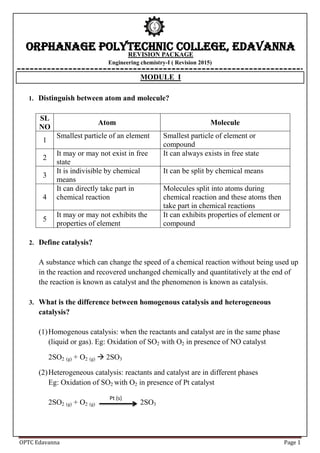
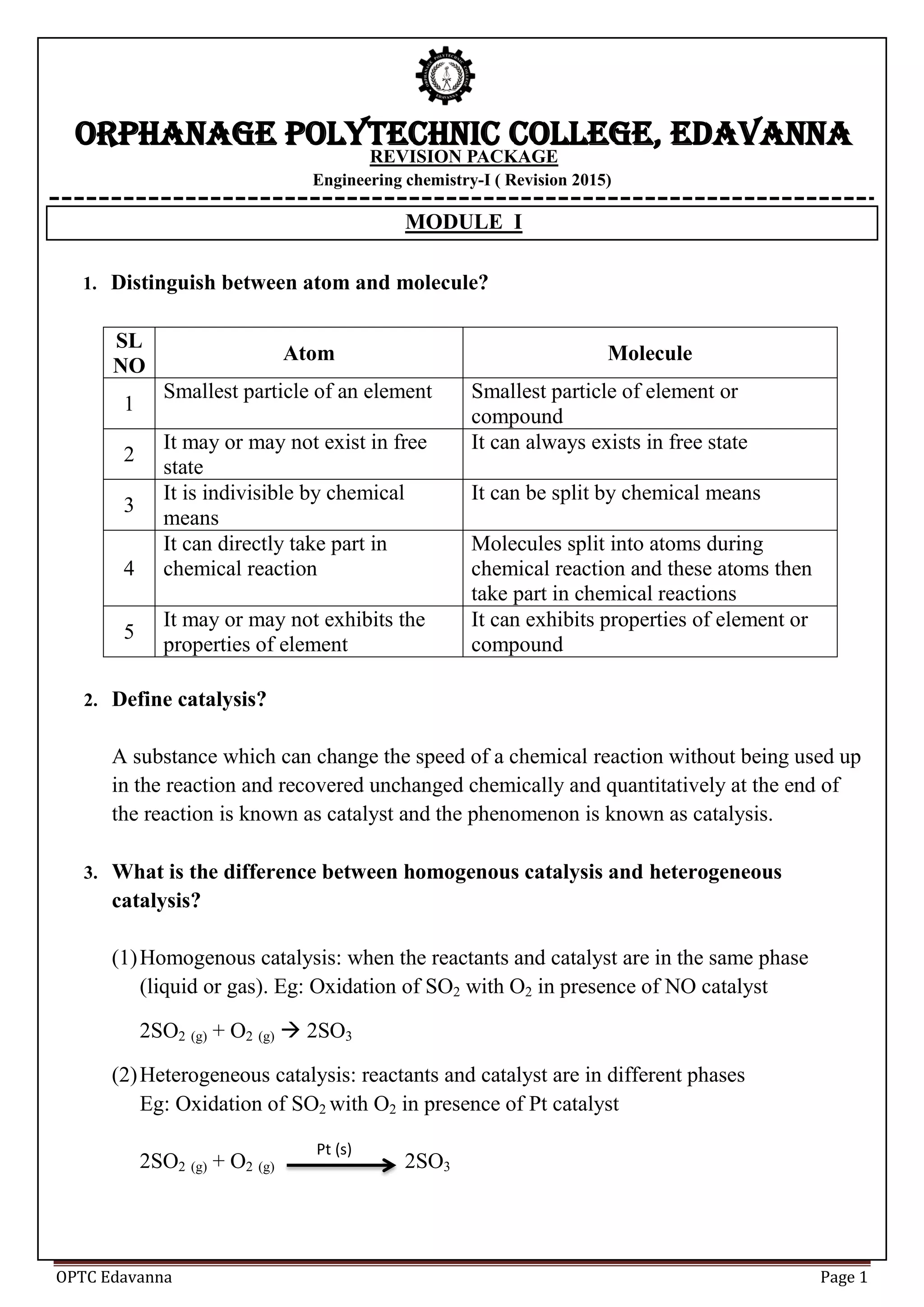
1. Distinguish between atom and molecule?
SL
NO
Atom Molecule
1
Smallest particle of an element Smallest particle of element or
compound
2
It may or may not exist in free
state
It can always exists in free state
3
It is indivisible by chemical
means
It can be split by chemical means
4
It can directly take part in
chemical reaction
Molecules split into atoms during
chemical reaction and these atoms then
take part in chemical reactions
5
It may or may not exhibits the
properties of element
It can exhibits properties of element or
compound
2. Define catalysis?
A substance which can change the speed of a chemical reaction without being used up
in the reaction and recovered unchanged chemically and quantitatively at the end of
the reaction is known as catalyst and the phenomenon is known as catalysis.
3. What is the difference between homogenous catalysis and heterogeneous
catalysis?
(1)Homogenous catalysis: when the reactants and catalyst are in the same phase
(liquid or gas). Eg: Oxidation of SO2 with O2 in presence of NO catalyst
2SO2 (g) + O2 (g)  2SO3
(2)Heterogeneous catalysis: reactants and catalyst are in different phases
Eg: Oxidation of SO2 with O2 in presence of Pt catalyst
2SO2 (g) + O2 (g) 2SO3
Orphanage Polytechnic College, Edavanna
REVISION PACKAGE
Engineering chemistry-I ( Revision 2015)
Pt (s)
OPTC Edavanna Page 2
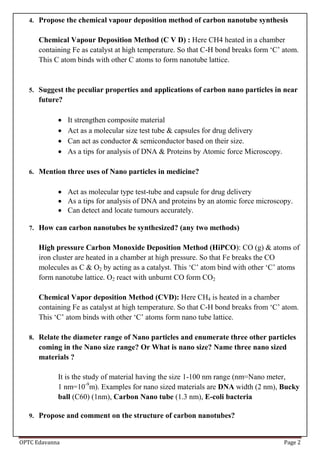
4. Propose the chemical vapour deposition method of carbon nanotube synthesis
Chemical Vapour Deposition Method (C V D) : Here CH4 heated in a chamber
containing Fe as catalyst at high temperature. So that C-H bond breaks form ‘C’ atom.
This C atom binds with other C atoms to form nanotube lattice.
5. Suggest the peculiar properties and applications of carbon nano particles in near
future?
 It strengthen composite material
 Act as a molecular size test tube & capsules for drug delivery
 Can act as conductor & semiconductor based on their size.
 As a tips for analysis of DNA & Proteins by Atomic force Microscopy.
6. Mention three uses of Nano particles in medicine?
 Act as molecular type test-tube and capsule for drug delivery
 As a tips for analysis of DNA and proteins by an atomic force microscopy.
 Can detect and locate tumours accurately.
7. How can carbon nanotubes be synthesized? (any two methods)
High pressure Carbon Monoxide Deposition Method (HiPCO): CO (g) & atoms of
iron cluster are heated in a chamber at high pressure. So that Fe breaks the CO
molecules as C & O2 by acting as a catalyst. This ‘C’ atom bind with other ‘C’ atoms
form nanotube lattice. O2 react with unburnt CO form CO2
Chemical Vapor deposition Method (CVD): Here CH4 is heated in a chamber
containing Fe as catalyst at high temperature. So that C-H bond breaks from ‘C’ atom.
This ‘C’ atom binds with other ‘C’ atoms form nano tube lattice.
8. Relate the diameter range of Nano particles and enumerate three other particles
coming in the Nano size range? Or What is nano size? Name three nano sized
materials ?
It is the study of material having the size 1-100 nm range (nm=Nano meter,
1 nm=10-9
m). Examples for nano sized materials are DNA width (2 nm), Bucky
ball (C60) (1nm), Carbon Nano tube (1.3 nm), E-coli bacteria
9. Propose and comment on the structure of carbon nanotubes?
OPTC Edavanna Page 3
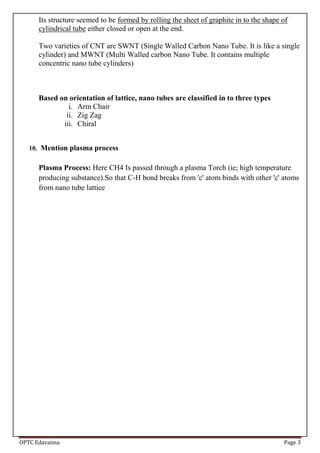
Its structure seemed to be formed by rolling the sheet of graphite in to the shape of
cylindrical tube either closed or open at the end.
Two varieties of CNT are SWNT (Single Walled Carbon Nano Tube. It is like a single
cylinder) and MWNT (Multi Walled carbon Nano Tube. It contains multiple
concentric nano tube cylinders)
Based on orientation of lattice, nano tubes are classified in to three types
i. Arm Chair
ii. Zig Zag
iii. Chiral
10. Mention plasma process
Plasma Process: Here CH4 Is passed through a plasma Torch (ie; high temperature
producing substance).So that C-H bond breaks from 'c' atom binds with other 'c' atoms
from nano tube lattice
OPTC Edavanna Page 4
MODULE II
1. The equivalent mass of a monobasic acid is 63. Its salt with a very weak base is
used as an explosive and as a fertilizer. Enlist the acid and base and give the
chemical reaction . ?
Acid is HNO3 & Base is K2CO3
Chemical equation is 2HNO3 + K2CO3  2KNO3 + H2O + CO2
2. Define equivalent weight of acids and bases. Calculate the equivalent weights of
H2SO4 and Ca(OH)2 ?
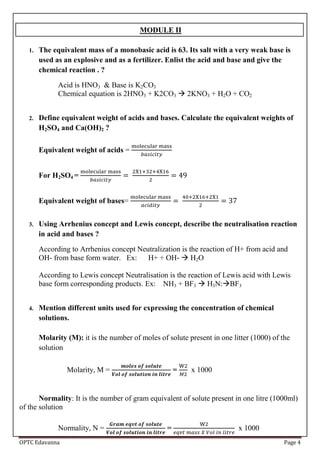
Equivalent weight of acids =
For H2SO4 =
Equivalent weight of bases=
3. Using Arrhenius concept and Lewis concept, describe the neutralisation reaction
in acid and bases ?
According to Arrhenius concept Neutralization is the reaction of H+ from acid and
OH- from base form water. Ex: H+ + OH-  H2O
According to Lewis concept Neutralisation is the reaction of Lewis acid with Lewis
base form corresponding products. Ex: NH3 + BF3  H3N:BF3
4. Mention different units used for expressing the concentration of chemical
solutions.
Molarity (M): it is the number of moles of solute present in one litter (1000) of the
solution
Molarity, M = = x 1000
Normality: It is the number of gram equivalent of solute present in one litre (1000ml)
of the solution
Normality, N = = x 1000
OPTC Edavanna Page 5
5. A solution is prepared by dissolving 0.4 g of NaOH in ml of water. What is the
pH of the solution?
Molarity M= Concn of OH- = X 1000 = X 1000 = 0.1 M
6. A solution is prepared by dissolving 0.49 of NaOH in 500 ml .What is the pH of
the solution?
Molarity, M= = X 1000 = X 1000 = 0.0245 mol/L = [OH-]
We have, [H+] [OH-] = 10-14
[H+] = 10-14
/ 0.0245
= 4.08 x 10⁻¹³
PH
= -log[H+] = -log (4.08 x 10⁻¹³
)
= 12.38
7. What is mean by indicator range? Give two example
Indicator range: it is the range of pH in which an indicator changes the colour
methyl orange : 3.1 to 4.5
Phenolphthalein : 8.3 to 10
8. What are radicals? Give two examples
Charged atom or atom groups are called radicals: NH4+, Cl- , etc.
9. Calculate the pH of an aqueous solution that has an OH- concentration of
1.9 10-3
M?
Given , [OH-] = 1.9 x 10⁻³ M
We have,
[H+] [OH-] = 10-14
[H+] = 10-14
/ 1.9 x10-3
= 5.263 x 10⁻¹²
OPTC Edavanna Page 6
PH
= -log [H+] = -log (5.263 x10⁻¹²
)
= 11.279
10. Explain the terms: (1) Standard solution (2) Indicator
Standard solution: Solution whose concentration is known Eg: 1N NaOH
Indicator: Substance added to the conical flask to know the end point. It shows colour
change in a particular PH
range. Eg: Methyl orange, phenolphthalein, methyl red etc
11. Calculate the pH of a 0.025M HNO3 solution
Given, [H+]= 0.025 M
PH
=-log[H+] = -log (0.025) = 1.602
12. Calculate the normality and molarity of the following solutions:
a) NaOH solution containing 20 g in 500 ml
b) 0.63 g of oxalic acid (H2C2O4.2H2O) in 250 ml
(a) Normality, N = = 1 N
Molarity, M = = x 1000 = X 1000 = 1 M
(b) Normality, N = = 0.04 N
Molarity, M = x 1000 = X 1000 = 0.02 M
13. Classify the following as Lewis acid and Lewis base : NH3, Ni2+, Ag+,H2O,
CO2+ , CN-, BF3,Cl -,
Lewis acids Lewis acids
Ni2+
NH3
Ag+
H2O
CO2+
CN-
BF3 Cl -
14. What is acid-base indicator?
OPTC Edavanna Page 7
Indicator: Substance added to the conical flask to know the end point. It shows colour
change in a particular PH
range. Eg: Methyl orange, Phenolphthalein, Methyl red etc.
What types of indicators are used in the following set of titrations?
a) NaOH x HCl : Phenolphthalein/Methyl orange
b) NaOH X acetic acid : Phenolphthalein
c) K2CO3 xH2SO4 : Methyl orange
15. PH
of cold drink water is 4.5. What will be its action on blue and red litmus
solution?
It turns blue litmus solution into red. But no change on red litmus solution
16. Propose any two industrial and Biological applications of PH
?
 PH
of blood is very important. Small change in its PH
results even death
 PH
of human gastric juice is in b/w 1-3. Increase of PH
generally cause
Vomiting
 In textile industry: acidity of water used for bleaching cotton is harmful. So
they should control
 Chemical industry: The effluents from chemical factories should be
neutralizing before they discharging to river. Because they are either acidic
or basic
17. Define PH
. Calculate the PH
of 0.001 normal NaOH Solution?
PH
is negative logarithm of H+ ion concentration
PH
= - log [H+]
Given,
[OH-] = 0.001 N
We have,
[H+][OH-] = 10-14
 [H+] = 10-14
/0.001
= 10-11
So, PH = -log [H+] = - log [10-11
] = 11
18. PH
of cold drink is 5. What will be its action on blue and red litmus solution?
OPTC Edavanna Page 8
Here PH
is 5, so acidic. So it turn blue litmus solution to red. But there is no action on
red litmus Solution.
19. Calculate the pH and specify the nature of the following solutions :
a) [H+] = 0.0123 mol/l
o pH = -log[H+]
= -log(0.0123)
= 1.91, acidic
b) [H+] = 1x10⁻⁷ mol/l
o pH= -log[H+]
= -log(1x10⁻⁷)
= 7 , Neutral
c) [H+] = 5x10-13 mol/l
o pH = -log[H+]
= -log (5x10⁻³)
= 12.3 , basic
20. 3.15 g of oxalic acid is dissolved in 100 ml water, calculate its normality and
molarity?
N = X 1000
= X 1000 = 0.5 N
Molecular mass of oxalic acid = 126
Equivalent weight = 126/2 = 63
M = X 1000
= X 1000 = 0.25 M
M2 = Molecular mass of oxalic acid = 126
21. Define pH and mention its three uses?
It is the negative logarithm of H+ ion concentration. Its value varies from 0 to 14
OPTC Edavanna Page 9
I.e., pH = -log [H+
]
 To find out the nature of the medium
 Can calculate the [H+] ion
 In textile industry: Acidity of water used for bleaching cotton is harmful.
So they should control
22. What is a buffer solution? Give one example each for acid buffer and basic
buffer?
Buffer solution: There are acidic buffer solution and basic buffer solution. A
buffer solution is the solution which resists change in pH when small amount
of acid or base added to it.
Eg: Blood, CH3COOH + CH3COONa, NH4OH + NH4Cl
23. Account why the pH of the blood remains constant?
Blood is buffer or due to combined action of HCO3-
/CO32+
buffer
24. 40 ml of 0.5 normal hydrochloric acid exactly combines with 0.42 g of a chemical
substance. Calculate the equivalent mass of the compound?
N = X 1000
Eqvt wt = X 1000 = X 1000 = 21
25. 20 ml KOH solution containing 8.5 g of KOH per litre of the solution is titrated
against sulphuric acid solution. The volume of the acid required is 19.2 ml.
calculate the normality and strength of the acid solution?
Normality of KOH solution, N = X 1000 = = 0.1 N
26. Which indicator will you use in the following titrations? Why?
H2SO4 x Na2CO3 & CH3COOH x NaOH
For H2SO4 & Na2CO3 we use methyl orange indicator. Because for the titration of
strong acid+ weak base, pH range at the end point is 3.5 to 7.5.
For CH3COOH & NaOH , we use phenolphthalein indicator. Because for the
titration of weak acid and strong base, pH range at the end point is 6.5 to 10
27. Which indicator is suitable for the titration of a strong acid against a weak base?
Explain.
OPTC Edavanna Page 10
For the titration of a strong acid against a weak base we use methyl orange indicator.
Because for the titration of strong acid+ Vs weak base, PH
range at the end point is 3.5
to 7.5.
28. Calculate the mass of NaOH required to make 0.01 normal 250 ml solution
N = X 1000
W2 =
29. Briefly explain volumetric analysis
Determination of volume of a standard solution (taken in burette) used to react
quantitatively with a so known volume of a solution ( taken in pipette) to be
estimated is called VOLUMETRIC ANALYSIS and the process is called
titration.
Different terms used in Volumetric analysis are Standard solution, End point,
Indicator etc. An indicator changes the colour at a particular PH
range.
Principle of Volumetric Analysis: If N1 and V1 are the normality and volume
of first solution and N2 and V2 are the normality and volume of the second
solution, then according to Normality equation N1 V1=N2V2. This is the
Principle of Volumetric Analysis
30. How many moles how many grams of NaCl are present in 250 ml of 0.25 M NaCl
solution ?
We have, M = X 1000  W2 = = 3.65 g
No. of moles = = = 0.0623
31. Define ionic product of water? How will you obtain this value?
Ionic product of water [Kw] is the product of concentration of H+ and OH- ions in
water. It was experimentally found that at 25o
C,
[H+] = [OH-] = 10-7
mol/litre
OPTC Edavanna Page 11
MODULE III
1. Rain water is the purest form of natural waters. Give reason?
Because it is a distilled water and iIt does not Contain Mg/Ca salts
2. What is meant by degree of hardness?
It is the number of parts by weight of CaCO3 present in one million (106) parts by
weights of water. Unit= PPM (Parts Per Million)
3. Distinguish between temporary hardness and permanent hardness of water?
Temporary hardness: it is due to HCO3 of Ca and Mg. It can be removed by boiling
Permanent hardness: It is due to Cl-, SO4
2-
of Ca and Mg. It can be removed by ion
exchange method using synthetic resins like carbon exchanger (E-H+) or anion
exchange (E-OH-)
4. What is portable water? What are the characteristics of portable water?
Portable water: Water which safe to drink. it is need not be pure like distilled water.
Characteristics:
 Clear and odourless
 Free from micro-organisms like bacteria
 Free from dissolved gases like H2S, CO2, etc and minerals like NO3
-, NO2
-
 Free from suspended impurities
 PH
should be between 6.5 to 8.5
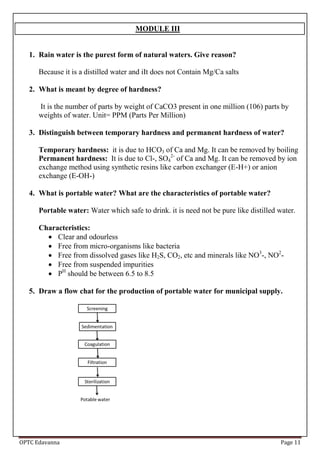
5. Draw a flow chat for the production of portable water for municipal supply.
OPTC Edavanna Page 12
6. You had a sample of hard water. How can you prepare soft water and deionised
water from it? Or
By removing hardness. It is done either by heating or By ion exchange
method as shown below. By boiling, the following reactions occurs
ie M(HCO3 )2  MCO3 + H2O +CO2 M = Ca/Mg
[Explain the role of ion exchange resins in softening of hard water ? or Explain
ion exchange method?]
In ion exchange method hardness can be removed by using synthetic resins
like Cation exchanger [E-H+] or anion exchanger [E-OH-] as shown below
Step 1:
Hard water passed through a tank containing [E-H+] so the following occur
2 E-H+ + Ca2+  E2Ca + 2H+
Step 2:
This water coming out of cation exchanger is then passed through anion
exchanger [E-OH-]
ie E-OH- + Cl-  ECl + OH- and H+ + OH-  H2O
7. Enumerate the disadvantages of hard water?
A) In laundry :
Wastage of soap: because While washing with hard water, soap from lather
only after removing all dissolved impurities, so cause wastage of soap.
It causes spot and streak on the cloth.
B) In steam boiler :
Wastage of fuel:- Hard water cause a hard deposit on boiler called scale.
It cause wastage of fuel
Cause explosion of boiler: Due to intense heat, the scale may crack and
Cause explosion of boiler (because it is a heat
insulating one.)
Cause corrosion of the boiler: Because of the formation of HCl as shown
below.
MgCl2 + H2O  Mg(OH)2 + 2HCl
C) Not use for cooking, bathing
OPTC Edavanna Page 13
8. Give two advantages of hard and soft water?
Soft water Hard water
 Give lather
readily with soap
Advantages:
 Used for
cooking.
 Bathing
 In boiler
 In laundry
purposes etc
 Does not give lather with soap
 Contains dissolved impurities like
HCO3
-
, SO42-
of Ca and Mg
Advantages:
 Contains Ca2+
and Mg2+
ions
required for health
 Does not dissolve Pb from lead
pipe
9. Give the use of alum in flocculation process of water purification?
Alum is used to remove finely divided particle from water. While adding alum, it is
settle down & can be removed by filtration.
10.Give reason of hardness of water and how we can remove temporary hardness
It is due to dissolved impurities like HCO3-, Cl -, SO4
2-
of Ca and Mg.
Temporary hardness is due to HCO3- of Ca and Mg. It can be removed by
boiling.
M (HCO3)2  MCO3 +H2O +CO2 M= Ca and Mg
11.Propose a suitable method for the purification of a water sample containing
dissolved salts in small quantities?
Boiling : By boiling the dissolved salt settle down & and can be removed by filtration.
12.What is sterilization of water? Mention the different methods of sterilization of
water? Or Compare the sterilization of water using bleaching powder and ozone?
Sterilization: it is the destroying of disease causing bacteria and micro-organism
using fertilizers or disinfectant like bleaching powder etc. These are
a) Chlorination: By passing chlorine gas or chlorine water. Here Hypo
chlorous acid produced killed
the germs as shown below
Cl2+H2O HOCl ( Hypo chlorous acid)
HOClHCl+[O]
[O] + Germs Germs killed
It need less space, Cl2 available in pure form are advantages, but excess
Cl2 cause unpleasant smell, taste etc
OPTC Edavanna Page 14
b) Using Bleaching Powder : Mix 1kg CaOCl2 with 1000 kilo litre water. By
oxidizing action of Cl, it kills
the germs as shown below
CaOCl2+H2O Ca (OH)2+ Cl2
Cl2+H2OHOCl ( Hypo chlorous acid)
HOClHCl+[O]
[O] + Germs Germs killed
c) By Passing Ozone(O3): On passing O3 through water , following reaction
occurs.
O3O2+ [O]
Here nascent oxygen produces killed the germs as shown below by
oxidizing action
[O] + Germs Germs killed
Its excess is not harmful
d) By passing UV radiation: so it kills the germs. It is expensive and is
adopted when chemical
methods are not suitable
13.Explain the different filtration techniques used in water treatment
Filtration: Used to remove colloidal and bacterial impurities from water. These are
1) Gravity sand filter
2) Pressure filter method
1. Gravity sand filter:
2. Pressure filter method: Here filtering medium is essentially same as above.
Filtering materials is kept in a closed cylinder and water is forced into filter under
pressure. It is used hot water, require less space.
OPTC Edavanna Page 15
Module IV
1. Explain physical properties of metals?
 Malleability: property which allows metal to be beaten into thin sheets.
 Ductility: property which allows metal to be drawn into wires.
 Thermal conductivity: ability of metal to conduct heat
 Electrical conductivity: ability allowing passage of electricity
 Weldability: by welding together with heat or pressure or both
 Machinability: metal can be easily cut into desired shapes
 Melting point: metals process high melting point
 Toughness
 Hardness
 Specific gravity
2. Explain heat treatments of steel ?
Annealing: process of heating the metal to a certain high temperature in furnace and
cooling it slowly in a planned manner.
Quenching or Hardening: Process of heating steel beyond redness (1123 K) and
suddenly cooling it by plunging in water or oil.
Tampering: Quenched steel is heated to a temperature of 550 K. It is then kept at that
temperature for some time and cooled slowly. This is called tampering of steel.
Nitriding: Steel is heated upto 820 K in an atmosphere of ammonia gas. After heating
for long periods it slowly cooled.
3. Explain two features of solid catalyst?
Two important features of solid catalyst are (1) Activity (2) Selectivity
(1)Activity: Capacity of catalyst to increase the speed of the chemical reaction
(2)Selectivity: Ability of catalyst to direct the reaction to form particular products
excluding others.
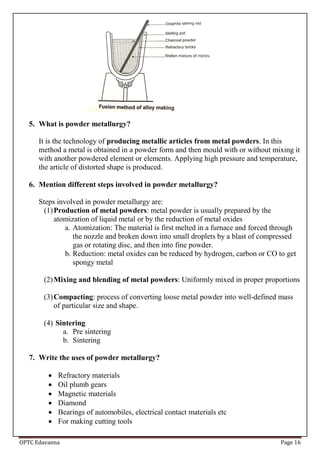
4. Explain the preparation of alloy by fusion method?
 Oldest method of making alloys
 The components of the alloy are fused together in refractory brick lined crucible
or melting pot.
 The component with higher melting point is first melted in the crucible and then
the component with lower melting point is added.
 The melt is thoroughly stirred with a graphite rod.
 A layer of powdered carbon is spread on surface to prevent oxidation
 Molten mass allowed to cool to get a solid alloy
OPTC Edavanna Page 16
5. What is powder metallurgy?
It is the technology of producing metallic articles from metal powders. In this
method a metal is obtained in a powder form and then mould with or without mixing it
with another powdered element or elements. Applying high pressure and temperature,
the article of distorted shape is produced.
6. Mention different steps involved in powder metallurgy?
Steps involved in powder metallurgy are:
(1)Production of metal powders: metal powder is usually prepared by the
atomization of liquid metal or by the reduction of metal oxides
a. Atomization: The material is first melted in a furnace and forced through
the nozzle and broken down into small droplets by a blast of compressed
gas or rotating disc, and then into fine powder.
b. Reduction: metal oxides can be reduced by hydrogen, carbon or CO to get
spongy metal
(2)Mixing and blending of metal powders: Uniformly mixed in proper proportions
(3)Compacting: process of converting loose metal powder into well-defined mass
of particular size and shape.
(4) Sintering
a. Pre sintering
b. Sintering
7. Write the uses of powder metallurgy?
 Refractory materials
 Oil plumb gears
 Magnetic materials
 Diamond
 Bearings of automobiles, electrical contact materials etc
 For making cutting tools
OPTC Edavanna Page 17
8. Explain the limitations of powder metallurgy? (Or Disadvantages)
 Toxicity: Metal powders are hazardous to human body
 Pyrophoricity: Property of metals to get self-ignited at high temperature
 Explosivity: Metal powders are highly explosive
 Relatively high pressure is required to compact the powder into the desired
shape.
9. Explain advantages of powder metallurgy?
 Articles of any shape can be manufactured
 Dimensional accuracy and good surface finish is obtained
 Clear and quick
 Metals as well as non-metals can be mixed in any proportion
 The products are relatively more uniform and free from defects such as voids,
blow holes, etc
 Parts with wide variations in composition can be produced
 Life of component parts is longer
 Rate of production is high
 Highly skilled labours is not required
 Porous parts can be produced
 Impossible parts like super-hard cutting tools can be prepared
 Materials which cannot be prepared by fusion or reduction can also be prepared
by this method.

First semester diploma Engineering chemistry I

  • 1.
    OPTC Edavanna Page1 MODULE I 1. Distinguish between atom and molecule? SL NO Atom Molecule 1 Smallest particle of an element Smallest particle of element or compound 2 It may or may not exist in free state It can always exists in free state 3 It is indivisible by chemical means It can be split by chemical means 4 It can directly take part in chemical reaction Molecules split into atoms during chemical reaction and these atoms then take part in chemical reactions 5 It may or may not exhibits the properties of element It can exhibits properties of element or compound 2. Define catalysis? A substance which can change the speed of a chemical reaction without being used up in the reaction and recovered unchanged chemically and quantitatively at the end of the reaction is known as catalyst and the phenomenon is known as catalysis. 3. What is the difference between homogenous catalysis and heterogeneous catalysis? (1)Homogenous catalysis: when the reactants and catalyst are in the same phase (liquid or gas). Eg: Oxidation of SO2 with O2 in presence of NO catalyst 2SO2 (g) + O2 (g)  2SO3 (2)Heterogeneous catalysis: reactants and catalyst are in different phases Eg: Oxidation of SO2 with O2 in presence of Pt catalyst 2SO2 (g) + O2 (g) 2SO3 Orphanage Polytechnic College, Edavanna REVISION PACKAGE Engineering chemistry-I ( Revision 2015) Pt (s)
  • 2.
    OPTC Edavanna Page2 4. Propose the chemical vapour deposition method of carbon nanotube synthesis Chemical Vapour Deposition Method (C V D) : Here CH4 heated in a chamber containing Fe as catalyst at high temperature. So that C-H bond breaks form ‘C’ atom. This C atom binds with other C atoms to form nanotube lattice. 5. Suggest the peculiar properties and applications of carbon nano particles in near future?  It strengthen composite material  Act as a molecular size test tube & capsules for drug delivery  Can act as conductor & semiconductor based on their size.  As a tips for analysis of DNA & Proteins by Atomic force Microscopy. 6. Mention three uses of Nano particles in medicine?  Act as molecular type test-tube and capsule for drug delivery  As a tips for analysis of DNA and proteins by an atomic force microscopy.  Can detect and locate tumours accurately. 7. How can carbon nanotubes be synthesized? (any two methods) High pressure Carbon Monoxide Deposition Method (HiPCO): CO (g) & atoms of iron cluster are heated in a chamber at high pressure. So that Fe breaks the CO molecules as C & O2 by acting as a catalyst. This ‘C’ atom bind with other ‘C’ atoms form nanotube lattice. O2 react with unburnt CO form CO2 Chemical Vapor deposition Method (CVD): Here CH4 is heated in a chamber containing Fe as catalyst at high temperature. So that C-H bond breaks from ‘C’ atom. This ‘C’ atom binds with other ‘C’ atoms form nano tube lattice. 8. Relate the diameter range of Nano particles and enumerate three other particles coming in the Nano size range? Or What is nano size? Name three nano sized materials ? It is the study of material having the size 1-100 nm range (nm=Nano meter, 1 nm=10-9 m). Examples for nano sized materials are DNA width (2 nm), Bucky ball (C60) (1nm), Carbon Nano tube (1.3 nm), E-coli bacteria 9. Propose and comment on the structure of carbon nanotubes?
  • 3.
    OPTC Edavanna Page3 Its structure seemed to be formed by rolling the sheet of graphite in to the shape of cylindrical tube either closed or open at the end. Two varieties of CNT are SWNT (Single Walled Carbon Nano Tube. It is like a single cylinder) and MWNT (Multi Walled carbon Nano Tube. It contains multiple concentric nano tube cylinders) Based on orientation of lattice, nano tubes are classified in to three types i. Arm Chair ii. Zig Zag iii. Chiral 10. Mention plasma process Plasma Process: Here CH4 Is passed through a plasma Torch (ie; high temperature producing substance).So that C-H bond breaks from 'c' atom binds with other 'c' atoms from nano tube lattice
  • 4.
    OPTC Edavanna Page4 MODULE II 1. The equivalent mass of a monobasic acid is 63. Its salt with a very weak base is used as an explosive and as a fertilizer. Enlist the acid and base and give the chemical reaction . ? Acid is HNO3 & Base is K2CO3 Chemical equation is 2HNO3 + K2CO3  2KNO3 + H2O + CO2 2. Define equivalent weight of acids and bases. Calculate the equivalent weights of H2SO4 and Ca(OH)2 ? Equivalent weight of acids = For H2SO4 = Equivalent weight of bases= 3. Using Arrhenius concept and Lewis concept, describe the neutralisation reaction in acid and bases ? According to Arrhenius concept Neutralization is the reaction of H+ from acid and OH- from base form water. Ex: H+ + OH-  H2O According to Lewis concept Neutralisation is the reaction of Lewis acid with Lewis base form corresponding products. Ex: NH3 + BF3  H3N:BF3 4. Mention different units used for expressing the concentration of chemical solutions. Molarity (M): it is the number of moles of solute present in one litter (1000) of the solution Molarity, M = = x 1000 Normality: It is the number of gram equivalent of solute present in one litre (1000ml) of the solution Normality, N = = x 1000
  • 5.
    OPTC Edavanna Page5 5. A solution is prepared by dissolving 0.4 g of NaOH in ml of water. What is the pH of the solution? Molarity M= Concn of OH- = X 1000 = X 1000 = 0.1 M 6. A solution is prepared by dissolving 0.49 of NaOH in 500 ml .What is the pH of the solution? Molarity, M= = X 1000 = X 1000 = 0.0245 mol/L = [OH-] We have, [H+] [OH-] = 10-14 [H+] = 10-14 / 0.0245 = 4.08 x 10⁻¹³ PH = -log[H+] = -log (4.08 x 10⁻¹³ ) = 12.38 7. What is mean by indicator range? Give two example Indicator range: it is the range of pH in which an indicator changes the colour methyl orange : 3.1 to 4.5 Phenolphthalein : 8.3 to 10 8. What are radicals? Give two examples Charged atom or atom groups are called radicals: NH4+, Cl- , etc. 9. Calculate the pH of an aqueous solution that has an OH- concentration of 1.9 10-3 M? Given , [OH-] = 1.9 x 10⁻³ M We have, [H+] [OH-] = 10-14 [H+] = 10-14 / 1.9 x10-3 = 5.263 x 10⁻¹²
  • 6.
    OPTC Edavanna Page6 PH = -log [H+] = -log (5.263 x10⁻¹² ) = 11.279 10. Explain the terms: (1) Standard solution (2) Indicator Standard solution: Solution whose concentration is known Eg: 1N NaOH Indicator: Substance added to the conical flask to know the end point. It shows colour change in a particular PH range. Eg: Methyl orange, phenolphthalein, methyl red etc 11. Calculate the pH of a 0.025M HNO3 solution Given, [H+]= 0.025 M PH =-log[H+] = -log (0.025) = 1.602 12. Calculate the normality and molarity of the following solutions: a) NaOH solution containing 20 g in 500 ml b) 0.63 g of oxalic acid (H2C2O4.2H2O) in 250 ml (a) Normality, N = = 1 N Molarity, M = = x 1000 = X 1000 = 1 M (b) Normality, N = = 0.04 N Molarity, M = x 1000 = X 1000 = 0.02 M 13. Classify the following as Lewis acid and Lewis base : NH3, Ni2+, Ag+,H2O, CO2+ , CN-, BF3,Cl -, Lewis acids Lewis acids Ni2+ NH3 Ag+ H2O CO2+ CN- BF3 Cl - 14. What is acid-base indicator?
  • 7.
    OPTC Edavanna Page7 Indicator: Substance added to the conical flask to know the end point. It shows colour change in a particular PH range. Eg: Methyl orange, Phenolphthalein, Methyl red etc. What types of indicators are used in the following set of titrations? a) NaOH x HCl : Phenolphthalein/Methyl orange b) NaOH X acetic acid : Phenolphthalein c) K2CO3 xH2SO4 : Methyl orange 15. PH of cold drink water is 4.5. What will be its action on blue and red litmus solution? It turns blue litmus solution into red. But no change on red litmus solution 16. Propose any two industrial and Biological applications of PH ?  PH of blood is very important. Small change in its PH results even death  PH of human gastric juice is in b/w 1-3. Increase of PH generally cause Vomiting  In textile industry: acidity of water used for bleaching cotton is harmful. So they should control  Chemical industry: The effluents from chemical factories should be neutralizing before they discharging to river. Because they are either acidic or basic 17. Define PH . Calculate the PH of 0.001 normal NaOH Solution? PH is negative logarithm of H+ ion concentration PH = - log [H+] Given, [OH-] = 0.001 N We have, [H+][OH-] = 10-14  [H+] = 10-14 /0.001 = 10-11 So, PH = -log [H+] = - log [10-11 ] = 11 18. PH of cold drink is 5. What will be its action on blue and red litmus solution?
  • 8.
    OPTC Edavanna Page8 Here PH is 5, so acidic. So it turn blue litmus solution to red. But there is no action on red litmus Solution. 19. Calculate the pH and specify the nature of the following solutions : a) [H+] = 0.0123 mol/l o pH = -log[H+] = -log(0.0123) = 1.91, acidic b) [H+] = 1x10⁻⁷ mol/l o pH= -log[H+] = -log(1x10⁻⁷) = 7 , Neutral c) [H+] = 5x10-13 mol/l o pH = -log[H+] = -log (5x10⁻³) = 12.3 , basic 20. 3.15 g of oxalic acid is dissolved in 100 ml water, calculate its normality and molarity? N = X 1000 = X 1000 = 0.5 N Molecular mass of oxalic acid = 126 Equivalent weight = 126/2 = 63 M = X 1000 = X 1000 = 0.25 M M2 = Molecular mass of oxalic acid = 126 21. Define pH and mention its three uses? It is the negative logarithm of H+ ion concentration. Its value varies from 0 to 14
  • 9.
    OPTC Edavanna Page9 I.e., pH = -log [H+ ]  To find out the nature of the medium  Can calculate the [H+] ion  In textile industry: Acidity of water used for bleaching cotton is harmful. So they should control 22. What is a buffer solution? Give one example each for acid buffer and basic buffer? Buffer solution: There are acidic buffer solution and basic buffer solution. A buffer solution is the solution which resists change in pH when small amount of acid or base added to it. Eg: Blood, CH3COOH + CH3COONa, NH4OH + NH4Cl 23. Account why the pH of the blood remains constant? Blood is buffer or due to combined action of HCO3- /CO32+ buffer 24. 40 ml of 0.5 normal hydrochloric acid exactly combines with 0.42 g of a chemical substance. Calculate the equivalent mass of the compound? N = X 1000 Eqvt wt = X 1000 = X 1000 = 21 25. 20 ml KOH solution containing 8.5 g of KOH per litre of the solution is titrated against sulphuric acid solution. The volume of the acid required is 19.2 ml. calculate the normality and strength of the acid solution? Normality of KOH solution, N = X 1000 = = 0.1 N 26. Which indicator will you use in the following titrations? Why? H2SO4 x Na2CO3 & CH3COOH x NaOH For H2SO4 & Na2CO3 we use methyl orange indicator. Because for the titration of strong acid+ weak base, pH range at the end point is 3.5 to 7.5. For CH3COOH & NaOH , we use phenolphthalein indicator. Because for the titration of weak acid and strong base, pH range at the end point is 6.5 to 10 27. Which indicator is suitable for the titration of a strong acid against a weak base? Explain.
  • 10.
    OPTC Edavanna Page10 For the titration of a strong acid against a weak base we use methyl orange indicator. Because for the titration of strong acid+ Vs weak base, PH range at the end point is 3.5 to 7.5. 28. Calculate the mass of NaOH required to make 0.01 normal 250 ml solution N = X 1000 W2 = 29. Briefly explain volumetric analysis Determination of volume of a standard solution (taken in burette) used to react quantitatively with a so known volume of a solution ( taken in pipette) to be estimated is called VOLUMETRIC ANALYSIS and the process is called titration. Different terms used in Volumetric analysis are Standard solution, End point, Indicator etc. An indicator changes the colour at a particular PH range. Principle of Volumetric Analysis: If N1 and V1 are the normality and volume of first solution and N2 and V2 are the normality and volume of the second solution, then according to Normality equation N1 V1=N2V2. This is the Principle of Volumetric Analysis 30. How many moles how many grams of NaCl are present in 250 ml of 0.25 M NaCl solution ? We have, M = X 1000  W2 = = 3.65 g No. of moles = = = 0.0623 31. Define ionic product of water? How will you obtain this value? Ionic product of water [Kw] is the product of concentration of H+ and OH- ions in water. It was experimentally found that at 25o C, [H+] = [OH-] = 10-7 mol/litre
  • 11.
    OPTC Edavanna Page11 MODULE III 1. Rain water is the purest form of natural waters. Give reason? Because it is a distilled water and iIt does not Contain Mg/Ca salts 2. What is meant by degree of hardness? It is the number of parts by weight of CaCO3 present in one million (106) parts by weights of water. Unit= PPM (Parts Per Million) 3. Distinguish between temporary hardness and permanent hardness of water? Temporary hardness: it is due to HCO3 of Ca and Mg. It can be removed by boiling Permanent hardness: It is due to Cl-, SO4 2- of Ca and Mg. It can be removed by ion exchange method using synthetic resins like carbon exchanger (E-H+) or anion exchange (E-OH-) 4. What is portable water? What are the characteristics of portable water? Portable water: Water which safe to drink. it is need not be pure like distilled water. Characteristics:  Clear and odourless  Free from micro-organisms like bacteria  Free from dissolved gases like H2S, CO2, etc and minerals like NO3 -, NO2 -  Free from suspended impurities  PH should be between 6.5 to 8.5 5. Draw a flow chat for the production of portable water for municipal supply.
  • 12.
    OPTC Edavanna Page12 6. You had a sample of hard water. How can you prepare soft water and deionised water from it? Or By removing hardness. It is done either by heating or By ion exchange method as shown below. By boiling, the following reactions occurs ie M(HCO3 )2  MCO3 + H2O +CO2 M = Ca/Mg [Explain the role of ion exchange resins in softening of hard water ? or Explain ion exchange method?] In ion exchange method hardness can be removed by using synthetic resins like Cation exchanger [E-H+] or anion exchanger [E-OH-] as shown below Step 1: Hard water passed through a tank containing [E-H+] so the following occur 2 E-H+ + Ca2+  E2Ca + 2H+ Step 2: This water coming out of cation exchanger is then passed through anion exchanger [E-OH-] ie E-OH- + Cl-  ECl + OH- and H+ + OH-  H2O 7. Enumerate the disadvantages of hard water? A) In laundry : Wastage of soap: because While washing with hard water, soap from lather only after removing all dissolved impurities, so cause wastage of soap. It causes spot and streak on the cloth. B) In steam boiler : Wastage of fuel:- Hard water cause a hard deposit on boiler called scale. It cause wastage of fuel Cause explosion of boiler: Due to intense heat, the scale may crack and Cause explosion of boiler (because it is a heat insulating one.) Cause corrosion of the boiler: Because of the formation of HCl as shown below. MgCl2 + H2O  Mg(OH)2 + 2HCl C) Not use for cooking, bathing
  • 13.
    OPTC Edavanna Page13 8. Give two advantages of hard and soft water? Soft water Hard water  Give lather readily with soap Advantages:  Used for cooking.  Bathing  In boiler  In laundry purposes etc  Does not give lather with soap  Contains dissolved impurities like HCO3 - , SO42- of Ca and Mg Advantages:  Contains Ca2+ and Mg2+ ions required for health  Does not dissolve Pb from lead pipe 9. Give the use of alum in flocculation process of water purification? Alum is used to remove finely divided particle from water. While adding alum, it is settle down & can be removed by filtration. 10.Give reason of hardness of water and how we can remove temporary hardness It is due to dissolved impurities like HCO3-, Cl -, SO4 2- of Ca and Mg. Temporary hardness is due to HCO3- of Ca and Mg. It can be removed by boiling. M (HCO3)2  MCO3 +H2O +CO2 M= Ca and Mg 11.Propose a suitable method for the purification of a water sample containing dissolved salts in small quantities? Boiling : By boiling the dissolved salt settle down & and can be removed by filtration. 12.What is sterilization of water? Mention the different methods of sterilization of water? Or Compare the sterilization of water using bleaching powder and ozone? Sterilization: it is the destroying of disease causing bacteria and micro-organism using fertilizers or disinfectant like bleaching powder etc. These are a) Chlorination: By passing chlorine gas or chlorine water. Here Hypo chlorous acid produced killed the germs as shown below Cl2+H2O HOCl ( Hypo chlorous acid) HOClHCl+[O] [O] + Germs Germs killed It need less space, Cl2 available in pure form are advantages, but excess Cl2 cause unpleasant smell, taste etc
  • 14.
    OPTC Edavanna Page14 b) Using Bleaching Powder : Mix 1kg CaOCl2 with 1000 kilo litre water. By oxidizing action of Cl, it kills the germs as shown below CaOCl2+H2O Ca (OH)2+ Cl2 Cl2+H2OHOCl ( Hypo chlorous acid) HOClHCl+[O] [O] + Germs Germs killed c) By Passing Ozone(O3): On passing O3 through water , following reaction occurs. O3O2+ [O] Here nascent oxygen produces killed the germs as shown below by oxidizing action [O] + Germs Germs killed Its excess is not harmful d) By passing UV radiation: so it kills the germs. It is expensive and is adopted when chemical methods are not suitable 13.Explain the different filtration techniques used in water treatment Filtration: Used to remove colloidal and bacterial impurities from water. These are 1) Gravity sand filter 2) Pressure filter method 1. Gravity sand filter: 2. Pressure filter method: Here filtering medium is essentially same as above. Filtering materials is kept in a closed cylinder and water is forced into filter under pressure. It is used hot water, require less space.
  • 15.
    OPTC Edavanna Page15 Module IV 1. Explain physical properties of metals?  Malleability: property which allows metal to be beaten into thin sheets.  Ductility: property which allows metal to be drawn into wires.  Thermal conductivity: ability of metal to conduct heat  Electrical conductivity: ability allowing passage of electricity  Weldability: by welding together with heat or pressure or both  Machinability: metal can be easily cut into desired shapes  Melting point: metals process high melting point  Toughness  Hardness  Specific gravity 2. Explain heat treatments of steel ? Annealing: process of heating the metal to a certain high temperature in furnace and cooling it slowly in a planned manner. Quenching or Hardening: Process of heating steel beyond redness (1123 K) and suddenly cooling it by plunging in water or oil. Tampering: Quenched steel is heated to a temperature of 550 K. It is then kept at that temperature for some time and cooled slowly. This is called tampering of steel. Nitriding: Steel is heated upto 820 K in an atmosphere of ammonia gas. After heating for long periods it slowly cooled. 3. Explain two features of solid catalyst? Two important features of solid catalyst are (1) Activity (2) Selectivity (1)Activity: Capacity of catalyst to increase the speed of the chemical reaction (2)Selectivity: Ability of catalyst to direct the reaction to form particular products excluding others. 4. Explain the preparation of alloy by fusion method?  Oldest method of making alloys  The components of the alloy are fused together in refractory brick lined crucible or melting pot.  The component with higher melting point is first melted in the crucible and then the component with lower melting point is added.  The melt is thoroughly stirred with a graphite rod.  A layer of powdered carbon is spread on surface to prevent oxidation  Molten mass allowed to cool to get a solid alloy
  • 16.
    OPTC Edavanna Page16 5. What is powder metallurgy? It is the technology of producing metallic articles from metal powders. In this method a metal is obtained in a powder form and then mould with or without mixing it with another powdered element or elements. Applying high pressure and temperature, the article of distorted shape is produced. 6. Mention different steps involved in powder metallurgy? Steps involved in powder metallurgy are: (1)Production of metal powders: metal powder is usually prepared by the atomization of liquid metal or by the reduction of metal oxides a. Atomization: The material is first melted in a furnace and forced through the nozzle and broken down into small droplets by a blast of compressed gas or rotating disc, and then into fine powder. b. Reduction: metal oxides can be reduced by hydrogen, carbon or CO to get spongy metal (2)Mixing and blending of metal powders: Uniformly mixed in proper proportions (3)Compacting: process of converting loose metal powder into well-defined mass of particular size and shape. (4) Sintering a. Pre sintering b. Sintering 7. Write the uses of powder metallurgy?  Refractory materials  Oil plumb gears  Magnetic materials  Diamond  Bearings of automobiles, electrical contact materials etc  For making cutting tools
  • 17.
    OPTC Edavanna Page17 8. Explain the limitations of powder metallurgy? (Or Disadvantages)  Toxicity: Metal powders are hazardous to human body  Pyrophoricity: Property of metals to get self-ignited at high temperature  Explosivity: Metal powders are highly explosive  Relatively high pressure is required to compact the powder into the desired shape. 9. Explain advantages of powder metallurgy?  Articles of any shape can be manufactured  Dimensional accuracy and good surface finish is obtained  Clear and quick  Metals as well as non-metals can be mixed in any proportion  The products are relatively more uniform and free from defects such as voids, blow holes, etc  Parts with wide variations in composition can be produced  Life of component parts is longer  Rate of production is high  Highly skilled labours is not required  Porous parts can be produced  Impossible parts like super-hard cutting tools can be prepared  Materials which cannot be prepared by fusion or reduction can also be prepared by this method.