Knowledge Representation using First-Order Logic


                 CS 271: Fall 2007

             Instructor: Padhraic Smyth
Logistics

          • Midterm results
                 – Graded, solutions mailed out


          • Extra-credit projects
                 – Treated as 2 additional homeworks
                     • Lowest 2 scoring homeworks dropped, rest averaged
                 – no- extra-credit project
                     • Single lowest homework score dropped, rest averaged
                 – More information on the Web site (if not now, then soon)


          • Homework 3
                 – Should be graded by Thursday


          • Homework 4
                 – Up on the Web shortly


CS 271, Fall 2007: Professor Padhraic Smyth                            Topic 8: First-Order Logic 2
Outline

          •     What is First-Order Logic (FOL)?
                 – Syntax and semantics


          •     Using FOL

          •     Wumpus world in FOL

          •     Knowledge engineering in FOL


          •     Required Reading:
                 – All of Chapter 8


CS 271, Fall 2007: Professor Padhraic Smyth        Topic 8: First-Order Logic 3
Pros and cons of propositional logic

           Propositional logic is declarative
                 - Knowledge and inference are separate


           Propositional logic allows partial/disjunctive/negated information
                 – unlike most programming languages and databases

           Propositional logic is compositional:
                 – meaning of B1,1 ∧ P1,2 is derived from meaning of B1,1 and of P1,2


           Meaning in propositional logic is context-independent
                 – unlike natural language, where meaning depends on context


           Propositional logic has limited expressive power
                 – unlike natural language
                 – E.g., cannot say "pits cause breezes in adjacent squares“
                     • except by writing one sentence for each square


CS 271, Fall 2007: Professor Padhraic Smyth                                 Topic 8: First-Order Logic 4
First-Order Logic

          • Propositional logic assumes the world contains facts,

          • First-order logic (like natural language) assumes the world
            contains

                 – Objects: people, houses, numbers, colors, baseball games, wars, …

                 – Relations: red, round, prime, brother of, bigger than, part of,
                   comes between, …

                 – Functions: father of, best friend, one more than, plus, …


CS 271, Fall 2007: Professor Padhraic Smyth                                Topic 8: First-Order Logic 5
Logics in General

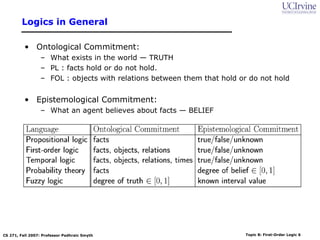
          • Ontological Commitment:
                 – What exists in the world — TRUTH
                 – PL : facts hold or do not hold.
                 – FOL : objects with relations between them that hold or do not hold


          • Epistemological Commitment:
                 – What an agent believes about facts — BELIEF


CS 271, Fall 2007: Professor Padhraic Smyth                              Topic 8: First-Order Logic 6
Syntax of FOL: Basic elements

          • Constant Symbols:
                 – Stand for objects
                 – e.g., KingJohn, 2, UCI,...

          • Predicate Symbols
                 – Stand for relations
                 – E.g., Brother(Richard, John), greater_than(3,2)...

          • Function Symbols
                 – Stand for functions
                 – E.g., Sqrt(3), LeftLegOf(John),...


CS 271, Fall 2007: Professor Padhraic Smyth                        Topic 8: First-Order Logic 7
Syntax of FOL: Basic elements

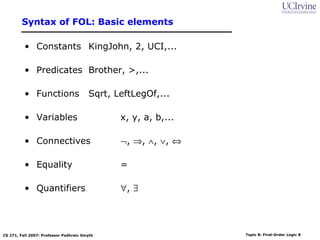
          • Constants KingJohn, 2, UCI,...

          • Predicates Brother, >,...

          • Functions                   Sqrt, LeftLegOf,...

          • Variables                          x, y, a, b,...

          • Connectives                        ¬, ⇒, ∧, ∨, ⇔

          • Equality                           =

          • Quantifiers                        ∀, ∃


CS 271, Fall 2007: Professor Padhraic Smyth                     Topic 8: First-Order Logic 8
Relations

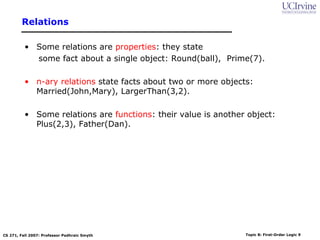
          • Some relations are properties: they state
            some fact about a single object: Round(ball), Prime(7).

          • n-ary relations state facts about two or more objects:
            Married(John,Mary), LargerThan(3,2).

          • Some relations are functions: their value is another object:
            Plus(2,3), Father(Dan).


CS 271, Fall 2007: Professor Padhraic Smyth                     Topic 8: First-Order Logic 9
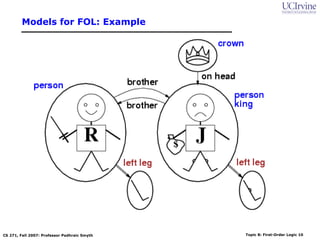
Models for FOL: Example


CS 271, Fall 2007: Professor Padhraic Smyth   Topic 8: First-Order Logic 10
Terms

          • Term = logical expression that refers to an object.

          • There are 2 kinds of terms:
                 – constant symbols: Table, Computer
                 – function symbols: LeftLeg(Pete), Sqrt(3), Plus(2,3) etc


CS 271, Fall 2007: Professor Padhraic Smyth                              Topic 8: First-Order Logic 11
Atomic Sentences


       •     Atomic sentences state facts using terms and predicate symbols
               – P(x,y) interpreted as “x is P of y”


       •     Examples:
                 LargerThan(2,3) is false.
                 Brother_of(Mary,Pete) is false.
                 Married(Father(Richard), Mother(John)) could be true or false

       •     Note: Functions do not state facts and form no sentence:
               – Brother(Pete) refers to John (his brother) and is neither true nor false.


       •     Brother_of(Pete,Brother(Pete)) is True.


        Binary relation                       Function


CS 271, Fall 2007: Professor Padhraic Smyth                                       Topic 8: First-Order Logic 12
Complex Sentences


       • We make complex sentences with connectives (just like in
         propositional logic).
                                                       property

           ¬Brother (LeftLeg (Richard ), John ) ∨ (Democrat (Bush ))

                binary             function
                relation

                                              objects


          connectives


CS 271, Fall 2007: Professor Padhraic Smyth                 Topic 8: First-Order Logic 13
More Examples


      •     Brother(Richard, John) ∧ Brother(John, Richard)


      •     King(Richard) ∨ King(John)


      •     King(John) => ¬ King(Richard)


      •     LessThan(Plus(1,2) ,4) ∧ GreaterThan(1,2)


      (Semantics are the same as in propositional logic)


CS 271, Fall 2007: Professor Padhraic Smyth                   Topic 8: First-Order Logic 14
Variables

          • Person(John) is true or false because we give it a single
            argument ‘John’

          • We can be much more flexible if we allow variables which can
            take on values in a domain. e.g., all persons x, all integers i,
            etc.
                 – E.g., can state rules like Person(x) => HasHead(x)
                            or Integer(i) => Integer(plus(i,1)


CS 271, Fall 2007: Professor Padhraic Smyth                             Topic 8: First-Order Logic 15
Universal Quantification ∀

          ∀ ∀ means “for all”

          •     Allows us to make statements about all objects that have certain
                properties

          •     Can now state general rules:

                 ∀ x King(x) => Person(x)

                 ∀ x Person(x) => HasHead(x)

                 ∀ i Integer(i) => Integer(plus(i,1))


                 Note that
                 ∀ x King(x) ∧ Person(x) is not correct!
                 This would imply that all objects x are Kings and are People

                 ∀ x King(x) => Person(x) is the correct way to say this


CS 271, Fall 2007: Professor Padhraic Smyth                                     Topic 8: First-Order Logic 16
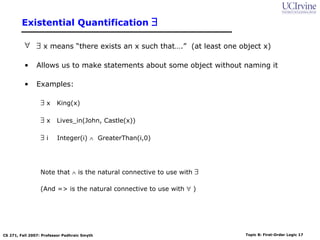
Existential Quantification ∃

          ∀ ∃ x means “there exists an x such that….” (at least one object x)

          •     Allows us to make statements about some object without naming it

          •     Examples:

                 ∃ x King(x)

                 ∃ x Lives_in(John, Castle(x))

                 ∃i      Integer(i) ∧ GreaterThan(i,0)


                 Note that ∧ is the natural connective to use with ∃

                 (And => is the natural connective to use with ∀ )


CS 271, Fall 2007: Professor Padhraic Smyth                            Topic 8: First-Order Logic 17
More examples


                                              For all real x, x>2 implies x>3.

                      ∀x [(x > 2) ⇒ (x > 3)] x ∈ R (false )
                      ∃x [(x 2 = −1)]                 x ∈ R (false )

                                      There exists some real x whose square is minus 1.


CS 271, Fall 2007: Professor Padhraic Smyth                                       Topic 8: First-Order Logic 18
CS 271, Fall 2007: Professor Padhraic Smyth   Topic 8: First-Order Logic 19
CS 271, Fall 2007: Professor Padhraic Smyth   Topic 8: First-Order Logic 20
CS 271, Fall 2007: Professor Padhraic Smyth   Topic 8: First-Order Logic 21
CS 271, Fall 2007: Professor Padhraic Smyth   Topic 8: First-Order Logic 22
CS 271, Fall 2007: Professor Padhraic Smyth   Topic 8: First-Order Logic 23
Combining Quantifiers

          ∀ x ∃ y Loves(x,y)
                 – For everyone (“all x”) there is someone (“y”) who loves them


          ∃ y ∀ x Loves(x,y)
               - there is someone (“y”) who loves everyone

          Clearer with parentheses:           ∃y(∀x   Loves(x,y) )


CS 271, Fall 2007: Professor Padhraic Smyth                             Topic 8: First-Order Logic 24
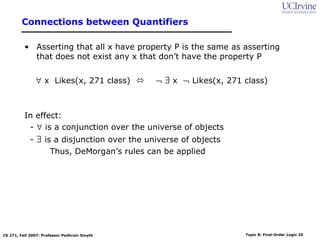
Connections between Quantifiers

          • Asserting that all x have property P is the same as asserting
            that does not exist any x that don’t have the property P


               ∀ x Likes(x, 271 class)       ¬ ∃ x ¬ Likes(x, 271 class)


          In effect:
           - ∀ is a conjunction over the universe of objects
            - ∃ is a disjunction over the universe of objects
                  Thus, DeMorgan’s rules can be applied


CS 271, Fall 2007: Professor Padhraic Smyth                        Topic 8: First-Order Logic 25
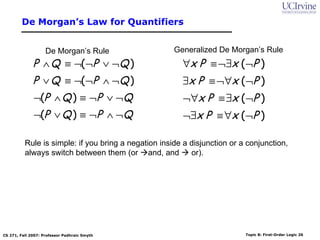
De Morgan’s Law for Quantifiers


                    De Morgan’s Rule                  Generalized De Morgan’s Rule
              P ∧ Q ≡ ¬(¬P ∨ ¬Q )                       ∀x P ≡ ¬∃x (¬P )
              P ∨ Q ≡ ¬(¬P ∧ ¬Q )                       ∃x P ≡ ¬∀x (¬P )
              ¬(P ∧ Q ) ≡ ¬P ∨ ¬Q                       ¬∀x P ≡ ∃x (¬P )
              ¬(P ∨ Q ) ≡ ¬P ∧ ¬Q                       ¬∃x P ≡ ∀x (¬P )

          Rule is simple: if you bring a negation inside a disjunction or a conjunction,
          always switch between them (or and, and  or).


CS 271, Fall 2007: Professor Padhraic Smyth                                Topic 8: First-Order Logic 26
Using FOL

          • We want to TELL things to the KB, e.g.
            TELL(KB, ∀x , King (x ) ⇒ Person (x ) )
            TELL(KB, King(John) )

               These sentences are assertions


          • We also want to ASK things to the KB,
            ASK(KB, ∃x , Person (x )    )

                 these are queries or goals

                The KB should return the list of x’s for which Person(x) is true:
                {x/John,x/Richard,...}


CS 271, Fall 2007: Professor Padhraic Smyth                          Topic 8: First-Order Logic 27
FOL Version of Wumpus World

          • Typical percept sentence:
                Percept([Stench,Breeze,Glitter,None,None],5)


          • Actions:
                Turn(Right), Turn(Left), Forward, Shoot, Grab, Release, Climb


          • To determine best action, construct query:
             ∀ a BestAction(a,5)


          • ASK solves this and returns {a/Grab}
             – And TELL about the action.


CS 271, Fall 2007: Professor Padhraic Smyth                              Topic 8: First-Order Logic 28
Knowledge Base for Wumpus World

          • Perception
               ∀b,g,t Percept([Breeze,b,g],t) ⇒ Breeze(t)
               ∀s,b,t Percept([s,b,Glitter],t) ⇒ Glitter(t)

          • Reflex
               ∀t Glitter(t) ⇒ BestAction(Grab,t)

          • Reflex with internal state
               ∀t Glitter(t) ∧¬Holding(Gold,t) ⇒ BestAction(Grab,t)

                 Holding(Gold,t) can not be observed: keep track of change.


CS 271, Fall 2007: Professor Padhraic Smyth                       Topic 8: First-Order Logic 29
Deducing hidden properties

          Environment definition:
                 ∀x,y,a,b Adjacent([x,y],[a,b]) ⇔
                   [a,b] ∈ {[x+1,y], [x-1,y],[x,y+1],[x,y-1]}

                 Properties of locations:
                    ∀s,t At(Agent,s,t) ∧ Breeze(t) ⇒ Breezy(s)


          Squares are breezy near a pit:
             – Diagnostic rule---infer cause from effect
                 ∀s Breezy(s) ⇔ ∃ r Adjacent(r,s) ∧ Pit(r)

                 – Causal rule---infer effect from cause (model based reasoning)
                    ∀r Pit(r) ⇒ [∀s Adjacent(r,s) ⇒ Breezy(s)]


CS 271, Fall 2007: Professor Padhraic Smyth                       Topic 8: First-Order Logic 30
Set Theory in First-Order Logic

         Can we define set theory using FOL?
             - individual sets, union, intersection, etc


         Answer is yes.

         Basics:
          - empty set = constant = { }

           - unary predicate Set( ), true for sets

           - binary predicates:
                x∈ s    (true if x is a member of the set x)
                s1 ⊆ s2 (true if s1 is a subset of s2)

          - binary functions:
               intersection s1 ∩ s2, union s1 ∪ s2 , adjoining {x|s}


CS 271, Fall 2007: Professor Padhraic Smyth                            Topic 8: First-Order Logic 31
A Possible Set of FOL Axioms for Set Theory

          The only sets are the empty set and sets made by adjoining an
             element to a set
            ∀s Set(s) ⇔ (s = {} ) ∨ (∃x,s2 Set(s2) ∧ s = {x|s2})

          The empty set has no elements adjoined to it
              ¬∃x,s {x|s} = {}

          Adjoining an element already in the set has no effect
                 ∀x,s x ∈ s ⇔ s = {x|s}

           The only elements of a set are those that were adjoined into it.
             Expressed recursively:
            ∀x,s x ∈ s ⇔ [ ∃y,s2 (s = {y|s2} ∧ (x = y ∨ x ∈ s2))]


CS 271, Fall 2007: Professor Padhraic Smyth                       Topic 8: First-Order Logic 32
A Possible Set of FOL Axioms for Set Theory

          A set is a subset of another set iff all the first set’s members are
             members of the 2nd set
             ∀s1,s2 s1 ⊆ s2 ⇔ (∀x x ∈ s1 ⇒ x ∈ s2)

          Two sets are equal iff each is a subset of the other
            ∀s1,s2 (s1 = s2) ⇔ (s1 ⊆ s2 ∧ s2 ⊆ s1)

          An object is in the intersection of 2 sets only if a member of both
             ∀x,s1,s2 x ∈ (s1 ∩ s2) ⇔ (x ∈ s1 ∧ x ∈ s2)

          An object is in the union of 2 sets only if a member of either
             ∀x,s1,s2 x ∈ (s1 ∪ s2) ⇔ (x ∈ s1 ∨ x ∈ s2)


CS 271, Fall 2007: Professor Padhraic Smyth                        Topic 8: First-Order Logic 33
Knowledge engineering in FOL

          1.       Identify the task

          3.       Assemble the relevant knowledge

          5.       Decide on a vocabulary of predicates, functions, and constants

          7.       Encode general knowledge about the domain

          9.       Encode a description of the specific problem instance

          11. Pose queries to the inference procedure and get answers

          13. Debug the knowledge base


          •
CS 271, Fall 2007: Professor Padhraic Smyth                                Topic 8: First-Order Logic 34
The electronic circuits domain

          One-bit full adder


          Possible queries:
             - does the circuit function properly?
            - what gates are connected to the first input terminal?
            - what would happen if one of the gates is broken?
            and so on


CS 271, Fall 2007: Professor Padhraic Smyth                     Topic 8: First-Order Logic 35
The electronic circuits domain

          1.       Identify the task
                 –       Does the circuit actually add properly?

          2.       Assemble the relevant knowledge
                 –       Composed of wires and gates; Types of gates (AND, OR, XOR, NOT)
                 –       Irrelevant: size, shape, color, cost of gates

          3.       Decide on a vocabulary
                 –       Alternatives:
                         Type(X1) = XOR (function)
                         Type(X1, XOR) (binary predicate)
                         XOR(X1)
                                (unary predicate)
                 –

                 –
                 –

          •


CS 271, Fall 2007: Professor Padhraic Smyth                                     Topic 8: First-Order Logic 36
The electronic circuits domain

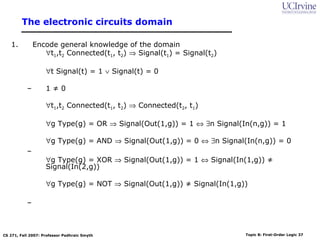
   1.          Encode general knowledge of the domain
                  ∀t1,t2 Connected(t1, t2) ⇒ Signal(t1) = Signal(t2)

                    ∀t Signal(t) = 1 ∨ Signal(t) = 0

           –        1≠0

                    ∀t1,t2 Connected(t1, t2) ⇒ Connected(t2, t1)

                    ∀g Type(g) = OR ⇒ Signal(Out(1,g)) = 1 ⇔ ∃n Signal(In(n,g)) = 1

                    ∀g Type(g) = AND ⇒ Signal(Out(1,g)) = 0 ⇔ ∃n Signal(In(n,g)) = 0
           –
                    ∀g Type(g) = XOR ⇒ Signal(Out(1,g)) = 1 ⇔ Signal(In(1,g)) ≠
                    Signal(In(2,g))

                    ∀g Type(g) = NOT ⇒ Signal(Out(1,g)) ≠ Signal(In(1,g))

           –


CS 271, Fall 2007: Professor Padhraic Smyth                             Topic 8: First-Order Logic 37
The electronic circuits domain

          1. Encode the specific problem instance
              Type(X1) = XOR                 Type(X2) = XOR
              Type(A1) = AND                 Type(A2) = AND
              Type(O1) = OR

                 Connected(Out(1,X1),In(1,X2))      Connected(In(1,C1),In(1,X1))
                 Connected(Out(1,X1),In(2,A2))      Connected(In(1,C1),In(1,A1))
                 Connected(Out(1,A2),In(1,O1))      Connected(In(2,C1),In(2,X1))
                 Connected(Out(1,A1),In(2,O1))      Connected(In(2,C1),In(2,A1))
                 Connected(Out(1,X2),Out(1,C1))     Connected(In(3,C1),In(2,X2))
                 Connected(Out(1,O1),Out(2,C1))     Connected(In(3,C1),In(1,A2))


          •


CS 271, Fall 2007: Professor Padhraic Smyth                         Topic 8: First-Order Logic 38
The electronic circuits domain

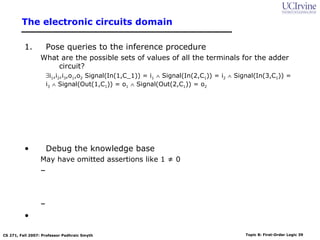
          1.         Pose queries to the inference procedure
                 What are the possible sets of values of all the terminals for the adder
                     circuit?
                     ∃i1,i2,i3,o1,o2 Signal(In(1,C_1)) = i1 ∧ Signal(In(2,C1)) = i2 ∧ Signal(In(3,C1)) =
                     i3 ∧ Signal(Out(1,C1)) = o1 ∧ Signal(Out(2,C1)) = o2


          •          Debug the knowledge base
                 May have omitted assertions like 1 ≠ 0
                 –


                 –
          •

CS 271, Fall 2007: Professor Padhraic Smyth                                             Topic 8: First-Order Logic 39
Summary

          • First-order logic:
                 –    Much more expressive than propositional logic
                 –    Allows objects and relations as semantic primitives
                 –    Universal and existential quantifiers
                 –    syntax: constants, functions, predicates, equality, quantifiers


          • Knowledge engineering using FOL
                 – Capturing domain knowledge in logical form


          • Inference and reasoning in FOL
                 – Next lecture


          • Required Reading:
                 – All of Chapter 8


                 –
CS 271, Fall 2007: Professor Padhraic Smyth                                   Topic 8: First-Order Logic 40

Class first order logic

  • 1.
    Knowledge Representation usingFirst-Order Logic CS 271: Fall 2007 Instructor: Padhraic Smyth
  • 2.
    Logistics • Midterm results – Graded, solutions mailed out • Extra-credit projects – Treated as 2 additional homeworks • Lowest 2 scoring homeworks dropped, rest averaged – no- extra-credit project • Single lowest homework score dropped, rest averaged – More information on the Web site (if not now, then soon) • Homework 3 – Should be graded by Thursday • Homework 4 – Up on the Web shortly CS 271, Fall 2007: Professor Padhraic Smyth Topic 8: First-Order Logic 2
  • 3.
    Outline • What is First-Order Logic (FOL)? – Syntax and semantics • Using FOL • Wumpus world in FOL • Knowledge engineering in FOL • Required Reading: – All of Chapter 8 CS 271, Fall 2007: Professor Padhraic Smyth Topic 8: First-Order Logic 3
  • 4.
    Pros and consof propositional logic  Propositional logic is declarative - Knowledge and inference are separate  Propositional logic allows partial/disjunctive/negated information – unlike most programming languages and databases  Propositional logic is compositional: – meaning of B1,1 ∧ P1,2 is derived from meaning of B1,1 and of P1,2  Meaning in propositional logic is context-independent – unlike natural language, where meaning depends on context  Propositional logic has limited expressive power – unlike natural language – E.g., cannot say "pits cause breezes in adjacent squares“ • except by writing one sentence for each square CS 271, Fall 2007: Professor Padhraic Smyth Topic 8: First-Order Logic 4
  • 5.
    First-Order Logic • Propositional logic assumes the world contains facts, • First-order logic (like natural language) assumes the world contains – Objects: people, houses, numbers, colors, baseball games, wars, … – Relations: red, round, prime, brother of, bigger than, part of, comes between, … – Functions: father of, best friend, one more than, plus, … CS 271, Fall 2007: Professor Padhraic Smyth Topic 8: First-Order Logic 5
  • 6.
    Logics in General • Ontological Commitment: – What exists in the world — TRUTH – PL : facts hold or do not hold. – FOL : objects with relations between them that hold or do not hold • Epistemological Commitment: – What an agent believes about facts — BELIEF CS 271, Fall 2007: Professor Padhraic Smyth Topic 8: First-Order Logic 6
  • 7.
    Syntax of FOL:Basic elements • Constant Symbols: – Stand for objects – e.g., KingJohn, 2, UCI,... • Predicate Symbols – Stand for relations – E.g., Brother(Richard, John), greater_than(3,2)... • Function Symbols – Stand for functions – E.g., Sqrt(3), LeftLegOf(John),... CS 271, Fall 2007: Professor Padhraic Smyth Topic 8: First-Order Logic 7
  • 8.
    Syntax of FOL:Basic elements • Constants KingJohn, 2, UCI,... • Predicates Brother, >,... • Functions Sqrt, LeftLegOf,... • Variables x, y, a, b,... • Connectives ¬, ⇒, ∧, ∨, ⇔ • Equality = • Quantifiers ∀, ∃ CS 271, Fall 2007: Professor Padhraic Smyth Topic 8: First-Order Logic 8
  • 9.
    Relations • Some relations are properties: they state some fact about a single object: Round(ball), Prime(7). • n-ary relations state facts about two or more objects: Married(John,Mary), LargerThan(3,2). • Some relations are functions: their value is another object: Plus(2,3), Father(Dan). CS 271, Fall 2007: Professor Padhraic Smyth Topic 8: First-Order Logic 9
  • 10.
    Models for FOL:Example CS 271, Fall 2007: Professor Padhraic Smyth Topic 8: First-Order Logic 10
  • 11.
    Terms • Term = logical expression that refers to an object. • There are 2 kinds of terms: – constant symbols: Table, Computer – function symbols: LeftLeg(Pete), Sqrt(3), Plus(2,3) etc CS 271, Fall 2007: Professor Padhraic Smyth Topic 8: First-Order Logic 11
  • 12.
    Atomic Sentences • Atomic sentences state facts using terms and predicate symbols – P(x,y) interpreted as “x is P of y” • Examples: LargerThan(2,3) is false. Brother_of(Mary,Pete) is false. Married(Father(Richard), Mother(John)) could be true or false • Note: Functions do not state facts and form no sentence: – Brother(Pete) refers to John (his brother) and is neither true nor false. • Brother_of(Pete,Brother(Pete)) is True. Binary relation Function CS 271, Fall 2007: Professor Padhraic Smyth Topic 8: First-Order Logic 12
  • 13.
    Complex Sentences • We make complex sentences with connectives (just like in propositional logic). property ¬Brother (LeftLeg (Richard ), John ) ∨ (Democrat (Bush )) binary function relation objects connectives CS 271, Fall 2007: Professor Padhraic Smyth Topic 8: First-Order Logic 13
  • 14.
    More Examples • Brother(Richard, John) ∧ Brother(John, Richard) • King(Richard) ∨ King(John) • King(John) => ¬ King(Richard) • LessThan(Plus(1,2) ,4) ∧ GreaterThan(1,2) (Semantics are the same as in propositional logic) CS 271, Fall 2007: Professor Padhraic Smyth Topic 8: First-Order Logic 14
  • 15.
    Variables • Person(John) is true or false because we give it a single argument ‘John’ • We can be much more flexible if we allow variables which can take on values in a domain. e.g., all persons x, all integers i, etc. – E.g., can state rules like Person(x) => HasHead(x) or Integer(i) => Integer(plus(i,1) CS 271, Fall 2007: Professor Padhraic Smyth Topic 8: First-Order Logic 15
  • 16.
    Universal Quantification ∀ ∀ ∀ means “for all” • Allows us to make statements about all objects that have certain properties • Can now state general rules: ∀ x King(x) => Person(x) ∀ x Person(x) => HasHead(x) ∀ i Integer(i) => Integer(plus(i,1)) Note that ∀ x King(x) ∧ Person(x) is not correct! This would imply that all objects x are Kings and are People ∀ x King(x) => Person(x) is the correct way to say this CS 271, Fall 2007: Professor Padhraic Smyth Topic 8: First-Order Logic 16
  • 17.
    Existential Quantification ∃ ∀ ∃ x means “there exists an x such that….” (at least one object x) • Allows us to make statements about some object without naming it • Examples: ∃ x King(x) ∃ x Lives_in(John, Castle(x)) ∃i Integer(i) ∧ GreaterThan(i,0) Note that ∧ is the natural connective to use with ∃ (And => is the natural connective to use with ∀ ) CS 271, Fall 2007: Professor Padhraic Smyth Topic 8: First-Order Logic 17
  • 18.
    More examples For all real x, x>2 implies x>3. ∀x [(x > 2) ⇒ (x > 3)] x ∈ R (false ) ∃x [(x 2 = −1)] x ∈ R (false ) There exists some real x whose square is minus 1. CS 271, Fall 2007: Professor Padhraic Smyth Topic 8: First-Order Logic 18
  • 19.
    CS 271, Fall2007: Professor Padhraic Smyth Topic 8: First-Order Logic 19
  • 20.
    CS 271, Fall2007: Professor Padhraic Smyth Topic 8: First-Order Logic 20
  • 21.
    CS 271, Fall2007: Professor Padhraic Smyth Topic 8: First-Order Logic 21
  • 22.
    CS 271, Fall2007: Professor Padhraic Smyth Topic 8: First-Order Logic 22
  • 23.
    CS 271, Fall2007: Professor Padhraic Smyth Topic 8: First-Order Logic 23
  • 24.
    Combining Quantifiers ∀ x ∃ y Loves(x,y) – For everyone (“all x”) there is someone (“y”) who loves them ∃ y ∀ x Loves(x,y) - there is someone (“y”) who loves everyone Clearer with parentheses: ∃y(∀x Loves(x,y) ) CS 271, Fall 2007: Professor Padhraic Smyth Topic 8: First-Order Logic 24
  • 25.
    Connections between Quantifiers • Asserting that all x have property P is the same as asserting that does not exist any x that don’t have the property P ∀ x Likes(x, 271 class)  ¬ ∃ x ¬ Likes(x, 271 class) In effect: - ∀ is a conjunction over the universe of objects - ∃ is a disjunction over the universe of objects Thus, DeMorgan’s rules can be applied CS 271, Fall 2007: Professor Padhraic Smyth Topic 8: First-Order Logic 25
  • 26.
    De Morgan’s Lawfor Quantifiers De Morgan’s Rule Generalized De Morgan’s Rule P ∧ Q ≡ ¬(¬P ∨ ¬Q ) ∀x P ≡ ¬∃x (¬P ) P ∨ Q ≡ ¬(¬P ∧ ¬Q ) ∃x P ≡ ¬∀x (¬P ) ¬(P ∧ Q ) ≡ ¬P ∨ ¬Q ¬∀x P ≡ ∃x (¬P ) ¬(P ∨ Q ) ≡ ¬P ∧ ¬Q ¬∃x P ≡ ∀x (¬P ) Rule is simple: if you bring a negation inside a disjunction or a conjunction, always switch between them (or and, and  or). CS 271, Fall 2007: Professor Padhraic Smyth Topic 8: First-Order Logic 26
  • 27.
    Using FOL • We want to TELL things to the KB, e.g. TELL(KB, ∀x , King (x ) ⇒ Person (x ) ) TELL(KB, King(John) ) These sentences are assertions • We also want to ASK things to the KB, ASK(KB, ∃x , Person (x ) ) these are queries or goals The KB should return the list of x’s for which Person(x) is true: {x/John,x/Richard,...} CS 271, Fall 2007: Professor Padhraic Smyth Topic 8: First-Order Logic 27
  • 28.
    FOL Version ofWumpus World • Typical percept sentence: Percept([Stench,Breeze,Glitter,None,None],5) • Actions: Turn(Right), Turn(Left), Forward, Shoot, Grab, Release, Climb • To determine best action, construct query: ∀ a BestAction(a,5) • ASK solves this and returns {a/Grab} – And TELL about the action. CS 271, Fall 2007: Professor Padhraic Smyth Topic 8: First-Order Logic 28
  • 29.
    Knowledge Base forWumpus World • Perception ∀b,g,t Percept([Breeze,b,g],t) ⇒ Breeze(t) ∀s,b,t Percept([s,b,Glitter],t) ⇒ Glitter(t) • Reflex ∀t Glitter(t) ⇒ BestAction(Grab,t) • Reflex with internal state ∀t Glitter(t) ∧¬Holding(Gold,t) ⇒ BestAction(Grab,t) Holding(Gold,t) can not be observed: keep track of change. CS 271, Fall 2007: Professor Padhraic Smyth Topic 8: First-Order Logic 29
  • 30.
    Deducing hidden properties Environment definition: ∀x,y,a,b Adjacent([x,y],[a,b]) ⇔ [a,b] ∈ {[x+1,y], [x-1,y],[x,y+1],[x,y-1]} Properties of locations: ∀s,t At(Agent,s,t) ∧ Breeze(t) ⇒ Breezy(s) Squares are breezy near a pit: – Diagnostic rule---infer cause from effect ∀s Breezy(s) ⇔ ∃ r Adjacent(r,s) ∧ Pit(r) – Causal rule---infer effect from cause (model based reasoning) ∀r Pit(r) ⇒ [∀s Adjacent(r,s) ⇒ Breezy(s)] CS 271, Fall 2007: Professor Padhraic Smyth Topic 8: First-Order Logic 30
  • 31.
    Set Theory inFirst-Order Logic Can we define set theory using FOL? - individual sets, union, intersection, etc Answer is yes. Basics: - empty set = constant = { } - unary predicate Set( ), true for sets - binary predicates: x∈ s (true if x is a member of the set x) s1 ⊆ s2 (true if s1 is a subset of s2) - binary functions: intersection s1 ∩ s2, union s1 ∪ s2 , adjoining {x|s} CS 271, Fall 2007: Professor Padhraic Smyth Topic 8: First-Order Logic 31
  • 32.
    A Possible Setof FOL Axioms for Set Theory The only sets are the empty set and sets made by adjoining an element to a set ∀s Set(s) ⇔ (s = {} ) ∨ (∃x,s2 Set(s2) ∧ s = {x|s2}) The empty set has no elements adjoined to it ¬∃x,s {x|s} = {} Adjoining an element already in the set has no effect ∀x,s x ∈ s ⇔ s = {x|s} The only elements of a set are those that were adjoined into it. Expressed recursively: ∀x,s x ∈ s ⇔ [ ∃y,s2 (s = {y|s2} ∧ (x = y ∨ x ∈ s2))] CS 271, Fall 2007: Professor Padhraic Smyth Topic 8: First-Order Logic 32
  • 33.
    A Possible Setof FOL Axioms for Set Theory A set is a subset of another set iff all the first set’s members are members of the 2nd set ∀s1,s2 s1 ⊆ s2 ⇔ (∀x x ∈ s1 ⇒ x ∈ s2) Two sets are equal iff each is a subset of the other ∀s1,s2 (s1 = s2) ⇔ (s1 ⊆ s2 ∧ s2 ⊆ s1) An object is in the intersection of 2 sets only if a member of both ∀x,s1,s2 x ∈ (s1 ∩ s2) ⇔ (x ∈ s1 ∧ x ∈ s2) An object is in the union of 2 sets only if a member of either ∀x,s1,s2 x ∈ (s1 ∪ s2) ⇔ (x ∈ s1 ∨ x ∈ s2) CS 271, Fall 2007: Professor Padhraic Smyth Topic 8: First-Order Logic 33
  • 34.
    Knowledge engineering inFOL 1. Identify the task 3. Assemble the relevant knowledge 5. Decide on a vocabulary of predicates, functions, and constants 7. Encode general knowledge about the domain 9. Encode a description of the specific problem instance 11. Pose queries to the inference procedure and get answers 13. Debug the knowledge base • CS 271, Fall 2007: Professor Padhraic Smyth Topic 8: First-Order Logic 34
  • 35.
    The electronic circuitsdomain One-bit full adder Possible queries: - does the circuit function properly? - what gates are connected to the first input terminal? - what would happen if one of the gates is broken? and so on CS 271, Fall 2007: Professor Padhraic Smyth Topic 8: First-Order Logic 35
  • 36.
    The electronic circuitsdomain 1. Identify the task – Does the circuit actually add properly? 2. Assemble the relevant knowledge – Composed of wires and gates; Types of gates (AND, OR, XOR, NOT) – Irrelevant: size, shape, color, cost of gates 3. Decide on a vocabulary – Alternatives: Type(X1) = XOR (function) Type(X1, XOR) (binary predicate) XOR(X1) (unary predicate) – – – • CS 271, Fall 2007: Professor Padhraic Smyth Topic 8: First-Order Logic 36
  • 37.
    The electronic circuitsdomain 1. Encode general knowledge of the domain ∀t1,t2 Connected(t1, t2) ⇒ Signal(t1) = Signal(t2) ∀t Signal(t) = 1 ∨ Signal(t) = 0 – 1≠0 ∀t1,t2 Connected(t1, t2) ⇒ Connected(t2, t1) ∀g Type(g) = OR ⇒ Signal(Out(1,g)) = 1 ⇔ ∃n Signal(In(n,g)) = 1 ∀g Type(g) = AND ⇒ Signal(Out(1,g)) = 0 ⇔ ∃n Signal(In(n,g)) = 0 – ∀g Type(g) = XOR ⇒ Signal(Out(1,g)) = 1 ⇔ Signal(In(1,g)) ≠ Signal(In(2,g)) ∀g Type(g) = NOT ⇒ Signal(Out(1,g)) ≠ Signal(In(1,g)) – CS 271, Fall 2007: Professor Padhraic Smyth Topic 8: First-Order Logic 37
  • 38.
    The electronic circuitsdomain 1. Encode the specific problem instance Type(X1) = XOR Type(X2) = XOR Type(A1) = AND Type(A2) = AND Type(O1) = OR Connected(Out(1,X1),In(1,X2)) Connected(In(1,C1),In(1,X1)) Connected(Out(1,X1),In(2,A2)) Connected(In(1,C1),In(1,A1)) Connected(Out(1,A2),In(1,O1)) Connected(In(2,C1),In(2,X1)) Connected(Out(1,A1),In(2,O1)) Connected(In(2,C1),In(2,A1)) Connected(Out(1,X2),Out(1,C1)) Connected(In(3,C1),In(2,X2)) Connected(Out(1,O1),Out(2,C1)) Connected(In(3,C1),In(1,A2)) • CS 271, Fall 2007: Professor Padhraic Smyth Topic 8: First-Order Logic 38
  • 39.
    The electronic circuitsdomain 1. Pose queries to the inference procedure What are the possible sets of values of all the terminals for the adder circuit? ∃i1,i2,i3,o1,o2 Signal(In(1,C_1)) = i1 ∧ Signal(In(2,C1)) = i2 ∧ Signal(In(3,C1)) = i3 ∧ Signal(Out(1,C1)) = o1 ∧ Signal(Out(2,C1)) = o2 • Debug the knowledge base May have omitted assertions like 1 ≠ 0 – – • CS 271, Fall 2007: Professor Padhraic Smyth Topic 8: First-Order Logic 39
  • 40.
    Summary • First-order logic: – Much more expressive than propositional logic – Allows objects and relations as semantic primitives – Universal and existential quantifiers – syntax: constants, functions, predicates, equality, quantifiers • Knowledge engineering using FOL – Capturing domain knowledge in logical form • Inference and reasoning in FOL – Next lecture • Required Reading: – All of Chapter 8 – CS 271, Fall 2007: Professor Padhraic Smyth Topic 8: First-Order Logic 40