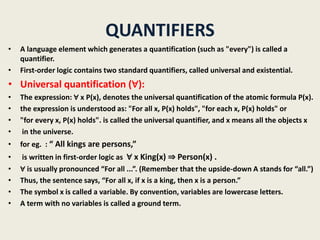
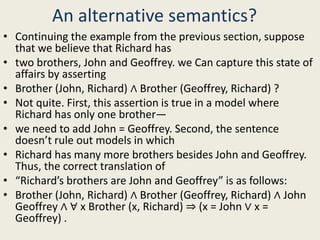
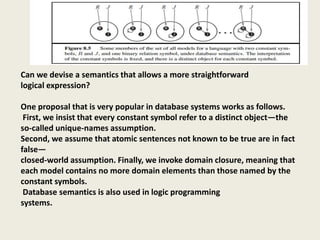
1. First-order logic uses quantifiers like ∀ (for all) and ∃ (there exists) to make general statements about objects in a domain.
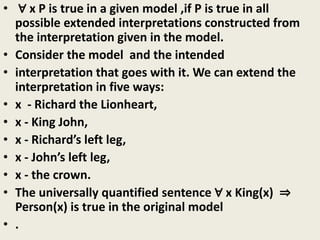
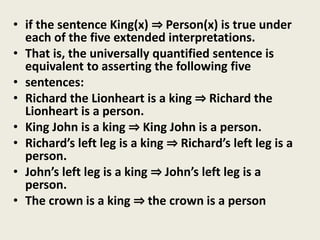
2. ∀ statements are true if the statement holds for all possible objects, while ∃ statements are true if the statement holds for at least one object.
3. Logical statements can include multiple nested quantifiers to express more complex relationships between objects.