1 
Language Learning in Early 
Childhood 
 Definitions of L1, L2, FL, TL 
 Patterns and sequences in L1 development 
Language Acquisition 
First Lecture 
By: Ms.Hajar ALmaa
2 
Definitions of L1 & L2 
 Definition of “first language” (L1): 
 The language(s) that an individual learns first. 
 Other terms for “first language”- 
• Native language or mother tongue 
 Definition of “second language” (L2): 
 Any language other than the first language learned (in 
a broader sense). 
 A language learned after the first language in a context 
where the language is used widely in the speech 
community (in a narrower sense). 
• e.g., For many people in Taiwan, their L1 is 
Taiwanese and L2 is Mandarin.
3 
Definitions of FL & TL 
 Definition of “foreign language” (FL) 
 A second (or third, or fourth) language learned in a 
context where the language is NOT widely used in the 
speech community. This is often contrasted with 
second language learning in a narrower sense. 
e.g., English or Japanese is a foreign language for 
people in Taiwan. 
 Definition of “target language” (TL) 
 A language which is being learned, where it is the first 
language or a second, third language. 
e.g., English is a target language for you now.
4 
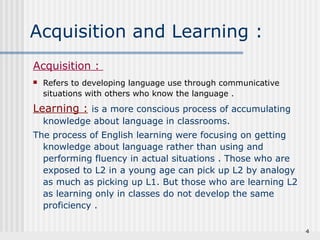
Acquisition and Learning : 
Acquisition : 
 Refers to developing language use through communicative 
situations with others who know the language . 
Learning : is a more conscious process of accumulating 
knowledge about language in classrooms. 
The process of English learning were focusing on getting 
knowledge about language rather than using and 
performing fluency in actual situations . Those who are 
exposed to L2 in a young age can pick up L2 by analogy 
as much as picking up L1. But those who are learning L2 
as learning only in classes do not develop the same 
proficiency .
5 
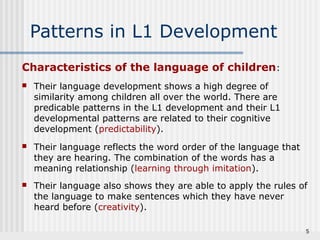
Patterns in L1 Development 
Characteristics of the language of children: 
 Their language development shows a high degree of 
similarity among children all over the world. There are 
predicable patterns in the L1 development and their L1 
developmental patterns are related to their cognitive 
development (predictability). 
 Their language reflects the word order of the language that 
they are hearing. The combination of the words has a 
meaning relationship (learning through imitation). 
 Their language also shows they are able to apply the rules of 
the language to make sentences which they have never 
heard before (creativity).
6 
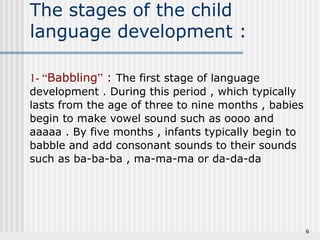
The stages of the child 
language development : 
1- “Babbling” : The first stage of language 
development . During this period , which typically 
lasts from the age of three to nine months , babies 
begin to make vowel sound such as oooo and 
aaaaa . By five months , infants typically begin to 
babble and add consonant sounds to their sounds 
such as ba-ba-ba , ma-ma-ma or da-da-da
7 
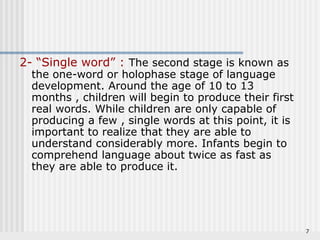
2- “Single word” : The second stage is known as 
the one-word or holophase stage of language 
development. Around the age of 10 to 13 
months , children will begin to produce their first 
real words. While children are only capable of 
producing a few , single words at this point, it is 
important to realize that they are able to 
understand considerably more. Infants begin to 
comprehend language about twice as fast as 
they are able to produce it.
8 
3- “Two words” : The third stage begins around 
the age of 18 months, when children begin to use 
two word sentences. These sentences usually 
consist of just nouns and verbs, such as :Where 
daddy?” and “ Puppy big” .
9 
4- “Multi-word sentences” : Around the age 
of two, children begin to produce short , 
multi-word sentences that have a subject and 
predicate . For example, a child might say 
“Mommy is nice” or “ Want more candy” . 
~ As children age, they continue to learn more 
new words every day. By the time they enter 
school around the age of five, children 
typically have a vocabulary of 10,000 words 
or more.
- Birth : Language learning starts at birth . 
Even new babies are aware of the sounds 
in the environment. 
- They listen to the speech of those close 
to them, and startle or cry if there is an 
unexpected noise. 
- 0-3 months : babies learn to turn to you 
when you speak , and smile when they 
hear your voice. In fact, they seem to 
recognize your familiar voice. 
10 
Ages :
11 
- 4-6 months: babies respond to the word 
“no” . They are also responsive to changes 
in your tone of voice. And to sounds other 
than speech. For example, they can be 
fascinated by toys and other objects that 
make sounds, enjoy music and rhythm.
12 
- 7-12 months : The baby listens when 
spoken to, turns and looks at your face 
when called by name, and discovers the 
fun of games like: “round and round the 
garden” , “peep-oh” , “ I see” , (daaaaay). 
- The child recognizes the names of familiar 
objects (Daddy, car, eyes, phone, key) and 
begin to respond to requests (Give it to 
Granny) and questions (More juice) ?
13 
1-2 years : The child can follow simple 
commands (Push the bus!) , (Don’t touch, it’s 
hot!) and understand simple questions 
(Where’s the bunny?) , (Who likes Miffy?) , 
(What’s in your purse ?) 
Your toddler now likes listening to simple stories 
and enjoys it when you sing songs or say 
rhymes. 
This is a stage in which he or she will want the 
same story , rhyme or game repeated many 
times.
14 
2-3 years : They understand two stage 
commands (Get your socks and put them in 
the basket) and understand contrasting 
concepts or meanings like hot/cold , 
stop/go , in/on and nice/yuccy. He or she 
notices sounds like the telephone or 
doorbell ringing and may point or become 
excited , get you to answer, or attempt to 
answer themselves.
15 
3-4 years : Your three or four years old 
understand simple “Who”? , “What?” and 
“Where?” questions, and can hear you when 
you call from another room. This is an age 
where hearing difficulties may become 
evident. If you are in doubt about your 
child’s hearing , see a clinical audiologist.
16 
4-5 years : Children in this age range enjoy 
stories and can answer simple questions about 
them. He or she hears and understands nearly 
everything that is said (within reason) at home 
at pre-school or day care. The child speaks 
clearly and fluently in an easy-to-listen-to voice. 
He or she can construct long and detailed 
sentences (We went to the zoo but we had to 
come home early because Sally wasn’t feeling 
well”; “ I want to have a horse of my own like 
Evan, and Daddy says when he wins the lottery 
he will buy me a one” .

First Lec / language.acq

  • 1.
    1 Language Learningin Early Childhood  Definitions of L1, L2, FL, TL  Patterns and sequences in L1 development Language Acquisition First Lecture By: Ms.Hajar ALmaa
  • 2.
    2 Definitions ofL1 & L2  Definition of “first language” (L1):  The language(s) that an individual learns first.  Other terms for “first language”- • Native language or mother tongue  Definition of “second language” (L2):  Any language other than the first language learned (in a broader sense).  A language learned after the first language in a context where the language is used widely in the speech community (in a narrower sense). • e.g., For many people in Taiwan, their L1 is Taiwanese and L2 is Mandarin.
  • 3.
    3 Definitions ofFL & TL  Definition of “foreign language” (FL)  A second (or third, or fourth) language learned in a context where the language is NOT widely used in the speech community. This is often contrasted with second language learning in a narrower sense. e.g., English or Japanese is a foreign language for people in Taiwan.  Definition of “target language” (TL)  A language which is being learned, where it is the first language or a second, third language. e.g., English is a target language for you now.
  • 4.
    4 Acquisition andLearning : Acquisition :  Refers to developing language use through communicative situations with others who know the language . Learning : is a more conscious process of accumulating knowledge about language in classrooms. The process of English learning were focusing on getting knowledge about language rather than using and performing fluency in actual situations . Those who are exposed to L2 in a young age can pick up L2 by analogy as much as picking up L1. But those who are learning L2 as learning only in classes do not develop the same proficiency .
  • 5.
    5 Patterns inL1 Development Characteristics of the language of children:  Their language development shows a high degree of similarity among children all over the world. There are predicable patterns in the L1 development and their L1 developmental patterns are related to their cognitive development (predictability).  Their language reflects the word order of the language that they are hearing. The combination of the words has a meaning relationship (learning through imitation).  Their language also shows they are able to apply the rules of the language to make sentences which they have never heard before (creativity).
  • 6.
    6 The stagesof the child language development : 1- “Babbling” : The first stage of language development . During this period , which typically lasts from the age of three to nine months , babies begin to make vowel sound such as oooo and aaaaa . By five months , infants typically begin to babble and add consonant sounds to their sounds such as ba-ba-ba , ma-ma-ma or da-da-da
  • 7.
    7 2- “Singleword” : The second stage is known as the one-word or holophase stage of language development. Around the age of 10 to 13 months , children will begin to produce their first real words. While children are only capable of producing a few , single words at this point, it is important to realize that they are able to understand considerably more. Infants begin to comprehend language about twice as fast as they are able to produce it.
  • 8.
    8 3- “Twowords” : The third stage begins around the age of 18 months, when children begin to use two word sentences. These sentences usually consist of just nouns and verbs, such as :Where daddy?” and “ Puppy big” .
  • 9.
    9 4- “Multi-wordsentences” : Around the age of two, children begin to produce short , multi-word sentences that have a subject and predicate . For example, a child might say “Mommy is nice” or “ Want more candy” . ~ As children age, they continue to learn more new words every day. By the time they enter school around the age of five, children typically have a vocabulary of 10,000 words or more.
  • 10.
    - Birth :Language learning starts at birth . Even new babies are aware of the sounds in the environment. - They listen to the speech of those close to them, and startle or cry if there is an unexpected noise. - 0-3 months : babies learn to turn to you when you speak , and smile when they hear your voice. In fact, they seem to recognize your familiar voice. 10 Ages :
  • 11.
    11 - 4-6months: babies respond to the word “no” . They are also responsive to changes in your tone of voice. And to sounds other than speech. For example, they can be fascinated by toys and other objects that make sounds, enjoy music and rhythm.
  • 12.
    12 - 7-12months : The baby listens when spoken to, turns and looks at your face when called by name, and discovers the fun of games like: “round and round the garden” , “peep-oh” , “ I see” , (daaaaay). - The child recognizes the names of familiar objects (Daddy, car, eyes, phone, key) and begin to respond to requests (Give it to Granny) and questions (More juice) ?
  • 13.
    13 1-2 years: The child can follow simple commands (Push the bus!) , (Don’t touch, it’s hot!) and understand simple questions (Where’s the bunny?) , (Who likes Miffy?) , (What’s in your purse ?) Your toddler now likes listening to simple stories and enjoys it when you sing songs or say rhymes. This is a stage in which he or she will want the same story , rhyme or game repeated many times.
  • 14.
    14 2-3 years: They understand two stage commands (Get your socks and put them in the basket) and understand contrasting concepts or meanings like hot/cold , stop/go , in/on and nice/yuccy. He or she notices sounds like the telephone or doorbell ringing and may point or become excited , get you to answer, or attempt to answer themselves.
  • 15.
    15 3-4 years: Your three or four years old understand simple “Who”? , “What?” and “Where?” questions, and can hear you when you call from another room. This is an age where hearing difficulties may become evident. If you are in doubt about your child’s hearing , see a clinical audiologist.
  • 16.
    16 4-5 years: Children in this age range enjoy stories and can answer simple questions about them. He or she hears and understands nearly everything that is said (within reason) at home at pre-school or day care. The child speaks clearly and fluently in an easy-to-listen-to voice. He or she can construct long and detailed sentences (We went to the zoo but we had to come home early because Sally wasn’t feeling well”; “ I want to have a horse of my own like Evan, and Daddy says when he wins the lottery he will buy me a one” .