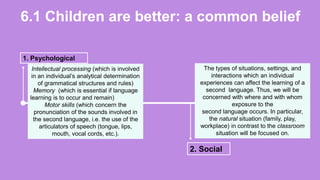
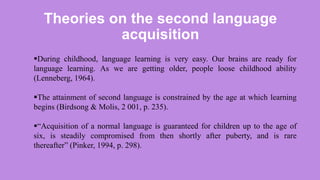
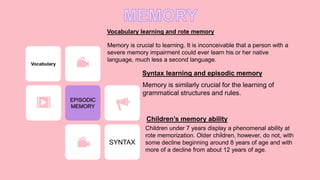
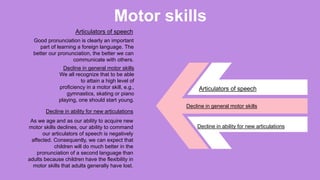
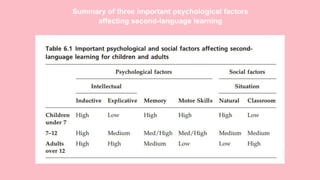
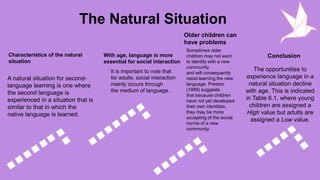
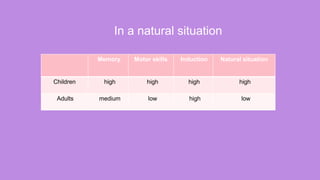
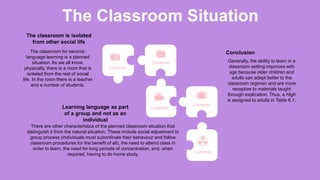
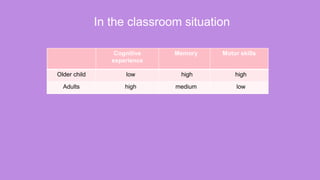
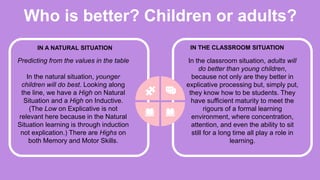
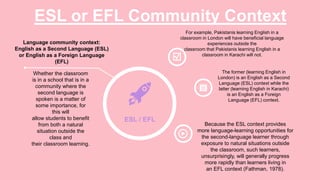
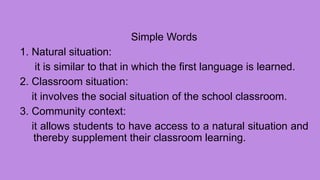
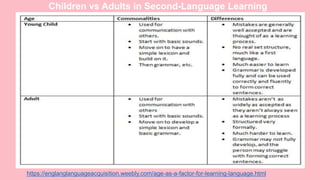
Children are generally better than adults at learning a second language in natural situations due to three key psychological factors: memory ability, motor skills, and an ability to learn through induction. However, adults are better than children at learning a second language in a classroom setting due to their greater ability to learn through explicit instruction and their cognitive maturity which helps them function better in a formal learning environment. The best conditions for second language learning are in an environment where both natural situations outside the classroom and formal classroom learning can be utilized, such as learning English in an English-speaking community/country.







![Language (1)[1].pptx](https://cdn.slidesharecdn.com/ss_thumbnails/language11-230208135138-7565968f-thumbnail.jpg?width=640&height=640&fit=bounds)


![제 23회 보아즈(BOAZ) 빅데이터 컨퍼런스 - [MBOAX] : ABSA를 활용한 소비자 반응 분석 기반 운영 효율화 대시보드 설계](https://cdn.slidesharecdn.com/ss_thumbnails/3-1boaz23rdconferencemboax-260203102709-9d519923-thumbnail.jpg?width=640&height=640&fit=bounds)


