Temporal decorrelation effects  in super-resolution 3D Tomosar Francesco Cai, Fabrizio Lombardini, Lucio Verrazzani  University of Pisa Department of Information Engineering Gold conference  2010  Livorno, April 29 2009
Outline 3D SAR  Tomography concept Temporal decorrelation in SAR Tomography Blurring effects of temporal decorrelating volume  scatterers: simulated analysis SAR Tomography criticalities Indication on conditions critical  for SAR Tomography in partially coherent scenes   Ad-hoc solution  for decorrelating volume scatterers: the Diff-Tomo concept Examples of robust SAR   Tomography Conclusions and perspectives
3D SAR Tomography concept flight direction b N b n b 1 s, elevation z y ( b 1 ) y ( b n ) y ( b N ) Range-azimuth cell Azimuth Ground range Signal spatial sample at baseline  b n : Define an elevation-dependent spatial frequency: 1-D Fourier relation Tomo-SAR can localize the multiple scatterers through spatial spectral estimation (i.e. elevation beamforming) Applications: solving InSAR layover heights and reflectivity misinterpretation in urban areas estimation of forest biomass and height sub-canopy topography soil humidity and ice thickness monitoring [Reigber-Moreira, IEEE-TGARS ’00] Complex amplitude elevation distribution However… Limited and sparse baseline distribution, poor Fourier imaging quality Proposed solutions: adaptive beamforming, SVD, spatial interpolators (compressed sensing)… [Lombardini-Reigber, IGARSS ‘03] [Fornaro-Serafino-Soldovieri, IEEE-TGARS ’03] [Lombardini-Pardini, IEEE-GRSL ‘08] Elevation blurring problems from scatterers motion and temporal decorrelation ! NASA-JPL and ESA recognized this as a major limiting factor (forest scatterers and spaceborne acquisitions)
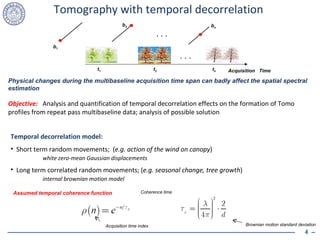
Tomography with temporal decorrelation Acquisition  Time Temporal decorrelation model: Short term random movements;  ( e.g. action of the wind on canopy )  white zero-mean Gaussian displacements Long term correlated random movements; ( e.g. seasonal change, tree growth ) internal brownian motion model   Assumed temporal coherence function Coherence time Brownian motion standard deviation Acquisition time index Physical changes during the multibaseline acquisition time span can badly affect the spatial spectral estimation Objective:  Analysis and quantification of temporal decorrelation effects on the formation of Tomo profiles from repeat pass multibaseline data; analysis of possible solution  . . . . . . b 1 b 2 t 1 t 2 t n b n
Tomographic analysis: scenario and methods Temporal decorrelation model from [Lombardini-Griffiths, IEE-EUREL ’98] Baseline-time acquisition pattern Long term temp. dec.   c  = 3 rev. times Different temporal decorrelation conditions for temporal decorrelating canopy Long term temp. dec.   c  = 34 rev. times Analysis of a  model based  and  adaptive BF  Tomo SAR methods,  useful for critical resolutions Simulated analysis: forest scenario Compact scatterer (ground) + volumetric scatterer (canopy) Different baseline-time acquisition pattern: monostatic and multistatic Height distance: 0.7 Rayleigh res. Units g/v = 1/5  (L-band acquisition) Total  SNR  = 15dB 16 looks Different temporal decorrelation processes  Weak Strong Satellite cluster
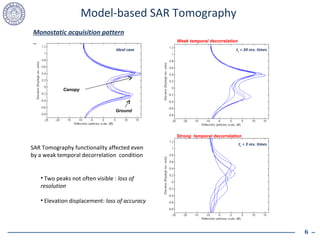
Model-based SAR Tomography Scatterers  rarely unresolved The positions of the scatterers are correctly located  Ideal case Monostatic acquisition pattern  Canopy Ground  c  = 34 rev. times  c  = 3 rev. times Strong  temporal decorrelation Weak temporal decorrelation Two peaks not often visible :  loss of resolution Elevation displacement:  loss of accuracy  SAR Tomography functionality affected even  by a weak temporal decorrelation  condition
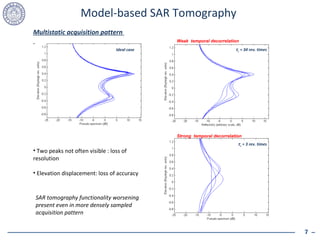
Model-based SAR Tomography Two peaks not often visible : loss of resolution Elevation displacement: loss of accuracy  Ideal case Multistatic acquisition pattern  SAR tomography functionality worsening present even in more densely sampled acquisition pattern  c  = 34 rev. times  c  = 3 rev. times Strong  temporal decorrelation Weak  temporal decorrelation
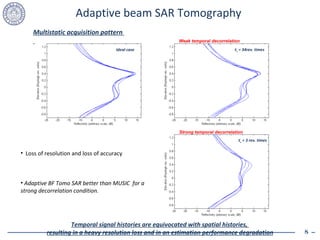
Adaptive beam SAR Tomography Ideal case Loss of resolution and loss of accuracy Adaptive BF Tomo SAR better than MUSIC  for a strong decorrelation condition. Multistatic acquisition pattern  Temporal signal histories are equivocated with spatial histories,  resulting in a heavy resolution loss and in an estimation performance degradation  c  = 34rev. times  c  = 3 rev. times Strong temporal decorrelation Weak temporal decorrelation
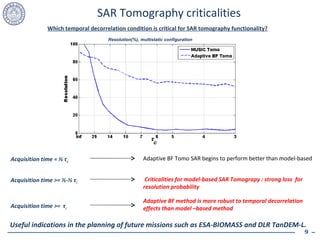
SAR Tomography criticalities Which temporal decorrelation condition is critical for SAR tomography functionality? Resolution(%), multistatic configuration Useful indications in the planning of future missions such as ESA-BIOMASS and DLR TanDEM-L. Acquisition time >≈  ½-⅓  τ c   Acquisition time >≈  τ c   Criticalities for model-based SAR Tomograpy : strong loss  for resolution probability Adaptive BF method is more robust to temporal decorrelation effects than model –based method Acquisition time ≈  ⅓  τ c   Adaptive BF Tomo SAR begins to perform better than model-based
A new approach: the Differential SAR Tomography framework Point-like scatterer in height  Uniform motion (l.o.s. direction) spatial harmonic  temporal harmonic  Discrete space-time spectrum Temporal frequencies code velocities Example:  subsidence in urban layover areas Extended scatterers in height   Range of velocities spatial harmonic distribution   temporal harmonic  distribution Continuous space-time spectrum Temporal frequencies code velocities   Example:  a glacier flow (sliding  random volume over ground) Temporal decorrelation of a scattering component temporal harmonic  distribution Temporal frequencies are  signatures  of the temporal decorrelation   ! [Lombardini-Fornaro, IGARSS’05] [Fornaro-Serafino-Reale, IEEE-TGARS’09] [Lombardini, ESA FRINGE Wrkshp’07] Diff-Tomo exploits the multibaseline-multitemporal information content to  enter  the SAR pixel and extract separated information on  elevation and velocity of  multiple  superimposed scatterers [Lombardini, TGARS Jan. 2005] “ Diff-Tomo” is a new interferometric mode, which avoids the misinterpretation  of spatial signal histories (scatterers location) and temporal histories in non-stationary scenarios Temporal signal histories from decorrelation can be decoupled from the spatial spectral estimation . D-InSAR and Tomo-SAR crossed in an unified framework Joint elevation-velocity resolution of multiple scatterers
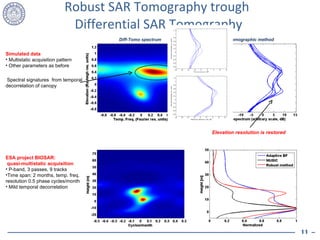
Robust SAR Tomography trough  Differential SAR Tomography Simulated data Multistatic acquisition pattern Other parameters as before ESA project BIOSAR: quasi-multistatic acquisition P-band, 3 passes, 9 tracks Time span: 2 months, temp. freq. resolution 0.5 phase cycles/month Mild temporal decorrelation  Spectral signatures  from temporal decorrelation of canopy  Robust tomographic method Diff-Tomo spectrum Elevation resolution is restored
Conclusions and perspectives Quantification of temporal effects on SAR Tomography   for volumetric scatterers Model-based Tomo-SAR criticalities for acquisition time span beyond 1/2~1/3 of the long-term decorrelation time  Adaptive BF Tomography  better than model-based Tomography  with temporal decorrelation Differential-Tomography , accounts for the temporal dimension and improves the MB tomographic information extraction; demonstration of robust SAR Tomography Future work:  Extension of analysis for different acquisition configurations and different g/v Possible application of robust sar tomography to new spaceborne SAR systems  can be also investigated

Cai lomver gold2010

  • 1.
    Temporal decorrelation effects in super-resolution 3D Tomosar Francesco Cai, Fabrizio Lombardini, Lucio Verrazzani University of Pisa Department of Information Engineering Gold conference 2010 Livorno, April 29 2009
  • 2.
    Outline 3D SAR Tomography concept Temporal decorrelation in SAR Tomography Blurring effects of temporal decorrelating volume scatterers: simulated analysis SAR Tomography criticalities Indication on conditions critical for SAR Tomography in partially coherent scenes Ad-hoc solution for decorrelating volume scatterers: the Diff-Tomo concept Examples of robust SAR Tomography Conclusions and perspectives
  • 3.
    3D SAR Tomographyconcept flight direction b N b n b 1 s, elevation z y ( b 1 ) y ( b n ) y ( b N ) Range-azimuth cell Azimuth Ground range Signal spatial sample at baseline b n : Define an elevation-dependent spatial frequency: 1-D Fourier relation Tomo-SAR can localize the multiple scatterers through spatial spectral estimation (i.e. elevation beamforming) Applications: solving InSAR layover heights and reflectivity misinterpretation in urban areas estimation of forest biomass and height sub-canopy topography soil humidity and ice thickness monitoring [Reigber-Moreira, IEEE-TGARS ’00] Complex amplitude elevation distribution However… Limited and sparse baseline distribution, poor Fourier imaging quality Proposed solutions: adaptive beamforming, SVD, spatial interpolators (compressed sensing)… [Lombardini-Reigber, IGARSS ‘03] [Fornaro-Serafino-Soldovieri, IEEE-TGARS ’03] [Lombardini-Pardini, IEEE-GRSL ‘08] Elevation blurring problems from scatterers motion and temporal decorrelation ! NASA-JPL and ESA recognized this as a major limiting factor (forest scatterers and spaceborne acquisitions)
  • 4.
    Tomography with temporaldecorrelation Acquisition Time Temporal decorrelation model: Short term random movements; ( e.g. action of the wind on canopy ) white zero-mean Gaussian displacements Long term correlated random movements; ( e.g. seasonal change, tree growth ) internal brownian motion model Assumed temporal coherence function Coherence time Brownian motion standard deviation Acquisition time index Physical changes during the multibaseline acquisition time span can badly affect the spatial spectral estimation Objective: Analysis and quantification of temporal decorrelation effects on the formation of Tomo profiles from repeat pass multibaseline data; analysis of possible solution . . . . . . b 1 b 2 t 1 t 2 t n b n
  • 5.
    Tomographic analysis: scenarioand methods Temporal decorrelation model from [Lombardini-Griffiths, IEE-EUREL ’98] Baseline-time acquisition pattern Long term temp. dec.  c = 3 rev. times Different temporal decorrelation conditions for temporal decorrelating canopy Long term temp. dec.  c = 34 rev. times Analysis of a model based and adaptive BF Tomo SAR methods, useful for critical resolutions Simulated analysis: forest scenario Compact scatterer (ground) + volumetric scatterer (canopy) Different baseline-time acquisition pattern: monostatic and multistatic Height distance: 0.7 Rayleigh res. Units g/v = 1/5 (L-band acquisition) Total SNR = 15dB 16 looks Different temporal decorrelation processes Weak Strong Satellite cluster
  • 6.
    Model-based SAR TomographyScatterers rarely unresolved The positions of the scatterers are correctly located Ideal case Monostatic acquisition pattern Canopy Ground  c = 34 rev. times  c = 3 rev. times Strong temporal decorrelation Weak temporal decorrelation Two peaks not often visible : loss of resolution Elevation displacement: loss of accuracy SAR Tomography functionality affected even by a weak temporal decorrelation condition
  • 7.
    Model-based SAR TomographyTwo peaks not often visible : loss of resolution Elevation displacement: loss of accuracy Ideal case Multistatic acquisition pattern SAR tomography functionality worsening present even in more densely sampled acquisition pattern  c = 34 rev. times  c = 3 rev. times Strong temporal decorrelation Weak temporal decorrelation
  • 8.
    Adaptive beam SARTomography Ideal case Loss of resolution and loss of accuracy Adaptive BF Tomo SAR better than MUSIC for a strong decorrelation condition. Multistatic acquisition pattern Temporal signal histories are equivocated with spatial histories, resulting in a heavy resolution loss and in an estimation performance degradation  c = 34rev. times  c = 3 rev. times Strong temporal decorrelation Weak temporal decorrelation
  • 9.
    SAR Tomography criticalitiesWhich temporal decorrelation condition is critical for SAR tomography functionality? Resolution(%), multistatic configuration Useful indications in the planning of future missions such as ESA-BIOMASS and DLR TanDEM-L. Acquisition time >≈ ½-⅓ τ c Acquisition time >≈ τ c Criticalities for model-based SAR Tomograpy : strong loss for resolution probability Adaptive BF method is more robust to temporal decorrelation effects than model –based method Acquisition time ≈ ⅓ τ c Adaptive BF Tomo SAR begins to perform better than model-based
  • 10.
    A new approach:the Differential SAR Tomography framework Point-like scatterer in height Uniform motion (l.o.s. direction) spatial harmonic temporal harmonic Discrete space-time spectrum Temporal frequencies code velocities Example: subsidence in urban layover areas Extended scatterers in height Range of velocities spatial harmonic distribution temporal harmonic distribution Continuous space-time spectrum Temporal frequencies code velocities Example: a glacier flow (sliding random volume over ground) Temporal decorrelation of a scattering component temporal harmonic distribution Temporal frequencies are signatures of the temporal decorrelation ! [Lombardini-Fornaro, IGARSS’05] [Fornaro-Serafino-Reale, IEEE-TGARS’09] [Lombardini, ESA FRINGE Wrkshp’07] Diff-Tomo exploits the multibaseline-multitemporal information content to enter the SAR pixel and extract separated information on elevation and velocity of multiple superimposed scatterers [Lombardini, TGARS Jan. 2005] “ Diff-Tomo” is a new interferometric mode, which avoids the misinterpretation of spatial signal histories (scatterers location) and temporal histories in non-stationary scenarios Temporal signal histories from decorrelation can be decoupled from the spatial spectral estimation . D-InSAR and Tomo-SAR crossed in an unified framework Joint elevation-velocity resolution of multiple scatterers
  • 11.
    Robust SAR Tomographytrough Differential SAR Tomography Simulated data Multistatic acquisition pattern Other parameters as before ESA project BIOSAR: quasi-multistatic acquisition P-band, 3 passes, 9 tracks Time span: 2 months, temp. freq. resolution 0.5 phase cycles/month Mild temporal decorrelation Spectral signatures from temporal decorrelation of canopy Robust tomographic method Diff-Tomo spectrum Elevation resolution is restored
  • 12.
    Conclusions and perspectivesQuantification of temporal effects on SAR Tomography for volumetric scatterers Model-based Tomo-SAR criticalities for acquisition time span beyond 1/2~1/3 of the long-term decorrelation time Adaptive BF Tomography better than model-based Tomography with temporal decorrelation Differential-Tomography , accounts for the temporal dimension and improves the MB tomographic information extraction; demonstration of robust SAR Tomography Future work: Extension of analysis for different acquisition configurations and different g/v Possible application of robust sar tomography to new spaceborne SAR systems can be also investigated