GCSE PHYSICAL EDUCATION May 25 th  2005
Why do we take part in  physical activity? Social  – Meet people, make friends.   -  Co – operation, competition, physical  challenge, aesthetic appreciation. Mental  – Relieve stress and tension and stress  related illness. Physical  – Improve body shape, good health,
Health “ Health is a state of complete physical, mental and social well – being and not merely the absence of disease or infirmity”.
Fitness “ the ability to meet the demands of the environment”. Your environment = your life and the things you do in it.
Exercise “  a form of physical activity done primarily to improve one’s health and physical fitness”.
Performance “ how well a task is completed”.
Health Related Fitness Cardio vascular fitness Muscular strength Muscular endurance Flexibility Body composition (A lack of any of these components will have a negative effect on your health).
Health Related Fitness C.V. fitness is  “ the ability to exercise the entire body for long periods of time ”. Muscular Strength is “The ability to apply force and overcome resistance”. Muscular Endurance is  “The ability to use muscles,many times without getting tired”.
Flexibility is -  “The range of movement at a joint.” Body composition is -  “The percentage of  body weight which is fat muscle and bone.”
Skill Related Fitness These are the components of fitness which determine which sports you will be good at. They  do not  affect health. Agility – to change direction at speed. Balance – retain centre of mass over base of support.  Co – ordination – to use two or more body parts together
A B C P R S Power – strength performance quickly Reaction Time - “The time between the presentation of a stimulus and the onset of movement.”  Speed - “How fast your body can move over a short distance”.
Principles of Training
S.P.O.R.T. Specificity  – the activity/ training done must match the outcomes that you want to achieve. Progression  – start slowly and build up gradually. Overload  – making your body systems work harder than normal. Reversibility  – when you stop training you lose the fitness built up. Tedium
FITT PRINCIPLES Frequency  – How often? Intensity  – How hard? Time  – How long? Type  – What you do. 3miles 15mins 3 times 4miles 20mins 3 times 4miles 20mins 4 times
Methods of Training
Methods of Training Circuit  Weight  Interval  Continuous Fartlek  Cross
Muscular contractions Isotonic   Isometric
Exercise Session Warm up: Pulse raisers, stretches, mobilising joints. Main activity: skills, drills, tactics. Cool down: to remove lactic acid and repay oxygen debt.
Immediate effects of exercise Increased  heart rate,  breathing rate,  body temperature,  blood flow to working muscles.
Long term effects of exercise Bones  – become denser. Joints  – remain mobile – increased production of synovial fluid lubricates the joints. Muscles  – get stronger and can contract with more force.
Long term effects of exercise Cardiovascular system  – increased stroke volume, increased cardiac output, heart muscle gets thicker/ stronger. - Decreased resting heart rate. Respiratory system  -  Vital capacity increases. More alveoli  become surrounded by capillaries so gas exchange is more efficient. As a result of this we can  work for longer  before tiring (aerobically).
Recovery Rate This is the length of time it takes our heart rate to return to normal after we finish exercising.
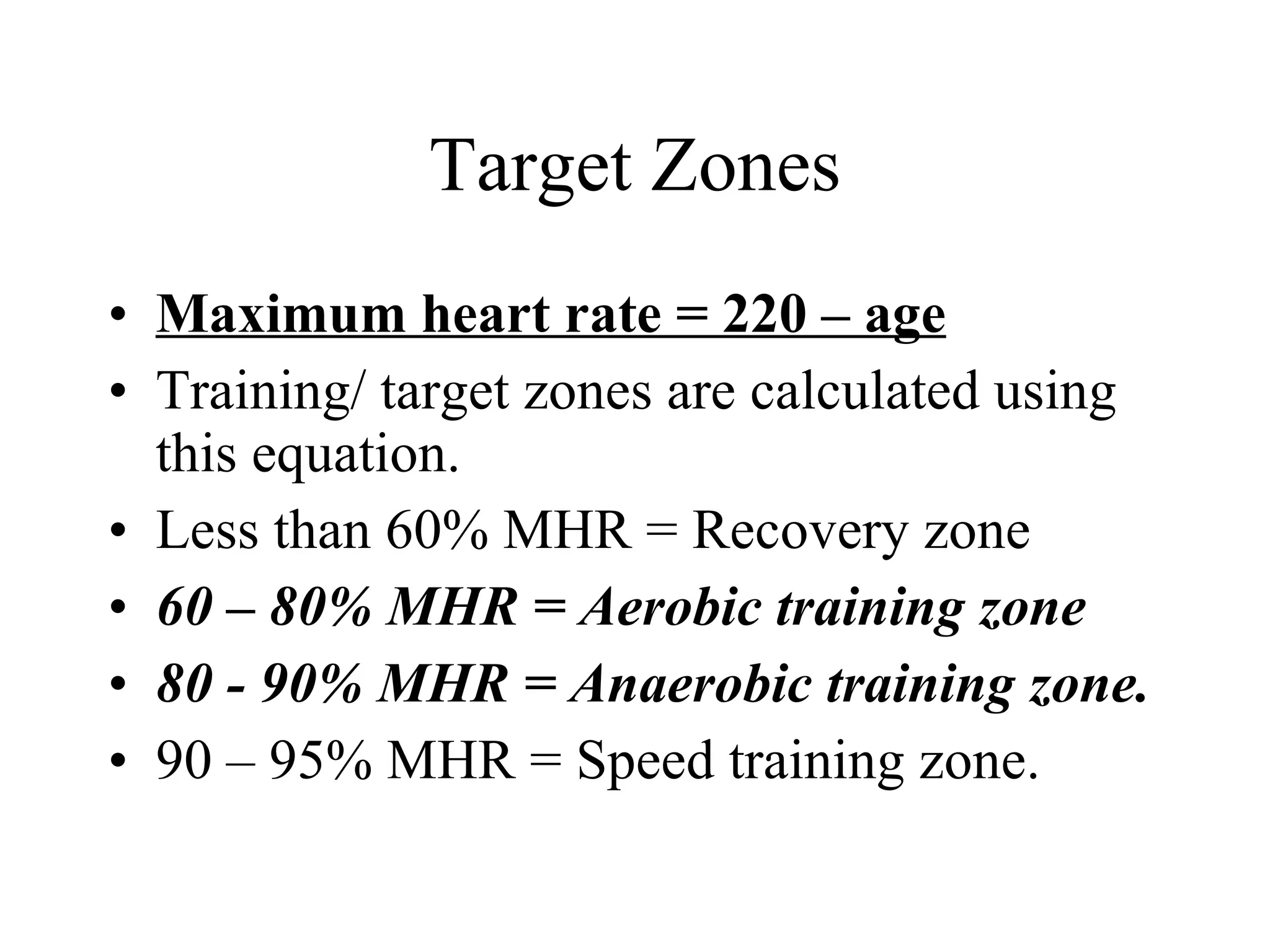
Target Zones Maximum heart rate = 220 – age Training/ target zones are calculated using this equation. Less than 60% MHR = Recovery zone 60 – 80% MHR = Aerobic training zone 80 - 90% MHR = Anaerobic training zone. 90 – 95% MHR = Speed training zone.
DIET, HEALTH & HYGIENE
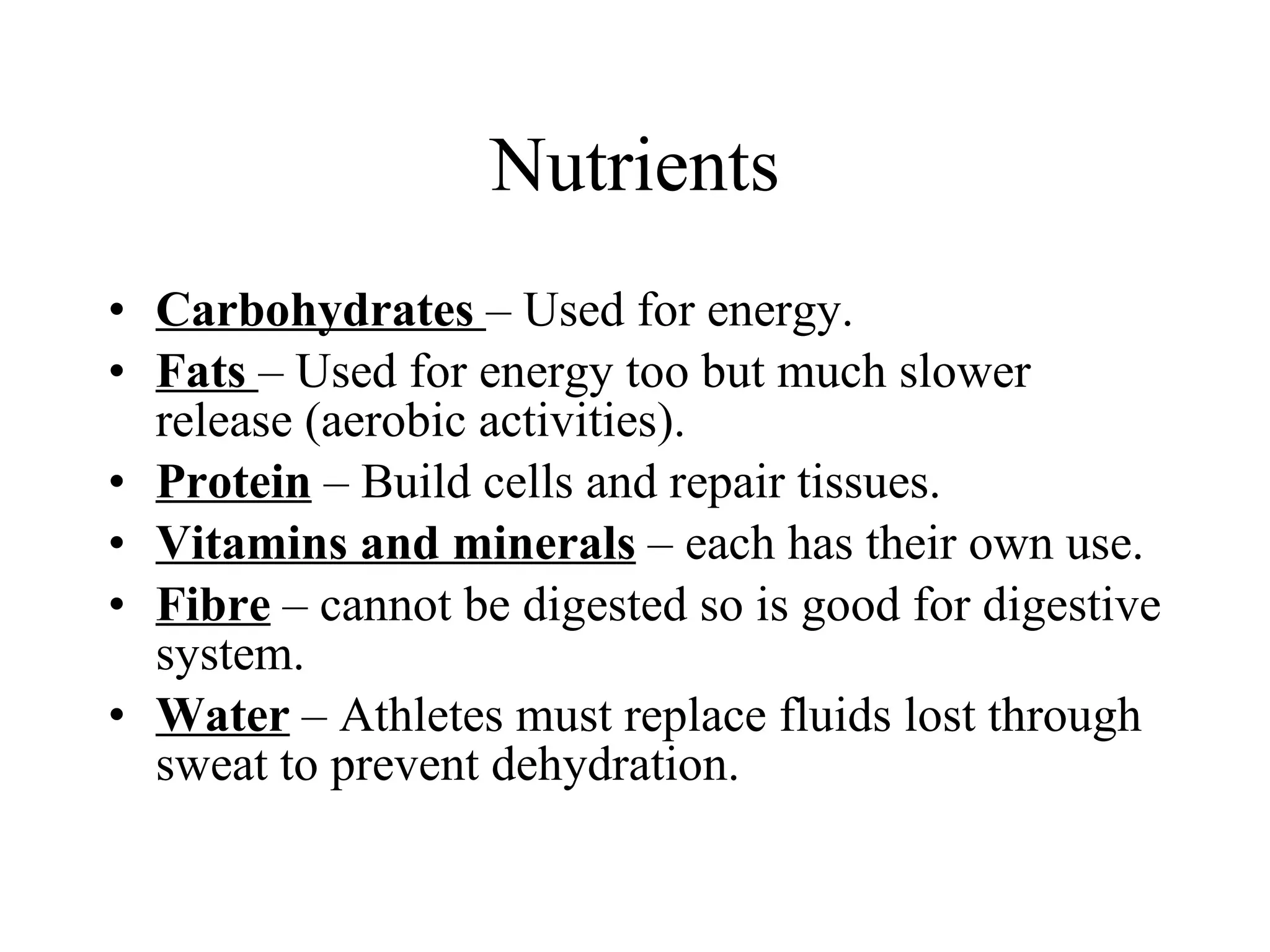
Nutrients Carbohydrates  – Used for energy.  Fats  – Used for energy too but much slower release (aerobic activities). Protein  – Build cells and repair tissues. Vitamins and minerals  – each has their own use. Fibre  – cannot be digested so is good for digestive system. Water  – Athletes must replace fluids lost through sweat to prevent dehydration.
Extreme body types (Somatotypes) Endomorph  – lots of fat Mesomorph  – lots of muscle Ectomorph  - skinny
Overweight, overfat and obese Overfat  = More body fat than you should have. Obese  = People who are very overfat. Overweight  = Having weight that is in excess of normal. This is not harmful unless the extra weight is made up of excess fat.
Socially acceptable drugs Nicotine  – cigarettes. Nicotine, tar and carbon monoxide. Affects sports performance by getting less oxygen to working muscles so tire easily. Alcohol  – affects co – ordination, balance , reaction time.
Stimulants Stimulate circulatory and nervous systems. Can work hard for long periods of time without feeling pain & fatigue. Dangers: Ignoring pain & fatigue can lead to injury. Examples include: amphetamines, speed, cocaine.
Narcotic Analgesics Pain killers . Dangers: Ignoring pain & fatigue can lead to injury. Very addictive. Examples: morphine, heroin, codeine
Anabolic Steroids Hormones that help build & repair muscle . Dangers: If you take artificial hormones your body stops making its own. Causes aggression, infertility, cancer, growth of facial hair & deepening voice in females. Examples: testosterone.
Diuretics Increase the amount of water excreted in urine. Misused by boxers & jockeys who need to lose weight to make the correct weight.
Beta Blockers Block the effect of adrenaline . Calm athletes nerves. (Archery, shooting) Dangers: reduce blood pressure, can cause depression.
Blood Doping Increasing the number of red blood cells. Red blood cells carry O2. Increasing O2 helps endurance athletes perform better for longer. Blood is withdrawn and red blood cells extracted & frozen. Immediately before the event they are injected into the athlete. Dangers: Infection & blocked capillaries.
Foot Infections Athlete’s foot –  fungus  between toes. Spread by contact or on wet floors. Athletes foot powder cures it. Verruca – is a  wart  on the sole of the foot. Spread by contact or on wet floors. Treated by creams or by a chiropodist.
Prevention of Injury Rules Correct clothing/ footwear Protective clothing/ equipment e.g. shin pads, gum shields, post protectors. Warm up and cool down Balanced competition  – Same age, sex, skill level/ grade, weight.
Sports Injuries R est I ce – constricts blood vessels C ompression – i.e. Tight bandage E levation – lift high then it is harder for blood to flow there. Use   RICE  for soft tissue injuries i.e. strains and sprains.
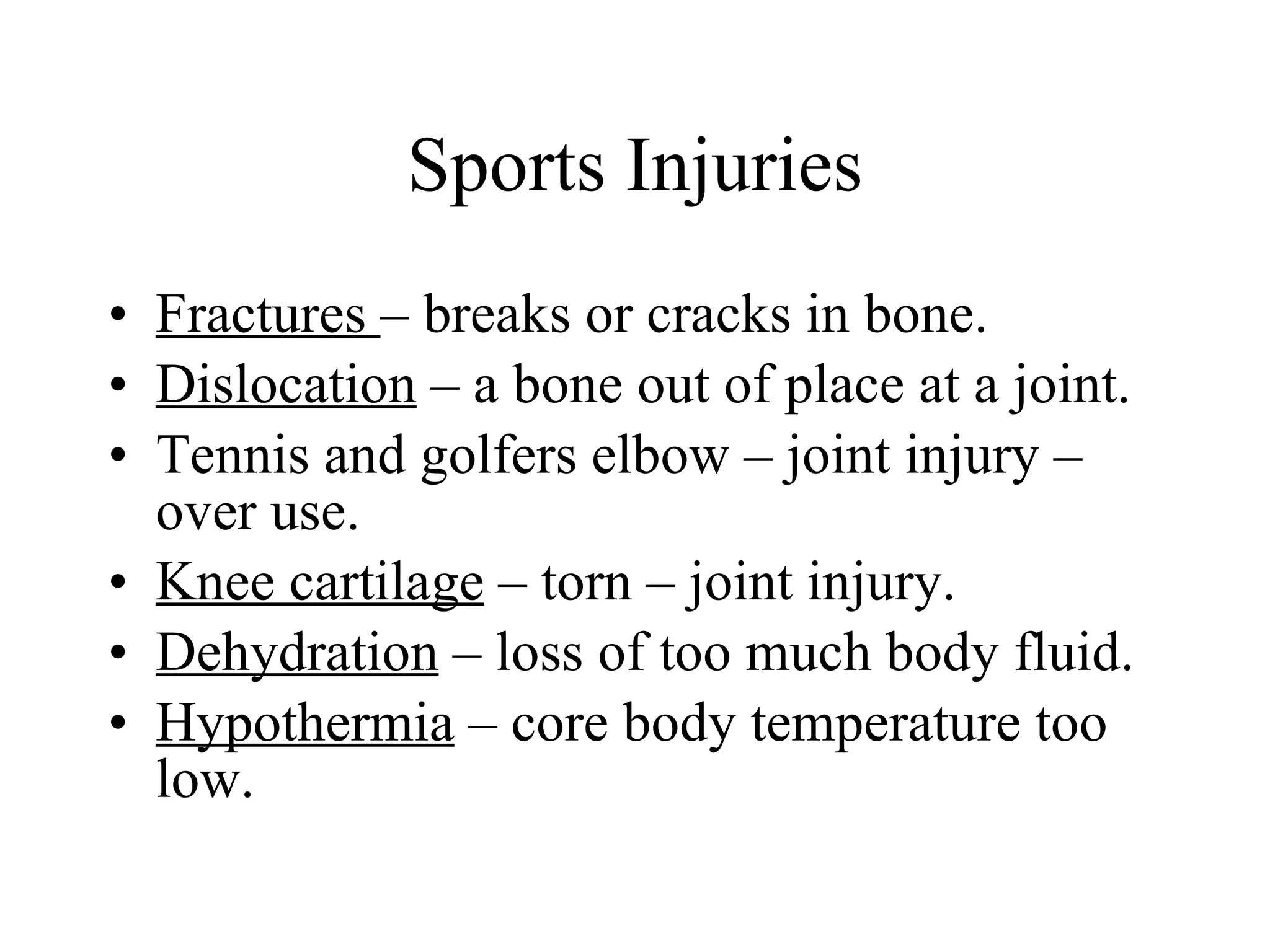
Sports Injuries Fractures  – breaks or cracks in bone. Dislocation  – a bone out of place at a joint. Tennis and golfers elbow – joint injury – over use. Knee cartilage  – torn – joint injury. Dehydration  – loss of too much body fluid. Hypothermia  – core body temperature too low.
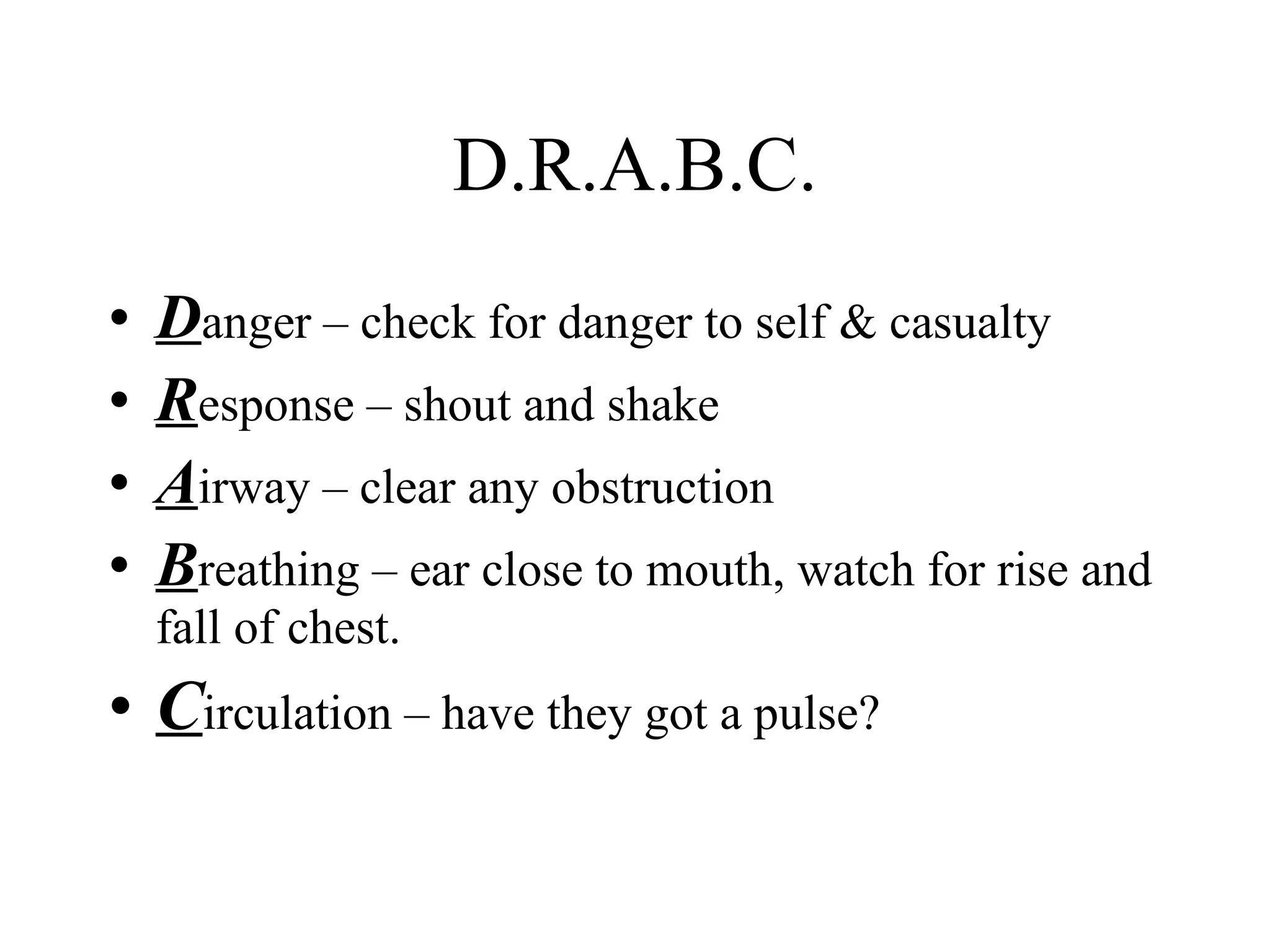
D.R.A.B.C. D anger – check for danger to self & casualty R esponse – shout and shake A irway – clear any obstruction B reathing – ear close to mouth, watch for rise and fall of chest. C irculation – have they got a pulse?
Cardiac Massage If casualty is  not breathing and has no pulse , first phone the ambulance, then give  two breaths and fifteen chest compressions  until help arrives. These chest compressions do the same job as the heart in pumping blood to vital organs.( You are not really trying to start the heart).
Recovery Position If the casualty is breathing and has a pulse (but are unconscious), place on their side in the recovery position and keep checking they are breathing & have pulse until help arrives. This keeps airway clear.
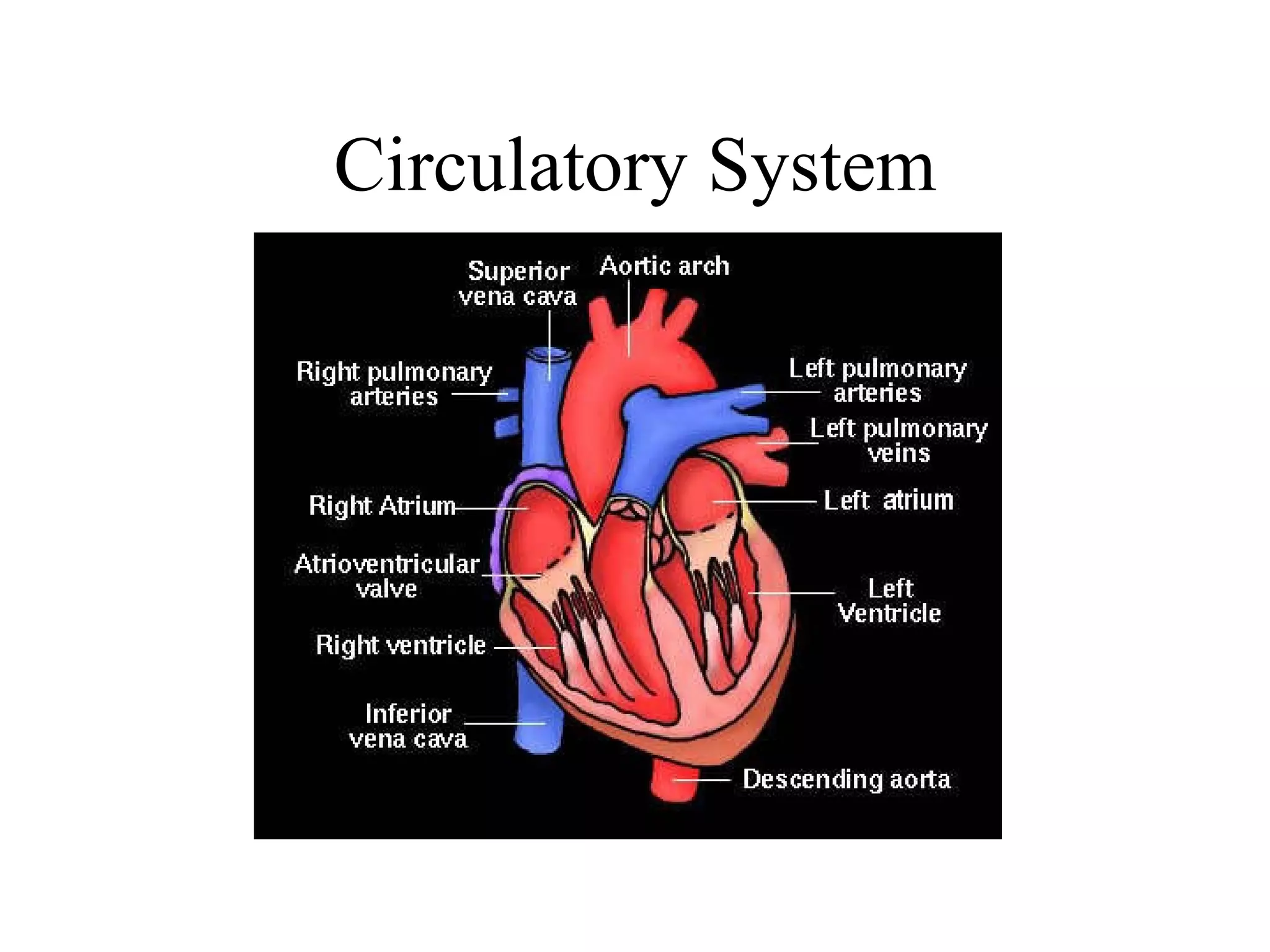
Circulatory System
Double circulatory system The heart acts as a pump in a double circulatory system. Imagine that the two sides of the heart are separated. The right side always deals with de – oxygenated blood & sends it to the lungs. The left side always deals with oxygen rich blood and sends it round the body.
In Short . . . Vena cava Right atrium Tricuspid valve Right ventricle Semi lunar valves Pulmonary artery Lungs Pulmonary vein Left atrium Bicuspid (mitral) valve Left ventricle Semi lunar valves Aorta Body
Septum The  septum  is the wall of muscle that separates the two sides of the heart to prevent the de oxygenated and oxygenated  blood from mixing.
Important Definitions Heart rate  – the number of times the heart beats each minute.  (Pulse)  This will  decrease  the  fitter you are.  Stroke volume  – the amount of blood pumped out of the heart with each beat.  This will  increase  the fitter you are as the muscle walls of the heart will get stronger and pump out more blood with every beat.
Important Definitions Cardiac output  – the amount of blood ejected by the heart in one minute. This will increase the fitter you are because the stroke volume increases. Cardiac output = heart rate X stroke volume
Arteries & Veins Arteries Veins No valves Have valves Go away Go towards heart Narrow lumen Large lumen High Pressure Low Pressure Thick muscle Thin muscle Mainly oxygenated Mainly deoxygenated
Capillaries Thin (one cell thick) Exchange gases (see respiratory system).
Blood Red blood cells  – transport oxygen from lungs to tissues (Haemoglobin). Plasma  – Transport carbon dioxide from tissues to lungs ( and glucose and mineral salts to tissues). Platelets  – help in blood clotting (forming scabs) White blood cells  – Immune system, defence against disease.
THE RESPIRATORY SYSTEM
The Respiratory System
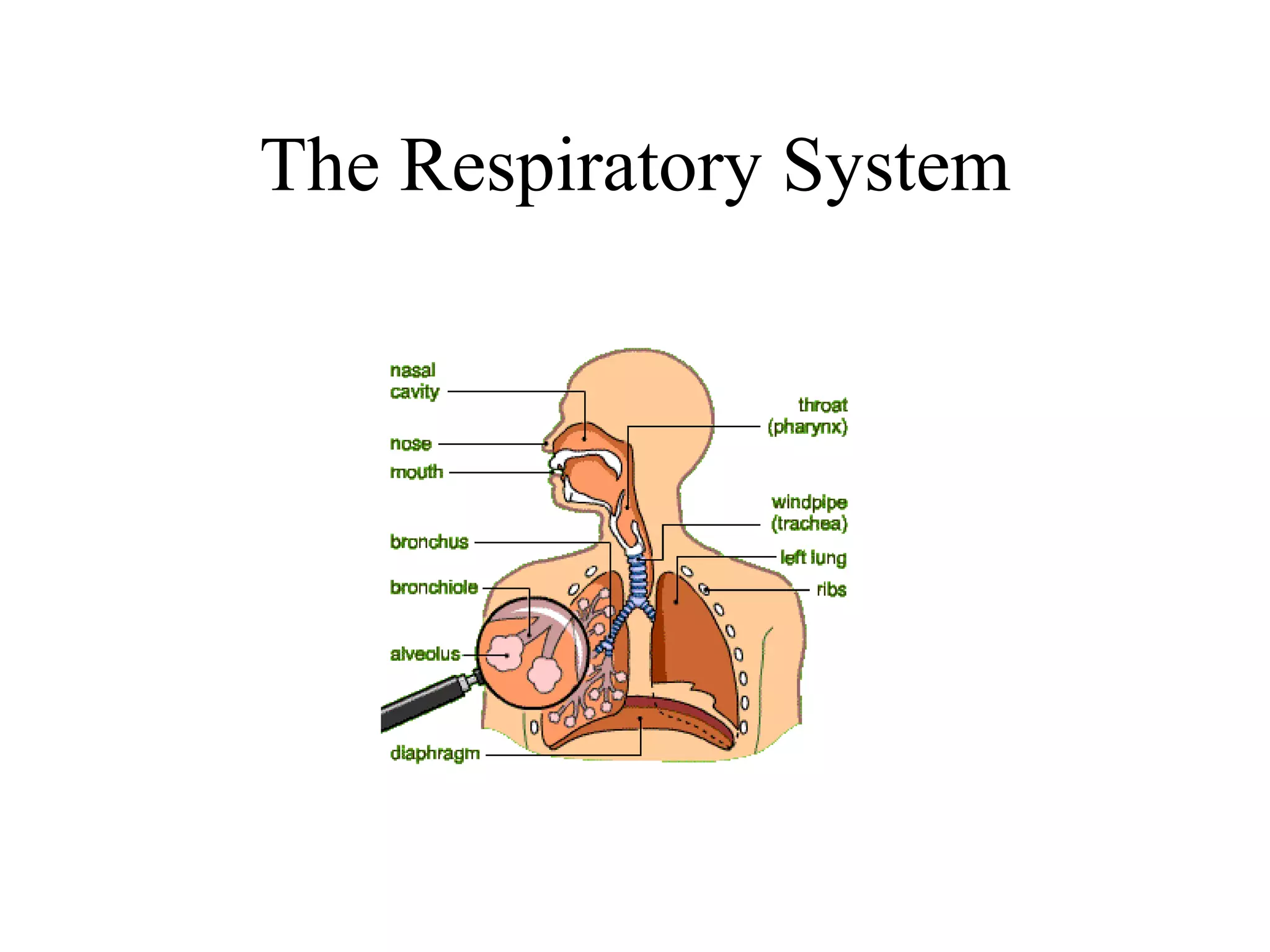
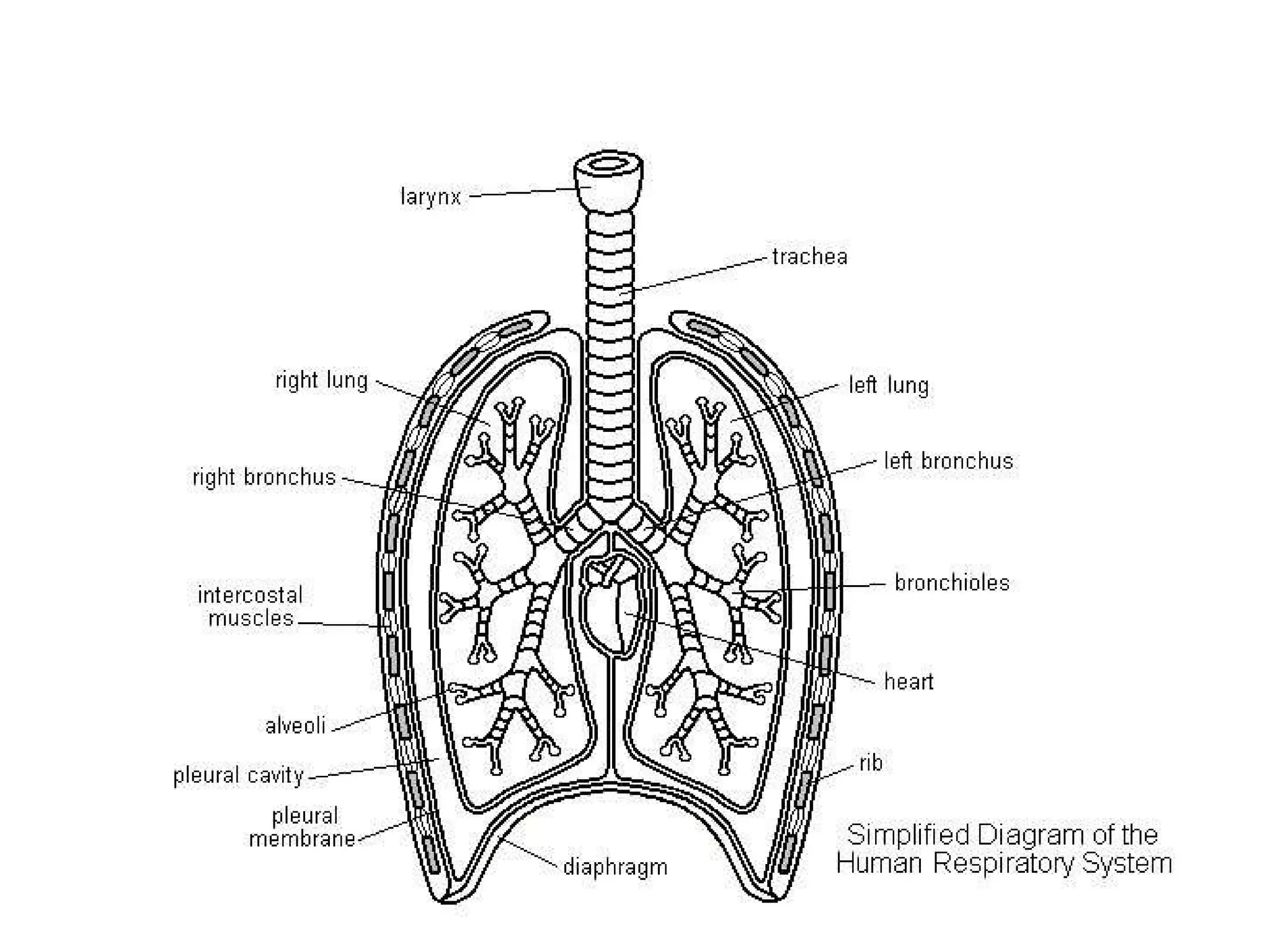
Parts of the Respiratory System Air is breathed into the nose, where it is filtered by  cilia  (tiny hairs) and warmed and moistened by  mucus. The  epiglottis  (a small flap of cartilage) stops food going into the windpipe instead of the gullet. The  larynx  is the voice box.
The windpipe or  trachea  is a flexible tube held open by rings of  cartilage. The  lungs  are soft and spongy and are in a space called the thoracic cavity. The  pleural membrane  is a slippery skin that protects the lungs as they rub against the ribs.
The ribs protect the lungs.  Intercostal muscles  in between the ribs help us breathe in and out. In the lungs, the trachea branches into two  bronchi . Each is a  bronchus . The bronchi branch into smaller  bronchioles. The bronchioles end in bunches of tiny air sacs called  alveoli . Their walls are thin so gases can pass through them.
The Lungs
GASEOUS EXCHANGE Gaseous exchange takes place in the  alveoli  of the lungs. Capillaries (are one cell thick) surround the alveoli. The oxygen from the lungs pass into the capillaries and this then goes back to the heart to be pumped round the body. The carbon dioxide passes from the blood into the lungs and is then breathed out.
Composition of air Substance Amount inhaled Amount exhaled Oxygen 21% 17% Carbon dioxide A tiny amount 3% Nitrogen 79% 79% Water little more
Breathing Is also called  respiration. Breathing in is called  inspiration. Breathing out is called  expiration.
Definitions Tidal volume : The amount of air you breathe out in one breath. Respiratory rate : how many breaths you  take in one minute. Vital capacity : the maximum amount of air you can breathe out, after breathing in as deeply as you can.
Minute Volume Tidal volume X respiratory rate = minute volume (the amount you breathe in one minute).
Bones
Ossification Inside the womb, bones start life as  cartilage .  Over the years this turns into bone in a process called  ossification.
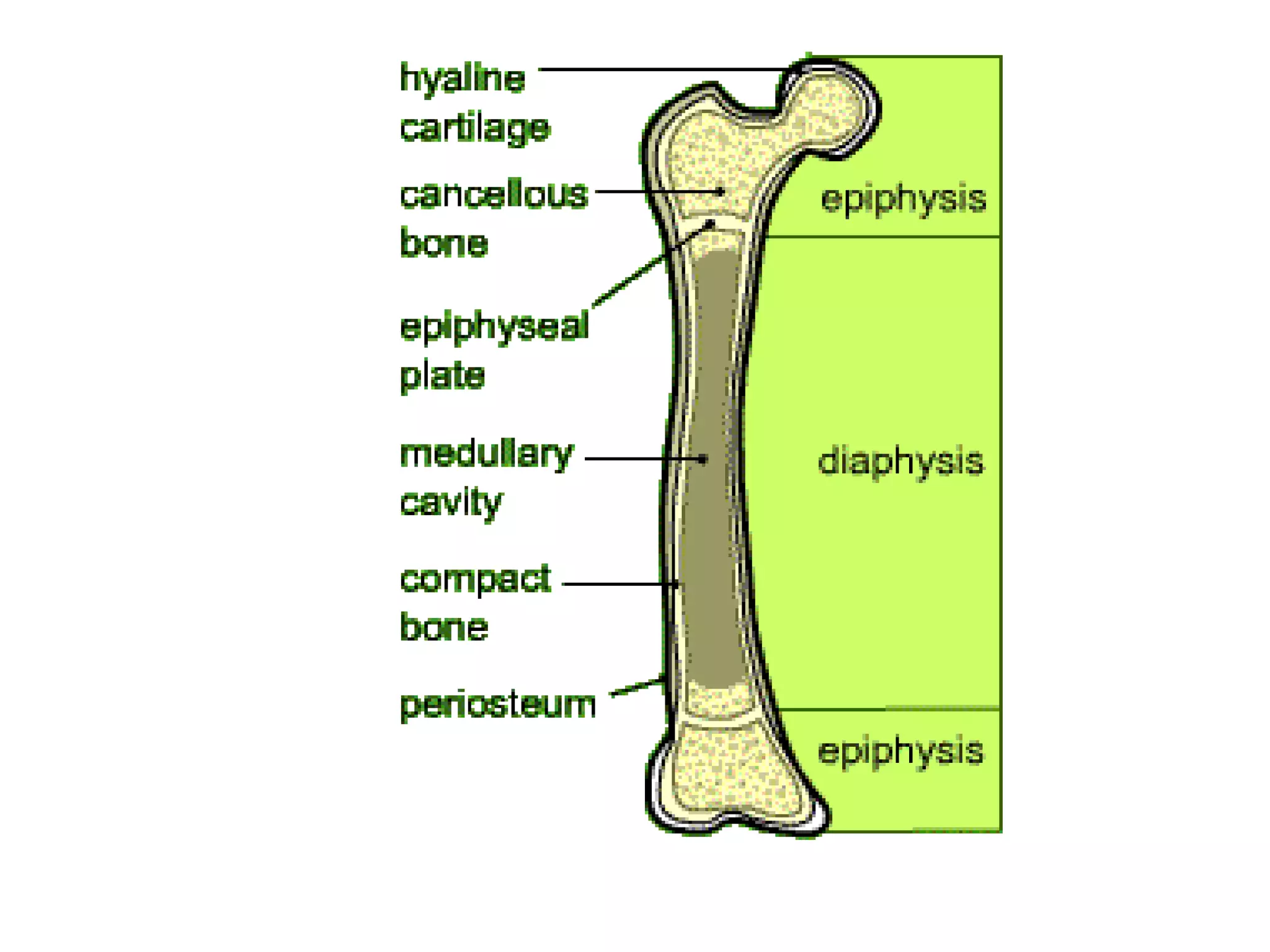
Composition of Bones Periosteum  – grows around the cartilage. Controls the shape & thickness of the bone. Bone cells appear at the end of bones – the  growth plates  or epiphyseal plates. The  epiphysis  is at the end of the bone. The  diaphysis  is the shaft (length) of the bone.
Cartilage  – prevents bones rubbing together. Becomes thicker with exercise. Compact bone  - hard and strong, it protects the bone from breaking. Becomes thicker with exercise. Marrow cavity  – contains bone marrow. With exercise the production of red and white blood cells is speeded up. Spongy bone  – helps with shock absorption. This increases through exercise.
 
Functions of the Skeleton Shape / support – The bones form a framework to support the body. Different length and thickness of bones determine our shape. Protection  – Bones surround our vital organs. E.g. the skull protects the brain, the vertebral column protect the spinal cord.  Movement  –produced by muscles pulling on bones. Blood production  – Bones make blood cells in the marrow cavity and spongy bone.
THE FOUR TYPES OF BONE LONG BONES – arms & legs, hands, feet, fingers & toes. Used for movement. SHORT BONES – Carpals & tarsals. Fine movement & strength. FLAT BONES – Scapula, cranium, pelvis. Protection of vital organs. IRREGULAR BONES – Vertebrae. Protection & support.
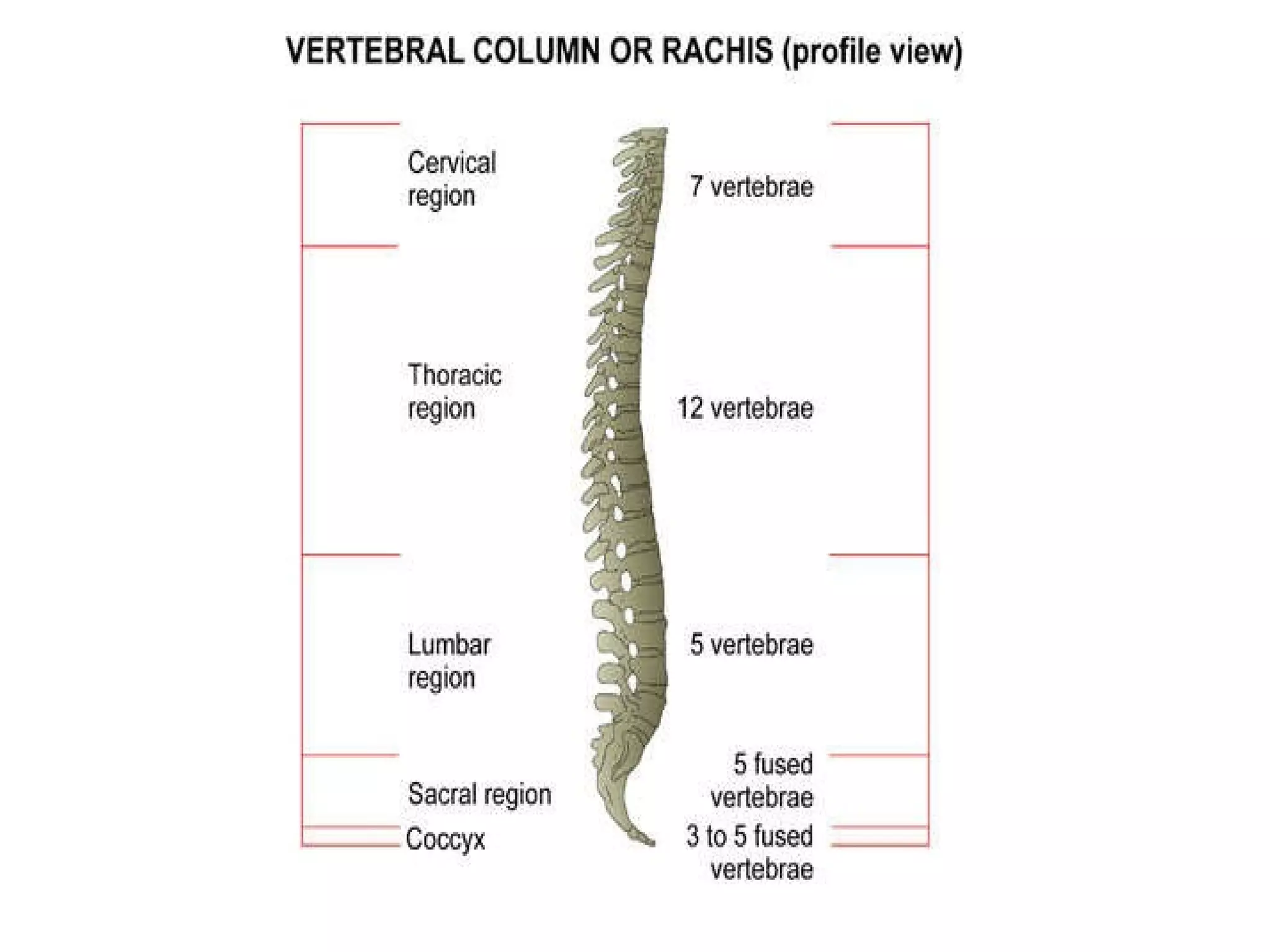
The vertebral column The 5 sections of the vertebral column are: CERVICAL 7  PIECES THORACIC 12  PIECES LUMBAR 5  PIECES SACRUM 5  PIECES COCCYX 4  PIECES
 
Functions of vertebral Column CERVICAL  – neck – atlas & axis - nodding THORACIC  – chest – ribs attached LUMBAR  – largest bones, support weight, most movement & injuries occur here. SACRUM  – Fused. Transmit force from legs to upper body. Throwing events. COCCYX  - fused. No real function.
Why is the spine regarded as weak for some activities? The spine is fairly  thin  for the weight that it is expected to carry. Any activity where we have to  lift or carry  any extra weight can be dangerous. E.g. Weightlifting. Any activity which could result in our spine  moving in a way for which it was not designed  is dangerous. E.g. Trampolining.
Any  contact sport  is dangerous due to the chance of another person causing you an injury, even by accident. E.g. a rugby scrum collapsing, or someone mis-timing a tackle. The  structure  of the spine. Between each vertebra there is a disc of cartilage. Vertebrae are linked by ligaments. Too much movement causes these ligaments to be strained or the vertebral discs to slip which is very painful.
Joints and Movement
Joints A joint is defined as  “a place where two, or more, bones meet”.
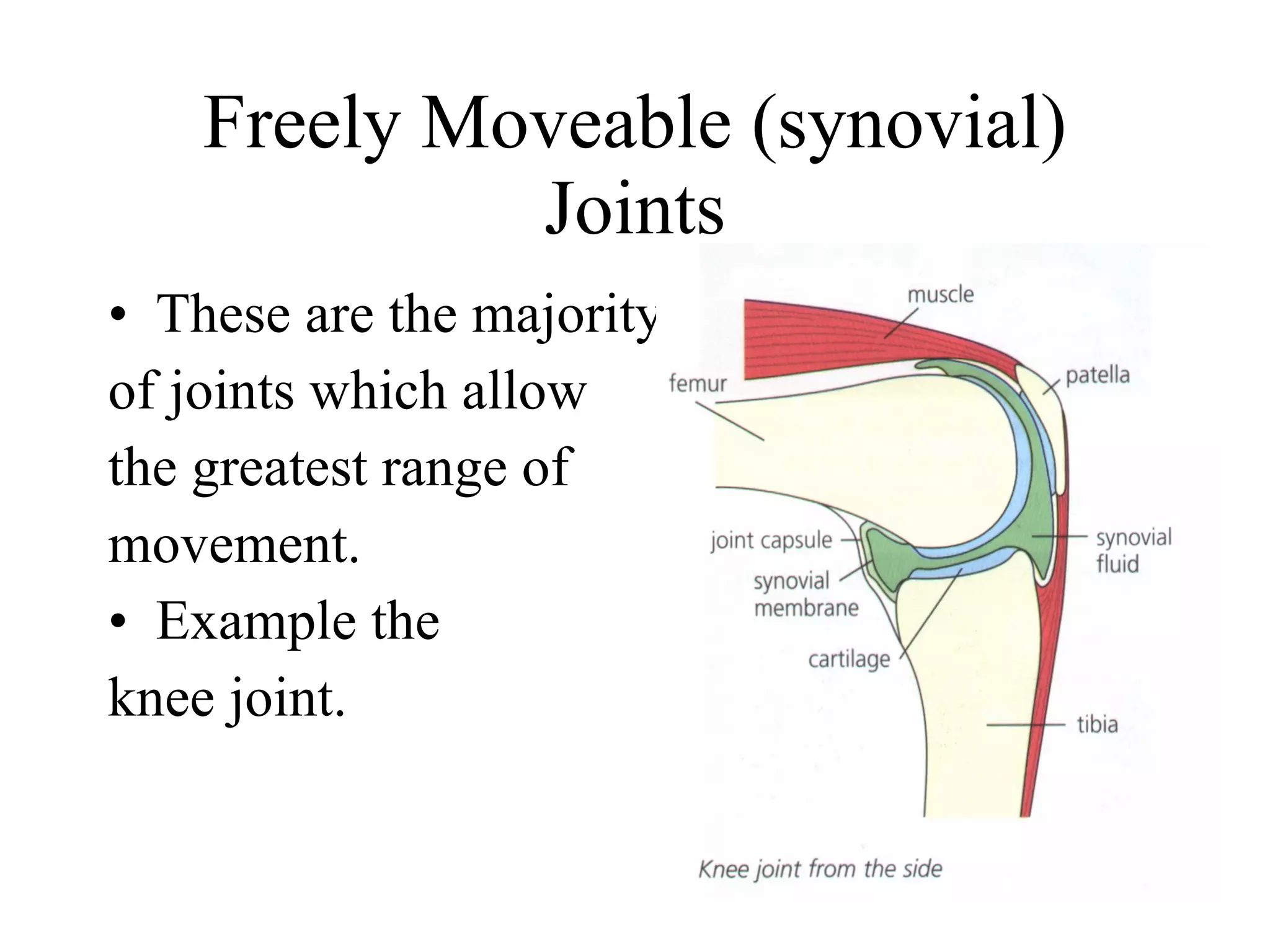
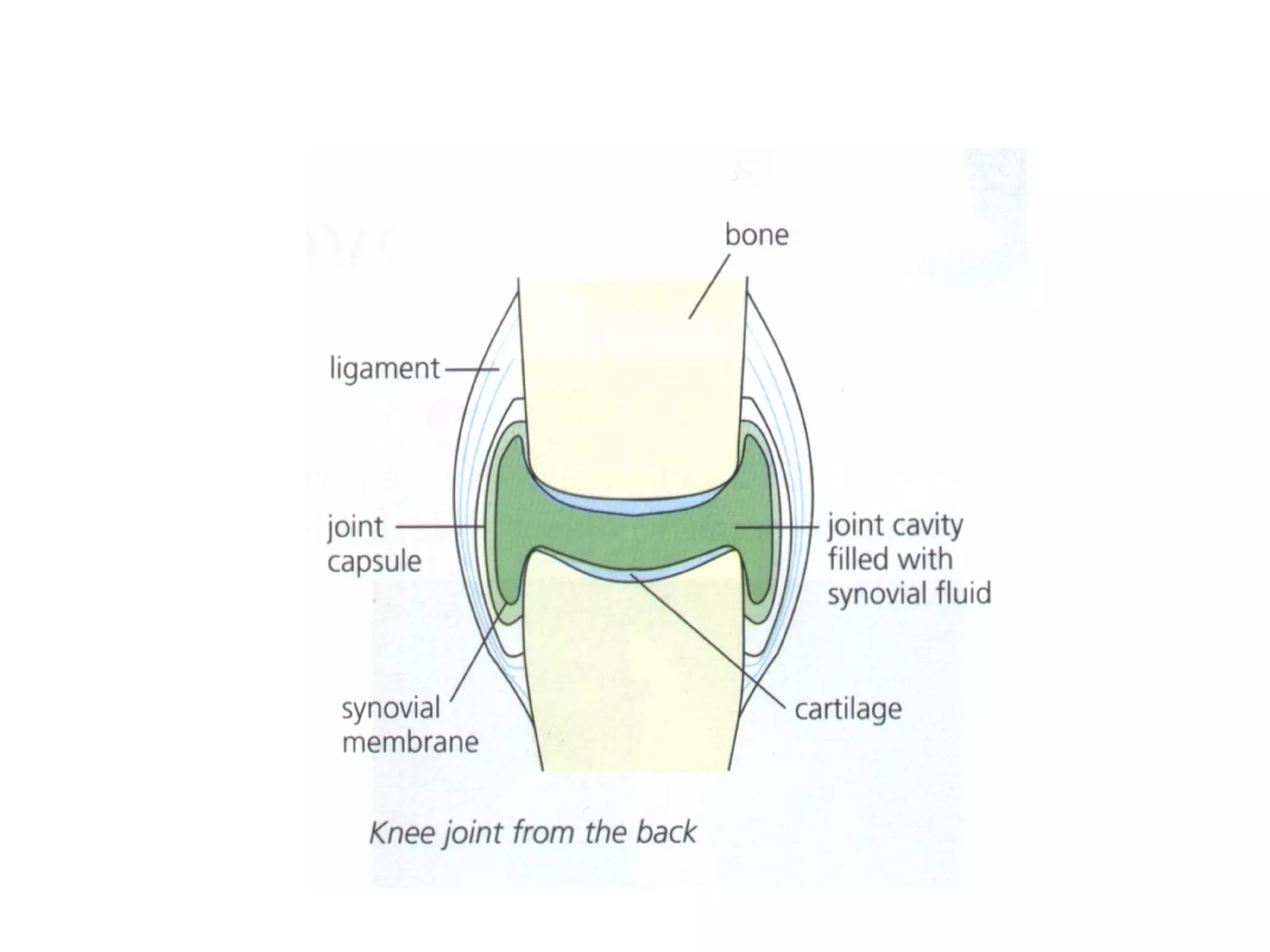
Freely Moveable (synovial) Joints These are the majority  of joints which allow  the greatest range of  movement.  Example the  knee joint.
Joint capsule : holds the bone together and protects the joint. Synovial membrane : This lines the capsule and contains liquid called the synovial fluid. Joint cavity :  This is a small gap between the bones that is filled by  synovial fluid.  This lubricates the joint so bones move easier. Cartilage :  At the end of bones to prevent them rubbing together. Ligaments :  Hold bones together .
 
Freely Movable Joints Ball and socket : E.g. hip – cross over step in javelin. Shoulder – bowling in cricket. Hinge : E.g. Elbow – press ups. Knee – kicking a ball. Pivot  – Neck, Radius & ulna – changing from forehand to backhand in tennis. Saddle  – thumb Gliding  – carpals & tarsals – swinging golf club.
Fixed or immovable joints These bones can’t move at all. E.g. Cranium. The plates in the cranium are fused together for greater strength.
Slightly movable joints The bones at a slightly moveable joint can move very slightly. They are held together by ligaments and are cushioned by cartilage. A good example of this joint is the vertebrae and the ribs and sternum.
Muscles and Muscle Action
Types of Muscle
Voluntary/ Skeletal These are attached to bones. They work when we want them to, when we decide. Voluntary muscles are also called skeletal muscle because they are attached to bones. They are also called  striped  or striated because of their appearance under a microscope.
Involuntary Muscles We do not have to think about using these muscles.They work on their own. Examples include:  stomach, gut, bladder   and blood vessels .  Also known as  smooth  muscles because they have no stripes under a microscope.
Cardiac Muscle Is a special type of involuntary muscle that forms the walls of the heart. It works non – stop without ever tiring.
Antagonistic Pairs Muscles work in  antagonistic pairs . Working muscle =  prime mover  or  agonist  The relaxing muscle is called the  antagonist. E.g. to flex the arm: Biceps = agonist, triceps = antagonist To extend the arm Triceps = agonist, biceps = antagonist. The hamstrings and quadriceps are also an example of antagonistic muscle action.
Types of Movement Flexion  – bending a limb at a joint. (Decreasing the angle). Extension  – Straightening a limb at a joint. (Increasing the angle). Adduction  – Movement towards the mid line of the body. Abduction  – Movement away from the mid line of the body.
REMEMBER !!! As soon as you are allowed to open your exam paper write down the following -
REMEMBER !!! Mental, Social, Physical benefits HRF – Body comp, CV, Endurance, Flex, Strength.  SRF – Agility, Balance, Co – ord, Power Reaction time, Speed. (ABCPRS) Specificity, Progression, Overload, Reversibility, Tedium. (SPORT) Frequency, Intensity, Time, Type. (FITT)
REMEMBER !!! Rest, Ice, Compression, Elevation. (RICE) Danger, Response, Airway, Breathing, Circulation. (DRABC)

PEShare.co.uk Shared Resource

  • 1.
  • 2.
    Why do wetake part in physical activity? Social – Meet people, make friends. - Co – operation, competition, physical challenge, aesthetic appreciation. Mental – Relieve stress and tension and stress related illness. Physical – Improve body shape, good health,
  • 3.
    Health “ Healthis a state of complete physical, mental and social well – being and not merely the absence of disease or infirmity”.
  • 4.
    Fitness “ theability to meet the demands of the environment”. Your environment = your life and the things you do in it.
  • 5.
    Exercise “ a form of physical activity done primarily to improve one’s health and physical fitness”.
  • 6.
    Performance “ howwell a task is completed”.
  • 7.
    Health Related FitnessCardio vascular fitness Muscular strength Muscular endurance Flexibility Body composition (A lack of any of these components will have a negative effect on your health).
  • 8.
    Health Related FitnessC.V. fitness is “ the ability to exercise the entire body for long periods of time ”. Muscular Strength is “The ability to apply force and overcome resistance”. Muscular Endurance is “The ability to use muscles,many times without getting tired”.
  • 9.
    Flexibility is - “The range of movement at a joint.” Body composition is - “The percentage of body weight which is fat muscle and bone.”
  • 10.
    Skill Related FitnessThese are the components of fitness which determine which sports you will be good at. They do not affect health. Agility – to change direction at speed. Balance – retain centre of mass over base of support. Co – ordination – to use two or more body parts together
  • 11.
    A B CP R S Power – strength performance quickly Reaction Time - “The time between the presentation of a stimulus and the onset of movement.” Speed - “How fast your body can move over a short distance”.
  • 12.
  • 13.
    S.P.O.R.T. Specificity – the activity/ training done must match the outcomes that you want to achieve. Progression – start slowly and build up gradually. Overload – making your body systems work harder than normal. Reversibility – when you stop training you lose the fitness built up. Tedium
  • 14.
    FITT PRINCIPLES Frequency – How often? Intensity – How hard? Time – How long? Type – What you do. 3miles 15mins 3 times 4miles 20mins 3 times 4miles 20mins 4 times
  • 15.
  • 16.
    Methods of TrainingCircuit Weight Interval Continuous Fartlek Cross
  • 17.
  • 18.
    Exercise Session Warmup: Pulse raisers, stretches, mobilising joints. Main activity: skills, drills, tactics. Cool down: to remove lactic acid and repay oxygen debt.
  • 19.
    Immediate effects ofexercise Increased heart rate, breathing rate, body temperature, blood flow to working muscles.
  • 20.
    Long term effectsof exercise Bones – become denser. Joints – remain mobile – increased production of synovial fluid lubricates the joints. Muscles – get stronger and can contract with more force.
  • 21.
    Long term effectsof exercise Cardiovascular system – increased stroke volume, increased cardiac output, heart muscle gets thicker/ stronger. - Decreased resting heart rate. Respiratory system - Vital capacity increases. More alveoli become surrounded by capillaries so gas exchange is more efficient. As a result of this we can work for longer before tiring (aerobically).
  • 22.
    Recovery Rate Thisis the length of time it takes our heart rate to return to normal after we finish exercising.
  • 23.
    Target Zones Maximumheart rate = 220 – age Training/ target zones are calculated using this equation. Less than 60% MHR = Recovery zone 60 – 80% MHR = Aerobic training zone 80 - 90% MHR = Anaerobic training zone. 90 – 95% MHR = Speed training zone.
  • 24.
  • 25.
    Nutrients Carbohydrates – Used for energy. Fats – Used for energy too but much slower release (aerobic activities). Protein – Build cells and repair tissues. Vitamins and minerals – each has their own use. Fibre – cannot be digested so is good for digestive system. Water – Athletes must replace fluids lost through sweat to prevent dehydration.
  • 26.
    Extreme body types(Somatotypes) Endomorph – lots of fat Mesomorph – lots of muscle Ectomorph - skinny
  • 27.
    Overweight, overfat andobese Overfat = More body fat than you should have. Obese = People who are very overfat. Overweight = Having weight that is in excess of normal. This is not harmful unless the extra weight is made up of excess fat.
  • 28.
    Socially acceptable drugsNicotine – cigarettes. Nicotine, tar and carbon monoxide. Affects sports performance by getting less oxygen to working muscles so tire easily. Alcohol – affects co – ordination, balance , reaction time.
  • 29.
    Stimulants Stimulate circulatoryand nervous systems. Can work hard for long periods of time without feeling pain & fatigue. Dangers: Ignoring pain & fatigue can lead to injury. Examples include: amphetamines, speed, cocaine.
  • 30.
    Narcotic Analgesics Painkillers . Dangers: Ignoring pain & fatigue can lead to injury. Very addictive. Examples: morphine, heroin, codeine
  • 31.
    Anabolic Steroids Hormonesthat help build & repair muscle . Dangers: If you take artificial hormones your body stops making its own. Causes aggression, infertility, cancer, growth of facial hair & deepening voice in females. Examples: testosterone.
  • 32.
    Diuretics Increase theamount of water excreted in urine. Misused by boxers & jockeys who need to lose weight to make the correct weight.
  • 33.
    Beta Blockers Blockthe effect of adrenaline . Calm athletes nerves. (Archery, shooting) Dangers: reduce blood pressure, can cause depression.
  • 34.
    Blood Doping Increasingthe number of red blood cells. Red blood cells carry O2. Increasing O2 helps endurance athletes perform better for longer. Blood is withdrawn and red blood cells extracted & frozen. Immediately before the event they are injected into the athlete. Dangers: Infection & blocked capillaries.
  • 35.
    Foot Infections Athlete’sfoot – fungus between toes. Spread by contact or on wet floors. Athletes foot powder cures it. Verruca – is a wart on the sole of the foot. Spread by contact or on wet floors. Treated by creams or by a chiropodist.
  • 36.
    Prevention of InjuryRules Correct clothing/ footwear Protective clothing/ equipment e.g. shin pads, gum shields, post protectors. Warm up and cool down Balanced competition – Same age, sex, skill level/ grade, weight.
  • 37.
    Sports Injuries Rest I ce – constricts blood vessels C ompression – i.e. Tight bandage E levation – lift high then it is harder for blood to flow there. Use RICE for soft tissue injuries i.e. strains and sprains.
  • 38.
    Sports Injuries Fractures – breaks or cracks in bone. Dislocation – a bone out of place at a joint. Tennis and golfers elbow – joint injury – over use. Knee cartilage – torn – joint injury. Dehydration – loss of too much body fluid. Hypothermia – core body temperature too low.
  • 39.
    D.R.A.B.C. D anger– check for danger to self & casualty R esponse – shout and shake A irway – clear any obstruction B reathing – ear close to mouth, watch for rise and fall of chest. C irculation – have they got a pulse?
  • 40.
    Cardiac Massage Ifcasualty is not breathing and has no pulse , first phone the ambulance, then give two breaths and fifteen chest compressions until help arrives. These chest compressions do the same job as the heart in pumping blood to vital organs.( You are not really trying to start the heart).
  • 41.
    Recovery Position Ifthe casualty is breathing and has a pulse (but are unconscious), place on their side in the recovery position and keep checking they are breathing & have pulse until help arrives. This keeps airway clear.
  • 42.
  • 43.
    Double circulatory systemThe heart acts as a pump in a double circulatory system. Imagine that the two sides of the heart are separated. The right side always deals with de – oxygenated blood & sends it to the lungs. The left side always deals with oxygen rich blood and sends it round the body.
  • 44.
    In Short .. . Vena cava Right atrium Tricuspid valve Right ventricle Semi lunar valves Pulmonary artery Lungs Pulmonary vein Left atrium Bicuspid (mitral) valve Left ventricle Semi lunar valves Aorta Body
  • 45.
    Septum The septum is the wall of muscle that separates the two sides of the heart to prevent the de oxygenated and oxygenated blood from mixing.
  • 46.
    Important Definitions Heartrate – the number of times the heart beats each minute. (Pulse) This will decrease the fitter you are. Stroke volume – the amount of blood pumped out of the heart with each beat. This will increase the fitter you are as the muscle walls of the heart will get stronger and pump out more blood with every beat.
  • 47.
    Important Definitions Cardiacoutput – the amount of blood ejected by the heart in one minute. This will increase the fitter you are because the stroke volume increases. Cardiac output = heart rate X stroke volume
  • 48.
    Arteries & VeinsArteries Veins No valves Have valves Go away Go towards heart Narrow lumen Large lumen High Pressure Low Pressure Thick muscle Thin muscle Mainly oxygenated Mainly deoxygenated
  • 49.
    Capillaries Thin (onecell thick) Exchange gases (see respiratory system).
  • 50.
    Blood Red bloodcells – transport oxygen from lungs to tissues (Haemoglobin). Plasma – Transport carbon dioxide from tissues to lungs ( and glucose and mineral salts to tissues). Platelets – help in blood clotting (forming scabs) White blood cells – Immune system, defence against disease.
  • 51.
  • 52.
  • 53.
    Parts of theRespiratory System Air is breathed into the nose, where it is filtered by cilia (tiny hairs) and warmed and moistened by mucus. The epiglottis (a small flap of cartilage) stops food going into the windpipe instead of the gullet. The larynx is the voice box.
  • 54.
    The windpipe or trachea is a flexible tube held open by rings of cartilage. The lungs are soft and spongy and are in a space called the thoracic cavity. The pleural membrane is a slippery skin that protects the lungs as they rub against the ribs.
  • 55.
    The ribs protectthe lungs. Intercostal muscles in between the ribs help us breathe in and out. In the lungs, the trachea branches into two bronchi . Each is a bronchus . The bronchi branch into smaller bronchioles. The bronchioles end in bunches of tiny air sacs called alveoli . Their walls are thin so gases can pass through them.
  • 56.
  • 57.
    GASEOUS EXCHANGE Gaseousexchange takes place in the alveoli of the lungs. Capillaries (are one cell thick) surround the alveoli. The oxygen from the lungs pass into the capillaries and this then goes back to the heart to be pumped round the body. The carbon dioxide passes from the blood into the lungs and is then breathed out.
  • 58.
    Composition of airSubstance Amount inhaled Amount exhaled Oxygen 21% 17% Carbon dioxide A tiny amount 3% Nitrogen 79% 79% Water little more
  • 59.
    Breathing Is alsocalled respiration. Breathing in is called inspiration. Breathing out is called expiration.
  • 60.
    Definitions Tidal volume: The amount of air you breathe out in one breath. Respiratory rate : how many breaths you take in one minute. Vital capacity : the maximum amount of air you can breathe out, after breathing in as deeply as you can.
  • 61.
    Minute Volume Tidalvolume X respiratory rate = minute volume (the amount you breathe in one minute).
  • 62.
  • 63.
    Ossification Inside thewomb, bones start life as cartilage . Over the years this turns into bone in a process called ossification.
  • 64.
    Composition of BonesPeriosteum – grows around the cartilage. Controls the shape & thickness of the bone. Bone cells appear at the end of bones – the growth plates or epiphyseal plates. The epiphysis is at the end of the bone. The diaphysis is the shaft (length) of the bone.
  • 65.
    Cartilage –prevents bones rubbing together. Becomes thicker with exercise. Compact bone - hard and strong, it protects the bone from breaking. Becomes thicker with exercise. Marrow cavity – contains bone marrow. With exercise the production of red and white blood cells is speeded up. Spongy bone – helps with shock absorption. This increases through exercise.
  • 66.
  • 67.
    Functions of theSkeleton Shape / support – The bones form a framework to support the body. Different length and thickness of bones determine our shape. Protection – Bones surround our vital organs. E.g. the skull protects the brain, the vertebral column protect the spinal cord. Movement –produced by muscles pulling on bones. Blood production – Bones make blood cells in the marrow cavity and spongy bone.
  • 68.
    THE FOUR TYPESOF BONE LONG BONES – arms & legs, hands, feet, fingers & toes. Used for movement. SHORT BONES – Carpals & tarsals. Fine movement & strength. FLAT BONES – Scapula, cranium, pelvis. Protection of vital organs. IRREGULAR BONES – Vertebrae. Protection & support.
  • 69.
    The vertebral columnThe 5 sections of the vertebral column are: CERVICAL 7 PIECES THORACIC 12 PIECES LUMBAR 5 PIECES SACRUM 5 PIECES COCCYX 4 PIECES
  • 70.
  • 71.
    Functions of vertebralColumn CERVICAL – neck – atlas & axis - nodding THORACIC – chest – ribs attached LUMBAR – largest bones, support weight, most movement & injuries occur here. SACRUM – Fused. Transmit force from legs to upper body. Throwing events. COCCYX - fused. No real function.
  • 72.
    Why is thespine regarded as weak for some activities? The spine is fairly thin for the weight that it is expected to carry. Any activity where we have to lift or carry any extra weight can be dangerous. E.g. Weightlifting. Any activity which could result in our spine moving in a way for which it was not designed is dangerous. E.g. Trampolining.
  • 73.
    Any contactsport is dangerous due to the chance of another person causing you an injury, even by accident. E.g. a rugby scrum collapsing, or someone mis-timing a tackle. The structure of the spine. Between each vertebra there is a disc of cartilage. Vertebrae are linked by ligaments. Too much movement causes these ligaments to be strained or the vertebral discs to slip which is very painful.
  • 74.
  • 75.
    Joints A jointis defined as “a place where two, or more, bones meet”.
  • 76.
    Freely Moveable (synovial)Joints These are the majority of joints which allow the greatest range of movement. Example the knee joint.
  • 77.
    Joint capsule :holds the bone together and protects the joint. Synovial membrane : This lines the capsule and contains liquid called the synovial fluid. Joint cavity : This is a small gap between the bones that is filled by synovial fluid. This lubricates the joint so bones move easier. Cartilage : At the end of bones to prevent them rubbing together. Ligaments : Hold bones together .
  • 78.
  • 79.
    Freely Movable JointsBall and socket : E.g. hip – cross over step in javelin. Shoulder – bowling in cricket. Hinge : E.g. Elbow – press ups. Knee – kicking a ball. Pivot – Neck, Radius & ulna – changing from forehand to backhand in tennis. Saddle – thumb Gliding – carpals & tarsals – swinging golf club.
  • 80.
    Fixed or immovablejoints These bones can’t move at all. E.g. Cranium. The plates in the cranium are fused together for greater strength.
  • 81.
    Slightly movable jointsThe bones at a slightly moveable joint can move very slightly. They are held together by ligaments and are cushioned by cartilage. A good example of this joint is the vertebrae and the ribs and sternum.
  • 82.
  • 83.
  • 84.
    Voluntary/ Skeletal Theseare attached to bones. They work when we want them to, when we decide. Voluntary muscles are also called skeletal muscle because they are attached to bones. They are also called striped or striated because of their appearance under a microscope.
  • 85.
    Involuntary Muscles Wedo not have to think about using these muscles.They work on their own. Examples include: stomach, gut, bladder and blood vessels . Also known as smooth muscles because they have no stripes under a microscope.
  • 86.
    Cardiac Muscle Isa special type of involuntary muscle that forms the walls of the heart. It works non – stop without ever tiring.
  • 87.
    Antagonistic Pairs Muscleswork in antagonistic pairs . Working muscle = prime mover or agonist The relaxing muscle is called the antagonist. E.g. to flex the arm: Biceps = agonist, triceps = antagonist To extend the arm Triceps = agonist, biceps = antagonist. The hamstrings and quadriceps are also an example of antagonistic muscle action.
  • 88.
    Types of MovementFlexion – bending a limb at a joint. (Decreasing the angle). Extension – Straightening a limb at a joint. (Increasing the angle). Adduction – Movement towards the mid line of the body. Abduction – Movement away from the mid line of the body.
  • 89.
    REMEMBER !!! Assoon as you are allowed to open your exam paper write down the following -
  • 90.
    REMEMBER !!! Mental,Social, Physical benefits HRF – Body comp, CV, Endurance, Flex, Strength. SRF – Agility, Balance, Co – ord, Power Reaction time, Speed. (ABCPRS) Specificity, Progression, Overload, Reversibility, Tedium. (SPORT) Frequency, Intensity, Time, Type. (FITT)
  • 91.
    REMEMBER !!! Rest,Ice, Compression, Elevation. (RICE) Danger, Response, Airway, Breathing, Circulation. (DRABC)