Training Program for Fire
Department Detail Officers
Harry J. Hallgring Jr.
Chief of Department
 RI State Fire Marshal’s Office
 RI Fire Academy
 Providence Fire Department
 Newport Fire Department Bureau of Fire
Prevention
 NFPA 1 Uniform Fire Code
 NFPA 101 Life Safety Code
 Tragedy occurs, creates change.
 As the on-site professionalsYOU need to
know exactly what to do in the event of an
emergency.
 The public and the building managers will
look to you in their time of need.
 Your actions will be a major contributor to
saving lives.
 April 13, 1928 -West Plains, Mo., 40 dead,
dance hall (explosion).
Cause – Undetermined
 April 23, 1940 - Natchez, Miss., 198 dead,
Rhythm Night Club dance hall.
Cause – undetermined
 Nov. 28 1942 - Boston, Mass., 491 dead,
Cocoanut Grove Supper club.
Cause – Undetermined
 June 24, 1973 - New Orleans, 32 dead,
Upstairs Bar. Cause – Arson
 June 30, 1974 - Port Chester, NY., 24 dead,
Cause – Arson
 Oct. 24, 1976 - Bronx, NY., 25 dead, Puerto
Rican Social club. Cause – arson
 May 28 1977 - Southgate, KY., 164 dead,
Beverly Hills supper club. Cause – arson
 March 25, 1990 - Bronx, NY., 87 dead, Happy
Land Social Club.
Cause – Arson
 Feb. 20, 2003 -WestWarwick, RI., 100 dead,
Station Night Club.
Cause – under investigation
 To enable Detail personnel to understand their duties,
as well as the Ordinances of the City of Newport and
the General Laws of Rhode Island
 ExplainWhy Firefighters are at the detail
 Present General building design features
 To ensure proper enforcement
 Why?To protect the public from needless tragedy
 Present information as to how to correct a potential
problem
 Whom to contact for help
 How FireWorks
 The main purpose of a Fire Detail is to
maintain the Public Fire Safety at the venue.
 The firefighter shall maintain a visible
presence at all details
 Created a new category of public assembly
venue
 Requirements for announcements, sound
cessation and firefighter on duty
 Designated crowd control manager
 Creation of administrative warrants to force
compliance with inspection requests
 Instituted “tickets” for violations of the fire
code & stiffer fines
 Process still being worked out
Assembly Occupancies
 An occupancy used for a gathering of 50 or more
persons for deliberation, worship, entertainment,
eating, drinking, amusement, awaiting
transportation or similar uses, or…
 Any occupancy used as a special amusement
building regardless of occupant load
▪ NFPA 1 Uniform Fire Code
 A Special Amusement Building Concentrated
Occupancy [SAB/CO] place of assembly
 shall mean a Class A, B or C place of assembly
with a maximum occupancy calculated on the basis
of less than fifteen square feet (15 sq. ft.) per
person and for which there is either a license issued
pursuant to R.I.G.L. Chapter 3-7 (Retail Licenses)
or there is entertainment or there are both a liquor
license and entertainment.
Uniformed Firefighter(s) Required at:
 All places of occupancy greater than 1,000
 Occupancy load between 300 and 1,000 of less
concentrated use
 Occupancy load between 50 and 1,000 of
concentrated use
 Occupancy load between 50 and 1,000 of
concentrated or less concentrated use being
utilized for activities of unusual hazard
 Must be on approval list through State Fire
Marshal’s office
 Which Means?
 Gather event inspection checklist and the
pre-plan for your location
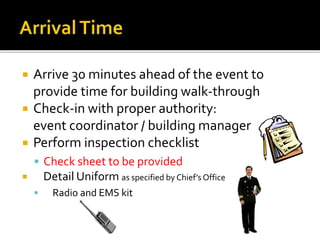
 Arrive 30 minutes ahead of the event to
provide time for building walk-through
 Check-in with proper authority:
event coordinator / building manager
 Perform inspection checklist
 Check sheet to be provided
 Detail Uniform as specified by Chief’s Office
 Radio and EMS kit
 Familiarize yourselves with all fire
protection features, and with the
condition of exits
 Exits Unlocked and unblocked
 Fire Extinguisher locations
 Radio box or pull station location (if
applicable)
 Pre-plan from specific venue provided by
building owner or manager
 Shall patrol the entire area of the tent during
the time it is occupied.
 Ensure that overcrowding is not permitted
 Aisles and exits are kept to be kept open
 Enforce the no smoking rules are observed
 The Following Items Should Be Inspected
While PerformingYour Checklist…
 Occupancy/Capacity signs posted and visible
 Every assembly occupancy room without fixed seating must
have occupant load posted
 Employees must be aware of the occupancies of
each floor, room and level
 There must be a system to count and keep track of
occupancy in each area
 Employees should be trained in duties they
are to perform in an emergency.
 Should be trained how to notify the Fire
Department (activate alarm system).
 Employees need to know locations of all exits
and how to direct patrons to nearest exit.
Means of Egress
 Continuous & unobstructed way of travel from
any point in a building or structure to a public
way consisting of three separate & distinct parts
1. Exit Access
2. The Exit
3. Exit Discharge
 No Furnishings, decorations, or other objects
shall obstruct exits, access thereto, egress
there from, or visibility thereof
 No obstruction by railings, barriers, furniture
or other objects are allowed
 Every door and principal entrance required to
serve as an exit shall be obvious and direct
 All exit doors open in direction of egress
travel
 Open / close easily and unobstructed
 Exit doors free of hold-open devices (ex.
wedges, straps, etc.)
 All exit doors inspected and not locked,
bolted or otherwise fastened, preventing
egress
 Exits shall terminate directly at a public way
or at an exterior exit discharge
 Means of egress shall be illuminated
continuously during the time that the
conditions of occupancy require the means of
egress be available for use
 Showing occupant load, seating diagram and
location of the exits should be on site
 Must be signed and approved by Assistant
Deputy State Fire Marshal
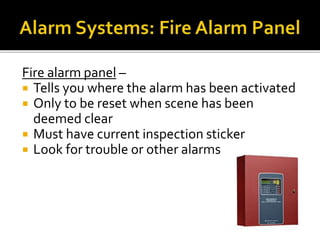
Fire alarm panel –
 Tells you where the alarm has been activated
 Only to be reset when scene has been
deemed clear
 Must have current inspection sticker
 Look for trouble or other alarms
Smoke Detectors –
 Commercial buildings:
Must be hard wired with
battery backup
 Must not be blocked by
anything, including dust,
cobwebs or paint
 Power light must be
active – steady blink
Heat detector –
 Used where smoke detectors too sensitive
 Rated for different temperatures
 Usually mounted on ceiling
Horn / Strobe –
 Notification to building occupants of fire by
sound and strobe light
 Will only stop when alarm panel is reset
 Must not be blocked or covered
 Located near exit doors
 Different operations but same idea
 Check to make sure not obstructed or unable
to function
 All places of assembly must have lighted
signs
 Must remain lit during power outage
 Signs must be lit and visible for all main
egress’
 All places of assembly must have working
emergency lighting.
 Can be checked by test button or central box.
 Must never be blocked
 Have marking sign above
 Properly mounted and located
near exits
 Inspection tag will tell you
when the last inspection was.
 Indicator gauge will tell you if
the extinguisher is in proper
working order (Green area).
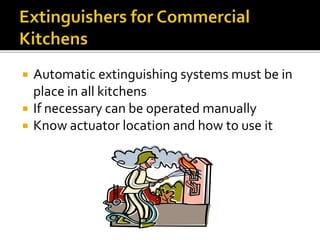
 Automatic extinguishing systems must be in
place in all kitchens
 If necessary can be operated manually
 Know actuator location and how to use it
 Other items on checklist that you are not sure
about… ask!
Tents
Grandstands
Air-Supported Structures
Special Events
 Definition:
 Tent
 Membrane Structure
 Grandstand
 Permit Process
 Detail Duties
 Tents
 Circus, Carnival, Large Crowd Events
 Tent
 NFPA 101: “a temporary structure, for covering of which is
made of a pliable material that achieves its support by
mechanical means such as beams, columns, poles, or
arches, or by rope or cables, or both.”
 Membrane Structure
 “a building or portion of a building incorporating an air-
inflated, air-supported, tensioned membrane structure”.
 Grand stand
 A structure that provides tiered or stepped seating
Questions to ask…
 Number of people attending? (Needed for permit)
 Flame resistant certificates from tent
manufacturer
 Will there be a stage in the tent?
 Will cooking or heating devices be used?
 Number of people attending will be provided
by permit
 Egress must be maintained
 Tent must not take up more than 75% of
premises
 Area within and 10 feet around tent must be
free of debris and ground growth
 Exception: approved animal bedding
Flammable liquids or gases
▪ Must be stored at least 10’ away from tents
▪ Must not be refueled within 5’ of tent area
▪ Propane tanks must be secured from falling over,
strapped to a stationary object or staked to ground
Electrical
▪ Switches & fuses must be in approved enclosures
▪ Cables on ground traversed by public must be in
trenches or approved covers
▪ Generators must be no less than 5 feet away and
protected by fencing, enclosure or approved means
 NO SMOKING
 Exit signs for all egress, Lit for night events
 Emergency alarm or notification system must be
provided
 Fireworks or unauthorized open flames are
prohibited in any tent or temporary membrane
structure
 Egress shall meet the same requirements as that
for enclosed structures
23-28.19-15 Detail of Firefighters
 Uniformed firefighters required for all circuses,
carnivals or other exhibitions where large crowds
assemble
 Detail must familiarize themselves with all fire
protection facilities and fire prevention features &
exits
 Detail shall patrol the entire area during the time it
is occupied
 Special police officers or firefighters
should see that overcrowding is not
permitted
 Aisles and exit ways are kept open
 No smoking rules are observed
 No tent exceeding 120 sq. ft. (10x12) shall be
erected, without a license (building permit)
 Licenses shall not be issued for more than 30
days.
 Any tent exceeding 400 sq. ft. require fire
department approval and an on-site
inspection:
 Building department, police department
 When used for more than 200 persons
• Schematic of tent size, location, use, and seating
plan
• Stage plan
• Date of set up, date & time of event, break down
• Flame resistant documentation, decorations
• Exit lighting, and emergency lighting
• Propane tanks properly spaced, secured, protected
• Fire extinguishers
• Electrical equipment (and protection)
• Generators
• All combustible debris and vegetation clear for 10 ft
surrounding tents
 NFPA 1 – Uniform Fire Code
 NFPA 101 – Life Safety Code
 NFPA 102 – Standard for Grandstands, Folding and
Telescopic Seating,Tents, and Membrane Structures
 NFPA 30 – Flammable and Combustible Liquids
 NFPA 54 – National Fuel Gas Code
 NFPA 58 – Liquefied Petroleum Gas Code
 Signs prohibiting smoking shall be prominently
displayed at all entrances.
 Frequent announcements regarding no smoking
shall be made
 Non-combustible containers shall be provided at all
entrances for cigar or cigarette butts, and a
uniformed attendant shall be stationed at locations
to advise patrons of the no smoking regulation
 Capacity of 100 or more: 2 exits
 Capacity >500: minimum 9 ft in width
 Exits not over 75 ft apart
 Poles between 8 -10 ft apart
 AislesWidth: Minimum 44” apart
 Rows (between): Minimum 12” ?
 Fire Extinguishers
 Assembly Occupancy: exceeding 1000
 One (1) trained manager for every 250 occupants
▪ Not inclusive of religious services (not exceeding 2000
occupants)
▪ May be reduced due to sprinkler system
 Festival Seating
 Uniformed firefighters shall be detailed to all
circuses, carnivals, or other exhibits where large
crowds assemble.
 All tents with a capacity of 1000 or more persons shall
have a minimum of two (2) uniformed fire fighters and any
additional when deemed necessary by the Chief
 All tents with a capacity of 301- 1000 shall have a
minimum of one (1) uniformed fire fighter and any
additional when deemed necessary by the Chief
 All tents with a capacity of 50 - 300 shall have a minimum
of one (1) uniformed fire fighter when deemed necessary
by the Chief.
▪ This provision may be waived by the Chief
 Seating
 If seating is provided, no standing in aisles is
permitted (site managers should enforce,
however firefighters have a duty to clear the
aisle).
▪ Not applicable to Ushers, police, other workers
 Any person violating this provision may be fined
up to $500.00
▪ Police enforcement
 Lighted candles in all
places of assembly
shall be protected by a
proper enclosure
manufactured for that
specific purpose
 No open or unprotected
flame
YES NO
Vent pipe?
FireWorks Displays
 Watch for unsafe handling and storage
 Watch assistants for ability to use
extinguishers or other safety equipment
 All personnel involved in the display must
wear proper PPE
 Safety Glasses, Long-sleeved shirt, long-pants
made of 100% cotton, leather or equivalent fabric
Immediate notification must be made if any of
the following occur:
 Injury to any person resulting from the display of
fireworks
 Fire or damage to property resulting from the
display of fireworks
 Unsafe or defective pyrotechnic products used or
observed
 Continue to enforce all items on checklist
 Pay special attention to corridors and exits
 Watch for unplanned events in performance
 If violations observed:
 Correct them immediately
 If problem, Notify Deputy Chief on-duty
 Ask Police Officer at the event to help enforce, if
necessary
 Rescue
 Anyone in immediate danger.
 If this should require more than a few seconds to
accomplish, the alarm should be sounded
immediately
Sound Alarm!
 Sounding the building Fire Alarm followed by
communication to dispatch via portable radio
 Give exact location & description of the situation
(Building name & address)
 Floor number
 Area
 Details of emergency
 Occupancy at time of fire
Confine the Fire
 Restrict fire to certain areas by closing doors and
cutting off further fuel or oxygen
 Performed as you leave the area to sound alarm
and direct patrons out
Evacuate the building!
 Direct all people to the exit
 Ensure that staff are following the Egress Plan
 Remain at your posted location until all guests have
left or until hazardous items are properly disposed
of
 Note any issues or concerns on your event checklist
 Report safety concerns to Assistant Deputy State
Fire Marshal
Upon Completion of the Detail
 Violations and/or questions shall be forwarded to
the Fire Marshal’s Office through the Deputy Chief’s
Office
 Job #1
 Safety of event participants and guests
Objects can be replaced but lives cannot
Fire Officer Detail Training Program

Fire Officer Detail Training Program

  • 1.
    Training Program forFire Department Detail Officers Harry J. Hallgring Jr. Chief of Department
  • 2.
     RI StateFire Marshal’s Office  RI Fire Academy  Providence Fire Department  Newport Fire Department Bureau of Fire Prevention  NFPA 1 Uniform Fire Code  NFPA 101 Life Safety Code
  • 3.
     Tragedy occurs,creates change.  As the on-site professionalsYOU need to know exactly what to do in the event of an emergency.  The public and the building managers will look to you in their time of need.  Your actions will be a major contributor to saving lives.
  • 4.
     April 13,1928 -West Plains, Mo., 40 dead, dance hall (explosion). Cause – Undetermined  April 23, 1940 - Natchez, Miss., 198 dead, Rhythm Night Club dance hall. Cause – undetermined  Nov. 28 1942 - Boston, Mass., 491 dead, Cocoanut Grove Supper club. Cause – Undetermined
  • 5.
     June 24,1973 - New Orleans, 32 dead, Upstairs Bar. Cause – Arson  June 30, 1974 - Port Chester, NY., 24 dead, Cause – Arson  Oct. 24, 1976 - Bronx, NY., 25 dead, Puerto Rican Social club. Cause – arson  May 28 1977 - Southgate, KY., 164 dead, Beverly Hills supper club. Cause – arson
  • 6.
     March 25,1990 - Bronx, NY., 87 dead, Happy Land Social Club. Cause – Arson  Feb. 20, 2003 -WestWarwick, RI., 100 dead, Station Night Club. Cause – under investigation
  • 7.
     To enableDetail personnel to understand their duties, as well as the Ordinances of the City of Newport and the General Laws of Rhode Island  ExplainWhy Firefighters are at the detail  Present General building design features  To ensure proper enforcement  Why?To protect the public from needless tragedy  Present information as to how to correct a potential problem  Whom to contact for help
  • 8.
  • 9.
     The mainpurpose of a Fire Detail is to maintain the Public Fire Safety at the venue.  The firefighter shall maintain a visible presence at all details
  • 10.
     Created anew category of public assembly venue  Requirements for announcements, sound cessation and firefighter on duty  Designated crowd control manager  Creation of administrative warrants to force compliance with inspection requests  Instituted “tickets” for violations of the fire code & stiffer fines  Process still being worked out
  • 11.
    Assembly Occupancies  Anoccupancy used for a gathering of 50 or more persons for deliberation, worship, entertainment, eating, drinking, amusement, awaiting transportation or similar uses, or…  Any occupancy used as a special amusement building regardless of occupant load ▪ NFPA 1 Uniform Fire Code
  • 12.
     A SpecialAmusement Building Concentrated Occupancy [SAB/CO] place of assembly  shall mean a Class A, B or C place of assembly with a maximum occupancy calculated on the basis of less than fifteen square feet (15 sq. ft.) per person and for which there is either a license issued pursuant to R.I.G.L. Chapter 3-7 (Retail Licenses) or there is entertainment or there are both a liquor license and entertainment.
  • 13.
    Uniformed Firefighter(s) Requiredat:  All places of occupancy greater than 1,000  Occupancy load between 300 and 1,000 of less concentrated use  Occupancy load between 50 and 1,000 of concentrated use  Occupancy load between 50 and 1,000 of concentrated or less concentrated use being utilized for activities of unusual hazard
  • 14.
     Must beon approval list through State Fire Marshal’s office  Which Means?  Gather event inspection checklist and the pre-plan for your location
  • 15.
     Arrive 30minutes ahead of the event to provide time for building walk-through  Check-in with proper authority: event coordinator / building manager  Perform inspection checklist  Check sheet to be provided  Detail Uniform as specified by Chief’s Office  Radio and EMS kit
  • 16.
     Familiarize yourselveswith all fire protection features, and with the condition of exits  Exits Unlocked and unblocked  Fire Extinguisher locations  Radio box or pull station location (if applicable)  Pre-plan from specific venue provided by building owner or manager
  • 17.
     Shall patrolthe entire area of the tent during the time it is occupied.  Ensure that overcrowding is not permitted  Aisles and exits are kept to be kept open  Enforce the no smoking rules are observed
  • 18.
     The FollowingItems Should Be Inspected While PerformingYour Checklist…
  • 19.
     Occupancy/Capacity signsposted and visible  Every assembly occupancy room without fixed seating must have occupant load posted  Employees must be aware of the occupancies of each floor, room and level  There must be a system to count and keep track of occupancy in each area
  • 20.
     Employees shouldbe trained in duties they are to perform in an emergency.  Should be trained how to notify the Fire Department (activate alarm system).  Employees need to know locations of all exits and how to direct patrons to nearest exit.
  • 21.
    Means of Egress Continuous & unobstructed way of travel from any point in a building or structure to a public way consisting of three separate & distinct parts 1. Exit Access 2. The Exit 3. Exit Discharge
  • 22.
     No Furnishings,decorations, or other objects shall obstruct exits, access thereto, egress there from, or visibility thereof  No obstruction by railings, barriers, furniture or other objects are allowed  Every door and principal entrance required to serve as an exit shall be obvious and direct
  • 23.
     All exitdoors open in direction of egress travel  Open / close easily and unobstructed  Exit doors free of hold-open devices (ex. wedges, straps, etc.)  All exit doors inspected and not locked, bolted or otherwise fastened, preventing egress
  • 24.
     Exits shallterminate directly at a public way or at an exterior exit discharge  Means of egress shall be illuminated continuously during the time that the conditions of occupancy require the means of egress be available for use
  • 25.
     Showing occupantload, seating diagram and location of the exits should be on site  Must be signed and approved by Assistant Deputy State Fire Marshal
  • 26.
    Fire alarm panel–  Tells you where the alarm has been activated  Only to be reset when scene has been deemed clear  Must have current inspection sticker  Look for trouble or other alarms
  • 27.
    Smoke Detectors – Commercial buildings: Must be hard wired with battery backup  Must not be blocked by anything, including dust, cobwebs or paint  Power light must be active – steady blink
  • 28.
    Heat detector – Used where smoke detectors too sensitive  Rated for different temperatures  Usually mounted on ceiling
  • 29.
    Horn / Strobe–  Notification to building occupants of fire by sound and strobe light  Will only stop when alarm panel is reset  Must not be blocked or covered
  • 30.
     Located nearexit doors  Different operations but same idea  Check to make sure not obstructed or unable to function
  • 31.
     All placesof assembly must have lighted signs  Must remain lit during power outage  Signs must be lit and visible for all main egress’
  • 32.
     All placesof assembly must have working emergency lighting.  Can be checked by test button or central box.
  • 33.
     Must neverbe blocked  Have marking sign above  Properly mounted and located near exits  Inspection tag will tell you when the last inspection was.  Indicator gauge will tell you if the extinguisher is in proper working order (Green area).
  • 34.
     Automatic extinguishingsystems must be in place in all kitchens  If necessary can be operated manually  Know actuator location and how to use it
  • 35.
     Other itemson checklist that you are not sure about… ask!
  • 36.
  • 37.
     Definition:  Tent Membrane Structure  Grandstand  Permit Process  Detail Duties
  • 38.
     Tents  Circus,Carnival, Large Crowd Events
  • 39.
     Tent  NFPA101: “a temporary structure, for covering of which is made of a pliable material that achieves its support by mechanical means such as beams, columns, poles, or arches, or by rope or cables, or both.”  Membrane Structure  “a building or portion of a building incorporating an air- inflated, air-supported, tensioned membrane structure”.  Grand stand  A structure that provides tiered or stepped seating
  • 40.
    Questions to ask… Number of people attending? (Needed for permit)  Flame resistant certificates from tent manufacturer  Will there be a stage in the tent?  Will cooking or heating devices be used?
  • 41.
     Number ofpeople attending will be provided by permit  Egress must be maintained  Tent must not take up more than 75% of premises  Area within and 10 feet around tent must be free of debris and ground growth  Exception: approved animal bedding
  • 42.
    Flammable liquids orgases ▪ Must be stored at least 10’ away from tents ▪ Must not be refueled within 5’ of tent area ▪ Propane tanks must be secured from falling over, strapped to a stationary object or staked to ground
  • 43.
    Electrical ▪ Switches &fuses must be in approved enclosures ▪ Cables on ground traversed by public must be in trenches or approved covers ▪ Generators must be no less than 5 feet away and protected by fencing, enclosure or approved means
  • 44.
     NO SMOKING Exit signs for all egress, Lit for night events  Emergency alarm or notification system must be provided  Fireworks or unauthorized open flames are prohibited in any tent or temporary membrane structure  Egress shall meet the same requirements as that for enclosed structures
  • 45.
    23-28.19-15 Detail ofFirefighters  Uniformed firefighters required for all circuses, carnivals or other exhibitions where large crowds assemble  Detail must familiarize themselves with all fire protection facilities and fire prevention features & exits  Detail shall patrol the entire area during the time it is occupied
  • 46.
     Special policeofficers or firefighters should see that overcrowding is not permitted  Aisles and exit ways are kept open  No smoking rules are observed
  • 47.
     No tentexceeding 120 sq. ft. (10x12) shall be erected, without a license (building permit)  Licenses shall not be issued for more than 30 days.  Any tent exceeding 400 sq. ft. require fire department approval and an on-site inspection:  Building department, police department  When used for more than 200 persons
  • 48.
    • Schematic oftent size, location, use, and seating plan • Stage plan • Date of set up, date & time of event, break down • Flame resistant documentation, decorations • Exit lighting, and emergency lighting • Propane tanks properly spaced, secured, protected • Fire extinguishers • Electrical equipment (and protection) • Generators • All combustible debris and vegetation clear for 10 ft surrounding tents
  • 49.
     NFPA 1– Uniform Fire Code  NFPA 101 – Life Safety Code  NFPA 102 – Standard for Grandstands, Folding and Telescopic Seating,Tents, and Membrane Structures  NFPA 30 – Flammable and Combustible Liquids  NFPA 54 – National Fuel Gas Code  NFPA 58 – Liquefied Petroleum Gas Code
  • 50.
     Signs prohibitingsmoking shall be prominently displayed at all entrances.  Frequent announcements regarding no smoking shall be made  Non-combustible containers shall be provided at all entrances for cigar or cigarette butts, and a uniformed attendant shall be stationed at locations to advise patrons of the no smoking regulation
  • 51.
     Capacity of100 or more: 2 exits  Capacity >500: minimum 9 ft in width  Exits not over 75 ft apart  Poles between 8 -10 ft apart
  • 52.
     AislesWidth: Minimum44” apart  Rows (between): Minimum 12” ?
  • 53.
  • 54.
     Assembly Occupancy:exceeding 1000  One (1) trained manager for every 250 occupants ▪ Not inclusive of religious services (not exceeding 2000 occupants) ▪ May be reduced due to sprinkler system  Festival Seating
  • 55.
     Uniformed firefightersshall be detailed to all circuses, carnivals, or other exhibits where large crowds assemble.  All tents with a capacity of 1000 or more persons shall have a minimum of two (2) uniformed fire fighters and any additional when deemed necessary by the Chief  All tents with a capacity of 301- 1000 shall have a minimum of one (1) uniformed fire fighter and any additional when deemed necessary by the Chief  All tents with a capacity of 50 - 300 shall have a minimum of one (1) uniformed fire fighter when deemed necessary by the Chief. ▪ This provision may be waived by the Chief
  • 56.
     Seating  Ifseating is provided, no standing in aisles is permitted (site managers should enforce, however firefighters have a duty to clear the aisle). ▪ Not applicable to Ushers, police, other workers  Any person violating this provision may be fined up to $500.00 ▪ Police enforcement
  • 57.
     Lighted candlesin all places of assembly shall be protected by a proper enclosure manufactured for that specific purpose  No open or unprotected flame YES NO
  • 58.
  • 59.
  • 60.
     Watch forunsafe handling and storage  Watch assistants for ability to use extinguishers or other safety equipment  All personnel involved in the display must wear proper PPE  Safety Glasses, Long-sleeved shirt, long-pants made of 100% cotton, leather or equivalent fabric
  • 61.
    Immediate notification mustbe made if any of the following occur:  Injury to any person resulting from the display of fireworks  Fire or damage to property resulting from the display of fireworks  Unsafe or defective pyrotechnic products used or observed
  • 62.
     Continue toenforce all items on checklist  Pay special attention to corridors and exits  Watch for unplanned events in performance  If violations observed:  Correct them immediately  If problem, Notify Deputy Chief on-duty  Ask Police Officer at the event to help enforce, if necessary
  • 63.
     Rescue  Anyonein immediate danger.  If this should require more than a few seconds to accomplish, the alarm should be sounded immediately
  • 64.
    Sound Alarm!  Soundingthe building Fire Alarm followed by communication to dispatch via portable radio  Give exact location & description of the situation (Building name & address)  Floor number  Area  Details of emergency  Occupancy at time of fire
  • 65.
    Confine the Fire Restrict fire to certain areas by closing doors and cutting off further fuel or oxygen  Performed as you leave the area to sound alarm and direct patrons out Evacuate the building!  Direct all people to the exit  Ensure that staff are following the Egress Plan
  • 66.
     Remain atyour posted location until all guests have left or until hazardous items are properly disposed of  Note any issues or concerns on your event checklist  Report safety concerns to Assistant Deputy State Fire Marshal Upon Completion of the Detail  Violations and/or questions shall be forwarded to the Fire Marshal’s Office through the Deputy Chief’s Office
  • 67.
     Job #1 Safety of event participants and guests Objects can be replaced but lives cannot