TO ENABLE THE PARTICIPANTS TO :
 Identify common hazards related to fire at work;
 Identify relevant statutory requirements related to
fire prevention;
 Identify general precautions to control identified
hazards; and
 Perform his/her duties as stipulated under
regulations 25 & 26, factories & machinery
(building operations & work of engineering
construction) (safety), regulations 1986.
 Provisions Against
Fire – provisions and
maintenance of safe
means of access and
egress in case of fire
and extinguishing
media.
FMA
1967
 Containers for volatile
inflammable substances
 Precautions against
ignition
 Precautions with regards
to explosives or
inflammable dust, fumes
or substances
 Safety provision in case
of fire
SHW
1970
 Unsuitable or badly positioned cooking appliances
 Wet clothing placed fell upon heating source
 Children playing with fire on site
 Welding sparks
 Misused of faulty liquefied petroleum gas
equipment
 Discarded cigarette ends / matches
 Faulty or wrongly used portable electrical
apparatus
 Faulty or wrongly used portable electrical
apparatus
 Improperly controlled rubbish burning
 Malicious or intentional ignition
 Improper storage of highly flammable liquids and gases
 Internal combustion engine -spark from unprotected
exhausts
 Spark from abrasive wheels and metal cutting
 Spread of highly flammable vapour to a source of
ignition
Oxygen Depletion Flame / Heat
Gases Combustion
Product
Smoke
Structural Failure
 Fuel paper, wood,
flammable gas, energized
electrical equipment, etc...
 Energy (heat), sufficient to
support combustion. Often
referred to as the ignition
source.
 Oxidizer (air)
IF ANY ONE OF THESE IS
MISSING, AFIRE CANNOT
CONTINUE.
THEREFORE…
 Prevention is based on
eliminating or minimizing
one of the components of
the “Fire Triangle”.
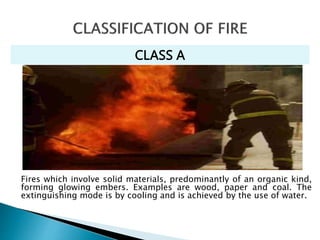
Fires which involve solid materials, predominantly of an organic kind,
forming glowing embers. Examples are wood, paper and coal. The
extinguishing mode is by cooling and is achieved by the use of water.
CLASS A
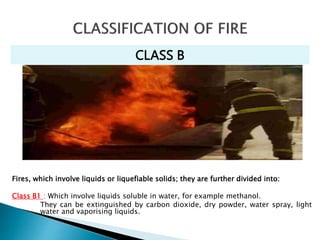
Fires, which involve liquids or liquefiable solids; they are further divided into:
Class B1 : Which involve liquids soluble in water, for example methanol.
They can be extinguished by carbon dioxide, dry powder, water spray, light
water and vaporising liquids.
CLASS B
Fires, which involve liquids or liquefiable solids; they are further divided into:
Class B2 : Which involve liquid which not soluble in water, such as petrol and oil. They
can be extinguished by foam, carbon dioxide, dry powder, light water and
vaporising liquids.
CLASS B
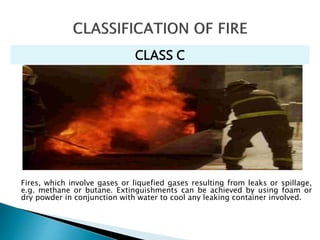
Fires, which involve gases or liquefied gases resulting from leaks or spillage,
e.g. methane or butane. Extinguishments can be achieved by using foam or
dry powder in conjunction with water to cool any leaking container involved.
CLASS C
Fires, which involve metals such as aluminium or magnesium. Special dry
powder extinguishers are required to fight these., which may contained
powdered graphite or talc. No other extinguisher type should be used.
CLASS D
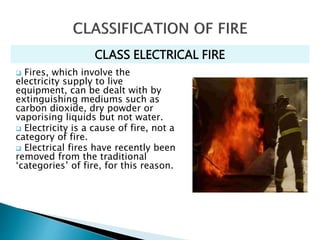
 Fires, which involve the
electricity supply to live
equipment, can be dealt with by
extinguishing mediums such as
carbon dioxide, dry powder or
vaporising liquids but not water.
 Electricity is a cause of fire, not a
category of fire.
 Electrical fires have recently been
removed from the traditional
‘categories’ of fire, for this reason.
CLASS ELECTRICAL FIRE
 The fire risk must be assessed
during design stage as to
ensure that fire risk and
potential for damage are
properly assessed and kept to
a minimum during
construction, and the finished
building will comply with all
statutory requirements in
respect of fire precautions.
1. Design & Planning Stage
 Name of the Site Fire Safety
Coordinator.
 General site fire precautions.
 Hot work permit system.
 Site accommodation - fire
escape.
 Communication – reporting,
alerting and evacuation
emergency plan.
 Procedures for calling BOMBA.
 Fire drills and training.
2. Construction Stage
a) Fire Safety Plan
 The person appointed as
Site Fire Safety Coordinator
should have attended and
received appropriate and
adequate training with
respect to fire precautions
and emergency.
2. Construction Stage
b) Site Fire Safety
Controller
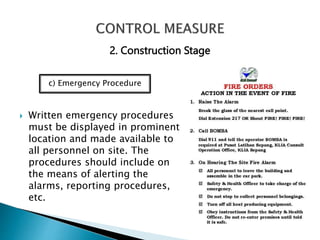
 Written emergency procedures
must be displayed in prominent
location and made available to
all personnel on site. The
procedures should include on
the means of alerting the
alarms, reporting procedures,
etc.
2. Construction Stage
c) Emergency Procedure
 Adequate numbers of
suitable types of portable
extinguishers must be
available throughout the
site. Those extinguishers
must be located and
maintained in such ways
that they are easily and
readily accessible.
2. Construction Stage
d) Extinguishing Media
 Where ever possible site
boundary to be fenced and
manned by security guards.
Implement site security
pass system for all
personnel and visitors.
2. Construction Stage
e) Security Against Arson
 Illumination of the site is
an additional deterrent to
unauthorised access and is
recommended where
appropriate.
 Where 24 hours security is
provided, fire checks
should be undertaken
throughout the night,
during holiday periods and
at weekends.
2. Construction Stage
e) Security Against Arson
 Temporary buildings
should be separated from
building under
construction or
refurbishment and other
permanent building.
2. Construction Stage
f) Temporary Building
 Temporary building should
be constructed with
materials that do not
significantly contribute to
growth of fire.
Temporary Building
2. Construction Stage
f) Temporary Building
 Cooking appliances in
canteen and kitchen must
be properly installed and
adequate ventilation
provided. Cooking in living
accommodation should be
prohibited.
Temporary Building
2. Construction Stage
f) Temporary Building
 Highly flammable liquids
and liquefied petroleum
gases should be stored
separately from other
combustible materials.
 Stored in open
compounds, which are
securely fenced and
shaded from the sun.
2. Construction Stage
NO
g) Highly Flammable Liquid
and LPG
 Amount of those material
to be stored on site to be
kept at minimum.
 Warning and cautions
signs must be displayed at
the entrances to stores
and adequate numbers of
appropriate extinguishers
should be sited in the
same vicinity.
2. Construction Stage
NO
g) Highly Flammable Liquid
and LPG
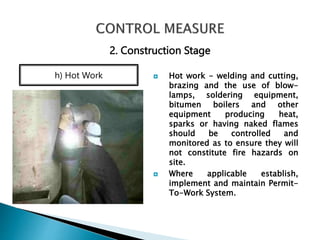
 Hot work - welding and cutting,
brazing and the use of blow-
lamps, soldering equipment,
bitumen boilers and other
equipment producing heat,
sparks or having naked flames
should be controlled and
monitored as to ensure they will
not constitute fire hazards on
site.
 Where applicable establish,
implement and maintain Permit-
To-Work System.
2. Construction Stage
h) Hot Work
 Electrical installations must be
installed in accordance with
relevant statutory requirements.
 Where possible, main switches,
other than controlling security
lights, should be turned off
when work ceases and all
electrical equipment unplugged
when not in use.
 Only authorised competent
person should carry out all
electrical installation, connection
and maintenance.
2. Construction Stage
i) Electricity
 Internal combustion engines
should be positioned in the
open air.
 exhaust pipes and exhaust
gases are kept clear of
combustible materials.
 Fuel tanks must not be filled
whilst engines are running.
 Plant and equipment must be
provided against accidental
impact and provided with
suitable extinguishers.
2. Construction Stage
j) Mechanical Plant
 Combustible materials must
be stored in a safe place
outside the building under
construction.
 Suitable fire extinguishers
should be readily to hand.
 All wastes, packing materials,
wood, shavings and oily rags
must be regularly removed.
 Debris and rubbish should
not be burned on site.
2. Construction Stage
k) Material Storage and
Housekeeping

Fire Prevention.pptx

  • 2.
    TO ENABLE THEPARTICIPANTS TO :  Identify common hazards related to fire at work;  Identify relevant statutory requirements related to fire prevention;  Identify general precautions to control identified hazards; and  Perform his/her duties as stipulated under regulations 25 & 26, factories & machinery (building operations & work of engineering construction) (safety), regulations 1986.
  • 3.
     Provisions Against Fire– provisions and maintenance of safe means of access and egress in case of fire and extinguishing media. FMA 1967
  • 4.
     Containers forvolatile inflammable substances  Precautions against ignition  Precautions with regards to explosives or inflammable dust, fumes or substances  Safety provision in case of fire SHW 1970
  • 5.
     Unsuitable orbadly positioned cooking appliances  Wet clothing placed fell upon heating source  Children playing with fire on site  Welding sparks  Misused of faulty liquefied petroleum gas equipment
  • 6.
     Discarded cigaretteends / matches  Faulty or wrongly used portable electrical apparatus  Faulty or wrongly used portable electrical apparatus  Improperly controlled rubbish burning  Malicious or intentional ignition
  • 7.
     Improper storageof highly flammable liquids and gases  Internal combustion engine -spark from unprotected exhausts  Spark from abrasive wheels and metal cutting  Spread of highly flammable vapour to a source of ignition
  • 8.
    Oxygen Depletion Flame/ Heat Gases Combustion Product Smoke Structural Failure
  • 9.
     Fuel paper,wood, flammable gas, energized electrical equipment, etc...  Energy (heat), sufficient to support combustion. Often referred to as the ignition source.  Oxidizer (air) IF ANY ONE OF THESE IS MISSING, AFIRE CANNOT CONTINUE. THEREFORE…
  • 10.
     Prevention isbased on eliminating or minimizing one of the components of the “Fire Triangle”.
  • 11.
    Fires which involvesolid materials, predominantly of an organic kind, forming glowing embers. Examples are wood, paper and coal. The extinguishing mode is by cooling and is achieved by the use of water. CLASS A
  • 12.
    Fires, which involveliquids or liquefiable solids; they are further divided into: Class B1 : Which involve liquids soluble in water, for example methanol. They can be extinguished by carbon dioxide, dry powder, water spray, light water and vaporising liquids. CLASS B
  • 13.
    Fires, which involveliquids or liquefiable solids; they are further divided into: Class B2 : Which involve liquid which not soluble in water, such as petrol and oil. They can be extinguished by foam, carbon dioxide, dry powder, light water and vaporising liquids. CLASS B
  • 14.
    Fires, which involvegases or liquefied gases resulting from leaks or spillage, e.g. methane or butane. Extinguishments can be achieved by using foam or dry powder in conjunction with water to cool any leaking container involved. CLASS C
  • 15.
    Fires, which involvemetals such as aluminium or magnesium. Special dry powder extinguishers are required to fight these., which may contained powdered graphite or talc. No other extinguisher type should be used. CLASS D
  • 16.
     Fires, whichinvolve the electricity supply to live equipment, can be dealt with by extinguishing mediums such as carbon dioxide, dry powder or vaporising liquids but not water.  Electricity is a cause of fire, not a category of fire.  Electrical fires have recently been removed from the traditional ‘categories’ of fire, for this reason. CLASS ELECTRICAL FIRE
  • 17.
     The firerisk must be assessed during design stage as to ensure that fire risk and potential for damage are properly assessed and kept to a minimum during construction, and the finished building will comply with all statutory requirements in respect of fire precautions. 1. Design & Planning Stage
  • 19.
     Name ofthe Site Fire Safety Coordinator.  General site fire precautions.  Hot work permit system.  Site accommodation - fire escape.  Communication – reporting, alerting and evacuation emergency plan.  Procedures for calling BOMBA.  Fire drills and training. 2. Construction Stage a) Fire Safety Plan
  • 20.
     The personappointed as Site Fire Safety Coordinator should have attended and received appropriate and adequate training with respect to fire precautions and emergency. 2. Construction Stage b) Site Fire Safety Controller
  • 21.
     Written emergencyprocedures must be displayed in prominent location and made available to all personnel on site. The procedures should include on the means of alerting the alarms, reporting procedures, etc. 2. Construction Stage c) Emergency Procedure
  • 22.
     Adequate numbersof suitable types of portable extinguishers must be available throughout the site. Those extinguishers must be located and maintained in such ways that they are easily and readily accessible. 2. Construction Stage d) Extinguishing Media
  • 23.
     Where everpossible site boundary to be fenced and manned by security guards. Implement site security pass system for all personnel and visitors. 2. Construction Stage e) Security Against Arson
  • 24.
     Illumination ofthe site is an additional deterrent to unauthorised access and is recommended where appropriate.  Where 24 hours security is provided, fire checks should be undertaken throughout the night, during holiday periods and at weekends. 2. Construction Stage e) Security Against Arson
  • 25.
     Temporary buildings shouldbe separated from building under construction or refurbishment and other permanent building. 2. Construction Stage f) Temporary Building
  • 26.
     Temporary buildingshould be constructed with materials that do not significantly contribute to growth of fire. Temporary Building 2. Construction Stage f) Temporary Building
  • 27.
     Cooking appliancesin canteen and kitchen must be properly installed and adequate ventilation provided. Cooking in living accommodation should be prohibited. Temporary Building 2. Construction Stage f) Temporary Building
  • 28.
     Highly flammableliquids and liquefied petroleum gases should be stored separately from other combustible materials.  Stored in open compounds, which are securely fenced and shaded from the sun. 2. Construction Stage NO g) Highly Flammable Liquid and LPG
  • 29.
     Amount ofthose material to be stored on site to be kept at minimum.  Warning and cautions signs must be displayed at the entrances to stores and adequate numbers of appropriate extinguishers should be sited in the same vicinity. 2. Construction Stage NO g) Highly Flammable Liquid and LPG
  • 30.
     Hot work- welding and cutting, brazing and the use of blow- lamps, soldering equipment, bitumen boilers and other equipment producing heat, sparks or having naked flames should be controlled and monitored as to ensure they will not constitute fire hazards on site.  Where applicable establish, implement and maintain Permit- To-Work System. 2. Construction Stage h) Hot Work
  • 31.
     Electrical installationsmust be installed in accordance with relevant statutory requirements.  Where possible, main switches, other than controlling security lights, should be turned off when work ceases and all electrical equipment unplugged when not in use.  Only authorised competent person should carry out all electrical installation, connection and maintenance. 2. Construction Stage i) Electricity
  • 32.
     Internal combustionengines should be positioned in the open air.  exhaust pipes and exhaust gases are kept clear of combustible materials.  Fuel tanks must not be filled whilst engines are running.  Plant and equipment must be provided against accidental impact and provided with suitable extinguishers. 2. Construction Stage j) Mechanical Plant
  • 33.
     Combustible materialsmust be stored in a safe place outside the building under construction.  Suitable fire extinguishers should be readily to hand.  All wastes, packing materials, wood, shavings and oily rags must be regularly removed.  Debris and rubbish should not be burned on site. 2. Construction Stage k) Material Storage and Housekeeping