1
Interactive – Up to Date News – Facebook
Live Sessions – Competitions
Sign up today to enter the monthly prize
draw!
@ CB Associate
Training
Fire Warden Training
Staying safe in the workplace
2
3
It’s time to take it very seriously!
Rose Park Care Home
http://www.youtube.com/watch
?v=CsB39OpJQZU
Aims
4
To ensure you trained to the standards of the:
Regulatory Reform (Fire Safety) Order 2005
Fire Precautions (Workplace) Regulations 1997 (Amended 1999)
Health & Safety at Work Act 1974
5
Learning objectives
By the end of this session you will be able to:
•Explain the typical role of a fire marshal in relation to workplace safety
•Identify a range of portable fire extinguishers
•Recognise the way people behave in a fire situation
•Explain the key fire safety duties under the law
•Be competent in your duties during an evacuation
•Recognise the need for fire evacuation drills
•Describe how to prevent fire & limit its impact
•Understand the principles of a risk assessment.
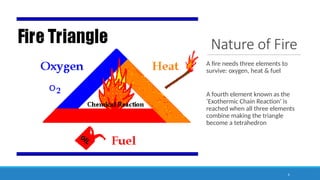
Nature of Fire
A fire needs three elements to
survive: oxygen, heat & fuel
A fourth element known as the
‘Exothermic Chain Reaction’ is
reached when all three elements
combine making the triangle
become a tetrahedron
6
To Eliminate The Fire
We must starve it of one of the three elements, therefore not
allowing the ‘Exothermic Chain Reaction’ to continue or
occur in the first place
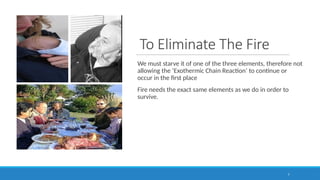
Fire needs the exact same elements as we do in order to
survive.
7
8
Removing the Oxygen
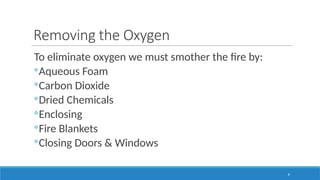
To eliminate oxygen we must smother the fire by:
◦Aqueous Foam
◦Carbon Dioxide
◦Dried Chemicals
◦Enclosing
◦Fire Blankets
◦Closing Doors & Windows
9
Removing the Fuel
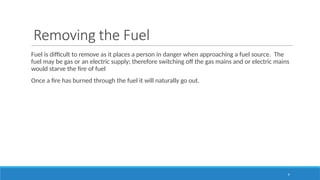
Fuel is difficult to remove as it places a person in danger when approaching a fuel source. The
fuel may be gas or an electric supply; therefore switching off the gas mains and or electric mains
would starve the fire of fuel
Once a fire has burned through the fuel it will naturally go out.
10
Remove the Heat
The heat acts as the ignition for the fire. To remove the heat we can use natural elements such
as water which will naturally turn to steam and take the heat with it
Note: water can at times be dangerous to use, why?
What would happen on electrical or chemical fires?
11
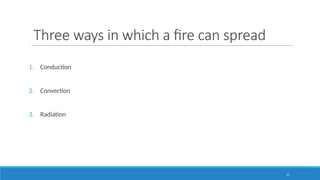
Three ways in which a fire can spread
1. Conduction
2. Convection
3. Radiation
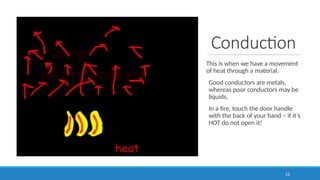
Conduction
This is when we have a movement
of heat through a material.
Good conductors are metals,
whereas poor conductors may be
liquids.
In a fire, touch the door handle
with the back of your hand – if it’s
HOT do not open it!
12
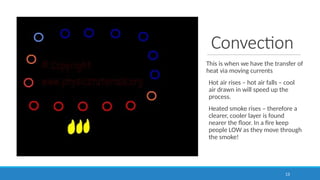
Convection
This is when we have the transfer of
heat via moving currents
Hot air rises – hot air falls – cool
air drawn in will speed up the
process.
Heated smoke rises – therefore a
clearer, cooler layer is found
nearer the floor. In a fire keep
people LOW as they move through
the smoke!
13
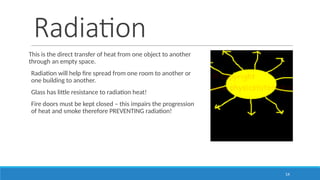
Radiation
This is the direct transfer of heat from one object to another
through an empty space.
Radiation will help fire spread from one room to another or
one building to another.
Glass has little resistance to radiation heat!
Fire doors must be kept closed – this impairs the progression
of heat and smoke therefore PREVENTING radiation!
14
Smoke Kills Faster Than Fire
As fire develops, smoke and combustion gases spread faster
than fire.
The gases inside the room heat up, expand and create
pressure, causing smoke to spread.
Smoke & combustion gases quickly spread through the
building usually ahead of the fire, presenting great danger to
anyone still in the building.
15
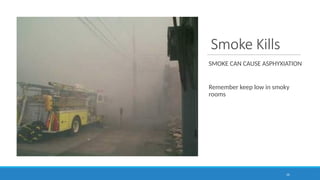
Smoke Kills
SMOKE CAN CAUSE ASPHYXIATION
Remember keep low in smoky
rooms
16
17
Ways a Fire Can Start
Arson – made easy by poorly secured buildings.
Electricity – neglect and misuse of wiring & electrical appliances.
Rubbish – accumulating in work/storage areas.
Smoking – discarded cigarettes, matches, inadequate ash trays.
Heaters – portable heaters can be knocked over, poorly sited or inadequately guarded; all
heaters can over-heat if obstructed.
Hazardous Goods – e.g. paints, adhesives or other chemicals.
Specific Hazards – machinery in dusty environments, heated equipment; blow torches, cutting &
welding, flammable liquids.
18
A Known Fact!
65% of fires are caused by arson resulting in an average cost to commercial businesses of
£250,000.
The Department of Communities & Local Government estimate the average cost of any fire to be
£30,000
80% of companies never re-open or fail after a fire
19
The True Cost Of Fire
Disruption of business after fire
Medical costs for survivors
Possible litigation costs
Emotional responsibility (life time)
Grief
Guilt
Trauma from injury
Prevention is better, but if fire does break out, deal with it properly!
20
Good House Keeping Practice
Skips, wheelie bins & rubbish cause lots of fires – keep away from buildings
Designated smoking area – where?
Good management, responsibility & accountability procedures
◦ Portable Appliance Testing
◦ Good security
◦ Staff training
◦ Closed fire doors
◦ Regular testing of alarm systems, correctly positioned and regularly maintained
◦ Good audit trails to ensure conformity
◦ Minimising combustible loading
◦ Reducing the exposure of ignition sources to flammable items
21
Quick Question
Which of the statements below describes convection?
A) The movement of heat through material
B) The transfer of heat via moving air currents
C) The transfer of heat in solids & liquids
The correct answer is ‘B’
22
Reducing The Risk With Alerting
Equipment
What type of fire alarm system is in your workplace?
L – Protect life
P – Protect building
M – Manual system
L2 – Protect life throughout a building
P2 – High risk of ignition to property
23
Reducing The Risk With Alerting
Equipment
Smoke detectors:
Where are they sited?
Are they working properly?
Are they regularly maintained?
◦ Clean with a vacuum twice a year and replace every ten years – test once a week and if battery
operated, change batteries annually.
24
Fire Doors – Remain Closed For a
Reason!
Fire doors are rated either 30mins or 60 mins
Designed to resist fire and smoke for the allotted amount of time
They can be on a self closing mechanism (hard wired) to the alarm system or manually closed;
never wedged open. Think About Rose Park!
25
Signage & Their Usage
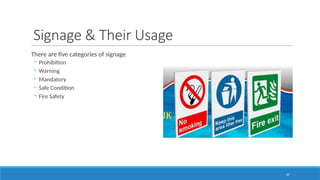
There are five categories of signage
◦ Prohibition
◦ Warning
◦ Mandatory
◦ Safe Condition
◦ Fire Safety
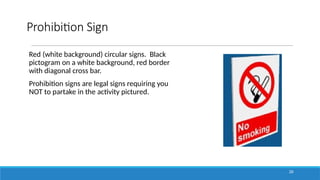
Prohibition Sign
Red (white background) circular signs. Black
pictogram on a white background, red border
with diagonal cross bar.
Prohibition signs are legal signs requiring you
NOT to partake in the activity pictured.
26
27
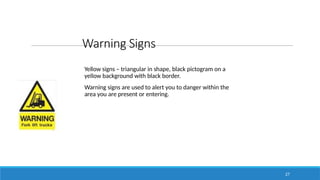
Warning Signs
Yellow signs – triangular in shape, black pictogram on a
yellow background with black border.
Warning signs are used to alert you to danger within the
area you are present or entering.
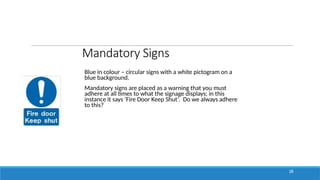
Mandatory Signs
Blue in colour – circular signs with a white pictogram on a
blue background.
Mandatory signs are placed as a warning that you must
adhere at all times to what the signage displays; in this
instance it says ‘Fire Door Keep Shut’. Do we always adhere
to this?
28
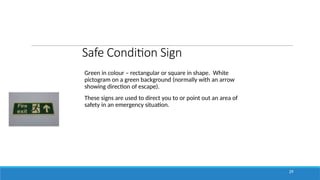
Safe Condition Sign
Green in colour – rectangular or square in shape. White
pictogram on a green background (normally with an arrow
showing direction of escape).
These signs are used to direct you to or point out an area of
safety in an emergency situation.
29
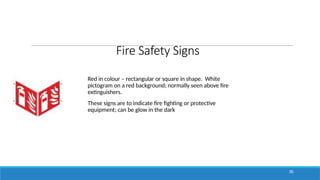
Fire Safety Signs
Red in colour – rectangular or square in shape. White
pictogram on a red background; normally seen above fire
extinguishers.
These signs are to indicate fire fighting or protective
equipment; can be glow in the dark
30
Fire Action Signs
Fire action signs are vitally important throughout the
workplace; they can be sited on –
◦ Notice boards
◦ Break glass emergency call points
◦ Fire points (where extinguishers are located)
◦ Final exit points
Ensure you have the right signs in the right place;
know the importance!
31
32
Quick Question
The L2 fire alarm is designed to protect what?
A) Machinery
B) Life
C) Property
◦ The correct answer is ‘B’
33
Fire Prevention
Risk Assessment Forms Fire Policy
Prevention is about taking action – make sure that you and your colleagues are working in a safe
environment.
Plan – Conduct – Evaluate
The Regulatory Reform (Fire Safety) Order 2005 Articles 8 to 23 requires all work premises to
provide a thorough Fire Risk Assessment: this must be completed by the Responsible Person. The
FRA also requires an accompanying emergency Fire Evacuation Plan known as the FEP.
All companies must adhere to the RRO however the legislation places a responsibility on
companies to train fire wardens/marshals to assist in adhering.
Risk Assessment
Remember a risk assessment is about identifying the hazard and
the associated risk.
◦ Hazard – the potential to cause harm
◦ Risk – chance of that harm occurring
Risk assessments should determine if the following are working
correctly:
◦ Fire Procedures
◦ Fire Measures
◦ Fire Plans
Who might be at risk should there be a fire – what's in your
Company’s Fire Risk Assessment? 34
35
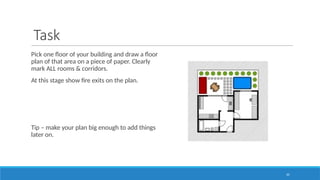
Task
Pick one floor of your building and draw a floor
plan of that area on a piece of paper. Clearly
mark ALL rooms & corridors.
At this stage show fire exits on the plan.
Tip – make your plan big enough to add things
later on.
36
Requirements By Law
Within the RRO all workplaces are required
to have the following:
◦ Fire Evacuation Plan (up to date)
◦ Assembly points clearly marked
◦ Fire evacuation drill training sessions
◦ Regular fire awareness training for all staff
◦ Induction for new staff
As a Fire Warden
You have daily duties to assess
◦ Fire doors are closed
◦ Fire exits and routes are clear
◦ Visitors are signed in and aware of evacuation points
◦ Any actions that have arisen have been dealt with.
◦ All staff aware of evacuation plan
37
38
Promote a Safe Working Environment
Think – about your premises, is there anything else that could pose a risk?
Remember – to take great care when dealing with flammable chemicals, gas, electrical
equipment etc.
Regular Checks – rubbish, stairwells, stationary cupboards, kitchens, power plant rooms etc.
39
Floor Plans
On your floor plans mark each room with an identified risk score:
◦ L = Low Risk
◦ M = Medium Risk
◦ H = High Risk
Think resident, think storage facility, think of work duty that takes place, think about the risk that
area poses for fire to start or for a person’s safety in the event of a fire.
40
Other conditions of the Regulatory
Reform Order
Hazardous areas must be signed
Fence dangerous machinery and install safety devices on them
Service machinery and equipment regularly
Provide and use PPE
Later we shall talk about fire fighting
equipment and its requirement
41
Quick Question
Who should carry out a fire risk assessment?
A) The Fire Rescue Service
B) The Responsible Person
C) The Fire Warden
◦ The correct answer is ‘B’
42
Fire Evacuation Drills
Drills have to be carried out twice a year (minimum) and no longer than six months apart. (If you
have a high staff turn-over, assess if you require FEDs more frequently.)
The aim is to alert staff to the nearest fire exits, evacuation points and if there ARE any high risks
then staff know how to deal with them
Evacuation needs to be conducted in a safe and satisfactory manner and always taken seriously
Everyone must take part and scenarios should be staged that do not allow use of certain zones as
a means of escape.
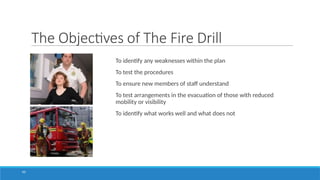
The Objectives of The Fire Drill
To identify any weaknesses within the plan
To test the procedures
To ensure new members of staff understand
To test arrangements in the evacuation of those with reduced
mobility or visibility
To identify what works well and what does not
43
44
Carrying Out The Drill
Circulate details prior, giving plenty of advanced warning
Ensure that equipment can be safely left
Nominate observers
Inform the alarm receiving centre
Inform visitors
Activate alarm
Instruct staff
Evacuate premises in a safe manner
All to meet at fire assembly point
Competent person to carry out role call – register, visitors book, staff rota
Log details of the drill – duration; who took part; what problems were identified
45
Quick Question
What is the most important reason for a fire evacuation drill?
A) To identify weakness in the evacuation strategy
B) To check that the fire alarms work
C) To make sure alarms can be heard throughout the building
◦ The correct answer is ‘A’
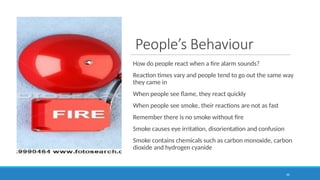
People’s Behaviour
How do people react when a fire alarm sounds?
Reaction times vary and people tend to go out the same way
they came in
When people see flame, they react quickly
When people see smoke, their reactions are not as fast
Remember there is no smoke without fire
Smoke causes eye irritation, disorientation and confusion
Smoke contains chemicals such as carbon monoxide, carbon
dioxide and hydrogen cyanide
46
47
Smoke Kills
In most cases people die from smoke inhalation either at the scene of the fire or later on after
the incident has occurred
It is important we educate people to act fast when they see smoke!
In an emergency situation people look for a person of authority – someone wearing an armband
or hi-vis jacket
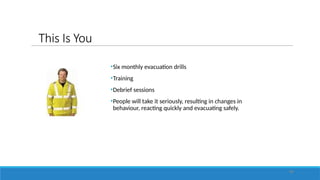
This Is You
•Six monthly evacuation drills
•Training
•Debrief sessions
•People will take it seriously, resulting in changes in
behaviour, reacting quickly and evacuating safely.
48
49
Quick Question
As a fire warden/marshal you need to?
A) Fight fires
B) Set a good example and ensure everyone remains calm & focussed
C) Wear a hi-vis jacket at ALL times
◦ The correct answer is ‘B’
50
As a Fire Warden/Marshal
Do not put yourself at risk
Make sure others respond
Instruct people to close doors and windows as they leave the building
You don’t need to be last out
Be prepared to be clear and firm
Make Sure You and Colleagues Know
1. How to raise the alarm immediately
2. The different locations of automatic fire detector
systems or manual call points
3. The fire action plan: how the alarm is raised and
what action you should take
4. Read your Company’s fire action plan and
familiarise yourself with procedures for operating
the alarms
51
Back To The Floor Plan
On your floor plans, please now mark where you believe
smoke or heat detectors can be found. Also mark areas
where you believe there to be ‘Break Glass Call Points’
52
53
Calling Emergency Services in Event of a
Fire
Dial 999
State fire service
Give the number of the phone you are using (including the area dialling code)
State location of fire (postcode, if known)
Give a landmark or connecting road
Do NOT hang up until the details have been repeated back to you.
54
Safe Evacuation
1. Personnel should leave the building as soon as the alarm sounds, unless given detailed
instructions as part of the fire action plan.
2. You should ensure the safe evacuation of anyone assigned to you.
3. The fire action plan outlines procedures for the safety of non-employees. Fire wardens may
have been nominated to ensure an area is evacuated.
55
Safe Evacuation
Don’t panic
Leave in a calm, orderly manner
Use the safest and most direct route
Do NOT stop to collect belongings
Do not put yourself in danger OR take personal risks
Do NOT use lifts (do use evacuation chairs)
Keep close to the floor in smoky conditions
56
Roll Call
A nominal roll call should be conducted by the responsible OR competent person; this could be
the fire warden/marshal.
The nominal roll call should be conducted at the fire assembly point (this should be away from
the building and on-coming Emergency Services.
Remember – to complete a nominal roll call you will need registers, the visitors’ book & a staff
rota
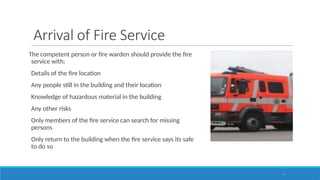
Arrival of Fire Service
The competent person or fire warden should provide the fire
service with:
Details of the fire location
Any people still in the building and their location
Knowledge of hazardous material in the building
Any other risks
Only members of the fire service can search for missing
persons
Only return to the building when the fire service says its safe
to do so
57
58
Quick Question
What route would you take when evacuating your workplace?
A) The route of which you are most familiar
B) The safest and most direct route
C) The way you came in
◦ The correct answer is ‘B’
59
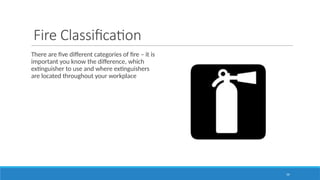
Fire Classification
There are five different categories of fire – it is
important you know the difference, which
extinguisher to use and where extinguishers
are located throughout your workplace
60
Class ‘A’ Fire
Ordinary combustible – things that turn to ash
Wood, paper, waste paper, baskets, stationary stores, textiles, fabrics and furniture.
61
Class ‘B’ Fire
Flammable liquids
Lubricants, spirits, petrol, paints, solvents, fuel, oils and flammable liquid stores
62
Class ‘C’ Fire
Flammable gases
Propane, Butane etc.
63
Class ‘D’ Fire
Metals
E.g. magnesium, aluminium, sodium, potassium etc.
64
Class ‘F’ Fires
Cooking oils
Vegetable oil, sunflower oil, fat, etc.
65
Electrical Hazard
All fires become an electrical hazard if electric is involved.
Ventilation systems, offices, computer rooms, switch gear and lift motor rooms
Using the wrong extinguisher could cost your life!
66
Quick Question
Class D fires represent what?
A) Metals
B) Plastics
C) Man Made Fibres
◦ The correct answer is ‘A’
67
Risk Assessment
Areas should be risk assessed as part of your FRA. Locations should include escape routes, room
exits & areas of high risk.
All fire extinguishers should be inspected on a yearly basis by an accredited external company
A sticker showing dates of inspections should be displayed on all fire extinguishers
68
Golden Rule!!!!!!!
One fire extinguisher
One person
One fire
If you have used one extinguisher and the fire is still spreading then it’s time to GET OUT.
69
Assess The Risk
How big is the fire?
◦ Bigger than a normal waste paper bin? It’s too big.
What type of fire is it?
What are the smoke levels like?
Are there any electrical risks?
By assessing the situation you may stay alive.
70
Tackling The Fire
Keep low
One person – one extinguisher
Stand by in case of re-ignition
Extinguish fire only if safe to do so
Don’t Be a Hero
71
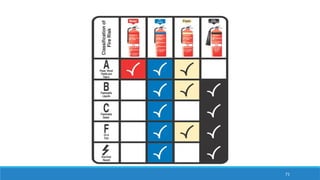
Choosing The
Correct
Extinguisher
72
British Standard EN3
Requires all fire extinguishers to be appropriately
coloured by at least 5%
◦RED = WATER
◦BLUE = POWDER
◦BLACK = CO2
◦CREAM = FOAM SPRAY
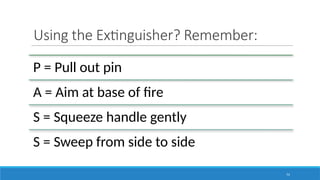
Using the Extinguisher? Remember:
73
P = Pull out pin
A = Aim at base of fire
S = Squeeze handle gently
S = Sweep from side to side
74
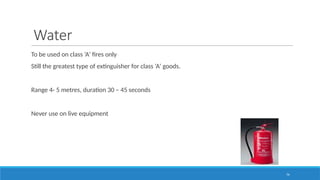
Water
To be used on class ‘A’ fires only
Still the greatest type of extinguisher for class ‘A’ goods.
Range 4- 5 metres, duration 30 – 45 seconds
Never use on live equipment
75
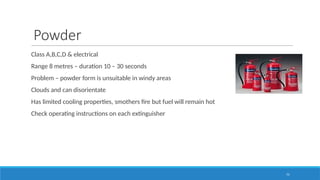
Powder
Class A,B,C,D & electrical
Range 8 metres – duration 10 – 30 seconds
Problem – powder form is unsuitable in windy areas
Clouds and can disorientate
Has limited cooling properties, smothers fire but fuel will remain hot
Check operating instructions on each extinguisher
76
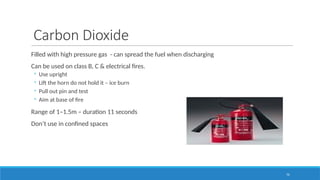
Carbon Dioxide
Filled with high pressure gas - can spread the fuel when discharging
Can be used on class B, C & electrical fires.
◦ Use upright
◦ Lift the horn do not hold it – ice burn
◦ Pull out pin and test
◦ Aim at base of fire
Range of 1–1.5m – duration 11 seconds
Don’t use in confined spaces
77
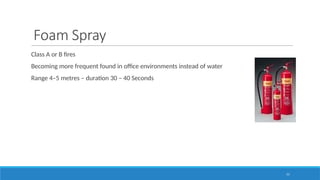
Foam Spray
Class A or B fires
Becoming more frequent found in office environments instead of water
Range 4–5 metres – duration 30 – 40 Seconds
78
Floor Plan – Final Challenge
Place on your floor plan where you think the fire extinguishers are located. Mark the type:
W = water
P = powder
C = carbon dioxide
F = foam spray
79
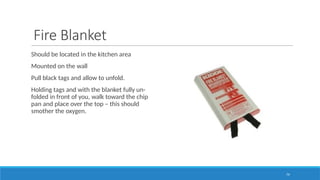
Fire Blanket
Should be located in the kitchen area
Mounted on the wall
Pull black tags and allow to unfold.
Holding tags and with the blanket fully un-
folded in front of you, walk toward the chip
pan and place over the top – this should
smother the oxygen.
80
Quick Question
On discovering a fire, what is the first thing you should do?
A) Put the fire out
B) Phone the fire service
C) Raise the alarm
◦ The correct answer is ‘C’
81
Your Floor Plan
Spend ten minutes with your floor plan looking at the area you have marked out; have a look to
see if you were able to mark all the areas out properly, assess the risks correctly and place the
correct signage and fire fighting equipment in the area.
82
Legislation
Regulatory Reform (Fire Safety) Order 2005
Employer must conduct fire risk assessments
Provide training & equipment (warden/marshal)
Log of all training, drills, inspections, services (including dates and times)
Emergency routes must be clearly marked
Floors to be non-slip
Adequate fire alarms for the service
Sufficient means to fight a small fire
Regular fire drills (maximum time between?)
False alarms must be recorded
Compliance of the Health & Safety at Work Act 1974
83
Quick Question
According to legislation, how often should a fire evacuation drill normally take place?
A) Every 6 Months
B) Every 12 Months
C) Every Week
◦ The correct answer is ‘A’
84
It’s Time For The Test
Please read the information on the sheets fully.
Thank You 
Thank You For Attending Today’s
Session
@CB Associate
Training
Don’t forget to follow us on Social Media for Up to Date News – Facebook
Live Sessions – Competitions and much more!
@CB Associate
Training
@CB Associate
Training

Copy_of_Fire_Marshal_-_pptx for staff training

  • 1.
    1 Interactive – Upto Date News – Facebook Live Sessions – Competitions Sign up today to enter the monthly prize draw! @ CB Associate Training
  • 2.
    Fire Warden Training Stayingsafe in the workplace 2
  • 3.
    3 It’s time totake it very seriously! Rose Park Care Home http://www.youtube.com/watch ?v=CsB39OpJQZU
  • 4.
    Aims 4 To ensure youtrained to the standards of the: Regulatory Reform (Fire Safety) Order 2005 Fire Precautions (Workplace) Regulations 1997 (Amended 1999) Health & Safety at Work Act 1974
  • 5.
    5 Learning objectives By theend of this session you will be able to: •Explain the typical role of a fire marshal in relation to workplace safety •Identify a range of portable fire extinguishers •Recognise the way people behave in a fire situation •Explain the key fire safety duties under the law •Be competent in your duties during an evacuation •Recognise the need for fire evacuation drills •Describe how to prevent fire & limit its impact •Understand the principles of a risk assessment.
  • 6.
    Nature of Fire Afire needs three elements to survive: oxygen, heat & fuel A fourth element known as the ‘Exothermic Chain Reaction’ is reached when all three elements combine making the triangle become a tetrahedron 6
  • 7.
    To Eliminate TheFire We must starve it of one of the three elements, therefore not allowing the ‘Exothermic Chain Reaction’ to continue or occur in the first place Fire needs the exact same elements as we do in order to survive. 7
  • 8.
    8 Removing the Oxygen Toeliminate oxygen we must smother the fire by: ◦Aqueous Foam ◦Carbon Dioxide ◦Dried Chemicals ◦Enclosing ◦Fire Blankets ◦Closing Doors & Windows
  • 9.
    9 Removing the Fuel Fuelis difficult to remove as it places a person in danger when approaching a fuel source. The fuel may be gas or an electric supply; therefore switching off the gas mains and or electric mains would starve the fire of fuel Once a fire has burned through the fuel it will naturally go out.
  • 10.
    10 Remove the Heat Theheat acts as the ignition for the fire. To remove the heat we can use natural elements such as water which will naturally turn to steam and take the heat with it Note: water can at times be dangerous to use, why? What would happen on electrical or chemical fires?
  • 11.
    11 Three ways inwhich a fire can spread 1. Conduction 2. Convection 3. Radiation
  • 12.
    Conduction This is whenwe have a movement of heat through a material. Good conductors are metals, whereas poor conductors may be liquids. In a fire, touch the door handle with the back of your hand – if it’s HOT do not open it! 12
  • 13.
    Convection This is whenwe have the transfer of heat via moving currents Hot air rises – hot air falls – cool air drawn in will speed up the process. Heated smoke rises – therefore a clearer, cooler layer is found nearer the floor. In a fire keep people LOW as they move through the smoke! 13
  • 14.
    Radiation This is thedirect transfer of heat from one object to another through an empty space. Radiation will help fire spread from one room to another or one building to another. Glass has little resistance to radiation heat! Fire doors must be kept closed – this impairs the progression of heat and smoke therefore PREVENTING radiation! 14
  • 15.
    Smoke Kills FasterThan Fire As fire develops, smoke and combustion gases spread faster than fire. The gases inside the room heat up, expand and create pressure, causing smoke to spread. Smoke & combustion gases quickly spread through the building usually ahead of the fire, presenting great danger to anyone still in the building. 15
  • 16.
    Smoke Kills SMOKE CANCAUSE ASPHYXIATION Remember keep low in smoky rooms 16
  • 17.
    17 Ways a FireCan Start Arson – made easy by poorly secured buildings. Electricity – neglect and misuse of wiring & electrical appliances. Rubbish – accumulating in work/storage areas. Smoking – discarded cigarettes, matches, inadequate ash trays. Heaters – portable heaters can be knocked over, poorly sited or inadequately guarded; all heaters can over-heat if obstructed. Hazardous Goods – e.g. paints, adhesives or other chemicals. Specific Hazards – machinery in dusty environments, heated equipment; blow torches, cutting & welding, flammable liquids.
  • 18.
    18 A Known Fact! 65%of fires are caused by arson resulting in an average cost to commercial businesses of £250,000. The Department of Communities & Local Government estimate the average cost of any fire to be £30,000 80% of companies never re-open or fail after a fire
  • 19.
    19 The True CostOf Fire Disruption of business after fire Medical costs for survivors Possible litigation costs Emotional responsibility (life time) Grief Guilt Trauma from injury Prevention is better, but if fire does break out, deal with it properly!
  • 20.
    20 Good House KeepingPractice Skips, wheelie bins & rubbish cause lots of fires – keep away from buildings Designated smoking area – where? Good management, responsibility & accountability procedures ◦ Portable Appliance Testing ◦ Good security ◦ Staff training ◦ Closed fire doors ◦ Regular testing of alarm systems, correctly positioned and regularly maintained ◦ Good audit trails to ensure conformity ◦ Minimising combustible loading ◦ Reducing the exposure of ignition sources to flammable items
  • 21.
    21 Quick Question Which ofthe statements below describes convection? A) The movement of heat through material B) The transfer of heat via moving air currents C) The transfer of heat in solids & liquids The correct answer is ‘B’
  • 22.
    22 Reducing The RiskWith Alerting Equipment What type of fire alarm system is in your workplace? L – Protect life P – Protect building M – Manual system L2 – Protect life throughout a building P2 – High risk of ignition to property
  • 23.
    23 Reducing The RiskWith Alerting Equipment Smoke detectors: Where are they sited? Are they working properly? Are they regularly maintained? ◦ Clean with a vacuum twice a year and replace every ten years – test once a week and if battery operated, change batteries annually.
  • 24.
    24 Fire Doors –Remain Closed For a Reason! Fire doors are rated either 30mins or 60 mins Designed to resist fire and smoke for the allotted amount of time They can be on a self closing mechanism (hard wired) to the alarm system or manually closed; never wedged open. Think About Rose Park!
  • 25.
    25 Signage & TheirUsage There are five categories of signage ◦ Prohibition ◦ Warning ◦ Mandatory ◦ Safe Condition ◦ Fire Safety
  • 26.
    Prohibition Sign Red (whitebackground) circular signs. Black pictogram on a white background, red border with diagonal cross bar. Prohibition signs are legal signs requiring you NOT to partake in the activity pictured. 26
  • 27.
    27 Warning Signs Yellow signs– triangular in shape, black pictogram on a yellow background with black border. Warning signs are used to alert you to danger within the area you are present or entering.
  • 28.
    Mandatory Signs Blue incolour – circular signs with a white pictogram on a blue background. Mandatory signs are placed as a warning that you must adhere at all times to what the signage displays; in this instance it says ‘Fire Door Keep Shut’. Do we always adhere to this? 28
  • 29.
    Safe Condition Sign Greenin colour – rectangular or square in shape. White pictogram on a green background (normally with an arrow showing direction of escape). These signs are used to direct you to or point out an area of safety in an emergency situation. 29
  • 30.
    Fire Safety Signs Redin colour – rectangular or square in shape. White pictogram on a red background; normally seen above fire extinguishers. These signs are to indicate fire fighting or protective equipment; can be glow in the dark 30
  • 31.
    Fire Action Signs Fireaction signs are vitally important throughout the workplace; they can be sited on – ◦ Notice boards ◦ Break glass emergency call points ◦ Fire points (where extinguishers are located) ◦ Final exit points Ensure you have the right signs in the right place; know the importance! 31
  • 32.
    32 Quick Question The L2fire alarm is designed to protect what? A) Machinery B) Life C) Property ◦ The correct answer is ‘B’
  • 33.
    33 Fire Prevention Risk AssessmentForms Fire Policy Prevention is about taking action – make sure that you and your colleagues are working in a safe environment. Plan – Conduct – Evaluate The Regulatory Reform (Fire Safety) Order 2005 Articles 8 to 23 requires all work premises to provide a thorough Fire Risk Assessment: this must be completed by the Responsible Person. The FRA also requires an accompanying emergency Fire Evacuation Plan known as the FEP. All companies must adhere to the RRO however the legislation places a responsibility on companies to train fire wardens/marshals to assist in adhering.
  • 34.
    Risk Assessment Remember arisk assessment is about identifying the hazard and the associated risk. ◦ Hazard – the potential to cause harm ◦ Risk – chance of that harm occurring Risk assessments should determine if the following are working correctly: ◦ Fire Procedures ◦ Fire Measures ◦ Fire Plans Who might be at risk should there be a fire – what's in your Company’s Fire Risk Assessment? 34
  • 35.
    35 Task Pick one floorof your building and draw a floor plan of that area on a piece of paper. Clearly mark ALL rooms & corridors. At this stage show fire exits on the plan. Tip – make your plan big enough to add things later on.
  • 36.
    36 Requirements By Law Withinthe RRO all workplaces are required to have the following: ◦ Fire Evacuation Plan (up to date) ◦ Assembly points clearly marked ◦ Fire evacuation drill training sessions ◦ Regular fire awareness training for all staff ◦ Induction for new staff
  • 37.
    As a FireWarden You have daily duties to assess ◦ Fire doors are closed ◦ Fire exits and routes are clear ◦ Visitors are signed in and aware of evacuation points ◦ Any actions that have arisen have been dealt with. ◦ All staff aware of evacuation plan 37
  • 38.
    38 Promote a SafeWorking Environment Think – about your premises, is there anything else that could pose a risk? Remember – to take great care when dealing with flammable chemicals, gas, electrical equipment etc. Regular Checks – rubbish, stairwells, stationary cupboards, kitchens, power plant rooms etc.
  • 39.
    39 Floor Plans On yourfloor plans mark each room with an identified risk score: ◦ L = Low Risk ◦ M = Medium Risk ◦ H = High Risk Think resident, think storage facility, think of work duty that takes place, think about the risk that area poses for fire to start or for a person’s safety in the event of a fire.
  • 40.
    40 Other conditions ofthe Regulatory Reform Order Hazardous areas must be signed Fence dangerous machinery and install safety devices on them Service machinery and equipment regularly Provide and use PPE Later we shall talk about fire fighting equipment and its requirement
  • 41.
    41 Quick Question Who shouldcarry out a fire risk assessment? A) The Fire Rescue Service B) The Responsible Person C) The Fire Warden ◦ The correct answer is ‘B’
  • 42.
    42 Fire Evacuation Drills Drillshave to be carried out twice a year (minimum) and no longer than six months apart. (If you have a high staff turn-over, assess if you require FEDs more frequently.) The aim is to alert staff to the nearest fire exits, evacuation points and if there ARE any high risks then staff know how to deal with them Evacuation needs to be conducted in a safe and satisfactory manner and always taken seriously Everyone must take part and scenarios should be staged that do not allow use of certain zones as a means of escape.
  • 43.
    The Objectives ofThe Fire Drill To identify any weaknesses within the plan To test the procedures To ensure new members of staff understand To test arrangements in the evacuation of those with reduced mobility or visibility To identify what works well and what does not 43
  • 44.
    44 Carrying Out TheDrill Circulate details prior, giving plenty of advanced warning Ensure that equipment can be safely left Nominate observers Inform the alarm receiving centre Inform visitors Activate alarm Instruct staff Evacuate premises in a safe manner All to meet at fire assembly point Competent person to carry out role call – register, visitors book, staff rota Log details of the drill – duration; who took part; what problems were identified
  • 45.
    45 Quick Question What isthe most important reason for a fire evacuation drill? A) To identify weakness in the evacuation strategy B) To check that the fire alarms work C) To make sure alarms can be heard throughout the building ◦ The correct answer is ‘A’
  • 46.
    People’s Behaviour How dopeople react when a fire alarm sounds? Reaction times vary and people tend to go out the same way they came in When people see flame, they react quickly When people see smoke, their reactions are not as fast Remember there is no smoke without fire Smoke causes eye irritation, disorientation and confusion Smoke contains chemicals such as carbon monoxide, carbon dioxide and hydrogen cyanide 46
  • 47.
    47 Smoke Kills In mostcases people die from smoke inhalation either at the scene of the fire or later on after the incident has occurred It is important we educate people to act fast when they see smoke! In an emergency situation people look for a person of authority – someone wearing an armband or hi-vis jacket
  • 48.
    This Is You •Sixmonthly evacuation drills •Training •Debrief sessions •People will take it seriously, resulting in changes in behaviour, reacting quickly and evacuating safely. 48
  • 49.
    49 Quick Question As afire warden/marshal you need to? A) Fight fires B) Set a good example and ensure everyone remains calm & focussed C) Wear a hi-vis jacket at ALL times ◦ The correct answer is ‘B’
  • 50.
    50 As a FireWarden/Marshal Do not put yourself at risk Make sure others respond Instruct people to close doors and windows as they leave the building You don’t need to be last out Be prepared to be clear and firm
  • 51.
    Make Sure Youand Colleagues Know 1. How to raise the alarm immediately 2. The different locations of automatic fire detector systems or manual call points 3. The fire action plan: how the alarm is raised and what action you should take 4. Read your Company’s fire action plan and familiarise yourself with procedures for operating the alarms 51
  • 52.
    Back To TheFloor Plan On your floor plans, please now mark where you believe smoke or heat detectors can be found. Also mark areas where you believe there to be ‘Break Glass Call Points’ 52
  • 53.
    53 Calling Emergency Servicesin Event of a Fire Dial 999 State fire service Give the number of the phone you are using (including the area dialling code) State location of fire (postcode, if known) Give a landmark or connecting road Do NOT hang up until the details have been repeated back to you.
  • 54.
    54 Safe Evacuation 1. Personnelshould leave the building as soon as the alarm sounds, unless given detailed instructions as part of the fire action plan. 2. You should ensure the safe evacuation of anyone assigned to you. 3. The fire action plan outlines procedures for the safety of non-employees. Fire wardens may have been nominated to ensure an area is evacuated.
  • 55.
    55 Safe Evacuation Don’t panic Leavein a calm, orderly manner Use the safest and most direct route Do NOT stop to collect belongings Do not put yourself in danger OR take personal risks Do NOT use lifts (do use evacuation chairs) Keep close to the floor in smoky conditions
  • 56.
    56 Roll Call A nominalroll call should be conducted by the responsible OR competent person; this could be the fire warden/marshal. The nominal roll call should be conducted at the fire assembly point (this should be away from the building and on-coming Emergency Services. Remember – to complete a nominal roll call you will need registers, the visitors’ book & a staff rota
  • 57.
    Arrival of FireService The competent person or fire warden should provide the fire service with: Details of the fire location Any people still in the building and their location Knowledge of hazardous material in the building Any other risks Only members of the fire service can search for missing persons Only return to the building when the fire service says its safe to do so 57
  • 58.
    58 Quick Question What routewould you take when evacuating your workplace? A) The route of which you are most familiar B) The safest and most direct route C) The way you came in ◦ The correct answer is ‘B’
  • 59.
    59 Fire Classification There arefive different categories of fire – it is important you know the difference, which extinguisher to use and where extinguishers are located throughout your workplace
  • 60.
    60 Class ‘A’ Fire Ordinarycombustible – things that turn to ash Wood, paper, waste paper, baskets, stationary stores, textiles, fabrics and furniture.
  • 61.
    61 Class ‘B’ Fire Flammableliquids Lubricants, spirits, petrol, paints, solvents, fuel, oils and flammable liquid stores
  • 62.
    62 Class ‘C’ Fire Flammablegases Propane, Butane etc.
  • 63.
    63 Class ‘D’ Fire Metals E.g.magnesium, aluminium, sodium, potassium etc.
  • 64.
    64 Class ‘F’ Fires Cookingoils Vegetable oil, sunflower oil, fat, etc.
  • 65.
    65 Electrical Hazard All firesbecome an electrical hazard if electric is involved. Ventilation systems, offices, computer rooms, switch gear and lift motor rooms Using the wrong extinguisher could cost your life!
  • 66.
    66 Quick Question Class Dfires represent what? A) Metals B) Plastics C) Man Made Fibres ◦ The correct answer is ‘A’
  • 67.
    67 Risk Assessment Areas shouldbe risk assessed as part of your FRA. Locations should include escape routes, room exits & areas of high risk. All fire extinguishers should be inspected on a yearly basis by an accredited external company A sticker showing dates of inspections should be displayed on all fire extinguishers
  • 68.
    68 Golden Rule!!!!!!! One fireextinguisher One person One fire If you have used one extinguisher and the fire is still spreading then it’s time to GET OUT.
  • 69.
    69 Assess The Risk Howbig is the fire? ◦ Bigger than a normal waste paper bin? It’s too big. What type of fire is it? What are the smoke levels like? Are there any electrical risks? By assessing the situation you may stay alive.
  • 70.
    70 Tackling The Fire Keeplow One person – one extinguisher Stand by in case of re-ignition Extinguish fire only if safe to do so Don’t Be a Hero
  • 71.
  • 72.
    72 British Standard EN3 Requiresall fire extinguishers to be appropriately coloured by at least 5% ◦RED = WATER ◦BLUE = POWDER ◦BLACK = CO2 ◦CREAM = FOAM SPRAY
  • 73.
    Using the Extinguisher?Remember: 73 P = Pull out pin A = Aim at base of fire S = Squeeze handle gently S = Sweep from side to side
  • 74.
    74 Water To be usedon class ‘A’ fires only Still the greatest type of extinguisher for class ‘A’ goods. Range 4- 5 metres, duration 30 – 45 seconds Never use on live equipment
  • 75.
    75 Powder Class A,B,C,D &electrical Range 8 metres – duration 10 – 30 seconds Problem – powder form is unsuitable in windy areas Clouds and can disorientate Has limited cooling properties, smothers fire but fuel will remain hot Check operating instructions on each extinguisher
  • 76.
    76 Carbon Dioxide Filled withhigh pressure gas - can spread the fuel when discharging Can be used on class B, C & electrical fires. ◦ Use upright ◦ Lift the horn do not hold it – ice burn ◦ Pull out pin and test ◦ Aim at base of fire Range of 1–1.5m – duration 11 seconds Don’t use in confined spaces
  • 77.
    77 Foam Spray Class Aor B fires Becoming more frequent found in office environments instead of water Range 4–5 metres – duration 30 – 40 Seconds
  • 78.
    78 Floor Plan –Final Challenge Place on your floor plan where you think the fire extinguishers are located. Mark the type: W = water P = powder C = carbon dioxide F = foam spray
  • 79.
    79 Fire Blanket Should belocated in the kitchen area Mounted on the wall Pull black tags and allow to unfold. Holding tags and with the blanket fully un- folded in front of you, walk toward the chip pan and place over the top – this should smother the oxygen.
  • 80.
    80 Quick Question On discoveringa fire, what is the first thing you should do? A) Put the fire out B) Phone the fire service C) Raise the alarm ◦ The correct answer is ‘C’
  • 81.
    81 Your Floor Plan Spendten minutes with your floor plan looking at the area you have marked out; have a look to see if you were able to mark all the areas out properly, assess the risks correctly and place the correct signage and fire fighting equipment in the area.
  • 82.
    82 Legislation Regulatory Reform (FireSafety) Order 2005 Employer must conduct fire risk assessments Provide training & equipment (warden/marshal) Log of all training, drills, inspections, services (including dates and times) Emergency routes must be clearly marked Floors to be non-slip Adequate fire alarms for the service Sufficient means to fight a small fire Regular fire drills (maximum time between?) False alarms must be recorded Compliance of the Health & Safety at Work Act 1974
  • 83.
    83 Quick Question According tolegislation, how often should a fire evacuation drill normally take place? A) Every 6 Months B) Every 12 Months C) Every Week ◦ The correct answer is ‘A’
  • 84.
    84 It’s Time ForThe Test Please read the information on the sheets fully. Thank You 
  • 85.
    Thank You ForAttending Today’s Session @CB Associate Training Don’t forget to follow us on Social Media for Up to Date News – Facebook Live Sessions – Competitions and much more! @CB Associate Training @CB Associate Training

Editor's Notes