Rhode Island
Emergency Medical Services
Statewide EMS Protocols
October 2016
Rhode Island Department of Health
Trauma - Environmental -
Toxicological Protocols
Section 4
Trauma – Environmental – Toxicological
Protocols
General Changes and Additions
• This is a new section in the EMS protocols
• This section has 24 protocols
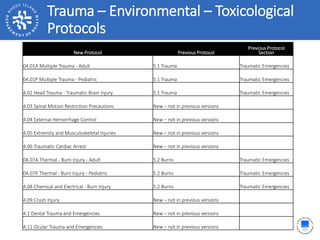
Trauma – Environmental – Toxicological
Protocols
New Protocol Previous Protocol
Previous Protocol
Section
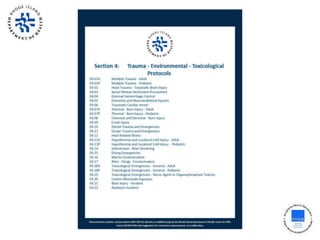
04.01A Multiple Trauma - Adult 5.1 Trauma Traumatic Emergencies
04.01P Multiple Trauma - Pediatric 5.1 Trauma Traumatic Emergencies
4.02 Head Trauma - Traumatic Brain Injury 5.1 Trauma Traumatic Emergencies
4.03 Spinal Motion Restriction Precautions New – not in previous versions
4.04 External Hemorrhage Control New – not in previous versions
4.05 Extremity and Musculoskeletal Injuries New – not in previous versions
4.06 Traumatic Cardiac Arrest New – not in previous versions
04.07A Thermal - Burn Injury - Adult 5.2 Burns Traumatic Emergencies
04.07P Thermal - Burn Injury - Pediatric 5.2 Burns Traumatic Emergencies
4.08 Chemical and Electrical - Burn Injury 5.2 Burns Traumatic Emergencies
4.09 Crush Injury New – not in previous versions
4.1 Dental Trauma and Emergencies New – not in previous versions
4.11 Ocular Trauma and Emergencies New – not in previous versions
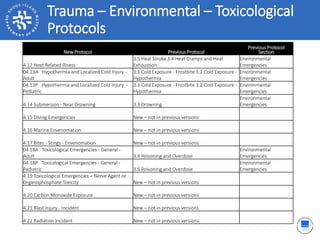
Trauma – Environmental – Toxicological
Protocols
New Protocol Previous Protocol
Previous Protocol
Section
4.12 Heat Related Illness
3.5 Heat Stroke 3.4 Heat Cramps and Heat
Exhaustion
Environmental
Emergencies
04.13A Hypothermia and Localized Cold Injury -
Adult
3.1 Cold Exposure - Frostbite 3.2 Cold Exposure -
Hypothermia
Environmental
Emergencies
04.13P Hypothermia and Localized Cold Injury -
Pediatric
3.1 Cold Exposure - Frostbite 3.2 Cold Exposure -
Hypothermia
Environmental
Emergencies
4.14 Submersion - Near Drowning 3.3 Drowning
Environmental
Emergencies
4.15 Diving Emergencies New – not in previous versions
4.16 Marine Envenomation New – not in previous versions
4.17 Bites - Stings - Envenomation New – not in previous versions
04.18A Toxicological Emergencies - General -
Adult 3.6 Poisoning and Overdose
Environmental
Emergencies
04.18P Toxicological Emergencies - General -
Pediatric 3.6 Poisoning and Overdose
Environmental
Emergencies
4.19 Toxicological Emergencies – Nerve Agent or
Organophosphate Toxicity New – not in previous versions
4.20 Carbon Monoxide Exposure New – not in previous versions
4.21 Blast Injury - Incident New – not in previous versions
4.22 Radiation Incident New – not in previous versions
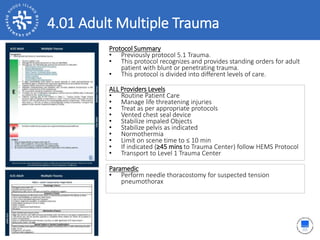
4.01 Adult Multiple Trauma
Protocol Summary
• Previously protocol 5.1 Trauma.
• This protocol recognizes and provides standing orders for adult
patient with blunt or penetrating trauma.
• This protocol is divided into different levels of care.
ALL Providers Levels
• Routine Patient Care
• Manage life threatening injuries
• Treat as per appropriate protocols
• Vented chest seal device
• Stabilize impaled Objects
• Stabilize pelvis as indicated
• Normothermia
• Limit on scene time to ≤ 10 min
• If indicated (≥45 mins to Trauma Center) follow HEMS Protocol
• Transport to Level 1 Trauma Center
Paramedic
• Perform needle thoracostomy for suspected tension
pneumothorax
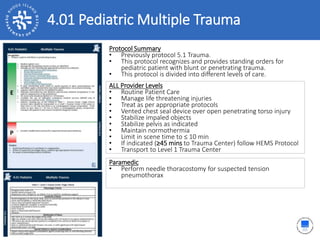
4.01 Pediatric Multiple Trauma
Protocol Summary
• Previously protocol 5.1 Trauma.
• This protocol recognizes and provides standing orders for
pediatric patient with blunt or penetrating trauma.
• This protocol is divided into different levels of care.
ALL Provider Levels
• Routine Patient Care
• Manage life threatening injuries
• Treat as per appropriate protocols
• Vented chest seal device over open penetrating torso injury
• Stabilize impaled objects
• Stabilize pelvis as indicated
• Maintain normothermia
• Limit in scene time to ≤ 10 min
• If indicated (≥45 mins to Trauma Center) follow HEMS Protocol
• Transport to Level 1 Trauma Center
Paramedic
• Perform needle thoracostomy for suspected tension
pneumothorax
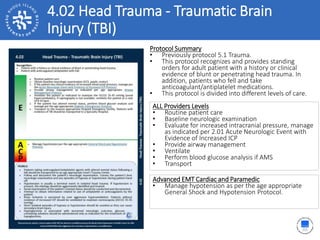
4.02 Head Trauma - Traumatic Brain
Injury (TBI)
Protocol Summary
• Previously protocol 5.1 Trauma.
• This protocol recognizes and provides standing
orders for adult patient with a history or clinical
evidence of blunt or penetrating head trauma. In
addition, patients who fell and take
anticoagulant/antiplatelet medications.
• This protocol is divided into different levels of care.
ALL Providers Levels
• Routine patient care
• Baseline neurologic examination
• Evaluate for increased intracranial pressure, manage
as indicated per 2.01 Acute Neurologic Event with
Evidence of Increased ICP
• Provide airway management
• Ventilate
• Perform blood glucose analysis if AMS
• Transport
Advanced EMT Cardiac and Paramedic
• Manage hypotension as per the age appropriate
General Shock and Hypotension Protocol.
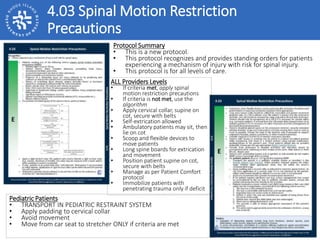
4.03 Spinal Motion Restriction
Precautions
Protocol Summary
• This is a new protocol.
• This protocol recognizes and provides standing orders for patients
experiencing a mechanism of injury with risk for spinal injury.
• This protocol is for all levels of care.
ALL Providers Levels
• If criteria met, apply spinal
motion restriction precautions
• If criteria is not met, use the
algorithm
• Apply cervical collar, supine on
cot, secure with belts
• Self-extrication allowed
• Ambulatory patients may sit, then
lie on cot
• Scoop and flexible devices to
move patients
• Long spine boards for extrication
and movement
• Position patient supine on cot,
secure with belts
• Manage as per Patient Comfort
protocol
• Immobilize patients with
penetrating trauma only if deficit
Pediatric Patients
• TRANSPORT IN PEDIATRIC RESTRAINT SYSTEM
• Apply padding to cervical collar
• Avoid movement
• Move from car seat to stretcher ONLY if criteria are met
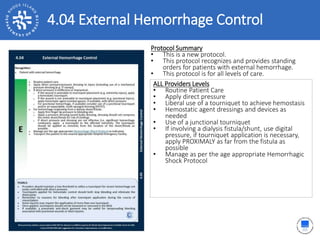
4.04 External Hemorrhage Control
ALL Providers Levels
• Routine Patient Care
• Apply direct pressure
• Liberal use of a tourniquet to achieve hemostasis
• Hemostatic agent dressings and devices as
needed
• Use of a junctional tourniquet
• If involving a dialysis fistula/shunt, use digital
pressure, if tourniquet application is necessary,
apply PROXIMALY as far from the fistula as
possible
• Manage as per the age appropriate Hemorrhagic
Shock Protocol
Protocol Summary
• This is a new protocol.
• This protocol recognizes and provides standing
orders for patients with external hemorrhage.
• This protocol is for all levels of care.
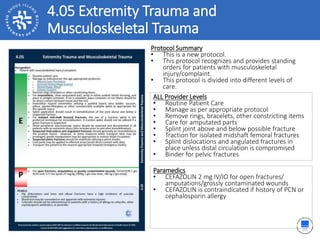
4.05 Extremity Trauma and
Musculoskeletal Trauma
ALL Provider Levels
• Routine Patient Care
• Manage as per appropriate protocol
• Remove rings, bracelets, other constricting items
• Care for amputated parts
• Splint joint above and below possible fracture
• Traction for isolated midshaft femoral fractures
• Splint dislocations and angulated fractures in
place unless distal circulation is compromised
• Binder for pelvic fractures
Protocol Summary
• This is a new protocol.
• This protocol recognizes and provides standing
orders for patients with musculoskeletal
injury/complaint.
• This protocol is divided into different levels of
care.
Paramedics
• CEFAZOLIN 2 mg IV/IO for open fractures/
amputations/grossly contaminated wounds
• CEFAZOLIN is contraindicated if history of PCN or
cephalosporin allergy
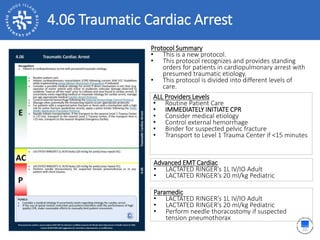
4.06 Traumatic Cardiac Arrest
ALL Providers Levels
• Routine Patient Care
• IMMEDIATELY INITIATE CPR
• Consider medical etiology
• Control external hemorrhage
• Binder for suspected pelvic fracture
• Transport to Level 1 Trauma Center if <15 minutes
Protocol Summary
• This is a new protocol.
• This protocol recognizes and provides standing
orders for patients in cardiopulmonary arrest with
presumed traumatic etiology.
• This protocol is divided into different levels of
care.
Advanced EMT Cardiac
• LACTATED RINGER’s 1L IV/IO Adult
• LACTATED RINGER’s 20 ml/kg Pediatric
Paramedic
• LACTATED RINGER’s 1L IV/IO Adult
• LACTATED RINGER’s 20 ml/kg Pediatric
• Perform needle thoracostomy if suspected
tension pneumothorax
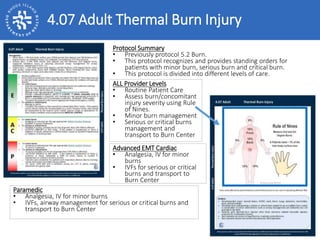
4.07 Adult Thermal Burn Injury
ALL Provider Levels
• Routine Patient Care
• Assess burn/concomitant
injury severity using Rule
of Nines.
• Minor burn management
• Serious or critical burns
management and
transport to Burn Center
Protocol Summary
• Previously protocol 5.2 Burn.
• This protocol recognizes and provides standing orders for
patients with minor burn, serious burn and critical burn.
• This protocol is divided into different levels of care.
Advanced EMT Cardiac
• Analgesia, IV for minor
burns
• IVFs for serious or critical
burns and transport to
Burn Center
Paramedic
• Analgesia, IV for minor burns
• IVFs, airway management for serious or critical burns and
transport to Burn Center
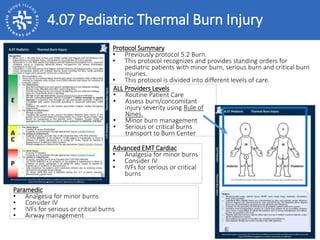
ALL Providers Levels
• Routine Patient Care
• Assess burn/concomitant
injury severity using Rule of
Nines.
• Minor burn management
• Serious or critical burns
transport to Burn Center
Protocol Summary
• Previously protocol 5.2 Burn.
• This protocol recognizes and provides standing orders for
pediatric patients with minor burn, serious burn and critical burn
injuries.
• This protocol is divided into different levels of care.
Advanced EMT Cardiac
• Analgesia for minor burns
• Consider IV
• IVFs for serious or critical
burns
Paramedic
• Analgesia for minor burns
• Consider IV
• IVFs for serious or critical burns
• Airway management
4.07 Pediatric Thermal Burn Injury
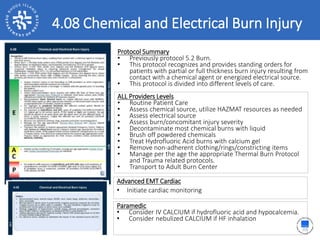
4.08 Chemical and Electrical Burn Injury
ALL Providers Levels
• Routine Patient Care
• Assess chemical source, utilize HAZMAT resources as needed
• Assess electrical source
• Assess burn/concomitant injury severity
• Decontaminate most chemical burns with liquid
• Brush off powdered chemicals
• Treat Hydrofluoric Acid burns with calcium gel
• Remove non-adherent clothing/rings/constricting items
• Manage per the age the appropriate Thermal Burn Protocol
and Trauma related protocols.
• Transport to Adult Burn Center
Protocol Summary
• Previously protocol 5.2 Burn.
• This protocol recognizes and provides standing orders for
patients with partial or full thickness burn injury resulting from
contact with a chemical agent or energized electrical source.
• This protocol is divided into different levels of care.
Advanced EMT Cardiac
• Initiate cardiac monitoring
Paramedic
• Consider IV CALCIUM if hydrofluoric acid and hypocalcemia.
• Consider nebulized CALCIUM if HF inhalation
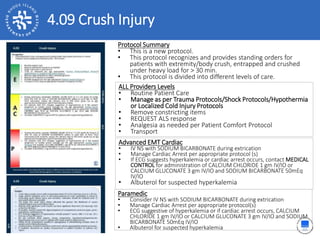
4.09 Crush Injury
ALL Providers Levels
• Routine Patient Care
• Manage as per Trauma Protocols/Shock Protocols/Hypothermia
or Localized Cold Injury Protocols
• Remove constricting items
• REQUEST ALS response
• Analgesia as needed per Patient Comfort Protocol
• Transport
Protocol Summary
• This is a new protocol.
• This protocol recognizes and provides standing orders for
patients with extremity/body crush, entrapped and crushed
under heavy load for > 30 min.
• This protocol is divided into different levels of care.
Advanced EMT Cardiac
• IV NS with SODIUM BICARBONATE during extrication
• Manage Cardiac Arrest per appropriate protocol (s)
• If ECG suggests hyperkalemia or cardiac arrest occurs, contact MEDICAL
CONTROL for administration of CALCIUM CHLORIDE 1 gm IV/IO or
CALCIUM GLUCONATE 3 gm IV/IO and SODIUM BICARBONATE 50mEq
IV/IO
• Albuterol for suspected hyperkalemia
Paramedic
• Consider IV NS with SODIUM BICARBONATE during extrication
• Manage Cardiac Arrest per appropriate protocol(s)
• ECG suggestive of hyperkalemia or if cardiac arrest occurs, CALCIUM
CHLORIDE 1 gm IV/IO or CALCIUM GLUCONATE 3 gm IV/IO and SODIUM
BICARBONATE 50mEq IV/IO
• Albuterol for suspected hyperkalemia
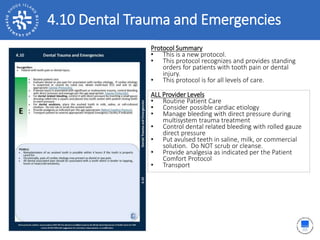
4.10 Dental Trauma and Emergencies
ALL Provider Levels
• Routine Patient Care
• Consider possible cardiac etiology
• Manage bleeding with direct pressure during
multisystem trauma treatment
• Control dental related bleeding with rolled gauze
direct pressure
• Put avulsed teeth in saline, milk, or commercial
solution. Do NOT scrub or cleanse.
• Provide analgesia as indicated per the Patient
Comfort Protocol
• Transport
Protocol Summary
• This is a new protocol.
• This protocol recognizes and provides standing
orders for patients with tooth pain or dental
injury.
• This protocol is for all levels of care.
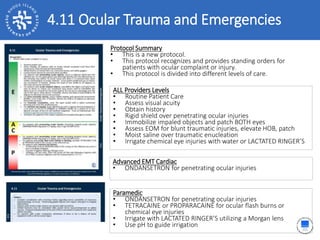
4.11 Ocular Trauma and Emergencies
ALL Providers Levels
• Routine Patient Care
• Assess visual acuity
• Obtain history
• Rigid shield over penetrating ocular injuries
• Immobilize impaled objects and patch BOTH eyes
• Assess EOM for blunt traumatic injuries, elevate HOB, patch
• Moist saline over traumatic enucleation
• Irrigate chemical eye injuries with water or LACTATED RINGER’S
Protocol Summary
• This is a new protocol.
• This protocol recognizes and provides standing orders for
patients with ocular complaint or injury.
• This protocol is divided into different levels of care.
Advanced EMT Cardiac
• ONDANSETRON for penetrating ocular injuries
Paramedic
• ONDANSETRON for penetrating ocular injuries
• TETRACAINE or PROPARACAINE for ocular flash burns or
chemical eye injuries
• Irrigate with LACTATED RINGER’S utilizing a Morgan lens
• Use pH to guide irrigation
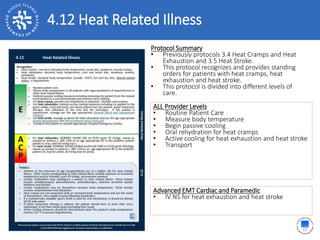
4.12 Heat Related Illness
ALL Provider Levels
• Routine Patient Care
• Measure body temperature
• Begin passive cooling
• Oral rehydration for heat cramps
• Active cooling for heat exhaustion and heat stroke
• Transport
Protocol Summary
• Previously protocols 3.4 Heat Cramps and Heat
Exhaustion and 3.5 Heat Stroke.
• This protocol recognizes and provides standing
orders for patients with heat cramps, heat
exhaustion and heat stroke.
• This protocol is divided into different levels of
care.
Advanced EMT Cardiac and Paramedic
• IV NS for heat exhaustion and heat stroke
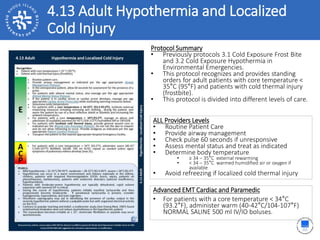
4.13 Adult Hypothermia and Localized
Cold Injury
ALL Providers Levels
• Routine Patient Care
• Provide airway management
• Check pulse 60 seconds if unresponsive
• Assess mental status and treat as indicated
• Determine body temperature
• ≥ 34 – 35°C external rewarming
• < 34 – 35°C warmed humidified air or oxygen if
available
• Avoid refreezing if localized cold thermal injury
Protocol Summary
• Previously protocols 3.1 Cold Exposure Frost Bite
and 3.2 Cold Exposure Hypothermia in
Environmental Emergencies.
• This protocol recognizes and provides standing
orders for adult patients with core temperature <
35°C (95°F) and patients with cold thermal injury
(frostbite).
• This protocol is divided into different levels of care.
Advanced EMT Cardiac and Paramedic
• For patients with a core temperature < 34°C
(93.2°F), administer warm (40-42°C/104-107°F)
NORMAL SALINE 500 ml IV/IO boluses.
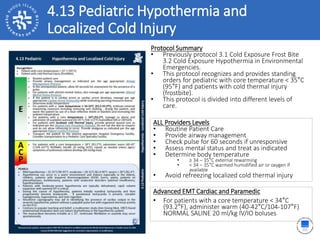
4.13 Pediatric Hypothermia and
Localized Cold Injury
ALL Providers Levels
• Routine Patient Care
• Provide airway management
• Check pulse for 60 seconds if unresponsive
• Assess mental status and treat as indicated
• Determine body temperature
• ≥ 34 – 35°C external rewarming
• < 34 – 35°C warmed humidified air or oxygen if
available
• Avoid refreezing localized cold thermal injury
Protocol Summary
• Previously protocol 3.1 Cold Exposure Frost Bite
3.2 Cold Exposure Hypothermia in Environmental
Emergencies.
• This protocol recognizes and provides standing
orders for pediatric with core temperature < 35°C
(95°F) and patients with cold thermal injury
(frostbite).
• This protocol is divided into different levels of
care.
Advanced EMT Cardiac and Paramedic
• For patients with a core temperature < 34°C
(93.2°F), administer warm (40-42°C/104-107°F)
NORMAL SALINE 20 ml/kg IV/IO boluses
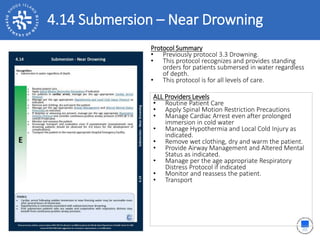
4.14 Submersion – Near Drowning
ALL Providers Levels
• Routine Patient Care
• Apply Spinal Motion Restriction Precautions
• Manage Cardiac Arrest even after prolonged
immersion in cold water
• Manage Hypothermia and Local Cold Injury as
indicated.
• Remove wet clothing, dry and warm the patient.
• Provide Airway Management and Altered Mental
Status as indicated.
• Manage per the age appropriate Respiratory
Distress Protocol if indicated
• Monitor and reassess the patient.
• Transport
Protocol Summary
• Previously protocol 3.3 Drowning.
• This protocol recognizes and provides standing
orders for patients submersed in water regardless
of depth.
• This protocol is for all levels of care.
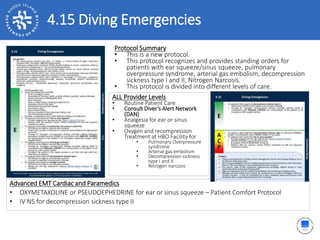
4.15 Diving Emergencies
ALL Provider Levels
• Routine Patient Care
• Consult Diver’s Alert Network
(DAN)
• Analgesia for ear or sinus
squeeze
• Oxygen and recompression
Treatment at HBO Facility for
• Pulmonary Overpressure
syndrome
• Arterial gas embolism
• Decompression sickness
type I and II
• Nitrogen narcosis
Protocol Summary
• This is a new protocol.
• This protocol recognizes and provides standing orders for
patients with ear squeeze/sinus squeeze, pulmonary
overpressure syndrome, arterial gas embolism, decompression
sickness type I and II, Nitrogen Narcosis.
• This protocol is divided into different levels of care.
Advanced EMT Cardiac and Paramedics
• OXYMETAXOLINE or PSEUDOEPHEDRINE for ear or sinus squeeze – Patient Comfort Protocol
• IV NS for decompression sickness type II
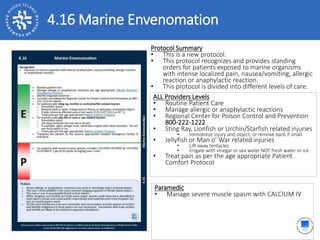
4.16 Marine Envenomation
ALL Providers Levels
• Routine Patient Care
• Manage allergic or anaphylactic reactions
• Regional Center for Poison Control and Prevention
800-222-1222
• Sting Ray, Lionfish or Urchin/Starfish related injuries
• Immobilize injury and object, or remove barb if small
• Jellyfish or Man o’ War related injuries
• Lift away tentacles
• Irrigate with vinegar or sea water NOT fresh water or ice
• Treat pain as per the age appropriate Patient
Comfort Protocol
Protocol Summary
• This is a new protocol.
• This protocol recognizes and provides standing
orders for patients exposed to marine organisms
with intense localized pain, nausea/vomiting, allergic
reaction or anaphylactic reaction.
• This protocol is divided into different levels of care.
Paramedic
• Manage severe muscle spasm with CALCIUM IV
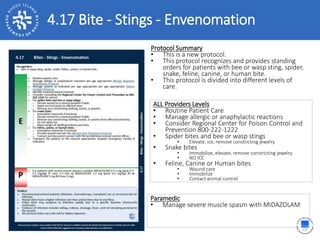
4.17 Bite - Stings - Envenomation
Protocol Summary
• This is a new protocol.
• This protocol recognizes and provides standing
orders for patients with bee or wasp sting, spider,
snake, feline, canine, or human bite.
• This protocol is divided into different levels of
care.
Paramedic
• Manage severe muscle spasm with MIDAZOLAM
ALL Providers Levels
• Routine Patient Care
• Manage allergic or anaphylactic reactions
• Consider Regional Center for Poison Control and
Prevention 800-222-1222
• Spider bites and bee or wasp stings
• Elevate, ice, remove constricting jewelry
• Snake bites
• Immobilize, elevate, remove constricting jewelry
• NO ICE
• Feline, Canine or Human bites
• Wound care
• Immobilize
• Contact animal control
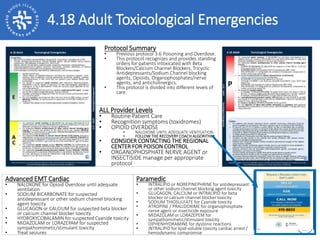
4.18 Adult Toxicological Emergencies
ALL Provider Levels
• Routine Patient Care
• Recognition symptoms (toxidromes)
• OPIOID OVERDOSE
• NALOXONE UNTIL ADEQUATE VENTILATION
• FOLLOW THE RECOVERY COACH ALGORITHM
• CONSIDER CONTACTING THE REGIONAL
CENTER FOR POISON CONTROL
• ORGANOPHOSPHATE NERVE AGENT or
INSECTISIDE manage per appropriate
protocol
Protocol Summary
• Previous protocol 3.6 Poisoning and Overdose.
• This protocol recognizes and provides standing
orders for patients intoxicated with Beta
Blockers/Calcium Channel Blockers, Tricyclic
Antidepressants/Sodium Channel blocking
agents, Opioids, Organophosphates/nerve
agents, and anticholinergics.
• This protocol is divided into different levels of
care.
Advanced EMT Cardiac
• NALOXONE for Opioid Overdose until adequate
ventilation
• SODIUM BICARBONATE for suspected
antidepressant or other sodium channel blocking
agent toxicity
• GLUCAGON or CALCIUM for suspected beta blocker
or calcium channel blocker toxicity
• HYDROXYCOBALAMIN for suspected Cyanide toxicity
• MIDAZOLAM or LORAZEPAM for suspected
sympathomimetic/stimulant toxicity
• Treat seizures
Paramedic
• INTRALIPID or NOREPINEPHRINE for antidepressant
or other sodium channel blocking agent toxicity
• GLUCAGON, CALCIUM or INTRALIPID for beta
blocker or calcium channel blocker toxicity
• SODIUM THIOSULFATE for Cyanide toxicity
• ATROPINE / PRALIDOXIME for organophosphate
nerve agent or insecticide exposure
• MIDAZOLAM or LORAZEPEM for
sympathomimetic/stimulant toxicity
• DIPHENHYDRAMINE for dystonic reactions
• INTRALIPID for lipid-soluble toxicity cardiac arrest /
hemodynamic compromise
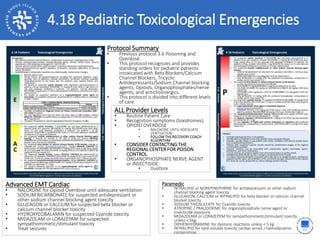
2.17 Obstetrical Delivery4.18 Pediatric Toxicological Emergencies
ALL Provider Levels
• Routine Patient Care
• Recognition symptoms (toxidromes)
• OPIOID OVERDOSE
• NALOXONE UNTIL ADEQUATE
VENTILATION
• FOLLOW THE RECOVERY COACH
ALGORITHM
• CONSIDER CONTACTING THE
REGIONAL CENTER FOR POISON
CONTROL
• ORGANOPHOSPHATE NERVE AGENT
or INSECTISIDE
• DuoDote
Protocol Summary
• Previous protocol 3.6 Poisoning and
Overdose.
• This protocol recognizes and provides
standing orders for pediatric patients
intoxicated with Beta Blockers/Calcium
Channel Blockers, Tricyclic
Antidepressants/Sodium Channel blocking
agents, Opioids, Organophosphates/nerve
agents, and anticholinergics.
• This protocol is divided into different levels
of care.
Advanced EMT Cardiac
• NALOXONE for Opioid Overdose until adequate ventilation
• SODIUM BICARBONATE for suspected antidepressant or
other sodium channel blocking agent toxicity
• GLUCAGON or CALCIUM for suspected beta blocker or
calcium channel blocker toxicity
• HYDROXYCOBALAMIN for suspected Cyanide toxicity
• MIDAZOLAM or LORAZEPAM for suspected
sympathomimetic/stimulant toxicity
• Treat seizures
Paramedic
• INTRALIPID or NOREPINEPHRINE for antidepressant or other sodium
channel blocking agent toxicity
• GLUCAGON, CALCIUM or INTRALIPID for beta blocker or calcium channel
blocker toxicity
• SODIUM THIOSULFATE for Cyanide toxicity
• ATROPINE / PRALIDOXIME for organophosphate nerve agent or
insecticide exposure
• MIDAZOLAM or LORAZEPEM for sympathomimetic/stimulant toxicity
unless < 5kg
• DIPHENHYDRAMINE for dystonic reactions unless < 5 kg
• INTRALIPID for lipid-soluble toxicity cardiac arrest / hemodynamic
compromise
2.17 Obstetrical Delivery4.19 Nerve Agent or Organophosphate Toxicity
ALL Provider Levels
• Routine Patient Care
• PPE
• DuoDote
• Adult
• Pediatric
Protocol Summary
• New Protocol
• This protocol recognizes and provides standing orders for patient with suspected or know
exposure to a nerve or organophosphate agent with salivation, lacrimation, urination,
defecation, GI distress, emesis [SLUDGE], muscle twitching, seizures, respiratory arrest),
bradycardia, bronchorrhea, and/or bronchospasm.
• This protocol is divided into different levels of care.
Advanced EMT Cardiac
• Manage Seizures as per the age appropriate Seizure Protocol
Paramedic
• Manage Seizure as per the age appropriate Seizure Protocol
• ATROPINE / PRALIDOXIME for organophosphate nerve agent or insecticide exposure
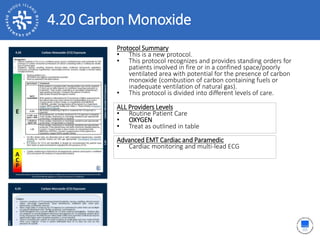
4.20 Carbon Monoxide
ALL Providers Levels
• Routine Patient Care
• OXYGEN
• Treat as outlined in table
Protocol Summary
• This is a new protocol.
• This protocol recognizes and provides standing orders for
patients involved in fire or in a confined space/poorly
ventilated area with potential for the presence of carbon
monoxide (combustion of carbon containing fuels or
inadequate ventilation of natural gas).
• This protocol is divided into different levels of care.
Advanced EMT Cardiac and Paramedic
• Cardiac monitoring and multi-lead ECG
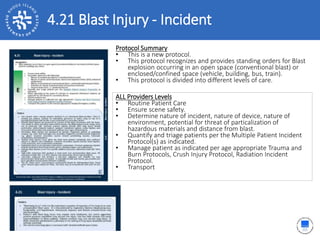
4.21 Blast Injury - Incident
ALL Providers Levels
• Routine Patient Care
• Ensure scene safety.
• Determine nature of incident, nature of device, nature of
environment, potential for threat of particalization of
hazardous materials and distance from blast.
• Quantify and triage patients per the Multiple Patient Incident
Protocol(s) as indicated.
• Manage patient as indicated per age appropriate Trauma and
Burn Protocols, Crush Injury Protocol, Radiation Incident
Protocol.
• Transport
Protocol Summary
• This is a new protocol.
• This protocol recognizes and provides standing orders for Blast
explosion occurring in an open space (conventional blast) or
enclosed/confined space (vehicle, building, bus, train).
• This protocol is divided into different levels of care.
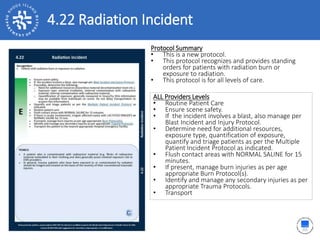
4.22 Radiation Incident
ALL Providers Levels
• Routine Patient Care
• Ensure scene safety.
• If the incident involves a blast, also manage per
Blast Incident and Injury Protocol.
• Determine need for additional resources,
exposure type, quantification of exposure,
quantify and triage patients as per the Multiple
Patient Incident Protocol as indicated.
• Flush contact areas with NORMAL SALINE for 15
minutes.
• If present, manage burn injuries as per age
appropriate Burn Protocol(s).
• Identify and manage any secondary injuries as per
appropriate Trauma Protocols.
• Transport
Protocol Summary
• This is a new protocol.
• This protocol recognizes and provides standing
orders for patients with radiation burn or
exposure to radiation.
• This protocol is for all levels of care.
Continue on to RI EMS
Protocol Education
Modules
Section 5

2017 RI Statewide EMS Protocols Education Modules - Section 4

  • 2.
    Rhode Island Emergency MedicalServices Statewide EMS Protocols October 2016 Rhode Island Department of Health
  • 3.
    Trauma - Environmental- Toxicological Protocols Section 4
  • 5.
    Trauma – Environmental– Toxicological Protocols General Changes and Additions • This is a new section in the EMS protocols • This section has 24 protocols
  • 6.
    Trauma – Environmental– Toxicological Protocols New Protocol Previous Protocol Previous Protocol Section 04.01A Multiple Trauma - Adult 5.1 Trauma Traumatic Emergencies 04.01P Multiple Trauma - Pediatric 5.1 Trauma Traumatic Emergencies 4.02 Head Trauma - Traumatic Brain Injury 5.1 Trauma Traumatic Emergencies 4.03 Spinal Motion Restriction Precautions New – not in previous versions 4.04 External Hemorrhage Control New – not in previous versions 4.05 Extremity and Musculoskeletal Injuries New – not in previous versions 4.06 Traumatic Cardiac Arrest New – not in previous versions 04.07A Thermal - Burn Injury - Adult 5.2 Burns Traumatic Emergencies 04.07P Thermal - Burn Injury - Pediatric 5.2 Burns Traumatic Emergencies 4.08 Chemical and Electrical - Burn Injury 5.2 Burns Traumatic Emergencies 4.09 Crush Injury New – not in previous versions 4.1 Dental Trauma and Emergencies New – not in previous versions 4.11 Ocular Trauma and Emergencies New – not in previous versions
  • 7.
    Trauma – Environmental– Toxicological Protocols New Protocol Previous Protocol Previous Protocol Section 4.12 Heat Related Illness 3.5 Heat Stroke 3.4 Heat Cramps and Heat Exhaustion Environmental Emergencies 04.13A Hypothermia and Localized Cold Injury - Adult 3.1 Cold Exposure - Frostbite 3.2 Cold Exposure - Hypothermia Environmental Emergencies 04.13P Hypothermia and Localized Cold Injury - Pediatric 3.1 Cold Exposure - Frostbite 3.2 Cold Exposure - Hypothermia Environmental Emergencies 4.14 Submersion - Near Drowning 3.3 Drowning Environmental Emergencies 4.15 Diving Emergencies New – not in previous versions 4.16 Marine Envenomation New – not in previous versions 4.17 Bites - Stings - Envenomation New – not in previous versions 04.18A Toxicological Emergencies - General - Adult 3.6 Poisoning and Overdose Environmental Emergencies 04.18P Toxicological Emergencies - General - Pediatric 3.6 Poisoning and Overdose Environmental Emergencies 4.19 Toxicological Emergencies – Nerve Agent or Organophosphate Toxicity New – not in previous versions 4.20 Carbon Monoxide Exposure New – not in previous versions 4.21 Blast Injury - Incident New – not in previous versions 4.22 Radiation Incident New – not in previous versions
  • 8.
    4.01 Adult MultipleTrauma Protocol Summary • Previously protocol 5.1 Trauma. • This protocol recognizes and provides standing orders for adult patient with blunt or penetrating trauma. • This protocol is divided into different levels of care. ALL Providers Levels • Routine Patient Care • Manage life threatening injuries • Treat as per appropriate protocols • Vented chest seal device • Stabilize impaled Objects • Stabilize pelvis as indicated • Normothermia • Limit on scene time to ≤ 10 min • If indicated (≥45 mins to Trauma Center) follow HEMS Protocol • Transport to Level 1 Trauma Center Paramedic • Perform needle thoracostomy for suspected tension pneumothorax
  • 9.
    4.01 Pediatric MultipleTrauma Protocol Summary • Previously protocol 5.1 Trauma. • This protocol recognizes and provides standing orders for pediatric patient with blunt or penetrating trauma. • This protocol is divided into different levels of care. ALL Provider Levels • Routine Patient Care • Manage life threatening injuries • Treat as per appropriate protocols • Vented chest seal device over open penetrating torso injury • Stabilize impaled objects • Stabilize pelvis as indicated • Maintain normothermia • Limit in scene time to ≤ 10 min • If indicated (≥45 mins to Trauma Center) follow HEMS Protocol • Transport to Level 1 Trauma Center Paramedic • Perform needle thoracostomy for suspected tension pneumothorax
  • 10.
    4.02 Head Trauma- Traumatic Brain Injury (TBI) Protocol Summary • Previously protocol 5.1 Trauma. • This protocol recognizes and provides standing orders for adult patient with a history or clinical evidence of blunt or penetrating head trauma. In addition, patients who fell and take anticoagulant/antiplatelet medications. • This protocol is divided into different levels of care. ALL Providers Levels • Routine patient care • Baseline neurologic examination • Evaluate for increased intracranial pressure, manage as indicated per 2.01 Acute Neurologic Event with Evidence of Increased ICP • Provide airway management • Ventilate • Perform blood glucose analysis if AMS • Transport Advanced EMT Cardiac and Paramedic • Manage hypotension as per the age appropriate General Shock and Hypotension Protocol.
  • 11.
    4.03 Spinal MotionRestriction Precautions Protocol Summary • This is a new protocol. • This protocol recognizes and provides standing orders for patients experiencing a mechanism of injury with risk for spinal injury. • This protocol is for all levels of care. ALL Providers Levels • If criteria met, apply spinal motion restriction precautions • If criteria is not met, use the algorithm • Apply cervical collar, supine on cot, secure with belts • Self-extrication allowed • Ambulatory patients may sit, then lie on cot • Scoop and flexible devices to move patients • Long spine boards for extrication and movement • Position patient supine on cot, secure with belts • Manage as per Patient Comfort protocol • Immobilize patients with penetrating trauma only if deficit Pediatric Patients • TRANSPORT IN PEDIATRIC RESTRAINT SYSTEM • Apply padding to cervical collar • Avoid movement • Move from car seat to stretcher ONLY if criteria are met
  • 12.
    4.04 External HemorrhageControl ALL Providers Levels • Routine Patient Care • Apply direct pressure • Liberal use of a tourniquet to achieve hemostasis • Hemostatic agent dressings and devices as needed • Use of a junctional tourniquet • If involving a dialysis fistula/shunt, use digital pressure, if tourniquet application is necessary, apply PROXIMALY as far from the fistula as possible • Manage as per the age appropriate Hemorrhagic Shock Protocol Protocol Summary • This is a new protocol. • This protocol recognizes and provides standing orders for patients with external hemorrhage. • This protocol is for all levels of care.
  • 13.
    4.05 Extremity Traumaand Musculoskeletal Trauma ALL Provider Levels • Routine Patient Care • Manage as per appropriate protocol • Remove rings, bracelets, other constricting items • Care for amputated parts • Splint joint above and below possible fracture • Traction for isolated midshaft femoral fractures • Splint dislocations and angulated fractures in place unless distal circulation is compromised • Binder for pelvic fractures Protocol Summary • This is a new protocol. • This protocol recognizes and provides standing orders for patients with musculoskeletal injury/complaint. • This protocol is divided into different levels of care. Paramedics • CEFAZOLIN 2 mg IV/IO for open fractures/ amputations/grossly contaminated wounds • CEFAZOLIN is contraindicated if history of PCN or cephalosporin allergy
  • 14.
    4.06 Traumatic CardiacArrest ALL Providers Levels • Routine Patient Care • IMMEDIATELY INITIATE CPR • Consider medical etiology • Control external hemorrhage • Binder for suspected pelvic fracture • Transport to Level 1 Trauma Center if <15 minutes Protocol Summary • This is a new protocol. • This protocol recognizes and provides standing orders for patients in cardiopulmonary arrest with presumed traumatic etiology. • This protocol is divided into different levels of care. Advanced EMT Cardiac • LACTATED RINGER’s 1L IV/IO Adult • LACTATED RINGER’s 20 ml/kg Pediatric Paramedic • LACTATED RINGER’s 1L IV/IO Adult • LACTATED RINGER’s 20 ml/kg Pediatric • Perform needle thoracostomy if suspected tension pneumothorax
  • 15.
    4.07 Adult ThermalBurn Injury ALL Provider Levels • Routine Patient Care • Assess burn/concomitant injury severity using Rule of Nines. • Minor burn management • Serious or critical burns management and transport to Burn Center Protocol Summary • Previously protocol 5.2 Burn. • This protocol recognizes and provides standing orders for patients with minor burn, serious burn and critical burn. • This protocol is divided into different levels of care. Advanced EMT Cardiac • Analgesia, IV for minor burns • IVFs for serious or critical burns and transport to Burn Center Paramedic • Analgesia, IV for minor burns • IVFs, airway management for serious or critical burns and transport to Burn Center
  • 16.
    ALL Providers Levels •Routine Patient Care • Assess burn/concomitant injury severity using Rule of Nines. • Minor burn management • Serious or critical burns transport to Burn Center Protocol Summary • Previously protocol 5.2 Burn. • This protocol recognizes and provides standing orders for pediatric patients with minor burn, serious burn and critical burn injuries. • This protocol is divided into different levels of care. Advanced EMT Cardiac • Analgesia for minor burns • Consider IV • IVFs for serious or critical burns Paramedic • Analgesia for minor burns • Consider IV • IVFs for serious or critical burns • Airway management 4.07 Pediatric Thermal Burn Injury
  • 17.
    4.08 Chemical andElectrical Burn Injury ALL Providers Levels • Routine Patient Care • Assess chemical source, utilize HAZMAT resources as needed • Assess electrical source • Assess burn/concomitant injury severity • Decontaminate most chemical burns with liquid • Brush off powdered chemicals • Treat Hydrofluoric Acid burns with calcium gel • Remove non-adherent clothing/rings/constricting items • Manage per the age the appropriate Thermal Burn Protocol and Trauma related protocols. • Transport to Adult Burn Center Protocol Summary • Previously protocol 5.2 Burn. • This protocol recognizes and provides standing orders for patients with partial or full thickness burn injury resulting from contact with a chemical agent or energized electrical source. • This protocol is divided into different levels of care. Advanced EMT Cardiac • Initiate cardiac monitoring Paramedic • Consider IV CALCIUM if hydrofluoric acid and hypocalcemia. • Consider nebulized CALCIUM if HF inhalation
  • 18.
    4.09 Crush Injury ALLProviders Levels • Routine Patient Care • Manage as per Trauma Protocols/Shock Protocols/Hypothermia or Localized Cold Injury Protocols • Remove constricting items • REQUEST ALS response • Analgesia as needed per Patient Comfort Protocol • Transport Protocol Summary • This is a new protocol. • This protocol recognizes and provides standing orders for patients with extremity/body crush, entrapped and crushed under heavy load for > 30 min. • This protocol is divided into different levels of care. Advanced EMT Cardiac • IV NS with SODIUM BICARBONATE during extrication • Manage Cardiac Arrest per appropriate protocol (s) • If ECG suggests hyperkalemia or cardiac arrest occurs, contact MEDICAL CONTROL for administration of CALCIUM CHLORIDE 1 gm IV/IO or CALCIUM GLUCONATE 3 gm IV/IO and SODIUM BICARBONATE 50mEq IV/IO • Albuterol for suspected hyperkalemia Paramedic • Consider IV NS with SODIUM BICARBONATE during extrication • Manage Cardiac Arrest per appropriate protocol(s) • ECG suggestive of hyperkalemia or if cardiac arrest occurs, CALCIUM CHLORIDE 1 gm IV/IO or CALCIUM GLUCONATE 3 gm IV/IO and SODIUM BICARBONATE 50mEq IV/IO • Albuterol for suspected hyperkalemia
  • 19.
    4.10 Dental Traumaand Emergencies ALL Provider Levels • Routine Patient Care • Consider possible cardiac etiology • Manage bleeding with direct pressure during multisystem trauma treatment • Control dental related bleeding with rolled gauze direct pressure • Put avulsed teeth in saline, milk, or commercial solution. Do NOT scrub or cleanse. • Provide analgesia as indicated per the Patient Comfort Protocol • Transport Protocol Summary • This is a new protocol. • This protocol recognizes and provides standing orders for patients with tooth pain or dental injury. • This protocol is for all levels of care.
  • 20.
    4.11 Ocular Traumaand Emergencies ALL Providers Levels • Routine Patient Care • Assess visual acuity • Obtain history • Rigid shield over penetrating ocular injuries • Immobilize impaled objects and patch BOTH eyes • Assess EOM for blunt traumatic injuries, elevate HOB, patch • Moist saline over traumatic enucleation • Irrigate chemical eye injuries with water or LACTATED RINGER’S Protocol Summary • This is a new protocol. • This protocol recognizes and provides standing orders for patients with ocular complaint or injury. • This protocol is divided into different levels of care. Advanced EMT Cardiac • ONDANSETRON for penetrating ocular injuries Paramedic • ONDANSETRON for penetrating ocular injuries • TETRACAINE or PROPARACAINE for ocular flash burns or chemical eye injuries • Irrigate with LACTATED RINGER’S utilizing a Morgan lens • Use pH to guide irrigation
  • 21.
    4.12 Heat RelatedIllness ALL Provider Levels • Routine Patient Care • Measure body temperature • Begin passive cooling • Oral rehydration for heat cramps • Active cooling for heat exhaustion and heat stroke • Transport Protocol Summary • Previously protocols 3.4 Heat Cramps and Heat Exhaustion and 3.5 Heat Stroke. • This protocol recognizes and provides standing orders for patients with heat cramps, heat exhaustion and heat stroke. • This protocol is divided into different levels of care. Advanced EMT Cardiac and Paramedic • IV NS for heat exhaustion and heat stroke
  • 22.
    4.13 Adult Hypothermiaand Localized Cold Injury ALL Providers Levels • Routine Patient Care • Provide airway management • Check pulse 60 seconds if unresponsive • Assess mental status and treat as indicated • Determine body temperature • ≥ 34 – 35°C external rewarming • < 34 – 35°C warmed humidified air or oxygen if available • Avoid refreezing if localized cold thermal injury Protocol Summary • Previously protocols 3.1 Cold Exposure Frost Bite and 3.2 Cold Exposure Hypothermia in Environmental Emergencies. • This protocol recognizes and provides standing orders for adult patients with core temperature < 35°C (95°F) and patients with cold thermal injury (frostbite). • This protocol is divided into different levels of care. Advanced EMT Cardiac and Paramedic • For patients with a core temperature < 34°C (93.2°F), administer warm (40-42°C/104-107°F) NORMAL SALINE 500 ml IV/IO boluses.
  • 23.
    4.13 Pediatric Hypothermiaand Localized Cold Injury ALL Providers Levels • Routine Patient Care • Provide airway management • Check pulse for 60 seconds if unresponsive • Assess mental status and treat as indicated • Determine body temperature • ≥ 34 – 35°C external rewarming • < 34 – 35°C warmed humidified air or oxygen if available • Avoid refreezing localized cold thermal injury Protocol Summary • Previously protocol 3.1 Cold Exposure Frost Bite 3.2 Cold Exposure Hypothermia in Environmental Emergencies. • This protocol recognizes and provides standing orders for pediatric with core temperature < 35°C (95°F) and patients with cold thermal injury (frostbite). • This protocol is divided into different levels of care. Advanced EMT Cardiac and Paramedic • For patients with a core temperature < 34°C (93.2°F), administer warm (40-42°C/104-107°F) NORMAL SALINE 20 ml/kg IV/IO boluses
  • 24.
    4.14 Submersion –Near Drowning ALL Providers Levels • Routine Patient Care • Apply Spinal Motion Restriction Precautions • Manage Cardiac Arrest even after prolonged immersion in cold water • Manage Hypothermia and Local Cold Injury as indicated. • Remove wet clothing, dry and warm the patient. • Provide Airway Management and Altered Mental Status as indicated. • Manage per the age appropriate Respiratory Distress Protocol if indicated • Monitor and reassess the patient. • Transport Protocol Summary • Previously protocol 3.3 Drowning. • This protocol recognizes and provides standing orders for patients submersed in water regardless of depth. • This protocol is for all levels of care.
  • 25.
    4.15 Diving Emergencies ALLProvider Levels • Routine Patient Care • Consult Diver’s Alert Network (DAN) • Analgesia for ear or sinus squeeze • Oxygen and recompression Treatment at HBO Facility for • Pulmonary Overpressure syndrome • Arterial gas embolism • Decompression sickness type I and II • Nitrogen narcosis Protocol Summary • This is a new protocol. • This protocol recognizes and provides standing orders for patients with ear squeeze/sinus squeeze, pulmonary overpressure syndrome, arterial gas embolism, decompression sickness type I and II, Nitrogen Narcosis. • This protocol is divided into different levels of care. Advanced EMT Cardiac and Paramedics • OXYMETAXOLINE or PSEUDOEPHEDRINE for ear or sinus squeeze – Patient Comfort Protocol • IV NS for decompression sickness type II
  • 26.
    4.16 Marine Envenomation ALLProviders Levels • Routine Patient Care • Manage allergic or anaphylactic reactions • Regional Center for Poison Control and Prevention 800-222-1222 • Sting Ray, Lionfish or Urchin/Starfish related injuries • Immobilize injury and object, or remove barb if small • Jellyfish or Man o’ War related injuries • Lift away tentacles • Irrigate with vinegar or sea water NOT fresh water or ice • Treat pain as per the age appropriate Patient Comfort Protocol Protocol Summary • This is a new protocol. • This protocol recognizes and provides standing orders for patients exposed to marine organisms with intense localized pain, nausea/vomiting, allergic reaction or anaphylactic reaction. • This protocol is divided into different levels of care. Paramedic • Manage severe muscle spasm with CALCIUM IV
  • 27.
    4.17 Bite -Stings - Envenomation Protocol Summary • This is a new protocol. • This protocol recognizes and provides standing orders for patients with bee or wasp sting, spider, snake, feline, canine, or human bite. • This protocol is divided into different levels of care. Paramedic • Manage severe muscle spasm with MIDAZOLAM ALL Providers Levels • Routine Patient Care • Manage allergic or anaphylactic reactions • Consider Regional Center for Poison Control and Prevention 800-222-1222 • Spider bites and bee or wasp stings • Elevate, ice, remove constricting jewelry • Snake bites • Immobilize, elevate, remove constricting jewelry • NO ICE • Feline, Canine or Human bites • Wound care • Immobilize • Contact animal control
  • 28.
    4.18 Adult ToxicologicalEmergencies ALL Provider Levels • Routine Patient Care • Recognition symptoms (toxidromes) • OPIOID OVERDOSE • NALOXONE UNTIL ADEQUATE VENTILATION • FOLLOW THE RECOVERY COACH ALGORITHM • CONSIDER CONTACTING THE REGIONAL CENTER FOR POISON CONTROL • ORGANOPHOSPHATE NERVE AGENT or INSECTISIDE manage per appropriate protocol Protocol Summary • Previous protocol 3.6 Poisoning and Overdose. • This protocol recognizes and provides standing orders for patients intoxicated with Beta Blockers/Calcium Channel Blockers, Tricyclic Antidepressants/Sodium Channel blocking agents, Opioids, Organophosphates/nerve agents, and anticholinergics. • This protocol is divided into different levels of care. Advanced EMT Cardiac • NALOXONE for Opioid Overdose until adequate ventilation • SODIUM BICARBONATE for suspected antidepressant or other sodium channel blocking agent toxicity • GLUCAGON or CALCIUM for suspected beta blocker or calcium channel blocker toxicity • HYDROXYCOBALAMIN for suspected Cyanide toxicity • MIDAZOLAM or LORAZEPAM for suspected sympathomimetic/stimulant toxicity • Treat seizures Paramedic • INTRALIPID or NOREPINEPHRINE for antidepressant or other sodium channel blocking agent toxicity • GLUCAGON, CALCIUM or INTRALIPID for beta blocker or calcium channel blocker toxicity • SODIUM THIOSULFATE for Cyanide toxicity • ATROPINE / PRALIDOXIME for organophosphate nerve agent or insecticide exposure • MIDAZOLAM or LORAZEPEM for sympathomimetic/stimulant toxicity • DIPHENHYDRAMINE for dystonic reactions • INTRALIPID for lipid-soluble toxicity cardiac arrest / hemodynamic compromise
  • 29.
    2.17 Obstetrical Delivery4.18Pediatric Toxicological Emergencies ALL Provider Levels • Routine Patient Care • Recognition symptoms (toxidromes) • OPIOID OVERDOSE • NALOXONE UNTIL ADEQUATE VENTILATION • FOLLOW THE RECOVERY COACH ALGORITHM • CONSIDER CONTACTING THE REGIONAL CENTER FOR POISON CONTROL • ORGANOPHOSPHATE NERVE AGENT or INSECTISIDE • DuoDote Protocol Summary • Previous protocol 3.6 Poisoning and Overdose. • This protocol recognizes and provides standing orders for pediatric patients intoxicated with Beta Blockers/Calcium Channel Blockers, Tricyclic Antidepressants/Sodium Channel blocking agents, Opioids, Organophosphates/nerve agents, and anticholinergics. • This protocol is divided into different levels of care. Advanced EMT Cardiac • NALOXONE for Opioid Overdose until adequate ventilation • SODIUM BICARBONATE for suspected antidepressant or other sodium channel blocking agent toxicity • GLUCAGON or CALCIUM for suspected beta blocker or calcium channel blocker toxicity • HYDROXYCOBALAMIN for suspected Cyanide toxicity • MIDAZOLAM or LORAZEPAM for suspected sympathomimetic/stimulant toxicity • Treat seizures Paramedic • INTRALIPID or NOREPINEPHRINE for antidepressant or other sodium channel blocking agent toxicity • GLUCAGON, CALCIUM or INTRALIPID for beta blocker or calcium channel blocker toxicity • SODIUM THIOSULFATE for Cyanide toxicity • ATROPINE / PRALIDOXIME for organophosphate nerve agent or insecticide exposure • MIDAZOLAM or LORAZEPEM for sympathomimetic/stimulant toxicity unless < 5kg • DIPHENHYDRAMINE for dystonic reactions unless < 5 kg • INTRALIPID for lipid-soluble toxicity cardiac arrest / hemodynamic compromise
  • 30.
    2.17 Obstetrical Delivery4.19Nerve Agent or Organophosphate Toxicity ALL Provider Levels • Routine Patient Care • PPE • DuoDote • Adult • Pediatric Protocol Summary • New Protocol • This protocol recognizes and provides standing orders for patient with suspected or know exposure to a nerve or organophosphate agent with salivation, lacrimation, urination, defecation, GI distress, emesis [SLUDGE], muscle twitching, seizures, respiratory arrest), bradycardia, bronchorrhea, and/or bronchospasm. • This protocol is divided into different levels of care. Advanced EMT Cardiac • Manage Seizures as per the age appropriate Seizure Protocol Paramedic • Manage Seizure as per the age appropriate Seizure Protocol • ATROPINE / PRALIDOXIME for organophosphate nerve agent or insecticide exposure
  • 31.
    4.20 Carbon Monoxide ALLProviders Levels • Routine Patient Care • OXYGEN • Treat as outlined in table Protocol Summary • This is a new protocol. • This protocol recognizes and provides standing orders for patients involved in fire or in a confined space/poorly ventilated area with potential for the presence of carbon monoxide (combustion of carbon containing fuels or inadequate ventilation of natural gas). • This protocol is divided into different levels of care. Advanced EMT Cardiac and Paramedic • Cardiac monitoring and multi-lead ECG
  • 32.
    4.21 Blast Injury- Incident ALL Providers Levels • Routine Patient Care • Ensure scene safety. • Determine nature of incident, nature of device, nature of environment, potential for threat of particalization of hazardous materials and distance from blast. • Quantify and triage patients per the Multiple Patient Incident Protocol(s) as indicated. • Manage patient as indicated per age appropriate Trauma and Burn Protocols, Crush Injury Protocol, Radiation Incident Protocol. • Transport Protocol Summary • This is a new protocol. • This protocol recognizes and provides standing orders for Blast explosion occurring in an open space (conventional blast) or enclosed/confined space (vehicle, building, bus, train). • This protocol is divided into different levels of care.
  • 33.
    4.22 Radiation Incident ALLProviders Levels • Routine Patient Care • Ensure scene safety. • If the incident involves a blast, also manage per Blast Incident and Injury Protocol. • Determine need for additional resources, exposure type, quantification of exposure, quantify and triage patients as per the Multiple Patient Incident Protocol as indicated. • Flush contact areas with NORMAL SALINE for 15 minutes. • If present, manage burn injuries as per age appropriate Burn Protocol(s). • Identify and manage any secondary injuries as per appropriate Trauma Protocols. • Transport Protocol Summary • This is a new protocol. • This protocol recognizes and provides standing orders for patients with radiation burn or exposure to radiation. • This protocol is for all levels of care.
  • 34.
    Continue on toRI EMS Protocol Education Modules Section 5