1FireTraining
3 Elements2
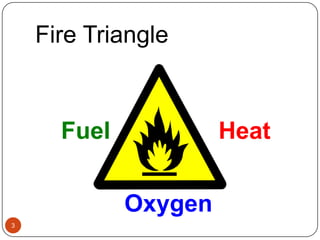
Fire Triangle3FuelHeatOxygen
Main Hazards4Oxygen depletionFlame and heatSmokeGaseous combustion productsStructural failure of buildings
Fuels5Class A - Solids and Dustswood, paper, textiles, rubber, plastic, flour,Class B - Liquidspetrol, oil, fats, solventsClass C - Gasesmethane, natural gas, LPG, acetylene, hydrogenClass D - Metalssodium, magnesiumClass F - Cooking Oils
Oxygen6from the atmospherefrom fuel
Heat - Sources of Ignition7Open Flamematches, fires, gas rings, lighters, cigarettes,Spontaneous Ignitionoily rags, hay stacks, damp waste, coal freshly minedHot Surfacesirons, stoves, furnaces, light bulbs, pipesFrictionpoorly lubricated parts, rubbing parts
Heat - Sources of Ignition8Electrical Equipmentsparks, overheating, switches, short circuits, static electricityChemical Reactionsacids, potassium,Sparkswelding, impact, lightning, grindingArson
Fire Prevention - sources of fire9Fuel-Rubbish, papers and clothes around radiators, flammable containers - lids off, spillages of flammable liquidsAir- Fire doors open, doors and windows left open on evacuation of building because of fireHeat/ignition- Smoking, Machine running hot, electrical faults, vandals
Control of Sources10Good house keepingCare with smokingCare with flammablesCare with machinesElectrical hazardsVigilance over vandalismDoors windows shut whilst premises unoccupied
Important Temperatures11Flash Pointlowest temperature to flash momentarilyFire Point (Ignition Temperature)lowest temperature at which burning will continueSpontaneous Ignition Temperaturelowest temperature to ignite spontaneously
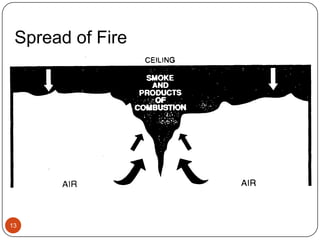
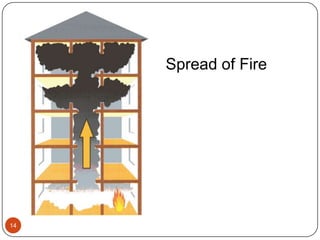
Spread of Fire12ConvectionRadiationConductionDirect BurningRelease of Vapours/Liquids
Spread of Fire13
Spread of Fire14
Factors Assisting the Spread of Fire15Weather conditionsProximity of flammable materials & vapoursCalorific energy of fireAir movementOxygen supplyCollapse of burning roof/ceilingVoids, shafts and false ceilings
Spread of Fire16Any questions?
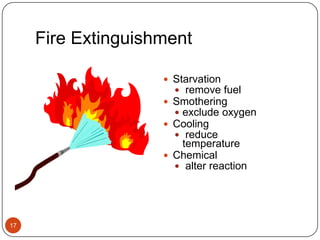
Fire Extinguishment17Starvation remove fuelSmotheringexclude oxygenCooling reduce temperatureChemical alter reaction
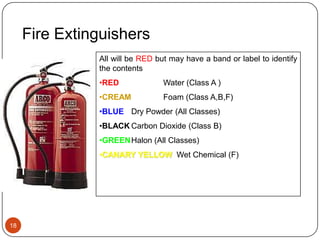
Fire Extinguishers18All will be RED but may have a band or label to identify the contentsRED		Water (Class A )
CREAM	Foam (Class A,B,F)
BLUE	Dry Powder (All Classes)
BLACK	Carbon Dioxide (Class B)
GREEN	Halon (All Classes)
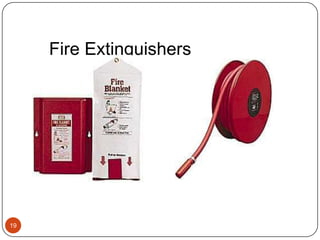
CANARY YELLOW  Wet Chemical (F)Fire Extinguishers19
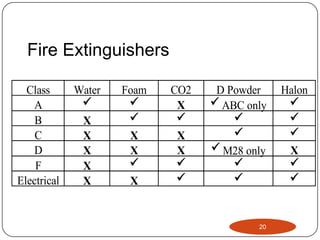
Fire Extinguishers20
Using a Fire Extinguisher21Only tackle a fire after alarm has been raised and safe to do soOnly use extinguisher if familiar with its correct use and typeRemove safety pin from handleKeep upright or place on groundAim nozzle or horn at base of flameSqueeze handles togetherKeep between fire and exit
Checking fire extinguishers22Access to hose reels and extinguishers is unobstructedManual hose reel valves are in the off position( except automatic reels) and free from leaksAll hoses are neatly woundHose reels nozzles are not blocked
Checking fire extinguishers23All fire extinguishers in their correct position, are undamaged and on their bracketsThe gauges of stored pressure extinguishers indicate normal pressureAny seals on hose reel valves or extinguishers are in placeLabels attached to indicate maintenance within 12 months
Fire Precautions24Keep all exits clearKeep extinguishers availableKeep fire doors closedKnow where the fire alarms areKnow the fire procedures - trainingKnow the assembly pointFollow fire prevention measuresHot Work - fire extinguisher available
Managers & Fire Wardens25Be aware of disabled staffEnsure evacuation arrangements are in handSupervise evacuation of areaCheck no-one remainsReport to management or Fire Brigade OfficerEnsure fire precautions are maintainedHold regular fire drills
Training26Action to be taken on finding a fireAction to be taken on hearing fire alarmLocation of alarms, extinguishers & assembly pointsCorrect method of calling fire brigadeImportance of fire doorsKnowledge of alternative means of escapeRoll call procedure
Fire Drill27Raise the alarmClose doors and windowsEvacuate the areaOnly attempt to put out the fire IF SAFE TO DO SOEnsure you can escapeReport to the assembly pointDo not re-enter
Fire Precautions28Any questions?
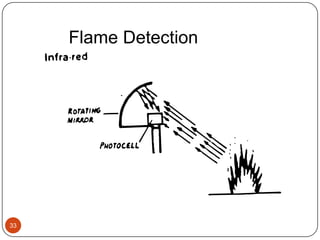
Fire Detection29Fire can be detected in one of three ways:By HEATactual temperaturerate of riseBy SMOKEBy FLAME
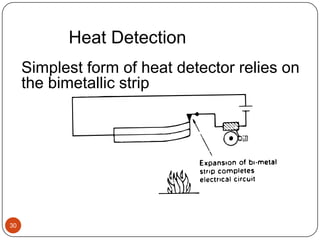
Heat Detection30Simplest form of heat detector relies on the bimetallic strip
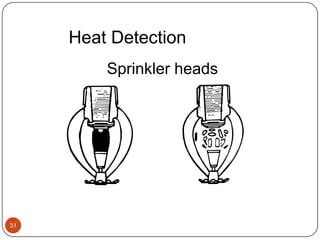
Heat Detection31Sprinkler heads
Smoke Detection32Ionisation radiationsmoke enters chamber, absorb radiation and cause electrical imbalance in circuit Light Scattersmoke cause light to be reflected onto light sensor Light Obscurationsmoke cause light not to reach light sensor
Flame Detection33
Fire Alarms34Shout for helpRing hand bellManually operated call pointAutomatic detectionSometimes linked with fire fighting systems, venting, fire door release, third party control/verification
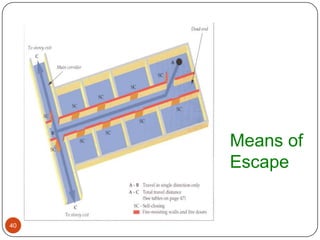
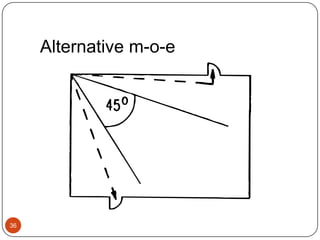
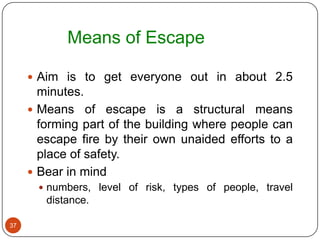
Means of Escape35Ideally, persons should be able to turn their backs on a fire a walk away to a place of safety.Escape in one direction is only acceptable in specific circumstances.Escape routes sufficiently separated by direction, space of fire resisting structure to enable at least one to be available.
Alternative m-o-e36
Means of Escape37Aim is to get everyone out in about 2.5 minutes.Means of escape is a structural means forming part of the building where people can escape fire by their own unaided efforts to a place of safety.Bear in mindnumbers, level of risk, types of people, travel distance.
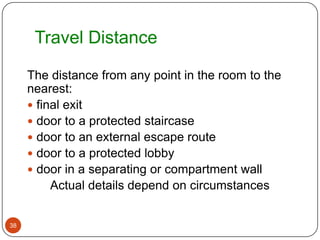
Travel Distance38The distance from any point in the room to the nearest: final exit door to a protected staircase door to an external escape route door to a protected lobby door in a separating or compartment wallActual details depend on circumstances
Travel Distance39More than one routeHigh risk area 	- 25 metresNormal risk area 	- 45 metresLow risk area		- 60 metresSingle route onlyHigh risk area 	- 12 metresNormal risk area 	- 25 metresLow risk area		- 45 metres
Means of Escape40
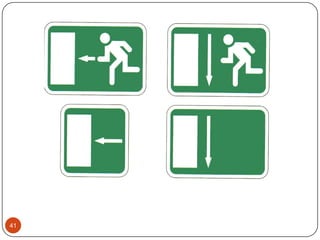
41
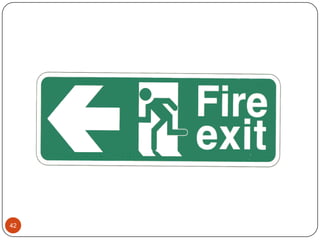
42
CONCLUSION43Any questions?
Fire Legislation44Regulatory Reform (Fire Safety) Order 2005
Designated Premises45Premises used as , or providing, sleeping accommodation;Premises used as an institute providing treatment or care;Premises used for entertainment, recreation or instruction or any club, association or society;
Designated Premises46Premises used for teaching, training or research;premises where public access is involved;premises used as a place of work.
Fire Risk Assessment47Identify fire hazardssources of ignition, fuel, work processesIdentify location of people at significant riskEvaluate the fire risks and control measuresRecord findings and action takenKeep under review

Fire

  • 1.
  • 2.
  • 3.
  • 4.
    Main Hazards4Oxygen depletionFlameand heatSmokeGaseous combustion productsStructural failure of buildings
  • 5.
    Fuels5Class A -Solids and Dustswood, paper, textiles, rubber, plastic, flour,Class B - Liquidspetrol, oil, fats, solventsClass C - Gasesmethane, natural gas, LPG, acetylene, hydrogenClass D - Metalssodium, magnesiumClass F - Cooking Oils
  • 6.
  • 7.
    Heat - Sourcesof Ignition7Open Flamematches, fires, gas rings, lighters, cigarettes,Spontaneous Ignitionoily rags, hay stacks, damp waste, coal freshly minedHot Surfacesirons, stoves, furnaces, light bulbs, pipesFrictionpoorly lubricated parts, rubbing parts
  • 8.
    Heat - Sourcesof Ignition8Electrical Equipmentsparks, overheating, switches, short circuits, static electricityChemical Reactionsacids, potassium,Sparkswelding, impact, lightning, grindingArson
  • 9.
    Fire Prevention -sources of fire9Fuel-Rubbish, papers and clothes around radiators, flammable containers - lids off, spillages of flammable liquidsAir- Fire doors open, doors and windows left open on evacuation of building because of fireHeat/ignition- Smoking, Machine running hot, electrical faults, vandals
  • 10.
    Control of Sources10Goodhouse keepingCare with smokingCare with flammablesCare with machinesElectrical hazardsVigilance over vandalismDoors windows shut whilst premises unoccupied
  • 11.
    Important Temperatures11Flash Pointlowesttemperature to flash momentarilyFire Point (Ignition Temperature)lowest temperature at which burning will continueSpontaneous Ignition Temperaturelowest temperature to ignite spontaneously
  • 12.
  • 13.
  • 14.
  • 15.
    Factors Assisting theSpread of Fire15Weather conditionsProximity of flammable materials & vapoursCalorific energy of fireAir movementOxygen supplyCollapse of burning roof/ceilingVoids, shafts and false ceilings
  • 16.
  • 17.
    Fire Extinguishment17Starvation removefuelSmotheringexclude oxygenCooling reduce temperatureChemical alter reaction
  • 18.
    Fire Extinguishers18All willbe RED but may have a band or label to identify the contentsRED Water (Class A )
  • 19.
  • 20.
  • 21.
  • 22.
  • 23.
    CANARY YELLOW Wet Chemical (F)Fire Extinguishers19
  • 24.
  • 25.
    Using a FireExtinguisher21Only tackle a fire after alarm has been raised and safe to do soOnly use extinguisher if familiar with its correct use and typeRemove safety pin from handleKeep upright or place on groundAim nozzle or horn at base of flameSqueeze handles togetherKeep between fire and exit
  • 26.
    Checking fire extinguishers22Accessto hose reels and extinguishers is unobstructedManual hose reel valves are in the off position( except automatic reels) and free from leaksAll hoses are neatly woundHose reels nozzles are not blocked
  • 27.
    Checking fire extinguishers23Allfire extinguishers in their correct position, are undamaged and on their bracketsThe gauges of stored pressure extinguishers indicate normal pressureAny seals on hose reel valves or extinguishers are in placeLabels attached to indicate maintenance within 12 months
  • 28.
    Fire Precautions24Keep allexits clearKeep extinguishers availableKeep fire doors closedKnow where the fire alarms areKnow the fire procedures - trainingKnow the assembly pointFollow fire prevention measuresHot Work - fire extinguisher available
  • 29.
    Managers & FireWardens25Be aware of disabled staffEnsure evacuation arrangements are in handSupervise evacuation of areaCheck no-one remainsReport to management or Fire Brigade OfficerEnsure fire precautions are maintainedHold regular fire drills
  • 30.
    Training26Action to betaken on finding a fireAction to be taken on hearing fire alarmLocation of alarms, extinguishers & assembly pointsCorrect method of calling fire brigadeImportance of fire doorsKnowledge of alternative means of escapeRoll call procedure
  • 31.
    Fire Drill27Raise thealarmClose doors and windowsEvacuate the areaOnly attempt to put out the fire IF SAFE TO DO SOEnsure you can escapeReport to the assembly pointDo not re-enter
  • 32.
  • 33.
    Fire Detection29Fire canbe detected in one of three ways:By HEATactual temperaturerate of riseBy SMOKEBy FLAME
  • 34.
    Heat Detection30Simplest formof heat detector relies on the bimetallic strip
  • 35.
  • 36.
    Smoke Detection32Ionisation radiationsmokeenters chamber, absorb radiation and cause electrical imbalance in circuit Light Scattersmoke cause light to be reflected onto light sensor Light Obscurationsmoke cause light not to reach light sensor
  • 37.
  • 38.
    Fire Alarms34Shout forhelpRing hand bellManually operated call pointAutomatic detectionSometimes linked with fire fighting systems, venting, fire door release, third party control/verification
  • 39.
    Means of Escape35Ideally,persons should be able to turn their backs on a fire a walk away to a place of safety.Escape in one direction is only acceptable in specific circumstances.Escape routes sufficiently separated by direction, space of fire resisting structure to enable at least one to be available.
  • 40.
  • 41.
    Means of Escape37Aimis to get everyone out in about 2.5 minutes.Means of escape is a structural means forming part of the building where people can escape fire by their own unaided efforts to a place of safety.Bear in mindnumbers, level of risk, types of people, travel distance.
  • 42.
    Travel Distance38The distancefrom any point in the room to the nearest: final exit door to a protected staircase door to an external escape route door to a protected lobby door in a separating or compartment wallActual details depend on circumstances
  • 43.
    Travel Distance39More thanone routeHigh risk area - 25 metresNormal risk area - 45 metresLow risk area - 60 metresSingle route onlyHigh risk area - 12 metresNormal risk area - 25 metresLow risk area - 45 metres
  • 44.
  • 45.
  • 46.
  • 47.
  • 48.
    Fire Legislation44Regulatory Reform(Fire Safety) Order 2005
  • 49.
    Designated Premises45Premises usedas , or providing, sleeping accommodation;Premises used as an institute providing treatment or care;Premises used for entertainment, recreation or instruction or any club, association or society;
  • 50.
    Designated Premises46Premises usedfor teaching, training or research;premises where public access is involved;premises used as a place of work.
  • 51.
    Fire Risk Assessment47Identifyfire hazardssources of ignition, fuel, work processesIdentify location of people at significant riskEvaluate the fire risks and control measuresRecord findings and action takenKeep under review