FIRE SAFETY INDUCTION
Name and ID:
OVERVIEW
We will look at
• Legal requirements
• Understanding fire
• Fire hazards and risks
• Fire prevention and control
• Fire extinguisher safety
• Fire procedures
LEGAL REQUIREMENTS
Regulatory Reform (Fire Safety) Order 2005
requires that;
• Fire risks are identified and controlled
• A Fire Risk Assessment is completed and reviewed
regularly or if work areas change
• Findings are implemented, so far as is reasonably
practicable
UNDERSTANDING FIRE
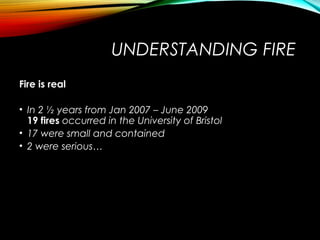
Fire is real
• In 2 ½ years from Jan 2007 – June 2009
19 fires occurred in the University of Bristol
• 17 were small and contained
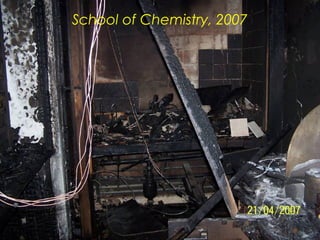
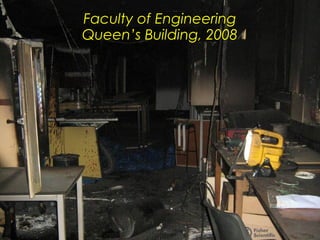
• 2 were serious…
School of Chemistry, 2007
Faculty of Engineering
Queen’s Building, 2008
UNDERSTANDING FIRE
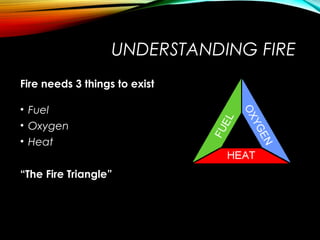
Fire needs 3 things to exist
• Fuel
• Oxygen
• Heat
“The Fire Triangle”
UNDERSTANDING FIRE
Fuel
• Chemicals - acetone, ether, methanol, etc
• Gases - hydrogen, natural gas
• Plastics - PCs, cable insulation, research equipment
• Paper and cardboard - packaging
• Wood - desks, benches
• Fabrics - chairs, blinds, clothing
• You…
UNDERSTANDING FIRE
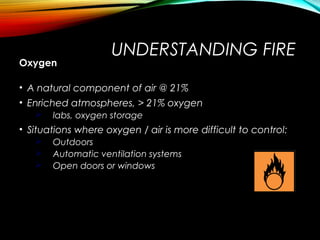
Oxygen
• A natural component of air @ 21%
• Enriched atmospheres, > 21% oxygen
 labs, oxygen storage
• Situations where oxygen / air is more difficult to control:
 Outdoors
 Automatic ventilation systems
 Open doors or windows
UNDERSTANDING FIRE
Heat (Ignition Source)
• Heating appliances
• Research and computer equipment
• Other electrical equipment
• Smoking materials
• Contractor’s equipment
• Arson
UNDERSTANDING FIRE
Hazards and risks of fire
• Smoke & fumes
 Breathing difficulties, asphyxiation, poisoning
• Heat & flames - up to 1250°C
 Burns
• Building debris
 Impact injuries, burns
• Injury while escaping fire
 Trips, falls, trampling
FIRE PREVENTION
• Be fire safety aware
• Control ignition sources
• Prevent any accumulation of fuels
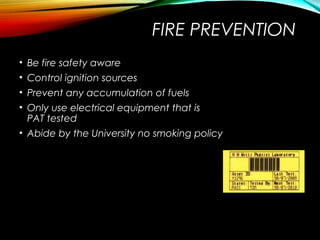
• Only use electrical equipment that is
PAT tested
• Abide by the University no smoking policy
FIRE PREVENTION
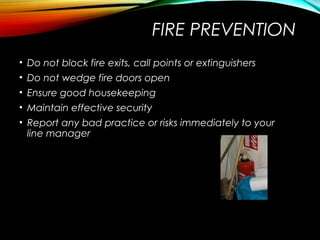
• Do not block fire exits, call points or extinguishers
• Do not wedge fire doors open
• Ensure good housekeeping
• Maintain effective security
• Report any bad practice or risks immediately to your
line manager
FIRE PREVENTION
Fire alarm testing
• Is a legal requirement
• Alarm will sound for 15 seconds (add details of your
departmental or building testing regime)
• No need to take action during a test, however if the
alarm sounds for greater than 15 seconds, or at any
other time than the arranged testing,
you must treat as genuine alarm and immediately
evacuate
FIRE PROCEDURE - FINDING A FIRE
If you discover a fire
• Shout ‘FIRE’.
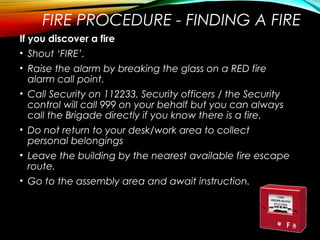
• Raise the alarm by breaking the glass on a RED fire
alarm call point.
• Call Security on 112233. Security officers / the Security
control will call 999 on your behalf but you can always
call the Brigade directly if you know there is a fire.
• Do not return to your desk/work area to collect
personal belongings
• Leave the building by the nearest available fire escape
route.
• Go to the assembly area and await instruction.
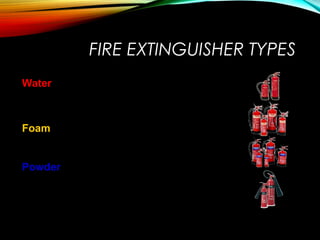
FIRE EXTINGUISHER TYPES
Water Paper, wood, etc.
Not electrical, liquids or gases
FoamFoam Solids & liquids
Not electrical or gases
Powder Solids, liquids, gases &
electrical
CO2 Electrical, safe on most small fires
On hearing the alarm
• Call Security on 112233 to advise of the fire alarm – do not
assume someone else has done it.
• Leave the building by the nearest available fire escape route.
• DO NOT delay your escape but if you can turn off
equipment/close doors and windows as you leave then do so.
• Go to the assembly area and await instruction
FIRE PROCEDURE -
EVACUATION
• Do not delay to collect belongings
• Do not use the lifts
• If smoke is present then keep low to the floor to add
your escape
• If necessary check that internal doors are cool with the
back of your hand before opening them
FIRE PROCEDURE -
EVACUATION
FIRE PROCEDURE -
EVACUATION
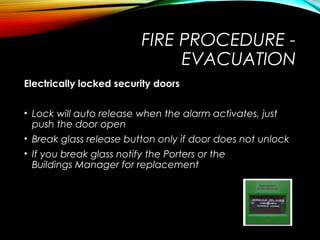
Electrically locked security doors
• Lock will auto release when the alarm activates, just
push the door open
• Break glass release button only if door does not unlock
• If you break glass notify the Porters or the
Buildings Manager for replacement
People with disabilities
• Need to be assisted by volunteers or
nominated personnel, detail will be available in
their Personal Emergency Evacuation Plans
(PEEP’s)
• For special events ensure that disabled
persons have been taken into account and an
evacuation plan is in place
• (Add details of Departmental Evacuation Plan)
FIRE PROCEDURE -
EVACUATION
FIRE PROCEDURE -
EVACUATION
On exiting the building
• Report to designated
assembly point promptly
• Don’t block any Emergency Services
route to the building
• Add diagram if
possible of exit
routes for
department or
form building
On exiting the building
• Report any missing colleagues to your Fire Warden
• Report any disabled persons left at Refuge Points
• Remain at assembly point until advised otherwise
• Do not wander off as it may be assumed that you
are trapped in the building
FIRE PROCEDURE -
EVACUATION
ON YOUR RETURN TO YOUR
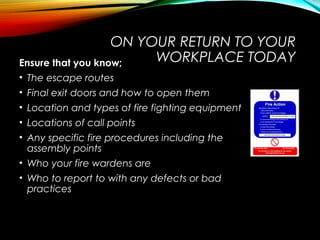
WORKPLACE TODAYEnsure that you know;
• The escape routes
• Final exit doors and how to open them
• Location and types of fire fighting equipment
• Locations of call points
• Any specific fire procedures including the
assembly points
• Who your fire wardens are
• Who to report to with any defects or bad
practices
EXAMPLES OF DEFECTS
TO REPORT
• Covered smoke detectors
• Fire doors damaged or not closing properly
• Broken/damaged lighting, especially emergency
lighting
• Missing or damaged fire extinguishers
• Service riser covers open.
• Accumulation of rubbish and clutter excessive paper in
offices etc.
• Obstructed corridors.
 
SUMMARY
As a member of staff at the University you have a
responsibility for fire safety. Make sure you know:
• What the fire alarm sound like in your building
• The Escape routes within your building
• If you discover a fire, how to raise the alarm
• What to do if you hear the fire alarm
• Who to call if a fire starts
• How to open final exit doors
• Why is it important to go to the assembly area?
• Why fire doors should remain closed at all times?
• Why are fire extinguishers provided?
THANK YOU!
Any Questions?

Fire project

  • 1.
  • 2.
    OVERVIEW We will lookat • Legal requirements • Understanding fire • Fire hazards and risks • Fire prevention and control • Fire extinguisher safety • Fire procedures
  • 3.
    LEGAL REQUIREMENTS Regulatory Reform(Fire Safety) Order 2005 requires that; • Fire risks are identified and controlled • A Fire Risk Assessment is completed and reviewed regularly or if work areas change • Findings are implemented, so far as is reasonably practicable
  • 4.
    UNDERSTANDING FIRE Fire isreal • In 2 ½ years from Jan 2007 – June 2009 19 fires occurred in the University of Bristol • 17 were small and contained • 2 were serious…
  • 5.
  • 6.
  • 7.
    UNDERSTANDING FIRE Fire needs3 things to exist • Fuel • Oxygen • Heat “The Fire Triangle”
  • 8.
    UNDERSTANDING FIRE Fuel • Chemicals- acetone, ether, methanol, etc • Gases - hydrogen, natural gas • Plastics - PCs, cable insulation, research equipment • Paper and cardboard - packaging • Wood - desks, benches • Fabrics - chairs, blinds, clothing • You…
  • 9.
    UNDERSTANDING FIRE Oxygen • Anatural component of air @ 21% • Enriched atmospheres, > 21% oxygen  labs, oxygen storage • Situations where oxygen / air is more difficult to control:  Outdoors  Automatic ventilation systems  Open doors or windows
  • 10.
    UNDERSTANDING FIRE Heat (IgnitionSource) • Heating appliances • Research and computer equipment • Other electrical equipment • Smoking materials • Contractor’s equipment • Arson
  • 11.
    UNDERSTANDING FIRE Hazards andrisks of fire • Smoke & fumes  Breathing difficulties, asphyxiation, poisoning • Heat & flames - up to 1250°C  Burns • Building debris  Impact injuries, burns • Injury while escaping fire  Trips, falls, trampling
  • 12.
    FIRE PREVENTION • Befire safety aware • Control ignition sources • Prevent any accumulation of fuels • Only use electrical equipment that is PAT tested • Abide by the University no smoking policy
  • 13.
    FIRE PREVENTION • Donot block fire exits, call points or extinguishers • Do not wedge fire doors open • Ensure good housekeeping • Maintain effective security • Report any bad practice or risks immediately to your line manager
  • 14.
    FIRE PREVENTION Fire alarmtesting • Is a legal requirement • Alarm will sound for 15 seconds (add details of your departmental or building testing regime) • No need to take action during a test, however if the alarm sounds for greater than 15 seconds, or at any other time than the arranged testing, you must treat as genuine alarm and immediately evacuate
  • 15.
    FIRE PROCEDURE -FINDING A FIRE If you discover a fire • Shout ‘FIRE’. • Raise the alarm by breaking the glass on a RED fire alarm call point. • Call Security on 112233. Security officers / the Security control will call 999 on your behalf but you can always call the Brigade directly if you know there is a fire. • Do not return to your desk/work area to collect personal belongings • Leave the building by the nearest available fire escape route. • Go to the assembly area and await instruction.
  • 16.
    FIRE EXTINGUISHER TYPES WaterPaper, wood, etc. Not electrical, liquids or gases FoamFoam Solids & liquids Not electrical or gases Powder Solids, liquids, gases & electrical CO2 Electrical, safe on most small fires
  • 17.
    On hearing thealarm • Call Security on 112233 to advise of the fire alarm – do not assume someone else has done it. • Leave the building by the nearest available fire escape route. • DO NOT delay your escape but if you can turn off equipment/close doors and windows as you leave then do so. • Go to the assembly area and await instruction FIRE PROCEDURE - EVACUATION
  • 18.
    • Do notdelay to collect belongings • Do not use the lifts • If smoke is present then keep low to the floor to add your escape • If necessary check that internal doors are cool with the back of your hand before opening them FIRE PROCEDURE - EVACUATION
  • 19.
    FIRE PROCEDURE - EVACUATION Electricallylocked security doors • Lock will auto release when the alarm activates, just push the door open • Break glass release button only if door does not unlock • If you break glass notify the Porters or the Buildings Manager for replacement
  • 20.
    People with disabilities •Need to be assisted by volunteers or nominated personnel, detail will be available in their Personal Emergency Evacuation Plans (PEEP’s) • For special events ensure that disabled persons have been taken into account and an evacuation plan is in place • (Add details of Departmental Evacuation Plan) FIRE PROCEDURE - EVACUATION
  • 21.
    FIRE PROCEDURE - EVACUATION Onexiting the building • Report to designated assembly point promptly • Don’t block any Emergency Services route to the building • Add diagram if possible of exit routes for department or form building
  • 22.
    On exiting thebuilding • Report any missing colleagues to your Fire Warden • Report any disabled persons left at Refuge Points • Remain at assembly point until advised otherwise • Do not wander off as it may be assumed that you are trapped in the building FIRE PROCEDURE - EVACUATION
  • 23.
    ON YOUR RETURNTO YOUR WORKPLACE TODAYEnsure that you know; • The escape routes • Final exit doors and how to open them • Location and types of fire fighting equipment • Locations of call points • Any specific fire procedures including the assembly points • Who your fire wardens are • Who to report to with any defects or bad practices
  • 24.
    EXAMPLES OF DEFECTS TOREPORT • Covered smoke detectors • Fire doors damaged or not closing properly • Broken/damaged lighting, especially emergency lighting • Missing or damaged fire extinguishers • Service riser covers open. • Accumulation of rubbish and clutter excessive paper in offices etc. • Obstructed corridors.  
  • 25.
    SUMMARY As a memberof staff at the University you have a responsibility for fire safety. Make sure you know: • What the fire alarm sound like in your building • The Escape routes within your building • If you discover a fire, how to raise the alarm • What to do if you hear the fire alarm • Who to call if a fire starts • How to open final exit doors • Why is it important to go to the assembly area? • Why fire doors should remain closed at all times? • Why are fire extinguishers provided?
  • 26.