
FIRST CLASS BRICKWORK
IN
BUILDING
PREPARED BY
NAME: SHYAM SUNDAR ROY
REGESTRATION NUMBER: D202108759
ROLL: DHITCES6 ; NUMBER: 10008886
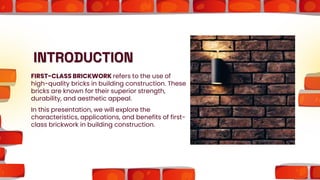
FIRST-CLASS BRICKWORK refers to the use of
high-quality bricks in building construction. These
bricks are known for their superior strength,
durability, and aesthetic appeal.
In this presentation, we will explore the
characteristics, applications, and benefits of first-
class brickwork in building construction.
INTRODUCTION
FIRST CLASS BRICK
Properties of First Class Brick
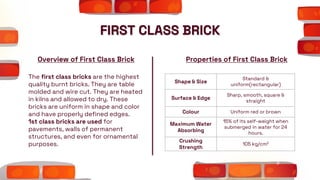
The first class bricks are the highest
quality burnt bricks. They are table
molded and wire cut. They are heated
in kilns and allowed to dry. These
bricks are uniform in shape and color
and have properly defined edges.
1st class bricks are used for
pavements, walls of permanent
structures, and even for ornamental
purposes.
Shape & Size
Standard &
uniform(rectangular)
Surface & Edge
Sharp, smooth, square &
straight
Colour Uniform red or brown
Maximum Water
Absorbing
15% of its self-weight when
submerged in water for 24
hours.
Crushing
Strength
105 kg/cm2
Overview of First Class Brick
BOND IN BRICK MASONRY
Stretcher Bond
In a stretcher bond, all
the bricks are laid as
lengthwise stretchers
English Bond
English bond essentially
comprises alternating
courses of headers and
stretchers
Dutch Bond
Dutch bond consists of
alternate courses of
headers and stretchers
and is a modified form
of the English cross
bond.
Header Bond
All bricks are
constructed in the
header course in
header bond brick
masonry
Flemish Bond
Stretcher and header
bricks alternating in
each course.
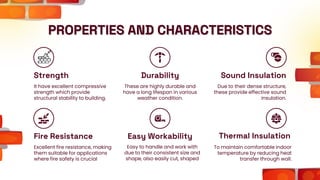
Due to their dense structure,
these provide effective sound
insulation.
To maintain comfortable indoor
temperature by reducing heat
transfer through wall.
PROPERTIES AND CHARACTERISTICS
It have excellent compressive
strength which provide
structural stability to building.
These are highly durable and
have a long lifespan in various
weather condition.
Excellent fire resistance, making
them suitable for applications
where fire safety is crucial
Easy to handle and work with
due to their consistent size and
shape, also easily cut, shaped
Durability
Easy Workability
Sound Insulation
Thermal Insulation
Strength
Fire Resistance
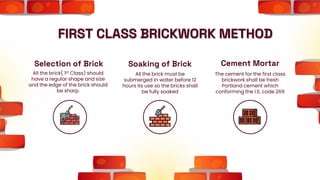
FIRST CLASS BRICKWORK METHOD
All the brick( 1st Class) should
have a regular shape and size
and the edge of the brick should
be sharp.
All the brick must be
submerged in water before 12
hours its use so the bricks shall
be fully soaked
The cement for the first class
brickwork shall be fresh
Portland cement which
conforming the I.S. code 269
Selection of Brick Soaking of Brick Cement Mortar
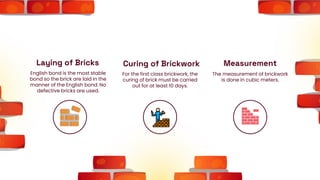
English bond is the most stable
bond so the brick are laid in the
manner of the English bond. No
defective bricks are used.
For the first class brickwork, the
curing of brick must be carried
out for at least 10 days.
The measurement of brickwork
is done in cubic meters.
Laying of Bricks Curing of Brickwork Measurement
APPLICATION
OF FIRST CLASS BRICK WORK
RESEDINTIAL BUILDING & COMMERCIAL BUILDING
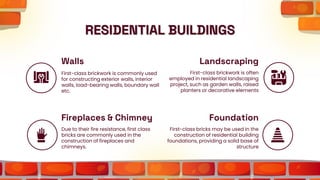
RESIDENTIAL BUILDINGS
Due to their fire resistance, first class
bricks are commonly used in the
construction of fireplaces and
chimneys.
First-class brickwork is commonly used
for constructing exterior walls, interior
walls, load-bearing walls, boundary wall
etc.
First-class brickwork is often
employed in residential landscaping
project, such as garden walls, raised
planters or decorative elements
First-class bricks may be used in the
construction of residential building
foundations, providing a solid base of
structure
Walls Landscraping
Fireplaces & Chimney Foundation
COMMERCIAL & INDUSTRIAL BUILDINGS
First-class brickwork is commonly
used in the construction of industrial
chimney, as it can withstand high
temperatures and provide stability,
Commonly used for constructing exterior
walls, interior walls, load-bearing walls,
boundary walls, retaining walls, fire-
rated walls.
First-class brickwork is employed for
constructing walls in storage facilities
& warehouses, providing strength and
durability to withstand heavy loads.
First-class bricks may be used in the
construction of foundation for
commercial & industrial building ,
providing a solid base of structure.
Walls Storage & Warehouse
Industrial Chimneys Foundation
ADVANTAGES
• High structural strength and load-bearing capacity
• Long-lasting durability
• Excellent thermal and sound insulation properties
• Superior fire resistance
• Low maintenance requirements
• Provides a solid foundation for other construction elements
• Can be easily repaired or replaced if needed
• Adds value and enhances the overall quality of the building
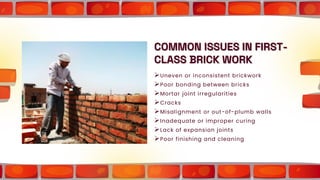
COMMON ISSUES IN FIRST-
CLASS BRICK WORK
Uneven or inconsistent brickwork
Poor bonding between bricks
Mortar joint irregularities
Cracks
Misalignment or out-of-plumb walls
Inadequate or improper curing
Lack of expansion joints
Poor finishing and cleaning
MAINTENANCE OF FIRST CLASS BRICKWORK
 Regular cleaning to remove dirt, dust, and debris.
 Inspection of mortar joints for signs of cracking.
 Repointing or repairing damaged.
 Proper drainage to prevent water accumulation.
 Trim or remove vegetation near the brickwork to prevent damage from roots.
 Routine inspections to identify and address any signs of damage or issues.
 Protection against accidental impact or damage during construction or renovation
activities.
 Maintain proper ventilation to prevent moisture buildup.
 Regular maintenance to ensure the longevity, structural integrity, and aesthetic
appeal of the brickwork.
A PICTURE IS WORTH A THOUSAND WORDS
PHOTO SHOWCASE
CREDITS: This presentation template was
created by Slidesgo, including icons by
Flaticon and infographics & images by Freepik
THANK YOU

FIRST CLASS BRICKWORK IN BUILDING.pptx

  • 1.
    FIRST CLASS BRICKWORK IN BUILDING PREPAREDBY NAME: SHYAM SUNDAR ROY REGESTRATION NUMBER: D202108759 ROLL: DHITCES6 ; NUMBER: 10008886
  • 2.
    FIRST-CLASS BRICKWORK refersto the use of high-quality bricks in building construction. These bricks are known for their superior strength, durability, and aesthetic appeal. In this presentation, we will explore the characteristics, applications, and benefits of first- class brickwork in building construction. INTRODUCTION
  • 3.
    FIRST CLASS BRICK Propertiesof First Class Brick The first class bricks are the highest quality burnt bricks. They are table molded and wire cut. They are heated in kilns and allowed to dry. These bricks are uniform in shape and color and have properly defined edges. 1st class bricks are used for pavements, walls of permanent structures, and even for ornamental purposes. Shape & Size Standard & uniform(rectangular) Surface & Edge Sharp, smooth, square & straight Colour Uniform red or brown Maximum Water Absorbing 15% of its self-weight when submerged in water for 24 hours. Crushing Strength 105 kg/cm2 Overview of First Class Brick
  • 4.
    BOND IN BRICKMASONRY Stretcher Bond In a stretcher bond, all the bricks are laid as lengthwise stretchers English Bond English bond essentially comprises alternating courses of headers and stretchers Dutch Bond Dutch bond consists of alternate courses of headers and stretchers and is a modified form of the English cross bond. Header Bond All bricks are constructed in the header course in header bond brick masonry Flemish Bond Stretcher and header bricks alternating in each course.
  • 5.
    Due to theirdense structure, these provide effective sound insulation. To maintain comfortable indoor temperature by reducing heat transfer through wall. PROPERTIES AND CHARACTERISTICS It have excellent compressive strength which provide structural stability to building. These are highly durable and have a long lifespan in various weather condition. Excellent fire resistance, making them suitable for applications where fire safety is crucial Easy to handle and work with due to their consistent size and shape, also easily cut, shaped Durability Easy Workability Sound Insulation Thermal Insulation Strength Fire Resistance
  • 6.
    FIRST CLASS BRICKWORKMETHOD All the brick( 1st Class) should have a regular shape and size and the edge of the brick should be sharp. All the brick must be submerged in water before 12 hours its use so the bricks shall be fully soaked The cement for the first class brickwork shall be fresh Portland cement which conforming the I.S. code 269 Selection of Brick Soaking of Brick Cement Mortar
  • 7.
    English bond isthe most stable bond so the brick are laid in the manner of the English bond. No defective bricks are used. For the first class brickwork, the curing of brick must be carried out for at least 10 days. The measurement of brickwork is done in cubic meters. Laying of Bricks Curing of Brickwork Measurement
  • 8.
    APPLICATION OF FIRST CLASSBRICK WORK RESEDINTIAL BUILDING & COMMERCIAL BUILDING
  • 9.
    RESIDENTIAL BUILDINGS Due totheir fire resistance, first class bricks are commonly used in the construction of fireplaces and chimneys. First-class brickwork is commonly used for constructing exterior walls, interior walls, load-bearing walls, boundary wall etc. First-class brickwork is often employed in residential landscaping project, such as garden walls, raised planters or decorative elements First-class bricks may be used in the construction of residential building foundations, providing a solid base of structure Walls Landscraping Fireplaces & Chimney Foundation
  • 10.
    COMMERCIAL & INDUSTRIALBUILDINGS First-class brickwork is commonly used in the construction of industrial chimney, as it can withstand high temperatures and provide stability, Commonly used for constructing exterior walls, interior walls, load-bearing walls, boundary walls, retaining walls, fire- rated walls. First-class brickwork is employed for constructing walls in storage facilities & warehouses, providing strength and durability to withstand heavy loads. First-class bricks may be used in the construction of foundation for commercial & industrial building , providing a solid base of structure. Walls Storage & Warehouse Industrial Chimneys Foundation
  • 11.
    ADVANTAGES • High structuralstrength and load-bearing capacity • Long-lasting durability • Excellent thermal and sound insulation properties • Superior fire resistance • Low maintenance requirements • Provides a solid foundation for other construction elements • Can be easily repaired or replaced if needed • Adds value and enhances the overall quality of the building
  • 12.
    COMMON ISSUES INFIRST- CLASS BRICK WORK Uneven or inconsistent brickwork Poor bonding between bricks Mortar joint irregularities Cracks Misalignment or out-of-plumb walls Inadequate or improper curing Lack of expansion joints Poor finishing and cleaning
  • 13.
    MAINTENANCE OF FIRSTCLASS BRICKWORK  Regular cleaning to remove dirt, dust, and debris.  Inspection of mortar joints for signs of cracking.  Repointing or repairing damaged.  Proper drainage to prevent water accumulation.  Trim or remove vegetation near the brickwork to prevent damage from roots.  Routine inspections to identify and address any signs of damage or issues.  Protection against accidental impact or damage during construction or renovation activities.  Maintain proper ventilation to prevent moisture buildup.  Regular maintenance to ensure the longevity, structural integrity, and aesthetic appeal of the brickwork.
  • 14.
    A PICTURE ISWORTH A THOUSAND WORDS
  • 15.
  • 16.
    CREDITS: This presentationtemplate was created by Slidesgo, including icons by Flaticon and infographics & images by Freepik THANK YOU