DISSERTATION -IV
MAR 427
FIRE SERVICES IN COMMERCIAL BUILDING
Submitted by
TARUNENDRA SINGH
M.ARCH (BUILDING SERVICES)
SEMESTER- IV
2015-2016
GUIDE: AR. MOHD. FIROZ ANWAR
C0-GUIDE: AR. MANSI BEDI
FACULTY OF ARCHITECTURE AND EKISTICS
JAMIA MILLIA ISLAMIA
NEW DELHI
1
The aim of this dissertation is to study aspects of fire safety measures used in a
commercial building.
AIMS
2
OBJECTIVES
1. Understand the fire risk associated with commercial buildings.
2. Identify the fire safety problems associated with commercial buildings
3. Identify the strategies for providing fire safety in commercial buildings. and
how they relate to the building design .
4. To know about the sprinkler system used their placing & arrangements,
staircase and lift lobby pressurisation.
CHAPTER 1: PREFACE
TARUNENDRA SINGH M.ARCH 4RD SEM BUILDING SERVICES
3
SCOPE AND LIMITATIONS:
The scope of study is limited to study wet fire fighting system in commercial building .
Its application in building as per building Code/Norms.
RESEARCH METHODOLOGY
The methodology for research adopted in this dissertation includes.
i. Study of online research materials on fire fighting systems
ii. Study of literature at Jamia Millia Islamia architecture faculty library.
iii. Study of national building code pertaining to fire services.
iv. Analyzing the data collected.
TARUNENDRA SINGH M.ARCH 4RD SEM BUILDING SERVICES
PROBLEMS IN COMMERCIAL BUILDINGS™
:
 ™
Limited Means Os Escape.
 Higher occupant load.
 Vertical ,horizontal spread of fire in commercial ™
 Violation of fire safety norms™
.
 Mock Drills are not conducted regularly.
4
SPREAD OF FIRE:
 ™
Compartment to compartment
 F™
loor to floor
 ™
Unsealed service shafts
 ™
Ceiling voids
 ™
Ducts
TARUNENDRA SINGH M.ARCH 4RD SEM BUILDING SERVICES
5
CAUSES OF FIRE:
The reasons of fire may vary from building to building pertaining to its use & user’s .
Some common reasons can be observed as
 Cooking/heating equipment
 Intentional and unintentionally
 Electrical
 Open flame.
 Appliance, tool or air conditioning
 Child playing
 Other heat source
 Natural causes: earthquake, volcanic eruption and lightening
 Other equipment
 Smoking material
 Storage of combustible material
In case of an outbreak of fire, the danger is from fire, smoke and panic.
TARUNENDRA SINGH M.ARCH 4RD SEM BUILDING SERVICES
6
CHARACTERISTICS AND EFFECTS OF FIRE
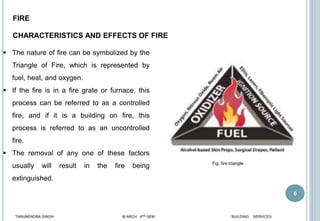
 The nature of fire can be symbolized by the
Triangle of Fire, which is represented by
fuel, heat, and oxygen.
 If the fire is in a fire grate or furnace, this
process can be referred to as a controlled
fire, and if it is a building on fire, this
process is referred to as an uncontrolled
fire.
 The removal of any one of these factors
usually will result in the fire being
extinguished.
TARUNENDRA SINGH M.ARCH 4RD SEM BUILDING SERVICES
FIRE
Fig. fire triangle
7
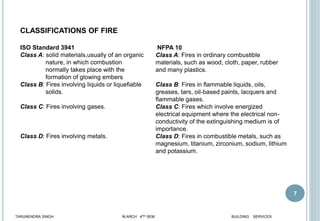
NFPA 10
Class A: Fires in ordinary combustible
materials, such as wood, cloth, paper, rubber
and many plastics.
Class B: Fires in flammable liquids, oils,
greases, tars, oil-based paints, lacquers and
flammable gases.
Class C: Fires which involve energized
electrical equipment where the electrical non-
conductivity of the extinguishing medium is of
importance.
Class D: Fires in combustible metals, such as
magnesium, titanium, zirconium, sodium, lithium
and potassium.
CLASSIFICATIONS OF FIRE
ISO Standard 3941
Class A: solid materials,usually of an organic
nature, in which combustion
normally takes place with the
formation of glowing embers
Class B: Fires involving liquids or liquefiable
solids.
Class C: Fires involving gases.
Class D: Fires involving metals.
TARUNENDRA SINGH M.ARCH 4RD SEM BUILDING SERVICES
8
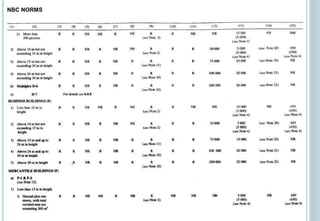
NBC NORMS
9
FIRE SAFETY FOR COMMERCIAL BUILDINGS:
The following represents some of the most significant of their unique features.
Egress system:
- The potential for crowding and slow movement in exit stairs.
-Stair shafts also represents one of the primary means by which smoke moves
vertically.
-The basic issue is that the building egress system must provide sufficient
evacuation time before smoke reaches lethal levels.
TARUNENDRA SINGH M.ARCH 4RD SEM BUILDING SERVICES
10
TARUNENDRA SINGH M.ARCH 4RD SEM BUILDING SERVICES
FIRE DEPARTMENT ACCESS:
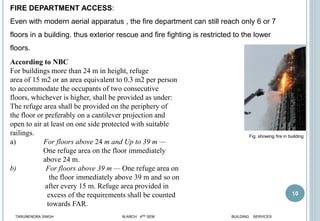
Even with modern aerial apparatus , the fire department can still reach only 6 or 7
floors in a building. thus exterior rescue and fire fighting is restricted to the lower
floors.
Fig. showing fire in building
According to NBC
For buildings more than 24 m in height, refuge
area of 15 m2 or an area equivalent to 0.3 m2 per person
to accommodate the occupants of two consecutive
floors, whichever is higher, shall be provided as under:
The refuge area shall be provided on the periphery of
the floor or preferably on a cantilever projection and
open to air at least on one side protected with suitable
railings.
a) For floors above 24 m and Up to 39 m —
One refuge area on the floor immediately
above 24 m.
b) For floors above 39 m — One refuge area on
the floor immediately above 39 m and so on
after every 15 m. Refuge area provided in
excess of the requirements shall be counted
towards FAR.
There are three main strategies which can be adopted to
reduce the risk of lives and property loss.
1. Fire prevention
2. Fire safety
3. Fire protection or fire fighting
11
1. FIRE PREVENTION
a) Classification based on occupancy
b) Fire zones
c) Type of construction
d) General requirements of all the buildings
For high-rise buildings: (under construction)
1. Dry riser of minimum 150mm dia pipe with hydrant outlets on the
floors constructed.
2. Drums filled with water of 2000 L
3. A water storage tank of minimum 20000 L, may be used in other
construction purposes also
TARUNENDRA SINGH M.ARCH 4RD SEM BUILDING SERVICES
Source: From NBC
12
2. LIFE SAFETY:
a) General exit requirements
b) Occupants load
c) Capacity of exits
d) No of exits / Arrangements of exits /
travel distance
e) Internal staircases
f) Pressurization of staircases
g) External staircase
a) An external staircase shall is
desirable to be provided for high-
rise building
b) Unprotected steel frame staircase
will not be accepted as means of
escape, however steel staircase in
an enclosed fire rated
compartment of 2 h will be
acceptable as means of escape.
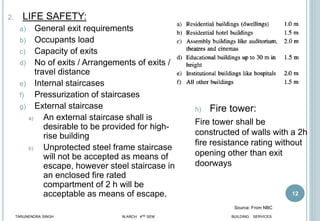
h) Fire tower:
Fire tower shall be
constructed of walls with a 2h
fire resistance rating without
opening other than exit
doorways
TARUNENDRA SINGH M.ARCH 4RD SEM BUILDING SERVICES
Source: From NBC
13
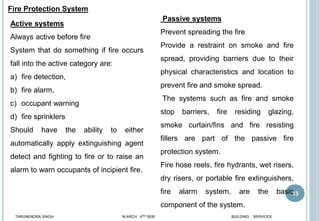
Active systems
Always active before fire
System that do something if fire occurs
fall into the active category are:
a) fire detection,
b) fire alarm,
c) occupant warning
d) fire sprinklers
Should have the ability to either
automatically apply extinguishing agent
detect and fighting to fire or to raise an
alarm to warn occupants of incipient fire.
Passive systems
Prevent spreading the fire
Provide a restraint on smoke and fire
spread, providing barriers due to their
physical characteristics and location to
prevent fire and smoke spread.
The systems such as fire and smoke
stop barriers, fire residing glazing,
smoke curtain/fins and fire resisting
fillers are part of the passive fire
protection system.
Fire hose reels, fire hydrants, wet risers,
dry risers, or portable fire extinguishers,
fire alarm system, are the basic
component of the system.
Fire Protection System
TARUNENDRA SINGH M.ARCH 4RD SEM BUILDING SERVICES
14
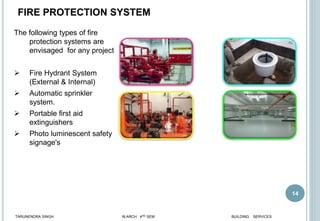
FIRE PROTECTION SYSTEM
The following types of fire
protection systems are
envisaged for any project
 Fire Hydrant System
(External & Internal)
 Automatic sprinkler
system.
 Portable first aid
extinguishers
 Photo luminescent safety
signage's
TARUNENDRA SINGH M.ARCH 4RD SEM BUILDING SERVICES
15
TARUNENDRA SINGH M.ARCH 4RD SEM BUILDING SERVICES
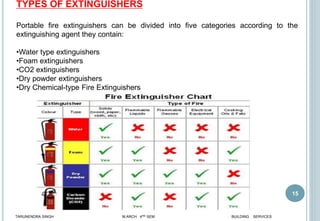
TYPES OF EXTINGUISHERS
Portable fire extinguishers can be divided into five categories according to the
extinguishing agent they contain:
•Water type extinguishers
•Foam extinguishers
•CO2 extinguishers
•Dry powder extinguishers
•Dry Chemical-type Fire Extinguishers
16
TARUNENDRA SINGH M.ARCH 4RD SEM BUILDING SERVICES
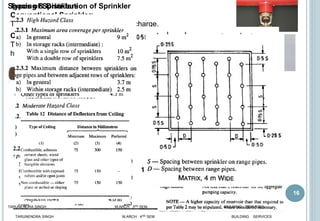
Types of Sprinklers
Conventional Sprinkler:
These produce a spherical type of Discharge.
Ceiling flush sprinkler:
The heads are installed with the base flush to the ceiling, and
heat sensitive elements facing downwards.
Side wall sprinkler:
These sprinklers are mainly used for aesthetic reasons to
keep ceilings free of pipes .
•Dry upright sprinkler:
• These are the same as pendent type sprinklers.
Spacing & Distribution of Sprinkler
TARUNENDRA SINGH M.ARCH 3RD SEM BUILDING SERVICES
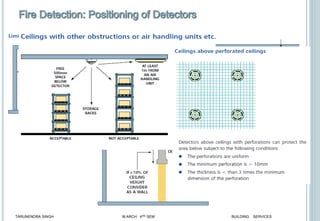
Smoke detector
Ionization
Optical/ photoelectric
Heat detector
Fixed temperature
Rate of rise
Flame detector
Infrared detectors
UV detectors
17
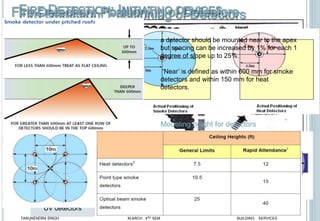
In corridors up to 2 m wide
a detector should be mounted near to the apex
but spacing can be increased by 1% for each 1
degree of slope up to 25%.
‘Near’ is defined as within 600 mm for smoke
detectors and within 150 mm for heat
detectors.
Mounting height for detectors
TARUNENDRA SINGH M.ARCH 4RD SEM BUILDING SERVICES
18
TARUNENDRA SINGH M.ARCH 4RD SEM BUILDING SERVICES
19
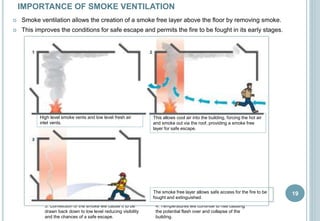
IMPORTANCE OF SMOKE VENTILATION
1. In an unventilated room, smoke will rise
directly to the ceiling.
2. The smoke will begin to fill the space
available moving laterally instead of vertically.
3. Convection of the smoke will cause it to be
drawn back down to low level reducing visibility
and the chances of a safe escape.
4. Temperatures will continue to rise causing
the potential flash over and collapse of the
building.
 Smoke ventilation allows the creation of a smoke free layer above the floor by removing smoke.
 This improves the conditions for safe escape and permits the fire to be fought in its early stages.
High level smoke vents and low level fresh air
inlet vents.
This allows cool air into the building, forcing the hot air
and smoke out via the roof, providing a smoke free
layer for safe escape.
The smoke free layer allows safe access for the fire to be
fought and extinguished.
20
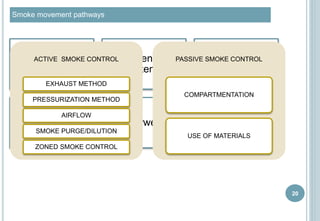
Air and service
ducts connecting
floors
HVAC/ventilation
systems
Atrium
Gaps between
wall and floor
constructions
Stairwells Lift shafts
Smoke movement pathways
ACTIVE SMOKE CONTROL
EXHAUST METHOD
PRESSURIZATION METHOD
AIRFLOW
SMOKE PURGE/DILUTION
ZONED SMOKE CONTROL
PASSIVE SMOKE CONTROL
COMPARTMENTATION
USE OF MATERIALS
21
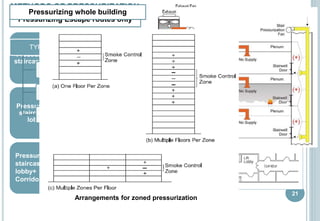
METHODS OF PRESSURIZATION
Pressurizing Escape routes only
• Provide protection to the vertical part of the
escape route only.
• Used when the STAIRCASE is entered
direct from the accommodation or via a
simple lobby
Pressurizing
staircase only
• Two duct systems, from a common fan,
required both for STAIRCASE and LIFT
LOBBY,
• Used where the LOBBY provides outlets
from LIFTS, contains TOILETS or other
ancillary rooms
Pressurizing
staircase +
lobby
• Used only where the construction of the
corridor has a fire resistance of 30 minutes
or more.
Pressurizing
staircase +
lobby+
Corridor
TYPES OF PRESSURIZATION
POSITIVE PRESSURIZATION
NEGATIVE PRESSURIZATION
ZONED SMOKE CONTROL
Pressurizing whole building
Arrangements for zoned pressurization
22
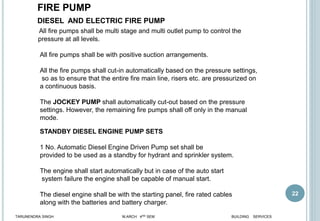
All fire pumps shall be multi stage and multi outlet pump to control the
pressure at all levels.
All fire pumps shall be with positive suction arrangements.
All the fire pumps shall cut-in automatically based on the pressure settings,
so as to ensure that the entire fire main line, risers etc. are pressurized on
a continuous basis.
The JOCKEY PUMP shall automatically cut-out based on the pressure
settings. However, the remaining fire pumps shall off only in the manual
mode.
DIESEL AND ELECTRIC FIRE PUMP
STANDBY DIESEL ENGINE PUMP SETS
1 No. Automatic Diesel Engine Driven Pump set shall be
provided to be used as a standby for hydrant and sprinkler system.
The engine shall start automatically but in case of the auto start
system failure the engine shall be capable of manual start.
The diesel engine shall be with the starting panel, fire rated cables
along with the batteries and battery charger.
TARUNENDRA SINGH M.ARCH 4RD SEM BUILDING SERVICES
FIRE PUMP
23
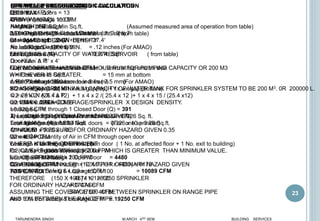
STAIR CASE PRESSURIZATION CALCULATION
Q1 = Kf A √ Δ P
Q1 = Air Leakage in CFM
A = Area of leakage in Sq.ft.
Δ P = Pressure difference in inches ( 7.5 mm)
Kf = Coefficient 2610
No. of Floors = GF+ 9
No. of doors = 10
Door size = 8’ x 4’
Gap between door and frame/floor = 2mm at top and on side
= 15 mm at bottom
Area of leakage between door & frame
= 2 x H x gap (side) + 1 x w x gap(top) + 1x wx gap (bottom)
= 2 x 8 x 2 / (25.4 x 12) + 1 x 4 x 2 /( 25.4 x 12 )+ 1 x 4 x 15 / (25.4 x12)
=0.104 + 0.0262 + 0.196
=0.326 Sq. Ft.
Area of leakage in closed condition / door = 0.326 Sq. ft.
Total leakage area for 10 Nos. doors = 0.326 x 10 = 3.26 Sq.ft.
Q1 = 2610 x 3.26 x √ 0.3
= 4674 CFM
Leakage of air through 2 Nos. open door ( 1 No. at affected floor + 1 No. exit to building)
Q2 = Area of doors x Velocity
= 8’ x 4’ x 2 Nos. x 200 FPM
Q2 = 12800 CFM
FAN CAPACITY = Q1 + Q2
= 4674 + 12800
= 17474 CFM
SAY 17500 CFM
Add 10% For Safety & Leakage CFM = 19250 CFM
TARUNENDRA SINGH M.ARCH 4RD SEM BUILDING SERVICES
LIFT WELL PRESSURIZATION CALCULATION
Total No. of Floors = 13
Width (W) = 3.2’
Height (H) = 7’
1 Leakage through Closed Door of size 3.2’ x 7’
Leakage Length , 2x(W+H)+H = 27.4’
Air Leakage Gap( mm) 3 = .12 inches
Leakage Area (A) = 0.274 Sqft
Q = Kf A √ Δ P
Q = Volumetric Flow rate in CFM
A = Flow area in Sq.ft.
Δ P = Pressure difference in inches ( 7.5 mm)
Kf = Coefficient 2610
Q = 2610 X A X √ Δ P
= 2610 x .274 x √ .3
Leakage CFM through 1 Closed Door (Q) = 391
2) Leakage through Open Door of size 3.2’ x 7’
Leakage Area (A) = 22.4 Sqft
Q = A X E
Where Q = Quantity of Air in CFM through open door
A = Leakage Area in sq.ft.
E = Egress Velocity, = 200 FPM
Leakage CFM through 1 Open Door = 4480
Total leakage CFM through (12 X 391+1 x 4480) = 9172
Add 10% For Safety & Leakage CFM = 10089 CFM
SPRINKLER CALCULATION
LETS SAY
AREA = 150 M X 100 M
AMAO= 360 SQ.M (Assumed measured area of operation from table)
DESIGN DENSITY = 5 L/MIN/M2 ( from table)
Q1 = AMAO X DESIGN DENSITY
= 360 X 5 = 1800 L/MIN. (For AMAO)
EFFECTIVE CAPACITY OF WATER RESERVOIR ( from table)
FOR MODERATE HAZARD IS 1 HOUR RUN FOR PUMPING CAPACITY OR 200 M3
WHICHEVER IS GREATER.
= 1800 X 60 = 10800 L (For AMAO)
SO AS PER NORM MINIMUM CAPACITY OF WATER TANK FOR SPRINKLER SYSTEM TO BE 200 M3. 0R 200000 L.
Q2 = MAX. AREA COVERAGE/SPRINKLER X DESIGN DENSITY.
(12 M2 FOR ORDINARY HAZARD GIVEN)
= 12 X 5 = 60 L/MIN. (For one sprinkler)
MINIMUM PRESSURE FOR ORDINARY HAZARD GIVEN 0.35
Q2 = K √ P
WHERE K IS THE COEFFICIENT
P= (Q2/K) 2 = (360/80) 2 = 0.562 bar WHICH IS GREATER THAN MINIMUM VALUE.
NO. OF SPRINKLER
COVERAGE/SPRINKLER = 12 M2 FOR ORDINARY HAZARD GIVEN
TOTAL AREA = 150 X 100
THEREFORE (150 X 100 ) / 12 = 1250 SPRINKLER
FOR ORDINARY HAZARD CASE
ASSUMING THE COVERAGE OF 4M BETWEEN SPRINKLER ON RANGE PIPE
AND 3 M BETWEEN THE RANGE PIPE.
24
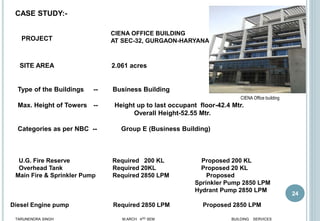
CASE STUDY:-
PROJECT
CIENA OFFICE BUILDING
AT SEC-32, GURGAON-HARYANA
SITE AREA 2.061 acres
Type of the Buildings -- Business Building
Max. Height of Towers -- Height up to last occupant floor-42.4 Mtr.
Overall Height-52.55 Mtr.
Categories as per NBC -- Group E (Business Building)
U.G. Fire Reserve Required 200 KL Proposed 200 KL
Overhead Tank Required 20KL Proposed 20 KL
Main Fire & Sprinkler Pump Required 2850 LPM Proposed
Sprinkler Pump 2850 LPM
Hydrant Pump 2850 LPM
Diesel Engine pump Required 2850 LPM Proposed 2850 LPM
TARUNENDRA SINGH M.ARCH 4RD SEM BUILDING SERVICES
CIENA Office building
25
Sprinkler System
•Sprinkler System shall be provided for all the basement areas. Sprinklers shall also be provided
for Business building above 15 meters height
•Pendant sprinklers shall be used @ 9 m2 for basement and 12 m2 for upper floors of built up
area, with a center to center spacing not to exceed approximately 2.8 M for basement & 3.5
meters for upper floors.
•Upright sprinklers shall be provided for any false ceiling areas in lobbies/common areas etc. of
basement and similar voids which are greater than 800 mm in height, if any.
Water Storage
Under Ground Static fire tank
It is proposed to provide separate Under Ground fire water tanks of 200 M3.
Overhead storage fire tank
Office Building = 20 M3
Wet Riser & Hydrants System
Fire main of 150 mm dia. connected to external yard hydrants placed @ 45m c/c distance.
TARUNENDRA SINGH M.ARCH 4RD SEM BUILDING SERVICES
26
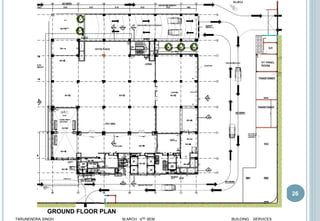
GROUND FLOOR PLAN
TARUNENDRA SINGH M.ARCH 4RD SEM BUILDING SERVICES
27
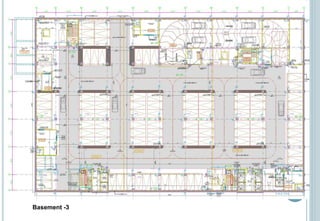
Basement -3
28
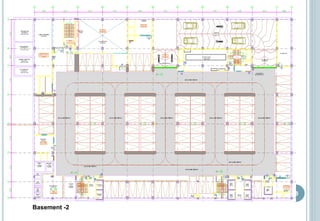
Basement -2
29
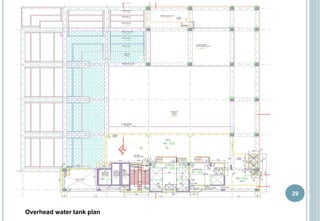
Overhead water tank plan
30
BIBLIOGRAPHY:
Books:
Part 4 fire and life safety, national building codes of india-2005, bureau of Indian
standards.
NFPA 92 – Standards for smoke control system.
NBC 2005
Fire Services in India: History, Detection, Protection, Management, Environment,
Training and Loss Prevention,. Mittal Publications.
Web Pages:
www.wikipedia.com
www.google.com
TARUNENDRA SINGH M.ARCH 4RD SEM BUILDING SERVICES
31

commercial FIRE PPT DISSERTATION_Tarunendra_ (1).pptx

  • 1.
    DISSERTATION -IV MAR 427 FIRESERVICES IN COMMERCIAL BUILDING Submitted by TARUNENDRA SINGH M.ARCH (BUILDING SERVICES) SEMESTER- IV 2015-2016 GUIDE: AR. MOHD. FIROZ ANWAR C0-GUIDE: AR. MANSI BEDI FACULTY OF ARCHITECTURE AND EKISTICS JAMIA MILLIA ISLAMIA NEW DELHI 1
  • 2.
    The aim ofthis dissertation is to study aspects of fire safety measures used in a commercial building. AIMS 2 OBJECTIVES 1. Understand the fire risk associated with commercial buildings. 2. Identify the fire safety problems associated with commercial buildings 3. Identify the strategies for providing fire safety in commercial buildings. and how they relate to the building design . 4. To know about the sprinkler system used their placing & arrangements, staircase and lift lobby pressurisation. CHAPTER 1: PREFACE TARUNENDRA SINGH M.ARCH 4RD SEM BUILDING SERVICES
  • 3.
    3 SCOPE AND LIMITATIONS: Thescope of study is limited to study wet fire fighting system in commercial building . Its application in building as per building Code/Norms. RESEARCH METHODOLOGY The methodology for research adopted in this dissertation includes. i. Study of online research materials on fire fighting systems ii. Study of literature at Jamia Millia Islamia architecture faculty library. iii. Study of national building code pertaining to fire services. iv. Analyzing the data collected. TARUNENDRA SINGH M.ARCH 4RD SEM BUILDING SERVICES
  • 4.
    PROBLEMS IN COMMERCIALBUILDINGS™ :  ™ Limited Means Os Escape.  Higher occupant load.  Vertical ,horizontal spread of fire in commercial ™  Violation of fire safety norms™ .  Mock Drills are not conducted regularly. 4 SPREAD OF FIRE:  ™ Compartment to compartment  F™ loor to floor  ™ Unsealed service shafts  ™ Ceiling voids  ™ Ducts TARUNENDRA SINGH M.ARCH 4RD SEM BUILDING SERVICES
  • 5.
    5 CAUSES OF FIRE: Thereasons of fire may vary from building to building pertaining to its use & user’s . Some common reasons can be observed as  Cooking/heating equipment  Intentional and unintentionally  Electrical  Open flame.  Appliance, tool or air conditioning  Child playing  Other heat source  Natural causes: earthquake, volcanic eruption and lightening  Other equipment  Smoking material  Storage of combustible material In case of an outbreak of fire, the danger is from fire, smoke and panic. TARUNENDRA SINGH M.ARCH 4RD SEM BUILDING SERVICES
  • 6.
    6 CHARACTERISTICS AND EFFECTSOF FIRE  The nature of fire can be symbolized by the Triangle of Fire, which is represented by fuel, heat, and oxygen.  If the fire is in a fire grate or furnace, this process can be referred to as a controlled fire, and if it is a building on fire, this process is referred to as an uncontrolled fire.  The removal of any one of these factors usually will result in the fire being extinguished. TARUNENDRA SINGH M.ARCH 4RD SEM BUILDING SERVICES FIRE Fig. fire triangle
  • 7.
    7 NFPA 10 Class A:Fires in ordinary combustible materials, such as wood, cloth, paper, rubber and many plastics. Class B: Fires in flammable liquids, oils, greases, tars, oil-based paints, lacquers and flammable gases. Class C: Fires which involve energized electrical equipment where the electrical non- conductivity of the extinguishing medium is of importance. Class D: Fires in combustible metals, such as magnesium, titanium, zirconium, sodium, lithium and potassium. CLASSIFICATIONS OF FIRE ISO Standard 3941 Class A: solid materials,usually of an organic nature, in which combustion normally takes place with the formation of glowing embers Class B: Fires involving liquids or liquefiable solids. Class C: Fires involving gases. Class D: Fires involving metals. TARUNENDRA SINGH M.ARCH 4RD SEM BUILDING SERVICES
  • 8.
  • 9.
    9 FIRE SAFETY FORCOMMERCIAL BUILDINGS: The following represents some of the most significant of their unique features. Egress system: - The potential for crowding and slow movement in exit stairs. -Stair shafts also represents one of the primary means by which smoke moves vertically. -The basic issue is that the building egress system must provide sufficient evacuation time before smoke reaches lethal levels. TARUNENDRA SINGH M.ARCH 4RD SEM BUILDING SERVICES
  • 10.
    10 TARUNENDRA SINGH M.ARCH4RD SEM BUILDING SERVICES FIRE DEPARTMENT ACCESS: Even with modern aerial apparatus , the fire department can still reach only 6 or 7 floors in a building. thus exterior rescue and fire fighting is restricted to the lower floors. Fig. showing fire in building According to NBC For buildings more than 24 m in height, refuge area of 15 m2 or an area equivalent to 0.3 m2 per person to accommodate the occupants of two consecutive floors, whichever is higher, shall be provided as under: The refuge area shall be provided on the periphery of the floor or preferably on a cantilever projection and open to air at least on one side protected with suitable railings. a) For floors above 24 m and Up to 39 m — One refuge area on the floor immediately above 24 m. b) For floors above 39 m — One refuge area on the floor immediately above 39 m and so on after every 15 m. Refuge area provided in excess of the requirements shall be counted towards FAR.
  • 11.
    There are threemain strategies which can be adopted to reduce the risk of lives and property loss. 1. Fire prevention 2. Fire safety 3. Fire protection or fire fighting 11 1. FIRE PREVENTION a) Classification based on occupancy b) Fire zones c) Type of construction d) General requirements of all the buildings For high-rise buildings: (under construction) 1. Dry riser of minimum 150mm dia pipe with hydrant outlets on the floors constructed. 2. Drums filled with water of 2000 L 3. A water storage tank of minimum 20000 L, may be used in other construction purposes also TARUNENDRA SINGH M.ARCH 4RD SEM BUILDING SERVICES Source: From NBC
  • 12.
    12 2. LIFE SAFETY: a)General exit requirements b) Occupants load c) Capacity of exits d) No of exits / Arrangements of exits / travel distance e) Internal staircases f) Pressurization of staircases g) External staircase a) An external staircase shall is desirable to be provided for high- rise building b) Unprotected steel frame staircase will not be accepted as means of escape, however steel staircase in an enclosed fire rated compartment of 2 h will be acceptable as means of escape. h) Fire tower: Fire tower shall be constructed of walls with a 2h fire resistance rating without opening other than exit doorways TARUNENDRA SINGH M.ARCH 4RD SEM BUILDING SERVICES Source: From NBC
  • 13.
    13 Active systems Always activebefore fire System that do something if fire occurs fall into the active category are: a) fire detection, b) fire alarm, c) occupant warning d) fire sprinklers Should have the ability to either automatically apply extinguishing agent detect and fighting to fire or to raise an alarm to warn occupants of incipient fire. Passive systems Prevent spreading the fire Provide a restraint on smoke and fire spread, providing barriers due to their physical characteristics and location to prevent fire and smoke spread. The systems such as fire and smoke stop barriers, fire residing glazing, smoke curtain/fins and fire resisting fillers are part of the passive fire protection system. Fire hose reels, fire hydrants, wet risers, dry risers, or portable fire extinguishers, fire alarm system, are the basic component of the system. Fire Protection System TARUNENDRA SINGH M.ARCH 4RD SEM BUILDING SERVICES
  • 14.
    14 FIRE PROTECTION SYSTEM Thefollowing types of fire protection systems are envisaged for any project  Fire Hydrant System (External & Internal)  Automatic sprinkler system.  Portable first aid extinguishers  Photo luminescent safety signage's TARUNENDRA SINGH M.ARCH 4RD SEM BUILDING SERVICES
  • 15.
    15 TARUNENDRA SINGH M.ARCH4RD SEM BUILDING SERVICES TYPES OF EXTINGUISHERS Portable fire extinguishers can be divided into five categories according to the extinguishing agent they contain: •Water type extinguishers •Foam extinguishers •CO2 extinguishers •Dry powder extinguishers •Dry Chemical-type Fire Extinguishers
  • 16.
    16 TARUNENDRA SINGH M.ARCH4RD SEM BUILDING SERVICES Types of Sprinklers Conventional Sprinkler: These produce a spherical type of Discharge. Ceiling flush sprinkler: The heads are installed with the base flush to the ceiling, and heat sensitive elements facing downwards. Side wall sprinkler: These sprinklers are mainly used for aesthetic reasons to keep ceilings free of pipes . •Dry upright sprinkler: • These are the same as pendent type sprinklers. Spacing & Distribution of Sprinkler TARUNENDRA SINGH M.ARCH 3RD SEM BUILDING SERVICES
  • 17.
    Smoke detector Ionization Optical/ photoelectric Heatdetector Fixed temperature Rate of rise Flame detector Infrared detectors UV detectors 17 In corridors up to 2 m wide a detector should be mounted near to the apex but spacing can be increased by 1% for each 1 degree of slope up to 25%. ‘Near’ is defined as within 600 mm for smoke detectors and within 150 mm for heat detectors. Mounting height for detectors TARUNENDRA SINGH M.ARCH 4RD SEM BUILDING SERVICES
  • 18.
    18 TARUNENDRA SINGH M.ARCH4RD SEM BUILDING SERVICES
  • 19.
    19 IMPORTANCE OF SMOKEVENTILATION 1. In an unventilated room, smoke will rise directly to the ceiling. 2. The smoke will begin to fill the space available moving laterally instead of vertically. 3. Convection of the smoke will cause it to be drawn back down to low level reducing visibility and the chances of a safe escape. 4. Temperatures will continue to rise causing the potential flash over and collapse of the building.  Smoke ventilation allows the creation of a smoke free layer above the floor by removing smoke.  This improves the conditions for safe escape and permits the fire to be fought in its early stages. High level smoke vents and low level fresh air inlet vents. This allows cool air into the building, forcing the hot air and smoke out via the roof, providing a smoke free layer for safe escape. The smoke free layer allows safe access for the fire to be fought and extinguished.
  • 20.
    20 Air and service ductsconnecting floors HVAC/ventilation systems Atrium Gaps between wall and floor constructions Stairwells Lift shafts Smoke movement pathways ACTIVE SMOKE CONTROL EXHAUST METHOD PRESSURIZATION METHOD AIRFLOW SMOKE PURGE/DILUTION ZONED SMOKE CONTROL PASSIVE SMOKE CONTROL COMPARTMENTATION USE OF MATERIALS
  • 21.
    21 METHODS OF PRESSURIZATION PressurizingEscape routes only • Provide protection to the vertical part of the escape route only. • Used when the STAIRCASE is entered direct from the accommodation or via a simple lobby Pressurizing staircase only • Two duct systems, from a common fan, required both for STAIRCASE and LIFT LOBBY, • Used where the LOBBY provides outlets from LIFTS, contains TOILETS or other ancillary rooms Pressurizing staircase + lobby • Used only where the construction of the corridor has a fire resistance of 30 minutes or more. Pressurizing staircase + lobby+ Corridor TYPES OF PRESSURIZATION POSITIVE PRESSURIZATION NEGATIVE PRESSURIZATION ZONED SMOKE CONTROL Pressurizing whole building Arrangements for zoned pressurization
  • 22.
    22 All fire pumpsshall be multi stage and multi outlet pump to control the pressure at all levels. All fire pumps shall be with positive suction arrangements. All the fire pumps shall cut-in automatically based on the pressure settings, so as to ensure that the entire fire main line, risers etc. are pressurized on a continuous basis. The JOCKEY PUMP shall automatically cut-out based on the pressure settings. However, the remaining fire pumps shall off only in the manual mode. DIESEL AND ELECTRIC FIRE PUMP STANDBY DIESEL ENGINE PUMP SETS 1 No. Automatic Diesel Engine Driven Pump set shall be provided to be used as a standby for hydrant and sprinkler system. The engine shall start automatically but in case of the auto start system failure the engine shall be capable of manual start. The diesel engine shall be with the starting panel, fire rated cables along with the batteries and battery charger. TARUNENDRA SINGH M.ARCH 4RD SEM BUILDING SERVICES FIRE PUMP
  • 23.
    23 STAIR CASE PRESSURIZATIONCALCULATION Q1 = Kf A √ Δ P Q1 = Air Leakage in CFM A = Area of leakage in Sq.ft. Δ P = Pressure difference in inches ( 7.5 mm) Kf = Coefficient 2610 No. of Floors = GF+ 9 No. of doors = 10 Door size = 8’ x 4’ Gap between door and frame/floor = 2mm at top and on side = 15 mm at bottom Area of leakage between door & frame = 2 x H x gap (side) + 1 x w x gap(top) + 1x wx gap (bottom) = 2 x 8 x 2 / (25.4 x 12) + 1 x 4 x 2 /( 25.4 x 12 )+ 1 x 4 x 15 / (25.4 x12) =0.104 + 0.0262 + 0.196 =0.326 Sq. Ft. Area of leakage in closed condition / door = 0.326 Sq. ft. Total leakage area for 10 Nos. doors = 0.326 x 10 = 3.26 Sq.ft. Q1 = 2610 x 3.26 x √ 0.3 = 4674 CFM Leakage of air through 2 Nos. open door ( 1 No. at affected floor + 1 No. exit to building) Q2 = Area of doors x Velocity = 8’ x 4’ x 2 Nos. x 200 FPM Q2 = 12800 CFM FAN CAPACITY = Q1 + Q2 = 4674 + 12800 = 17474 CFM SAY 17500 CFM Add 10% For Safety & Leakage CFM = 19250 CFM TARUNENDRA SINGH M.ARCH 4RD SEM BUILDING SERVICES LIFT WELL PRESSURIZATION CALCULATION Total No. of Floors = 13 Width (W) = 3.2’ Height (H) = 7’ 1 Leakage through Closed Door of size 3.2’ x 7’ Leakage Length , 2x(W+H)+H = 27.4’ Air Leakage Gap( mm) 3 = .12 inches Leakage Area (A) = 0.274 Sqft Q = Kf A √ Δ P Q = Volumetric Flow rate in CFM A = Flow area in Sq.ft. Δ P = Pressure difference in inches ( 7.5 mm) Kf = Coefficient 2610 Q = 2610 X A X √ Δ P = 2610 x .274 x √ .3 Leakage CFM through 1 Closed Door (Q) = 391 2) Leakage through Open Door of size 3.2’ x 7’ Leakage Area (A) = 22.4 Sqft Q = A X E Where Q = Quantity of Air in CFM through open door A = Leakage Area in sq.ft. E = Egress Velocity, = 200 FPM Leakage CFM through 1 Open Door = 4480 Total leakage CFM through (12 X 391+1 x 4480) = 9172 Add 10% For Safety & Leakage CFM = 10089 CFM SPRINKLER CALCULATION LETS SAY AREA = 150 M X 100 M AMAO= 360 SQ.M (Assumed measured area of operation from table) DESIGN DENSITY = 5 L/MIN/M2 ( from table) Q1 = AMAO X DESIGN DENSITY = 360 X 5 = 1800 L/MIN. (For AMAO) EFFECTIVE CAPACITY OF WATER RESERVOIR ( from table) FOR MODERATE HAZARD IS 1 HOUR RUN FOR PUMPING CAPACITY OR 200 M3 WHICHEVER IS GREATER. = 1800 X 60 = 10800 L (For AMAO) SO AS PER NORM MINIMUM CAPACITY OF WATER TANK FOR SPRINKLER SYSTEM TO BE 200 M3. 0R 200000 L. Q2 = MAX. AREA COVERAGE/SPRINKLER X DESIGN DENSITY. (12 M2 FOR ORDINARY HAZARD GIVEN) = 12 X 5 = 60 L/MIN. (For one sprinkler) MINIMUM PRESSURE FOR ORDINARY HAZARD GIVEN 0.35 Q2 = K √ P WHERE K IS THE COEFFICIENT P= (Q2/K) 2 = (360/80) 2 = 0.562 bar WHICH IS GREATER THAN MINIMUM VALUE. NO. OF SPRINKLER COVERAGE/SPRINKLER = 12 M2 FOR ORDINARY HAZARD GIVEN TOTAL AREA = 150 X 100 THEREFORE (150 X 100 ) / 12 = 1250 SPRINKLER FOR ORDINARY HAZARD CASE ASSUMING THE COVERAGE OF 4M BETWEEN SPRINKLER ON RANGE PIPE AND 3 M BETWEEN THE RANGE PIPE.
  • 24.
    24 CASE STUDY:- PROJECT CIENA OFFICEBUILDING AT SEC-32, GURGAON-HARYANA SITE AREA 2.061 acres Type of the Buildings -- Business Building Max. Height of Towers -- Height up to last occupant floor-42.4 Mtr. Overall Height-52.55 Mtr. Categories as per NBC -- Group E (Business Building) U.G. Fire Reserve Required 200 KL Proposed 200 KL Overhead Tank Required 20KL Proposed 20 KL Main Fire & Sprinkler Pump Required 2850 LPM Proposed Sprinkler Pump 2850 LPM Hydrant Pump 2850 LPM Diesel Engine pump Required 2850 LPM Proposed 2850 LPM TARUNENDRA SINGH M.ARCH 4RD SEM BUILDING SERVICES CIENA Office building
  • 25.
    25 Sprinkler System •Sprinkler Systemshall be provided for all the basement areas. Sprinklers shall also be provided for Business building above 15 meters height •Pendant sprinklers shall be used @ 9 m2 for basement and 12 m2 for upper floors of built up area, with a center to center spacing not to exceed approximately 2.8 M for basement & 3.5 meters for upper floors. •Upright sprinklers shall be provided for any false ceiling areas in lobbies/common areas etc. of basement and similar voids which are greater than 800 mm in height, if any. Water Storage Under Ground Static fire tank It is proposed to provide separate Under Ground fire water tanks of 200 M3. Overhead storage fire tank Office Building = 20 M3 Wet Riser & Hydrants System Fire main of 150 mm dia. connected to external yard hydrants placed @ 45m c/c distance. TARUNENDRA SINGH M.ARCH 4RD SEM BUILDING SERVICES
  • 26.
    26 GROUND FLOOR PLAN TARUNENDRASINGH M.ARCH 4RD SEM BUILDING SERVICES
  • 27.
  • 28.
  • 29.
  • 30.
    30 BIBLIOGRAPHY: Books: Part 4 fireand life safety, national building codes of india-2005, bureau of Indian standards. NFPA 92 – Standards for smoke control system. NBC 2005 Fire Services in India: History, Detection, Protection, Management, Environment, Training and Loss Prevention,. Mittal Publications. Web Pages: www.wikipedia.com www.google.com TARUNENDRA SINGH M.ARCH 4RD SEM BUILDING SERVICES
  • 31.