Electrical works for (FireFighting and A.C)
Dr. Amr Moatasem
Hesham Ali Ismael - 2021008497
Ibrahim Nasr Ibrahim - 20191650
Nayera Mostafa - 20194806
Hazem Mohammed - 20192683
Afnan Hossam - 20197451
Tasneem Abdulghany - 20194373
Youmna Ahmed - 20197451
➢ Firefighting
• Passive Fire Protection
• Active Fire Protection
• Fire Suppression
• Sprinkler Systems
• Fire Detection
• Hypoxic Air Fire Prevention
• Construction and maintenance
• System Of Fire Fighting
• Fire Escapes
• Escape Chute
➢ HVAC
• HVAC system selection
• Basic components
• Classification of HVAC systems
• HVAC system requirements
• Central HVAC systems
• Air Systems
Passive Fire Protection
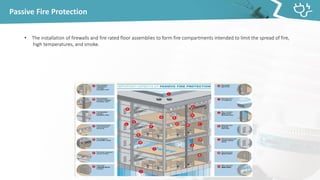
• The installation of firewalls and fire rated floor assemblies to form fire compartments intended to limit the spread of fire,
high temperatures, and smoke.
Passive Fire Protection
• Passive Fire Protection (PFP) is an integral component of the three components of structural fire protection and fire safety
in a building. PFP attempts to contain fires or slow the spread, through use of fire-resistant walls, floors, and doors (among
st other examples).
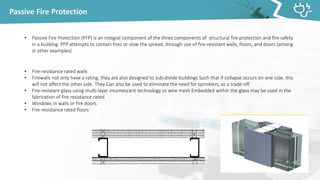
• Fire-resistance rated walls
• Firewalls not only have a rating, they are also designed to sub-divide buildings Such that if collapse occurs on one side, this
will not affect the other side. They Can also be used to eliminate the need for sprinklers, as a trade-off.
• Fire-resistant glass using multi-layer intumescent technology or wire mesh Embedded within the glass may be used in the
fabrication of fire-resistance rated
• Windows in walls or fire doors.
• Fire-resistance rated floors
Passive Fire Protection
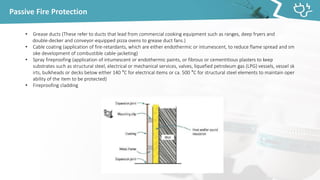
• Grease ducts (These refer to ducts that lead from commercial cooking equipment such as ranges, deep fryers and
double-decker and conveyor-equipped pizza ovens to grease duct fans.)
• Cable coating (application of fire-retardants, which are either endothermic or intumescent, to reduce flame spread and sm
oke development of combustible cable-jacketing)
• Spray fireproofing (application of intumescent or endothermic paints, or fibrous or cementitious plasters to keep
substrates such as structural steel, electrical or mechanical services, valves, liquefied petroleum gas (LPG) vessels, vessel sk
irts, bulkheads or decks below either 140 °C for electrical items or ca. 500 °C for structural steel elements to maintain oper
ability of the item to be protected)
• Fireproofing cladding
Passive Fire Protection
• In a passive system, stationary materials are designed to help prevent the spread of fire or smoke, keeping the fire to its or
iginal area and stopping it from spreading through the building. When combined with an active system, a passive system c
an help put out a fire faster and stop a lot of damage from occurring.
• Passive fire protection systems are mostly built right into the building. This may mean using fire retardant materials when c
onstructing the floors, walls and ceilings of the building. For example, cinder block walls are going to be less likely to sprea
d flames than a wood frame wall.
• Other passive systems may be added later, after the actual construction of the building has ceased. These systems may incl
ude smoke baffles, fire doors and fire-resistant glass partitions.
• They also include things like smoke and fire curtains, which can combine active and passive systems; fire and smoke curtai
ns may deploy after a fire or smoke has been detected, but then become a passive part of the fire suppression system.
Passive Fire Protection
• Some smoke curtains may also be used in permanent positions at the tops of warehouses and other tall, open spaces.
• A passive system’s objective is to hold the smoke and flames in one, contained area or to channel it out of the building. If t
he smoke and flames cannot spread to other areas inside of the building, then they’re easier to put out, there are fewer p
eople who may be affected, it’s easier for people to leave the building safely and there’s less equipment that may be affect
ed or damaged.
Passive Fire Protection
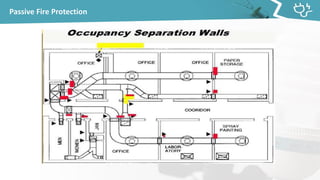
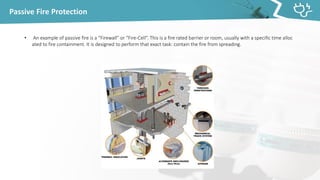
• An example of passive fire is a “Firewall” or “Fire-Cell”. This is a fire rated barrier or room, usually with a specific time alloc
ated to fire containment. It is designed to perform that exact task: contain the fire from spreading.
Active Fire Protection
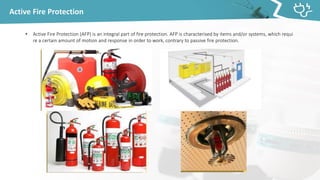
• Active Fire Protection (AFP) is an integral part of fire protection. AFP is characterised by items and/or systems, which requi
re a certain amount of motion and response in order to work, contrary to passive fire protection.
Fire suppression
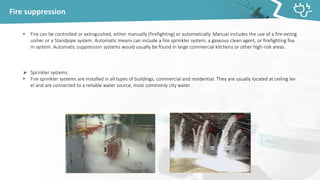
• Fire can be controlled or extinguished, either manually (firefighting) or automatically. Manual includes the use of a fire exting
uisher or a Standpipe system. Automatic means can include a fire sprinkler system, a gaseous clean agent, or firefighting foa
m system. Automatic suppression systems would usually be found in large commercial kitchens or other high-risk areas.
➢ Sprinkler systems
• Fire sprinkler systems are installed in all types of buildings, commercial and residential. They are usually located at ceiling lev
el and are connected to a reliable water source, most commonly city water.
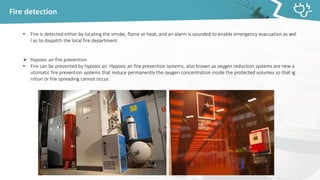
Fire detection
• Fire is detected either by locating the smoke, flame or heat, and an alarm is sounded to enable emergency evacuation as wel
l as to dispatch the local fire department.
➢ Hypoxic air fire prevention
• Fire can be prevented by hypoxic air. Hypoxic air fire prevention systems, also known as oxygen reduction systems are new a
utomatic fire prevention systems that reduce permanently the oxygen concentration inside the protected volumes so that ig
nition or fire spreading cannot occur.
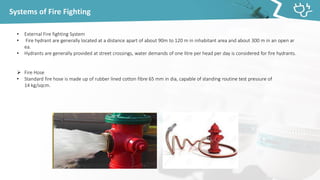
Systems of Fire Fighting
• External Fire fighting System
• Fire hydrant are generally located at a distance apart of about 90m to 120 m in inhabitant area and about 300 m in an open ar
ea.
• Hydrants are generally provided at street crossings, water demands of one litre per head per day is considered for fire hydrants.
➢ Fire Hose
• Standard fire hose is made up of rubber lined cotton fibre 65 mm in dia, capable of standing routine test pressure of
14 kg/sqcm.
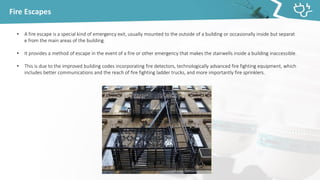
Fire Escapes
• A fire escape is a special kind of emergency exit, usually mounted to the outside of a building or occasionally inside but separat
e from the main areas of the building.
• It provides a method of escape in the event of a fire or other emergency that makes the stairwells inside a building inaccessible.
• This is due to the improved building codes incorporating fire detectors, technologically advanced fire fighting equipment, which
includes better communications and the reach of fire fighting ladder trucks, and more importantly fire sprinklers.
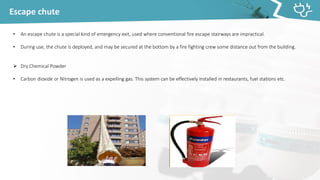
Escape chute
• An escape chute is a special kind of emergency exit, used where conventional fire escape stairways are impractical.
• During use, the chute is deployed, and may be secured at the bottom by a fire fighting crew some distance out from the building.
➢ Dry Chemical Powder
• Carbon dioxide or Nitrogen is used as a expelling gas. This system can be effectively installed in restaurants, fuel stations etc.
HVAC System
➢ HVAC
• HVAC system selection
• Basic components
• Classification of HVAC systems
• HVAC system requirements
-Central HVAC systems
-Air Systems
-Water Systems
- Air-water systems
-Water-source heat pumps
-Heating and cooling panels
-Local HVAC systems
-Local heating systems
-Local cooling systems
-Local ventilation systems
-Local air
-conditioning systems
-Split systems
HVAC system selection
➢ System selection depends on three main factors including:
• The building configuration
• The climate conditions
• The owner desire
➢ System selection depends on three main factors including:
➢ Some criteria can be considered such as:
• Climate change (temperature, humidity, and space pressure)
• Building capacity
• Spatial requirements
• Cost (capital cost, operating cost, and maintenance cost, life cycle analysis, and reliability and flexibility).
HVAC system selection
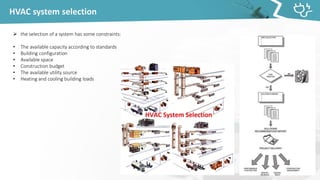
➢ the selection of a system has some constraints:
• The available capacity according to standards
• Building configuration
• Available space
• Construction budget
• The available utility source
• Heating and cooling building loads
Basic components of an HVAC system
➢ The basic components or equipment of an HVAC system that delivers conditioned air to satisfy thermal comfort of space and occ
upants and the achieve the indoor air quality are:
• Mixed-air plenum and outdoor air control
• Air filter
• Supply fan
• Exhaust or relief fans and an air outlet
• Outdoor air intake
• Ducts
• Terminal devices
• Return air system
• Heating and cooling coils
• Self-contained heating or cooling unit
• Cooling tower
• Boiler
• Control
• Water chiller
• Humidification and dehumidification equipment
Classification of HVAC systems
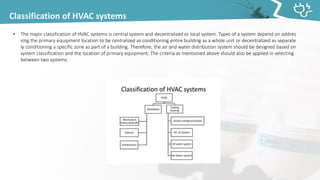
• The major classification of HVAC systems is central system and decentralized or local system. Types of a system depend on addres
sing the primary equipment location to be centralized as conditioning entire building as a whole unit or decentralized as separate
ly conditioning a specific zone as part of a building. Therefore, the air and water distribution system should be designed based on
system classification and the location of primary equipment. The criteria as mentioned above should also be applied in selecting
between two systems.
HVAC system requirements
• Equipment rooms: since the total mechanical and electrical space requirements range between 4 and 9% of the gross building area. It is
preferable to be centrally located in the building to reduce the long duct, pipe, and conduit runs and sizes, to simplify shaft layouts, and
centralized maintenance and operation.
• HVAC facilities: heating equipment and refrigeration equipment require many facilities to perform their primary tasks of heating and co
oling the building. The heating equipment requires boiler units, pumps, heat exchangers, pressure-reducing equipment, control air com
pressors, and miscellaneous equipment, while the refrigeration equipment requires water chillers or cooling water towers for large buil
dings, condenser water pumps, heat exchangers, air-conditioning equipment, control air compressors, and miscellaneous equipment. T
he design of equipment rooms to host both pieces of equipment should consider the size and the weight of equipment, the installation
and maintenance of equipment, and the applicable regulations to combustion air and ventilation air criteria.
• Fan rooms contain the HVAC fan equipment and other miscellaneous equipment. The rooms should consider the size of the installation
and removal of fan shafts and coils, the replacement, and maintenance. The size of fans depends on the required air flow rate to conditi
on the building, and it can be centralized or localized based on the availability, location, and cost. It is preferable to have easy access to
outdoor air.
• Vertical shaft: provide space for air distribution and water and steam pipe distribution. The air distribution contains HVAC supply air, exh
aust air, and return air ductwork. Pipe distribution includes hot water, chilled water, condenser water, and steam supply, and condenser
return. The vertical shaft includes other mechanical and electrical distribution to serve the entire building including plumbing pipes, fire
protection pipes, and electric conduits/closets.
• Equipment access: the equipment room must allow the movement of large, heavy equipment during the installation, replacement, and
maintenance.
HVAC system requirements
• Air distribution considers ductwork that delivers the conditioned air to the desired area in a direct, quiet, and economical way as possibl
e. Air distribution includes air terminal units such as grilles and diffusers to deliver supply air into a space at low velocity.
Air-water systems
• Air-water systems are introduced as a hybrid system to combine both advantages of all-air and all-water systems.
The volume of the combined is reduced, and the outdoor ventilation is produced to properly condition the desired zone. The water m
edium is responsible for carrying the thermal load in a building by 80–90% through heating and cooling water, while air medium cond
itions the remainder. There are two main types: fan-coil units and induction units.
Fan-coil units for air-water systems are similar to that of all-water systems except that the supply air and the conditioned water are pr
ovided to the desired zone from a central air handling unit and central water systems (e.g., boilers or chillers). The ventilation air can
be separately delivered into space or connected to the fan-coil units. The major types of fan-coil systems, are 2 pipes or 4-pipes.
Water-source heat pumps
• Water-source heat pumps are used to provide considerable energy savings for large building under the extreme cold weather . A buildin
g of various zones can be conditioned by several individual heat pumps since each heat pump can be controlled according to the zone.
Heating and cooling panels
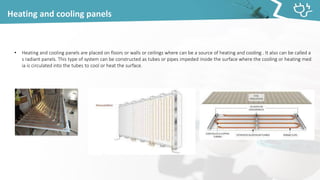
• Heating and cooling panels are placed on floors or walls or ceilings where can be a source of heating and cooling . It also can be called a
s radiant panels. This type of system can be constructed as tubes or pipes impeded inside the surface where the cooling or heating med
ia is circulated into the tubes to cool or heat the surface.
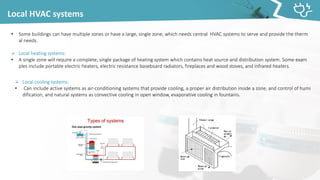
Local HVAC systems
• Some buildings can have multiple zones or have a large, single zone, which needs central HVAC systems to serve and provide the therm
al needs.
➢ Local heating systems:
• A single zone will require a complete, single package of heating system which contains heat source and distribution system. Some exam
ples include portable electric heaters, electric resistance baseboard radiators, fireplaces and wood stoves, and infrared heaters.
➢ Local cooling systems:
• Can include active systems as air-conditioning systems that provide cooling, a proper air distribution inside a zone, and control of humi
dification, and natural systems as convective cooling in open window, evaporative cooling in fountains.
Local HVAC systems
➢ Local ventilation systems: Can be forced systems by using devices such as window fan to allow air movement between outdoor and a sin
gle zone without changing in the thermal environment of the zone. Other systems used for ventilation are air circulation devices such as
desk or paddle fans to improve thermal comfort of the space by allowing the heat to be transferred by conventional mode.
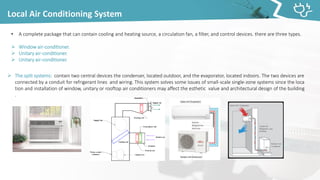
Local Air Conditioning System
• A complete package that can contain cooling and heating source, a circulation fan, a filter, and control devices. there are three types.
➢ Window air-conditioner.
➢ Unitary air-conditioner.
➢ The split systems: contain two central devices the condenser, located outdoor, and the evaporator, located indoors. The two devices are
connected by a conduit for refrigerant lines and wiring. This system solves some issues of small-scale single-zone systems since the loca
tion and installation of window, unitary or rooftop air conditioners may affect the esthetic value and architectural design of the building
.

Firefighting & HVAC.pdf

  • 1.
    Electrical works for(FireFighting and A.C) Dr. Amr Moatasem Hesham Ali Ismael - 2021008497 Ibrahim Nasr Ibrahim - 20191650 Nayera Mostafa - 20194806 Hazem Mohammed - 20192683 Afnan Hossam - 20197451 Tasneem Abdulghany - 20194373 Youmna Ahmed - 20197451
  • 2.
    ➢ Firefighting • PassiveFire Protection • Active Fire Protection • Fire Suppression • Sprinkler Systems • Fire Detection • Hypoxic Air Fire Prevention • Construction and maintenance • System Of Fire Fighting • Fire Escapes • Escape Chute ➢ HVAC • HVAC system selection • Basic components • Classification of HVAC systems • HVAC system requirements • Central HVAC systems • Air Systems
  • 3.
    Passive Fire Protection •The installation of firewalls and fire rated floor assemblies to form fire compartments intended to limit the spread of fire, high temperatures, and smoke.
  • 4.
    Passive Fire Protection •Passive Fire Protection (PFP) is an integral component of the three components of structural fire protection and fire safety in a building. PFP attempts to contain fires or slow the spread, through use of fire-resistant walls, floors, and doors (among st other examples). • Fire-resistance rated walls • Firewalls not only have a rating, they are also designed to sub-divide buildings Such that if collapse occurs on one side, this will not affect the other side. They Can also be used to eliminate the need for sprinklers, as a trade-off. • Fire-resistant glass using multi-layer intumescent technology or wire mesh Embedded within the glass may be used in the fabrication of fire-resistance rated • Windows in walls or fire doors. • Fire-resistance rated floors
  • 5.
  • 6.
    Passive Fire Protection •Grease ducts (These refer to ducts that lead from commercial cooking equipment such as ranges, deep fryers and double-decker and conveyor-equipped pizza ovens to grease duct fans.) • Cable coating (application of fire-retardants, which are either endothermic or intumescent, to reduce flame spread and sm oke development of combustible cable-jacketing) • Spray fireproofing (application of intumescent or endothermic paints, or fibrous or cementitious plasters to keep substrates such as structural steel, electrical or mechanical services, valves, liquefied petroleum gas (LPG) vessels, vessel sk irts, bulkheads or decks below either 140 °C for electrical items or ca. 500 °C for structural steel elements to maintain oper ability of the item to be protected) • Fireproofing cladding
  • 7.
    Passive Fire Protection •In a passive system, stationary materials are designed to help prevent the spread of fire or smoke, keeping the fire to its or iginal area and stopping it from spreading through the building. When combined with an active system, a passive system c an help put out a fire faster and stop a lot of damage from occurring. • Passive fire protection systems are mostly built right into the building. This may mean using fire retardant materials when c onstructing the floors, walls and ceilings of the building. For example, cinder block walls are going to be less likely to sprea d flames than a wood frame wall. • Other passive systems may be added later, after the actual construction of the building has ceased. These systems may incl ude smoke baffles, fire doors and fire-resistant glass partitions. • They also include things like smoke and fire curtains, which can combine active and passive systems; fire and smoke curtai ns may deploy after a fire or smoke has been detected, but then become a passive part of the fire suppression system.
  • 8.
    Passive Fire Protection •Some smoke curtains may also be used in permanent positions at the tops of warehouses and other tall, open spaces. • A passive system’s objective is to hold the smoke and flames in one, contained area or to channel it out of the building. If t he smoke and flames cannot spread to other areas inside of the building, then they’re easier to put out, there are fewer p eople who may be affected, it’s easier for people to leave the building safely and there’s less equipment that may be affect ed or damaged.
  • 9.
    Passive Fire Protection •An example of passive fire is a “Firewall” or “Fire-Cell”. This is a fire rated barrier or room, usually with a specific time alloc ated to fire containment. It is designed to perform that exact task: contain the fire from spreading.
  • 10.
    Active Fire Protection •Active Fire Protection (AFP) is an integral part of fire protection. AFP is characterised by items and/or systems, which requi re a certain amount of motion and response in order to work, contrary to passive fire protection.
  • 11.
    Fire suppression • Firecan be controlled or extinguished, either manually (firefighting) or automatically. Manual includes the use of a fire exting uisher or a Standpipe system. Automatic means can include a fire sprinkler system, a gaseous clean agent, or firefighting foa m system. Automatic suppression systems would usually be found in large commercial kitchens or other high-risk areas. ➢ Sprinkler systems • Fire sprinkler systems are installed in all types of buildings, commercial and residential. They are usually located at ceiling lev el and are connected to a reliable water source, most commonly city water.
  • 12.
    Fire detection • Fireis detected either by locating the smoke, flame or heat, and an alarm is sounded to enable emergency evacuation as wel l as to dispatch the local fire department. ➢ Hypoxic air fire prevention • Fire can be prevented by hypoxic air. Hypoxic air fire prevention systems, also known as oxygen reduction systems are new a utomatic fire prevention systems that reduce permanently the oxygen concentration inside the protected volumes so that ig nition or fire spreading cannot occur.
  • 13.
    Systems of FireFighting • External Fire fighting System • Fire hydrant are generally located at a distance apart of about 90m to 120 m in inhabitant area and about 300 m in an open ar ea. • Hydrants are generally provided at street crossings, water demands of one litre per head per day is considered for fire hydrants. ➢ Fire Hose • Standard fire hose is made up of rubber lined cotton fibre 65 mm in dia, capable of standing routine test pressure of 14 kg/sqcm.
  • 14.
    Fire Escapes • Afire escape is a special kind of emergency exit, usually mounted to the outside of a building or occasionally inside but separat e from the main areas of the building. • It provides a method of escape in the event of a fire or other emergency that makes the stairwells inside a building inaccessible. • This is due to the improved building codes incorporating fire detectors, technologically advanced fire fighting equipment, which includes better communications and the reach of fire fighting ladder trucks, and more importantly fire sprinklers.
  • 15.
    Escape chute • Anescape chute is a special kind of emergency exit, used where conventional fire escape stairways are impractical. • During use, the chute is deployed, and may be secured at the bottom by a fire fighting crew some distance out from the building. ➢ Dry Chemical Powder • Carbon dioxide or Nitrogen is used as a expelling gas. This system can be effectively installed in restaurants, fuel stations etc.
  • 16.
    HVAC System ➢ HVAC •HVAC system selection • Basic components • Classification of HVAC systems • HVAC system requirements -Central HVAC systems -Air Systems -Water Systems - Air-water systems -Water-source heat pumps -Heating and cooling panels -Local HVAC systems -Local heating systems -Local cooling systems -Local ventilation systems -Local air -conditioning systems -Split systems
  • 17.
    HVAC system selection ➢System selection depends on three main factors including: • The building configuration • The climate conditions • The owner desire ➢ System selection depends on three main factors including: ➢ Some criteria can be considered such as: • Climate change (temperature, humidity, and space pressure) • Building capacity • Spatial requirements • Cost (capital cost, operating cost, and maintenance cost, life cycle analysis, and reliability and flexibility).
  • 18.
    HVAC system selection ➢the selection of a system has some constraints: • The available capacity according to standards • Building configuration • Available space • Construction budget • The available utility source • Heating and cooling building loads
  • 19.
    Basic components ofan HVAC system ➢ The basic components or equipment of an HVAC system that delivers conditioned air to satisfy thermal comfort of space and occ upants and the achieve the indoor air quality are: • Mixed-air plenum and outdoor air control • Air filter • Supply fan • Exhaust or relief fans and an air outlet • Outdoor air intake • Ducts • Terminal devices • Return air system • Heating and cooling coils • Self-contained heating or cooling unit • Cooling tower • Boiler • Control • Water chiller • Humidification and dehumidification equipment
  • 20.
    Classification of HVACsystems • The major classification of HVAC systems is central system and decentralized or local system. Types of a system depend on addres sing the primary equipment location to be centralized as conditioning entire building as a whole unit or decentralized as separate ly conditioning a specific zone as part of a building. Therefore, the air and water distribution system should be designed based on system classification and the location of primary equipment. The criteria as mentioned above should also be applied in selecting between two systems.
  • 21.
    HVAC system requirements •Equipment rooms: since the total mechanical and electrical space requirements range between 4 and 9% of the gross building area. It is preferable to be centrally located in the building to reduce the long duct, pipe, and conduit runs and sizes, to simplify shaft layouts, and centralized maintenance and operation. • HVAC facilities: heating equipment and refrigeration equipment require many facilities to perform their primary tasks of heating and co oling the building. The heating equipment requires boiler units, pumps, heat exchangers, pressure-reducing equipment, control air com pressors, and miscellaneous equipment, while the refrigeration equipment requires water chillers or cooling water towers for large buil dings, condenser water pumps, heat exchangers, air-conditioning equipment, control air compressors, and miscellaneous equipment. T he design of equipment rooms to host both pieces of equipment should consider the size and the weight of equipment, the installation and maintenance of equipment, and the applicable regulations to combustion air and ventilation air criteria. • Fan rooms contain the HVAC fan equipment and other miscellaneous equipment. The rooms should consider the size of the installation and removal of fan shafts and coils, the replacement, and maintenance. The size of fans depends on the required air flow rate to conditi on the building, and it can be centralized or localized based on the availability, location, and cost. It is preferable to have easy access to outdoor air. • Vertical shaft: provide space for air distribution and water and steam pipe distribution. The air distribution contains HVAC supply air, exh aust air, and return air ductwork. Pipe distribution includes hot water, chilled water, condenser water, and steam supply, and condenser return. The vertical shaft includes other mechanical and electrical distribution to serve the entire building including plumbing pipes, fire protection pipes, and electric conduits/closets. • Equipment access: the equipment room must allow the movement of large, heavy equipment during the installation, replacement, and maintenance.
  • 22.
    HVAC system requirements •Air distribution considers ductwork that delivers the conditioned air to the desired area in a direct, quiet, and economical way as possibl e. Air distribution includes air terminal units such as grilles and diffusers to deliver supply air into a space at low velocity.
  • 23.
    Air-water systems • Air-watersystems are introduced as a hybrid system to combine both advantages of all-air and all-water systems. The volume of the combined is reduced, and the outdoor ventilation is produced to properly condition the desired zone. The water m edium is responsible for carrying the thermal load in a building by 80–90% through heating and cooling water, while air medium cond itions the remainder. There are two main types: fan-coil units and induction units. Fan-coil units for air-water systems are similar to that of all-water systems except that the supply air and the conditioned water are pr ovided to the desired zone from a central air handling unit and central water systems (e.g., boilers or chillers). The ventilation air can be separately delivered into space or connected to the fan-coil units. The major types of fan-coil systems, are 2 pipes or 4-pipes.
  • 24.
    Water-source heat pumps •Water-source heat pumps are used to provide considerable energy savings for large building under the extreme cold weather . A buildin g of various zones can be conditioned by several individual heat pumps since each heat pump can be controlled according to the zone.
  • 25.
    Heating and coolingpanels • Heating and cooling panels are placed on floors or walls or ceilings where can be a source of heating and cooling . It also can be called a s radiant panels. This type of system can be constructed as tubes or pipes impeded inside the surface where the cooling or heating med ia is circulated into the tubes to cool or heat the surface.
  • 26.
    Local HVAC systems •Some buildings can have multiple zones or have a large, single zone, which needs central HVAC systems to serve and provide the therm al needs. ➢ Local heating systems: • A single zone will require a complete, single package of heating system which contains heat source and distribution system. Some exam ples include portable electric heaters, electric resistance baseboard radiators, fireplaces and wood stoves, and infrared heaters. ➢ Local cooling systems: • Can include active systems as air-conditioning systems that provide cooling, a proper air distribution inside a zone, and control of humi dification, and natural systems as convective cooling in open window, evaporative cooling in fountains.
  • 27.
    Local HVAC systems ➢Local ventilation systems: Can be forced systems by using devices such as window fan to allow air movement between outdoor and a sin gle zone without changing in the thermal environment of the zone. Other systems used for ventilation are air circulation devices such as desk or paddle fans to improve thermal comfort of the space by allowing the heat to be transferred by conventional mode.
  • 28.
    Local Air ConditioningSystem • A complete package that can contain cooling and heating source, a circulation fan, a filter, and control devices. there are three types. ➢ Window air-conditioner. ➢ Unitary air-conditioner. ➢ Unitary air-conditioner. ➢ The split systems: contain two central devices the condenser, located outdoor, and the evaporator, located indoors. The two devices are connected by a conduit for refrigerant lines and wiring. This system solves some issues of small-scale single-zone systems since the loca tion and installation of window, unitary or rooftop air conditioners may affect the esthetic value and architectural design of the building .