Fire Safety In High Rise
Building
Building
CLASSIFICATION OF BUILDINGS
AS PER NATIONAL BUILDING
CODE
1. GROUPING.
Group ‘A’ - Residential : Lodgings, Dwellings,
Dormitories, Flats, Hotels.
Group ‘B’ - Educational : School, Colleges, Recreations.
Group ‘C’ - Institutional : Hospitals, Homes for aged,
Orphanages, Jails, Mental
Hospital, reformatories.
Group ‘D’ - Assembly : Theatres, Drama Hall,
Assembly Halls, Auditorium,
Exhibition, Restaurants, Place
of workship, Terminal etc.
Group ‘E’ - Business : Office, Labs, Computer
Installations
Group ‘F’ - Mercantile : Shops, Stores, Market.
Group ‘G’ - Industrial : Assembly Plants, Labs,
Pumping stations, Refineries,
Saw mills.
Group ‘H’ - Storage : All types of storages, Sheds,
trucks & marine terminals,
Garages, Hangars, Stables.
Group ‘J’ - Hazardous : Used to store highly
combustible or explosive
materials which may produce
poisonous fumes or
explosions or toxic etc.
WIDTH OF ROAD
WIDTH OF ROAD
Sections:- As per section 4.6 (a) of part 3 &
7.4.1 (a) of part IV of N.B.C.
The road which abuts a High rise building to be
constructed shall be more then 12 meter
12 meter width.The
road should be hard surfaced to carry a minimum
weight of 18,000 Kgs, the maximum weight of a Fire
Engine.
NOT TO
BE CONSIDER.
12 m 12 m
12 m 12 m
ENTRANCE WIDTH & HEIGHT
CLEARANCE
Section:- As per section 4.6 (c) of part C &
7.4.1(d) of part IV of N.B.C.
Every High rise building should have at least 2
means of access, one remote to the other, of
minimum width 4.5m. with height clearance of
5m. This minimum width is essential to facilitate
free movement of fire units.
5 m
4.5 m
5 m
4.5 m
12 m
SETBACK OR OPEN SPACES
Section : As per table 2 of section 8.2.3.1 of part III
of N.B.C.
UPTO
30 M.
HEIGHT
6 M.
1/3 OF
TOTAL
HEIGHT
OF
BUILDING.
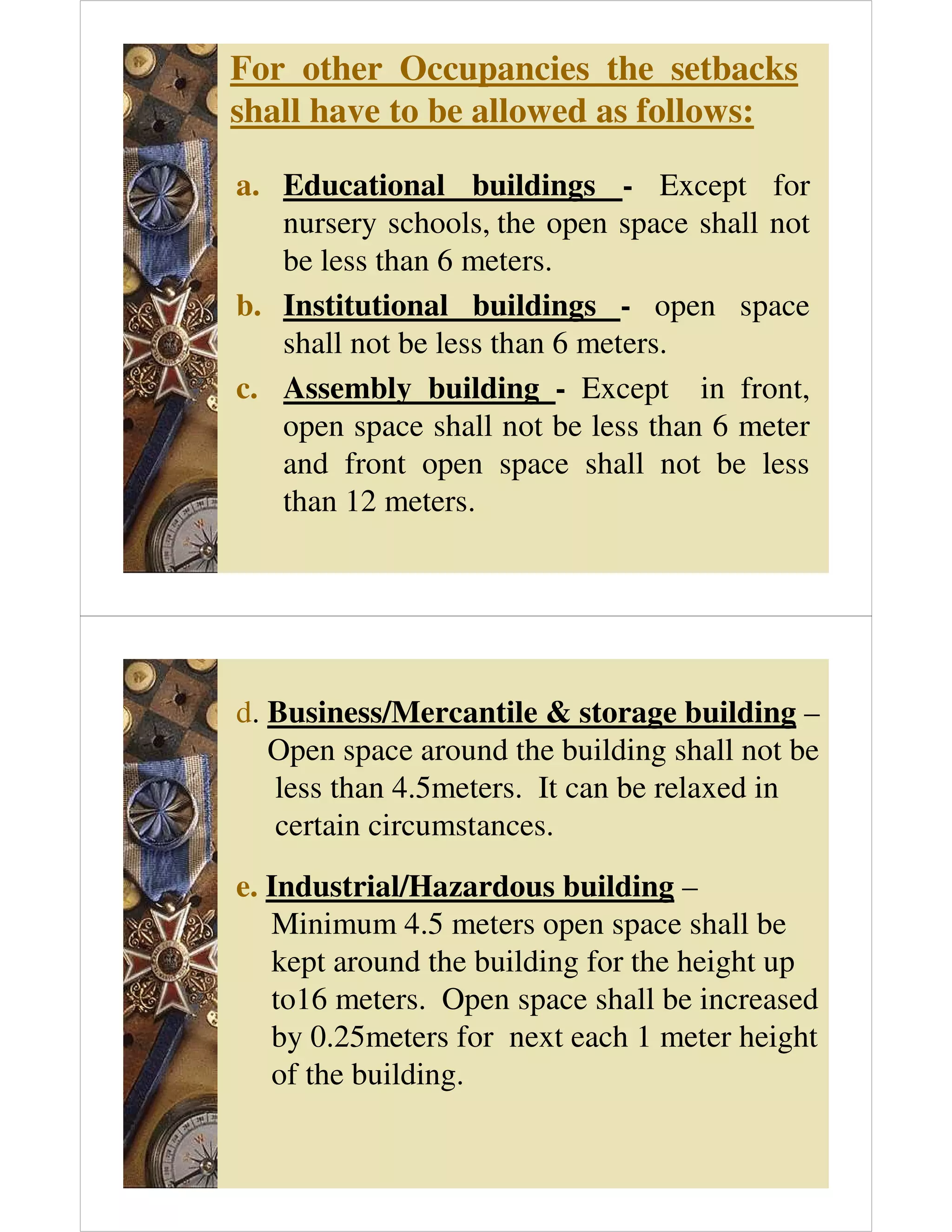
Sufficient open space (setbacks) around
residential buildings, as indicated in the
next slide, is essential to facilitate free
movement and operation of Fire
Service vehicles.
Sr.No Height of building in
Meters
Exterior open spaces/setbacks to
be left on all sides. Minimum in
meters
1. Above 9.5 up to 12 4.5
2. Above 12 up to 15 5.0
3. Above 15 up to 18 6.0
4. Above 18 up to 21 7.0
5. Above 21 up to 24 8.0
6. Above 24 up to 27 9.0
7. Above 27 up to 30 10.0
8. Above 30 up to 35 11.0
9. Above 35 up to 40 12.0
10. Above 40 up to 45 13.0
11. Above 45 up to 50 14.0
12. Above 50 16.0
For other Occupancies the setbacks
shall have to be allowed as follows:
a. Educational buildings - Except for
nursery schools, the open space shall not
be less than 6 meters.
b. Institutional buildings - open space
shall not be less than 6 meters.
c. Assembly building - Except in front,
open space shall not be less than 6 meter
and front open space shall not be less
than 12 meters.
d. Business/Mercantile & storage building –
Open space around the building shall not be
less than 4.5meters. It can be relaxed in
certain circumstances.
e. Industrial/Hazardous building –
Minimum 4.5 meters open space shall be
kept around the building for the height up
to16 meters. Open space shall be increased
by 0.25meters for next each 1 meter height
of the building.
Car Parking in Setback / Open
Spaces.
If the setback area / open spaces is more
then 12 meter, the provision for car parking
Can be done in the setback or open spaces at
the periphery of the courtyard leaving the
6 meter motorable road.
Section: As per section 4.6 (b) of
appendix B of part III of N.B.C.
CAR PARKING
IF MORE
THAN
12 METER.
6 M.
MOTARABLE
ROAD.
CAR PARKING
Section – As per section B/8 of
appendix ‘B’ of part III of N.B.C
Car Parking shall have to be done at the
basement with provision for minimum 2
ramps one remote to other.
B
G
1
2
3
STAIRCASES
Section :- As per section 12.18 of part III,
8.5.1 (Table 24), 8.6.2,8.9,8.10,8.13,
9.3.5(a),10.4.1,11.3.2 of part IV & appendix
D1.3,D1.4 of part of NBC.
a) Every high rise building
Have minimum 2 number of
Staircases.
b) Width of staircases varies
from 1 m. to 2 m.
C) For residential building width of staircases
should be 1 mtr.
d) Out of 2 staircases, 1 can be used as a fire
escape staircase.
e) Width of fire escape should be minimum 0.75
meter.
f) Number of staircases shall be given as per the
travel distances.
22.5 m 22.5 m
22.5 m
22.5 m
g) Staircase shall not be extended to basement
to prevent smoke , heat & gases. From the
basement smoke, heat 7 gases can be travel
to upper floors.
h) Access to the basement from the ground
should be through a separate staircase,
which is not connected to main staircase
(i.e. It should be remote to each other.)
i) Staircase shall be of enclosed type to
prevent entry of smoke & fire to the
staircase & vice versa.
j) Spiral staircase shall be provided up to 9
mtr. Height.
k) External staircase normally shall not be
allowed.
LIFTS
Section:- as per section 18 of part III & 6.18
& appendix A.15 of part IV of NBC.
a) Minimum 1 lift capable of carrying
minimum 8 persons weighing 545 kgs.
Shall be provided for every high rise
building.
b) Landing doors of lifts shall open to
ventilated lobby & shall have a fire
resistance of 1 hour.
c) 1 lift shall be designed as a “Fire Lift”
d) “Fireman Switch” shall be provided for
each lift.
e) Lifts shall not be used as means of
evacuation.
f) Collapsible gates shall not be provided for
the lift.
g) If more than 1 lifts are installed the
partition wall should be of minimum 2
hours fire resistance.
THE REFUGE AREA
Section: As per section 8.12.3 on part IV of NBC, the
refuge area shall be provided on the periphery of the
floor & open to air atleast on one side protected with
suitable railing.
a) For floors above 24m &
up to 39m one refuge area
on the floor immediately
above 24m.
b) For floors above 39m
one refuge area on the
floor immediately above
39m & so on after 15m
refuge area shall be provided.
RA
24m
39m
54m
Service Ducts
As per appendix D 1.9 part IV of N.B.C. all
the services ducts, if provided, should have to
be enclosed by walls of at least 2 hour fire
resistance & should have to be sealed at every
alternate floor with non-combustible
materials having at least 2 hour fire
resistance. The sealing at floor level is to
prevent travel of smoke & fire to the upper
floors through the ducts.
BUILT IN FIRE
FIGHTING SYSTEM
WET RISER CUM DOWN
COMMER SYSTEM
Wet riser : It is a vertical pipeline
(dia. depends on the floor
area of the building)
connected to a bottom
tank(underground
water tank).
Down Commer : It is a vertical pipeline
(dia. depends on the floor
area of the building)
connected to a overhead
tank.
WET RISER CUM DOWN
COMMER SYSTEM
Dry riser : It is a vertical pipe which
is always kept dry to avoid
the freezing of water.
Hydrant : It is a horizontal pipe line
with outlet of 63 mm. dia.
connected to underground
water tank.
WET RISER
 Wet riser cum down commer or only down
commer system shall be provided for residential
building.
 For commercial building only only wet-riser
system shall be provided.
 For hotels wet-riser cum down commer both the
systems shall be provided.
 Diameter of riser will be 150mm for all the
buildings.
 For each 1000m2 floor area or it’s part one riser
shall be provided.
 At every landing twin outlet each of 63mm dia.
shall be provided (one should be connected to
hose reel  another should be to hose  branch).
Length of hose should be shall that it should
reach at the last point of floor area.
 Minimum two courtyard hydrants shall be
provided (courtyard hydrant will be an extention
to riser).
 Hose reel hose of 12mm dia. shall be provided
from landing valve to wet-riser at each floor.
 A separate fire service inlet shall be provided at
the ground floor.
 Location of wet-riser shall be preferable as near
to staircase.
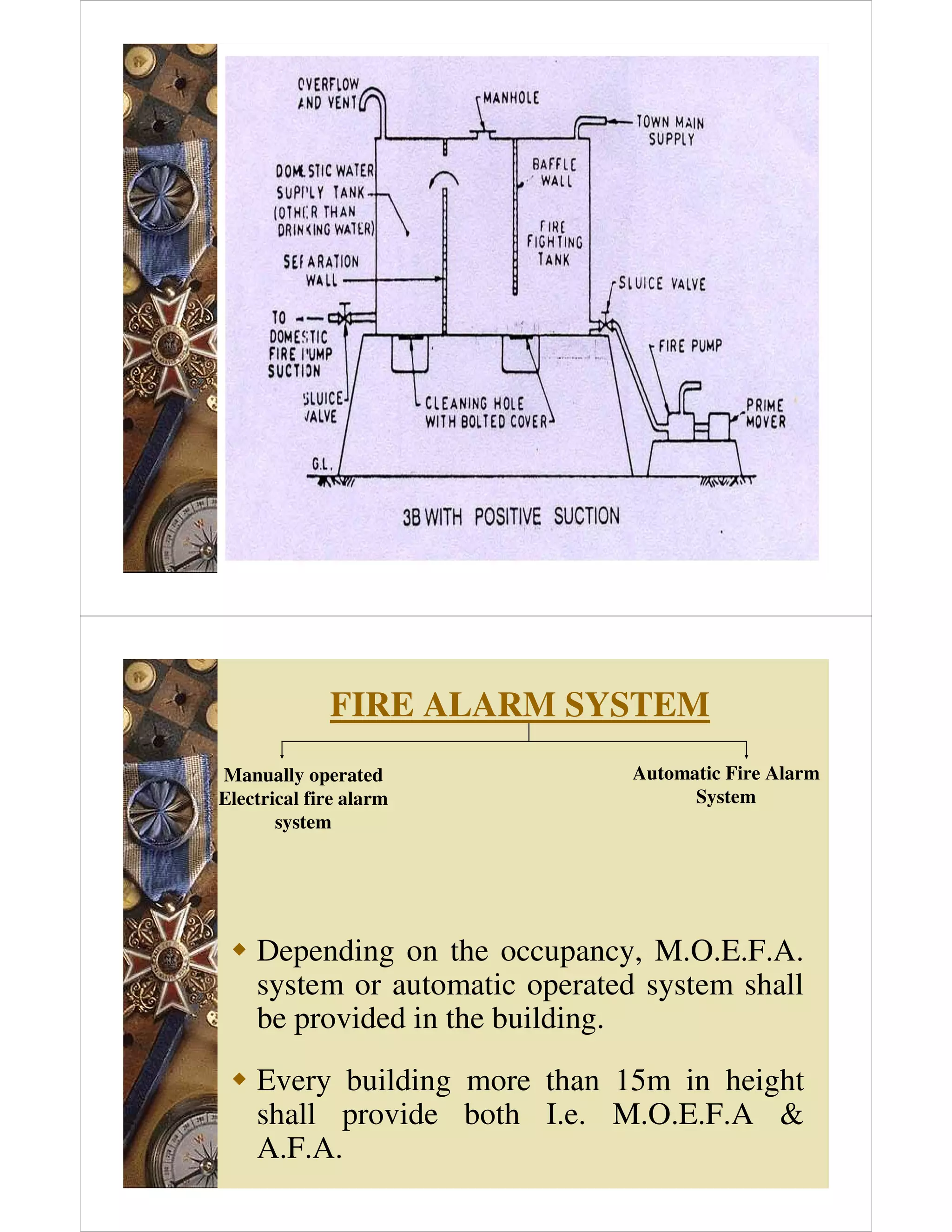
WATER TANK
The Capacity of
 Underground water storage tank varies from
50,000 ltrs. to 250,000 ltrs. Depending on the
type  occupancy of the buildings.
 The capacity of terrace level water storage tank
varies from 10,000 ltrs. to 20,000 ltrs. Depending
on the type  occupancy of the building.
Under Ground
Water Storage tank
Terrace
Level Tank
Above mentioned water tank capacity is for
1 riser. If the number of risers will be more
than 1, than quantity of water shall be
increased in that proportionate.
In addition to this if automatic sprinkler,
drenchers are provided for special risk then
this will be additional quantity of water.
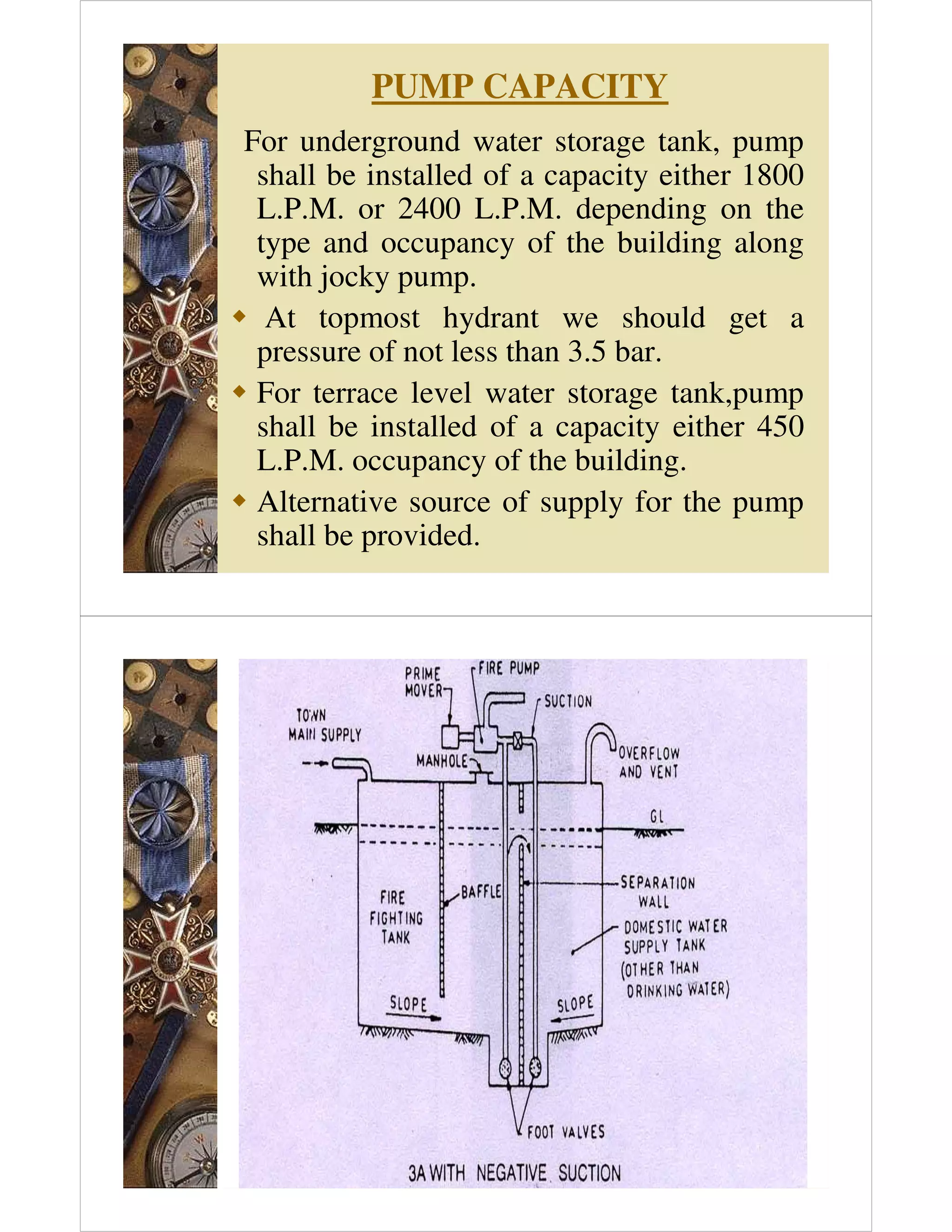
PUMP CAPACITY
For underground water storage tank, pump
shall be installed of a capacity either 1800
L.P.M. or 2400 L.P.M. depending on the
type and occupancy of the building along
with jocky pump.
 At topmost hydrant we should get a
pressure of not less than 3.5 bar.
 For terrace level water storage tank,pump
shall be installed of a capacity either 450
L.P.M. occupancy of the building.
 Alternative source of supply for the pump
shall be provided.
FIRE ALARM SYSTEM
 Depending on the occupancy, M.O.E.F.A.
system or automatic operated system shall
be provided in the building.
 Every building more than 15m in height
shall provide both I.e. M.O.E.F.A 
A.F.A.
Manually operated
Electrical fire alarm
system
Automatic Fire Alarm
System
Residential  office buildings between
15m  24m in height may be exempted
from installation of automatic fire alarm
system if local fire brigade is well
equipped to face the emergency up to 24m.
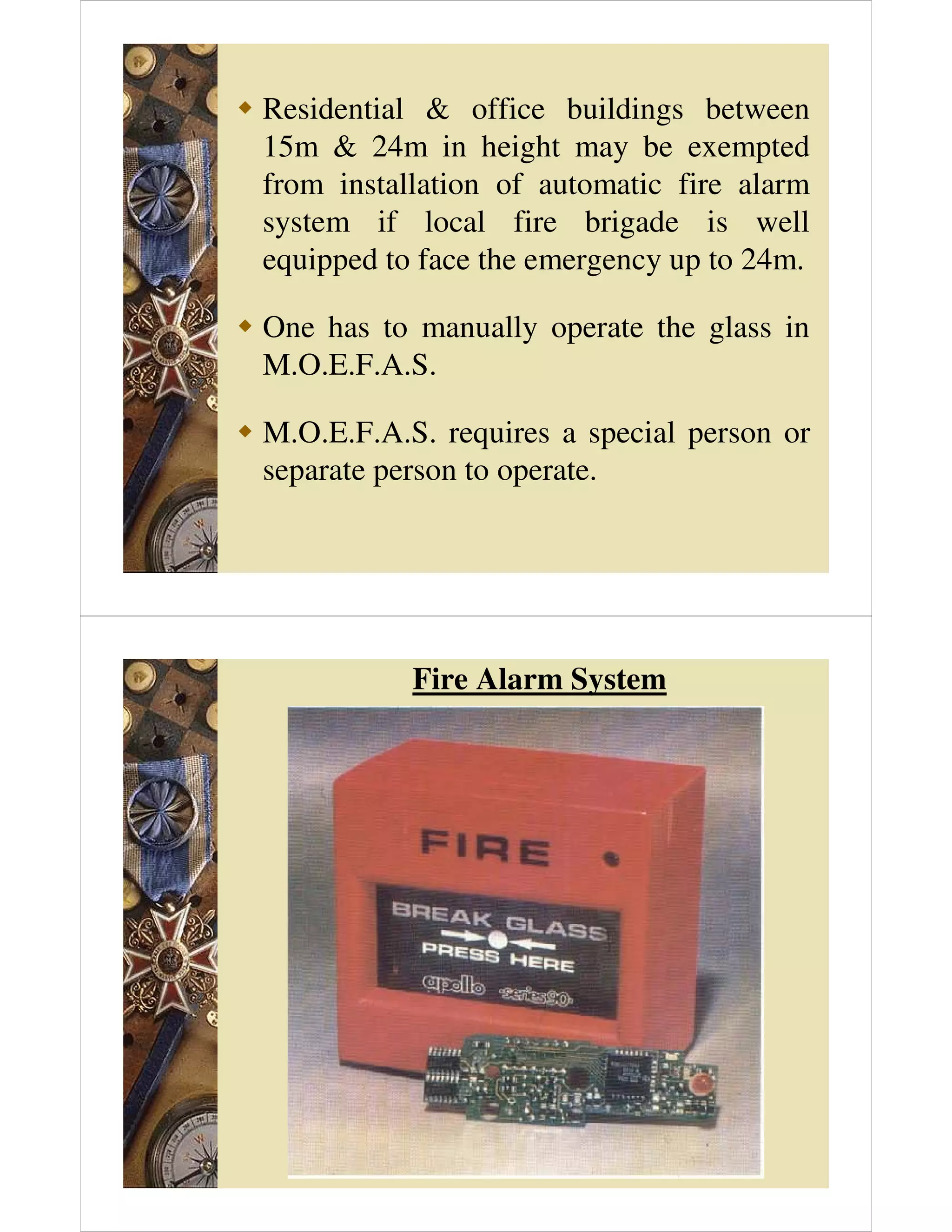
 One has to manually operate the glass in
M.O.E.F.A.S.
 M.O.E.F.A.S. requires a special person or
separate person to operate.
Fire Alarm System
FIRE DETECTION SYSTEM
Section: As per section 7.9 of part IV of NBC.
(8 of Appendix A)
 Different types of detectors are provided as per the
risk involved in the area.
 Zones are made as per the risk or as per the floor.
 2way communication system to be provided which
will help to contact from ground floor to specific
floor or vice-versa.
 Mike on every floor has to be provided.
 On mike instructions can be given as per situation.
 Manual call points, automatic detector  public
address system shall be interlinked.
 Detectors shall be installed as per IS 2189/ 1988.
Fire Detection System
SPRINKLER SYSTEM
Section: As per section 7.10.7 of part IV of NCB.
 Sprinkler system is a must for basement parking 
other risk areas where large quantities of combustible
materials are stored.
 Each sprinkler should cover 6.96m2 area.
 Normally a separate sprinkler should be provided for
a separate car.
 Sprinklers may connect to main water tank  pump,
but capacity of the tank  pump shall be increased in
that proportionate.
 The capacity of water tank shall be calculated on the
basis of sprinklers.
SPRINKLER SYSTEM
Alternate Power Supply
As per appendix D-1.5 of part IV of N.B.C. a
stand by generator should be installed to
supply power for staircase lighting, corridor
lighting, fire pump, pressurization fan 
blowers, in the event of disconnection of
failure of main supply.
PORTABLE FIRE EXTINGUISHERS.
Section: As per section 7.10.4 part IV of
N.B.C.
• First Aid Fire fighting appliances shall be
provided  installed in accordance with
LATEST IS 2190.
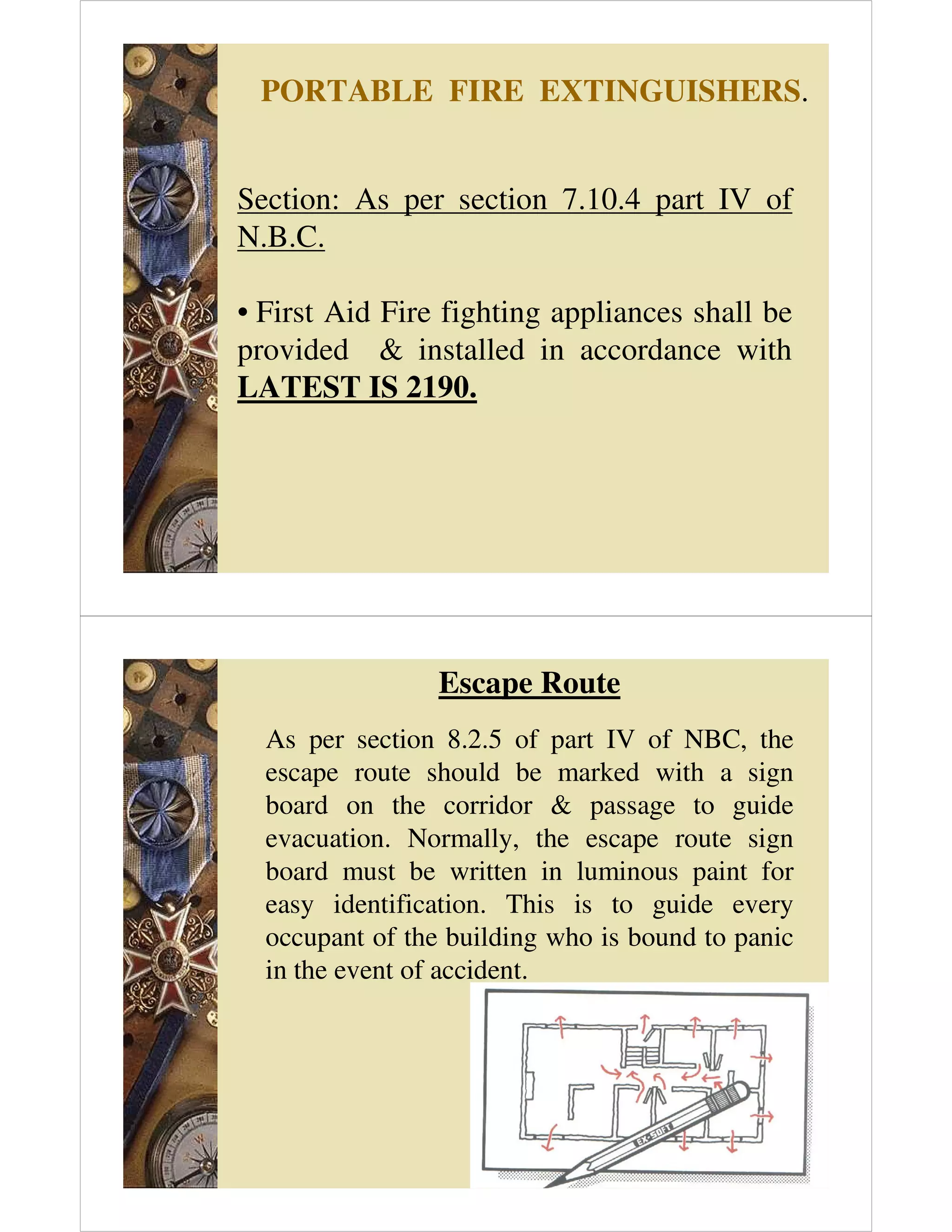
Escape Route
As per section 8.2.5 of part IV of NBC, the
escape route should be marked with a sign
board on the corridor  passage to guide
evacuation. Normally, the escape route sign
board must be written in luminous paint for
easy identification. This is to guide every
occupant of the building who is bound to panic
in the event of accident.
Public Address System
As per appendix D.5 of part IV of NBC, every
high rise building should have a public address
system with 2 way communication to conduct
evacuation in a systematic manner  to
communicate any messages to occupants on every
floor from the control room.
FIRE OFFICER
Section: As per section D6 (Appendix D) of
part IV of N.B.C.
Fire Officer / Supervisor for Hotels,
Business  Mercantile Buildings with
Height more than 30 m.
PROVISION OF HELIPAD
Section: As per D 10(Appendix D) of part IV
of N.B.C.
For High rise buildings above 60 m in
height provision for Helipad should be
made.
Fire Drills  Fire Orders
Section: As per section D 8 (Appendix D) of
part IV of N.B.C.
Fire Safety Plan: It`s very important to
have a fire safety plan to prevent 
extinguish any fire in the building with
details action to be taken by each occupant.
Telephone nos. of all emergence services
much be indicated in the plan.
Why DRILLS?
“Drills provide virtually the only means,
short of an actual incident, of measuring
the state of readiness and of testing the
effectiveness of an emergency response
plan”
Robert B. Kelly
PLANNED DRILLS
PLANNED DRILLS
TRY 2 / 3 SCENARIOS
TRY 2 / 3 SCENARIOS
AT DIFFERENT
AT DIFFERENT
TIMES / SHIFTS
TIMES / SHIFTS
CONIFIDENTIAL
CONIFIDENTIAL
DRILL
DRILL
KNOWN TO
KNOWN TO
MANAGEMENT
MANAGEMENT
TEAM
TEAM
TRY 2 / 3
TRY 2 / 3
SCENARIOS
SCENARIOS
ASSESSMENT
ASSESSMENT
of
of
PREPAREDNESS
PREPAREDNESS
SURPRISE DRILL
SURPRISE DRILL
KNOWN TO
KNOWN TO
MINIMUM
MINIMUM
TRAINING
Nothing would be done at all, if
a man waited till he could do
it so well, that no one could
find fault with it.
-Cardinal Newman

Fire safety guide

  • 1.
    Fire Safety InHigh Rise Fire Safety In High Rise Building Building CLASSIFICATION OF BUILDINGS AS PER NATIONAL BUILDING CODE 1. GROUPING. Group ‘A’ - Residential : Lodgings, Dwellings, Dormitories, Flats, Hotels. Group ‘B’ - Educational : School, Colleges, Recreations. Group ‘C’ - Institutional : Hospitals, Homes for aged, Orphanages, Jails, Mental Hospital, reformatories. Group ‘D’ - Assembly : Theatres, Drama Hall, Assembly Halls, Auditorium, Exhibition, Restaurants, Place of workship, Terminal etc.
  • 2.
    Group ‘E’ -Business : Office, Labs, Computer Installations Group ‘F’ - Mercantile : Shops, Stores, Market. Group ‘G’ - Industrial : Assembly Plants, Labs, Pumping stations, Refineries, Saw mills. Group ‘H’ - Storage : All types of storages, Sheds, trucks & marine terminals, Garages, Hangars, Stables. Group ‘J’ - Hazardous : Used to store highly combustible or explosive materials which may produce poisonous fumes or explosions or toxic etc. WIDTH OF ROAD WIDTH OF ROAD Sections:- As per section 4.6 (a) of part 3 & 7.4.1 (a) of part IV of N.B.C. The road which abuts a High rise building to be constructed shall be more then 12 meter 12 meter width.The road should be hard surfaced to carry a minimum weight of 18,000 Kgs, the maximum weight of a Fire Engine. NOT TO BE CONSIDER. 12 m 12 m 12 m 12 m
  • 3.
    ENTRANCE WIDTH &HEIGHT CLEARANCE Section:- As per section 4.6 (c) of part C & 7.4.1(d) of part IV of N.B.C. Every High rise building should have at least 2 means of access, one remote to the other, of minimum width 4.5m. with height clearance of 5m. This minimum width is essential to facilitate free movement of fire units. 5 m 4.5 m 5 m 4.5 m 12 m SETBACK OR OPEN SPACES Section : As per table 2 of section 8.2.3.1 of part III of N.B.C. UPTO 30 M. HEIGHT 6 M. 1/3 OF TOTAL HEIGHT OF BUILDING.
  • 4.
    Sufficient open space(setbacks) around residential buildings, as indicated in the next slide, is essential to facilitate free movement and operation of Fire Service vehicles. Sr.No Height of building in Meters Exterior open spaces/setbacks to be left on all sides. Minimum in meters 1. Above 9.5 up to 12 4.5 2. Above 12 up to 15 5.0 3. Above 15 up to 18 6.0 4. Above 18 up to 21 7.0 5. Above 21 up to 24 8.0 6. Above 24 up to 27 9.0 7. Above 27 up to 30 10.0 8. Above 30 up to 35 11.0 9. Above 35 up to 40 12.0 10. Above 40 up to 45 13.0 11. Above 45 up to 50 14.0 12. Above 50 16.0
  • 5.
    For other Occupanciesthe setbacks shall have to be allowed as follows: a. Educational buildings - Except for nursery schools, the open space shall not be less than 6 meters. b. Institutional buildings - open space shall not be less than 6 meters. c. Assembly building - Except in front, open space shall not be less than 6 meter and front open space shall not be less than 12 meters. d. Business/Mercantile & storage building – Open space around the building shall not be less than 4.5meters. It can be relaxed in certain circumstances. e. Industrial/Hazardous building – Minimum 4.5 meters open space shall be kept around the building for the height up to16 meters. Open space shall be increased by 0.25meters for next each 1 meter height of the building.
  • 6.
    Car Parking inSetback / Open Spaces. If the setback area / open spaces is more then 12 meter, the provision for car parking Can be done in the setback or open spaces at the periphery of the courtyard leaving the 6 meter motorable road. Section: As per section 4.6 (b) of appendix B of part III of N.B.C. CAR PARKING IF MORE THAN 12 METER. 6 M. MOTARABLE ROAD.
  • 7.
    CAR PARKING Section –As per section B/8 of appendix ‘B’ of part III of N.B.C Car Parking shall have to be done at the basement with provision for minimum 2 ramps one remote to other. B G 1 2 3 STAIRCASES Section :- As per section 12.18 of part III, 8.5.1 (Table 24), 8.6.2,8.9,8.10,8.13, 9.3.5(a),10.4.1,11.3.2 of part IV & appendix D1.3,D1.4 of part of NBC. a) Every high rise building Have minimum 2 number of Staircases. b) Width of staircases varies from 1 m. to 2 m. C) For residential building width of staircases should be 1 mtr.
  • 8.
    d) Out of2 staircases, 1 can be used as a fire escape staircase. e) Width of fire escape should be minimum 0.75 meter. f) Number of staircases shall be given as per the travel distances. 22.5 m 22.5 m 22.5 m 22.5 m g) Staircase shall not be extended to basement to prevent smoke , heat & gases. From the basement smoke, heat 7 gases can be travel to upper floors. h) Access to the basement from the ground should be through a separate staircase, which is not connected to main staircase (i.e. It should be remote to each other.) i) Staircase shall be of enclosed type to prevent entry of smoke & fire to the staircase & vice versa. j) Spiral staircase shall be provided up to 9 mtr. Height. k) External staircase normally shall not be allowed.
  • 9.
    LIFTS Section:- as persection 18 of part III & 6.18 & appendix A.15 of part IV of NBC. a) Minimum 1 lift capable of carrying minimum 8 persons weighing 545 kgs. Shall be provided for every high rise building. b) Landing doors of lifts shall open to ventilated lobby & shall have a fire resistance of 1 hour. c) 1 lift shall be designed as a “Fire Lift” d) “Fireman Switch” shall be provided for each lift. e) Lifts shall not be used as means of evacuation. f) Collapsible gates shall not be provided for the lift. g) If more than 1 lifts are installed the partition wall should be of minimum 2 hours fire resistance.
  • 10.
    THE REFUGE AREA Section:As per section 8.12.3 on part IV of NBC, the refuge area shall be provided on the periphery of the floor & open to air atleast on one side protected with suitable railing. a) For floors above 24m & up to 39m one refuge area on the floor immediately above 24m. b) For floors above 39m one refuge area on the floor immediately above 39m & so on after 15m refuge area shall be provided. RA 24m 39m 54m Service Ducts As per appendix D 1.9 part IV of N.B.C. all the services ducts, if provided, should have to be enclosed by walls of at least 2 hour fire resistance & should have to be sealed at every alternate floor with non-combustible materials having at least 2 hour fire resistance. The sealing at floor level is to prevent travel of smoke & fire to the upper floors through the ducts.
  • 11.
    BUILT IN FIRE FIGHTINGSYSTEM WET RISER CUM DOWN COMMER SYSTEM Wet riser : It is a vertical pipeline (dia. depends on the floor area of the building) connected to a bottom tank(underground water tank). Down Commer : It is a vertical pipeline (dia. depends on the floor area of the building) connected to a overhead tank.
  • 12.
    WET RISER CUMDOWN COMMER SYSTEM Dry riser : It is a vertical pipe which is always kept dry to avoid the freezing of water. Hydrant : It is a horizontal pipe line with outlet of 63 mm. dia. connected to underground water tank. WET RISER Wet riser cum down commer or only down commer system shall be provided for residential building. For commercial building only only wet-riser system shall be provided. For hotels wet-riser cum down commer both the systems shall be provided. Diameter of riser will be 150mm for all the buildings. For each 1000m2 floor area or it’s part one riser shall be provided. At every landing twin outlet each of 63mm dia. shall be provided (one should be connected to hose reel another should be to hose branch).
  • 13.
    Length of hoseshould be shall that it should reach at the last point of floor area. Minimum two courtyard hydrants shall be provided (courtyard hydrant will be an extention to riser). Hose reel hose of 12mm dia. shall be provided from landing valve to wet-riser at each floor. A separate fire service inlet shall be provided at the ground floor. Location of wet-riser shall be preferable as near to staircase.
  • 14.
    WATER TANK The Capacityof Underground water storage tank varies from 50,000 ltrs. to 250,000 ltrs. Depending on the type occupancy of the buildings. The capacity of terrace level water storage tank varies from 10,000 ltrs. to 20,000 ltrs. Depending on the type occupancy of the building. Under Ground Water Storage tank Terrace Level Tank Above mentioned water tank capacity is for 1 riser. If the number of risers will be more than 1, than quantity of water shall be increased in that proportionate. In addition to this if automatic sprinkler, drenchers are provided for special risk then this will be additional quantity of water.
  • 15.
    PUMP CAPACITY For undergroundwater storage tank, pump shall be installed of a capacity either 1800 L.P.M. or 2400 L.P.M. depending on the type and occupancy of the building along with jocky pump. At topmost hydrant we should get a pressure of not less than 3.5 bar. For terrace level water storage tank,pump shall be installed of a capacity either 450 L.P.M. occupancy of the building. Alternative source of supply for the pump shall be provided.
  • 16.
    FIRE ALARM SYSTEM Depending on the occupancy, M.O.E.F.A. system or automatic operated system shall be provided in the building. Every building more than 15m in height shall provide both I.e. M.O.E.F.A A.F.A. Manually operated Electrical fire alarm system Automatic Fire Alarm System
  • 17.
    Residential officebuildings between 15m 24m in height may be exempted from installation of automatic fire alarm system if local fire brigade is well equipped to face the emergency up to 24m. One has to manually operate the glass in M.O.E.F.A.S. M.O.E.F.A.S. requires a special person or separate person to operate. Fire Alarm System
  • 18.
    FIRE DETECTION SYSTEM Section:As per section 7.9 of part IV of NBC. (8 of Appendix A) Different types of detectors are provided as per the risk involved in the area. Zones are made as per the risk or as per the floor. 2way communication system to be provided which will help to contact from ground floor to specific floor or vice-versa. Mike on every floor has to be provided. On mike instructions can be given as per situation. Manual call points, automatic detector public address system shall be interlinked. Detectors shall be installed as per IS 2189/ 1988. Fire Detection System
  • 19.
    SPRINKLER SYSTEM Section: Asper section 7.10.7 of part IV of NCB. Sprinkler system is a must for basement parking other risk areas where large quantities of combustible materials are stored. Each sprinkler should cover 6.96m2 area. Normally a separate sprinkler should be provided for a separate car. Sprinklers may connect to main water tank pump, but capacity of the tank pump shall be increased in that proportionate. The capacity of water tank shall be calculated on the basis of sprinklers. SPRINKLER SYSTEM
  • 20.
    Alternate Power Supply Asper appendix D-1.5 of part IV of N.B.C. a stand by generator should be installed to supply power for staircase lighting, corridor lighting, fire pump, pressurization fan blowers, in the event of disconnection of failure of main supply.
  • 21.
    PORTABLE FIRE EXTINGUISHERS. Section:As per section 7.10.4 part IV of N.B.C. • First Aid Fire fighting appliances shall be provided installed in accordance with LATEST IS 2190. Escape Route As per section 8.2.5 of part IV of NBC, the escape route should be marked with a sign board on the corridor passage to guide evacuation. Normally, the escape route sign board must be written in luminous paint for easy identification. This is to guide every occupant of the building who is bound to panic in the event of accident.
  • 22.
    Public Address System Asper appendix D.5 of part IV of NBC, every high rise building should have a public address system with 2 way communication to conduct evacuation in a systematic manner to communicate any messages to occupants on every floor from the control room. FIRE OFFICER Section: As per section D6 (Appendix D) of part IV of N.B.C. Fire Officer / Supervisor for Hotels, Business Mercantile Buildings with Height more than 30 m.
  • 23.
    PROVISION OF HELIPAD Section:As per D 10(Appendix D) of part IV of N.B.C. For High rise buildings above 60 m in height provision for Helipad should be made. Fire Drills Fire Orders Section: As per section D 8 (Appendix D) of part IV of N.B.C. Fire Safety Plan: It`s very important to have a fire safety plan to prevent extinguish any fire in the building with details action to be taken by each occupant. Telephone nos. of all emergence services much be indicated in the plan.
  • 24.
    Why DRILLS? “Drills providevirtually the only means, short of an actual incident, of measuring the state of readiness and of testing the effectiveness of an emergency response plan” Robert B. Kelly PLANNED DRILLS PLANNED DRILLS TRY 2 / 3 SCENARIOS TRY 2 / 3 SCENARIOS AT DIFFERENT AT DIFFERENT TIMES / SHIFTS TIMES / SHIFTS CONIFIDENTIAL CONIFIDENTIAL DRILL DRILL KNOWN TO KNOWN TO MANAGEMENT MANAGEMENT TEAM TEAM TRY 2 / 3 TRY 2 / 3 SCENARIOS SCENARIOS ASSESSMENT ASSESSMENT of of PREPAREDNESS PREPAREDNESS SURPRISE DRILL SURPRISE DRILL KNOWN TO KNOWN TO MINIMUM MINIMUM
  • 25.
    TRAINING Nothing would bedone at all, if a man waited till he could do it so well, that no one could find fault with it. -Cardinal Newman