Under the Guidence of : PRESENTED BY:
MONIKA SINGH YADU KAROT
Professor(ET&T) Department
SSEC-SSTC
A Presentation on
"WIRELESS OPERATED FIRE
EXTINGUISHER VEHICLES WITH WATER
JET SPRAY”
Submitted to:Shri Shankaracharya Technical Campus
Shri Shankaracharya Engineering Collage, Bhilai
Dept. of Electronics & Telecommunication
CONTENT :
2
 ABSTRACT
 TECHNOLOGY / IDEA
 BLOCK DIAGRAM
 ADVANTAGES
 DISADVANAGES
 APPLICATION
 CONCLUSION
 FUTURE SCOPE
 REFERENCES
ABSTRACT
3
 This project deals with RF controlled Robot.
 It is used as fire extinguisher i.e. it sprinkles water on
to fire
 It is a prototype for the “path finder” which was sent
to mars in 1998
 This was a great achievement which detected the
secrets of MARS
 This can be moved forward and reverse direction
using geared motors and can take sharp turnings.
 When the robot is moving on a surface the system
produces a beep sound when metal is detected.
TECHNOLOGY/IDEA
4
 RF robot can also be used as fire extinguisher
i.e. it sprinkles water on to fire
 RF is a frequency or rate of oscillation within
the range of 3Hz -300GHz
 The RF modules used here are STT-433 MHz
Transmitter, STR-433 MHz Receiver, HT12E RF
Encoder and HT12D RF Decoder.
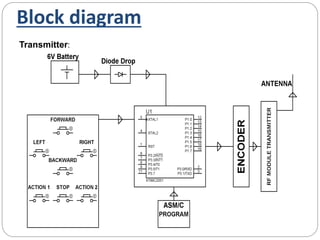
 The switches are interfaced to the RF
transmitter through RF Encoder.
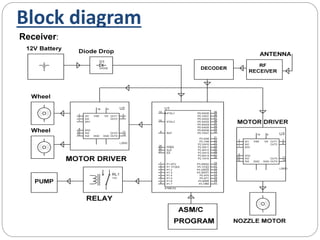
 If a switch is pressed then the motor gets
switched on which in turn switches on water
sprinkler
TECHNOLOGY/IDEA
5
 The encoder will continuously read the status of
the switches, passes the data to RF transmitter
and transmitter will transmits the data
 This data will be received by the RF receiver
 As the TX requires a encoder, the RX also needs a
decoder
 This project uses 9V battery
 This project uses AT89S52 MCU as its controller.
Block diagram
Transmitter:
Block diagram
Receiver:
DESCRIPTION
8
RF TRANSMITTER :
The transmitter used is STT 433 MHz.
It has 4 pins :
 Antenna
 Vcc
 Data
 GND
DESCRIPTION
9
RF RECEIVER :
The receiver used is STR 433MHz.
It has 8 pins :
 Antenna
 Three Ground
 Two Vcc supply
 Two Data pins
ADVANTAGES
10
 No line of sight
 Not blocked by common materials. It can pass
through solids
 Longer range
 Not sensitive to light
 Not sensitive to weather conditions
DISADVANTAGES
11
 Communication devices mostly use similar
frequency so interference occurs if address is not
specified.
 High cost.
 Data rate transmission is lower than wired
transmission.
 It cannot be work beyond limit
APPLICATION
12
 Industries are using RF solutions
for monitoring, control , process, inventory
tracking, data links and bar code reading devices.
 Consumer products
electronic toys, home security, gate and garage
door openers, Intercom, fire and safety systems,
and irrigation controllers.
 Medical products
patient call and monitoring, handicap assistance
device, surgery Communication system, remote
patient data logging and ECG monitor.
CONCLUSION
13
This Project presents a firefighting robot using RF
communication and it is designed and
implemented with Atmel 89S52 MCU in
embedded system domain. Experimental work has
been carried out carefully. The result shows that
higher efficiency is indeed achieved using the
embedded system. The proposed method is
verified to be highly beneficial for the security
purpose and industrial purpose.
FUTURE SCOPE OF
JAMMING
14
The practical application domains where
robotic technology is most likely to be used
are :
 Civil defence
 Search and rescue, Fire fighting
 Domestic services like cleaning , arranging
 Security/surveillance patrol, observation etc.
 War machines
 Exploration(oceans,space,deserts etc.)
15
REFRENCES
 http://www.academia.edu/6926582/DESIGN_AN
D_CONSTRUCTION_OF_FIRE_FIGHTING_RO
BOT_USING_ROBOTIC_VEHICAL.
 http://www.share.ne/rf-controlled-fire-fighting-
robot?from_action=save.
 http://www.elprocus.com/projects-on-fire-fighting-
robotic-vehicle/.
 http://www.edgefxkits.com/fire-fighting-robotic-
vehicle.
16
THANK YOU

FIRE FIGHTING ROBOT USING RF TECHNOLOGY

  • 1.
    Under the Guidenceof : PRESENTED BY: MONIKA SINGH YADU KAROT Professor(ET&T) Department SSEC-SSTC A Presentation on "WIRELESS OPERATED FIRE EXTINGUISHER VEHICLES WITH WATER JET SPRAY” Submitted to:Shri Shankaracharya Technical Campus Shri Shankaracharya Engineering Collage, Bhilai Dept. of Electronics & Telecommunication
  • 2.
    CONTENT : 2  ABSTRACT TECHNOLOGY / IDEA  BLOCK DIAGRAM  ADVANTAGES  DISADVANAGES  APPLICATION  CONCLUSION  FUTURE SCOPE  REFERENCES
  • 3.
    ABSTRACT 3  This projectdeals with RF controlled Robot.  It is used as fire extinguisher i.e. it sprinkles water on to fire  It is a prototype for the “path finder” which was sent to mars in 1998  This was a great achievement which detected the secrets of MARS  This can be moved forward and reverse direction using geared motors and can take sharp turnings.  When the robot is moving on a surface the system produces a beep sound when metal is detected.
  • 4.
    TECHNOLOGY/IDEA 4  RF robotcan also be used as fire extinguisher i.e. it sprinkles water on to fire  RF is a frequency or rate of oscillation within the range of 3Hz -300GHz  The RF modules used here are STT-433 MHz Transmitter, STR-433 MHz Receiver, HT12E RF Encoder and HT12D RF Decoder.  The switches are interfaced to the RF transmitter through RF Encoder.  If a switch is pressed then the motor gets switched on which in turn switches on water sprinkler
  • 5.
    TECHNOLOGY/IDEA 5  The encoderwill continuously read the status of the switches, passes the data to RF transmitter and transmitter will transmits the data  This data will be received by the RF receiver  As the TX requires a encoder, the RX also needs a decoder  This project uses 9V battery  This project uses AT89S52 MCU as its controller.
  • 6.
  • 7.
  • 8.
    DESCRIPTION 8 RF TRANSMITTER : Thetransmitter used is STT 433 MHz. It has 4 pins :  Antenna  Vcc  Data  GND
  • 9.
    DESCRIPTION 9 RF RECEIVER : Thereceiver used is STR 433MHz. It has 8 pins :  Antenna  Three Ground  Two Vcc supply  Two Data pins
  • 10.
    ADVANTAGES 10  No lineof sight  Not blocked by common materials. It can pass through solids  Longer range  Not sensitive to light  Not sensitive to weather conditions
  • 11.
    DISADVANTAGES 11  Communication devicesmostly use similar frequency so interference occurs if address is not specified.  High cost.  Data rate transmission is lower than wired transmission.  It cannot be work beyond limit
  • 12.
    APPLICATION 12  Industries areusing RF solutions for monitoring, control , process, inventory tracking, data links and bar code reading devices.  Consumer products electronic toys, home security, gate and garage door openers, Intercom, fire and safety systems, and irrigation controllers.  Medical products patient call and monitoring, handicap assistance device, surgery Communication system, remote patient data logging and ECG monitor.
  • 13.
    CONCLUSION 13 This Project presentsa firefighting robot using RF communication and it is designed and implemented with Atmel 89S52 MCU in embedded system domain. Experimental work has been carried out carefully. The result shows that higher efficiency is indeed achieved using the embedded system. The proposed method is verified to be highly beneficial for the security purpose and industrial purpose.
  • 14.
    FUTURE SCOPE OF JAMMING 14 Thepractical application domains where robotic technology is most likely to be used are :  Civil defence  Search and rescue, Fire fighting  Domestic services like cleaning , arranging  Security/surveillance patrol, observation etc.  War machines  Exploration(oceans,space,deserts etc.)
  • 15.
  • 16.