ABSTRACT
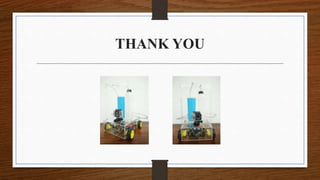
• The project aims to design and develop a FIRE EXTINGUISHER ROBOT.
• Fires are a major hazard that can cause significant damage to property and loss of
life.
• In many cases, fires can occur in hazardous environments where it is dangerous
or impossible for human firefighters to intervene.
• Fire extinguisher robots offer a potential solution to this problem by providing a
way to autonomously detect and extinguish fires in these environments.
INTRODUCTION
• It can autonomously detect and extinguish fires in hazardous environments,
• Robot will be equipped with a variety of sensors.
• It will also be equipped with a water tank and a pump to extinguish the fire.
• Robot will be controlled by a microcontroller that will use the sensor data to navigate the
robot.
• A microcontroller will also be programmed to avoid obstacles.
• It will be tested in a simulated fire environment to ensure that it is able to detect and
extinguish fires safely and effectively.
METHODOLOGY
• The project will be carried out in the following phases:
Phase 1:
• System Design- In this phase, the overall system architecture of the robot will be designed. This
will include selecting the appropriate hardware and software components, and designing the
communication and control system for the robot.
Phase 2:
• Hardware and Software Development- In this phase, the hardware and software components of
the robot will be developed. This will include developing the sensor system, the microcontroller
control system, and the navigation system for the robot.
METHODOLOGY(contd..)
Phase 3:
• Integration and Testing- In this phase, the hardware and software components of the robot will
be integrated and tested. This will include testing the robot's ability to detect and extinguish fires
in a simulated fire environment.
Phase 4:
• Deployment and Evaluation- In this phase, the robot will be deployed in a real-world
environment and evaluated for its performance. This will include evaluating the robot's ability to
detect and extinguish fires in a variety of hazardous environments.
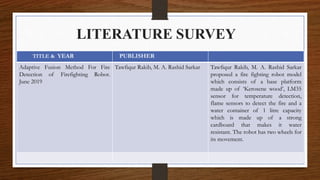
LITERATURE SURVEY
TITLE & YEAR PUBLISHER
Adaptive Fusion Method For Fire
Detection of Firefighting Robot.
June 2019
Tawfiqur Rakib, M. A. Rashid Sarkar Tawfiqur Rakib, M. A. Rashid Sarkar
proposed a fire fighting robot model
which consists of a base platform
made up of ‘Kerosene wood’, LM35
sensor for temperature detection,
flame sensors to detect the fire and a
water container of 1 litre capacity
which is made up of a strong
cardboard that makes it water
resistant. The robot has two wheels for
its movement.
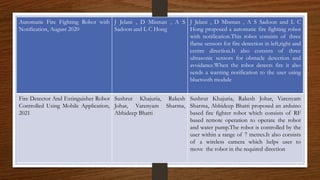
Automatic Fire Fighting Robot with
Notification, August 2020
J Jelani , D Misman , A S
Sadoon and L C Hong
J Jelani , D Misman , A S Sadoon and L C
Hong proposed a automatic fire fighting robot
with notification.This robot consists of three
flame sensors for fire detection in left,right and
centre direction.It also consists of three
ultrasonic sensors for obstacle detection and
avoidance.When the robot detects fire it also
sends a warning notification to the user using
bluetooth module
Fire Detector And Extinguisher Robot
Controlled Using Mobile Application,
2021
Sushrut Khajuria, Rakesh
Johar, Varenyam Sharma,
Abhideep Bhatti
Sushrut Khajuria, Rakesh Johar, Varenyam
Sharma, Abhideep Bhatti proposed an arduino
based fire fighter robot which consists of RF
based remote operation to operate the robot
and water pump.The robot is controlled by the
user within a range of 7 metres.It also consists
of a wireless camera which helps user to
move the robot in the required direction
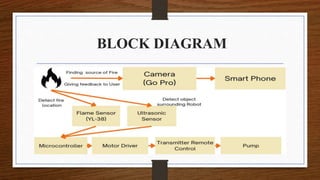
BLOCK DIAGRAM
HARDWARE AND SOFTWARE
DESCRIPTION(contd..)
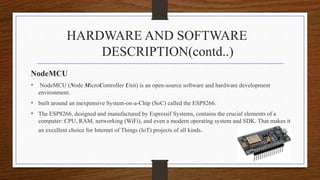
NodeMCU
• NodeMCU (Node MicroController Unit) is an open-source software and hardware development
environment.
• built around an inexpensive System-on-a-Chip (SoC) called the ESP8266.
• The ESP8266, designed and manufactured by Espressif Systems, contains the crucial elements of a
computer: CPU, RAM, networking (WiFi), and even a modern operating system and SDK. That makes it
an excellent choice for Internet of Things (IoT) projects of all kinds.
HARDWARE AND SOFTWARE
DESCRIPTION
IR Flame Sensor
• The IR flame sensor senses the environment and detects the presence of fire or flame.
• The module is based on the IR receiver and basically detects the presence of flammable and harmfu
l gases like nitrogen ,hydrogen, carbon mono oxide.
• The Signal detection capacity is adjustable. The robot contains three flame sensors.
HARDWARE AND SOFTWARE
DESCRIPTION
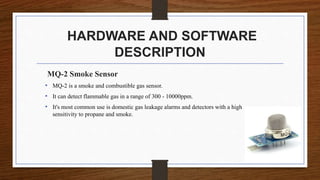
MQ-2 Smoke Sensor
• MQ-2 is a smoke and combustible gas sensor.
• It can detect flammable gas in a range of 300 - 10000ppm.
• It's most common use is domestic gas leakage alarms and detectors with a high
sensitivity to propane and smoke.
HARDWARE AND SOFTWARE
DESCRIPTION(contd..)
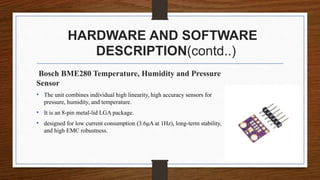
Bosch BME280 Temperature, Humidity and Pressure
Sensor
• The unit combines individual high linearity, high accuracy sensors for
pressure, humidity, and temperature.
• It is an 8-pin metal-lid LGA package.
• designed for low current consumption (3.6μA at 1Hz), long-term stability,
and high EMC robustness.
HARDWARE AND SOFTWARE
DESCRIPTION(contd..)
DC Motors
• Direct Current (DC) Motor
• electric machine that converts electrical energy into mechanical energy.
Servo Motors
• rotary actuator or linear actuator that allows for precise control of angular or linear position,
velocity, and acceleration in a mechanical system.
HARDWARE AND SOFTWARE
DESCRIPTION(contd..)
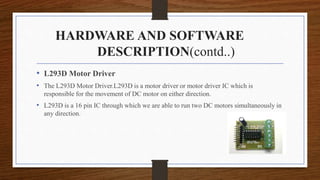
• L293D Motor Driver
• The L293D Motor Driver.L293D is a motor driver or motor driver IC which is
responsible for the movement of DC motor on either direction.
• L293D is a 16 pin IC through which we are able to run two DC motors simultaneously in
any direction.
HARDWARE AND SOFTWARE
DESCRIPTION(contd..)
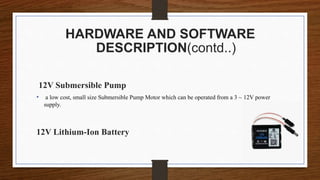
12V Submersible Pump
• a low cost, small size Submersible Pump Motor which can be operated from a 3 ~ 12V power
supply.
12V Lithium-Ion Battery
HARDWARE AND SOFTWARE
DESCRIPTION(contd..)
• SOFTWARE REQUIREMENTS:
• The Arduino software provides an integrated development environment (Arduino IDE) and core
libraries.
• The Arduino IDE program is a software program written in Java language and based on the Processing.
• The open source Arduino IDE makes it easy to write code and upload it to the Arduino Uno for
execution.It is available for all major desktop platform i.e.,Windows,Mac OS X,and Linux
CONCLUSION
• It gives a detailed concept about a robot which automatically detects fire and
extinguishes it in quickest time by the use of sensors, microcontroller, etc.
•
• This robot is used where human lives are very dangerous, for example for
extinguishing fire in tunnels, in industries, hospitals and in house uses.
THANK YOU

design and develop a FIRE EXTINGUISHER ROBOT.pptx

  • 2.
    ABSTRACT • The projectaims to design and develop a FIRE EXTINGUISHER ROBOT. • Fires are a major hazard that can cause significant damage to property and loss of life. • In many cases, fires can occur in hazardous environments where it is dangerous or impossible for human firefighters to intervene. • Fire extinguisher robots offer a potential solution to this problem by providing a way to autonomously detect and extinguish fires in these environments.
  • 3.
    INTRODUCTION • It canautonomously detect and extinguish fires in hazardous environments, • Robot will be equipped with a variety of sensors. • It will also be equipped with a water tank and a pump to extinguish the fire. • Robot will be controlled by a microcontroller that will use the sensor data to navigate the robot. • A microcontroller will also be programmed to avoid obstacles. • It will be tested in a simulated fire environment to ensure that it is able to detect and extinguish fires safely and effectively.
  • 4.
    METHODOLOGY • The projectwill be carried out in the following phases: Phase 1: • System Design- In this phase, the overall system architecture of the robot will be designed. This will include selecting the appropriate hardware and software components, and designing the communication and control system for the robot. Phase 2: • Hardware and Software Development- In this phase, the hardware and software components of the robot will be developed. This will include developing the sensor system, the microcontroller control system, and the navigation system for the robot.
  • 5.
    METHODOLOGY(contd..) Phase 3: • Integrationand Testing- In this phase, the hardware and software components of the robot will be integrated and tested. This will include testing the robot's ability to detect and extinguish fires in a simulated fire environment. Phase 4: • Deployment and Evaluation- In this phase, the robot will be deployed in a real-world environment and evaluated for its performance. This will include evaluating the robot's ability to detect and extinguish fires in a variety of hazardous environments.
  • 6.
    LITERATURE SURVEY TITLE &YEAR PUBLISHER Adaptive Fusion Method For Fire Detection of Firefighting Robot. June 2019 Tawfiqur Rakib, M. A. Rashid Sarkar Tawfiqur Rakib, M. A. Rashid Sarkar proposed a fire fighting robot model which consists of a base platform made up of ‘Kerosene wood’, LM35 sensor for temperature detection, flame sensors to detect the fire and a water container of 1 litre capacity which is made up of a strong cardboard that makes it water resistant. The robot has two wheels for its movement.
  • 7.
    Automatic Fire FightingRobot with Notification, August 2020 J Jelani , D Misman , A S Sadoon and L C Hong J Jelani , D Misman , A S Sadoon and L C Hong proposed a automatic fire fighting robot with notification.This robot consists of three flame sensors for fire detection in left,right and centre direction.It also consists of three ultrasonic sensors for obstacle detection and avoidance.When the robot detects fire it also sends a warning notification to the user using bluetooth module Fire Detector And Extinguisher Robot Controlled Using Mobile Application, 2021 Sushrut Khajuria, Rakesh Johar, Varenyam Sharma, Abhideep Bhatti Sushrut Khajuria, Rakesh Johar, Varenyam Sharma, Abhideep Bhatti proposed an arduino based fire fighter robot which consists of RF based remote operation to operate the robot and water pump.The robot is controlled by the user within a range of 7 metres.It also consists of a wireless camera which helps user to move the robot in the required direction
  • 8.
  • 9.
    HARDWARE AND SOFTWARE DESCRIPTION(contd..) NodeMCU •NodeMCU (Node MicroController Unit) is an open-source software and hardware development environment. • built around an inexpensive System-on-a-Chip (SoC) called the ESP8266. • The ESP8266, designed and manufactured by Espressif Systems, contains the crucial elements of a computer: CPU, RAM, networking (WiFi), and even a modern operating system and SDK. That makes it an excellent choice for Internet of Things (IoT) projects of all kinds.
  • 10.
    HARDWARE AND SOFTWARE DESCRIPTION IRFlame Sensor • The IR flame sensor senses the environment and detects the presence of fire or flame. • The module is based on the IR receiver and basically detects the presence of flammable and harmfu l gases like nitrogen ,hydrogen, carbon mono oxide. • The Signal detection capacity is adjustable. The robot contains three flame sensors.
  • 11.
    HARDWARE AND SOFTWARE DESCRIPTION MQ-2Smoke Sensor • MQ-2 is a smoke and combustible gas sensor. • It can detect flammable gas in a range of 300 - 10000ppm. • It's most common use is domestic gas leakage alarms and detectors with a high sensitivity to propane and smoke.
  • 12.
    HARDWARE AND SOFTWARE DESCRIPTION(contd..) BoschBME280 Temperature, Humidity and Pressure Sensor • The unit combines individual high linearity, high accuracy sensors for pressure, humidity, and temperature. • It is an 8-pin metal-lid LGA package. • designed for low current consumption (3.6μA at 1Hz), long-term stability, and high EMC robustness.
  • 13.
    HARDWARE AND SOFTWARE DESCRIPTION(contd..) DCMotors • Direct Current (DC) Motor • electric machine that converts electrical energy into mechanical energy. Servo Motors • rotary actuator or linear actuator that allows for precise control of angular or linear position, velocity, and acceleration in a mechanical system.
  • 14.
    HARDWARE AND SOFTWARE DESCRIPTION(contd..) •L293D Motor Driver • The L293D Motor Driver.L293D is a motor driver or motor driver IC which is responsible for the movement of DC motor on either direction. • L293D is a 16 pin IC through which we are able to run two DC motors simultaneously in any direction.
  • 15.
    HARDWARE AND SOFTWARE DESCRIPTION(contd..) 12VSubmersible Pump • a low cost, small size Submersible Pump Motor which can be operated from a 3 ~ 12V power supply. 12V Lithium-Ion Battery
  • 16.
    HARDWARE AND SOFTWARE DESCRIPTION(contd..) •SOFTWARE REQUIREMENTS: • The Arduino software provides an integrated development environment (Arduino IDE) and core libraries. • The Arduino IDE program is a software program written in Java language and based on the Processing. • The open source Arduino IDE makes it easy to write code and upload it to the Arduino Uno for execution.It is available for all major desktop platform i.e.,Windows,Mac OS X,and Linux
  • 17.
    CONCLUSION • It givesa detailed concept about a robot which automatically detects fire and extinguishes it in quickest time by the use of sensors, microcontroller, etc. • • This robot is used where human lives are very dangerous, for example for extinguishing fire in tunnels, in industries, hospitals and in house uses.
  • 18.