Basic Scaffolding Training
WEL COME to Emarat
Name of facilitator:
Syed Neyaz Ahmad
Safety Officer
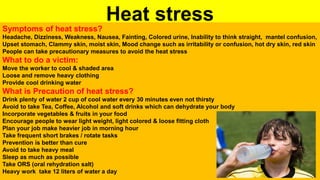
Heat stress
Symptoms of heat stress?
Headache, Dizziness, Weakness, Nausea, Fainting, Colored urine, Inability to think straight, mantel confusion,
Upset stomach, Clammy skin, moist skin, Mood change such as irritability or confusion, hot dry skin, red skin
People can take precautionary measures to avoid the heat stress
What to do a victim:
Move the worker to cool & shaded area
Loose and remove heavy clothing
Provide cool drinking water
What is Precaution of heat stress?
Drink plenty of water 2 cup of cool water every 30 minutes even not thirsty
Avoid to take Tea, Coffee, Alcohol and soft drinks which can dehydrate your body
Incorporate vegetables & fruits in your food
Encourage people to wear light weight, light colored & loose fitting cloth
Plan your job make heavier job in morning hour
Take frequent short brakes / rotate tasks
Prevention is better than cure
Avoid to take heavy meal
Sleep as much as possible
Take ORS (oral rehydration salt)
Heavy work take 12 liters of water a day
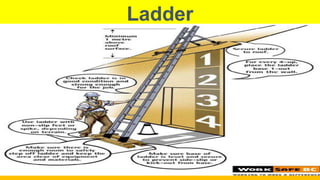
Ladder
• Make sure the ladder
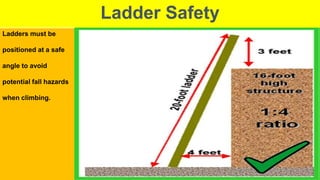
angle is at 75°
Don’t overload it.
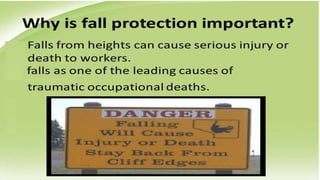
Importance of Fall Protection
Incomplete scaffold
OSHA 29 CFR 1926 Subpart M
(1926.500-503)
OSHA 29 CFR 1910 Subparts D, F, I
(1910.23, 66, 67, 132)
Proper Duty Rating/Capacity (Ladder)
Select a ladder with the proper
duty rating for your weight and
the materials you are handling
OSHA Requirement
Ladders shall not be loaded
beyond the maximum intended
load for which they were built nor
beyond their manufacturer's rated capacity.
TYPE DUTYRATING USE LOAD
1AA SpecialHeavyDuty Rugged 375Lbs.
1A ExtraHeavyDuty Industrial 300Lbs.
1 HeavyDuty Industrial 250Lbs.
II MediumDuty Commercial 225Lbs.
III LightDuty Household 200Lbs.
Ladder Safety
Ladders must be
positioned at a safe
angle to avoid
potential fall hazards
when climbing.
Ladder Safety
Always:
 using both hands to keep a safe grip.
 Face ladder when going up or down.
 Never climb a ladder while carrying any materials.
 Maintain three points of contact with the ladder at all times
 Maintain the center line of your body between the ladder’s
vertical support rails while working
 Check bottom of shoes and ladder rungs for grease and dirt
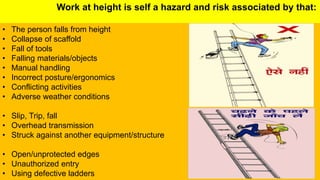
Work at height is self a hazard and risk associated by that:
• The person falls from height
• Collapse of scaffold
• Fall of tools
• Falling materials/objects
• Manual handling
• Incorrect posture/ergonomics
• Conflicting activities
• Adverse weather conditions
• Slip, Trip, fall
• Overhead transmission
• Struck against another equipment/structure
• Open/unprotected edges
• Unauthorized entry
• Using defective ladders
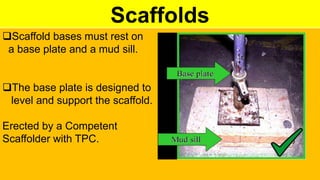
Scaffolds
Scaffold bases must rest on
a base plate and a mud sill.
The base plate is designed to
level and support the scaffold.
Erected by a Competent
Scaffolder with TPC.
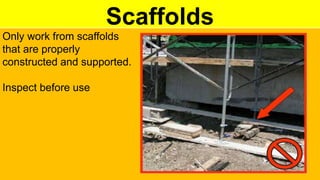
Scaffolds
Only work from scaffolds
that are properly
constructed and supported.
Inspect before use
Scaffolds
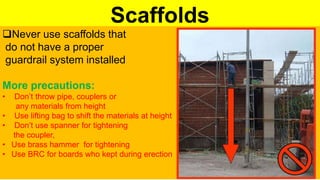
Never use scaffolds that
do not have a proper
guardrail system installed
More precautions:
• Don’t throw pipe, couplers or
any materials from height
• Use lifting bag to shift the materials at height
• Don’t use spanner for tightening
the coupler,
• Use brass hammer for tightening
• Use BRC for boards who kept during erection
Scaffolds
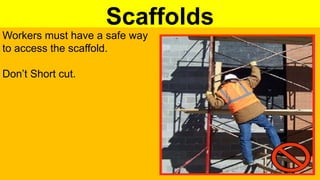
Workers must have a safe way
to access the scaffold.
Don’t Short cut.
Scaffolds
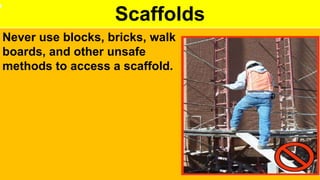
Never use blocks, bricks, walk
boards, and other unsafe
methods to access a scaffold.
Scaffolds
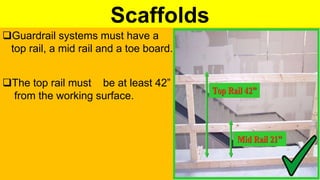
Guardrail systems must have a
top rail, a mid rail and a toe board.
The top rail must be at least 42”
from the working surface.
Scaffolds
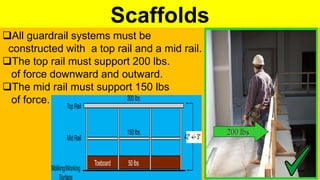
All guardrail systems must be
constructed with a top rail and a mid rail.
The top rail must support 200 lbs.
of force downward and outward.
The mid rail must support 150 lbs
of force.
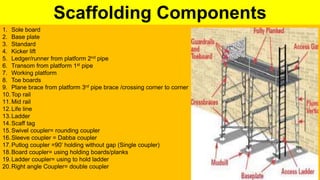
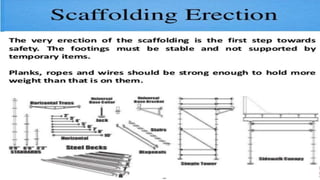
Scaffolding Components
1. Sole board
2. Base plate
3. Standard
4. Kicker lift
5. Ledger/runner from platform 2nd pipe
6. Transom from platform 1st pipe
7. Working platform
8. Toe boards
9. Plane brace from platform 3rd pipe brace /crossing corner to corner
10.Top rail
11.Mid rail
12.Life line
13.Ladder
14.Scaff tag
15.Swivel coupler= rounding coupler
16.Sleeve coupler = Dabba coupler
17.Putlog coupler =90’ holding without gap (Single coupler)
18.Board coupler= using holding boards/planks
19.Ladder coupler= using to hold ladder
20.Right angle Coupler= double coupler
Scaffolds
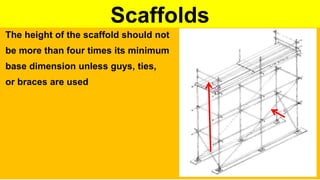
The height of the scaffold should not
be more than four times its minimum
base dimension unless guys, ties,
or braces are used
5’
Scaffolds
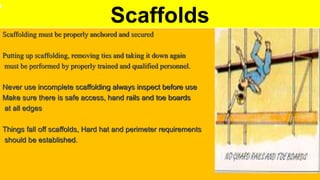
Scaffolding must be properly anchored and secured
Putting up scaffolding, removing ties and taking it down again
must be performed by properly trained and qualified personnel.
Never use incomplete scaffolding always inspect before use
Make sure there is safe access, hand rails and toe boards
at all edges
Things fall off scaffolds, Hard hat and perimeter requirements
should be established.
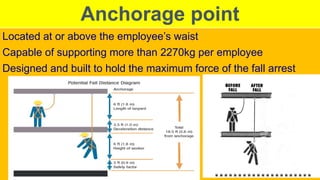
Anchorage point
Located at or above the employee’s waist
Capable of supporting more than 2270kg per employee
Designed and built to hold the maximum force of the fall arrest
Fall Arrest Equipment Use
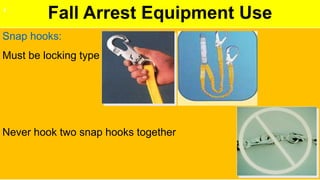
Snap hooks:
Must be locking type
Never hook two snap hooks together
Body Harness
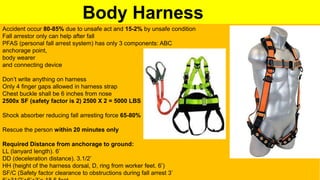
Accident occur 80-85% due to unsafe act and 15-2% by unsafe condition
Fall arrestor only can help after fall
PFAS (personal fall arrest system) has only 3 components: ABC
anchorage point,
body wearer
and connecting device
Don’t write anything on harness
Only 4 finger gaps allowed in harness strap
Chest buckle shall be 6 inches from nose
2500x SF (safety factor is 2) 2500 X 2 = 5000 LBS
Shock absorber reducing fall arresting force 65-80%
Rescue the person within 20 minutes only
Required Distance from anchorage to ground:
LL (lanyard length). 6’
DD (deceleration distance). 3.1/2’
HH (height of the harness dorsal, D, ring from worker feet. 6’)
SF/C (Safety factor clearance to obstructions during fall arrest 3’
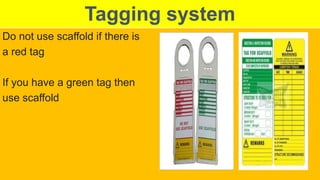
Tagging system
Do not use scaffold if there is
a red tag
If you have a green tag then
use scaffold
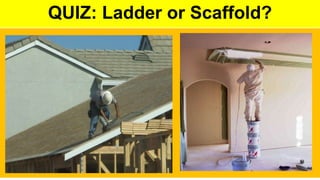
QUIZ: Ladder or Scaffold?
Thank you

Work at Height & Scaffolding Awareness 22.06.2021

  • 1.
    Basic Scaffolding Training WELCOME to Emarat Name of facilitator: Syed Neyaz Ahmad Safety Officer
  • 2.
    Heat stress Symptoms ofheat stress? Headache, Dizziness, Weakness, Nausea, Fainting, Colored urine, Inability to think straight, mantel confusion, Upset stomach, Clammy skin, moist skin, Mood change such as irritability or confusion, hot dry skin, red skin People can take precautionary measures to avoid the heat stress What to do a victim: Move the worker to cool & shaded area Loose and remove heavy clothing Provide cool drinking water What is Precaution of heat stress? Drink plenty of water 2 cup of cool water every 30 minutes even not thirsty Avoid to take Tea, Coffee, Alcohol and soft drinks which can dehydrate your body Incorporate vegetables & fruits in your food Encourage people to wear light weight, light colored & loose fitting cloth Plan your job make heavier job in morning hour Take frequent short brakes / rotate tasks Prevention is better than cure Avoid to take heavy meal Sleep as much as possible Take ORS (oral rehydration salt) Heavy work take 12 liters of water a day
  • 3.
    Ladder • Make surethe ladder angle is at 75° Don’t overload it.
  • 4.
  • 5.
    Incomplete scaffold OSHA 29CFR 1926 Subpart M (1926.500-503) OSHA 29 CFR 1910 Subparts D, F, I (1910.23, 66, 67, 132)
  • 6.
    Proper Duty Rating/Capacity(Ladder) Select a ladder with the proper duty rating for your weight and the materials you are handling OSHA Requirement Ladders shall not be loaded beyond the maximum intended load for which they were built nor beyond their manufacturer's rated capacity. TYPE DUTYRATING USE LOAD 1AA SpecialHeavyDuty Rugged 375Lbs. 1A ExtraHeavyDuty Industrial 300Lbs. 1 HeavyDuty Industrial 250Lbs. II MediumDuty Commercial 225Lbs. III LightDuty Household 200Lbs.
  • 7.
    Ladder Safety Ladders mustbe positioned at a safe angle to avoid potential fall hazards when climbing.
  • 8.
    Ladder Safety Always:  usingboth hands to keep a safe grip.  Face ladder when going up or down.  Never climb a ladder while carrying any materials.  Maintain three points of contact with the ladder at all times  Maintain the center line of your body between the ladder’s vertical support rails while working  Check bottom of shoes and ladder rungs for grease and dirt
  • 9.
    Work at heightis self a hazard and risk associated by that: • The person falls from height • Collapse of scaffold • Fall of tools • Falling materials/objects • Manual handling • Incorrect posture/ergonomics • Conflicting activities • Adverse weather conditions • Slip, Trip, fall • Overhead transmission • Struck against another equipment/structure • Open/unprotected edges • Unauthorized entry • Using defective ladders
  • 10.
    Scaffolds Scaffold bases mustrest on a base plate and a mud sill. The base plate is designed to level and support the scaffold. Erected by a Competent Scaffolder with TPC.
  • 11.
    Scaffolds Only work fromscaffolds that are properly constructed and supported. Inspect before use
  • 12.
    Scaffolds Never use scaffoldsthat do not have a proper guardrail system installed More precautions: • Don’t throw pipe, couplers or any materials from height • Use lifting bag to shift the materials at height • Don’t use spanner for tightening the coupler, • Use brass hammer for tightening • Use BRC for boards who kept during erection
  • 13.
    Scaffolds Workers must havea safe way to access the scaffold. Don’t Short cut.
  • 14.
    Scaffolds Never use blocks,bricks, walk boards, and other unsafe methods to access a scaffold.
  • 15.
    Scaffolds Guardrail systems musthave a top rail, a mid rail and a toe board. The top rail must be at least 42” from the working surface.
  • 16.
    Scaffolds All guardrail systemsmust be constructed with a top rail and a mid rail. The top rail must support 200 lbs. of force downward and outward. The mid rail must support 150 lbs of force.
  • 17.
    Scaffolding Components 1. Soleboard 2. Base plate 3. Standard 4. Kicker lift 5. Ledger/runner from platform 2nd pipe 6. Transom from platform 1st pipe 7. Working platform 8. Toe boards 9. Plane brace from platform 3rd pipe brace /crossing corner to corner 10.Top rail 11.Mid rail 12.Life line 13.Ladder 14.Scaff tag 15.Swivel coupler= rounding coupler 16.Sleeve coupler = Dabba coupler 17.Putlog coupler =90’ holding without gap (Single coupler) 18.Board coupler= using holding boards/planks 19.Ladder coupler= using to hold ladder 20.Right angle Coupler= double coupler
  • 18.
    Scaffolds The height ofthe scaffold should not be more than four times its minimum base dimension unless guys, ties, or braces are used 5’
  • 19.
    Scaffolds Scaffolding must beproperly anchored and secured Putting up scaffolding, removing ties and taking it down again must be performed by properly trained and qualified personnel. Never use incomplete scaffolding always inspect before use Make sure there is safe access, hand rails and toe boards at all edges Things fall off scaffolds, Hard hat and perimeter requirements should be established.
  • 20.
    Anchorage point Located ator above the employee’s waist Capable of supporting more than 2270kg per employee Designed and built to hold the maximum force of the fall arrest
  • 21.
    Fall Arrest EquipmentUse Snap hooks: Must be locking type Never hook two snap hooks together
  • 22.
    Body Harness Accident occur80-85% due to unsafe act and 15-2% by unsafe condition Fall arrestor only can help after fall PFAS (personal fall arrest system) has only 3 components: ABC anchorage point, body wearer and connecting device Don’t write anything on harness Only 4 finger gaps allowed in harness strap Chest buckle shall be 6 inches from nose 2500x SF (safety factor is 2) 2500 X 2 = 5000 LBS Shock absorber reducing fall arresting force 65-80% Rescue the person within 20 minutes only Required Distance from anchorage to ground: LL (lanyard length). 6’ DD (deceleration distance). 3.1/2’ HH (height of the harness dorsal, D, ring from worker feet. 6’) SF/C (Safety factor clearance to obstructions during fall arrest 3’
  • 23.
    Tagging system Do notuse scaffold if there is a red tag If you have a green tag then use scaffold
  • 25.
    QUIZ: Ladder orScaffold?
  • 26.