INTRODUCTION
TO
FIREFIGHTING


               1
What will you learn From this program
Life Safety
  The primary goal of fire safety efforts is to protect
    building occupants from injury and to prevent
    loss of life.
Property Protection
  The secondary goal of fire safety is to prevent
    property damage.
Protection of Operations
  By preventing fires and limiting damage we can
    assure that work operations will continue.
                                                          2
What will you learn From this program
a. How can you prevent Fire accidents?

b. How can you develop fire prevention checklists?

c. How can you inspect and update your fire fighting appliances?

d. How can you use Fire fighting appliances?

e. What will you do in case of fire accidents?

f. How can you develop fire emergency plan?
                                                                   3
Pakistan Petroleum Limited

                    What is a Fire
Fire is a chain of chemical reaction involving rapid
oxidation or burning of a fuel, which produce smoke,
heat and flame.
•Fuel
•Oxygen
•Temperature
                                                       4
CHEMISTRY OF FIRE
                   Chain Reaction


BURNING MATERIAL + TEMPERATURE + OXYGEN + CHAIN REACTION
                                =FIRE                   5
Classifications according to burning materials

•   Class A - Ordinary combustibles
•   Class B - Flammable liquids Fires
•   Class C – Class Gas Fires
•   Class D - Metal Fires
•   Class E – Electric & Machinery Fires
•   Class F – Kitchen Fires
                                                 6
                                                 1a
How to extinguish fire?


                          7
8
9
10
How Fire Expands?


                    11
12
CONVECTION


             13
RADIATION


            14
CAUSES OF FIRE
     AND
FIRE PREVENTION

                  15
COMMON CAUSES OF FIRE ACCIDENT
   Smoking
   Electric short circuiting
   Over heating of electric appliances.
   Over heating of engine or machine.
   Over heating of oil.
   Heater or coal burner
   Matches
   Spark of oven
   Sprit lamp
   Self created fire
   Friction or resistance
   High temperature in summer season      16
Special Causes of Fire
•   Dust Explosion
•   Gas and Vapor Explosion
•   Chemical Reactions
•   Seasonal Changes
•   Lightening
•   Etc.


                                    17
Basic Principles of Fire Prevention
• Prevention of the starting of fire.
• Prevention of the spreading of fire.
• Prevention of water damage.


                                         18
Prevention of Starting of Fire
• The premises, machines and house-hold
  articles to be kept neat and clean.
• Sufficient space in between the buildings.
• Proper Storage (in godowns)
• Careful about fire works.
• Periodic inspection of electrical wiring.
• No Smoking notices.

                                               19
Prevention of Spreading of Fire
• Firefighting Training for all.
• First Aid Firefighting Equipment.
• Provision of adequate water supply.
• Removal of combustible material from room
  and attics.
• Fire Receptivity.
• Efficient Firefighting Service.

                                              20
Prevention of Water Damage.
• It is job of the professional firefighters to see
  that less water damage is caused while
  fighting a fire.


                                                      21
FIRE EXTINGUISHER
AN INSTRUMENT USED
TO EXTINGUISH THE
FIRE IS KNOWN AS
FIRE EXTINGUISHER.


                          22
Standards for portable fire extinguishers


• OSHA-29 CFR 1910.157 - Portable Fire
  Extinguishers.

• NFPA-10

• Civil Defense Of Pakistan
                                                 23
WATER FIRE
EXTINGUISHER


               24
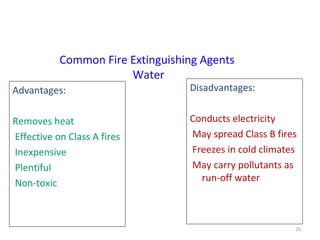
Common Fire Extinguishing Agents
                       Water
Advantages:                       Disadvantages:


Removes heat                      Conducts electricity
Effective on Class A fires        May spread Class B fires
Inexpensive                       Freezes in cold climates
Plentiful                         May carry pollutants as
                                    run-off water
Non-toxic


                                                         25
FOAM FIRE
EXTINGUISHER


               26
DCP FIRE EXTINGUISHER


                        27
28
Common Fire Extinguishing Agents
                  Dry Chemical

Advantage:                    Disadvantage:
• Interrupts chemical         • Leaves a residue
  reactions                   • Obscures vision
• Sodium bicarbonate          • Not good on deep-seated
   (baking soda)                 fires
• Very effective on Class B   • Nozzle pressure may cause
   and C fires                   burning liquids to splash
• Not considered toxic

                                                             29
Common Fire Extinguishing Agents
              Multipurpose Dry Chemical


Advantages:                      • Disadvantages:
                                 • Obscures vision
• Interrupts chemical
                                 • More irritating than
  reactions                         ordinary dry chemical
• Ammonium phosphate             • Nozzle pressure may
• Effective on Class A, B, and      cause
  C fires                        • burning liquids to splash
• Non-conductive                   Create a layer on
                                    components


                                                               30
CO2 FIRE EXTINGUISHER


                        31
Common Fire Extinguishing Agents
                  Carbon Dioxide (CO2)

Advantage:                     Disadvantage:

                               • Generally >35%
• Reduces oxygen to less
                                 concentration needed
  than 15%.                    • Toxic to humans at >4%
• Effective on Class B and C      by volume
  fires.                       • Not the best agent for
• No residue.                    smoldering fires
                               • Dissipates rapidly - allows
• Relatively inert.
                                 reflash

                                                               32
HALONTRON FIRE
EXTINGUISHER


                 33
FIRE EXTINGUISHER SLECTION

        Type Of Fire                         Class         Class B         Class C         Class K
                                               A
        Extinguisher
Water Type                             Yes           No              No              No


Carbon Dioxide (CO2)                   No            Yes             Yes             Yes


Dry Chemical Powder- BC                No            Yes             Yes             Yes


Multipurpose Dry Chemical Powder ABC   Yes           Yes             Yes             Yes


Halon/ Halotron                        Yes           Yes             Yes             Yes

                                                                                               34
Appropriate use of extinguishers
• You can fight the fire with your back toward
  an escape route

• The extinguisher matches the fire type

• The extinguisher works effectively


                                                 35
                                                  2b
Appropriate use of extinguishers


    • You are properly trained in the use of
      the extinguisher

    • You are confident you can put the
      fire out


                                           36
                                               2c
Appropriate use of extinguishers

• The fire is large and has grown beyond its
  original confined space

• Your escape path is threatened

• You are not sure if you have the correct type
  of fire extinguisher


                                                  37
                                                   3a
Personal hazards
• Smoke and noxious fumes

• Smoke and fumes cause unconsciousness

• Death may result


                                          38
                                           4a
How to inspect your fire extinguisher.

Access
Working pressure
Hose
Safety Pin
Refilling Date
Expiry Date


                                          39
PASS method of fighting fires
Hold the extinguisher upright
• Pull the pin
• Aim at the base of the fire
• Squeeze the handle
• Sweep the base of the fire

• Do not aim high at the flames

                                    40
                                     5a
Fire Hydrant System
• OSHA- 29 CFR 1910.158 - Stand pipe and hose
  systems

• NFPA-25

• IAP Standards


                                            41
Fire Fighter Kit


                   42
When not to fight a fire?
Never fight a fire:
• If the fire is spreading beyond the spot where it started

• If you can't fight the fire with your back to an escape exit

• If the fire can block your only escape

• If you don't have adequate fire-fighting equipment


                                                                 43
How to create an Emergency Action
                  Plan?
•   Objective
•   Information and communication
•   Evacuation
•   Emergency Equipment
•   workstations of the disabled workers
•   Emergency Action Leaders and Teams
•   Emergency Action Plan Locations
•   Training and Drills
                                           44
How to evacuate a burning
•
                         building?
    should not lock the door, just close it
•   Proceed to the exit.
•   NEVER, NEVER use elevators.
•   Stay low, crawl if necessary.
                                          Assembly Point # 1
•   Once in the stairwell, Never go up.
•   Report to a predetermined area.
•   when the evacuation alarm sounds,

    “EVERYONE MUST LEAVE THE BUILDING”

                                                               45
What to do if trapped in a burning building?
• Never open a closed door without feeling it first
• If the door is hot, try another exit
• use wet towels to seal the space under the door and
  prevent the entry of smoke
• If trapped, look for a nearby phone and call the fire
  department
• If on an upper floor and your window is of a type that
  CANNOT be opened, DON'T break it out- you'll be raining
  glass down on rescuers and people exiting the building
• If you can't contact the fire department by phone, wave for
  attention at the window. Don't panic.
                                                           46
Pakistan Petroleum Limited


Learn Not To Burn


                             47
What to do if someone catches
              fire?
If a co-worker catches on fire, smother flames
 by grabbing a blanket or rug and wrapping
 them up in it. That could save them from
 serious burns or even death.


                                             48
What to do if you catch a fire?
If you should catch on fire:

  STOP - where you are

  DROP - to the floor

  ROLL - around on the floor

  This will smother the flames, possibly saving
  your life.
                                                  49
Rescue
•   Fire Man Crawl
•   Fire Man lift
•   Jumping from low window
•   Jumping from high window


                               50

Fire

  • 1.
  • 2.
    What will youlearn From this program Life Safety The primary goal of fire safety efforts is to protect building occupants from injury and to prevent loss of life. Property Protection The secondary goal of fire safety is to prevent property damage. Protection of Operations By preventing fires and limiting damage we can assure that work operations will continue. 2
  • 3.
    What will youlearn From this program a. How can you prevent Fire accidents? b. How can you develop fire prevention checklists? c. How can you inspect and update your fire fighting appliances? d. How can you use Fire fighting appliances? e. What will you do in case of fire accidents? f. How can you develop fire emergency plan? 3
  • 4.
    Pakistan Petroleum Limited What is a Fire Fire is a chain of chemical reaction involving rapid oxidation or burning of a fuel, which produce smoke, heat and flame. •Fuel •Oxygen •Temperature 4
  • 5.
    CHEMISTRY OF FIRE Chain Reaction BURNING MATERIAL + TEMPERATURE + OXYGEN + CHAIN REACTION =FIRE 5
  • 6.
    Classifications according toburning materials • Class A - Ordinary combustibles • Class B - Flammable liquids Fires • Class C – Class Gas Fires • Class D - Metal Fires • Class E – Electric & Machinery Fires • Class F – Kitchen Fires 6 1a
  • 7.
  • 8.
  • 9.
  • 10.
  • 11.
  • 12.
  • 13.
  • 14.
  • 15.
    CAUSES OF FIRE AND FIRE PREVENTION 15
  • 16.
    COMMON CAUSES OFFIRE ACCIDENT  Smoking  Electric short circuiting  Over heating of electric appliances.  Over heating of engine or machine.  Over heating of oil.  Heater or coal burner  Matches  Spark of oven  Sprit lamp  Self created fire  Friction or resistance  High temperature in summer season 16
  • 17.
    Special Causes ofFire • Dust Explosion • Gas and Vapor Explosion • Chemical Reactions • Seasonal Changes • Lightening • Etc. 17
  • 18.
    Basic Principles ofFire Prevention • Prevention of the starting of fire. • Prevention of the spreading of fire. • Prevention of water damage. 18
  • 19.
    Prevention of Startingof Fire • The premises, machines and house-hold articles to be kept neat and clean. • Sufficient space in between the buildings. • Proper Storage (in godowns) • Careful about fire works. • Periodic inspection of electrical wiring. • No Smoking notices. 19
  • 20.
    Prevention of Spreadingof Fire • Firefighting Training for all. • First Aid Firefighting Equipment. • Provision of adequate water supply. • Removal of combustible material from room and attics. • Fire Receptivity. • Efficient Firefighting Service. 20
  • 21.
    Prevention of WaterDamage. • It is job of the professional firefighters to see that less water damage is caused while fighting a fire. 21
  • 22.
    FIRE EXTINGUISHER AN INSTRUMENTUSED TO EXTINGUISH THE FIRE IS KNOWN AS FIRE EXTINGUISHER. 22
  • 23.
    Standards for portablefire extinguishers • OSHA-29 CFR 1910.157 - Portable Fire Extinguishers. • NFPA-10 • Civil Defense Of Pakistan 23
  • 24.
  • 25.
    Common Fire ExtinguishingAgents Water Advantages: Disadvantages: Removes heat Conducts electricity Effective on Class A fires May spread Class B fires Inexpensive Freezes in cold climates Plentiful May carry pollutants as run-off water Non-toxic 25
  • 26.
  • 27.
  • 28.
  • 29.
    Common Fire ExtinguishingAgents Dry Chemical Advantage: Disadvantage: • Interrupts chemical • Leaves a residue reactions • Obscures vision • Sodium bicarbonate • Not good on deep-seated (baking soda) fires • Very effective on Class B • Nozzle pressure may cause and C fires burning liquids to splash • Not considered toxic 29
  • 30.
    Common Fire ExtinguishingAgents Multipurpose Dry Chemical Advantages: • Disadvantages: • Obscures vision • Interrupts chemical • More irritating than reactions ordinary dry chemical • Ammonium phosphate • Nozzle pressure may • Effective on Class A, B, and cause C fires • burning liquids to splash • Non-conductive Create a layer on components 30
  • 31.
  • 32.
    Common Fire ExtinguishingAgents Carbon Dioxide (CO2) Advantage: Disadvantage: • Generally >35% • Reduces oxygen to less concentration needed than 15%. • Toxic to humans at >4% • Effective on Class B and C by volume fires. • Not the best agent for • No residue. smoldering fires • Dissipates rapidly - allows • Relatively inert. reflash 32
  • 33.
  • 34.
    FIRE EXTINGUISHER SLECTION Type Of Fire Class Class B Class C Class K A Extinguisher Water Type Yes No No No Carbon Dioxide (CO2) No Yes Yes Yes Dry Chemical Powder- BC No Yes Yes Yes Multipurpose Dry Chemical Powder ABC Yes Yes Yes Yes Halon/ Halotron Yes Yes Yes Yes 34
  • 35.
    Appropriate use ofextinguishers • You can fight the fire with your back toward an escape route • The extinguisher matches the fire type • The extinguisher works effectively 35 2b
  • 36.
    Appropriate use ofextinguishers • You are properly trained in the use of the extinguisher • You are confident you can put the fire out 36 2c
  • 37.
    Appropriate use ofextinguishers • The fire is large and has grown beyond its original confined space • Your escape path is threatened • You are not sure if you have the correct type of fire extinguisher 37 3a
  • 38.
    Personal hazards • Smokeand noxious fumes • Smoke and fumes cause unconsciousness • Death may result 38 4a
  • 39.
    How to inspectyour fire extinguisher. Access Working pressure Hose Safety Pin Refilling Date Expiry Date 39
  • 40.
    PASS method offighting fires Hold the extinguisher upright • Pull the pin • Aim at the base of the fire • Squeeze the handle • Sweep the base of the fire • Do not aim high at the flames 40 5a
  • 41.
    Fire Hydrant System •OSHA- 29 CFR 1910.158 - Stand pipe and hose systems • NFPA-25 • IAP Standards 41
  • 42.
  • 43.
    When not tofight a fire? Never fight a fire: • If the fire is spreading beyond the spot where it started • If you can't fight the fire with your back to an escape exit • If the fire can block your only escape • If you don't have adequate fire-fighting equipment 43
  • 44.
    How to createan Emergency Action Plan? • Objective • Information and communication • Evacuation • Emergency Equipment • workstations of the disabled workers • Emergency Action Leaders and Teams • Emergency Action Plan Locations • Training and Drills 44
  • 45.
    How to evacuatea burning • building? should not lock the door, just close it • Proceed to the exit. • NEVER, NEVER use elevators. • Stay low, crawl if necessary. Assembly Point # 1 • Once in the stairwell, Never go up. • Report to a predetermined area. • when the evacuation alarm sounds, “EVERYONE MUST LEAVE THE BUILDING” 45
  • 46.
    What to doif trapped in a burning building? • Never open a closed door without feeling it first • If the door is hot, try another exit • use wet towels to seal the space under the door and prevent the entry of smoke • If trapped, look for a nearby phone and call the fire department • If on an upper floor and your window is of a type that CANNOT be opened, DON'T break it out- you'll be raining glass down on rescuers and people exiting the building • If you can't contact the fire department by phone, wave for attention at the window. Don't panic. 46
  • 47.
  • 48.
    What to doif someone catches fire? If a co-worker catches on fire, smother flames by grabbing a blanket or rug and wrapping them up in it. That could save them from serious burns or even death. 48
  • 49.
    What to doif you catch a fire? If you should catch on fire: STOP - where you are DROP - to the floor ROLL - around on the floor This will smother the flames, possibly saving your life. 49
  • 50.
    Rescue • Fire Man Crawl • Fire Man lift • Jumping from low window • Jumping from high window 50