Mrs Anam Ashfaq
Lahore
Fire Fighting
&
Safety Measures
Contents
 Civil Defence
 Fire
 Fire Classes
 Fire Protection
 Fire Extinguishers
 First aid
CIVIL DEFENCE
According to Civil Defence act 1952
amended in 1996 the definition of Civil
Defence is
"Civil Defence includes any measures
not amounting to actual combat for
affording defence against any form of
hostile attack by a foreign power or for
depriving any form of hostile attack by a
foreign power of its effects. Whether
such measures are taken before,
during or after the time of attack. It also
includes remedial measures against
natural and man made disasters in
peace time".
What is Fire?
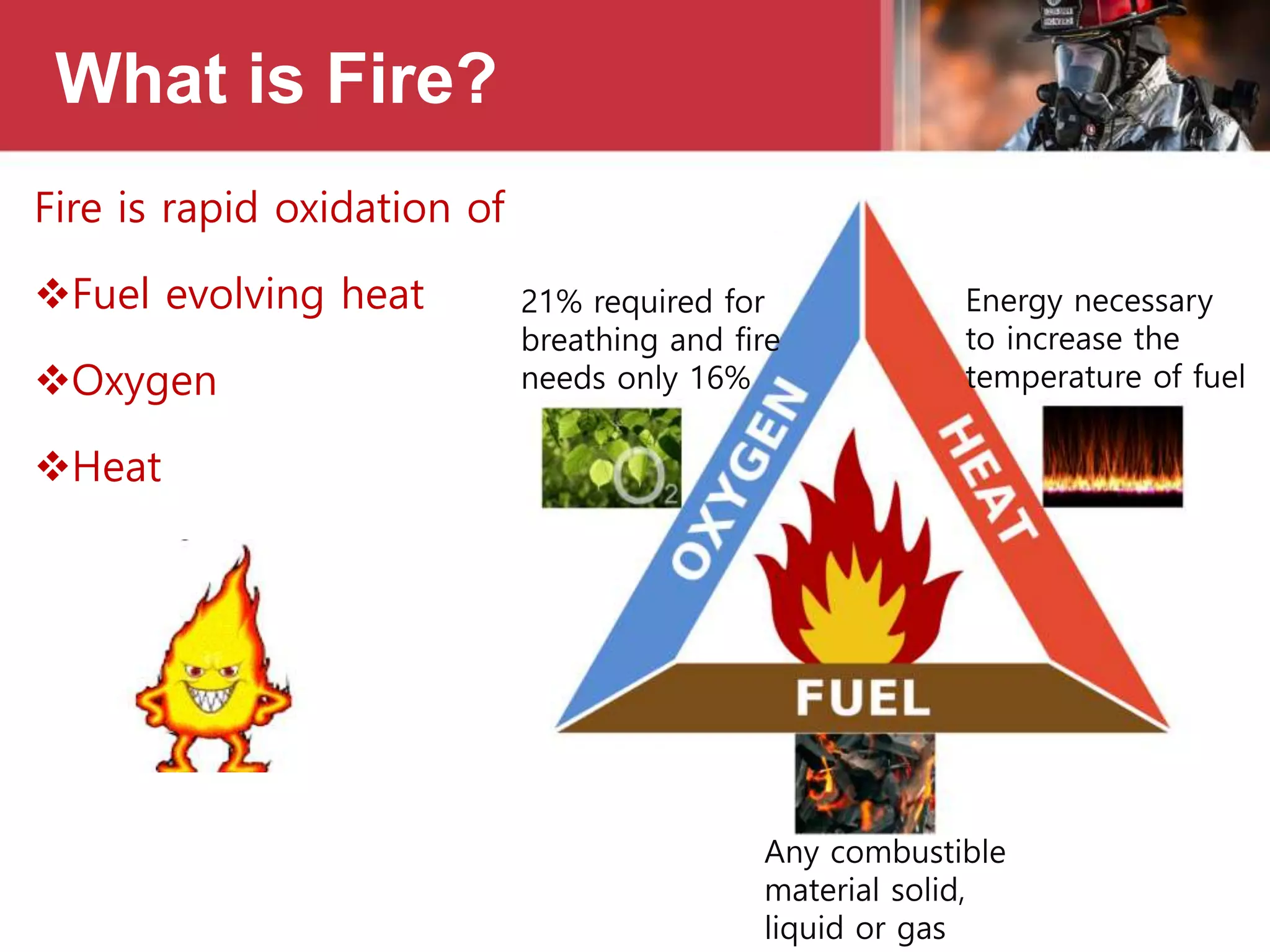
Fire is rapid oxidation of
Fuel evolving heat
Oxygen
Heat
Any combustible
material solid,
liquid or gas
21% required for
breathing and fire
needs only 16%
Energy necessary
to increase the
temperature of fuel
Extinguishing method
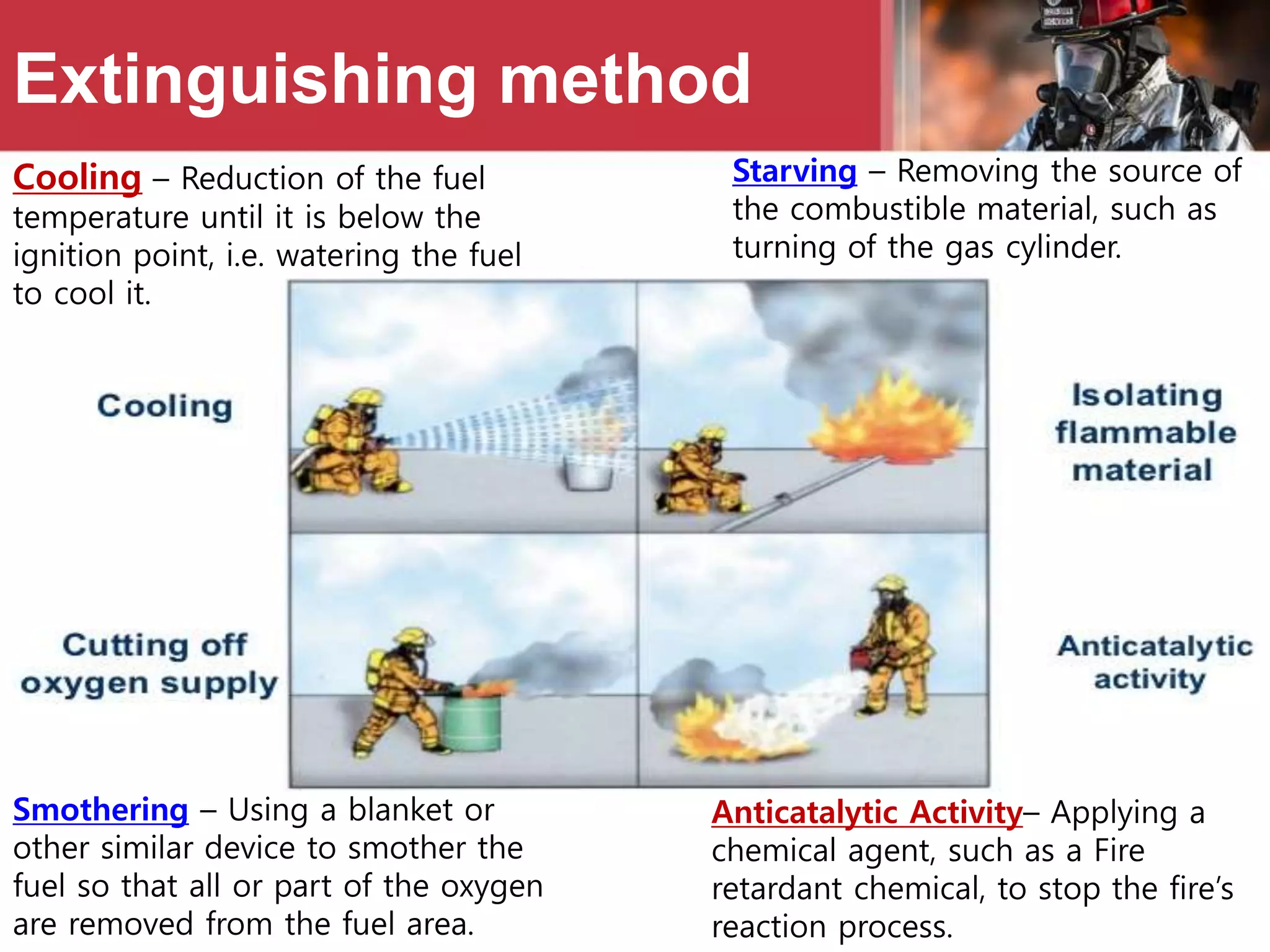
Cooling – Reduction of the fuel
temperature until it is below the
ignition point, i.e. watering the fuel
to cool it.
Smothering – Using a blanket or
other similar device to smother the
fuel so that all or part of the oxygen
are removed from the fuel area.
Starving – Removing the source of
the combustible material, such as
turning of the gas cylinder.
Anticatalytic Activity– Applying a
chemical agent, such as a Fire
retardant chemical, to stop the fire’s
reaction process.
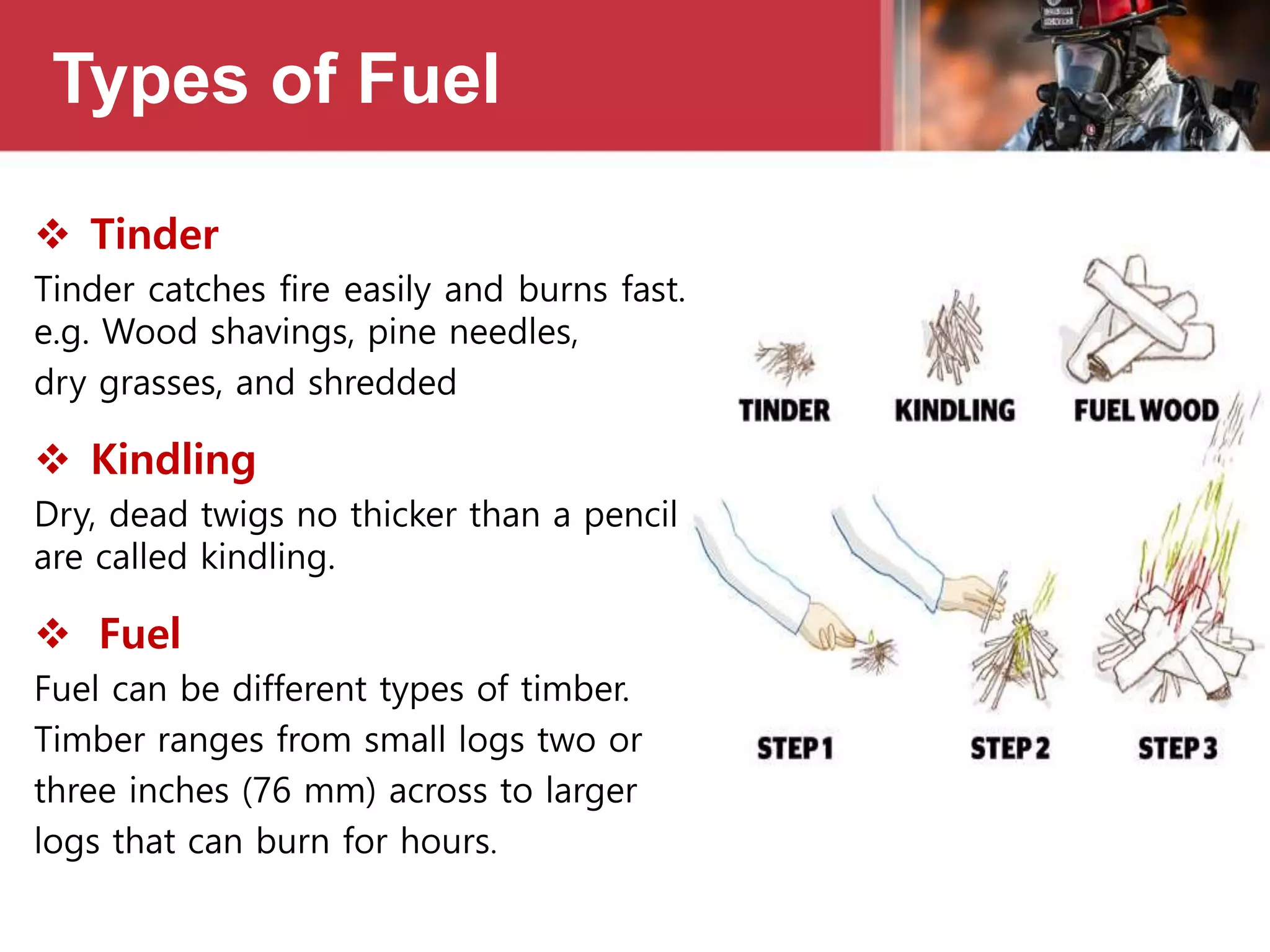
Types of Fuel
 Tinder
Tinder catches fire easily and burns fast.
e.g. Wood shavings, pine needles,
dry grasses, and shredded
 Kindling
Dry, dead twigs no thicker than a pencil
are called kindling.
 Fuel
Fuel can be different types of timber.
Timber ranges from small logs two or
three inches (76 mm) across to larger
logs that can burn for hours.
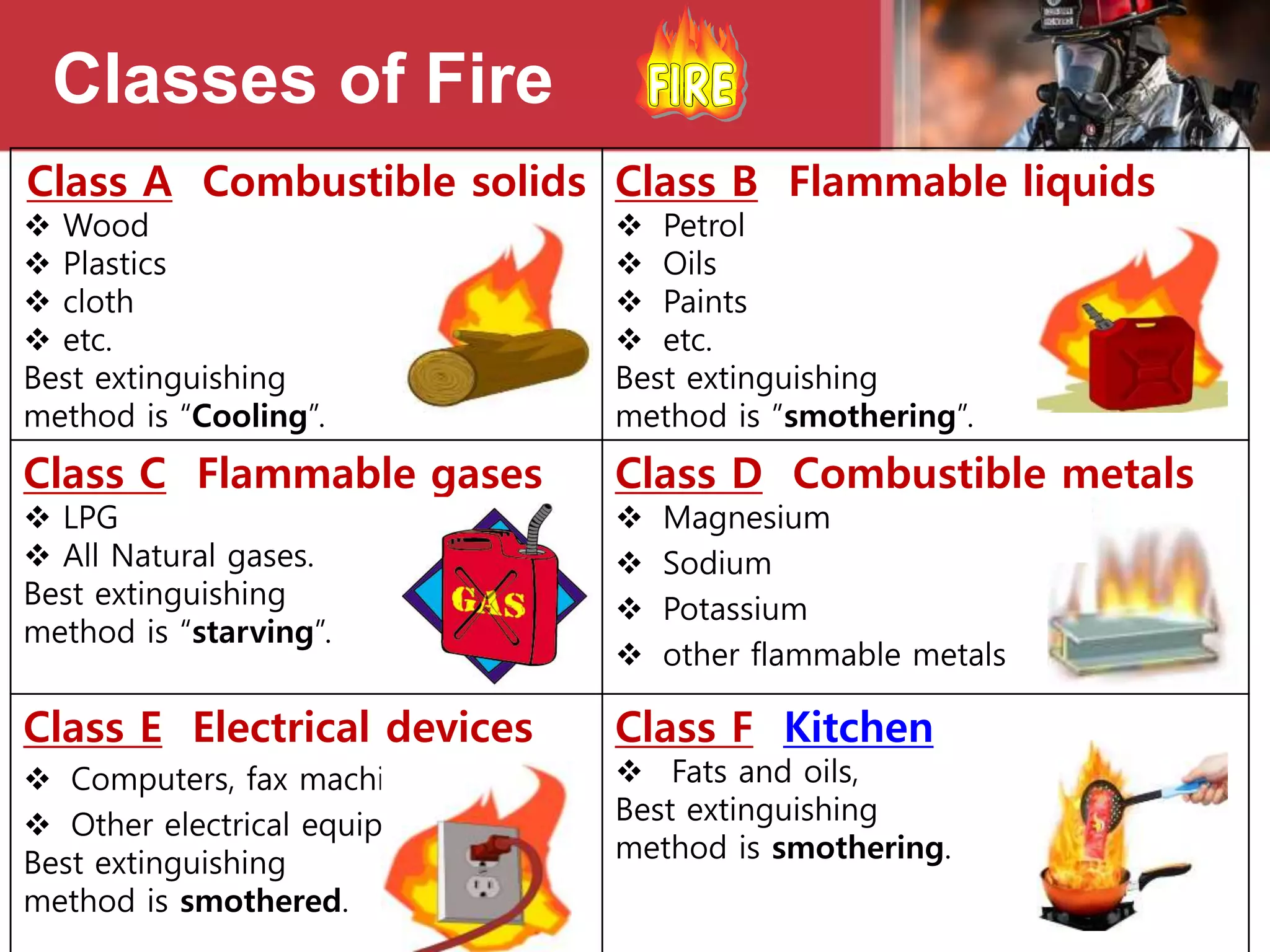
Classes of Fire
Class A Combustible solids
 Wood
 Plastics
 cloth
 etc.
Best extinguishing
method is “Cooling”.
Class B Flammable liquids
 Petrol
 Oils
 Paints
 etc.
Best extinguishing
method is ”smothering”.
Class C Flammable gases
 LPG
 All Natural gases.
Best extinguishing
method is “starving”.
Class D Combustible metals
 Magnesium
 Sodium
 Potassium
 other flammable metals
Class E Electrical devices
 Computers, fax machine
 Other electrical equip.
Best extinguishing
method is smothered.
Class F Kitchen
 Fats and oils,
Best extinguishing
method is smothering.
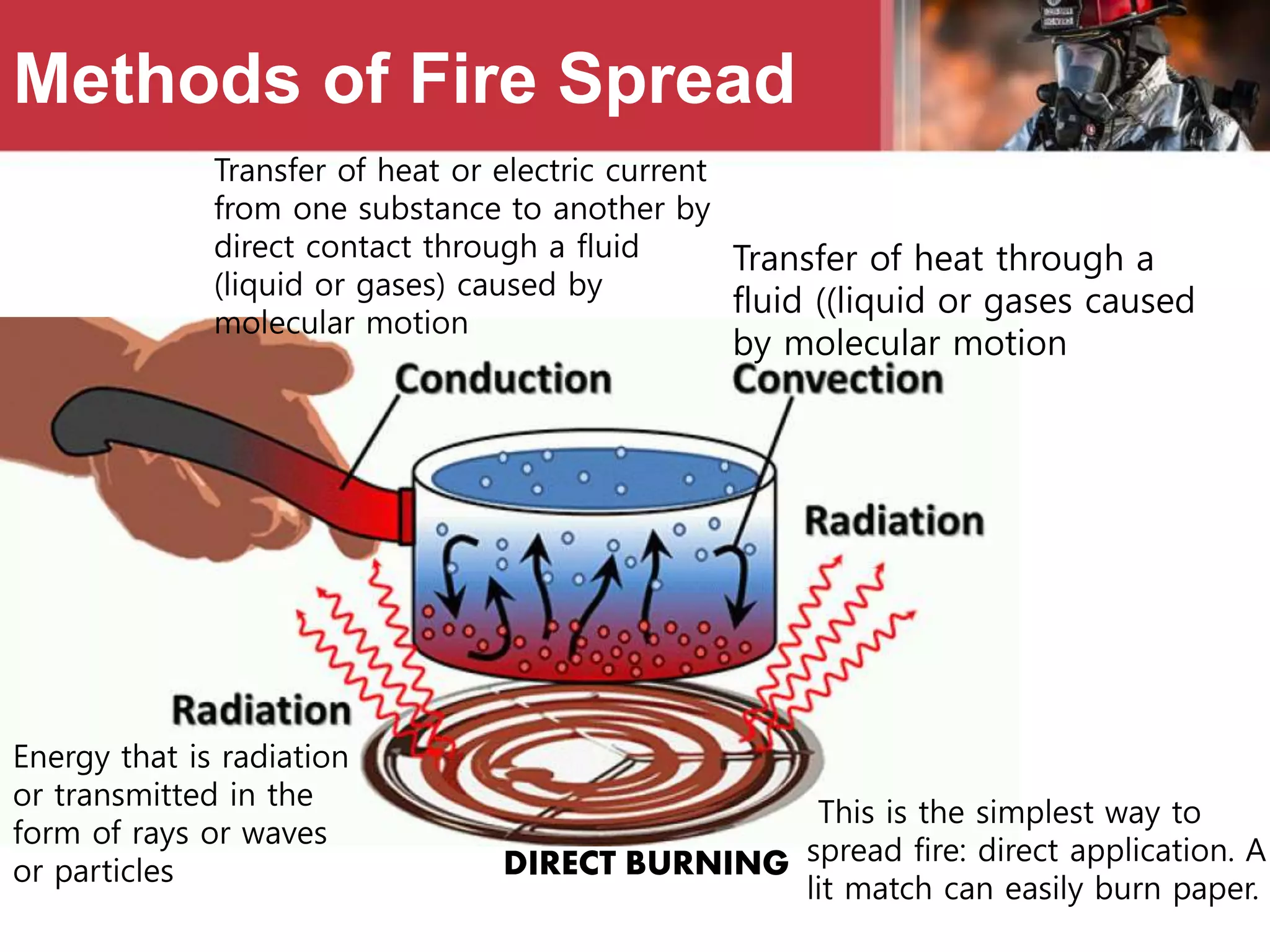
Methods of Fire Spread
Transfer of heat through a
fluid ((liquid or gases caused
by molecular motion
Transfer of heat or electric current
from one substance to another by
direct contact through a fluid
(liquid or gases) caused by
molecular motion
Energy that is radiation
or transmitted in the
form of rays or waves
or particles
This is the simplest way to
spread fire: direct application. A
lit match can easily burn paper.
DIRECT BURNING
Common causes of Ignition
and Spread Of Fire
Common emergencies in residential and office
buildings is a fire. It can happen for any number
of reasons, most of which are avoidable.
Not only is it destructive to property, it is also
highly dangerous for the lives of the people.
Cooking Equipment Heating Equipment Careless Smoking Electrical Equipment
Children Playing with Fire Inadequate WiringFlammable Liquids Candles
Computer Monitor Fire
A computer monitor left on over
a weekend caused this fire result
ing in $100,000 damage.
Fan Fire
$20000 Damage
Fire Protection Tips
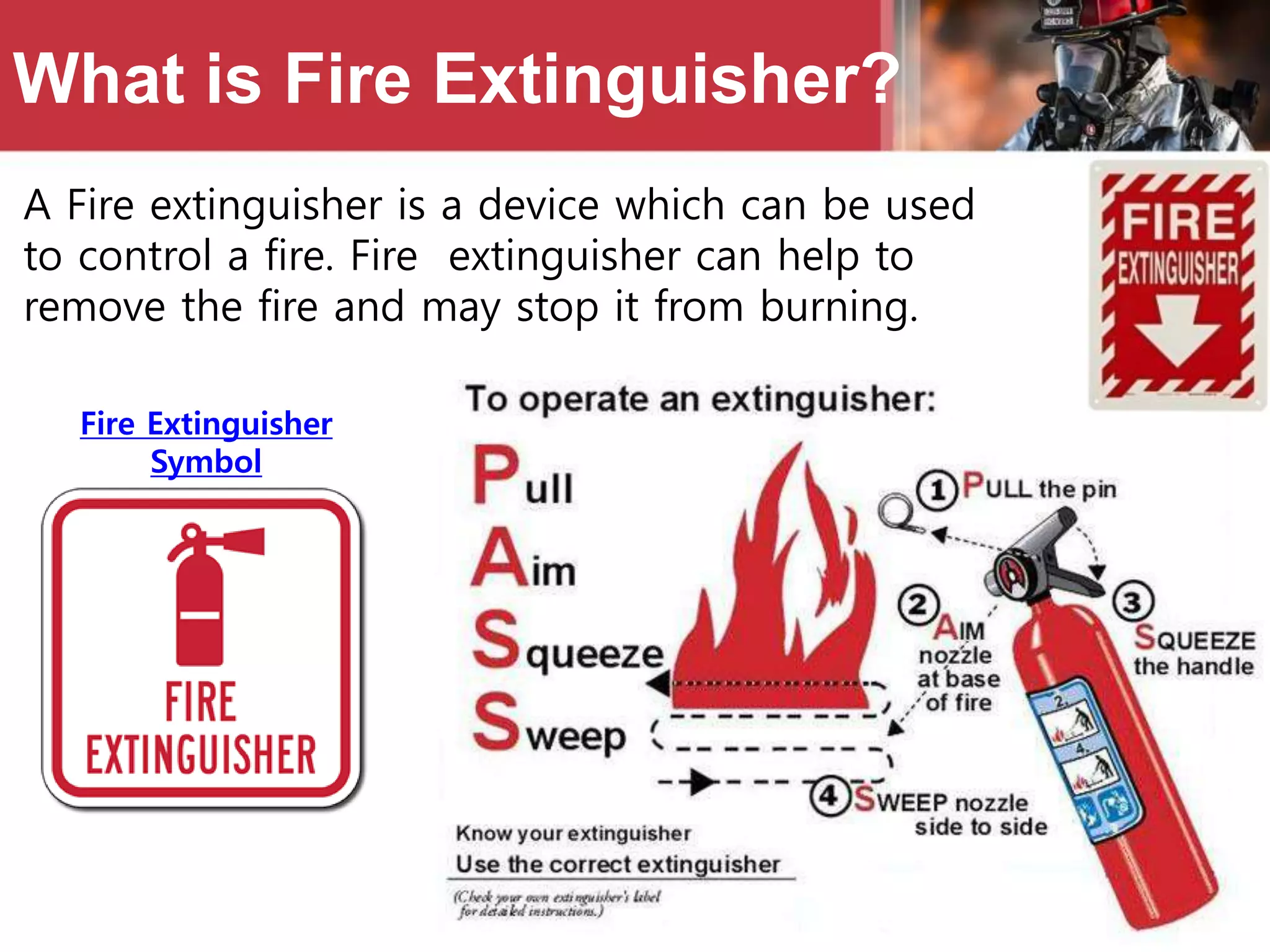
What is Fire Extinguisher?
A Fire extinguisher is a device which can be used
to control a fire. Fire extinguisher can help to
remove the fire and may stop it from burning.
Fire Extinguisher
Symbol
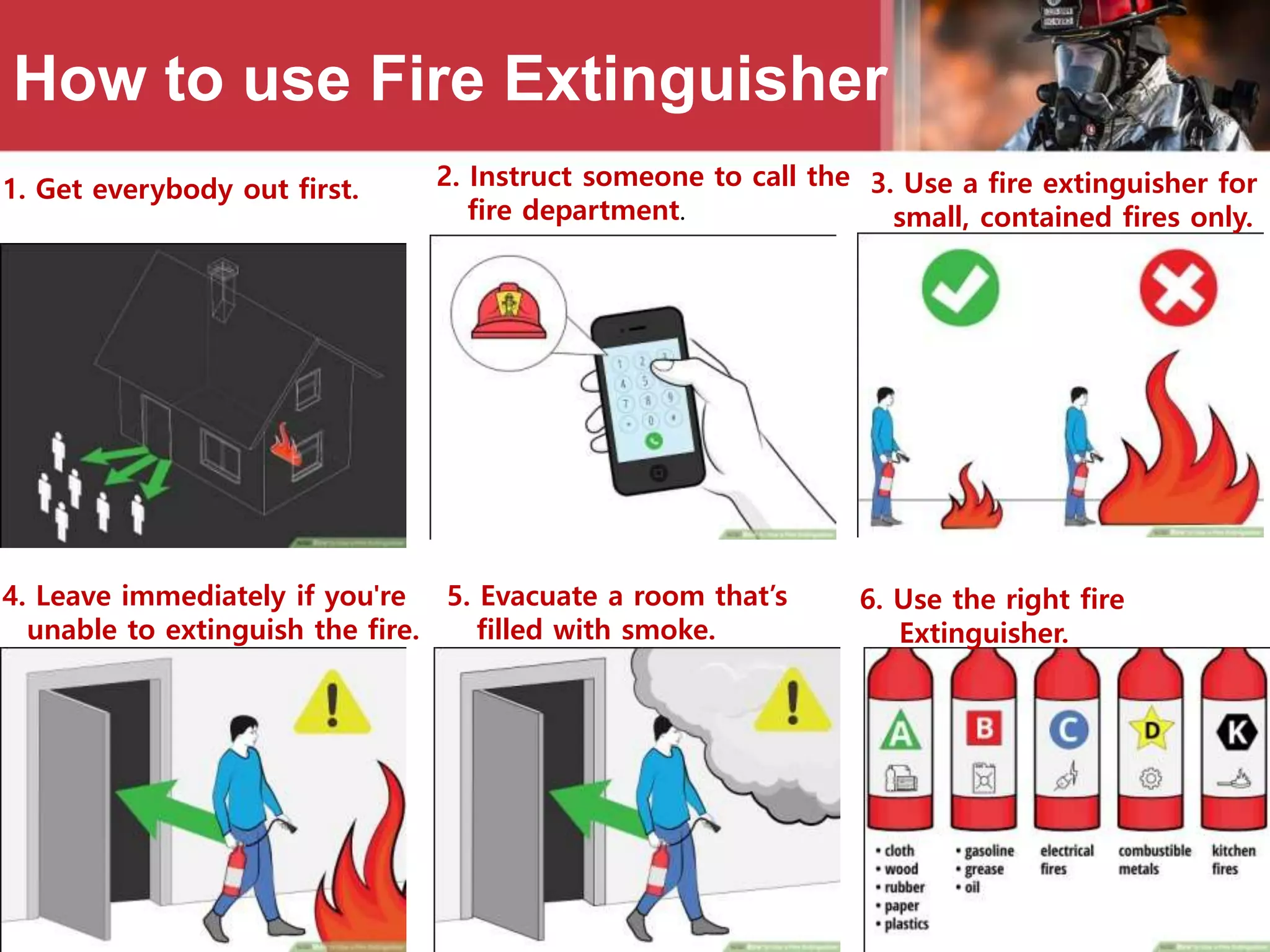
How to use Fire Extinguisher
2. Instruct someone to call the
fire department.
4. Leave immediately if you're
unable to extinguish the fire.
1. Get everybody out first. 3. Use a fire extinguisher for
small, contained fires only.
5. Evacuate a room that’s
filled with smoke.
6. Use the right fire
Extinguisher.
9. Pull the pin. 10. Aim the hose at the
base of the fire.
11. Squeeze the lever. 12. Sweep the hose from
side to side.
13 Back away and repeat
if the flames flare up.
14 Replace or recharge
your fire extinguisher
as soon as possible.
7. Stand with your back
to an exit.
8. Move to the proper
distance.
Water Fire Extinguishers
Signal Red
 Best For Organic solid materials
 Extinguishes by cooling burning material below ignition point.
 Do not use on burning fat or oil or Electrical appliances.
 How to Use
Point the jet at the base of the flames and keep it moving
across the area of the fire.
 How it Works
Water has a great Cooling effect on the fuel’s surface.
 2.5 gal. water at 150-175 psi (up to 1 minute discharge time).
 Has Pressure gauge to allow visual capacity check.
 Maximum effective Range. 30-40 ft.
A Trash W ood Paper
B Liquids Grease
C Electrical Equipment
A Trash W ood Paper
B Liquids Grease
C Electrical Equipment
Carbon Dioxide (CO2)
 Best For Flammable Liquids & Electrical equipment
 Extinguishes by smothering burning materials.
 Do not use on Chip or Fat pan fires,
 How to Use
The discharge horn should be directed at the base of the flames
and the jet kept moving across the area of the fire.
 How it Works
Carbon dioxide extinguishers work by suffocating the fire.
Carbon dioxide displaces oxygen in the air.
 2.5-100 lb. of CO2 gas at 150-200 psi (8-30 seconds discharge
time).
 Has NO pressure gauge--capacity verified by weight.
 Maximum effective Range. 3-8 ft
Signal Black
A Trash Wood Paper
B Liquids Grease
C Electrical Equipment
A Trash Wood Paper
B Liquids Grease
C Electrical Equipment
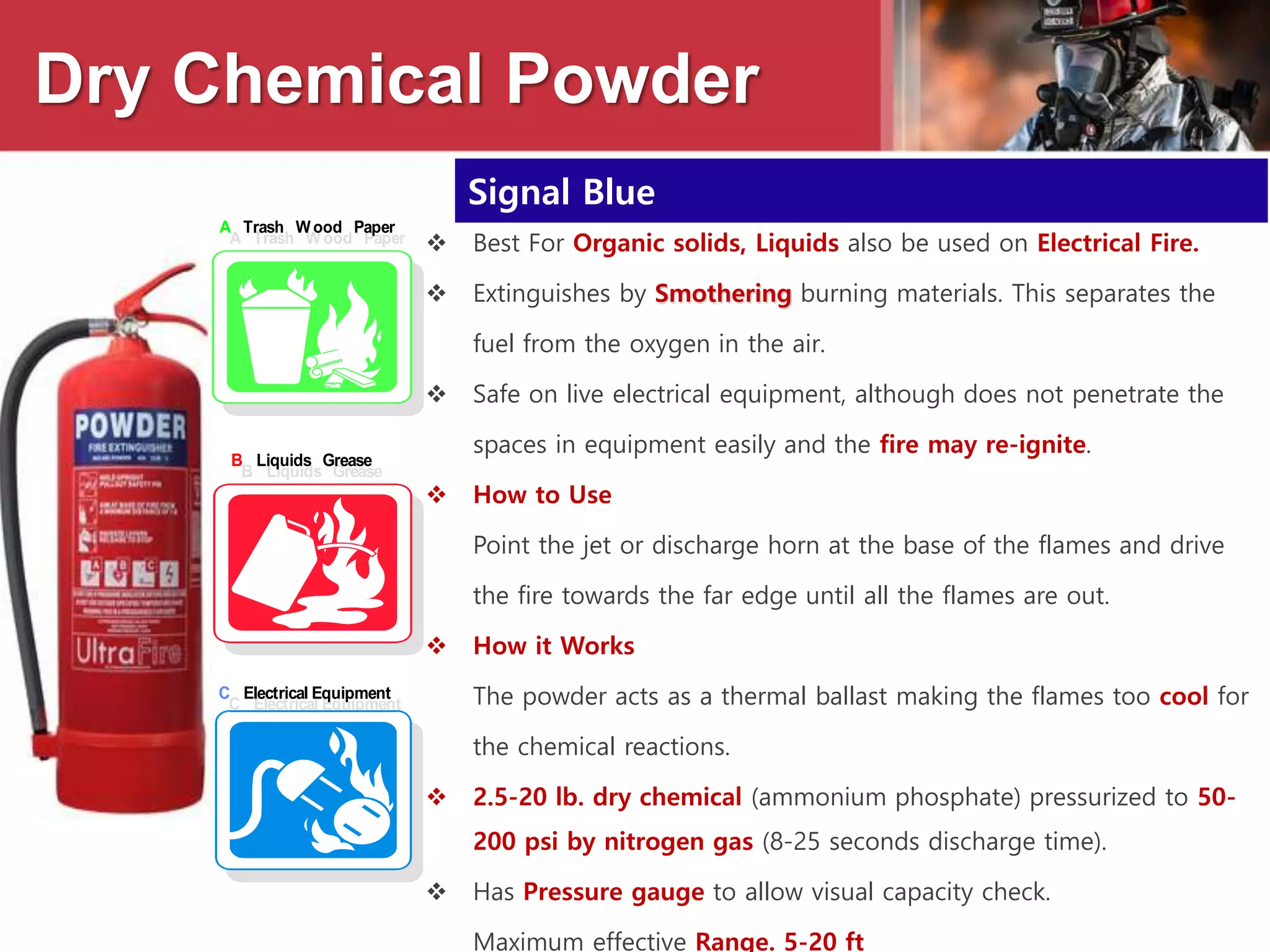
Dry Chemical Powder
Signal Blue
 Best For Organic solids, Liquids also be used on Electrical Fire.
 Extinguishes by Smothering burning materials. This separates the
fuel from the oxygen in the air.
 Safe on live electrical equipment, although does not penetrate the
spaces in equipment easily and the fire may re-ignite.
 How to Use
Point the jet or discharge horn at the base of the flames and drive
the fire towards the far edge until all the flames are out.
 How it Works
The powder acts as a thermal ballast making the flames too cool for
the chemical reactions.
 2.5-20 lb. dry chemical (ammonium phosphate) pressurized to 50-
200 psi by nitrogen gas (8-25 seconds discharge time).
 Has Pressure gauge to allow visual capacity check.
Maximum effective Range. 5-20 ft
A Trash W ood Paper
B Liquids Grease
C Electrical Equipment
A Trash W ood Paper
B Liquids Grease
C Electrical Equipment
Wet Chemical
 Best for Class F fires, involving cooking oils and fats.
 Extinguishes by Cooling and forming a foam blanket to prevent the fire
from reigniting.
 Not recommended for class B fires such as petrol.
 How to Use
Apply fine spray onto the burning fat until the surface of burning cookin
g oil changes into a soapy like substance which prevents re-ignition.
 How it Works
Contain a solution of potassium acetate. The extinguishers spray the agen
t out as a fine mist. The mist acts to cool the flame front, while the potass
-ium salts saponify the surface of the burning cooking oil, producing a lay
er of foam over the surface. This solution provides greater cooling effect.
 1.5 gal. of stored pressure wet chemical extinguishing agent (40 sec.
discharge time).
 10-12 ft. maximum effective range.
Signal Canary Yellow
F Cooking Media
A Trash Wood Paper
B Liquids Grease
C Electrical Equipment
A Trash Wood Paper
B Liquids Grease
C Electrical Equipment
AFFF Foam
 Best For Solids and Burning Liquids also Safe on Electricity fires.
 Extinguishes by Smothering and forming a foam blanket to separates
the flames/ignition source from the fuel surface.
 Do not use on Chip or Fat pan fires.
 How to Use
 Point the jet at the base of the flames and keep it moving across the
area of the fire. Allow the foam to build up and flow across the liquid.
 How it Works
 They are mainly water based, with a foaming agent so that the foam
can float on top of the burning liquid and break the interaction
between the flames and the fuel surface.
Signal Creamy
A Trash W ood Paper
B Liquids Grease
C Electrical Equipment
A Trash W ood Paper
B Liquids Grease
C Electrical Equipment
F Cooking Media
Fire Buckets
 A simple Bucket of water can be used on Class A type of fires as a
first attack if an extinguisher is not immediately available.
 It also can be filled with Dry Sand and used as an absorbing agent
or to dam a flow of flammable liquid.
 They do have serious disadvantages as they are often misused, left e
mpty or allowed to be used as a refuse container.
 Best For Wood, Cloth, Paper, Plastics, Coal (if filled with water). Spilled
flammable liquids (if filled with sand)
 Do not use on burning fat or oil or on electrical appliances before
the electric supply has been isolated.
 How to Use
Throw at the base of the flames. Ensure that all areas of fire are out.
 How it Works
Water has a great effect on cooling the fuel surfaces.
Signal Red
Fire Alarm System & Detector
Fire Alarm
Smoke Detector Heat Detector
Fire Bell
Fixed Extinguisher System
FOAM Extinguisher System
SPRINKLER Extinguisher System
HYDRANT Extinguisher System
Best Fire Extinguisher
Fireman Qualities
First Aid
Four Basic Rules
Call 1122 for medical
help immediately
Bring help to the victim,
don’t bring the victim
to help
Be careful, not to cause
additional injuries in
your attempt to help
Victim is breathing, and
has a pulse
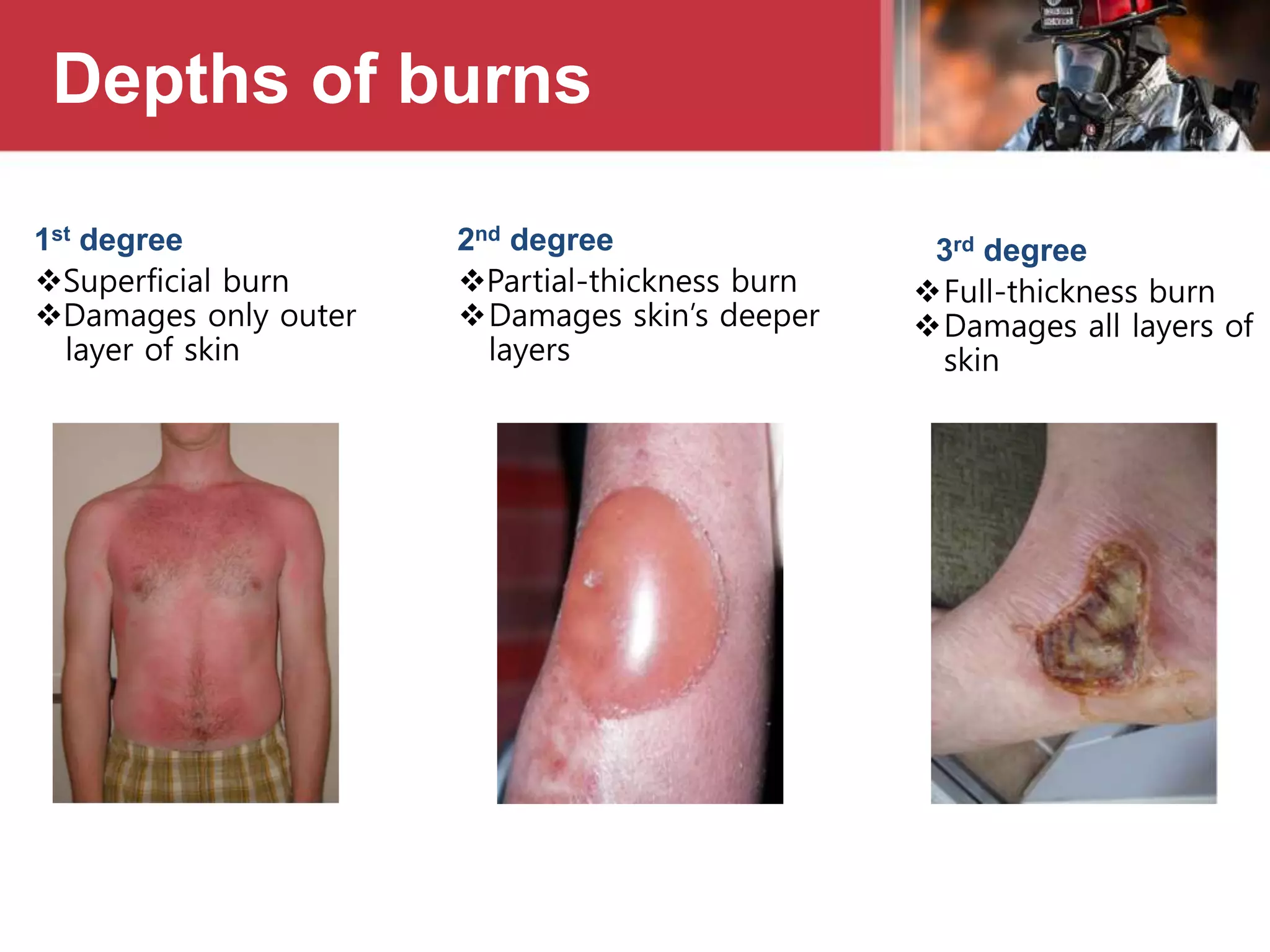
Depths of burns
1st degree
Superficial burn
Damages only outer
layer of skin
2nd degree
Partial-thickness burn
Damages skin’s deeper
layers
3rd degree
Full-thickness burn
Damages all layers of
skin
General treatment for burns
1. Immediately cool the affected
area with running water for at
least 10 minutes
2. Cover the burn with a non-sticky
dressing – Clingfilm, a plastic bag,
non-fluffy bandage
3. Seek medical attention, if the burn
is serious then call an ambulance.
If running water is not available then
improvise, any harmless Chemical
can be used to cool a burn.
Infection control
Try to
Keep the wound clean.
Avoid contact with the
casualty’s blood
Wear disposable gloves or any
available items to create a
barrier (e.g: a plastic bag).
Wash your hands
thoroughly with soap and
water afterwards.
Seek medical advice if
you are concerned.
Do not try to
Remove clothing sticking
to a burn.
Apply toothpaste / butter /
creams to a burn.
Exception: “Aftersun” lotion is us
eful for sunburn
Do not burst any blisters.
Do not stop cooling before
10 minutes is up!
Life is precious. Protect it

Firefightering and safty measures

  • 1.
    Mrs Anam Ashfaq Lahore FireFighting & Safety Measures
  • 2.
    Contents  Civil Defence Fire  Fire Classes  Fire Protection  Fire Extinguishers  First aid
  • 3.
    CIVIL DEFENCE According toCivil Defence act 1952 amended in 1996 the definition of Civil Defence is "Civil Defence includes any measures not amounting to actual combat for affording defence against any form of hostile attack by a foreign power or for depriving any form of hostile attack by a foreign power of its effects. Whether such measures are taken before, during or after the time of attack. It also includes remedial measures against natural and man made disasters in peace time".
  • 4.
    What is Fire? Fireis rapid oxidation of Fuel evolving heat Oxygen Heat Any combustible material solid, liquid or gas 21% required for breathing and fire needs only 16% Energy necessary to increase the temperature of fuel
  • 5.
    Extinguishing method Cooling –Reduction of the fuel temperature until it is below the ignition point, i.e. watering the fuel to cool it. Smothering – Using a blanket or other similar device to smother the fuel so that all or part of the oxygen are removed from the fuel area. Starving – Removing the source of the combustible material, such as turning of the gas cylinder. Anticatalytic Activity– Applying a chemical agent, such as a Fire retardant chemical, to stop the fire’s reaction process.
  • 6.
    Types of Fuel Tinder Tinder catches fire easily and burns fast. e.g. Wood shavings, pine needles, dry grasses, and shredded  Kindling Dry, dead twigs no thicker than a pencil are called kindling.  Fuel Fuel can be different types of timber. Timber ranges from small logs two or three inches (76 mm) across to larger logs that can burn for hours.
  • 7.
    Classes of Fire ClassA Combustible solids  Wood  Plastics  cloth  etc. Best extinguishing method is “Cooling”. Class B Flammable liquids  Petrol  Oils  Paints  etc. Best extinguishing method is ”smothering”. Class C Flammable gases  LPG  All Natural gases. Best extinguishing method is “starving”. Class D Combustible metals  Magnesium  Sodium  Potassium  other flammable metals Class E Electrical devices  Computers, fax machine  Other electrical equip. Best extinguishing method is smothered. Class F Kitchen  Fats and oils, Best extinguishing method is smothering.
  • 8.
    Methods of FireSpread Transfer of heat through a fluid ((liquid or gases caused by molecular motion Transfer of heat or electric current from one substance to another by direct contact through a fluid (liquid or gases) caused by molecular motion Energy that is radiation or transmitted in the form of rays or waves or particles This is the simplest way to spread fire: direct application. A lit match can easily burn paper. DIRECT BURNING
  • 9.
    Common causes ofIgnition and Spread Of Fire Common emergencies in residential and office buildings is a fire. It can happen for any number of reasons, most of which are avoidable. Not only is it destructive to property, it is also highly dangerous for the lives of the people. Cooking Equipment Heating Equipment Careless Smoking Electrical Equipment Children Playing with Fire Inadequate WiringFlammable Liquids Candles
  • 10.
    Computer Monitor Fire Acomputer monitor left on over a weekend caused this fire result ing in $100,000 damage. Fan Fire $20000 Damage
  • 11.
  • 12.
    What is FireExtinguisher? A Fire extinguisher is a device which can be used to control a fire. Fire extinguisher can help to remove the fire and may stop it from burning. Fire Extinguisher Symbol
  • 13.
    How to useFire Extinguisher 2. Instruct someone to call the fire department. 4. Leave immediately if you're unable to extinguish the fire. 1. Get everybody out first. 3. Use a fire extinguisher for small, contained fires only. 5. Evacuate a room that’s filled with smoke. 6. Use the right fire Extinguisher.
  • 14.
    9. Pull thepin. 10. Aim the hose at the base of the fire. 11. Squeeze the lever. 12. Sweep the hose from side to side. 13 Back away and repeat if the flames flare up. 14 Replace or recharge your fire extinguisher as soon as possible. 7. Stand with your back to an exit. 8. Move to the proper distance.
  • 15.
    Water Fire Extinguishers SignalRed  Best For Organic solid materials  Extinguishes by cooling burning material below ignition point.  Do not use on burning fat or oil or Electrical appliances.  How to Use Point the jet at the base of the flames and keep it moving across the area of the fire.  How it Works Water has a great Cooling effect on the fuel’s surface.  2.5 gal. water at 150-175 psi (up to 1 minute discharge time).  Has Pressure gauge to allow visual capacity check.  Maximum effective Range. 30-40 ft. A Trash W ood Paper B Liquids Grease C Electrical Equipment A Trash W ood Paper B Liquids Grease C Electrical Equipment
  • 16.
    Carbon Dioxide (CO2) Best For Flammable Liquids & Electrical equipment  Extinguishes by smothering burning materials.  Do not use on Chip or Fat pan fires,  How to Use The discharge horn should be directed at the base of the flames and the jet kept moving across the area of the fire.  How it Works Carbon dioxide extinguishers work by suffocating the fire. Carbon dioxide displaces oxygen in the air.  2.5-100 lb. of CO2 gas at 150-200 psi (8-30 seconds discharge time).  Has NO pressure gauge--capacity verified by weight.  Maximum effective Range. 3-8 ft Signal Black A Trash Wood Paper B Liquids Grease C Electrical Equipment A Trash Wood Paper B Liquids Grease C Electrical Equipment
  • 17.
    Dry Chemical Powder SignalBlue  Best For Organic solids, Liquids also be used on Electrical Fire.  Extinguishes by Smothering burning materials. This separates the fuel from the oxygen in the air.  Safe on live electrical equipment, although does not penetrate the spaces in equipment easily and the fire may re-ignite.  How to Use Point the jet or discharge horn at the base of the flames and drive the fire towards the far edge until all the flames are out.  How it Works The powder acts as a thermal ballast making the flames too cool for the chemical reactions.  2.5-20 lb. dry chemical (ammonium phosphate) pressurized to 50- 200 psi by nitrogen gas (8-25 seconds discharge time).  Has Pressure gauge to allow visual capacity check. Maximum effective Range. 5-20 ft A Trash W ood Paper B Liquids Grease C Electrical Equipment A Trash W ood Paper B Liquids Grease C Electrical Equipment
  • 18.
    Wet Chemical  Bestfor Class F fires, involving cooking oils and fats.  Extinguishes by Cooling and forming a foam blanket to prevent the fire from reigniting.  Not recommended for class B fires such as petrol.  How to Use Apply fine spray onto the burning fat until the surface of burning cookin g oil changes into a soapy like substance which prevents re-ignition.  How it Works Contain a solution of potassium acetate. The extinguishers spray the agen t out as a fine mist. The mist acts to cool the flame front, while the potass -ium salts saponify the surface of the burning cooking oil, producing a lay er of foam over the surface. This solution provides greater cooling effect.  1.5 gal. of stored pressure wet chemical extinguishing agent (40 sec. discharge time).  10-12 ft. maximum effective range. Signal Canary Yellow F Cooking Media A Trash Wood Paper B Liquids Grease C Electrical Equipment A Trash Wood Paper B Liquids Grease C Electrical Equipment
  • 19.
    AFFF Foam  BestFor Solids and Burning Liquids also Safe on Electricity fires.  Extinguishes by Smothering and forming a foam blanket to separates the flames/ignition source from the fuel surface.  Do not use on Chip or Fat pan fires.  How to Use  Point the jet at the base of the flames and keep it moving across the area of the fire. Allow the foam to build up and flow across the liquid.  How it Works  They are mainly water based, with a foaming agent so that the foam can float on top of the burning liquid and break the interaction between the flames and the fuel surface. Signal Creamy A Trash W ood Paper B Liquids Grease C Electrical Equipment A Trash W ood Paper B Liquids Grease C Electrical Equipment F Cooking Media
  • 20.
    Fire Buckets  Asimple Bucket of water can be used on Class A type of fires as a first attack if an extinguisher is not immediately available.  It also can be filled with Dry Sand and used as an absorbing agent or to dam a flow of flammable liquid.  They do have serious disadvantages as they are often misused, left e mpty or allowed to be used as a refuse container.  Best For Wood, Cloth, Paper, Plastics, Coal (if filled with water). Spilled flammable liquids (if filled with sand)  Do not use on burning fat or oil or on electrical appliances before the electric supply has been isolated.  How to Use Throw at the base of the flames. Ensure that all areas of fire are out.  How it Works Water has a great effect on cooling the fuel surfaces. Signal Red
  • 21.
    Fire Alarm System& Detector Fire Alarm Smoke Detector Heat Detector Fire Bell
  • 22.
    Fixed Extinguisher System FOAMExtinguisher System SPRINKLER Extinguisher System HYDRANT Extinguisher System
  • 23.
  • 24.
  • 25.
    First Aid Four BasicRules Call 1122 for medical help immediately Bring help to the victim, don’t bring the victim to help Be careful, not to cause additional injuries in your attempt to help Victim is breathing, and has a pulse
  • 26.
    Depths of burns 1stdegree Superficial burn Damages only outer layer of skin 2nd degree Partial-thickness burn Damages skin’s deeper layers 3rd degree Full-thickness burn Damages all layers of skin
  • 27.
    General treatment forburns 1. Immediately cool the affected area with running water for at least 10 minutes 2. Cover the burn with a non-sticky dressing – Clingfilm, a plastic bag, non-fluffy bandage 3. Seek medical attention, if the burn is serious then call an ambulance. If running water is not available then improvise, any harmless Chemical can be used to cool a burn.
  • 28.
    Infection control Try to Keepthe wound clean. Avoid contact with the casualty’s blood Wear disposable gloves or any available items to create a barrier (e.g: a plastic bag). Wash your hands thoroughly with soap and water afterwards. Seek medical advice if you are concerned. Do not try to Remove clothing sticking to a burn. Apply toothpaste / butter / creams to a burn. Exception: “Aftersun” lotion is us eful for sunburn Do not burst any blisters. Do not stop cooling before 10 minutes is up!
  • 29.

Editor's Notes

  • #4 The disaster which means an event that occurs in most cases suddenly and without any Warning or symptoms, causing severe disturbances to people, objects and environment, resulting in loss of precious life, property and health of the population. Such situation causes disruption in normal pattern of life, generating misfortune, helplessness and suffering affecting the socioeconomic structure of a region/Country to such an extent that there is need for assistance or immediate outside intervention. In order to make a strong Civil Defence structure there is an urgent need to make awareness among the students of schools, colleges and of other such institutions with regard to existence of Civil Defence and its important/unavoidable role in disaster management. As the students are the future saviors of our country.
  • #26 Physical Fitness, Decision Making, Handles Pressure, Deals with Uncertainty, Judgment, Dependability, Emotional Control, Safety Management Commitment to Diversity Openness to Change Confidence and Resilience Working with Others Effective Communication Commitment to Development Problem Solving Situational Awareness Commitment to Excellence