Dynamic model of robot manipulators
Claudio Melchiorri
Dipartimento di Elettronica, Informatica e Sistemistica (DEIS)
Universit`a di Bologna
email: claudio.melchiorri@unibo.it
C. Melchiorri (DEIS) Dynamic Model 1 / 65
Summary
1 Dynamic models
Introduction
Euler-Lagrange model
C. Melchiorri (DEIS) Dynamic Model 2 / 65
Dynamic models Introduction
Dynamic model of manipulators
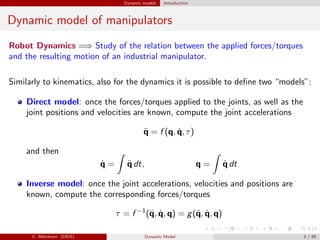
Robot Dynamics =⇒ Study of the relation between the applied forces/torques
and the resulting motion of an industrial manipulator.
Similarly to kinematics, also for the dynamics it is possible to define two “models”:
Direct model: once the forces/torques applied to the joints, as well as the
joint positions and velocities are known, compute the joint accelerations
¨q = f (q, ˙q, τ)
and then
˙q = ¨q dt, q = ˙q dt
Inverse model: once the joint accelerations, velocities and positions are
known, compute the corresponding forces/torques
τ = f −1
(¨q, ˙q, q) = g(¨q, ˙q, q)
C. Melchiorri (DEIS) Dynamic Model 3 / 65
Dynamic models Introduction
Dynamic model of manipulators
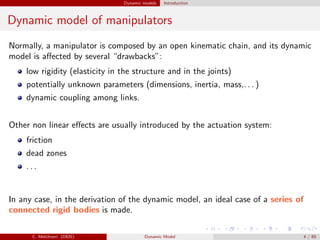
Normally, a manipulator is composed by an open kinematic chain, and its dynamic
model is affected by several “drawbacks”:
low rigidity (elasticity in the structure and in the joints)
potentially unknown parameters (dimensions, inertia, mass,. . . )
dynamic coupling among links.
Other non linear effects are usually introduced by the actuation system:
friction
dead zones
. . .
In any case, in the derivation of the dynamic model, an ideal case of a series of
connected rigid bodies is made.
C. Melchiorri (DEIS) Dynamic Model 4 / 65
Dynamic models Introduction
Dynamic model of manipulators
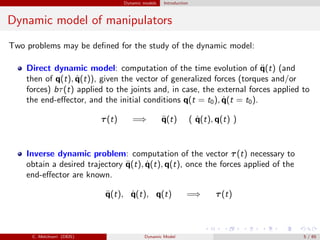
Two problems may be defined for the study of the dynamic model:
Direct dynamic model: computation of the time evolution of ¨q(t) (and
then of q(t), ˙q(t)), given the vector of generalized forces (torques and/or
forces) bτ(t) applied to the joints and, in case, the external forces applied to
the end-effector, and the initial conditions q(t = t0), ˙q(t = t0).
τ(t) =⇒ ¨q(t) ( ˙q(t), q(t) )
Inverse dynamic problem: computation of the vector τ(t) necessary to
obtain a desired trajectory ¨q(t), ˙q(t), q(t), once the forces applied of the
end-effector are known.
¨q(t), ˙q(t), q(t) =⇒ τ(t)
C. Melchiorri (DEIS) Dynamic Model 5 / 65
Dynamic models Introduction
Dynamic model of manipulators
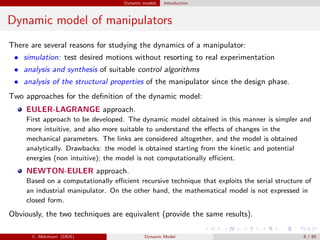
There are several reasons for studying the dynamics of a manipulator:
• simulation: test desired motions without resorting to real experimentation
• analysis and synthesis of suitable control algorithms
• analysis of the structural properties of the manipulator since the design phase.
Two approaches for the definition of the dynamic model:
EULER-LAGRANGE approach.
First approach to be developed. The dynamic model obtained in this manner is simpler and
more intuitive, and also more suitable to understand the effects of changes in the
mechanical parameters. The links are considered altogether, and the model is obtained
analytically. Drawbacks: the model is obtained starting from the kinetic and potential
energies (non intuitive); the model is not computationally efficient.
NEWTON-EULER approach.
Based on a computationally efficient recursive technique that exploits the serial structure of
an industrial manipulator. On the other hand, the mathematical model is not expressed in
closed form.
Obviously, the two techniques are equivalent (provide the same results).
C. Melchiorri (DEIS) Dynamic Model 6 / 65
Dynamic models Euler-Lagrange model
Euler-Lagrange model
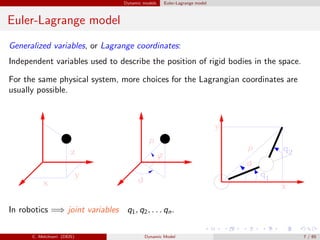
Generalized variables, or Lagrange coordinates:
Independent variables used to describe the position of rigid bodies in the space.
For the same physical system, more choices for the Lagrangian coordinates are
usually possible.
In robotics =⇒ joint variables q1, q2, . . . qn.
C. Melchiorri (DEIS) Dynamic Model 7 / 65
Dynamic models Euler-Lagrange model
Euler-Lagrange model
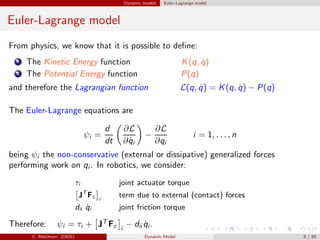
From physics, we know that it is possible to define:
1 The Kinetic Energy function K(q, ˙q)
2 The Potential Energy function P(q)
and therefore the Lagrangian function L(q, ˙q) = K(q, ˙q) − P(q)
The Euler-Lagrange equations are
ψi =
d
dt
∂L
∂ ˙qi
−
∂L
∂qi
i = 1, . . . , n
being ψi the non-conservative (external or dissipative) generalized forces
performing work on qi . In robotics, we consider:
τi joint actuator torque
JT
Fc i
term due to external (contact) forces
dii ˙qi joint friction torque
Therefore: ψi = τi + JT
Fc i
− dii ˙qi .
C. Melchiorri (DEIS) Dynamic Model 8 / 65
Dynamic models Euler-Lagrange model
Euler-Lagrange model
Since the potential energy does not depend on the velocity, the Euler-Lagrange
equations can be rewritten as
ψi =
d
dt
∂K
∂ ˙qi
−
∂K
∂qi
+
∂P
∂qi
i = 1, . . . , n (1)
This formulation is more convenient since in robotics it is possible to compute
quite easily the terms K and P from the geometric properties of the manipulator.
Then, by applying (1), the dynamic model is obtained.
Note that
K =
n
i=1
Ki P =
n
i=1
Pi
C. Melchiorri (DEIS) Dynamic Model 9 / 65
Dynamic models Euler-Lagrange model
Euler-Lagrange model
Computation of the Kinetic Energy. For a rigid body:
The mass can be computed by
m =
B
ρ(x, y, z) dx dy dz
where ρ(x, y, z) is the mass density (assumed constant): ρ(x, y, z) = ρ.
The center of mass (CoM) is
pC =
1
m B
p(x, y, z)ρ dx dy dz =
1
m B
p(x, y, z) dm
The kinetic energy results
K =
1
2 B
vT
(x, y, z)v(x, y, z)ρ dx dy dz
=
1
2 B
vT
(x, y, z)v(x, y, z) dm
C. Melchiorri (DEIS) Dynamic Model 10 / 65
Dynamic models Euler-Lagrange model
Euler-Lagrange model
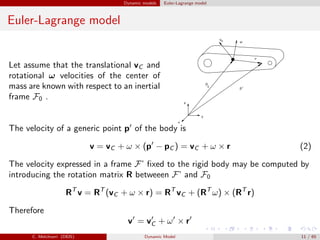
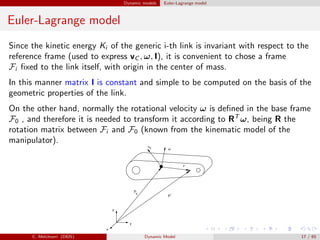
Let assume that the translational vC and
rotational ω velocities of the center of
mass are known with respect to an inertial
frame F0 .
The velocity of a generic point p′
of the body is
v = vC + ω × (p′
− pC ) = vC + ω × r (2)
The velocity expressed in a frame F’ fixed to the rigid body may be computed by
introducing the rotation matrix R betweeen F’ and F0
RT
v = RT
(vC + ω × r) = RT
vC + (RT
ω) × (RT
r)
Therefore
v′
= v′
C + ω′
× r′
C. Melchiorri (DEIS) Dynamic Model 11 / 65
Dynamic models Euler-Lagrange model
Euler-Lagrange model
Since the product ω × r in (2) can be expressed as S(ω) r, we have:
K =
1
2 B
vT
(x, y, z)v(x, y, z) dm
=
1
2 B
(vC + Sr)T
(vC + Sr) dm
=
1
2 B
vT
C vC dm +
1
2 B
rT
ST
Sr dm +
B
vT
C Sr dm
=
1
2 B
vT
C vC dm +
1
2 B
rT
ST
Sr dm
As a matter of fact, from the definition of CoM ( B r dm = B (pC − p)dm = 0):
B
vT
C Sr dm = vT
C S
B
r dm = 0
C. Melchiorri (DEIS) Dynamic Model 12 / 65
Dynamic models Euler-Lagrange model
Euler-Lagrange model
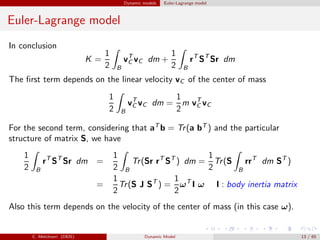
In conclusion
K =
1
2 B
vT
C vC dm +
1
2 B
rT
ST
Sr dm
The first term depends on the linear velocity vC of the center of mass
1
2 B
vT
C vC dm =
1
2
m vT
C vC
For the second term, considering that aT
b = Tr(a bT
) and the particular
structure of matrix S, we have
1
2 B
rT
ST
Sr dm =
1
2 B
Tr(Sr rT
ST
) dm =
1
2
Tr(S
B
rrT
dm ST
)
=
1
2
Tr(S J ST
) =
1
2
ωT
I ω I : body inertia matrix
Also this term depends on the velocity of the center of mass (in this case ω).
C. Melchiorri (DEIS) Dynamic Model 13 / 65
Dynamic models Euler-Lagrange model
Euler-Lagrange model
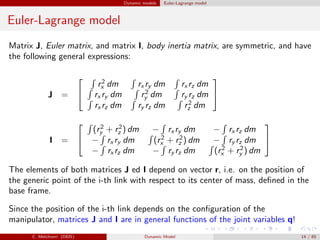
Matrix J, Euler matrix, and matrix I, body inertia matrix, are symmetric, and have
the following general expressions:
J =


r2
x dm rx ry dm rx rz dm
rx ry dm r2
y dm ry rz dm
rx rz dm ry rz dm r2
z dm


I =


(r2
y + r2
z ) dm − rx ry dm − rx rz dm
− rx ry dm (r2
x + r2
z ) dm − ry rz dm
− rx rz dm − ry rz dm (r2
x + r2
y ) dm


The elements of both matrices J ed I depend on vector r, i.e. on the position of
the generic point of the i-th link with respect to its center of mass, defined in the
base frame.
Since the position of the i-th link depends on the configuration of the
manipulator, matrices J and I are in general functions of the joint variables q!
C. Melchiorri (DEIS) Dynamic Model 14 / 65
Dynamic models Euler-Lagrange model
Examples of body inertia matrices
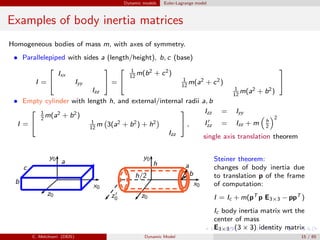
Homogeneous bodies of mass m, with axes of symmetry.
• Parallelepiped with sides a (length/height), b, c (base)
I =


Ixx
Iyy
Izz

 =


1
12
m(b2 + c2)
1
12
m(a2 + c2)
1
12
m(a2 + b2)


• Empty cylinder with length h, and external/internal radii a, b
I =


1
2
m(a2 + b2)
1
12
m 3(a2 + b2) + h2
Izz

 ,
Izz = Iyy
I′
zz = Izz + m h
2
2
single axis translation theorem
x0
y0
z0
a
b
c
x0
y0
z0z′
0
a
b
h
h/2
Steiner theorem:
changes of body inertia due
to translation p of the frame
of computation:
I = Ic + m(pT p E3×3 − ppT )
Ic body inertia matrix wrt the
center of mass
E3×3 (3 × 3) identity matrix
C. Melchiorri (DEIS) Dynamic Model 15 / 65
Dynamic models Euler-Lagrange model
Euler-Lagrange model
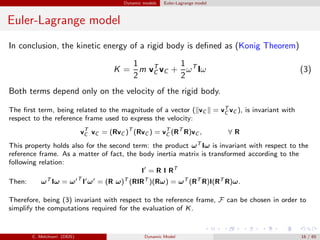
In conclusion, the kinetic energy of a rigid body is defined as (Konig Theorem)
K =
1
2
m vT
C vC +
1
2
ωT
Iω (3)
Both terms depend only on the velocity of the rigid body.
The first term, being related to the magnitude of a vector ( vC = vT
C vC ), is invariant with
respect to the reference frame used to express the velocity:
vT
C vC = (RvC )T
(RvC ) = vT
C (RT
R)vC , ∀ R
This property holds also for the second term: the product ωT Iω is invariant with respect to the
reference frame. As a matter of fact, the body inertia matrix is transformed according to the
following relation:
I′
= R I RT
Then: ωT Iω = ω′T
I′ω′ = (R ω)T (RIRT )(Rω) = ωT (RT R)I(RT R)ω.
Therefore, being (3) invariant with respect to the reference frame, F can be chosen in order to
simplify the computations required for the evaluation of K.
C. Melchiorri (DEIS) Dynamic Model 16 / 65
Dynamic models Euler-Lagrange model
Euler-Lagrange model
Since the kinetic energy Ki of the generic i-th link is invariant with respect to the
reference frame (used to express vC , ω, I), it is convenient to chose a frame
Fi fixed to the link itself, with origin in the center of mass.
In this manner matrix I is constant and simple to be computed on the basis of the
geometric properties of the link.
On the other hand, normally the rotational velocity ω is defined in the base frame
F0 , and therefore it is needed to transform it according to RT
ω, being R the
rotation matrix between Fi and F0 (known from the kinematic model of the
manipulator).
C. Melchiorri (DEIS) Dynamic Model 17 / 65
Dynamic models Euler-Lagrange model
Euler-Lagrange model
In conclusion, the kinetic energy of a manipulator can be determined when, for
each link, the following quantities are known:
the link mass mi ;
the inertia matrix Ii , computed wrt a frame Fi fixed to the center of mass in
which it has a constant expression ˜Ii ;
the linear velocity vCi of the center of mass, and the rotational velocity ωi of
the link (both expressed in F0 );
the rotation matrix Ri between the frame fixed to the link and F0 .
The kinetic energy Ki of the i-th link has the form:
Ki =
1
2
mi vT
Ci vCi +
1
2
ωT
i Ri
˜Ii RT
i ωi
It is now necessary to compute the linear and rotational velocities (vCi and ωi ) as
functions of the Lagrangian coordinates (i.e. the joint variables q).
C. Melchiorri (DEIS) Dynamic Model 18 / 65
Dynamic models Euler-Lagrange model
Euler-Lagrange model
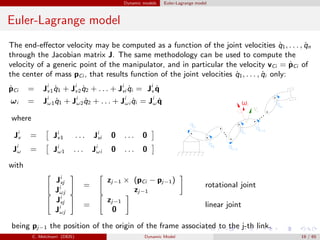
The end-effector velocity may be computed as a function of the joint velocities ˙q1, . . . , ˙qn
through the Jacobian matrix J. The same methodology can be used to compute the
velocity of a generic point of the manipulator, and in particular the velocity vCi = ˙pCi of
the center of mass pCi , that results function of the joint velocities ˙q1, . . . , ˙qi only:
˙pCi = Ji
v1 ˙q1 + Ji
v2 ˙q2 + . . . + Ji
vi ˙qi = Ji
v ˙q
ωi = Ji
ω1 ˙q1 + Ji
ω2 ˙q2 + . . . + Ji
ωi ˙qi = Ji
ω ˙q
where
Ji
v = Ji
v1 . . . Ji
vi 0 . . . 0
Ji
ω = Ji
ω1 . . . Ji
ωi 0 . . . 0
with
Ji
vj
Ji
ωj
=
zj−1 × (pCi − pj−1)
zj−1
rotational joint
Ji
vj
Ji
ωj
=
zj−1
0
linear joint
being pj−1 the position of the origin of the frame associated to the j-th link.
C. Melchiorri (DEIS) Dynamic Model 19 / 65
Dynamic models Euler-Lagrange model
Euler-Lagrange model
In conclusion, for a n dof manipulator we have:
K =
1
2
n
i=1
mi vT
Ci vCi +
1
2
n
i=1
ωT
i Ri
˜Ii RT
i ω
=
1
2
˙qT
n
i=1
mi Ji T
v (q)Ji
v (q) + Ji T
ω (q)Ri
˜Ii RT
i Ji
ω(q) ˙q
=
1
2
˙qT
M(q)˙q
=
1
2
n
i=1
n
j=1
Mij (q)˙qi ˙qj
where M(q) is a n × n, symmetric and positive definite matrix, function of the
manipulator configuration q.
Matrix M(q) is called the Inertia Matrix of the manipulator.
C. Melchiorri (DEIS) Dynamic Model 20 / 65
Dynamic models Euler-Lagrange model
Modello di Eulero-Lagrange
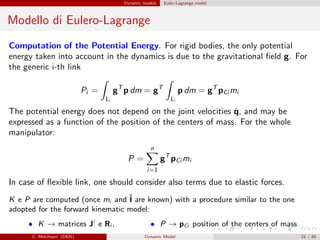
Computation of the Potential Energy. For rigid bodies, the only potential
energy taken into account in the dynamics is due to the gravitational field g. For
the generic i-th link
Pi =
Li
gT
p dm = gT
Li
p dm = gT
pCi mi
The potential energy does not depend on the joint velocities ˙q, and may be
expressed as a function of the position of the centers of mass. For the whole
manipulator:
P =
n
i=1
gT
pCi mi
In case of flexible link, one should consider also terms due to elastic forces.
K e P are computed (once mi and ˜I are known) with a procedure similar to the one
adopted for the forward kinematic model:
• K → matrices Ji
e Ri , • P → pCi position of the centers of mass
C. Melchiorri (DEIS) Dynamic Model 21 / 65
Dynamic models Euler-Lagrange model
Euler-Lagrange model
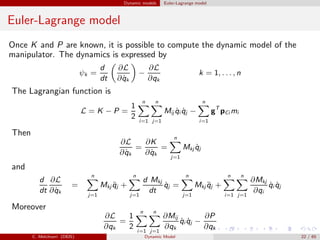
Once K and P are known, it is possible to compute the dynamic model of the
manipulator. The dynamics is expressed by
ψk =
d
dt
∂L
∂ ˙qk
−
∂L
∂qk
k = 1, . . . , n
The Lagrangian function is
L = K − P =
1
2
n
i=1
n
j=1
Mij ˙qi ˙qj −
n
i=1
gT
pCi mi
Then
∂L
∂ ˙qk
=
∂K
∂ ˙qk
=
n
j=1
Mkj ˙qj
and
d
dt
∂L
∂ ˙qk
=
n
j=1
Mkj ¨qj +
n
j=1
d Mkj
dt
˙qj =
n
j=1
Mkj ¨qj +
n
i=1
n
j=1
∂Mkj
∂qi
˙qi ˙qj
Moreover
∂L
∂qk
=
1
2
n
i=1
n
j=1
∂Mij
∂qk
˙qi ˙qj −
∂P
∂qk
C. Melchiorri (DEIS) Dynamic Model 22 / 65
Dynamic models Euler-Lagrange model
Euler-Lagrange model
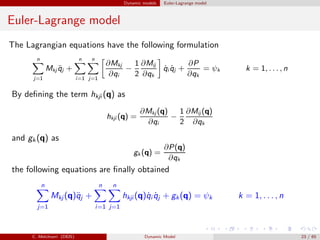
The Lagrangian equations have the following formulation
n
j=1
Mkj ¨qj +
n
i=1
n
j=1
∂Mkj
∂qi
−
1
2
∂Mij
∂qk
˙qi ˙qj +
∂P
∂qk
= ψk k = 1, . . . , n
By defining the term hkji (q) as
hkji (q) =
∂Mkj (q)
∂qi
−
1
2
∂Mij (q)
∂qk
and gk (q) as
gk (q) =
∂P(q)
∂qk
the following equations are finally obtained
n
j=1
Mkj (q)¨qj +
n
i=1
n
j=1
hkji (q)˙qi ˙qj + gk(q) = ψk k = 1, . . . , n
C. Melchiorri (DEIS) Dynamic Model 23 / 65
Dynamic models Euler-Lagrange model
Euler-Lagrange model
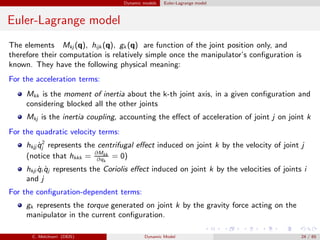
The elements Mkj (q), hijk (q), gk (q) are function of the joint position only, and
therefore their computation is relatively simple once the manipulator’s configuration is
known. They have the following physical meaning:
For the acceleration terms:
Mkk is the moment of inertia about the k-th joint axis, in a given configuration and
considering blocked all the other joints
Mkj is the inertia coupling, accounting the effect of acceleration of joint j on joint k
For the quadratic velocity terms:
hkjj ˙q2
j represents the centrifugal effect induced on joint k by the velocity of joint j
(notice that hkkk = ∂Mkk
∂qk
= 0)
hkji ˙qi ˙qj represents the Coriolis effect induced on joint k by the velocities of joints i
and j
For the configuration-dependent terms:
gk represents the torque generated on joint k by the gravity force acting on the
manipulator in the current configuration.
C. Melchiorri (DEIS) Dynamic Model 24 / 65
Dynamic models Euler-Lagrange model
Euler-Lagrange model
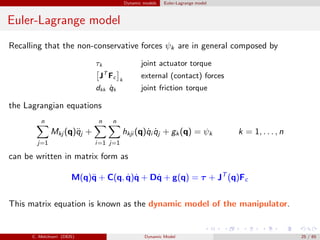
Recalling that the non-conservative forces ψk are in general composed by
τk joint actuator torque
JT
Fc k
external (contact) forces
dkk ˙qk joint friction torque
the Lagrangian equations
n
j=1
Mkj (q)¨qj +
n
i=1
n
j=1
hkji (q)˙qi ˙qj + gk(q) = ψk k = 1, . . . , n
can be written in matrix form as
M(q)¨q + C(q, ˙q)˙q + D˙q + g(q) = τ + JT
(q)Fc
This matrix equation is known as the dynamic model of the manipulator.
C. Melchiorri (DEIS) Dynamic Model 25 / 65
Dynamic models Euler-Lagrange model
Euler-Lagrange model - Some considerations
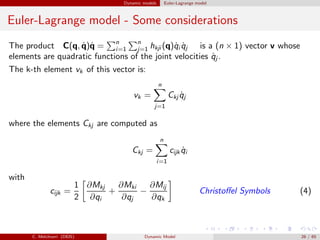
The product C(q, ˙q)˙q = n
i=1
n
j=1 hkji (q)˙qi ˙qj is a (n × 1) vector v whose
elements are quadratic functions of the joint velocities ˙qj .
The k-th element vk of this vector is:
vk =
n
j=1
Ckj ˙qj
where the elements Ckj are computed as
Ckj =
n
i=1
cijk ˙qi
with
cijk =
1
2
∂Mkj
∂qi
+
∂Mki
∂qj
−
∂Mij
∂qk
Christoffel Symbols (4)
C. Melchiorri (DEIS) Dynamic Model 26 / 65
Dynamic models Euler-Lagrange model
Euler-Lagrange model - Some considerations
The elements of matrix C(q, ˙q) are computed as follows. From
n
i=1
n
j=1
hkji ˙qi ˙qj =
n
i=1
n
j=1
∂Mkj
∂qi
−
1
2
∂Mij
∂qk
˙qi ˙qj
by exchanging the sum (i, j) and exploiting the symmetry one obtains
n
i=1
n
j=1
∂Mkj
∂qi
=
1
2
n
i=1
n
j=1
∂Mkj
∂qi
+
∂Mki
∂qj
and then
n
i=1
n
j=1
∂Mkj
∂qi
−
1
2
∂Mij
∂qk
=
n
i=1
n
j=1
1
2
∂Mkj
∂qi
+
∂Mki
∂qj
−
∂Mij
∂qk
=
n
i=1
n
j=1
cijk
where cijk = 1
2
∂Mkj
∂qi
+ ∂Mki
∂qj
−
∂Mij
∂qk
are the so-called Christoffel Symbols.
Since matrix M(q) is symmetric, for a given k then cijk = cjik .
The elements of matrix C(q, ˙q)are then computed as
[C(q, ˙q)]k,j =
n
i=1
cijk ˙qi (5)
C. Melchiorri (DEIS) Dynamic Model 27 / 65
Dynamic models Euler-Lagrange model
Euler-Lagrange model - Some considerations
This is not the only possible expression for matrix C(q, ˙q). In general, any matrix
such that
n
j=1
cij ˙qj =
n
j=1
n
k=1
hijk ˙qk ˙qj
can be considered. The choice (4) is preferred since in this case the following
property is verified.
Property. Matrix N(q, ˙q), defined as
N(q, ˙q) = ˙M(q, ˙q) − 2C(q, ˙q) (6)
in which the elements of C(q, ˙q) are defined as
cijk =
1
2
∂Mkj
∂qi
+
∂Mki
∂qj
−
∂Mij
∂qk
[C(q, ˙q)]k,j =
n
i=1
cijk ˙qi
results skew-symmetric, i.e. nkj = −njk , nkk = 0.
C. Melchiorri (DEIS) Dynamic Model 28 / 65
Dynamic models Euler-Lagrange model
Euler-Lagrange model - Some considerations
In fact, by considering the generic element nkj , one obtains
nkj =
d Mkj
dt
− 2[C]kj
=
n
i=1
∂Mkj
∂qi
− (
∂Mkj
∂qi
+
∂Mki
∂qj
−
∂Mij
∂qk
) ˙qi
=
n
i=1
∂Mij
∂qk
−
∂Mki
∂qj
˙qi
from which it follows (if indices k and j are exchanged, because of the symmetry
of M(q)) that nkj = −njk .
Since matrix N is skew-symmetrix, then
xT
N(q, ˙q) x = 0, ∀x
C. Melchiorri (DEIS) Dynamic Model 29 / 65
Dynamic models Euler-Lagrange model
Euler-Lagrange model - Some considerations
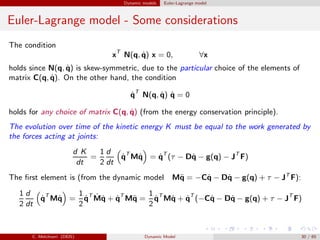
The condition
xT
N(q, ˙q) x = 0, ∀x
holds since N(q, ˙q) is skew-symmetric, due to the particular choice of the elements of
matrix C(q, ˙q). On the other hand, the condition
˙qT
N(q, ˙q) ˙q = 0
holds for any choice of matrix C(q, ˙q) (from the energy conservation principle).
The evolution over time of the kinetic energy K must be equal to the work generated by
the forces acting at joints:
d K
dt
=
1
2
d
dt
˙qT
M˙q = ˙qT
(τ − D˙q − g(q) − JT
F)
The first element is (from the dynamic model M¨q = −C˙q − D˙q − g(q) + τ − JT
F):
1
2
d
dt
˙qT
M˙q =
1
2
˙qT ˙M˙q + ˙qT
M¨q =
1
2
˙qT
M˙q + ˙qT
(−C˙q − D˙q − g(q) + τ − JT
F)
C. Melchiorri (DEIS) Dynamic Model 30 / 65
Dynamic models Euler-Lagrange model
Euler-Lagrange model - Some considerations
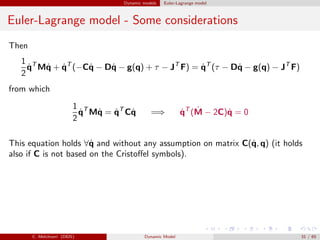
Then
1
2
˙qT
M˙q + ˙qT
(−C˙q − D˙q − g(q) + τ − JT
F) = ˙qT
(τ − D˙q − g(q) − JT
F)
from which
1
2
˙qT
M˙q = ˙qT
C˙q =⇒ ˙qT
( ˙M − 2C)˙q = 0
This equation holds ∀˙q and without any assumption on matrix C(˙q, q) (it holds
also if C is not based on the Cristoffel symbols).
C. Melchiorri (DEIS) Dynamic Model 31 / 65
Dynamic models Euler-Lagrange model
Euler-Lagrange model - Some considerations
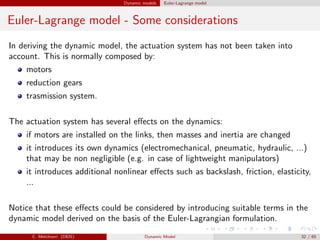
In deriving the dynamic model, the actuation system has not been taken into
account. This is normally composed by:
motors
reduction gears
trasmission system.
The actuation system has several effects on the dynamics:
if motors are installed on the links, then masses and inertia are changed
it introduces its own dynamics (electromechanical, pneumatic, hydraulic, ...)
that may be non negligible (e.g. in case of lightweight manipulators)
it introduces additional nonlinear effects such as backslash, friction, elasticity,
...
Notice that these effects could be considered by introducing suitable terms in the
dynamic model derived on the basis of the Euler-Lagrangian formulation.
C. Melchiorri (DEIS) Dynamic Model 32 / 65
Dynamic models Euler-Lagrange model
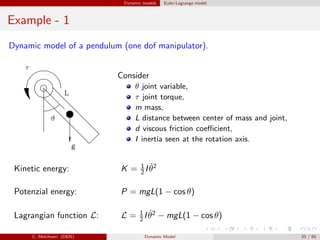
Example - 1
Dynamic model of a pendulum (one dof manipulator).
Consider
θ joint variable,
τ joint torque,
m mass,
L distance between center of mass and joint,
d viscous friction coefficient,
I inertia seen at the rotation axis.
Kinetic energy: K = 1
2 I ˙θ2
Potenzial energy: P = mgL(1 − cos θ)
Lagrangian function L: L = 1
2 I ˙θ2
− mgL(1 − cos θ)
C. Melchiorri (DEIS) Dynamic Model 33 / 65
Dynamic models Euler-Lagrange model
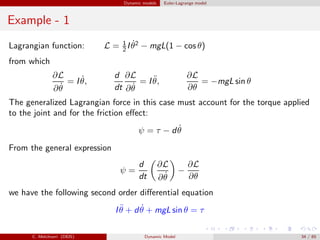
Example - 1
Lagrangian function: L = 1
2 I ˙θ2
− mgL(1 − cos θ)
from which
∂L
∂ ˙θ
= I ˙θ,
d
dt
∂L
∂ ˙θ
= I ¨θ,
∂L
∂θ
= −mgL sin θ
The generalized Lagrangian force in this case must account for the torque applied
to the joint and for the friction effect:
ψ = τ − d ˙θ
From the general expression
ψ =
d
dt
∂L
∂ ˙θ
−
∂L
∂θ
we have the following second order differential equation
I ¨θ + d ˙θ + mgL sin θ = τ
C. Melchiorri (DEIS) Dynamic Model 34 / 65
Dynamic models Euler-Lagrange model
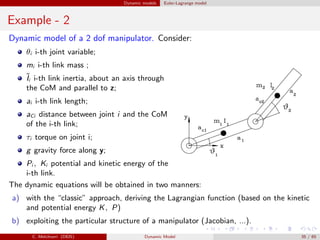
Example - 2
Dynamic model of a 2 dof manipulator. Consider:
θi i-th joint variable;
mi i-th link mass ;
˜Ii i-th link inertia, about an axis through
the CoM and parallel to z;
ai i-th link length;
aCi distance between joint i and the CoM
of the i-th link;
τi torque on joint i;
g gravity force along y;
Pi , Ki potential and kinetic energy of the
i-th link.
The dynamic equations will be obtained in two manners:
a) with the “classic” approach, deriving the Lagrangian function (based on the kinetic
and potential energy K, P)
b) exploiting the particular structure of a manipulator (Jacobian, ...).
C. Melchiorri (DEIS) Dynamic Model 35 / 65
Dynamic models Euler-Lagrange model
Example - 2 (classic approach)
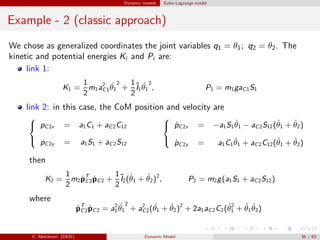
We chose as generalized coordinates the joint variables q1 = θ1; q2 = θ2. The
kinetic and potential energies Ki and Pi are:
link 1:
K1 =
1
2
m1a2
C1
˙θ1
2
+
1
2
˜I1
˙θ1
2
, P1 = m1gaC1S1
link 2: in this case, the CoM position and velocity are



pC2x = a1C1 + aC2C12
pC2y = a1S1 + aC2S12



˙pC2x = −a1S1
˙θ1 − aC2S12( ˙θ1 + ˙θ2)
˙pC2y = a1C1
˙θ1 + aC2C12( ˙θ1 + ˙θ2)
then
K2 =
1
2
m2 ˙pT
C2 ˙pC2 +
1
2
˜I2( ˙θ1 + ˙θ2)2
, P2 = m2g(a1S1 + aC2S12)
where
˙pT
C2 ˙pC2 = a2
1
˙θ1
2
+ a2
C2( ˙θ1 + ˙θ2)2
+ 2a1aC2C2( ˙θ2
1 + ˙θ1
˙θ2)
C. Melchiorri (DEIS) Dynamic Model 36 / 65
Dynamic models Euler-Lagrange model
Example - 2 (classic approach)
Therefore, L = K1 + K2 − P1 − P2 and
τ1 = [m1a2
C1 + ˜I1 + m2(a2
1 + a2
C2 + 2a1aC2C2) + ˜I2]¨θ1 +
+[m2(a2
C2 + a1aC2C2) + ˜I2]¨θ2 − m2a1aC2S2(2 ˙θ1
˙θ2 + ˙θ2
2) +
+m1gaC1C1 + m2g(a1C1 + aC2C12)
τ2 = [m2(a2
C2 + a1aC2C2) + ˜I2] ¨θ1 + (m2a2
C2 + ˜I2)¨θ2 +
m2a1aC2S2
˙θ2
1 + m2gaC2C12
C. Melchiorri (DEIS) Dynamic Model 37 / 65
Dynamic models Euler-Lagrange model
Example - 2 (‘robotics’ approach)
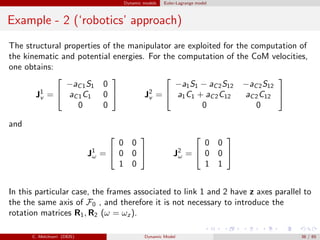
The structural properties of the manipulator are exploited for the computation of
the kinematic and potential energies. For the computation of the CoM velocities,
one obtains:
J1
v =


−aC1S1 0
aC1C1 0
0 0

 J2
v =


−a1S1 − aC2S12 −aC2S12
a1C1 + aC2C12 aC2C12
0 0


and
J1
ω =


0 0
0 0
1 0

 J2
ω =


0 0
0 0
1 1


In this particular case, the frames associated to link 1 and 2 have z axes parallel to
the the same axis of F0 , and therefore it is not necessary to introduce the
rotation matrices R1, R2 (ω = ωz ).
C. Melchiorri (DEIS) Dynamic Model 38 / 65
Dynamic models Euler-Lagrange model
Example - 2 (‘robotics’ approach)
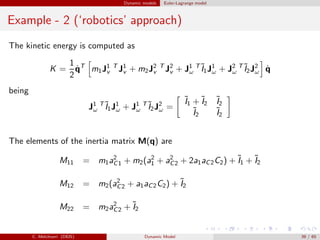
The kinetic energy is computed as
K =
1
2
˙qT
m1J1 T
v J1
v + m2J2 T
v J2
v + J1 T
ω
˜I1J1
ω + J2 T
ω
˜I2J2
ω ˙q
being
J1 T
ω
˜I1J1
ω + J1 T
ω
˜I2J2
ω =
˜I1 + ˜I2
˜I2
˜I2
˜I2
The elements of the inertia matrix M(q) are
M11 = m1a2
C1 + m2(a2
1 + a2
C2 + 2a1aC2C2) + ˜I1 + ˜I2
M12 = m2(a2
C2 + a1aC2C2) + ˜I2
M22 = m2a2
C2 + ˜I2
C. Melchiorri (DEIS) Dynamic Model 39 / 65
Dynamic models Euler-Lagrange model
Example - 2 (‘robotics’ approach)
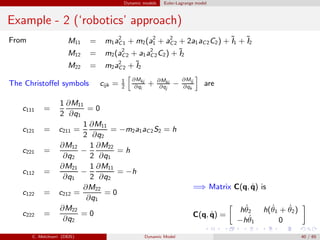
From M11 = m1a2
C1 + m2(a2
1 + a2
C2 + 2a1aC2C2) + ˜I1 + ˜I2
M12 = m2(a2
C2 + a1a2
C2C2) + ˜I2
M22 = m2a2
C2 + ˜I2
The Christoffel symbols cijk = 1
2
∂Mkj
∂qi
+ ∂Mki
∂qj
−
∂Mij
∂qk
are
c111 =
1
2
∂M11
∂q1
= 0
c121 = c211 =
1
2
∂M11
∂q2
= −m2a1aC2S2 = h
c221 =
∂M12
∂q2
−
1
2
∂M22
∂q1
= h
c112 =
∂M21
∂q1
−
1
2
∂M11
∂q2
= −h
c122 = c212 =
∂M22
∂q1
= 0
c222 =
∂M22
∂q2
= 0
=⇒ Matrix C(q, ˙q) is
C(q, ˙q) =
h ˙θ2 h( ˙θ1 + ˙θ2)
−h ˙θ1 0
C. Melchiorri (DEIS) Dynamic Model 40 / 65
Dynamic models Euler-Lagrange model
Example - 2 (‘robotics’ approach)
Matrix N(q) is
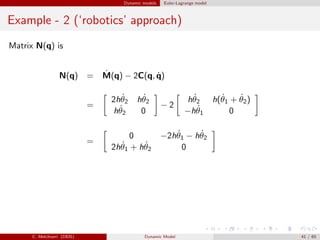
N(q) = ˙M(q) − 2C(q, ˙q)
=
2h ˙θ2 h ˙θ2
h ˙θ2 0
− 2
h ˙θ2 h( ˙θ1 + ˙θ2)
−h ˙θ1 0
=
0 −2h ˙θ1 − h ˙θ2
2h ˙θ1 + h ˙θ2 0
C. Melchiorri (DEIS) Dynamic Model 41 / 65
Dynamic models Euler-Lagrange model
Example - 2 (‘robotics’ approach)
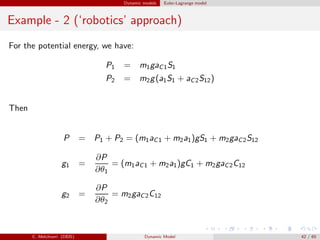
For the potential energy, we have:
P1 = m1gaC1S1
P2 = m2g(a1S1 + aC2S12)
Then
P = P1 + P2 = (m1aC1 + m2a1)gS1 + m2gaC2S12
g1 =
∂P
∂θ1
= (m1aC1 + m2a1)gC1 + m2gaC2C12
g2 =
∂P
∂θ2
= m2gaC2C12
C. Melchiorri (DEIS) Dynamic Model 42 / 65
Dynamic models Euler-Lagrange model
Example - 2 (‘robotics’ approach)
Summarizing, we have
M11
¨θ1 + M12
¨θ2 + c121
˙θ1
˙θ2 + c211
˙θ2
˙θ1 + c221
˙θ2
2 + g1 = τ1
M21
¨θ1 + M22
¨θ2 + c112
˙θ2
1 + g2 = τ2
or
[m1a2
C1 + m2(a2
1 + a2
C2 + 2a1aC2C2) + ˜I1 + ˜I2]¨θ1 + [m2(a2
C2 + a1a2
C2C2) + ˜I2]¨θ2
−m2a1aC2S2
˙θ2
2 − 2m2a1aC2S2
˙θ1
˙θ2
+(m1aC1 + m2a1)gC1 + m2gaC2C12 = τ1
[m2(a2
C2 + a1aC2C2) + ˜I2]¨θ1 + [m2a2
C2 + ˜I2]¨θ2
+m2a1aC2S2
˙θ2
1
+m2gaC2C12 = τ2
=⇒ Same result!
C. Melchiorri (DEIS) Dynamic Model 43 / 65
Dynamic models Euler-Lagrange model
Properties of the Euler-Lagrangian dynamic model
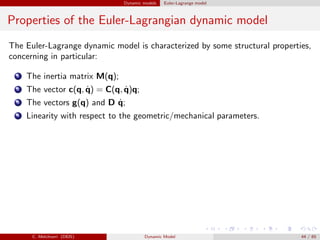
The Euler-Lagrange dynamic model is characterized by some structural properties,
concerning in particular:
1 The inertia matrix M(q);
2 The vector c(q, ˙q) = C(q, ˙q)q;
3 The vectors g(q) and D ˙q;
4 Linearity with respect to the geometric/mechanical parameters.
C. Melchiorri (DEIS) Dynamic Model 44 / 65
Dynamic models Euler-Lagrange model
Properties of the Euler-Lagrangian dynamic model
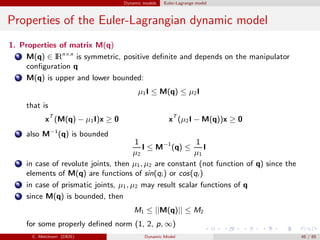
1. Properties of matrix M(q)
1 M(q) ∈ IRn×n
is symmetric, positive definite and depends on the manipulator
configuration q
2 M(q) is upper and lower bounded:
µ1I ≤ M(q) ≤ µ2I
that is
xT
(M(q) − µ1I)x ≥ 0 xT
(µ2I − M(q))x ≥ 0
3 also M−1
(q) is bounded
1
µ2
I ≤ M−1
(q) ≤
1
µ1
I
4 in case of revolute joints, then µ1, µ2 are constant (not function of q) since the
elements of M(q) are functions of sin(qi ) or cos(qi )
5 in case of prismatic joints, µ1, µ2 may result scalar functions of q
6 since M(q) is bounded, then
M1 ≤ ||M(q)|| ≤ M2
for some properly defined norm (1, 2, p, ∞)
C. Melchiorri (DEIS) Dynamic Model 45 / 65
Dynamic models Euler-Lagrange model
Properties of the Euler-Lagrangian dynamic model
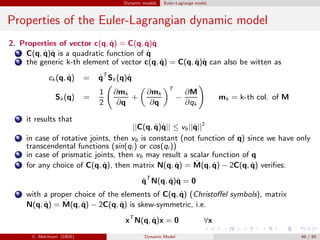
2. Properties of vector c(q, ˙q) = C(q, ˙q)˙q
1 C(q, ˙q)˙q is a quadratic function of ˙q
2 the generic k-th element of vector c(q, ˙q) = C(q, ˙q)˙q can also be witten as
ck (q, ˙q) = ˙qT
Sk (q)˙q
Sk(q) =
1
2
∂mk
∂q
+
∂mk
∂q
T
−
∂M
∂qk
mk = k-th col. of M
3 it results that
||C(q, ˙q)˙q|| ≤ vb||˙q||2
4 in case of rotative joints, then vb is constant (not function of q) since we have only
transcendental functions (sin(qi ) or cos(qi ))
5 in case of prismatic joints, then vb may result a scalar function of q
6 for any choice of C(q, ˙q), then matrix N(q, ˙q) = ˙M(q, ˙q) − 2C(q, ˙q) verifies:
˙qT
N(q, ˙q)˙q = 0
7 with a proper choice of the elements of C(q, ˙q) (Christoffel symbols), matrix
N(q, ˙q) = ˙M(q, ˙q) − 2C(q, ˙q) is skew-symmetric, i.e.
xT
N(q, ˙q)x = 0 ∀x
C. Melchiorri (DEIS) Dynamic Model 46 / 65
Dynamic models Euler-Lagrange model
Properties of the Euler-Lagrangian dynamic model
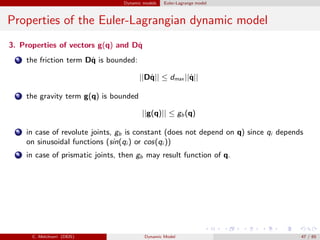
3. Properties of vectors g(q) and D˙q
1 the friction term D˙q is bounded:
||D˙q|| ≤ dmax ||˙q||
2 the gravity term g(q) is bounded
||g(q)|| ≤ gb(q)
3 in case of revolute joints, gb is constant (does not depend on q) since qi depends
on sinusoidal functions (sin(qi ) or cos(qi ))
4 in case of prismatic joints, then gb may result function of q.
C. Melchiorri (DEIS) Dynamic Model 47 / 65
Dynamic models Euler-Lagrange model
Properties of the Euler-Lagrangian dynamic model
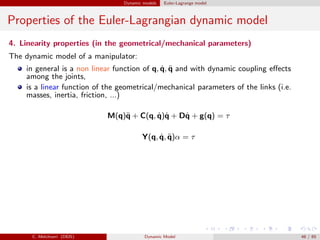
4. Linearity properties (in the geometrical/mechanical parameters)
The dynamic model of a manipulator:
in general is a non linear function of q, ˙q, ¨q and with dynamic coupling effects
among the joints,
is a linear function of the geometrical/mechanical parameters of the links (i.e.
masses, inertia, friction, ...)
M(q)¨q + C(q, ˙q)˙q + D˙q + g(q) = τ
Y(q, ˙q, ¨q)α = τ
C. Melchiorri (DEIS) Dynamic Model 48 / 65
Dynamic models Euler-Lagrange model
Example
Properties of the dynamic model of a
2 dof manipulator.
Neglecting friction effects we have:
M(q) =
m1a2
C1 + m2(a2
1 + a2
C2 + 2a1aC2C2) + ˜I1 + ˜I2 m2(a2
C2 + a1aC2C2) + ˜I2
m2(a2
C2 + a1aC2C2) + ˜I2 m2a2
C2 + ˜I2
C(q, ˙q)˙q = −m2a1aC2S2
2 ˙θ1
˙θ2 + ˙θ2
2
− ˙θ2
1
, g(q)=
(m1aC1 + m2a1)gC1 + m2gaC2C12
m2gaC2C12
Consider (for the sake of simplicity) the 1-norm || · ||1, and θ1, θ2 ∈ [−π/2, π/2].
C. Melchiorri (DEIS) Dynamic Model 49 / 65
Dynamic models Euler-Lagrange model
Example
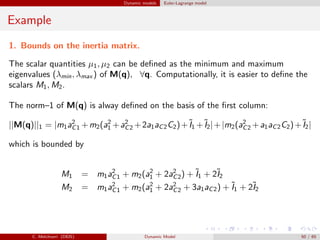
1. Bounds on the inertia matrix.
The scalar quantities µ1, µ2 can be defined as the minimum and maximum
eigenvalues (λmin, λmax ) of M(q), ∀q. Computationally, it is easier to define the
scalars M1, M2.
The norm–1 of M(q) is alway defined on the basis of the first column:
||M(q)||1 = |m1a2
C1 +m2(a2
1 +a2
C2 +2a1aC2C2)+˜I1 +˜I2|+|m2(a2
C2 +a1aC2C2)+˜I2|
which is bounded by
M1 = m1a2
C1 + m2(a2
1 + 2a2
C2) + ˜I1 + 2˜I2
M2 = m1a2
C1 + m2(a2
1 + 2a2
C2 + 3a1aC2) + ˜I1 + 2˜I2
C. Melchiorri (DEIS) Dynamic Model 50 / 65
Dynamic models Euler-Lagrange model
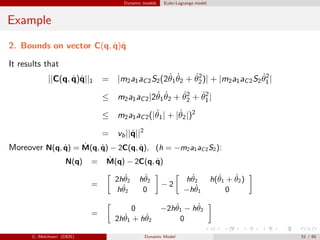
Example
2. Bounds on vector C(q, ˙q)˙q
It results that
||C(q, ˙q)˙q||1 = |m2a1aC2S2(2 ˙θ1
˙θ2 + ˙θ2
2)| + |m2a1aC2S2
˙θ2
1|
≤ m2a1aC2|2 ˙θ1
˙θ2 + ˙θ2
2 + ˙θ2
1|
≤ m2a1aC2(| ˙θ1| + | ˙θ2|)2
= vb||˙q||2
Moreover N(q, ˙q) = ˙M(q, ˙q) − 2C(q, ˙q), (h = −m2a1aC2S2):
N(q) = ˙M(q) − 2C(q, ˙q)
=
2h ˙θ2 h ˙θ2
h ˙θ2 0
− 2
h ˙θ2 h( ˙θ1 + ˙θ2)
−h ˙θ1 0
=
0 −2h ˙θ1 − h ˙θ2
2h ˙θ1 + h ˙θ2 0
C. Melchiorri (DEIS) Dynamic Model 51 / 65
Dynamic models Euler-Lagrange model
Example
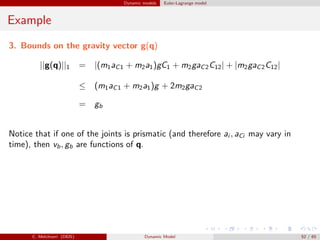
3. Bounds on the gravity vector g(q)
||g(q)||1 = |(m1aC1 + m2a1)gC1 + m2gaC2C12| + |m2gaC2C12|
≤ (m1aC1 + m2a1)g + 2m2gaC2
= gb
Notice that if one of the joints is prismatic (and therefore ai , aCi may vary in
time), then vb, gb are functions of q.
C. Melchiorri (DEIS) Dynamic Model 52 / 65
Dynamic models Euler-Lagrange model
Example
Plots of the eigenvalues of M(q) for the 2 dof planar manipulator
0
50
100
150
200
250
300
350
0
100
200
300
400
0
20
40
60
80
100
120
140
160
180
l
m
in = 6.2399
l
m
ax = 161.2601
q1 [deg]
Andamento autovalori minimo e massimo di M(q)
q2 [deg]
λmin = 6.2399
λmax = 161.2601
In this case, the eigenvalues depend only on q2! These results have been obtained
with:
m1 = m2 = 50kg; I1 = I2 = 10; a1 = a2 = 1; ac1 = ac2 = 0.5
One obtains
M1 = 117, 5, M2 = 192.5 e M 1 = 192.5, M 2 = 161.26, M ∞ = 192.5
C. Melchiorri (DEIS) Dynamic Model 53 / 65
Dynamic models Euler-Lagrange model
Example
3. Linearity of the dynamic model Y(q, ˙q, ¨q)α = τ
[m1a2
C1 + m2(a2
1 + a2
C2 + 2a1aC2C2) + ˜I1 + ˜I2]¨θ1 + [m2(a2
C2 + a1a2
C2C2) + ˜I2]¨θ2
−m2a1aC2S2
˙θ2
2 − 2m2a1aC2S2
˙θ1
˙θ2
+(m1aC1 + m2a1)gC1 + m2gaC2C12 = τ1
[m2(a2
C2 + a1aC2C2) + ˜I2]¨θ1 + [m2a2
C2 + ˜I2]¨θ2
+m2a1aC2S2
˙θ2
1
+m2gaC2C12 = τ2
By inspection, one can define the parameters vector
α = [α1, α2, α3, α4, α5]T
with
α1 = m1aC1, α2 = m1a2
C1 + ˜I1, α3 = m2, α4 = m2aC2, α5 = m2a2
C2 + ˜I2
C. Melchiorri (DEIS) Dynamic Model 54 / 65
Dynamic models Euler-Lagrange model
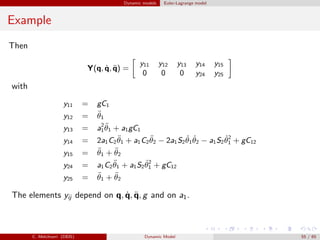
Example
Then
Y(q, ˙q, ¨q) =
y11 y12 y13 y14 y15
0 0 0 y24 y25
with
y11 = gC1
y12 = ¨θ1
y13 = a2
1
¨θ1 + a1gC1
y14 = 2a1C2
¨θ1 + a1C2
¨θ2 − 2a1S2
˙θ1
˙θ2 − a1S2
˙θ2
1 + gC12
y15 = ¨θ1 + ¨θ2
y24 = a1C2
¨θ1 + a1S2
˙θ2
1 + gC12
y25 = ¨θ1 + ¨θ2
The elements yij depend on q, ˙q, ¨q, g and on a1.
C. Melchiorri (DEIS) Dynamic Model 55 / 65
Dynamic models Euler-Lagrange model
Example
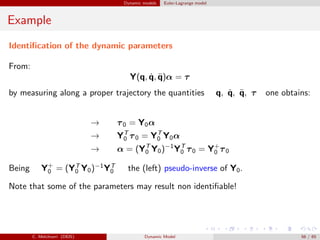
Identification of the dynamic parameters
From:
Y(q, ˙q, ¨q)α = τ
by measuring along a proper trajectory the quantities q, ˙q, ¨q, τ one obtains:
→ τ0 = Y0α
→ YT
0 τ0 = YT
0 Y0α
→ α = (YT
0 Y0)−1
YT
0 τ0 = Y+
0 τ0
Being Y+
0 = (YT
0 Y0)−1
YT
0 the (left) pseudo-inverse of Y0.
Note that some of the parameters may result non identifiable!
C. Melchiorri (DEIS) Dynamic Model 56 / 65
Dynamic models Euler-Lagrange model
A Simulink dynamic model
Demux
.
1/s
q2
1/s
dq2
Demux
Demux2
Mux
Mux2 ddq
dq
Mux
Mux
Mux
Mux3
1/s
q1
1/s
dq1
MATLAB
Function
dir2yn
Clock
t
Tempo
Coppie
Disturbo
q
Posizioni
dq
Velocita`
ddq
Accelerazioni
tau
Tau
Mux
Mux1
q
tau
sc_d2dof.m
Inizializzazione con
esed2dof.m
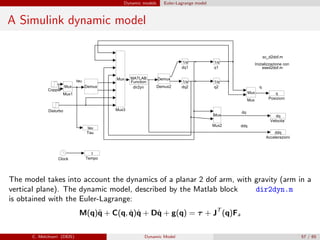
The model takes into account the dynamics of a planar 2 dof arm, with gravity (arm in a
vertical plane). The dynamic model, described by the Matlab block dir2dyn.m
is obtained with the Euler-Lagrange:
M(q)¨q + C(q, ˙q)˙q + D˙q + g(q) = τ + JT
(q)Fa
C. Melchiorri (DEIS) Dynamic Model 57 / 65
Dynamic models Euler-Lagrange model
Dynamic model in Simulink
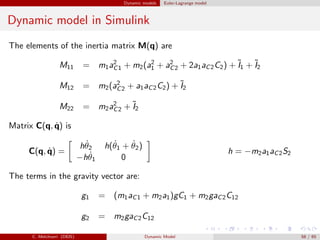
The elements of the inertia matrix M(q) are
M11 = m1a2
C1 + m2(a2
1 + a2
C2 + 2a1aC2C2) + ˜I1 + ˜I2
M12 = m2(a2
C2 + a1aC2C2) + ˜I2
M22 = m2a2
C2 + ˜I2
Matrix C(q, ˙q) is
C(q, ˙q) =
h ˙θ2 h( ˙θ1 + ˙θ2)
−h ˙θ1 0
h = −m2a1aC2S2
The terms in the gravity vector are:
g1 = (m1aC1 + m2a1)gC1 + m2gaC2C12
g2 = m2gaC2C12
C. Melchiorri (DEIS) Dynamic Model 58 / 65
Dynamic models Euler-Lagrange model
Dynamic model in Simulink
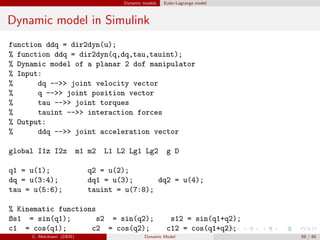
function ddq = dir2dyn(u);
% function ddq = dir2dyn(q,dq,tau,tauint);
% Dynamic model of a planar 2 dof manipulator
% Input:
% dq -->> joint velocity vector
% q -->> joint position vector
% tau -->> joint torques
% tauint -->> interaction forces
% Output:
% ddq -->> joint acceleration vector
global I1z I2z m1 m2 L1 L2 Lg1 Lg2 g D
q1 = u(1); q2 = u(2);
dq = u(3:4); dq1 = u(3); dq2 = u(4);
tau = u(5:6); tauint = u(7:8);
% Kinematic functions
ßs1 = sin(q1); s2 = sin(q2); s12 = sin(q1+q2);
c1 = cos(q1); c2 = cos(q2); c12 = cos(q1+q2);
C. Melchiorri (DEIS) Dynamic Model 59 / 65
Dynamic models Euler-Lagrange model
Dynamic model in Simulink
%%%%% Elements of the Inertia Matrix M
M11 = I1z+I2z+Lg1^2*m1+m2*(L1^2+Lg2^2+2*L1*Lg2*c2);
M12 = I2z+m2*(Lg2^2+L1*Lg2*c2);
M22 = I2z+Lg2^2*m2;
M = [M11, M12; M12, M22];
%%%%% Coriolis and centrifugal elements
C11 = -(L1*dq2*s2*(Lg2*m2)); C12 = -(L1*dq12*s2*(Lg2*m2));
C21 = m2*L1*Lg2*s2*dq1; C22 = 0;
C = [C11 C12; C21 C22];
%%%%% Gravity :
g1 = m1*Lg1*c1+m2*(Lg2*c12 + L1*c1); g2 = m2*Lg2*c12;
G = g*[g1; g2];
%%%%% Computation of acceleration
ddq = inv(M) * (tau + tauint - C*dq - D*dq - G);
C. Melchiorri (DEIS) Dynamic Model 60 / 65
Dynamic models Euler-Lagrange model
Dynamic model in Simulink
% Simulation of the dynamic model of a planar 2 dof manipulator
% Simulink scheme: sc_d2dof.m
% Definition and initialization of global variables
% Run the simulation RK45
%
%%%%%%%%%%%%%%%%%%%%%%%%%%%%%%
%%%% Robots’ Coefficients %%%%
%%%%%%%%%%%%%%%%%%%%%%%%%%%%%%
clear I1z I2z m1 m2 L1 L2 Lg1 Lg2 g D
global I1z I2z m1 m2 L1 L2 Lg1 Lg2 g D
I1z = 10; I2z = 10;
m1 = 50.0; m2 = 50.0;
L1 = 1; L2 = 1;
Lg1=L1/2; Lg2=L2/2;
g = 9.81;
D = 0.0 * eye(2); % friction
% D = diag([30,30]); % friction
% D = diag([80,80]); % friction
C. Melchiorri (DEIS) Dynamic Model 61 / 65
Dynamic models Euler-Lagrange model
Dynamic model in Simulink
COPPIA = 0; % joint torques
DISTURBO = 0; % joint torques due to interaction with environment
%%%% Iniziatialization and run
TI = 0; TF = 10;
ERR = 1e-3;
TMIN = 0.002; TMAX = 10*TMIN;
OPTIONS = [ERR,TMIN,TMAX,0,0,2];
X0 = [0 0 0 0];
[ti,xi,yi]=rk45(’sc_d2dof’,TF,X0,OPTIONS);
C. Melchiorri (DEIS) Dynamic Model 62 / 65
Dynamic models Euler-Lagrange model
Dynamic model in Simulink
D = diag[0, 0];
0 1 2 3 4 5 6 7 8 9 10
−4
−3
−2
−1
0
1
Posizioni q1, q2 (dash)
0 1 2 3 4 5 6 7 8 9 10
−10
−5
0
5
10
Velocita‘ dq1, dq2 (dash)
0 1 2 3 4 5 6 7 8 9 10
−40
−20
0
20
40
Accelerazioni ddq1, ddq2 (dash)
0 1 2 3 4 5 6 7 8 9 10
−1
−0.5
0
0.5
1
Coppie tau1, tau2 (dash)
C. Melchiorri (DEIS) Dynamic Model 63 / 65
Dynamic models Euler-Lagrange model
Dynamic model in Simulink
D = diag[30, 30];
0 1 2 3 4 5 6 7 8 9 10
−3
−2
−1
0
1
Posizioni q1, q2 (dash)
0 1 2 3 4 5 6 7 8 9 10
−4
−2
0
2
4
Velocita‘ dq1, dq2 (dash)
0 1 2 3 4 5 6 7 8 9 10
−15
−10
−5
0
5
10
15
Accelerazioni ddq1, ddq2 (dash)
0 1 2 3 4 5 6 7 8 9 10
−1
−0.5
0
0.5
1
Coppie tau1, tau2 (dash)
C. Melchiorri (DEIS) Dynamic Model 64 / 65
Dynamic models Euler-Lagrange model
Dynamic model in Simulink
D = diag[80, 80];
0 1 2 3 4 5 6 7 8 9 10
−3
−2
−1
0
1
2
Velocita‘ dq1, dq2 (dash)
0 1 2 3 4 5 6 7 8 9 10
−3
−2
−1
0
1
Posizioni q1, q2 (dash)
0 1 2 3 4 5 6 7 8 9 10
−15
−10
−5
0
5
10
15
Accelerazioni ddq1, ddq2 (dash)
0 1 2 3 4 5 6 7 8 9 10
−1
−0.5
0
0.5
1
Coppie tau1, tau2 (dash)
C. Melchiorri (DEIS) Dynamic Model 65 / 65

Fir 05 dynamics

  • 1.
    Dynamic model ofrobot manipulators Claudio Melchiorri Dipartimento di Elettronica, Informatica e Sistemistica (DEIS) Universit`a di Bologna email: claudio.melchiorri@unibo.it C. Melchiorri (DEIS) Dynamic Model 1 / 65
  • 2.
    Summary 1 Dynamic models Introduction Euler-Lagrangemodel C. Melchiorri (DEIS) Dynamic Model 2 / 65
  • 3.
    Dynamic models Introduction Dynamicmodel of manipulators Robot Dynamics =⇒ Study of the relation between the applied forces/torques and the resulting motion of an industrial manipulator. Similarly to kinematics, also for the dynamics it is possible to define two “models”: Direct model: once the forces/torques applied to the joints, as well as the joint positions and velocities are known, compute the joint accelerations ¨q = f (q, ˙q, τ) and then ˙q = ¨q dt, q = ˙q dt Inverse model: once the joint accelerations, velocities and positions are known, compute the corresponding forces/torques τ = f −1 (¨q, ˙q, q) = g(¨q, ˙q, q) C. Melchiorri (DEIS) Dynamic Model 3 / 65
  • 4.
    Dynamic models Introduction Dynamicmodel of manipulators Normally, a manipulator is composed by an open kinematic chain, and its dynamic model is affected by several “drawbacks”: low rigidity (elasticity in the structure and in the joints) potentially unknown parameters (dimensions, inertia, mass,. . . ) dynamic coupling among links. Other non linear effects are usually introduced by the actuation system: friction dead zones . . . In any case, in the derivation of the dynamic model, an ideal case of a series of connected rigid bodies is made. C. Melchiorri (DEIS) Dynamic Model 4 / 65
  • 5.
    Dynamic models Introduction Dynamicmodel of manipulators Two problems may be defined for the study of the dynamic model: Direct dynamic model: computation of the time evolution of ¨q(t) (and then of q(t), ˙q(t)), given the vector of generalized forces (torques and/or forces) bτ(t) applied to the joints and, in case, the external forces applied to the end-effector, and the initial conditions q(t = t0), ˙q(t = t0). τ(t) =⇒ ¨q(t) ( ˙q(t), q(t) ) Inverse dynamic problem: computation of the vector τ(t) necessary to obtain a desired trajectory ¨q(t), ˙q(t), q(t), once the forces applied of the end-effector are known. ¨q(t), ˙q(t), q(t) =⇒ τ(t) C. Melchiorri (DEIS) Dynamic Model 5 / 65
  • 6.
    Dynamic models Introduction Dynamicmodel of manipulators There are several reasons for studying the dynamics of a manipulator: • simulation: test desired motions without resorting to real experimentation • analysis and synthesis of suitable control algorithms • analysis of the structural properties of the manipulator since the design phase. Two approaches for the definition of the dynamic model: EULER-LAGRANGE approach. First approach to be developed. The dynamic model obtained in this manner is simpler and more intuitive, and also more suitable to understand the effects of changes in the mechanical parameters. The links are considered altogether, and the model is obtained analytically. Drawbacks: the model is obtained starting from the kinetic and potential energies (non intuitive); the model is not computationally efficient. NEWTON-EULER approach. Based on a computationally efficient recursive technique that exploits the serial structure of an industrial manipulator. On the other hand, the mathematical model is not expressed in closed form. Obviously, the two techniques are equivalent (provide the same results). C. Melchiorri (DEIS) Dynamic Model 6 / 65
  • 7.
    Dynamic models Euler-Lagrangemodel Euler-Lagrange model Generalized variables, or Lagrange coordinates: Independent variables used to describe the position of rigid bodies in the space. For the same physical system, more choices for the Lagrangian coordinates are usually possible. In robotics =⇒ joint variables q1, q2, . . . qn. C. Melchiorri (DEIS) Dynamic Model 7 / 65
  • 8.
    Dynamic models Euler-Lagrangemodel Euler-Lagrange model From physics, we know that it is possible to define: 1 The Kinetic Energy function K(q, ˙q) 2 The Potential Energy function P(q) and therefore the Lagrangian function L(q, ˙q) = K(q, ˙q) − P(q) The Euler-Lagrange equations are ψi = d dt ∂L ∂ ˙qi − ∂L ∂qi i = 1, . . . , n being ψi the non-conservative (external or dissipative) generalized forces performing work on qi . In robotics, we consider: τi joint actuator torque JT Fc i term due to external (contact) forces dii ˙qi joint friction torque Therefore: ψi = τi + JT Fc i − dii ˙qi . C. Melchiorri (DEIS) Dynamic Model 8 / 65
  • 9.
    Dynamic models Euler-Lagrangemodel Euler-Lagrange model Since the potential energy does not depend on the velocity, the Euler-Lagrange equations can be rewritten as ψi = d dt ∂K ∂ ˙qi − ∂K ∂qi + ∂P ∂qi i = 1, . . . , n (1) This formulation is more convenient since in robotics it is possible to compute quite easily the terms K and P from the geometric properties of the manipulator. Then, by applying (1), the dynamic model is obtained. Note that K = n i=1 Ki P = n i=1 Pi C. Melchiorri (DEIS) Dynamic Model 9 / 65
  • 10.
    Dynamic models Euler-Lagrangemodel Euler-Lagrange model Computation of the Kinetic Energy. For a rigid body: The mass can be computed by m = B ρ(x, y, z) dx dy dz where ρ(x, y, z) is the mass density (assumed constant): ρ(x, y, z) = ρ. The center of mass (CoM) is pC = 1 m B p(x, y, z)ρ dx dy dz = 1 m B p(x, y, z) dm The kinetic energy results K = 1 2 B vT (x, y, z)v(x, y, z)ρ dx dy dz = 1 2 B vT (x, y, z)v(x, y, z) dm C. Melchiorri (DEIS) Dynamic Model 10 / 65
  • 11.
    Dynamic models Euler-Lagrangemodel Euler-Lagrange model Let assume that the translational vC and rotational ω velocities of the center of mass are known with respect to an inertial frame F0 . The velocity of a generic point p′ of the body is v = vC + ω × (p′ − pC ) = vC + ω × r (2) The velocity expressed in a frame F’ fixed to the rigid body may be computed by introducing the rotation matrix R betweeen F’ and F0 RT v = RT (vC + ω × r) = RT vC + (RT ω) × (RT r) Therefore v′ = v′ C + ω′ × r′ C. Melchiorri (DEIS) Dynamic Model 11 / 65
  • 12.
    Dynamic models Euler-Lagrangemodel Euler-Lagrange model Since the product ω × r in (2) can be expressed as S(ω) r, we have: K = 1 2 B vT (x, y, z)v(x, y, z) dm = 1 2 B (vC + Sr)T (vC + Sr) dm = 1 2 B vT C vC dm + 1 2 B rT ST Sr dm + B vT C Sr dm = 1 2 B vT C vC dm + 1 2 B rT ST Sr dm As a matter of fact, from the definition of CoM ( B r dm = B (pC − p)dm = 0): B vT C Sr dm = vT C S B r dm = 0 C. Melchiorri (DEIS) Dynamic Model 12 / 65
  • 13.
    Dynamic models Euler-Lagrangemodel Euler-Lagrange model In conclusion K = 1 2 B vT C vC dm + 1 2 B rT ST Sr dm The first term depends on the linear velocity vC of the center of mass 1 2 B vT C vC dm = 1 2 m vT C vC For the second term, considering that aT b = Tr(a bT ) and the particular structure of matrix S, we have 1 2 B rT ST Sr dm = 1 2 B Tr(Sr rT ST ) dm = 1 2 Tr(S B rrT dm ST ) = 1 2 Tr(S J ST ) = 1 2 ωT I ω I : body inertia matrix Also this term depends on the velocity of the center of mass (in this case ω). C. Melchiorri (DEIS) Dynamic Model 13 / 65
  • 14.
    Dynamic models Euler-Lagrangemodel Euler-Lagrange model Matrix J, Euler matrix, and matrix I, body inertia matrix, are symmetric, and have the following general expressions: J =   r2 x dm rx ry dm rx rz dm rx ry dm r2 y dm ry rz dm rx rz dm ry rz dm r2 z dm   I =   (r2 y + r2 z ) dm − rx ry dm − rx rz dm − rx ry dm (r2 x + r2 z ) dm − ry rz dm − rx rz dm − ry rz dm (r2 x + r2 y ) dm   The elements of both matrices J ed I depend on vector r, i.e. on the position of the generic point of the i-th link with respect to its center of mass, defined in the base frame. Since the position of the i-th link depends on the configuration of the manipulator, matrices J and I are in general functions of the joint variables q! C. Melchiorri (DEIS) Dynamic Model 14 / 65
  • 15.
    Dynamic models Euler-Lagrangemodel Examples of body inertia matrices Homogeneous bodies of mass m, with axes of symmetry. • Parallelepiped with sides a (length/height), b, c (base) I =   Ixx Iyy Izz   =   1 12 m(b2 + c2) 1 12 m(a2 + c2) 1 12 m(a2 + b2)   • Empty cylinder with length h, and external/internal radii a, b I =   1 2 m(a2 + b2) 1 12 m 3(a2 + b2) + h2 Izz   , Izz = Iyy I′ zz = Izz + m h 2 2 single axis translation theorem x0 y0 z0 a b c x0 y0 z0z′ 0 a b h h/2 Steiner theorem: changes of body inertia due to translation p of the frame of computation: I = Ic + m(pT p E3×3 − ppT ) Ic body inertia matrix wrt the center of mass E3×3 (3 × 3) identity matrix C. Melchiorri (DEIS) Dynamic Model 15 / 65
  • 16.
    Dynamic models Euler-Lagrangemodel Euler-Lagrange model In conclusion, the kinetic energy of a rigid body is defined as (Konig Theorem) K = 1 2 m vT C vC + 1 2 ωT Iω (3) Both terms depend only on the velocity of the rigid body. The first term, being related to the magnitude of a vector ( vC = vT C vC ), is invariant with respect to the reference frame used to express the velocity: vT C vC = (RvC )T (RvC ) = vT C (RT R)vC , ∀ R This property holds also for the second term: the product ωT Iω is invariant with respect to the reference frame. As a matter of fact, the body inertia matrix is transformed according to the following relation: I′ = R I RT Then: ωT Iω = ω′T I′ω′ = (R ω)T (RIRT )(Rω) = ωT (RT R)I(RT R)ω. Therefore, being (3) invariant with respect to the reference frame, F can be chosen in order to simplify the computations required for the evaluation of K. C. Melchiorri (DEIS) Dynamic Model 16 / 65
  • 17.
    Dynamic models Euler-Lagrangemodel Euler-Lagrange model Since the kinetic energy Ki of the generic i-th link is invariant with respect to the reference frame (used to express vC , ω, I), it is convenient to chose a frame Fi fixed to the link itself, with origin in the center of mass. In this manner matrix I is constant and simple to be computed on the basis of the geometric properties of the link. On the other hand, normally the rotational velocity ω is defined in the base frame F0 , and therefore it is needed to transform it according to RT ω, being R the rotation matrix between Fi and F0 (known from the kinematic model of the manipulator). C. Melchiorri (DEIS) Dynamic Model 17 / 65
  • 18.
    Dynamic models Euler-Lagrangemodel Euler-Lagrange model In conclusion, the kinetic energy of a manipulator can be determined when, for each link, the following quantities are known: the link mass mi ; the inertia matrix Ii , computed wrt a frame Fi fixed to the center of mass in which it has a constant expression ˜Ii ; the linear velocity vCi of the center of mass, and the rotational velocity ωi of the link (both expressed in F0 ); the rotation matrix Ri between the frame fixed to the link and F0 . The kinetic energy Ki of the i-th link has the form: Ki = 1 2 mi vT Ci vCi + 1 2 ωT i Ri ˜Ii RT i ωi It is now necessary to compute the linear and rotational velocities (vCi and ωi ) as functions of the Lagrangian coordinates (i.e. the joint variables q). C. Melchiorri (DEIS) Dynamic Model 18 / 65
  • 19.
    Dynamic models Euler-Lagrangemodel Euler-Lagrange model The end-effector velocity may be computed as a function of the joint velocities ˙q1, . . . , ˙qn through the Jacobian matrix J. The same methodology can be used to compute the velocity of a generic point of the manipulator, and in particular the velocity vCi = ˙pCi of the center of mass pCi , that results function of the joint velocities ˙q1, . . . , ˙qi only: ˙pCi = Ji v1 ˙q1 + Ji v2 ˙q2 + . . . + Ji vi ˙qi = Ji v ˙q ωi = Ji ω1 ˙q1 + Ji ω2 ˙q2 + . . . + Ji ωi ˙qi = Ji ω ˙q where Ji v = Ji v1 . . . Ji vi 0 . . . 0 Ji ω = Ji ω1 . . . Ji ωi 0 . . . 0 with Ji vj Ji ωj = zj−1 × (pCi − pj−1) zj−1 rotational joint Ji vj Ji ωj = zj−1 0 linear joint being pj−1 the position of the origin of the frame associated to the j-th link. C. Melchiorri (DEIS) Dynamic Model 19 / 65
  • 20.
    Dynamic models Euler-Lagrangemodel Euler-Lagrange model In conclusion, for a n dof manipulator we have: K = 1 2 n i=1 mi vT Ci vCi + 1 2 n i=1 ωT i Ri ˜Ii RT i ω = 1 2 ˙qT n i=1 mi Ji T v (q)Ji v (q) + Ji T ω (q)Ri ˜Ii RT i Ji ω(q) ˙q = 1 2 ˙qT M(q)˙q = 1 2 n i=1 n j=1 Mij (q)˙qi ˙qj where M(q) is a n × n, symmetric and positive definite matrix, function of the manipulator configuration q. Matrix M(q) is called the Inertia Matrix of the manipulator. C. Melchiorri (DEIS) Dynamic Model 20 / 65
  • 21.
    Dynamic models Euler-Lagrangemodel Modello di Eulero-Lagrange Computation of the Potential Energy. For rigid bodies, the only potential energy taken into account in the dynamics is due to the gravitational field g. For the generic i-th link Pi = Li gT p dm = gT Li p dm = gT pCi mi The potential energy does not depend on the joint velocities ˙q, and may be expressed as a function of the position of the centers of mass. For the whole manipulator: P = n i=1 gT pCi mi In case of flexible link, one should consider also terms due to elastic forces. K e P are computed (once mi and ˜I are known) with a procedure similar to the one adopted for the forward kinematic model: • K → matrices Ji e Ri , • P → pCi position of the centers of mass C. Melchiorri (DEIS) Dynamic Model 21 / 65
  • 22.
    Dynamic models Euler-Lagrangemodel Euler-Lagrange model Once K and P are known, it is possible to compute the dynamic model of the manipulator. The dynamics is expressed by ψk = d dt ∂L ∂ ˙qk − ∂L ∂qk k = 1, . . . , n The Lagrangian function is L = K − P = 1 2 n i=1 n j=1 Mij ˙qi ˙qj − n i=1 gT pCi mi Then ∂L ∂ ˙qk = ∂K ∂ ˙qk = n j=1 Mkj ˙qj and d dt ∂L ∂ ˙qk = n j=1 Mkj ¨qj + n j=1 d Mkj dt ˙qj = n j=1 Mkj ¨qj + n i=1 n j=1 ∂Mkj ∂qi ˙qi ˙qj Moreover ∂L ∂qk = 1 2 n i=1 n j=1 ∂Mij ∂qk ˙qi ˙qj − ∂P ∂qk C. Melchiorri (DEIS) Dynamic Model 22 / 65
  • 23.
    Dynamic models Euler-Lagrangemodel Euler-Lagrange model The Lagrangian equations have the following formulation n j=1 Mkj ¨qj + n i=1 n j=1 ∂Mkj ∂qi − 1 2 ∂Mij ∂qk ˙qi ˙qj + ∂P ∂qk = ψk k = 1, . . . , n By defining the term hkji (q) as hkji (q) = ∂Mkj (q) ∂qi − 1 2 ∂Mij (q) ∂qk and gk (q) as gk (q) = ∂P(q) ∂qk the following equations are finally obtained n j=1 Mkj (q)¨qj + n i=1 n j=1 hkji (q)˙qi ˙qj + gk(q) = ψk k = 1, . . . , n C. Melchiorri (DEIS) Dynamic Model 23 / 65
  • 24.
    Dynamic models Euler-Lagrangemodel Euler-Lagrange model The elements Mkj (q), hijk (q), gk (q) are function of the joint position only, and therefore their computation is relatively simple once the manipulator’s configuration is known. They have the following physical meaning: For the acceleration terms: Mkk is the moment of inertia about the k-th joint axis, in a given configuration and considering blocked all the other joints Mkj is the inertia coupling, accounting the effect of acceleration of joint j on joint k For the quadratic velocity terms: hkjj ˙q2 j represents the centrifugal effect induced on joint k by the velocity of joint j (notice that hkkk = ∂Mkk ∂qk = 0) hkji ˙qi ˙qj represents the Coriolis effect induced on joint k by the velocities of joints i and j For the configuration-dependent terms: gk represents the torque generated on joint k by the gravity force acting on the manipulator in the current configuration. C. Melchiorri (DEIS) Dynamic Model 24 / 65
  • 25.
    Dynamic models Euler-Lagrangemodel Euler-Lagrange model Recalling that the non-conservative forces ψk are in general composed by τk joint actuator torque JT Fc k external (contact) forces dkk ˙qk joint friction torque the Lagrangian equations n j=1 Mkj (q)¨qj + n i=1 n j=1 hkji (q)˙qi ˙qj + gk(q) = ψk k = 1, . . . , n can be written in matrix form as M(q)¨q + C(q, ˙q)˙q + D˙q + g(q) = τ + JT (q)Fc This matrix equation is known as the dynamic model of the manipulator. C. Melchiorri (DEIS) Dynamic Model 25 / 65
  • 26.
    Dynamic models Euler-Lagrangemodel Euler-Lagrange model - Some considerations The product C(q, ˙q)˙q = n i=1 n j=1 hkji (q)˙qi ˙qj is a (n × 1) vector v whose elements are quadratic functions of the joint velocities ˙qj . The k-th element vk of this vector is: vk = n j=1 Ckj ˙qj where the elements Ckj are computed as Ckj = n i=1 cijk ˙qi with cijk = 1 2 ∂Mkj ∂qi + ∂Mki ∂qj − ∂Mij ∂qk Christoffel Symbols (4) C. Melchiorri (DEIS) Dynamic Model 26 / 65
  • 27.
    Dynamic models Euler-Lagrangemodel Euler-Lagrange model - Some considerations The elements of matrix C(q, ˙q) are computed as follows. From n i=1 n j=1 hkji ˙qi ˙qj = n i=1 n j=1 ∂Mkj ∂qi − 1 2 ∂Mij ∂qk ˙qi ˙qj by exchanging the sum (i, j) and exploiting the symmetry one obtains n i=1 n j=1 ∂Mkj ∂qi = 1 2 n i=1 n j=1 ∂Mkj ∂qi + ∂Mki ∂qj and then n i=1 n j=1 ∂Mkj ∂qi − 1 2 ∂Mij ∂qk = n i=1 n j=1 1 2 ∂Mkj ∂qi + ∂Mki ∂qj − ∂Mij ∂qk = n i=1 n j=1 cijk where cijk = 1 2 ∂Mkj ∂qi + ∂Mki ∂qj − ∂Mij ∂qk are the so-called Christoffel Symbols. Since matrix M(q) is symmetric, for a given k then cijk = cjik . The elements of matrix C(q, ˙q)are then computed as [C(q, ˙q)]k,j = n i=1 cijk ˙qi (5) C. Melchiorri (DEIS) Dynamic Model 27 / 65
  • 28.
    Dynamic models Euler-Lagrangemodel Euler-Lagrange model - Some considerations This is not the only possible expression for matrix C(q, ˙q). In general, any matrix such that n j=1 cij ˙qj = n j=1 n k=1 hijk ˙qk ˙qj can be considered. The choice (4) is preferred since in this case the following property is verified. Property. Matrix N(q, ˙q), defined as N(q, ˙q) = ˙M(q, ˙q) − 2C(q, ˙q) (6) in which the elements of C(q, ˙q) are defined as cijk = 1 2 ∂Mkj ∂qi + ∂Mki ∂qj − ∂Mij ∂qk [C(q, ˙q)]k,j = n i=1 cijk ˙qi results skew-symmetric, i.e. nkj = −njk , nkk = 0. C. Melchiorri (DEIS) Dynamic Model 28 / 65
  • 29.
    Dynamic models Euler-Lagrangemodel Euler-Lagrange model - Some considerations In fact, by considering the generic element nkj , one obtains nkj = d Mkj dt − 2[C]kj = n i=1 ∂Mkj ∂qi − ( ∂Mkj ∂qi + ∂Mki ∂qj − ∂Mij ∂qk ) ˙qi = n i=1 ∂Mij ∂qk − ∂Mki ∂qj ˙qi from which it follows (if indices k and j are exchanged, because of the symmetry of M(q)) that nkj = −njk . Since matrix N is skew-symmetrix, then xT N(q, ˙q) x = 0, ∀x C. Melchiorri (DEIS) Dynamic Model 29 / 65
  • 30.
    Dynamic models Euler-Lagrangemodel Euler-Lagrange model - Some considerations The condition xT N(q, ˙q) x = 0, ∀x holds since N(q, ˙q) is skew-symmetric, due to the particular choice of the elements of matrix C(q, ˙q). On the other hand, the condition ˙qT N(q, ˙q) ˙q = 0 holds for any choice of matrix C(q, ˙q) (from the energy conservation principle). The evolution over time of the kinetic energy K must be equal to the work generated by the forces acting at joints: d K dt = 1 2 d dt ˙qT M˙q = ˙qT (τ − D˙q − g(q) − JT F) The first element is (from the dynamic model M¨q = −C˙q − D˙q − g(q) + τ − JT F): 1 2 d dt ˙qT M˙q = 1 2 ˙qT ˙M˙q + ˙qT M¨q = 1 2 ˙qT M˙q + ˙qT (−C˙q − D˙q − g(q) + τ − JT F) C. Melchiorri (DEIS) Dynamic Model 30 / 65
  • 31.
    Dynamic models Euler-Lagrangemodel Euler-Lagrange model - Some considerations Then 1 2 ˙qT M˙q + ˙qT (−C˙q − D˙q − g(q) + τ − JT F) = ˙qT (τ − D˙q − g(q) − JT F) from which 1 2 ˙qT M˙q = ˙qT C˙q =⇒ ˙qT ( ˙M − 2C)˙q = 0 This equation holds ∀˙q and without any assumption on matrix C(˙q, q) (it holds also if C is not based on the Cristoffel symbols). C. Melchiorri (DEIS) Dynamic Model 31 / 65
  • 32.
    Dynamic models Euler-Lagrangemodel Euler-Lagrange model - Some considerations In deriving the dynamic model, the actuation system has not been taken into account. This is normally composed by: motors reduction gears trasmission system. The actuation system has several effects on the dynamics: if motors are installed on the links, then masses and inertia are changed it introduces its own dynamics (electromechanical, pneumatic, hydraulic, ...) that may be non negligible (e.g. in case of lightweight manipulators) it introduces additional nonlinear effects such as backslash, friction, elasticity, ... Notice that these effects could be considered by introducing suitable terms in the dynamic model derived on the basis of the Euler-Lagrangian formulation. C. Melchiorri (DEIS) Dynamic Model 32 / 65
  • 33.
    Dynamic models Euler-Lagrangemodel Example - 1 Dynamic model of a pendulum (one dof manipulator). Consider θ joint variable, τ joint torque, m mass, L distance between center of mass and joint, d viscous friction coefficient, I inertia seen at the rotation axis. Kinetic energy: K = 1 2 I ˙θ2 Potenzial energy: P = mgL(1 − cos θ) Lagrangian function L: L = 1 2 I ˙θ2 − mgL(1 − cos θ) C. Melchiorri (DEIS) Dynamic Model 33 / 65
  • 34.
    Dynamic models Euler-Lagrangemodel Example - 1 Lagrangian function: L = 1 2 I ˙θ2 − mgL(1 − cos θ) from which ∂L ∂ ˙θ = I ˙θ, d dt ∂L ∂ ˙θ = I ¨θ, ∂L ∂θ = −mgL sin θ The generalized Lagrangian force in this case must account for the torque applied to the joint and for the friction effect: ψ = τ − d ˙θ From the general expression ψ = d dt ∂L ∂ ˙θ − ∂L ∂θ we have the following second order differential equation I ¨θ + d ˙θ + mgL sin θ = τ C. Melchiorri (DEIS) Dynamic Model 34 / 65
  • 35.
    Dynamic models Euler-Lagrangemodel Example - 2 Dynamic model of a 2 dof manipulator. Consider: θi i-th joint variable; mi i-th link mass ; ˜Ii i-th link inertia, about an axis through the CoM and parallel to z; ai i-th link length; aCi distance between joint i and the CoM of the i-th link; τi torque on joint i; g gravity force along y; Pi , Ki potential and kinetic energy of the i-th link. The dynamic equations will be obtained in two manners: a) with the “classic” approach, deriving the Lagrangian function (based on the kinetic and potential energy K, P) b) exploiting the particular structure of a manipulator (Jacobian, ...). C. Melchiorri (DEIS) Dynamic Model 35 / 65
  • 36.
    Dynamic models Euler-Lagrangemodel Example - 2 (classic approach) We chose as generalized coordinates the joint variables q1 = θ1; q2 = θ2. The kinetic and potential energies Ki and Pi are: link 1: K1 = 1 2 m1a2 C1 ˙θ1 2 + 1 2 ˜I1 ˙θ1 2 , P1 = m1gaC1S1 link 2: in this case, the CoM position and velocity are    pC2x = a1C1 + aC2C12 pC2y = a1S1 + aC2S12    ˙pC2x = −a1S1 ˙θ1 − aC2S12( ˙θ1 + ˙θ2) ˙pC2y = a1C1 ˙θ1 + aC2C12( ˙θ1 + ˙θ2) then K2 = 1 2 m2 ˙pT C2 ˙pC2 + 1 2 ˜I2( ˙θ1 + ˙θ2)2 , P2 = m2g(a1S1 + aC2S12) where ˙pT C2 ˙pC2 = a2 1 ˙θ1 2 + a2 C2( ˙θ1 + ˙θ2)2 + 2a1aC2C2( ˙θ2 1 + ˙θ1 ˙θ2) C. Melchiorri (DEIS) Dynamic Model 36 / 65
  • 37.
    Dynamic models Euler-Lagrangemodel Example - 2 (classic approach) Therefore, L = K1 + K2 − P1 − P2 and τ1 = [m1a2 C1 + ˜I1 + m2(a2 1 + a2 C2 + 2a1aC2C2) + ˜I2]¨θ1 + +[m2(a2 C2 + a1aC2C2) + ˜I2]¨θ2 − m2a1aC2S2(2 ˙θ1 ˙θ2 + ˙θ2 2) + +m1gaC1C1 + m2g(a1C1 + aC2C12) τ2 = [m2(a2 C2 + a1aC2C2) + ˜I2] ¨θ1 + (m2a2 C2 + ˜I2)¨θ2 + m2a1aC2S2 ˙θ2 1 + m2gaC2C12 C. Melchiorri (DEIS) Dynamic Model 37 / 65
  • 38.
    Dynamic models Euler-Lagrangemodel Example - 2 (‘robotics’ approach) The structural properties of the manipulator are exploited for the computation of the kinematic and potential energies. For the computation of the CoM velocities, one obtains: J1 v =   −aC1S1 0 aC1C1 0 0 0   J2 v =   −a1S1 − aC2S12 −aC2S12 a1C1 + aC2C12 aC2C12 0 0   and J1 ω =   0 0 0 0 1 0   J2 ω =   0 0 0 0 1 1   In this particular case, the frames associated to link 1 and 2 have z axes parallel to the the same axis of F0 , and therefore it is not necessary to introduce the rotation matrices R1, R2 (ω = ωz ). C. Melchiorri (DEIS) Dynamic Model 38 / 65
  • 39.
    Dynamic models Euler-Lagrangemodel Example - 2 (‘robotics’ approach) The kinetic energy is computed as K = 1 2 ˙qT m1J1 T v J1 v + m2J2 T v J2 v + J1 T ω ˜I1J1 ω + J2 T ω ˜I2J2 ω ˙q being J1 T ω ˜I1J1 ω + J1 T ω ˜I2J2 ω = ˜I1 + ˜I2 ˜I2 ˜I2 ˜I2 The elements of the inertia matrix M(q) are M11 = m1a2 C1 + m2(a2 1 + a2 C2 + 2a1aC2C2) + ˜I1 + ˜I2 M12 = m2(a2 C2 + a1aC2C2) + ˜I2 M22 = m2a2 C2 + ˜I2 C. Melchiorri (DEIS) Dynamic Model 39 / 65
  • 40.
    Dynamic models Euler-Lagrangemodel Example - 2 (‘robotics’ approach) From M11 = m1a2 C1 + m2(a2 1 + a2 C2 + 2a1aC2C2) + ˜I1 + ˜I2 M12 = m2(a2 C2 + a1a2 C2C2) + ˜I2 M22 = m2a2 C2 + ˜I2 The Christoffel symbols cijk = 1 2 ∂Mkj ∂qi + ∂Mki ∂qj − ∂Mij ∂qk are c111 = 1 2 ∂M11 ∂q1 = 0 c121 = c211 = 1 2 ∂M11 ∂q2 = −m2a1aC2S2 = h c221 = ∂M12 ∂q2 − 1 2 ∂M22 ∂q1 = h c112 = ∂M21 ∂q1 − 1 2 ∂M11 ∂q2 = −h c122 = c212 = ∂M22 ∂q1 = 0 c222 = ∂M22 ∂q2 = 0 =⇒ Matrix C(q, ˙q) is C(q, ˙q) = h ˙θ2 h( ˙θ1 + ˙θ2) −h ˙θ1 0 C. Melchiorri (DEIS) Dynamic Model 40 / 65
  • 41.
    Dynamic models Euler-Lagrangemodel Example - 2 (‘robotics’ approach) Matrix N(q) is N(q) = ˙M(q) − 2C(q, ˙q) = 2h ˙θ2 h ˙θ2 h ˙θ2 0 − 2 h ˙θ2 h( ˙θ1 + ˙θ2) −h ˙θ1 0 = 0 −2h ˙θ1 − h ˙θ2 2h ˙θ1 + h ˙θ2 0 C. Melchiorri (DEIS) Dynamic Model 41 / 65
  • 42.
    Dynamic models Euler-Lagrangemodel Example - 2 (‘robotics’ approach) For the potential energy, we have: P1 = m1gaC1S1 P2 = m2g(a1S1 + aC2S12) Then P = P1 + P2 = (m1aC1 + m2a1)gS1 + m2gaC2S12 g1 = ∂P ∂θ1 = (m1aC1 + m2a1)gC1 + m2gaC2C12 g2 = ∂P ∂θ2 = m2gaC2C12 C. Melchiorri (DEIS) Dynamic Model 42 / 65
  • 43.
    Dynamic models Euler-Lagrangemodel Example - 2 (‘robotics’ approach) Summarizing, we have M11 ¨θ1 + M12 ¨θ2 + c121 ˙θ1 ˙θ2 + c211 ˙θ2 ˙θ1 + c221 ˙θ2 2 + g1 = τ1 M21 ¨θ1 + M22 ¨θ2 + c112 ˙θ2 1 + g2 = τ2 or [m1a2 C1 + m2(a2 1 + a2 C2 + 2a1aC2C2) + ˜I1 + ˜I2]¨θ1 + [m2(a2 C2 + a1a2 C2C2) + ˜I2]¨θ2 −m2a1aC2S2 ˙θ2 2 − 2m2a1aC2S2 ˙θ1 ˙θ2 +(m1aC1 + m2a1)gC1 + m2gaC2C12 = τ1 [m2(a2 C2 + a1aC2C2) + ˜I2]¨θ1 + [m2a2 C2 + ˜I2]¨θ2 +m2a1aC2S2 ˙θ2 1 +m2gaC2C12 = τ2 =⇒ Same result! C. Melchiorri (DEIS) Dynamic Model 43 / 65
  • 44.
    Dynamic models Euler-Lagrangemodel Properties of the Euler-Lagrangian dynamic model The Euler-Lagrange dynamic model is characterized by some structural properties, concerning in particular: 1 The inertia matrix M(q); 2 The vector c(q, ˙q) = C(q, ˙q)q; 3 The vectors g(q) and D ˙q; 4 Linearity with respect to the geometric/mechanical parameters. C. Melchiorri (DEIS) Dynamic Model 44 / 65
  • 45.
    Dynamic models Euler-Lagrangemodel Properties of the Euler-Lagrangian dynamic model 1. Properties of matrix M(q) 1 M(q) ∈ IRn×n is symmetric, positive definite and depends on the manipulator configuration q 2 M(q) is upper and lower bounded: µ1I ≤ M(q) ≤ µ2I that is xT (M(q) − µ1I)x ≥ 0 xT (µ2I − M(q))x ≥ 0 3 also M−1 (q) is bounded 1 µ2 I ≤ M−1 (q) ≤ 1 µ1 I 4 in case of revolute joints, then µ1, µ2 are constant (not function of q) since the elements of M(q) are functions of sin(qi ) or cos(qi ) 5 in case of prismatic joints, µ1, µ2 may result scalar functions of q 6 since M(q) is bounded, then M1 ≤ ||M(q)|| ≤ M2 for some properly defined norm (1, 2, p, ∞) C. Melchiorri (DEIS) Dynamic Model 45 / 65
  • 46.
    Dynamic models Euler-Lagrangemodel Properties of the Euler-Lagrangian dynamic model 2. Properties of vector c(q, ˙q) = C(q, ˙q)˙q 1 C(q, ˙q)˙q is a quadratic function of ˙q 2 the generic k-th element of vector c(q, ˙q) = C(q, ˙q)˙q can also be witten as ck (q, ˙q) = ˙qT Sk (q)˙q Sk(q) = 1 2 ∂mk ∂q + ∂mk ∂q T − ∂M ∂qk mk = k-th col. of M 3 it results that ||C(q, ˙q)˙q|| ≤ vb||˙q||2 4 in case of rotative joints, then vb is constant (not function of q) since we have only transcendental functions (sin(qi ) or cos(qi )) 5 in case of prismatic joints, then vb may result a scalar function of q 6 for any choice of C(q, ˙q), then matrix N(q, ˙q) = ˙M(q, ˙q) − 2C(q, ˙q) verifies: ˙qT N(q, ˙q)˙q = 0 7 with a proper choice of the elements of C(q, ˙q) (Christoffel symbols), matrix N(q, ˙q) = ˙M(q, ˙q) − 2C(q, ˙q) is skew-symmetric, i.e. xT N(q, ˙q)x = 0 ∀x C. Melchiorri (DEIS) Dynamic Model 46 / 65
  • 47.
    Dynamic models Euler-Lagrangemodel Properties of the Euler-Lagrangian dynamic model 3. Properties of vectors g(q) and D˙q 1 the friction term D˙q is bounded: ||D˙q|| ≤ dmax ||˙q|| 2 the gravity term g(q) is bounded ||g(q)|| ≤ gb(q) 3 in case of revolute joints, gb is constant (does not depend on q) since qi depends on sinusoidal functions (sin(qi ) or cos(qi )) 4 in case of prismatic joints, then gb may result function of q. C. Melchiorri (DEIS) Dynamic Model 47 / 65
  • 48.
    Dynamic models Euler-Lagrangemodel Properties of the Euler-Lagrangian dynamic model 4. Linearity properties (in the geometrical/mechanical parameters) The dynamic model of a manipulator: in general is a non linear function of q, ˙q, ¨q and with dynamic coupling effects among the joints, is a linear function of the geometrical/mechanical parameters of the links (i.e. masses, inertia, friction, ...) M(q)¨q + C(q, ˙q)˙q + D˙q + g(q) = τ Y(q, ˙q, ¨q)α = τ C. Melchiorri (DEIS) Dynamic Model 48 / 65
  • 49.
    Dynamic models Euler-Lagrangemodel Example Properties of the dynamic model of a 2 dof manipulator. Neglecting friction effects we have: M(q) = m1a2 C1 + m2(a2 1 + a2 C2 + 2a1aC2C2) + ˜I1 + ˜I2 m2(a2 C2 + a1aC2C2) + ˜I2 m2(a2 C2 + a1aC2C2) + ˜I2 m2a2 C2 + ˜I2 C(q, ˙q)˙q = −m2a1aC2S2 2 ˙θ1 ˙θ2 + ˙θ2 2 − ˙θ2 1 , g(q)= (m1aC1 + m2a1)gC1 + m2gaC2C12 m2gaC2C12 Consider (for the sake of simplicity) the 1-norm || · ||1, and θ1, θ2 ∈ [−π/2, π/2]. C. Melchiorri (DEIS) Dynamic Model 49 / 65
  • 50.
    Dynamic models Euler-Lagrangemodel Example 1. Bounds on the inertia matrix. The scalar quantities µ1, µ2 can be defined as the minimum and maximum eigenvalues (λmin, λmax ) of M(q), ∀q. Computationally, it is easier to define the scalars M1, M2. The norm–1 of M(q) is alway defined on the basis of the first column: ||M(q)||1 = |m1a2 C1 +m2(a2 1 +a2 C2 +2a1aC2C2)+˜I1 +˜I2|+|m2(a2 C2 +a1aC2C2)+˜I2| which is bounded by M1 = m1a2 C1 + m2(a2 1 + 2a2 C2) + ˜I1 + 2˜I2 M2 = m1a2 C1 + m2(a2 1 + 2a2 C2 + 3a1aC2) + ˜I1 + 2˜I2 C. Melchiorri (DEIS) Dynamic Model 50 / 65
  • 51.
    Dynamic models Euler-Lagrangemodel Example 2. Bounds on vector C(q, ˙q)˙q It results that ||C(q, ˙q)˙q||1 = |m2a1aC2S2(2 ˙θ1 ˙θ2 + ˙θ2 2)| + |m2a1aC2S2 ˙θ2 1| ≤ m2a1aC2|2 ˙θ1 ˙θ2 + ˙θ2 2 + ˙θ2 1| ≤ m2a1aC2(| ˙θ1| + | ˙θ2|)2 = vb||˙q||2 Moreover N(q, ˙q) = ˙M(q, ˙q) − 2C(q, ˙q), (h = −m2a1aC2S2): N(q) = ˙M(q) − 2C(q, ˙q) = 2h ˙θ2 h ˙θ2 h ˙θ2 0 − 2 h ˙θ2 h( ˙θ1 + ˙θ2) −h ˙θ1 0 = 0 −2h ˙θ1 − h ˙θ2 2h ˙θ1 + h ˙θ2 0 C. Melchiorri (DEIS) Dynamic Model 51 / 65
  • 52.
    Dynamic models Euler-Lagrangemodel Example 3. Bounds on the gravity vector g(q) ||g(q)||1 = |(m1aC1 + m2a1)gC1 + m2gaC2C12| + |m2gaC2C12| ≤ (m1aC1 + m2a1)g + 2m2gaC2 = gb Notice that if one of the joints is prismatic (and therefore ai , aCi may vary in time), then vb, gb are functions of q. C. Melchiorri (DEIS) Dynamic Model 52 / 65
  • 53.
    Dynamic models Euler-Lagrangemodel Example Plots of the eigenvalues of M(q) for the 2 dof planar manipulator 0 50 100 150 200 250 300 350 0 100 200 300 400 0 20 40 60 80 100 120 140 160 180 l m in = 6.2399 l m ax = 161.2601 q1 [deg] Andamento autovalori minimo e massimo di M(q) q2 [deg] λmin = 6.2399 λmax = 161.2601 In this case, the eigenvalues depend only on q2! These results have been obtained with: m1 = m2 = 50kg; I1 = I2 = 10; a1 = a2 = 1; ac1 = ac2 = 0.5 One obtains M1 = 117, 5, M2 = 192.5 e M 1 = 192.5, M 2 = 161.26, M ∞ = 192.5 C. Melchiorri (DEIS) Dynamic Model 53 / 65
  • 54.
    Dynamic models Euler-Lagrangemodel Example 3. Linearity of the dynamic model Y(q, ˙q, ¨q)α = τ [m1a2 C1 + m2(a2 1 + a2 C2 + 2a1aC2C2) + ˜I1 + ˜I2]¨θ1 + [m2(a2 C2 + a1a2 C2C2) + ˜I2]¨θ2 −m2a1aC2S2 ˙θ2 2 − 2m2a1aC2S2 ˙θ1 ˙θ2 +(m1aC1 + m2a1)gC1 + m2gaC2C12 = τ1 [m2(a2 C2 + a1aC2C2) + ˜I2]¨θ1 + [m2a2 C2 + ˜I2]¨θ2 +m2a1aC2S2 ˙θ2 1 +m2gaC2C12 = τ2 By inspection, one can define the parameters vector α = [α1, α2, α3, α4, α5]T with α1 = m1aC1, α2 = m1a2 C1 + ˜I1, α3 = m2, α4 = m2aC2, α5 = m2a2 C2 + ˜I2 C. Melchiorri (DEIS) Dynamic Model 54 / 65
  • 55.
    Dynamic models Euler-Lagrangemodel Example Then Y(q, ˙q, ¨q) = y11 y12 y13 y14 y15 0 0 0 y24 y25 with y11 = gC1 y12 = ¨θ1 y13 = a2 1 ¨θ1 + a1gC1 y14 = 2a1C2 ¨θ1 + a1C2 ¨θ2 − 2a1S2 ˙θ1 ˙θ2 − a1S2 ˙θ2 1 + gC12 y15 = ¨θ1 + ¨θ2 y24 = a1C2 ¨θ1 + a1S2 ˙θ2 1 + gC12 y25 = ¨θ1 + ¨θ2 The elements yij depend on q, ˙q, ¨q, g and on a1. C. Melchiorri (DEIS) Dynamic Model 55 / 65
  • 56.
    Dynamic models Euler-Lagrangemodel Example Identification of the dynamic parameters From: Y(q, ˙q, ¨q)α = τ by measuring along a proper trajectory the quantities q, ˙q, ¨q, τ one obtains: → τ0 = Y0α → YT 0 τ0 = YT 0 Y0α → α = (YT 0 Y0)−1 YT 0 τ0 = Y+ 0 τ0 Being Y+ 0 = (YT 0 Y0)−1 YT 0 the (left) pseudo-inverse of Y0. Note that some of the parameters may result non identifiable! C. Melchiorri (DEIS) Dynamic Model 56 / 65
  • 57.
    Dynamic models Euler-Lagrangemodel A Simulink dynamic model Demux . 1/s q2 1/s dq2 Demux Demux2 Mux Mux2 ddq dq Mux Mux Mux Mux3 1/s q1 1/s dq1 MATLAB Function dir2yn Clock t Tempo Coppie Disturbo q Posizioni dq Velocita` ddq Accelerazioni tau Tau Mux Mux1 q tau sc_d2dof.m Inizializzazione con esed2dof.m The model takes into account the dynamics of a planar 2 dof arm, with gravity (arm in a vertical plane). The dynamic model, described by the Matlab block dir2dyn.m is obtained with the Euler-Lagrange: M(q)¨q + C(q, ˙q)˙q + D˙q + g(q) = τ + JT (q)Fa C. Melchiorri (DEIS) Dynamic Model 57 / 65
  • 58.
    Dynamic models Euler-Lagrangemodel Dynamic model in Simulink The elements of the inertia matrix M(q) are M11 = m1a2 C1 + m2(a2 1 + a2 C2 + 2a1aC2C2) + ˜I1 + ˜I2 M12 = m2(a2 C2 + a1aC2C2) + ˜I2 M22 = m2a2 C2 + ˜I2 Matrix C(q, ˙q) is C(q, ˙q) = h ˙θ2 h( ˙θ1 + ˙θ2) −h ˙θ1 0 h = −m2a1aC2S2 The terms in the gravity vector are: g1 = (m1aC1 + m2a1)gC1 + m2gaC2C12 g2 = m2gaC2C12 C. Melchiorri (DEIS) Dynamic Model 58 / 65
  • 59.
    Dynamic models Euler-Lagrangemodel Dynamic model in Simulink function ddq = dir2dyn(u); % function ddq = dir2dyn(q,dq,tau,tauint); % Dynamic model of a planar 2 dof manipulator % Input: % dq -->> joint velocity vector % q -->> joint position vector % tau -->> joint torques % tauint -->> interaction forces % Output: % ddq -->> joint acceleration vector global I1z I2z m1 m2 L1 L2 Lg1 Lg2 g D q1 = u(1); q2 = u(2); dq = u(3:4); dq1 = u(3); dq2 = u(4); tau = u(5:6); tauint = u(7:8); % Kinematic functions ßs1 = sin(q1); s2 = sin(q2); s12 = sin(q1+q2); c1 = cos(q1); c2 = cos(q2); c12 = cos(q1+q2); C. Melchiorri (DEIS) Dynamic Model 59 / 65
  • 60.
    Dynamic models Euler-Lagrangemodel Dynamic model in Simulink %%%%% Elements of the Inertia Matrix M M11 = I1z+I2z+Lg1^2*m1+m2*(L1^2+Lg2^2+2*L1*Lg2*c2); M12 = I2z+m2*(Lg2^2+L1*Lg2*c2); M22 = I2z+Lg2^2*m2; M = [M11, M12; M12, M22]; %%%%% Coriolis and centrifugal elements C11 = -(L1*dq2*s2*(Lg2*m2)); C12 = -(L1*dq12*s2*(Lg2*m2)); C21 = m2*L1*Lg2*s2*dq1; C22 = 0; C = [C11 C12; C21 C22]; %%%%% Gravity : g1 = m1*Lg1*c1+m2*(Lg2*c12 + L1*c1); g2 = m2*Lg2*c12; G = g*[g1; g2]; %%%%% Computation of acceleration ddq = inv(M) * (tau + tauint - C*dq - D*dq - G); C. Melchiorri (DEIS) Dynamic Model 60 / 65
  • 61.
    Dynamic models Euler-Lagrangemodel Dynamic model in Simulink % Simulation of the dynamic model of a planar 2 dof manipulator % Simulink scheme: sc_d2dof.m % Definition and initialization of global variables % Run the simulation RK45 % %%%%%%%%%%%%%%%%%%%%%%%%%%%%%% %%%% Robots’ Coefficients %%%% %%%%%%%%%%%%%%%%%%%%%%%%%%%%%% clear I1z I2z m1 m2 L1 L2 Lg1 Lg2 g D global I1z I2z m1 m2 L1 L2 Lg1 Lg2 g D I1z = 10; I2z = 10; m1 = 50.0; m2 = 50.0; L1 = 1; L2 = 1; Lg1=L1/2; Lg2=L2/2; g = 9.81; D = 0.0 * eye(2); % friction % D = diag([30,30]); % friction % D = diag([80,80]); % friction C. Melchiorri (DEIS) Dynamic Model 61 / 65
  • 62.
    Dynamic models Euler-Lagrangemodel Dynamic model in Simulink COPPIA = 0; % joint torques DISTURBO = 0; % joint torques due to interaction with environment %%%% Iniziatialization and run TI = 0; TF = 10; ERR = 1e-3; TMIN = 0.002; TMAX = 10*TMIN; OPTIONS = [ERR,TMIN,TMAX,0,0,2]; X0 = [0 0 0 0]; [ti,xi,yi]=rk45(’sc_d2dof’,TF,X0,OPTIONS); C. Melchiorri (DEIS) Dynamic Model 62 / 65
  • 63.
    Dynamic models Euler-Lagrangemodel Dynamic model in Simulink D = diag[0, 0]; 0 1 2 3 4 5 6 7 8 9 10 −4 −3 −2 −1 0 1 Posizioni q1, q2 (dash) 0 1 2 3 4 5 6 7 8 9 10 −10 −5 0 5 10 Velocita‘ dq1, dq2 (dash) 0 1 2 3 4 5 6 7 8 9 10 −40 −20 0 20 40 Accelerazioni ddq1, ddq2 (dash) 0 1 2 3 4 5 6 7 8 9 10 −1 −0.5 0 0.5 1 Coppie tau1, tau2 (dash) C. Melchiorri (DEIS) Dynamic Model 63 / 65
  • 64.
    Dynamic models Euler-Lagrangemodel Dynamic model in Simulink D = diag[30, 30]; 0 1 2 3 4 5 6 7 8 9 10 −3 −2 −1 0 1 Posizioni q1, q2 (dash) 0 1 2 3 4 5 6 7 8 9 10 −4 −2 0 2 4 Velocita‘ dq1, dq2 (dash) 0 1 2 3 4 5 6 7 8 9 10 −15 −10 −5 0 5 10 15 Accelerazioni ddq1, ddq2 (dash) 0 1 2 3 4 5 6 7 8 9 10 −1 −0.5 0 0.5 1 Coppie tau1, tau2 (dash) C. Melchiorri (DEIS) Dynamic Model 64 / 65
  • 65.
    Dynamic models Euler-Lagrangemodel Dynamic model in Simulink D = diag[80, 80]; 0 1 2 3 4 5 6 7 8 9 10 −3 −2 −1 0 1 2 Velocita‘ dq1, dq2 (dash) 0 1 2 3 4 5 6 7 8 9 10 −3 −2 −1 0 1 Posizioni q1, q2 (dash) 0 1 2 3 4 5 6 7 8 9 10 −15 −10 −5 0 5 10 15 Accelerazioni ddq1, ddq2 (dash) 0 1 2 3 4 5 6 7 8 9 10 −1 −0.5 0 0.5 1 Coppie tau1, tau2 (dash) C. Melchiorri (DEIS) Dynamic Model 65 / 65