

iPad, Nooks & E-Readers:iPad, Nooks & E-Readers:
Digital Strategies for aDigital Strategies for a
Connected CampsConnected Camps
Higher Ed Hero WebinarHigher Ed Hero Webinar
November 3, 2010November 3, 2010
Laura PasquiniLaura Pasquini
Author’s DedicationAuthor’s Dedication
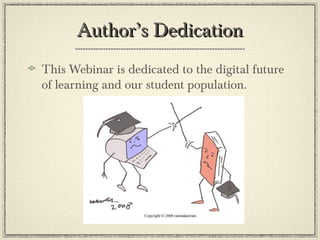
This Webinar is dedicated to the digital future
of learning and our student population.
ForwardForward
Are you an e-book reader?
Yes
No
I would like to be
AcknowledgementsAcknowledgements
What types of e-books do you read
the most?
Fiction
Non-Fiction
Reference
Other
Read This FirstRead This First
HOW do you read your e-books?
On the computer
E-Reader
Smartphone/Mobile
Tablet
Other
Table of ContentsTable of Contents
Evolutions of Digital Literacy
Student Impact in Higher Education
E-Readers & E-Books
Strategies for Implementation
Accessibility & Application on Campus
Thinking Forward
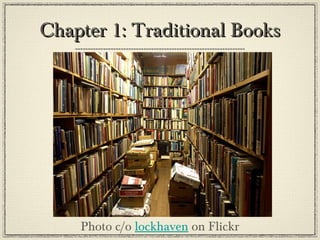
Chapter 1: Traditional BooksChapter 1: Traditional Books
Photo c/o lockhaven on Flickr
How Do You Use Textbooks?How Do You Use Textbooks?
Limited in-class time to cover material
Compliment the lecture topic
Provide academic rigor for course
Prepare students for career
Excellent learning resources
Other
Textbook PurchasingTextbook Purchasing
How are learning materials and textbooks purchased
at your campus?
Textbooks: Facts vs. RhetoricTextbooks: Facts vs. Rhetoric
Publishers lead in higher education for new
teaching technologies & solutions
Textbooks account for a fraction of total
educational costs
Textbooks prices increased 1.6 % between 1999-
2004
Publishers provide information on new editions,
products & prices
Association of American Publishers, 2006
Textbooks: Facts vs. RhetoricTextbooks: Facts vs. Rhetoric
Publishers offer an incredible number of options
in all price ranges
Integrated textbooks & materials purchased
together costs less
Instructors want students to succeed by having
the latest information & materials
Association of American Publishers, 2006
Chapter 2: Textbook EvolutionChapter 2: Textbook Evolution
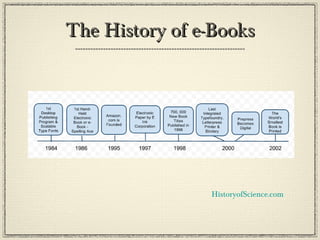
The History of e-BooksThe History of e-Books
HistoryofScience.com
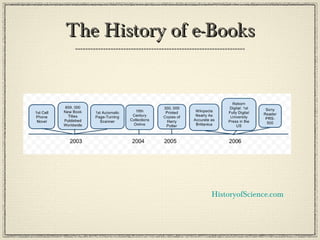
The History of e-BooksThe History of e-Books
HistoryofScience.com
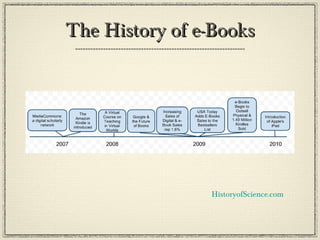
The History of e-BooksThe History of e-Books
HistoryofScience.com
Book Publishing 2010Book Publishing 2010
"The Association of American Publishers (AAP) has today released its annual estimate of total
book sales in the United States. The report, which uses data from the Bureau of the Census as well
as sales data from 86 publishers inclusive of all major book publishing media market holders,
estimates that U.S. publishers had net sales of $23.9 billion in 2009, down from $24.3 billion in
2008, representing a 1.8% decrease. In the last 7 years the industry had a compound annual growth
rate of 1.1%.“ ~April 7, 2010
"Audio book sales for 2009 totaled $192 million, down 12.9% on the prior year. E-books overtook
audio books in 2009 with sales reaching $313 million in 2009, up 176.6%" 
"The US book publishing industry consists of about 2,600 companies with combined annual
revenue of about $27 billion. Major companies include John Wiley & Sons, McGraw-Hill, Pearson,
and Scholastic, as well as publishing units of large media companies such as HarperCollins (owned
by News Corp); Random House (owned by Bertelsmann); and Simon & Schuster (owned by CBS).
The industry is highly concentrated: the top 50 companies generate about 80 percent of revenue.
AAP Report, 2009
Supply & DemandSupply & Demand
150, 000 NEW books are published in the US every year
Major trade publishers & university presses publish 40, 000
Book demand driven
Demographics
Economic Cycles
Product Development & Marketing
Types of Publications
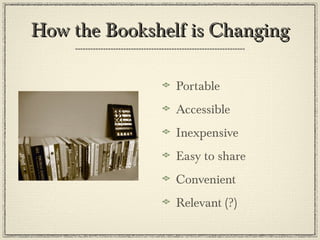
How the Bookshelf is ChangingHow the Bookshelf is Changing
Portable
Accessible
Inexpensive
Easy to share
Convenient
Relevant (?)
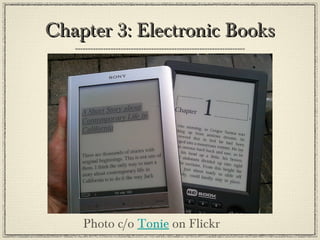
Chapter 3: Electronic BooksChapter 3: Electronic Books
Photo c/o Tonie on Flickr
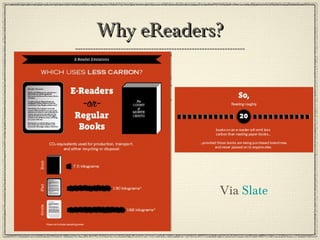
Why eReaders?Why eReaders?
Via Slate
Breaking GroundBreaking Ground
Social Networking Added to Reading Electronic
Books ~June 12, 2010
E-Books Outsell Physical Books at Amazon.com
~July 19, 2010
1st
Traditional Humanities Journal to Try
“Open” Peer Review ~July 26, 2010
HistoryofScience.com
Latest HappeningsLatest Happenings
129, 864, 880 Different Books in the World, says
Google ~August 5, 2010
eBook Edition Released Prior to Hardcover
Edition ~September 8, 2010
HistoryofScience.com
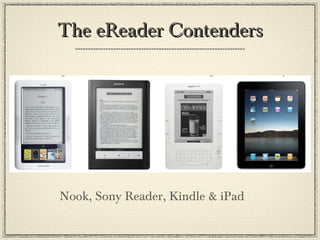
The eReader ContendersThe eReader Contenders
Nook, Sony Reader, Kindle & iPad
Popular eReadersPopular eReaders
Kindle http://kindle.amazon.com/
Sony E-Reader http://bit.ly/U8Nq7
iPad http://www.apple.com/ipad/
Nook (from B & N) http://bit.ly/3a8PDo
Kno http://www.kno.com/
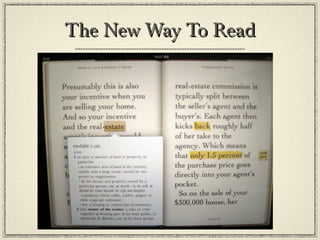
The New Way To ReadThe New Way To Read
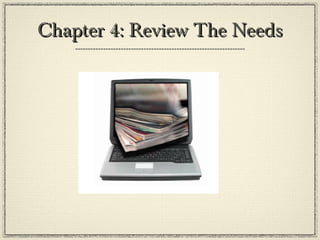
Chapter 4: Review The NeedsChapter 4: Review The Needs
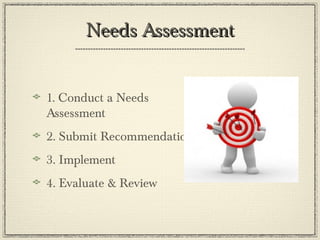
Needs AssessmentNeeds Assessment
1. Conduct a Needs
Assessment
2. Submit Recommendations
3. Implement
4. Evaluate & Review
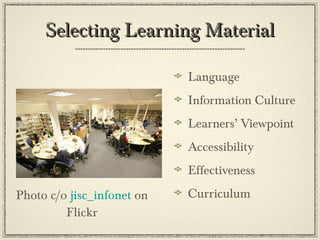
Selecting Learning MaterialSelecting Learning Material
Language
Information Culture
Learners’ Viewpoint
Accessibility
Effectiveness
CurriculumPhoto c/o jisc_infonet on
Flickr
Chapter 5: Student ImpactChapter 5: Student Impact
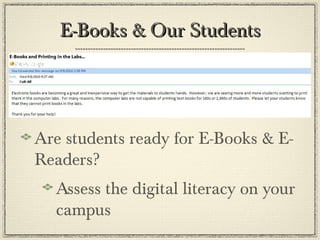
E-Books & Our StudentsE-Books & Our Students
Are students ready for E-Books & E-
Readers?
Assess the digital literacy on your
campus
The E-Book & E-Reader EffectThe E-Book & E-Reader Effect
Inexpensive
Quick adoption
Vivid examples
New Curriculum
E-literacy Issues
Trends in Higher Ed
Photo c/o ANVRecife on Flickr
E-Books & E-Readers Are…E-Books & E-Readers Are…
To Increase Student EngagementTo Increase Student Engagement
Encourage open collaboration
Ask more from each student
Use technology to customize resources
Maintain high quality learning curriculum
Connect students to authentic experiences
Continue to search, evolve & learn
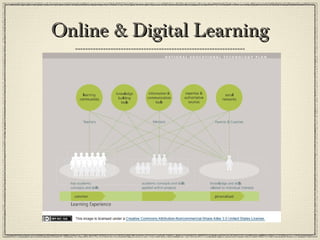
Online & Digital LearningOnline & Digital Learning
Questions to Think About…Questions to Think About…
How do students best learn with digital materials?
How do E-Books shape curriculum?
Are E-Books truly more accessible?
What is the learning curve for this new medium?
How will we measure success/failure of E-Books?
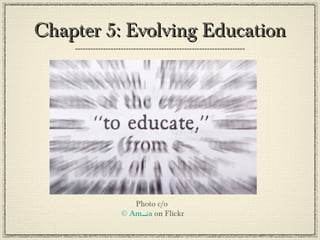
Chapter 5: Evolving EducationChapter 5: Evolving Education
Photo c/o
© Am‫نــ‬a on Flickr
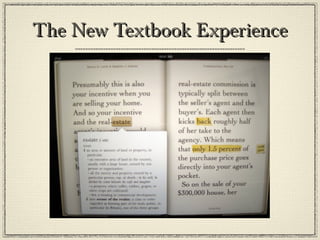
The New Textbook ExperienceThe New Textbook Experience
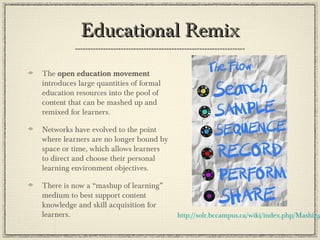
Educational RemixEducational Remix
The open education movement
introduces large quantities of formal
education resources into the pool of
content that can be mashed up and
remixed for learners.
Networks have evolved to the point
where learners are no longer bound by
space or time, which allows learners
to direct and choose their personal
learning environment objectives.
There is now a “mashup of learning”
medium to best support content
knowledge and skill acquisition for
learners. http://solr.bccampus.ca/wiki/index.php/Mashing
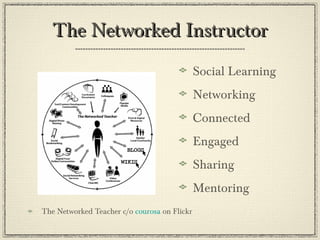
The Networked InstructorThe Networked Instructor
The Networked Teacher c/o courosa on Flickr
Social Learning
Networking
Connected
Engaged
Sharing
Mentoring
Customize TextbooksCustomize Textbooks
Free
Affordable
Open
Customizable
http://www.flatworldknowledge.com/
Browse the Flatworld Knowledge Catalog:
http://www.flatworldknowledge.com/catalog
eTextbook PublisherseTextbook Publishers
CourseSmart http://instructors.coursesmart.com/
McGraw-Hill Digital Products
http://mpss.mhhe.com/products.php
Others:
http://www.ebookcrossroads.com/epublishers.html
Chapter 6: On the HorizonChapter 6: On the Horizon
Changes to ConsiderChanges to Consider
Evolution of digital literacy
Shared educational resources
Multi-dimensional & dynamic course content
New methods for instruction
Customizing education & learning
ConclusionConclusion
“There is nothing wrong
with change, if it is in the
right direction.” ~Winston
Churchill
Epilogue: Things To ConsiderEpilogue: Things To Consider
What is the learning concern?
Can technology solve it?
What resources are currently on campus?
How will you conduct a needs assessment?
When will you pilot this technology?
Where will you go for help/support?
Questions?Questions?
Also By This AuthorAlso By This Author
Thanks!
Happy e-Reading!
Stay connected:
Laura.Pasquini@unt.edu
http://card.ly/laurapasquini
Appendix: ResourcesAppendix: Resources
All presentation resources & references can be
found in this Google Doc: http://bit.ly/cKniho
Feel free to add to it or share with others.

iPad, Nooks & E-Readers: Digital Strategies for a Connected Campus

  • 1.
    iPad, Nooks &E-Readers:iPad, Nooks & E-Readers: Digital Strategies for aDigital Strategies for a Connected CampsConnected Camps Higher Ed Hero WebinarHigher Ed Hero Webinar November 3, 2010November 3, 2010 Laura PasquiniLaura Pasquini
  • 2.
    Author’s DedicationAuthor’s Dedication ThisWebinar is dedicated to the digital future of learning and our student population.
  • 3.
    ForwardForward Are you ane-book reader? Yes No I would like to be
  • 4.
    AcknowledgementsAcknowledgements What types ofe-books do you read the most? Fiction Non-Fiction Reference Other
  • 5.
    Read This FirstReadThis First HOW do you read your e-books? On the computer E-Reader Smartphone/Mobile Tablet Other
  • 6.
    Table of ContentsTableof Contents Evolutions of Digital Literacy Student Impact in Higher Education E-Readers & E-Books Strategies for Implementation Accessibility & Application on Campus Thinking Forward
  • 7.
    Chapter 1: TraditionalBooksChapter 1: Traditional Books Photo c/o lockhaven on Flickr
  • 8.
    How Do YouUse Textbooks?How Do You Use Textbooks? Limited in-class time to cover material Compliment the lecture topic Provide academic rigor for course Prepare students for career Excellent learning resources Other
  • 9.
    Textbook PurchasingTextbook Purchasing Howare learning materials and textbooks purchased at your campus?
  • 10.
    Textbooks: Facts vs.RhetoricTextbooks: Facts vs. Rhetoric Publishers lead in higher education for new teaching technologies & solutions Textbooks account for a fraction of total educational costs Textbooks prices increased 1.6 % between 1999- 2004 Publishers provide information on new editions, products & prices Association of American Publishers, 2006
  • 11.
    Textbooks: Facts vs.RhetoricTextbooks: Facts vs. Rhetoric Publishers offer an incredible number of options in all price ranges Integrated textbooks & materials purchased together costs less Instructors want students to succeed by having the latest information & materials Association of American Publishers, 2006
  • 12.
    Chapter 2: TextbookEvolutionChapter 2: Textbook Evolution
  • 13.
    The History ofe-BooksThe History of e-Books HistoryofScience.com
  • 14.
    The History ofe-BooksThe History of e-Books HistoryofScience.com
  • 15.
    The History ofe-BooksThe History of e-Books HistoryofScience.com
  • 16.
    Book Publishing 2010BookPublishing 2010 "The Association of American Publishers (AAP) has today released its annual estimate of total book sales in the United States. The report, which uses data from the Bureau of the Census as well as sales data from 86 publishers inclusive of all major book publishing media market holders, estimates that U.S. publishers had net sales of $23.9 billion in 2009, down from $24.3 billion in 2008, representing a 1.8% decrease. In the last 7 years the industry had a compound annual growth rate of 1.1%.“ ~April 7, 2010 "Audio book sales for 2009 totaled $192 million, down 12.9% on the prior year. E-books overtook audio books in 2009 with sales reaching $313 million in 2009, up 176.6%"  "The US book publishing industry consists of about 2,600 companies with combined annual revenue of about $27 billion. Major companies include John Wiley & Sons, McGraw-Hill, Pearson, and Scholastic, as well as publishing units of large media companies such as HarperCollins (owned by News Corp); Random House (owned by Bertelsmann); and Simon & Schuster (owned by CBS). The industry is highly concentrated: the top 50 companies generate about 80 percent of revenue. AAP Report, 2009
  • 17.
    Supply & DemandSupply& Demand 150, 000 NEW books are published in the US every year Major trade publishers & university presses publish 40, 000 Book demand driven Demographics Economic Cycles Product Development & Marketing Types of Publications
  • 18.
    How the Bookshelfis ChangingHow the Bookshelf is Changing Portable Accessible Inexpensive Easy to share Convenient Relevant (?)
  • 19.
    Chapter 3: ElectronicBooksChapter 3: Electronic Books Photo c/o Tonie on Flickr
  • 20.
  • 21.
    Breaking GroundBreaking Ground SocialNetworking Added to Reading Electronic Books ~June 12, 2010 E-Books Outsell Physical Books at Amazon.com ~July 19, 2010 1st Traditional Humanities Journal to Try “Open” Peer Review ~July 26, 2010 HistoryofScience.com
  • 23.
    Latest HappeningsLatest Happenings 129,864, 880 Different Books in the World, says Google ~August 5, 2010 eBook Edition Released Prior to Hardcover Edition ~September 8, 2010 HistoryofScience.com
  • 24.
    The eReader ContendersTheeReader Contenders Nook, Sony Reader, Kindle & iPad
  • 25.
    Popular eReadersPopular eReaders Kindlehttp://kindle.amazon.com/ Sony E-Reader http://bit.ly/U8Nq7 iPad http://www.apple.com/ipad/ Nook (from B & N) http://bit.ly/3a8PDo Kno http://www.kno.com/
  • 26.
    The New WayTo ReadThe New Way To Read
  • 27.
    Chapter 4: ReviewThe NeedsChapter 4: Review The Needs
  • 28.
    Needs AssessmentNeeds Assessment 1.Conduct a Needs Assessment 2. Submit Recommendations 3. Implement 4. Evaluate & Review
  • 29.
    Selecting Learning MaterialSelectingLearning Material Language Information Culture Learners’ Viewpoint Accessibility Effectiveness CurriculumPhoto c/o jisc_infonet on Flickr
  • 30.
    Chapter 5: StudentImpactChapter 5: Student Impact
  • 31.
    E-Books & OurStudentsE-Books & Our Students Are students ready for E-Books & E- Readers? Assess the digital literacy on your campus
  • 32.
    The E-Book &E-Reader EffectThe E-Book & E-Reader Effect Inexpensive Quick adoption Vivid examples New Curriculum E-literacy Issues Trends in Higher Ed Photo c/o ANVRecife on Flickr
  • 33.
    E-Books & E-ReadersAre…E-Books & E-Readers Are…
  • 34.
    To Increase StudentEngagementTo Increase Student Engagement Encourage open collaboration Ask more from each student Use technology to customize resources Maintain high quality learning curriculum Connect students to authentic experiences Continue to search, evolve & learn
  • 35.
    Online & DigitalLearningOnline & Digital Learning
  • 36.
    Questions to ThinkAbout…Questions to Think About… How do students best learn with digital materials? How do E-Books shape curriculum? Are E-Books truly more accessible? What is the learning curve for this new medium? How will we measure success/failure of E-Books?
  • 37.
    Chapter 5: EvolvingEducationChapter 5: Evolving Education Photo c/o © Am‫نــ‬a on Flickr
  • 38.
    The New TextbookExperienceThe New Textbook Experience
  • 39.
    Educational RemixEducational Remix Theopen education movement introduces large quantities of formal education resources into the pool of content that can be mashed up and remixed for learners. Networks have evolved to the point where learners are no longer bound by space or time, which allows learners to direct and choose their personal learning environment objectives. There is now a “mashup of learning” medium to best support content knowledge and skill acquisition for learners. http://solr.bccampus.ca/wiki/index.php/Mashing
  • 40.
    The Networked InstructorTheNetworked Instructor The Networked Teacher c/o courosa on Flickr Social Learning Networking Connected Engaged Sharing Mentoring
  • 41.
  • 42.
    eTextbook PublisherseTextbook Publishers CourseSmarthttp://instructors.coursesmart.com/ McGraw-Hill Digital Products http://mpss.mhhe.com/products.php Others: http://www.ebookcrossroads.com/epublishers.html
  • 43.
    Chapter 6: Onthe HorizonChapter 6: On the Horizon
  • 44.
    Changes to ConsiderChangesto Consider Evolution of digital literacy Shared educational resources Multi-dimensional & dynamic course content New methods for instruction Customizing education & learning
  • 45.
    ConclusionConclusion “There is nothingwrong with change, if it is in the right direction.” ~Winston Churchill
  • 46.
    Epilogue: Things ToConsiderEpilogue: Things To Consider What is the learning concern? Can technology solve it? What resources are currently on campus? How will you conduct a needs assessment? When will you pilot this technology? Where will you go for help/support?
  • 47.
  • 48.
    Also By ThisAuthorAlso By This Author Thanks! Happy e-Reading! Stay connected: Laura.Pasquini@unt.edu http://card.ly/laurapasquini
  • 49.
    Appendix: ResourcesAppendix: Resources Allpresentation resources & references can be found in this Google Doc: http://bit.ly/cKniho Feel free to add to it or share with others.

Editor's Notes

  • #11 Textbook Facts vs. Rhetoric by the Association of American Publishers, Inc. http://www.publishers.org/main/HigherEducation/attachments/Textbook_20Facts_20Versus_20Rhetoric_20April_202006.pdf
  • #14 Book History Timeline http://www.historyofscience.com/G2I/timeline/index.php?category=Book+History
  • #15 Book History Timeline http://www.historyofscience.com/G2I/timeline/index.php?category=Book+History
  • #16 Book History Timeline http://www.historyofscience.com/G2I/timeline/index.php?category=Book+History
  • #17 AAP Reports Book Sales Estimated at $23.9 Billion in 2009 http://www.publishers.org/main/PressCenter/Archicves/2010_April/BookSalesEstimatedat23.9Billionin2009.htm
  • #18 Research and Markets: the US Book Publishing Industry Consists of about 2,600 Companies with Combined Annual Revenue of about $27 Billion http://www.businesswire.com/portal/site/home/permalink/?ndmViewId=news_view&newsId=20100506006043&newsLang=en
  • #22 From HistoryofScience.com http://www.historyofscience.com/G2I/timeline/index.php?category=Book+History
  • #36 Transforming American Education: Learning Powered by Technology http://www2.ed.gov/about/offices/list/os/technology/netp.pdf Part of the National Technology Plan http://www2.ed.gov/about/offices/list/os/technology/plan/2004/site/edlite-default.html