














iPad & E-Readers:  Tips to Implement Digital Textbooks on Campus Higher Ed Hero Webinar July 21, 2011 Laura Pasquini
About the Author Laura Pasquini - Learning Technologies Department, University of North Texas
Author’s Dedication This Webinar is dedicated to the digital evolution and changing landscape in higher education.
Acknowledgements What are some of your concerns about digital textbooks & e-books on campus? Learning application Usability for students Limited selection Cost of the initiative Partnerships with campus publishers
Table of Contents Digital Textbooks in Higher Education The Tools: E-Readers, E-Books & Applications Needs Assessment & Implementation Tips Case Study: The Connected Campus Future Thought s
The Digital Campus Photo c/o  lockhaven  on Flickr
Textbooks for Learning: Why? Limited in-class time to cover material Compliment the lecture topic Provide academic rigor for course Prepare students for career Excellent learning resources Other
 
Winston Churchill “ There is nothing wrong with change, if it is in the right direction.”
Changes in Higher Education Evolution of digital literacy Shared educational resources Dynamic course content New methods for instruction Customizing education & learning Online & blended-learning
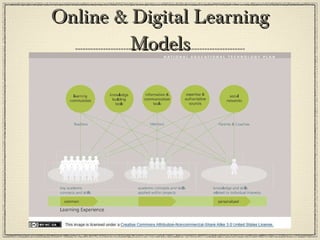
Online & Digital Learning Models
E-Books & E-Readers Are Just…
Is Your Campus Ready? HOW are learning materials & textbooks purchased at your campus?
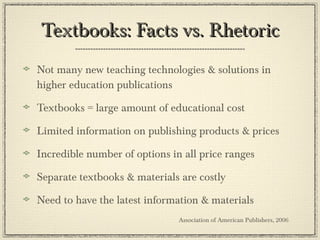
Textbooks: Facts vs. Rhetoric Not many new teaching technologies & solutions in higher education publications Textbooks = large amount of educational cost Limited information on publishing products & prices Incredible number of options in all price ranges Separate textbooks & materials are costly Need to have the latest information & materials  Association of American Publishers, 2006
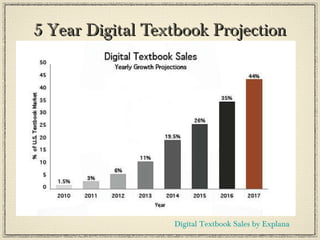
5 Year Digital Textbook Projection Digital Textbook Sales by Explana
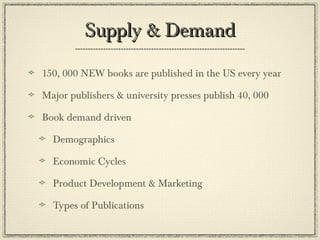
Supply & Demand 150, 000 NEW books are published in the US every year Major publishers & university presses publish 40, 000 Book demand driven Demographics Economic Cycles Product Development & Marketing Types of Publications
 
Starting Questions: What is the learning concern? Can technology solve it? What resources are currently on campus? How will you conduct a needs assessment? When will you pilot this technology? Where will you go for help/support?
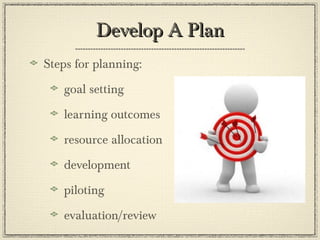
Develop A Plan Steps for planning: goal setting learning outcomes resource allocation development piloting evaluation/review 
How To Get Started…
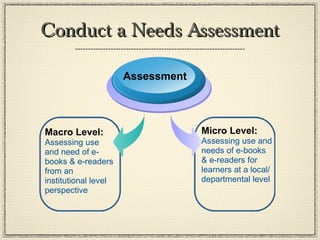
Conduct a Needs Assessment Micro Level:    Assessing use and needs of e-books & e-readers for learners at a local/departmental level Macro Level: Assessing use and need of e-books & e-readers from an institutional level perspective Assessment
The Micro Level
Know Your Audience
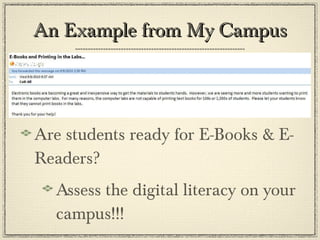
An Example from My Campus Are students ready for E-Books & E-Readers? Assess the digital literacy on your campus!!!
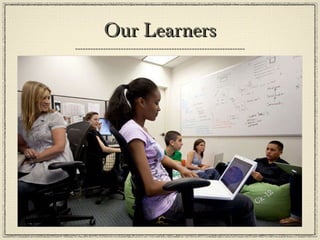
Our Learners
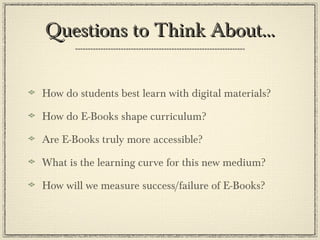
Questions to Think About… How do students best learn with digital materials? How do E-Books shape curriculum? Are E-Books truly more accessible? What is the learning curve for this new medium? How will we measure success/failure of E-Books?
The Macro Level
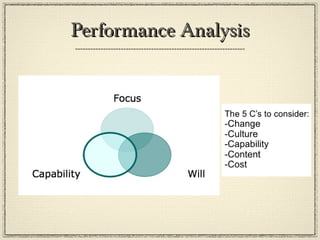
Performance Analysis
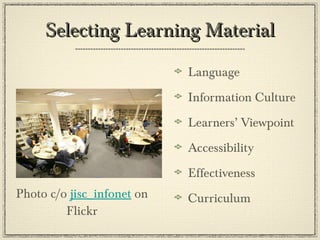
Selecting Learning Material Language Information Culture Learners’ Viewpoint Accessibility Effectiveness Curriculum  Photo c/o  jisc_infonet  on Flickr
 
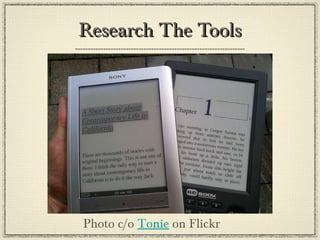
Research The Tools Photo c/o  Tonie  on Flickr
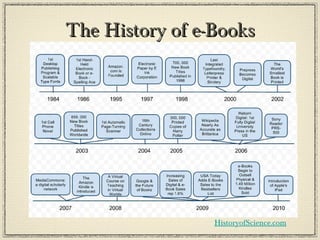
The History of e-Books HistoryofScience.com
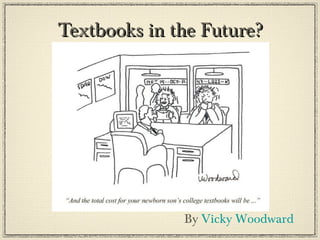
Textbooks in the Future? By  Vicky Woodward
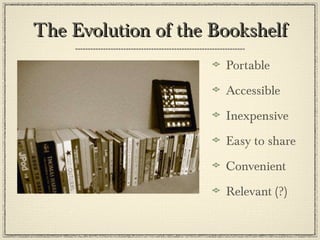
The Evolution of the Bookshelf Portable Accessible Inexpensive Easy to share Convenient Relevant (?)
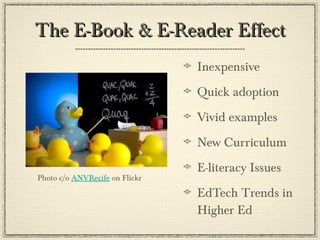
The E-Book & E-Reader Effect Inexpensive Quick adoption Vivid examples New Curriculum E-literacy Issues EdTech Trends in Higher Ed Photo c/o  ANVRecife  on Flickr
 
Breaking Ground  Social Networking Added to Reading Electronic Books ~June 12, 2010 E-Books Outsell Physical Books at Amazon.com ~July 19, 2010 1 st  Traditional Humanities Journal to Try “Open” Peer Review ~July 26, 2010 More campus publishers are developing digital options for learning. HistoryofScience.com
The eReader Contenders Nook, Sony Reader, Kindle & iPad... and MORE!!!
Popular eReaders Kindle  http://kindle.amazon.com/ iPad  http://www.apple.com/ipad/ Nook  http://bit.ly/3a8PDo Sony E-Reader  http://bit.ly/U8Nq7 Kno  http://www.kno.com iriver  http://www.iriver.com
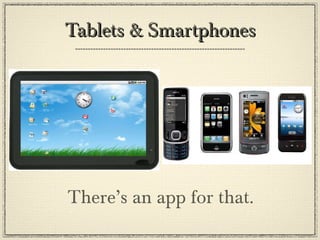
Tablets & Smartphones There’s an app for that.
Online Space & Retrieval Kindle App iBooks Amazon Cloud Virtual Labs/Libraries In the Cloud storage Social Bookmarks, highlights & sharing
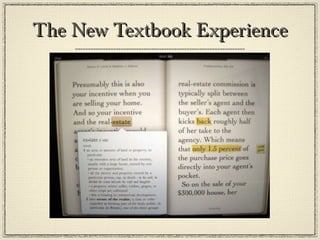
The New Textbook Experience
 
Brainstorm & Development
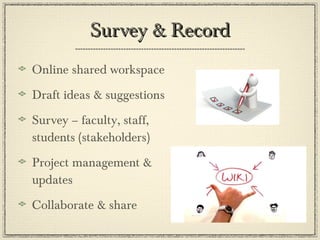
Survey & Record Online shared workspace  Draft ideas & suggestions Survey – faculty, staff, students (stakeholders) Project management & updates Collaborate & share
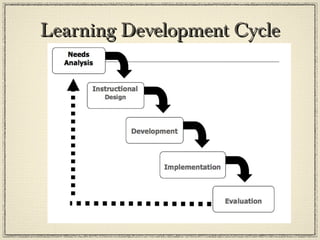
Learning Development Cycle
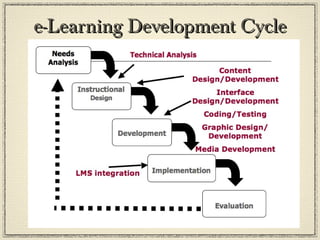
e-Learning Development Cycle
Customize Textbooks Free Affordable Open Customizable http://www.flatworldknowledge.com/   Browse the Flatworld Knowledge Catalog:  http://www.flatworldknowledge.com/ catalog
eTextbook Publishers McGraw-Hill Digital Products   http://mpss.mhhe.com/products.php Pearson | Higher Education  http://bit.ly/n54jjB   CourseSmart  http://instructors.coursesmart.com/ O'Reilly Media - Technology Books, Tech Conferences, IT Courses, News  http://oreil.ly/oMCSHi Connexions Project  http://cnx.org/ Xplana eBooks  http://bit.ly/q8XDO1   Others:  http://www.ebookcrossroads.com/epublishers.html
 
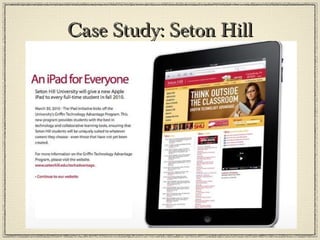
Case Study: Seton Hill
 
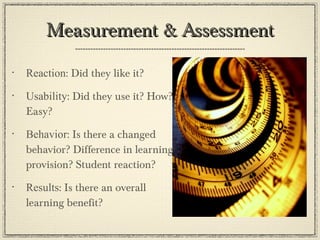
Measurement & Assessment Reaction : Did they like it? Usability : Did they use it? How? Easy? Behavior : Is there a changed behavior? Difference in learning provision? Student reaction? Results : Is there an overall learning benefit?
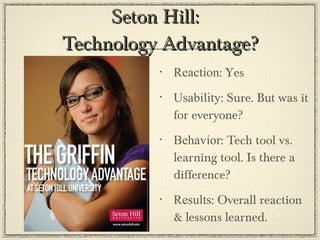
Seton Hill:  Technology Advantage? Reaction : Yes Usability : Sure. But was it for everyone?  Behavior : Tech tool vs. learning tool. Is there a difference?  Results : Overall reaction & lessons learned.
 
Evolution of Tech & Learners Encourage open collaboration Ask more from each student Use technology to customize resources  Maintain high quality learning curriculum Connect students to authentic experiences Continue to search, evolve & learn
Concerns & Challenges Digital Rights Management  ( DRM) -  prevents copying of text or printing of text or, in some cases, reading the text on a different device, e.g. Adobe Digital Edition PDFs seem to lock your content to the device it was registered to.  Study Skills  - Not being able to copy text or annotate text or print text is also a pain. Publisher perspective  - Lack of ability to print is particularly problematic for complex. Accessibility needs  -  most have computers, but if they have a problem with their technology, many do not have the resources to get back online quickly Compatibility  - between devices (i.e. epub may not work on some devises) Readability  - Most of my students find reading on a screen uncomfortable.  Therefore many seem unwilling to do the reading. Staff Support  - Inadequate training or experience on the part of staff and faculty leads to wasted opportunities to utilize these resources.
Best of Luck! Establish a team  Research & brainstorm Ask around on campus Create a plan Pilot the Project  Evaluate
Questions?
Also By This Author Stay connected: [email_address] http://about.me/laurapasquini
Appendix: Resources For resources & to share: iPads & eReaders: Tips to Implementing Digital Textbooks on Campus - Google Docs  http://bit.ly/n5mpy7

Digital Textbooks: Needs Assessment & Implementation on Campus

  • 1.
    iPad & E-Readers: Tips to Implement Digital Textbooks on Campus Higher Ed Hero Webinar July 21, 2011 Laura Pasquini
  • 2.
    About the AuthorLaura Pasquini - Learning Technologies Department, University of North Texas
  • 3.
    Author’s Dedication ThisWebinar is dedicated to the digital evolution and changing landscape in higher education.
  • 4.
    Acknowledgements What aresome of your concerns about digital textbooks & e-books on campus? Learning application Usability for students Limited selection Cost of the initiative Partnerships with campus publishers
  • 5.
    Table of ContentsDigital Textbooks in Higher Education The Tools: E-Readers, E-Books & Applications Needs Assessment & Implementation Tips Case Study: The Connected Campus Future Thought s
  • 6.
    The Digital CampusPhoto c/o lockhaven on Flickr
  • 7.
    Textbooks for Learning:Why? Limited in-class time to cover material Compliment the lecture topic Provide academic rigor for course Prepare students for career Excellent learning resources Other
  • 8.
  • 9.
    Winston Churchill “There is nothing wrong with change, if it is in the right direction.”
  • 10.
    Changes in HigherEducation Evolution of digital literacy Shared educational resources Dynamic course content New methods for instruction Customizing education & learning Online & blended-learning
  • 11.
    Online & DigitalLearning Models
  • 12.
  • 13.
    Is Your CampusReady? HOW are learning materials & textbooks purchased at your campus?
  • 14.
    Textbooks: Facts vs.Rhetoric Not many new teaching technologies & solutions in higher education publications Textbooks = large amount of educational cost Limited information on publishing products & prices Incredible number of options in all price ranges Separate textbooks & materials are costly Need to have the latest information & materials Association of American Publishers, 2006
  • 15.
    5 Year DigitalTextbook Projection Digital Textbook Sales by Explana
  • 16.
    Supply & Demand150, 000 NEW books are published in the US every year Major publishers & university presses publish 40, 000 Book demand driven Demographics Economic Cycles Product Development & Marketing Types of Publications
  • 17.
  • 18.
    Starting Questions: Whatis the learning concern? Can technology solve it? What resources are currently on campus? How will you conduct a needs assessment? When will you pilot this technology? Where will you go for help/support?
  • 19.
    Develop A PlanSteps for planning: goal setting learning outcomes resource allocation development piloting evaluation/review 
  • 20.
    How To GetStarted…
  • 21.
    Conduct a NeedsAssessment Micro Level:   Assessing use and needs of e-books & e-readers for learners at a local/departmental level Macro Level: Assessing use and need of e-books & e-readers from an institutional level perspective Assessment
  • 22.
  • 23.
  • 24.
    An Example fromMy Campus Are students ready for E-Books & E-Readers? Assess the digital literacy on your campus!!!
  • 25.
  • 26.
    Questions to ThinkAbout… How do students best learn with digital materials? How do E-Books shape curriculum? Are E-Books truly more accessible? What is the learning curve for this new medium? How will we measure success/failure of E-Books?
  • 27.
  • 28.
  • 29.
    Selecting Learning MaterialLanguage Information Culture Learners’ Viewpoint Accessibility Effectiveness Curriculum Photo c/o jisc_infonet on Flickr
  • 30.
  • 31.
    Research The ToolsPhoto c/o Tonie on Flickr
  • 32.
    The History ofe-Books HistoryofScience.com
  • 33.
    Textbooks in theFuture? By Vicky Woodward
  • 34.
    The Evolution ofthe Bookshelf Portable Accessible Inexpensive Easy to share Convenient Relevant (?)
  • 35.
    The E-Book &E-Reader Effect Inexpensive Quick adoption Vivid examples New Curriculum E-literacy Issues EdTech Trends in Higher Ed Photo c/o ANVRecife on Flickr
  • 36.
  • 37.
    Breaking Ground Social Networking Added to Reading Electronic Books ~June 12, 2010 E-Books Outsell Physical Books at Amazon.com ~July 19, 2010 1 st Traditional Humanities Journal to Try “Open” Peer Review ~July 26, 2010 More campus publishers are developing digital options for learning. HistoryofScience.com
  • 38.
    The eReader ContendersNook, Sony Reader, Kindle & iPad... and MORE!!!
  • 39.
    Popular eReaders Kindle http://kindle.amazon.com/ iPad http://www.apple.com/ipad/ Nook http://bit.ly/3a8PDo Sony E-Reader http://bit.ly/U8Nq7 Kno http://www.kno.com iriver http://www.iriver.com
  • 40.
    Tablets & SmartphonesThere’s an app for that.
  • 41.
    Online Space &Retrieval Kindle App iBooks Amazon Cloud Virtual Labs/Libraries In the Cloud storage Social Bookmarks, highlights & sharing
  • 42.
    The New TextbookExperience
  • 43.
  • 44.
  • 45.
    Survey & RecordOnline shared workspace Draft ideas & suggestions Survey – faculty, staff, students (stakeholders) Project management & updates Collaborate & share
  • 46.
  • 47.
  • 48.
    Customize Textbooks FreeAffordable Open Customizable http://www.flatworldknowledge.com/ Browse the Flatworld Knowledge Catalog: http://www.flatworldknowledge.com/ catalog
  • 49.
    eTextbook Publishers McGraw-HillDigital Products http://mpss.mhhe.com/products.php Pearson | Higher Education http://bit.ly/n54jjB CourseSmart http://instructors.coursesmart.com/ O'Reilly Media - Technology Books, Tech Conferences, IT Courses, News http://oreil.ly/oMCSHi Connexions Project http://cnx.org/ Xplana eBooks http://bit.ly/q8XDO1 Others: http://www.ebookcrossroads.com/epublishers.html
  • 50.
  • 51.
  • 52.
  • 53.
    Measurement & AssessmentReaction : Did they like it? Usability : Did they use it? How? Easy? Behavior : Is there a changed behavior? Difference in learning provision? Student reaction? Results : Is there an overall learning benefit?
  • 54.
    Seton Hill: Technology Advantage? Reaction : Yes Usability : Sure. But was it for everyone? Behavior : Tech tool vs. learning tool. Is there a difference? Results : Overall reaction & lessons learned.
  • 55.
  • 56.
    Evolution of Tech& Learners Encourage open collaboration Ask more from each student Use technology to customize resources Maintain high quality learning curriculum Connect students to authentic experiences Continue to search, evolve & learn
  • 57.
    Concerns & ChallengesDigital Rights Management ( DRM) - prevents copying of text or printing of text or, in some cases, reading the text on a different device, e.g. Adobe Digital Edition PDFs seem to lock your content to the device it was registered to. Study Skills - Not being able to copy text or annotate text or print text is also a pain. Publisher perspective - Lack of ability to print is particularly problematic for complex. Accessibility needs - most have computers, but if they have a problem with their technology, many do not have the resources to get back online quickly Compatibility - between devices (i.e. epub may not work on some devises) Readability - Most of my students find reading on a screen uncomfortable.  Therefore many seem unwilling to do the reading. Staff Support - Inadequate training or experience on the part of staff and faculty leads to wasted opportunities to utilize these resources.
  • 58.
    Best of Luck!Establish a team Research & brainstorm Ask around on campus Create a plan Pilot the Project Evaluate
  • 59.
  • 60.
    Also By ThisAuthor Stay connected: [email_address] http://about.me/laurapasquini
  • 61.
    Appendix: Resources Forresources & to share: iPads & eReaders: Tips to Implementing Digital Textbooks on Campus - Google Docs http://bit.ly/n5mpy7

Editor's Notes

  • #12 Transforming American Education: Learning Powered by Technology http://www2.ed.gov/about/offices/list/os/technology/netp.pdf Part of the National Technology Plan http://www2.ed.gov/about/offices/list/os/technology/plan/200 4/site/edlite-default.html
  • #15 Textbook Facts vs. Rhetoric by the Association of American Publishers, Inc. http://www.publishers.org/main/HigherEducation/attachments/Textbook_20Facts_20Versus_20Rhetoric_20April_202006.pdf
  • #16 Textbook Facts vs. Rhetoric by the Association of American Publishers, Inc. http://www.publishers.org/main/HigherEducation/attachments/Textbook_20Facts_20Versus_20Rhetoric_20April_202006.pdf
  • #17 Research and Markets: the US Book Publishing Industry Consists of about 2,600 Companies with Combined Annual Revenue of about $27 Billion http://www.businesswire.com/portal/site/home/permalink/?ndmViewId=news_view&newsId=20100506006043&newsLang=en
  • #33 Book History Timeline http://www.historyofscience.com/G2I/timeline/index.php?category=Book+History
  • #38 From HistoryofScience.com http://www.historyofscience.com/G2I/timeline/index.php?category=Book+History