






Frankenbooks:
 Understanding the eBook
 Opportunity

Stephen Abram, MLS, FSLA
Consultant, Dysart & Jones

SLA Solos and METRO
Feb. 26, 2013
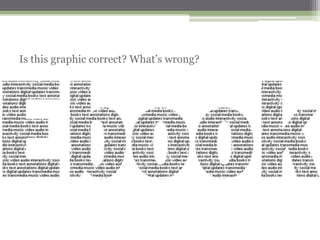
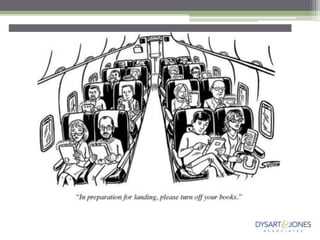
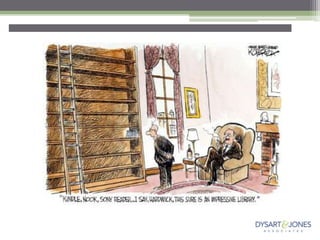
Is this graphic correct? What‟s wrong?
Questions for Today:

1. What is REALLY happening with eBooks?
2. Where is all this change taking us?
3. Does the eBook have a different value?
4. Today‟s session is about frameworks. For
   details see the webliography at the end or
   online.
5. What is the role for special librarians in our
   info-future?
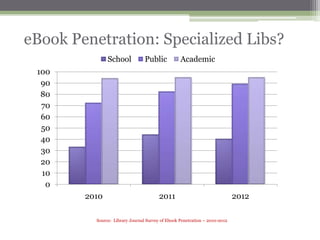
eBook Penetration: Specialized Libs?
               School            Public           Academic
 100
  90
  80
  70
  60
  50
  40
  30
  20
  10
   0
        2010                            2011                                2012

          Source: Library Journal Survey of Ebook Penetration – 2010-2012
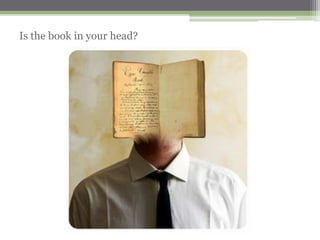
Is the book in your head?
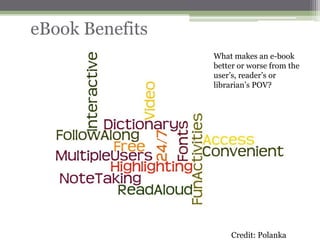
eBook Benefits
                 What makes an e-book
                 better or worse from the
                 user‟s, reader‟s or
                 librarian‟s POV?


                     Credit: Polanka
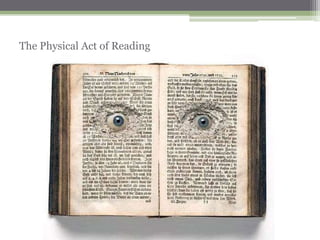
The Physical Act of Reading
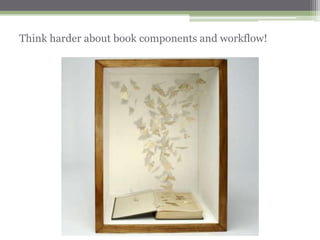
Think harder about book components and workflow!
Is it really
expensive or
just a matter
of ROI and
value?
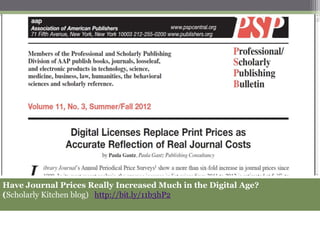
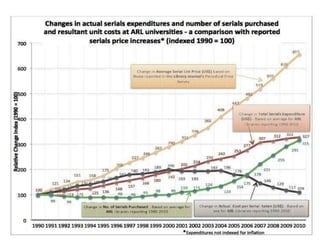
Have Journal Prices Really Increased Much in the Digital Age?
(Scholarly Kitchen blog) http://bit.ly/11b3hP2
Good Questions
• What if prices of the predominant journal form
  have actually been falling?
• What if we‟ve been measuring the wrong
  things, or measuring insufficiently?
• And what if the growth in expenses are not the
  result of price increases but a result of the
  growth in science?”
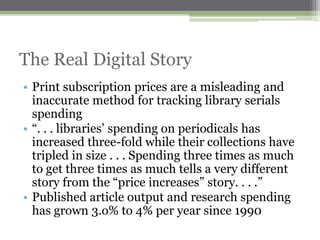
The Real Digital Story
• Print subscription prices are a misleading and
  inaccurate method for tracking library serials
  spending
• “. . . libraries‟ spending on periodicals has
  increased three-fold while their collections have
  tripled in size . . . Spending three times as much
  to get three times as much tells a very different
  story from the “price increases” story. . . .”
• Published article output and research spending
  has grown 3.o% to 4% per year since 1990
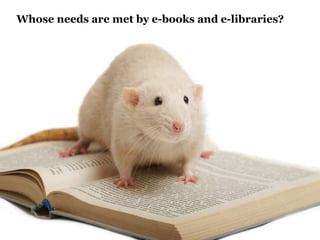
Whose needs are met by e-books and e-libraries?
Deer in headlamps slide here.
There is no guarantee that the e-
book scenario will play out to
include libraries
What is an EXPERIENCE?

             What is a library experience?
  What differentiates a library experience from a
                     transaction?
What differentiates special libraries from Google/Bing?
The Evolution
of Answers
Why do people ask questions?


Is your library experience conceptually organized
around people, answers and programs?
Or collections, technology and buildings?
Why do people ask questions?
 Who, What, When, Where
 How & Why
 Data – Information – Knowledge - Behavior
 To Learn or to Know
 To solve a problem
 To Acquire Information, Clarify, Tune
 To Decide, to Choose, to Delay
 To Interview, Delve, Interact, Progress
 To Entertain or Socialize
 To Reduce Fear
 To Help, Aid, Cure, Be a Friend
 To Win A Bet
READING EXERCISE


   Why do people read?

   What is the workflow context for
   reading in special libraries?
Why do people read?
1.    To learn
2.    To engage in hearing other‟s opinions (to agree or disagree or understand)
3.    To develop more knowledge about myself and develop as a whole person
4.    To be entertained and laugh, to engage and interact
5.    To address boredom and the inexorable progress of time
6.    To research and keep up-to-date
7.    To participate well in civil society (everything from news to voting)
8.    To be informed (and maybe smarter)
9.    To understand others (individually and culturally)
10.   To escape our day-to-day lives
11.   To stimulate the imagination and be inspired or spiritual
12.   To write and communicate better through reading others
13.   To teach
14.   To have something to talk about
15.   To connect with like-minded people
Books
Fiction
Non-Fiction
Encyclopedia

    Framing tools
Reference
 Quick, source, credit, proof …
Directories
  Workflow in targets, mailings, etc.
Dictionaries
Textbooks
Scholarly
 Quality, proofs, positioning …
E-Learning   MOOCs
Mobility
Understanding the different form factors
and target user environments
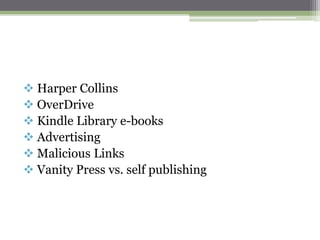
 Harper Collins
 OverDrive
 Kindle Library e-books
 Advertising
 Malicious Links
 Vanity Press vs. self publishing
Skirmishes but Big Ones
 App Store Rules
 Porn – e.g. Sports Illustrated
 No Criticism rule
 Politicians‟ apps
 Satire
 Pulitzer Prize winner
 Books as an app require approval
 Potential restraint of trade
 Who chooses?
 Censorship . . .?
What does all this mean?
 The Article level universe
 The Chapter and Paragraph Universe
 Complete integration of books and serials
 Integrated with Visuals – graphics and charts
 Integrated with „video‟
 Integrated with Sound and Speech
 Integrated with social web
 Integrated with interaction and not just
  interactivity, workflow…
 How would you enhance a book?
Device Issues
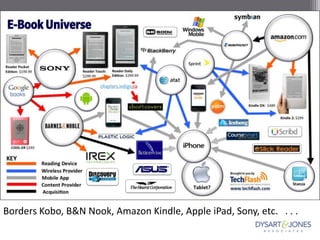
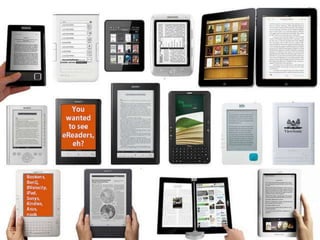
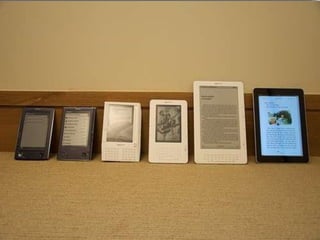
Borders Kobo, B&N Nook, Amazon Kindle, Apple iPad, Sony, etc. . . .
Mobility
Interdisciplinary
Cross-disciplinary
Integrated
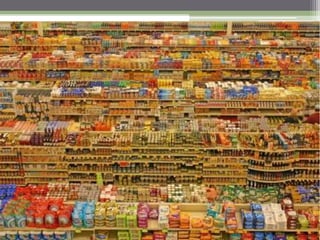
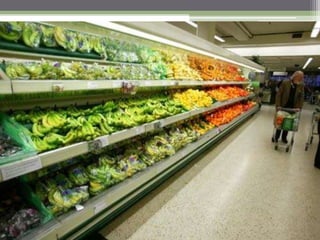
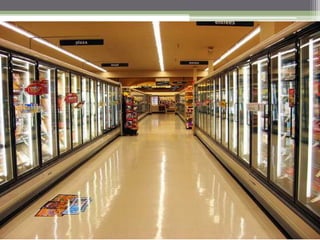
Grocery Stores
Grocery Stores
Grocery Stores
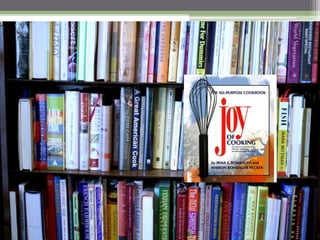
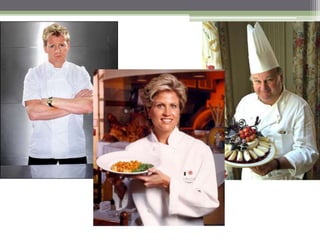
Cookbooks, Chefs . . .
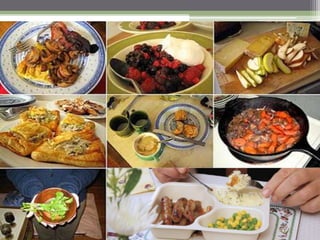
Meals
Technology Context
•   Cloud (SaaS, PaaS, IaaS)
•   Laptops and Tablets
•   Mobility / Smartphones
•   Bandwidth (Wired, WiFi, Whitespace)
•   Learning Management Systems
•   Streaming video and audio vs. download
•   HTML5 and Apps – the battle
•   Advertising auction models and „product‟
•   New(ish) Players
    (Amazon, Apple, G, B&N, Uni‟s, states/provinces/na
    tions)
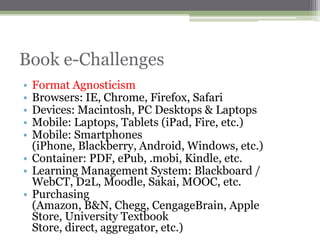
Book e-Challenges
• Format Agnosticism
• Browsers: IE, Chrome, Firefox, Safari
• Devices: Macintosh, PC Desktops & Laptops
• Mobile: Laptops, Tablets (iPad, Fire, etc.)
• Mobile: Smartphones
  (iPhone, Blackberry, Android, Windows, etc.)
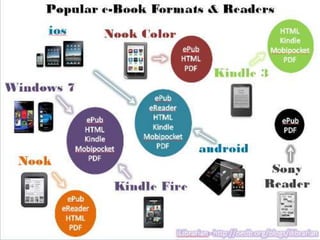
• Container: PDF, ePub, .mobi, Kindle, etc.
• Learning Management System: Blackboard /
  WebCT, D2L, Moodle, Sakai, MOOC, etc.
• Purchasing
  (Amazon, B&N, Chegg, CengageBrain, Apple
  Store, University Textbook
  Store, direct, aggregator, etc.)
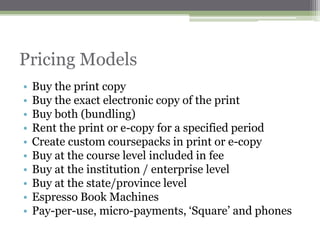
Pricing Models
•   Buy the print copy
•   Buy the exact electronic copy of the print
•   Buy both (bundling)
•   Rent the print or e-copy for a specified period
•   Create custom coursepacks in print or e-copy
•   Buy at the course level included in fee
•   Buy at the institution / enterprise level
•   Buy at the state/province level
•   Espresso Book Machines
•   Pay-per-use, micro-payments, „Square‟ and phones
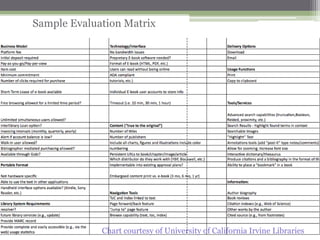
Sample Evaluation Matrix


             Chart courtesy of University of California Irvine Libraries
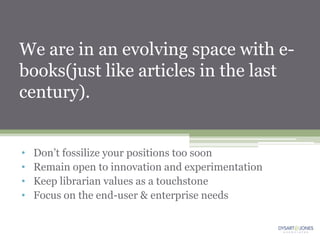
We are in an evolving space with e-
books(just like articles in the last
century).


•   Don‟t fossilize your positions too soon
•   Remain open to innovation and experimentation
•   Keep librarian values as a touchstone
•   Focus on the end-user & enterprise needs
What is the priority?


  Price, Cost, Value, ROI
  Managing or Mandating the Adoption Curve
  Learning and Progress
  Societal Impact = 17%, 40%, 70%?
  IMPACTS of Value to the Enterprise
  ROI, ROE, Productivity and efficiency and
  effectiveness
This era will see a Fundamental
Reimagining the Book


For the present there will be
those who resist and the
resisters will be the majority.
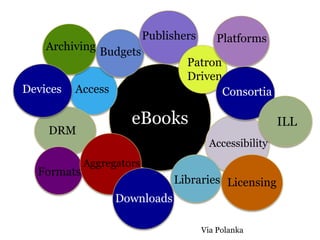
Publishers      Platforms
    Archiving Budgets
                                  Patron
                                  Driven
Devices   Access                         Consortia

                     eBooks                              ILL
    DRM
                                         Accessibility
            Aggregators
  Formats
                               Libraries Licensing
                   Downloads

                                       Via Polanka
Keeping Up Blogs
• No Shelf Required – www.noshelfrequired.com
• LJ/SLJ ebook blog– www.thedigitalshift.com
• ALA eContent blog-
  http://americanlibrariesmagazine.org/e-content
• ALA TechSource blog -
  www.alatechsource.org/blog
• Teleread – www.teleread.org
• INFOdocket– www.infodocket.com
• eBooknewser -
  www.mediabistro.com/ebooknewser/
• The Digital Reader - www.the-digital-reader.com/
• Go-to-hellman - go-to-hellman.blogspot.com
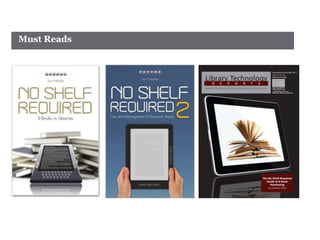
Must Reads
84


Resources

• Sue Polanka‟s presentation on eBooks for ALA:
• Purchasing eBooks for Your Library
• http://www.slideshare.net/ALATechSource/2013-ala-
  purchasing?ref=http://lonewolflibrarian.wordpress.com/2013/02/14/
  purchasing-e-books-for-libraries-02-14-13/
• Sue Polanka‟s ALA LTR book:
• The No Shelf Required Guide to eBook Purchasing
• Ellyssa Kroski‟s presentation on eBooks:
• Evaluating e-Book Offerings
• http://www.slideshare.net/ellyssa/evaluating-ebook-
  offerings?utm_source=slideshow&utm_medium=ssemail&utm_camp
  aign=download_notification
• JISC Compare eBook Platforms
• http://adat.crl.edu/ebooks
• Wellesley College eBook Vendor Evaluation matrix
• http://spreadsheets.google.com/ccc?key=pCQ6JLSQYx1F4gVAKNBU
  edg
Suggestions for readings

• E-Book Media and Communications Toolkit
  ▫ http://www.ala.org/transforminglibraries/ebooktoolkit

• Ebook Business Models: A Scorecard for Public Libraries
  ▫ ALA Digital Content & Libraries Working Group
  ▫ www.districtdispatch.org/wp-
    content/uploads/2013/01/Ebook_Scorecard.pdf

• Library Services in the Digital Age
  ▫ Pew Internet
  ▫ http://libraries.pewinternet.org/2013/01/22/library-services/

• Library Patrons and Ebook Usage
  ▫ Library Journal Patron Profiles, v1 n1 (fee-based report)

• A primer on eBooks for libraries just starting with downloadable
  media
  ▫ Polanka, Sue, in Library Journal http://bit.ly/Iz9jwE

                                                                Via Polanka
Thanks

                                   Stephen Abram, MLS, FSLA
                      VP strategic partnerships and markets
                                     Cengage Learning (Gale)
                                          Cel: 416-669-4855
                              stephen.abram@cengage.com
                                 Stephen.abram@gmail.com
                                   Stephen’s Lighthouse Blog
                             http://stephenslighthouse.com
         Facebook, Google+, LinkedIn, Plaxo : Stephen Abram
                     FourSquare, Pinterest: Stephen Abram
                           Twitter, Quora, Yelp, etc.: sabram
                                 SlideShare: StephenAbram1

Sla Solol feb.2013

  • 1.
    Frankenbooks: Understanding theeBook Opportunity Stephen Abram, MLS, FSLA Consultant, Dysart & Jones SLA Solos and METRO Feb. 26, 2013
  • 2.
    Is this graphiccorrect? What‟s wrong?
  • 3.
    Questions for Today: 1.What is REALLY happening with eBooks? 2. Where is all this change taking us? 3. Does the eBook have a different value? 4. Today‟s session is about frameworks. For details see the webliography at the end or online. 5. What is the role for special librarians in our info-future?
  • 4.
    eBook Penetration: SpecializedLibs? School Public Academic 100 90 80 70 60 50 40 30 20 10 0 2010 2011 2012 Source: Library Journal Survey of Ebook Penetration – 2010-2012
  • 11.
    Is the bookin your head?
  • 12.
    eBook Benefits What makes an e-book better or worse from the user‟s, reader‟s or librarian‟s POV? Credit: Polanka
  • 15.
    The Physical Actof Reading
  • 16.
    Think harder aboutbook components and workflow!
  • 18.
    Is it really expensiveor just a matter of ROI and value?
  • 19.
    Have Journal PricesReally Increased Much in the Digital Age? (Scholarly Kitchen blog) http://bit.ly/11b3hP2
  • 20.
    Good Questions • Whatif prices of the predominant journal form have actually been falling? • What if we‟ve been measuring the wrong things, or measuring insufficiently? • And what if the growth in expenses are not the result of price increases but a result of the growth in science?”
  • 21.
    The Real DigitalStory • Print subscription prices are a misleading and inaccurate method for tracking library serials spending • “. . . libraries‟ spending on periodicals has increased three-fold while their collections have tripled in size . . . Spending three times as much to get three times as much tells a very different story from the “price increases” story. . . .” • Published article output and research spending has grown 3.o% to 4% per year since 1990
  • 23.
    Whose needs aremet by e-books and e-libraries?
  • 25.
    Deer in headlampsslide here.
  • 26.
    There is noguarantee that the e- book scenario will play out to include libraries
  • 27.
    What is anEXPERIENCE? What is a library experience? What differentiates a library experience from a transaction? What differentiates special libraries from Google/Bing?
  • 28.
  • 29.
    Why do peopleask questions? Is your library experience conceptually organized around people, answers and programs? Or collections, technology and buildings?
  • 30.
    Why do peopleask questions?  Who, What, When, Where  How & Why  Data – Information – Knowledge - Behavior  To Learn or to Know  To solve a problem  To Acquire Information, Clarify, Tune  To Decide, to Choose, to Delay  To Interview, Delve, Interact, Progress  To Entertain or Socialize  To Reduce Fear  To Help, Aid, Cure, Be a Friend  To Win A Bet
  • 31.
    READING EXERCISE Why do people read? What is the workflow context for reading in special libraries?
  • 32.
    Why do peopleread? 1. To learn 2. To engage in hearing other‟s opinions (to agree or disagree or understand) 3. To develop more knowledge about myself and develop as a whole person 4. To be entertained and laugh, to engage and interact 5. To address boredom and the inexorable progress of time 6. To research and keep up-to-date 7. To participate well in civil society (everything from news to voting) 8. To be informed (and maybe smarter) 9. To understand others (individually and culturally) 10. To escape our day-to-day lives 11. To stimulate the imagination and be inspired or spiritual 12. To write and communicate better through reading others 13. To teach 14. To have something to talk about 15. To connect with like-minded people
  • 34.
  • 35.
  • 36.
  • 37.
    Encyclopedia Framing tools
  • 38.
    Reference Quick, source,credit, proof …
  • 39.
    Directories Workflowin targets, mailings, etc.
  • 40.
  • 41.
  • 42.
  • 43.
  • 45.
    Mobility Understanding the differentform factors and target user environments
  • 54.
     Harper Collins OverDrive  Kindle Library e-books  Advertising  Malicious Links  Vanity Press vs. self publishing
  • 56.
    Skirmishes but BigOnes  App Store Rules  Porn – e.g. Sports Illustrated  No Criticism rule  Politicians‟ apps  Satire  Pulitzer Prize winner  Books as an app require approval  Potential restraint of trade  Who chooses?  Censorship . . .?
  • 57.
    What does allthis mean?  The Article level universe  The Chapter and Paragraph Universe  Complete integration of books and serials  Integrated with Visuals – graphics and charts  Integrated with „video‟  Integrated with Sound and Speech  Integrated with social web  Integrated with interaction and not just interactivity, workflow…  How would you enhance a book?
  • 58.
  • 59.
    Borders Kobo, B&NNook, Amazon Kindle, Apple iPad, Sony, etc. . . .
  • 64.
  • 65.
  • 68.
  • 69.
  • 70.
  • 71.
  • 73.
  • 74.
    Technology Context • Cloud (SaaS, PaaS, IaaS) • Laptops and Tablets • Mobility / Smartphones • Bandwidth (Wired, WiFi, Whitespace) • Learning Management Systems • Streaming video and audio vs. download • HTML5 and Apps – the battle • Advertising auction models and „product‟ • New(ish) Players (Amazon, Apple, G, B&N, Uni‟s, states/provinces/na tions)
  • 75.
    Book e-Challenges • FormatAgnosticism • Browsers: IE, Chrome, Firefox, Safari • Devices: Macintosh, PC Desktops & Laptops • Mobile: Laptops, Tablets (iPad, Fire, etc.) • Mobile: Smartphones (iPhone, Blackberry, Android, Windows, etc.) • Container: PDF, ePub, .mobi, Kindle, etc. • Learning Management System: Blackboard / WebCT, D2L, Moodle, Sakai, MOOC, etc. • Purchasing (Amazon, B&N, Chegg, CengageBrain, Apple Store, University Textbook Store, direct, aggregator, etc.)
  • 76.
    Pricing Models • Buy the print copy • Buy the exact electronic copy of the print • Buy both (bundling) • Rent the print or e-copy for a specified period • Create custom coursepacks in print or e-copy • Buy at the course level included in fee • Buy at the institution / enterprise level • Buy at the state/province level • Espresso Book Machines • Pay-per-use, micro-payments, „Square‟ and phones
  • 77.
    Sample Evaluation Matrix Chart courtesy of University of California Irvine Libraries
  • 78.
    We are inan evolving space with e- books(just like articles in the last century). • Don‟t fossilize your positions too soon • Remain open to innovation and experimentation • Keep librarian values as a touchstone • Focus on the end-user & enterprise needs
  • 79.
    What is thepriority? Price, Cost, Value, ROI Managing or Mandating the Adoption Curve Learning and Progress Societal Impact = 17%, 40%, 70%? IMPACTS of Value to the Enterprise ROI, ROE, Productivity and efficiency and effectiveness
  • 80.
    This era willsee a Fundamental Reimagining the Book For the present there will be those who resist and the resisters will be the majority.
  • 81.
    Publishers Platforms Archiving Budgets Patron Driven Devices Access Consortia eBooks ILL DRM Accessibility Aggregators Formats Libraries Licensing Downloads Via Polanka
  • 82.
    Keeping Up Blogs •No Shelf Required – www.noshelfrequired.com • LJ/SLJ ebook blog– www.thedigitalshift.com • ALA eContent blog- http://americanlibrariesmagazine.org/e-content • ALA TechSource blog - www.alatechsource.org/blog • Teleread – www.teleread.org • INFOdocket– www.infodocket.com • eBooknewser - www.mediabistro.com/ebooknewser/ • The Digital Reader - www.the-digital-reader.com/ • Go-to-hellman - go-to-hellman.blogspot.com
  • 83.
  • 84.
    84 Resources • Sue Polanka‟spresentation on eBooks for ALA: • Purchasing eBooks for Your Library • http://www.slideshare.net/ALATechSource/2013-ala- purchasing?ref=http://lonewolflibrarian.wordpress.com/2013/02/14/ purchasing-e-books-for-libraries-02-14-13/ • Sue Polanka‟s ALA LTR book: • The No Shelf Required Guide to eBook Purchasing • Ellyssa Kroski‟s presentation on eBooks: • Evaluating e-Book Offerings • http://www.slideshare.net/ellyssa/evaluating-ebook- offerings?utm_source=slideshow&utm_medium=ssemail&utm_camp aign=download_notification • JISC Compare eBook Platforms • http://adat.crl.edu/ebooks • Wellesley College eBook Vendor Evaluation matrix • http://spreadsheets.google.com/ccc?key=pCQ6JLSQYx1F4gVAKNBU edg
  • 85.
    Suggestions for readings •E-Book Media and Communications Toolkit ▫ http://www.ala.org/transforminglibraries/ebooktoolkit • Ebook Business Models: A Scorecard for Public Libraries ▫ ALA Digital Content & Libraries Working Group ▫ www.districtdispatch.org/wp- content/uploads/2013/01/Ebook_Scorecard.pdf • Library Services in the Digital Age ▫ Pew Internet ▫ http://libraries.pewinternet.org/2013/01/22/library-services/ • Library Patrons and Ebook Usage ▫ Library Journal Patron Profiles, v1 n1 (fee-based report) • A primer on eBooks for libraries just starting with downloadable media ▫ Polanka, Sue, in Library Journal http://bit.ly/Iz9jwE Via Polanka
  • 86.
    Thanks Stephen Abram, MLS, FSLA VP strategic partnerships and markets Cengage Learning (Gale) Cel: 416-669-4855 stephen.abram@cengage.com Stephen.abram@gmail.com Stephen’s Lighthouse Blog http://stephenslighthouse.com Facebook, Google+, LinkedIn, Plaxo : Stephen Abram FourSquare, Pinterest: Stephen Abram Twitter, Quora, Yelp, etc.: sabram SlideShare: StephenAbram1

Editor's Notes

  • #5 For the last three years, Library Journal/SLJ has conducted surveys of school, public and academic libraries regarding ebooks. Data showed that 33 – 44 percent of school libraries reported offering ebooks. Public libraries ranged from 72 – 89 % in the same time period.
  • #13 Some of the reasons people may prefer ebooks include- 24/7 access anywhere, convenience of downloading content on the run or carrying hundreds of titles on one small device. Others like the built in dictionaries, highlighting/note taking, narration or interactive features. Some like the fact they can find free ebooks online or borrow ebooks at no cost from their library. In an educational setting, having multiple users access the same title is beneficial.
  • #82 I love ebooks, I think they have enormous potential for libraries, consumers, publishers, authors, and everyone in the information chain.But, as we’ve discussed today, eBooks are not simple, they bring an assortment of questions, issues, and challenges to the table. It will be important for all libraries to educate themselves about ebooks. Just how do you do that?
  • #83 There are a number of great sources about ebooks. The ones on this list are sources that I follow. The last one is on twitter, and each of the ones listed here also has a twitter feed. I welcome you to follow me on No Shelf Required, a blog I’ve maintained for the last 3 years. share screen, demo NSR – show feeds, articles, interviews, do a search for articles of interest