
Empowering the Reader in a Digital WorldChad Mairn, Novare Library Services
http://www.slideshare.net/chadmairnInteractive notebook: http://goo.gl/PrpCf 
Program GoalsDistinguish between dedicated and non-dedicated e-readers.Answer the “e-books: Fad or Trend?” question.Untangle the web of acronyms for e-publication (e-pub) formats and DRM schemes.
Program GoalsHighlight e-pub’s strengths and weakness for libraries and for end users. Explore how e-textbooks fit in to this emerging landscape.Propose new models for library service in a digital environment.
Program GoalsProvide you with some practical patron assisting tools.Give you some homework and an opportunity to change the world.
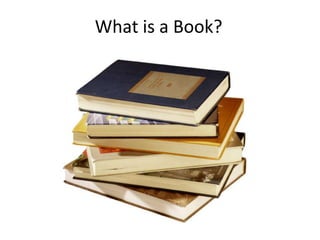
The form of the book has changed over time.
What is a Book?
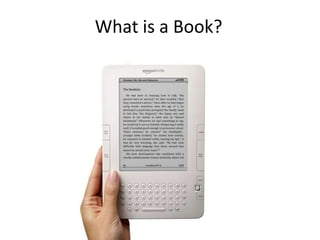
What is a Book?
What is a Book?
What is a Book?
What is a Book?
The form of the book has changed over time.The ‘book’ is the content, not the package!
So, what happens when the package undergoes a drastic change?
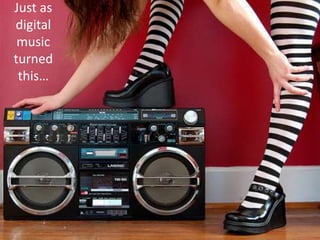
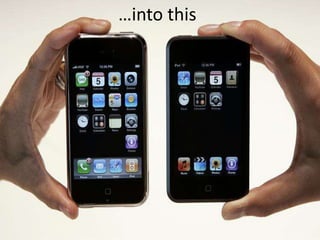
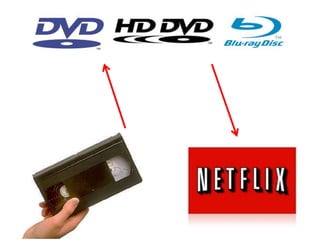
Just as digital music turned this…
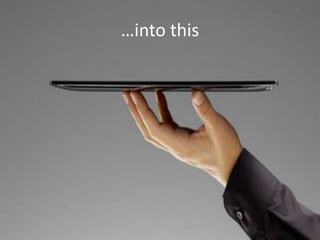
…into this
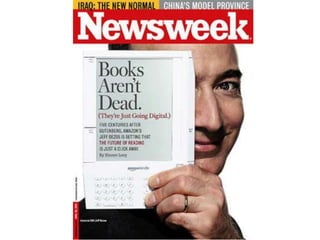
E-pub turns this…
…into this
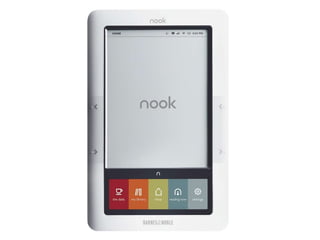
So, will these be replaced by…
And what happened to LPs? Are they dead?
RecapA “book” is the content; an e-book is just the next new package.The new package will last until it is replaced by a better package. We won’t revert to the previous package.History suggests that—as libraries—we won’t be ready. Let’s be ready!
What is a Dedicatede-reader?n modelsA device optimized for reading eBooks Kindle, Nook, Kobo, Sony Reader
What’s so special about them?Reflect light the way paper does (Outdoor reading).E-Ink has no backlighting so it is easier on the eyes and can be printed on any surface. Long battery life, especially if other features are turned off.Small format with huge capacity.
A few “dedicated” e-readers
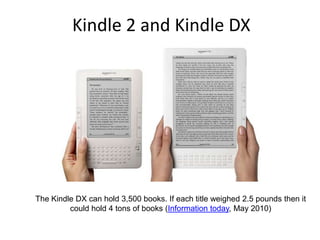
Kindle 2 and Kindle DXThe Kindle DX can hold 3,500 books. If each title weighed 2.5 pounds then it could hold 4 tons of books (Information today, May 2010)
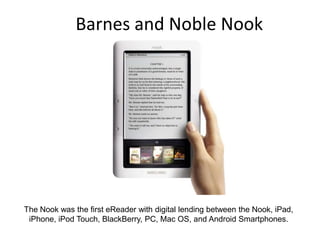
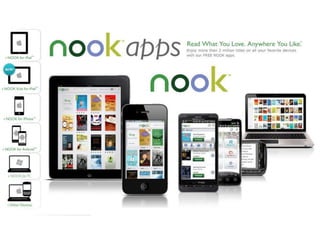
Barnes and Noble NookThe Nook was the first eReader with digital lending between the Nook, iPad, iPhone, iPod Touch, BlackBerry, PC, Mac OS, and Android Smartphones.
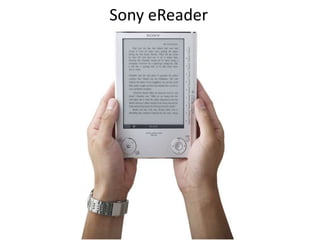
Sony eReader
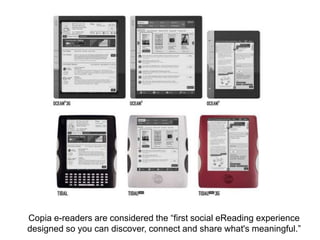
Copiae-readers are considered the “first social eReading experience designed so you can discover, connect and share what's meaningful.”
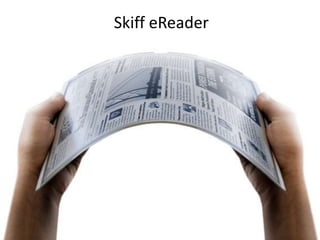
Skiff eReader
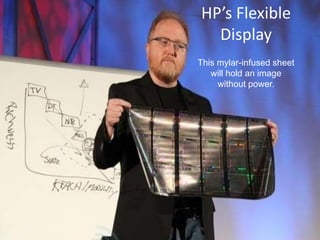
HP’s Flexible DisplayThis mylar-infused sheet will hold an image without power.
What’s a non-dedicated e-readerA device designed for some other, larger purpose that can also read e-publications. PC, Mac, iPad, netbook, iPhone, Android phones/tablets, Internet-enabled DVD players/TVs, gaming consoles etc.
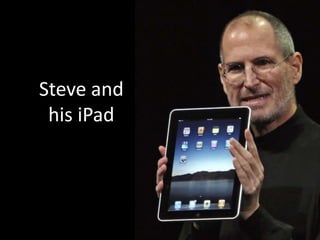
Steve and his iPad
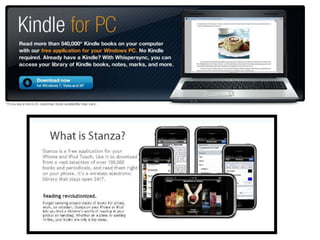
http://www.barnesandnoble.com/ebooks/download-reader.asp
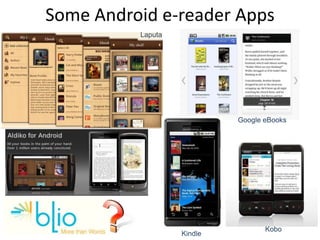
Some Android e-reader AppsLaputaGoogle eBooksKoboKindle
Which one is better?DedicatedNon-dedicatedExcellent for quick, casual reading.  Can read while multitasking. Excellent for extended reading and/or pleasure reading.You can “fall into” the book, and the mechanism does not interfere.
Is it OK to have both?Yes!
So, what will e-readers look like a few years from now?
I have no idea …
Formats and Digital Rights Management (DRM)
ePublication FormatsWe have an alphabet soup of formats:AZW, PDF, EPUB, MOBI, TXT, DJVU, LIT, etc.For a thorough explanation/comparison, see:http://en.wikipedia.org/wiki/Comparison_of_e-book_formatsThe big ones for us are EPUB, PDF and AZW (Kindle).“Everyone” else uses EPUB and PDFMicrosoft uses LIT, but hardly anyone caresOfficial ePub logo, International Digital Publishing Forum (IDPF)
Libraries and formatOverDrive uses the EPUB and PDF formatsAnyone not familiar with OverDrive?NetLibrary uses PDF, HTML, and DJVU formats for various documents. (EBSCO is changing this!)Anyone not familiar with “NetLibrary?”
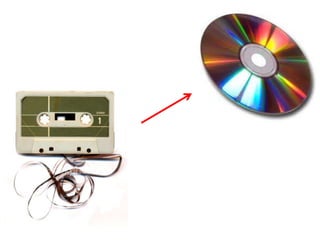
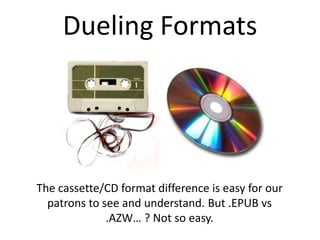
Dueling FormatsThe cassette/CD format difference is easy for our patrons to see and understand. But .EPUB vs .AZW… ? Not so easy.
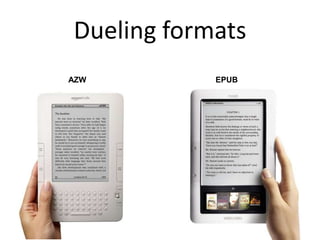
Dueling formatsAZWEPUB
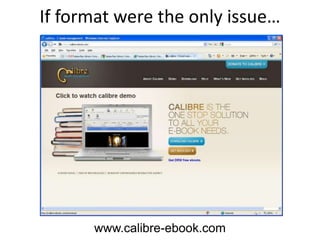
If format were the only issue…www.calibre-ebook.com
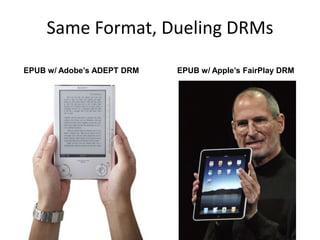
Same Format, Dueling DRMs EPUB w/ Adobe’s ADEPT DRM EPUB w/ Apple’s FairPlay DRM
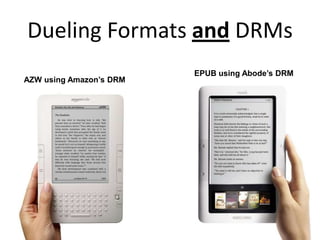
Dueling Formats and DRMsEPUB using Abode’s DRM AZW using Amazon’s DRM
So, what’s this DRM thing?Digital Rights Management.A software “lock” that controls access to a file (e-book, e-music, e-movie). You must have the correct software “key” to unlock it.
Is DRM a good thing or is it an evil thing?
Yes!
Like speed limits and banking regulations, DRM schemes can be a good thing and can protect an author’s livelihood.Like speed traps and unreasonable lending practices, DRM schemes can infuriate and frustrate our readers.
DRM schemes are a possibly necessary evil.Current treebookcheck out is primitive DRM.DRM schemes can be beaten, and it’s not illegal to know how.We can be the e-book source with the least annoying DRM and often none at all.
https://readersbillofrights.info/
I am upset! This is so frustrating! I don’t care what it is called; I JUST WANT to read an eBook!
A reader who has figured it out
RecapThere are dedicated and non-dedicated e-readers; both are wonderful.Any devices we see now will be quaint in a few years.E-publications come in a variety of (often) incompatible formats.They are protected by various forms of DRM.
E-pub and Public Libraries
How will e-pub affect Public Libraries?Access—Web site becomes “the” library
Old days--My library has a Web site!
Near future--My Web site still has a library!
Delivery—Instant home delivery.  No need to visit the library.  Or wait.
Delivery—Your costly, polluting, labor intensive inter-branch delivery vanishes.How will e-pub affect Public Libraries?Overdues—Nope.  Book self-returns when dueStorage—Your entire collection fits on a one or two terabyte hard drive.About $50 per terabyte at CompUSAService area—Why have a ‘local’ library?
How will e-pub affect Public Libraries?What happens to Ownership?Storage on “OverDrive’s” serversCheck out via “OverDrive’s” softwareAccess via “NetLibrary” web site(Are we sure that “we” own this book?)
How will (or does) e-pub affect Public Libraries?Publishers’ reluctance to sell to librariesTerm limited e-booksLimited range of vendors
OverDrive WINEliminate the need to deal with various file formats.Reduce staff time for collection development and help-desk support.Offer support for Kindle Library Lending.Add in-copyright eBook samples for immediate access.Enable patron driven acquisition.New 'always available' eBook collections for simultaneous access. Launch 'Open eBook' titles, free of DRM
HomeworkDevise or negotiate a purchasing plan that creates a “win” for publishers, vendors, librarians and patronsHint:  90% of it already exists
RecapE-pub offers huge benefits to public libraries, but also some threats to libraries as we now envision them.We need to figure out how to exploit e-pub’s power without being destroyed by it.
E-textbooksAl & ChadChad & Al
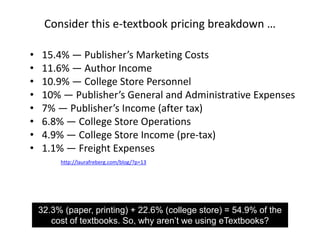
Consider this e-textbook pricing breakdown …32.3% — Publisher’s paper, printing, and editorial costs15.4% — Publisher’s Marketing Costs11.6% — Author Income10.9% — College Store Personnel10% — Publisher’s General and Administrative Expenses7% — Publisher’s Income (after tax)6.8% — College Store Operations4.9% — College Store Income (pre-tax)1.1% — Freight ExpensesSource: http://laurafreberg.com/blog/?p=1332.3% (paper, printing) + 22.6% (college store) = 54.9% of the cost of textbooks. So, why aren’t we using eTextbooks?
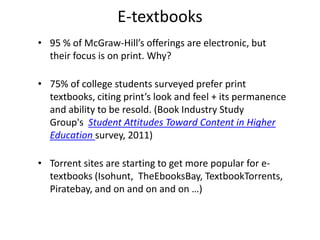
E-textbooks95 % of McGraw-Hill’s offerings are electronic, but their focus is on print. Why? 75% of college students surveyed prefer print textbooks, citing print’s look and feel + its permanence and ability to be resold. (Book Industry Study Group's  Student Attitudes Toward Content in Higher Education survey, 2011)Torrent sites are starting to get more popular for e-textbooks (Isohunt,  TheEbooksBay, TextbookTorrents, Piratebay, and on and on and on …)
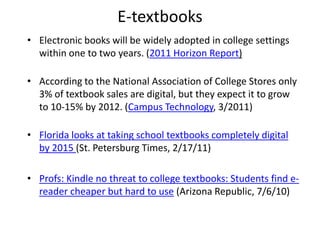
E-textbooksElectronic books will be widely adopted in college settings within one to two years. (2011 Horizon Report)According to the National Association of College Stores only 3% of textbook sales are digital, but they expect it to grow to 10-15% by 2012. (Campus Technology, 3/2011)Florida looks at taking school textbooks completely digital by 2015 (St. Petersburg Times, 2/17/11)Profs: Kindle no threat to college textbooks: Students find e-reader cheaper but hard to use (Arizona Republic, 7/6/10)
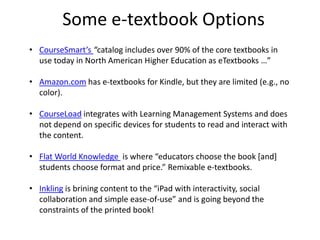
Some e-textbook OptionsCourseSmart’s “catalog includes over 90% of the core textbooks in use today in North American Higher Education as eTextbooks …”
Amazon.com has e-textbooks for Kindle, but they are limited (e.g., no color).
CourseLoad integrates with Learning Management Systems and does not depend on specific devices for students to read and interact with the content.
Flat World Knowledge  is where “educators choose the book [and] students choose format and price.” Remixablee-textbooks.
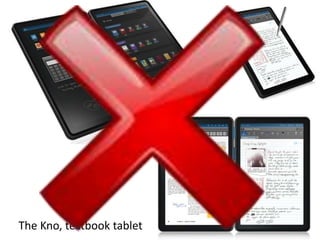
Inkling is brining content to the “iPad with interactivity, social collaboration and simple ease-of-use” and is going beyond the constraints of the printed book! The Kno, textbook tablet
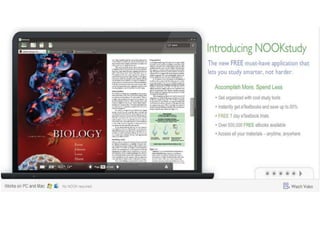
The Application requires 46MB of hard disk space; books range from 50KB to 1GB per title. (Source: http://www.barnesandnoble.com/nookstudy
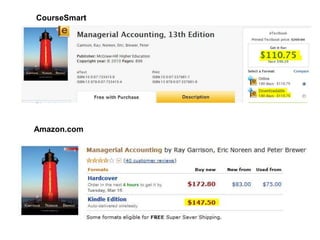
CourseSmartAmazon.com
Looking aheadBrowser-based books = truly device agnostic!With HTML 5 eBooks will become more interactive; content can be stored offline and then synced via the “cloud.” Books in Browsers 2010: The Future of Reading on the Web conference was held October 21, 2010 at the Internet Archive. 
Would a streaming Netflix-esque subscription model work for libraries or would it bypass them?
RecapE-books are powerful and complicated.They can fundamentally change libraries as we know them.Nobody fully grasps the full range of opportunities and threats they offer.Lots of people are bewildered and confused. So…How should we—as Librarians—respond?
Appropriate Library Response to these Problems
Issues like this that keep us relevant and employed.This is powerful and FUN!We are seeing evolution in action.Show me the rules that says “Libraries may not convert EPUB to AZW for patrons!”Or “Never, ever mention calibre or FeedBooks!”
How do we stay in the game?OverDrive modelWe exist but with a changed roleAmazon and Apple modelsWe don’t existEBSCO NetLibrary modelWe may exist.  We don’t know yet.Other modelsMaybe we should create our ownCreate a model right now…
SummaryGood e-pub newsThousands of free e-booksA MARC record makes it “yours”Potential for dramatic cost decreasesHuge increase in ability to serve patronsOpportunity for entirely new service modelsLocal authorship opportunities

Empowering the Reader in a Digital World

  • 1.
    Empowering the Readerin a Digital WorldChad Mairn, Novare Library Services
  • 2.
  • 3.
    Program GoalsDistinguish betweendedicated and non-dedicated e-readers.Answer the “e-books: Fad or Trend?” question.Untangle the web of acronyms for e-publication (e-pub) formats and DRM schemes.
  • 4.
    Program GoalsHighlight e-pub’sstrengths and weakness for libraries and for end users. Explore how e-textbooks fit in to this emerging landscape.Propose new models for library service in a digital environment.
  • 5.
    Program GoalsProvide youwith some practical patron assisting tools.Give you some homework and an opportunity to change the world.
  • 6.
    The form ofthe book has changed over time.
  • 7.
  • 8.
  • 9.
  • 10.
  • 11.
  • 12.
    The form ofthe book has changed over time.The ‘book’ is the content, not the package!
  • 13.
    So, what happenswhen the package undergoes a drastic change?
  • 14.
    Just as digitalmusic turned this…
  • 15.
  • 16.
  • 17.
  • 20.
    So, will thesebe replaced by…
  • 22.
    And what happenedto LPs? Are they dead?
  • 26.
    RecapA “book” isthe content; an e-book is just the next new package.The new package will last until it is replaced by a better package. We won’t revert to the previous package.History suggests that—as libraries—we won’t be ready. Let’s be ready!
  • 27.
    What is aDedicatede-reader?n modelsA device optimized for reading eBooks Kindle, Nook, Kobo, Sony Reader
  • 28.
    What’s so specialabout them?Reflect light the way paper does (Outdoor reading).E-Ink has no backlighting so it is easier on the eyes and can be printed on any surface. Long battery life, especially if other features are turned off.Small format with huge capacity.
  • 29.
  • 30.
    Kindle 2 andKindle DXThe Kindle DX can hold 3,500 books. If each title weighed 2.5 pounds then it could hold 4 tons of books (Information today, May 2010)
  • 31.
    Barnes and NobleNookThe Nook was the first eReader with digital lending between the Nook, iPad, iPhone, iPod Touch, BlackBerry, PC, Mac OS, and Android Smartphones.
  • 32.
  • 33.
    Copiae-readers are consideredthe “first social eReading experience designed so you can discover, connect and share what's meaningful.”
  • 34.
  • 35.
    HP’s Flexible DisplayThismylar-infused sheet will hold an image without power.
  • 36.
    What’s a non-dedicatede-readerA device designed for some other, larger purpose that can also read e-publications. PC, Mac, iPad, netbook, iPhone, Android phones/tablets, Internet-enabled DVD players/TVs, gaming consoles etc.
  • 37.
  • 39.
  • 40.
    Some Android e-readerAppsLaputaGoogle eBooksKoboKindle
  • 41.
    Which one isbetter?DedicatedNon-dedicatedExcellent for quick, casual reading. Can read while multitasking. Excellent for extended reading and/or pleasure reading.You can “fall into” the book, and the mechanism does not interfere.
  • 42.
    Is it OKto have both?Yes!
  • 43.
    So, what wille-readers look like a few years from now?
  • 44.
    I have noidea …
  • 45.
    Formats and DigitalRights Management (DRM)
  • 46.
    ePublication FormatsWe havean alphabet soup of formats:AZW, PDF, EPUB, MOBI, TXT, DJVU, LIT, etc.For a thorough explanation/comparison, see:http://en.wikipedia.org/wiki/Comparison_of_e-book_formatsThe big ones for us are EPUB, PDF and AZW (Kindle).“Everyone” else uses EPUB and PDFMicrosoft uses LIT, but hardly anyone caresOfficial ePub logo, International Digital Publishing Forum (IDPF)
  • 47.
    Libraries and formatOverDriveuses the EPUB and PDF formatsAnyone not familiar with OverDrive?NetLibrary uses PDF, HTML, and DJVU formats for various documents. (EBSCO is changing this!)Anyone not familiar with “NetLibrary?”
  • 48.
    Dueling FormatsThe cassette/CDformat difference is easy for our patrons to see and understand. But .EPUB vs .AZW… ? Not so easy.
  • 49.
  • 50.
    If format werethe only issue…www.calibre-ebook.com
  • 51.
    Same Format, DuelingDRMs EPUB w/ Adobe’s ADEPT DRM EPUB w/ Apple’s FairPlay DRM
  • 52.
    Dueling Formats andDRMsEPUB using Abode’s DRM AZW using Amazon’s DRM
  • 53.
    So, what’s thisDRM thing?Digital Rights Management.A software “lock” that controls access to a file (e-book, e-music, e-movie). You must have the correct software “key” to unlock it.
  • 54.
    Is DRM agood thing or is it an evil thing?
  • 55.
  • 56.
    Like speed limitsand banking regulations, DRM schemes can be a good thing and can protect an author’s livelihood.Like speed traps and unreasonable lending practices, DRM schemes can infuriate and frustrate our readers.
  • 57.
    DRM schemes area possibly necessary evil.Current treebookcheck out is primitive DRM.DRM schemes can be beaten, and it’s not illegal to know how.We can be the e-book source with the least annoying DRM and often none at all.
  • 58.
  • 59.
    I am upset!This is so frustrating! I don’t care what it is called; I JUST WANT to read an eBook!
  • 60.
    A reader whohas figured it out
  • 61.
    RecapThere are dedicatedand non-dedicated e-readers; both are wonderful.Any devices we see now will be quaint in a few years.E-publications come in a variety of (often) incompatible formats.They are protected by various forms of DRM.
  • 62.
  • 63.
    How will e-pubaffect Public Libraries?Access—Web site becomes “the” library
  • 64.
    Old days--My libraryhas a Web site!
  • 65.
    Near future--My Website still has a library!
  • 66.
    Delivery—Instant home delivery. No need to visit the library. Or wait.
  • 67.
    Delivery—Your costly, polluting,labor intensive inter-branch delivery vanishes.How will e-pub affect Public Libraries?Overdues—Nope. Book self-returns when dueStorage—Your entire collection fits on a one or two terabyte hard drive.About $50 per terabyte at CompUSAService area—Why have a ‘local’ library?
  • 68.
    How will e-pubaffect Public Libraries?What happens to Ownership?Storage on “OverDrive’s” serversCheck out via “OverDrive’s” softwareAccess via “NetLibrary” web site(Are we sure that “we” own this book?)
  • 69.
    How will (ordoes) e-pub affect Public Libraries?Publishers’ reluctance to sell to librariesTerm limited e-booksLimited range of vendors
  • 70.
    OverDrive WINEliminate theneed to deal with various file formats.Reduce staff time for collection development and help-desk support.Offer support for Kindle Library Lending.Add in-copyright eBook samples for immediate access.Enable patron driven acquisition.New 'always available' eBook collections for simultaneous access. Launch 'Open eBook' titles, free of DRM
  • 71.
    HomeworkDevise or negotiatea purchasing plan that creates a “win” for publishers, vendors, librarians and patronsHint: 90% of it already exists
  • 72.
    RecapE-pub offers hugebenefits to public libraries, but also some threats to libraries as we now envision them.We need to figure out how to exploit e-pub’s power without being destroyed by it.
  • 73.
  • 74.
    Consider this e-textbookpricing breakdown …32.3% — Publisher’s paper, printing, and editorial costs15.4% — Publisher’s Marketing Costs11.6% — Author Income10.9% — College Store Personnel10% — Publisher’s General and Administrative Expenses7% — Publisher’s Income (after tax)6.8% — College Store Operations4.9% — College Store Income (pre-tax)1.1% — Freight ExpensesSource: http://laurafreberg.com/blog/?p=1332.3% (paper, printing) + 22.6% (college store) = 54.9% of the cost of textbooks. So, why aren’t we using eTextbooks?
  • 75.
    E-textbooks95 % ofMcGraw-Hill’s offerings are electronic, but their focus is on print. Why? 75% of college students surveyed prefer print textbooks, citing print’s look and feel + its permanence and ability to be resold. (Book Industry Study Group's  Student Attitudes Toward Content in Higher Education survey, 2011)Torrent sites are starting to get more popular for e-textbooks (Isohunt, TheEbooksBay, TextbookTorrents, Piratebay, and on and on and on …)
  • 76.
    E-textbooksElectronic books willbe widely adopted in college settings within one to two years. (2011 Horizon Report)According to the National Association of College Stores only 3% of textbook sales are digital, but they expect it to grow to 10-15% by 2012. (Campus Technology, 3/2011)Florida looks at taking school textbooks completely digital by 2015 (St. Petersburg Times, 2/17/11)Profs: Kindle no threat to college textbooks: Students find e-reader cheaper but hard to use (Arizona Republic, 7/6/10)
  • 77.
    Some e-textbook OptionsCourseSmart’s“catalog includes over 90% of the core textbooks in use today in North American Higher Education as eTextbooks …”
  • 78.
    Amazon.com has e-textbooksfor Kindle, but they are limited (e.g., no color).
  • 79.
    CourseLoad integrates withLearning Management Systems and does not depend on specific devices for students to read and interact with the content.
  • 80.
    Flat World Knowledge is where “educators choose the book [and] students choose format and price.” Remixablee-textbooks.
  • 81.
    Inkling is briningcontent to the “iPad with interactivity, social collaboration and simple ease-of-use” and is going beyond the constraints of the printed book! The Kno, textbook tablet
  • 82.
    The Application requires46MB of hard disk space; books range from 50KB to 1GB per title. (Source: http://www.barnesandnoble.com/nookstudy
  • 83.
  • 84.
    Looking aheadBrowser-based books= truly device agnostic!With HTML 5 eBooks will become more interactive; content can be stored offline and then synced via the “cloud.” Books in Browsers 2010: The Future of Reading on the Web conference was held October 21, 2010 at the Internet Archive. 
  • 85.
    Would a streamingNetflix-esque subscription model work for libraries or would it bypass them?
  • 86.
    RecapE-books are powerfuland complicated.They can fundamentally change libraries as we know them.Nobody fully grasps the full range of opportunities and threats they offer.Lots of people are bewildered and confused. So…How should we—as Librarians—respond?
  • 87.
  • 88.
    Issues like thisthat keep us relevant and employed.This is powerful and FUN!We are seeing evolution in action.Show me the rules that says “Libraries may not convert EPUB to AZW for patrons!”Or “Never, ever mention calibre or FeedBooks!”
  • 89.
    How do westay in the game?OverDrive modelWe exist but with a changed roleAmazon and Apple modelsWe don’t existEBSCO NetLibrary modelWe may exist. We don’t know yet.Other modelsMaybe we should create our ownCreate a model right now…
  • 90.
    SummaryGood e-pub newsThousandsof free e-booksA MARC record makes it “yours”Potential for dramatic cost decreasesHuge increase in ability to serve patronsOpportunity for entirely new service modelsLocal authorship opportunities

Editor's Notes

  • #4 Here’s what we’ll do in the next hour or so
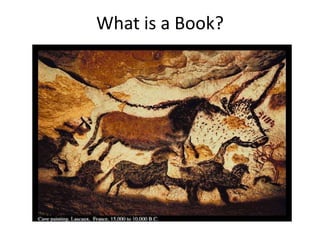
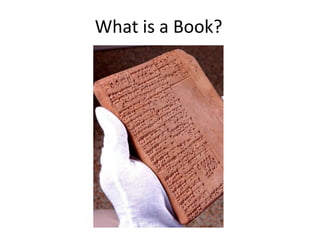
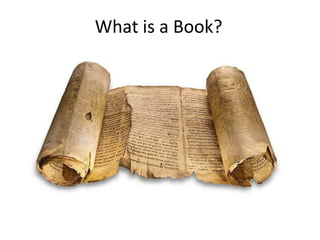
  • #8 Our notion of a book has changed over time.We could call the first cave paintings “books”; they stored information in a commonly understood format over time.The clay tablets used by the Babylonians were more portable and were definitely “hard copy”Imagine taking those to school in your backpack.Books got lighter when papyrus came out and got ‘longer’ with the development of the scroll.Which, actually, was a lot like reading a PDF document on your PC screen.
  • #15 For reading, this…
  • #16 …became this.
  • #18 Cumbersome became convenient.I used to carry “a” book with me where ever I went. Now I carry a few thousand books with me wherever I go.
  • #20 This used to be THE way to watch movies at home
  • #21 I was wondering whether this type of book was about to be totally replaced…
  • #22 …by this type of book.The best way to find out would be to travel into the future and just look.That turned out to be impractical.So, I thought it might be useful to find a transition from the past that was similar to this possible transition, and look for clues that indicated a major shift.Clues we could see at the beginning of the process, not after it was too late.I chose to look at the transition from VHS to DVD’sI got some help from Ask A Librarian, and I came up with this.
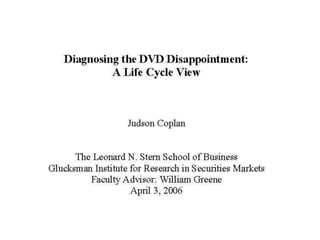
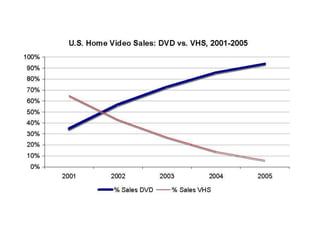
  • #25 Write down this title and Google it when you get back to work.It will give you ammunition when you talk to your boss and coworkers.It was written to help the DVD industry understand why their sales of players flattened after only six years.They thought the plateau meant they were doing something wrong, so they commissioned Judson Coplan to do a study.It turned out that they had done everything right.So right, in fact, that they had achieved ‘full’ market penetration about five years ahead of their original schedule.And faster than any ‘device’ had done before.Before they even thought of saying, “Are we there yet?”, they were there.
  • #26 Look at this, but pretend the red line is hard copy and the blue line is ePub.If this were 2001, what would you tell your library to buy more of? Less of?
  • #35 The Skiff hasn’t really caught on, but we love the idea of a flexible display
  • #36 So, we’re looking forward—eagerly—to an eReader that incorporates a truly flexible display and can be carried in a pocket protector.
  • #49 Easy to see why cassette won’t fit CD player
  • #50 Harder to see why Amazon e-book won’t ‘fit’ into Nook. Or, more likely, vice versa.Even if you saw the two side by side as files on a PC, most of our users won’t say, “Whoa! That’s an AZW file extension! No wonder it won’t work on a device configured for an EPUB file!”
  • #51 Calibre is a package of e-reading tools.It is a free download.It lets you convert “any” format to “any” format.But format is not the only issue
  • #52 Both of these read EPUB format, but Sony uses the Adobe DRM and the iPad uses the Fair Play DRM
  • #66 So, ePub offers some serious threats to public libraries as we know them, as well as some benefits.As librarians, we need to figure out how to exploit ePub’s power without being destroyed by it.Use the Force, but don’t go over to the dark side.Now, what about ePub and academic libraries?Chad?
  • #82 It is issues like this that keep us relevant and employed. You may say “I didn’t go to Library School for that!”Well, most of what I went to Library School for doesn’t even exist any more. Some of my class mates were blacksmiths.And I’m glad.Because this is a lot more powerful AND a lot more fun.In effect we are seeing evolution in action. The one that wins may not be the prettiest or the strongest or the smartest. It will be the one best suited to the environment it’s in. And any victory it has will be temporary, because something new will come along real soon.So: formats. Formats can be converted. (e.g. Word to PDF or HTML) You can buy a turntable, and it convert your vinyl to MP3 files as you play them. You can use calibre and convert EPUB to MOBI or MOBI to EPUB or either to djvu. [calibre-ebook.com] We may choose to do this in a hands on way. Nothing’s stopping us but tradition. There is no law that says “Libraries may not convert AZW to EPUB”.Or we may treat it as a reference question, and give ourselves a tic mark for sending a patron to calibre-ebook.com.Eventually every device that stays on the market will play every format that stays on the market. Just like the DVD player on your PC also plays CD’s.
  • #88 Note the sources of free eBooks