Done By:-
Nair.T.Krishnaprasad
Grade IX
 Electronic books, or E books, are editions
of books available electronically in a
variety of formats
 E books may be used on a variety of
devices, including: ◦ E reader , such as a
Kindle or Nook, Mobile device, such as a
Smartphone or tablet ◦ Personal computer
 E books may be text only, or
they may contain all of the same
material as the original book.
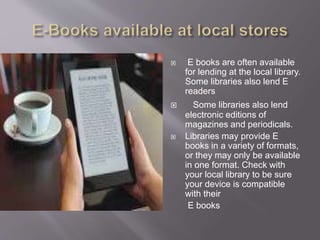
 E books are often available
for lending at the local library.
Some libraries also lend E
readers
 Some libraries also lend
electronic editions of
magazines and periodicals.
 Libraries may provide E
books in a variety of formats,
or they may only be available
in one format. Check with
your local library to be sure
your device is compatible
with their
E books
 Ebooks.com sells E books
compatible with a number
of devices. The site does
require downloading free
software to your personal
computer in order to
transfer the E books to
your device.
 Kobo.com sells a wide
variety (over 3.5 million) of
E books compatible with
their E readers.
 E books are also available
from many other retailers
 Many online booksellers
also sell electronic editions.
Amazon.com sells
electronic editions
designed for their Kindle.
Barnes & Noble
Booksellers, as well as
Books-a- Million, sell
E books designed for the
Nook.
 There are also online
booksellers dedicated to
E books.
 Books which are public
domain (often 75+ years old)
are often available for free in
an E- edition.
 This is an inexpensive way
to acquire some books, but
there are problems
 ◦ Some may be scanned from
the original, and have poor
image quality.
 ◦ Some are transcribed from
the original, and may have
typographical errors.
 Free E books are available from
a variety of online resources.
 ◦ Project Gutenberg
(www.gutenberg.org) provides
transcribed documents of many
books, often in a .txt or .pdf
format.
 ◦ Books related to Christian
History are available from the
Christian Classics Ethereal
Library (www.ccel.org) in .pdf
format.
 ◦ www.free-ebooks.net
provides free books from
independent authors (primarily
unpublished or public domain
books.
 E books are convenient
 ◦ Hundreds of books can be
carried on a single device.
 ◦ Books may be read
anywhere.
 E books help build a
community of readers
 ◦ Most major E readers, such
as the Kindle or the Nook,
enable users to see passages
highlighted by other readers. ◦
It is easy to post quotes from
the book to social
media.ywhere.
 Notations on the text are
saved electronically, instead of
taking up the margin of the
page.
 It is possible to access only
the highlighted passages of a
text.
 ◦ This feature assists
students.
 Authors starting their career
may find it easier to publish
electronically than traditionally.
 E books do not provide real ownership.
 ◦ A physical book may be lent to a friend or
family member, re-sold, or traded in for a
credit to another book at a used-book seller.
 ◦ An E book cannot be re-sold or lent to
another person. Risk of losing books or
notations.
 ◦ If an E reader is lost or stolen, some texts
may be lost, and any notations not backed
up will be lost.
 ◦ If an E reader is damaged or ceases to be
functional, some items may be lost.
 Cost of E books is not significantly lower than
paper editions.
 ◦ The cost of a Kindle edition from Amazon on
a bestseller is generally not significantly lower
than that of a regular edition.
 ◦ When factoring in the inability to re-sell the
book, the total cost of ownership may be
higher.
 Difficulty in highlighting/underlining and
taking notes.
 ◦ Although it is easier to save notes, typing
on most E reader keyboards is more difficult
than writing.
Conclusion
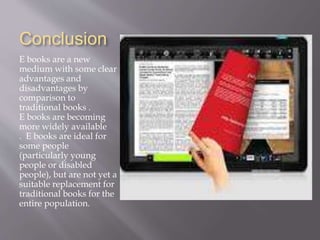
E books are a new
medium with some clear
advantages and
disadvantages by
comparison to
traditional books .
E books are becoming
more widely available
. E books are ideal for
some people
(particularly young
people or disabled
people), but are not yet a
suitable replacement for
traditional books for the
entire population.
Thankyou

Ppt on E books

  • 1.
  • 2.
     Electronic books,or E books, are editions of books available electronically in a variety of formats  E books may be used on a variety of devices, including: ◦ E reader , such as a Kindle or Nook, Mobile device, such as a Smartphone or tablet ◦ Personal computer  E books may be text only, or they may contain all of the same material as the original book.
  • 3.
     E booksare often available for lending at the local library. Some libraries also lend E readers  Some libraries also lend electronic editions of magazines and periodicals.  Libraries may provide E books in a variety of formats, or they may only be available in one format. Check with your local library to be sure your device is compatible with their E books
  • 4.
     Ebooks.com sellsE books compatible with a number of devices. The site does require downloading free software to your personal computer in order to transfer the E books to your device.  Kobo.com sells a wide variety (over 3.5 million) of E books compatible with their E readers.  E books are also available from many other retailers  Many online booksellers also sell electronic editions. Amazon.com sells electronic editions designed for their Kindle. Barnes & Noble Booksellers, as well as Books-a- Million, sell E books designed for the Nook.  There are also online booksellers dedicated to E books.
  • 5.
     Books whichare public domain (often 75+ years old) are often available for free in an E- edition.  This is an inexpensive way to acquire some books, but there are problems  ◦ Some may be scanned from the original, and have poor image quality.  ◦ Some are transcribed from the original, and may have typographical errors.  Free E books are available from a variety of online resources.  ◦ Project Gutenberg (www.gutenberg.org) provides transcribed documents of many books, often in a .txt or .pdf format.  ◦ Books related to Christian History are available from the Christian Classics Ethereal Library (www.ccel.org) in .pdf format.  ◦ www.free-ebooks.net provides free books from independent authors (primarily unpublished or public domain books.
  • 6.
     E booksare convenient  ◦ Hundreds of books can be carried on a single device.  ◦ Books may be read anywhere.  E books help build a community of readers  ◦ Most major E readers, such as the Kindle or the Nook, enable users to see passages highlighted by other readers. ◦ It is easy to post quotes from the book to social media.ywhere.  Notations on the text are saved electronically, instead of taking up the margin of the page.  It is possible to access only the highlighted passages of a text.  ◦ This feature assists students.  Authors starting their career may find it easier to publish electronically than traditionally.
  • 7.
     E booksdo not provide real ownership.  ◦ A physical book may be lent to a friend or family member, re-sold, or traded in for a credit to another book at a used-book seller.  ◦ An E book cannot be re-sold or lent to another person. Risk of losing books or notations.  ◦ If an E reader is lost or stolen, some texts may be lost, and any notations not backed up will be lost.  ◦ If an E reader is damaged or ceases to be functional, some items may be lost.  Cost of E books is not significantly lower than paper editions.  ◦ The cost of a Kindle edition from Amazon on a bestseller is generally not significantly lower than that of a regular edition.  ◦ When factoring in the inability to re-sell the book, the total cost of ownership may be higher.  Difficulty in highlighting/underlining and taking notes.  ◦ Although it is easier to save notes, typing on most E reader keyboards is more difficult than writing.
  • 8.
    Conclusion E books area new medium with some clear advantages and disadvantages by comparison to traditional books . E books are becoming more widely available . E books are ideal for some people (particularly young people or disabled people), but are not yet a suitable replacement for traditional books for the entire population.
  • 9.