Chapter – 9
FINANCIAL
STATEMENTS – I
Prepared by:Sandeep Kumar N V
HSST Commerce,Katukukke HSS Kasaragod
Mob:9496357371,
E mail:sandeepneelian@gmail.com
Residence :PILICODE
SUBSCRIBE
INTRODUCTION
Introduction:
Financial statements are formal records of the
financial activities and financial position of a
business. To find out financial result of the business
trading and profit & loss account is prepared. To
ascertain the financial position of the business
balance sheet is prepared.
Financial Statements include -
1.Trading Account:
2.Profit and Loss Account
3.Balance Sheet
Objectives of preparing
financial statements:
1. To find out financial result of the
business.
2. To ascertain the financial
position of the business.
1.Trading Account:
1.Trading Account:
Trading Account is an account which is
prepared to ascertain the trading(buying and
selling or production and selling) result of a
business. It includes all manufacturing level
items. Profit arising out from trading alone is
called gross profit. The object of preparing a
trading account is to ascertain the Gross Profit
earned or Gross Loss incurred.
In trading account, two items are compared, i.e.,
sales (direct income) and cost of goods sold. If sale is
more than cost of goods sold, there is a gross profit.
Otherwise, a gross loss. Whatever it be the balance,
which is transferred to profit and loss account.
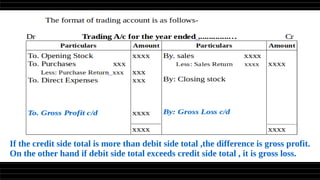
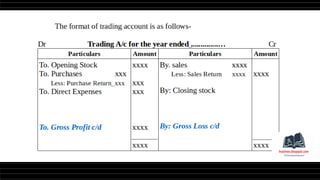
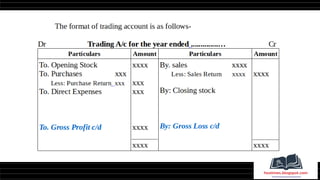
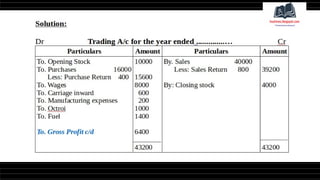
Trading account is debited with Opening Stock, Net
Purchase and Direct Expenses . It is credited with
Sales (direct income) and Closing Stock.
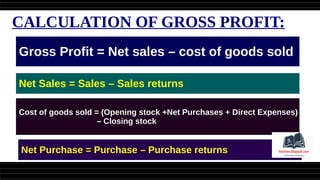
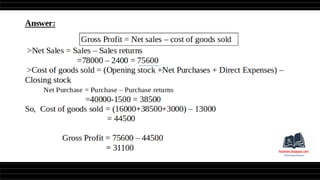
CALCULATION OF GROSS PROFIT:
Gross Profit = Net sales – cost of goods sold
Net Sales = Sales – Sales returns
Cost of goods sold = (Opening stock +Net Purchases + Direct Expenses)
– Closing stock
Net Purchase = Purchase – Purchase returns
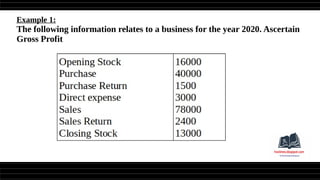
Example 1:
The following information relates to a business for the year 2020. Ascertain
Gross Profit
PREPARATION OF
TRADING ACCOUNT
CLOSING JOURNAL ENTRIES
+1 ACCOUNTANCY
PREPARATION OF
TRADING ACCOUNT
CLOSING ENTRIES
If the credit side total is more than debit side total ,the difference is gross profit.
On the other hand if debit side total exceeds credit side total , it is gross loss.
The above items are taken to trading
account by following double entry principle.
Journal entries which are passed to close the
accounts for the purpose of transferring them
to trading account are called closing entries.
Following are the closing entries passed to
prepare trial balance
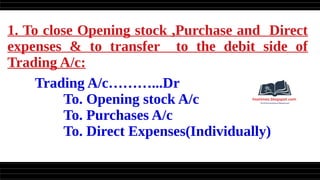
1. To close Opening stock ,Purchase and Direct
expenses & to transfer to the debit side of
Trading A/c:
Trading A/c………...Dr
To. Opening stock A/c
To. Purchases A/c
To. Direct Expenses(Individually)
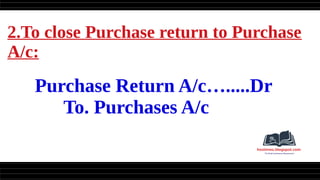
2.To close Purchase return to Purchase
A/c:
Purchase Return A/c….....Dr
To. Purchases A/c
3.To close Sales return to Sales A/c:
Sales A/c………...Dr
To .Sales Returns A/c
4. To close Sales by transferring to
Trading A/c:
Sales A/c…….....Dr
To. Trading A/c
5.Transferring Closing stock to
Trading A/c:
Closing Stock A/c……....Dr
To. Trading A/c
It is shown on the credit side of trading account as it reduces the
cost of sales.
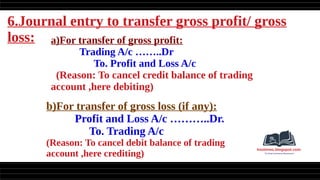
6.Journal entry to transfer gross profit/ gross
loss: a)For transfer of gross profit:
Trading A/c ……..Dr
To. Profit and Loss A/c
(Reason: To cancel credit balance of trading
account ,here debiting)
b)For transfer of gross loss (if any):
Profit and Loss A/c ………..Dr.
To. Trading A/c
(Reason: To cancel debit balance of trading
account ,here crediting)
RELEVANT ITEMS IN
TRADING ACCOUNT
ട്രേഡിങ്ങ് അക്കൗണ്ടിന്റെ ഡെബിറ്റ്
സൈഡിലും ക്രെഡിറ്റ് സൈഡിലും
എന്തൊക്കെ ഐറ്റംസ് ആണ് ഉള്ളത്
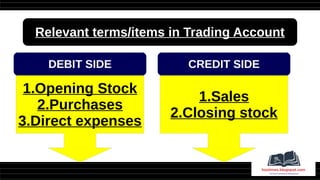
Relevant terms/items in Trading Account
DEBIT SIDE CREDIT SIDE
1.Opening Stock
2.Purchases
3.Direct expenses
1.Sales
2.Closing stock
I)ON THE DEBIT SIDE
1.Opening Stock: It is the balance of stock brought
forward from the previous year.
2.Purchases: It refers to goods purchased for resale
in business.
Net purchase = Purchase – Purchase
returns.
3.Direct expenses:
All expenses directly connected with
purchasing or manufacturing the goods
and making them ready for sale are called
direct expense. It must be debited to
trading account. It includes
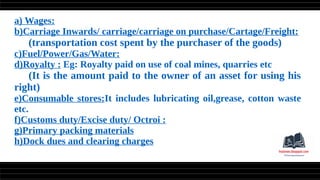
a) Wages:
b)Carriage Inwards/ carriage/carriage on purchase/Cartage/Freight:
(transportation cost spent by the purchaser of the goods)
c)Fuel/Power/Gas/Water:
d)Royalty : Eg: Royalty paid on use of coal mines, quarries etc
(It is the amount paid to the owner of an asset for using his
right)
e)Consumable stores:It includes lubricating oil,grease, cotton waste
etc.
f)Customs duty/Excise duty/ Octroi :
g)Primary packing materials
h)Dock dues and clearing charges
I)ON THE CREDIT SIDE
1.Sales : Sales less returns (net sales) is the
direct income for any business and is credited
to trading account.
2.Closing stock : It is the value of goods unsold at
the end of accounting year. It is shown on the credit
side of trading account as it reduces the cost of
sales.
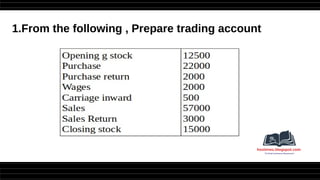
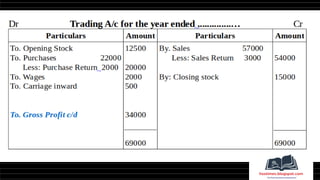
PROBLEMS 1:
TRADING ACCOUNT PREPARATION
1.From the following , Prepare trading account
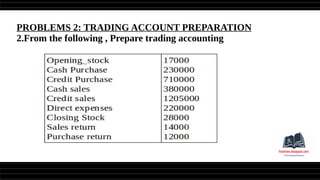
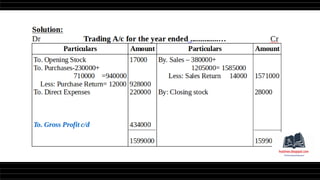
PROBLEMS 2: TRADING ACCOUNT PREPARATION
2.From the following , Prepare trading accounting
PROBLEMS 2: TRADING ACCOUNT PREPARATION
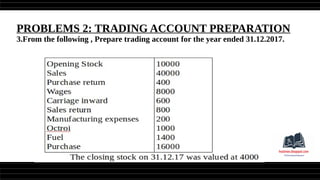
3.From the following , Prepare trading account for the year ended 31.12.2017.
Profit and Loss Account
2.Profit and Loss
Account:
Relevant items in
Profit and Loss Account:
2.Profit and Loss
Account:
Relevant items in
Profit and Loss Account:
2.Profit and Loss Account:
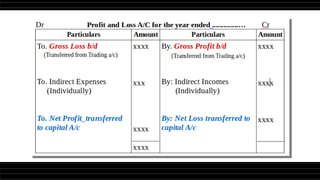
This account is prepared to find out the net profit earned or
net loss incurred by a business. Profit and Loss Account
includes all office level items.
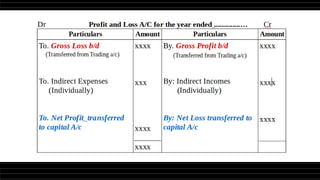
Profit and Loss account starts with Gross Profit/Gross
loss. All indirect expenses are transferred to the debit side of
the profit and loss account. All revenues/gains other than
sales are transferred to the credit side of the profit and loss
account.
The difference of the two sides of this account is net
profit or net loss. If the total of the credit side of the profit
and loss account is more than the debit side, the difference is
net profit. If the total of the debit side is more than the total
of the credit side, the difference is net loss.
The amount of net profit or net loss is transferred
to the capital account. Net profit increases the capital
and net loss decrease it. The format of Profit and
Loss account is as follows-
Relevant items in
Profit and Loss Account:
I) ON THE DEBIT SIDE:
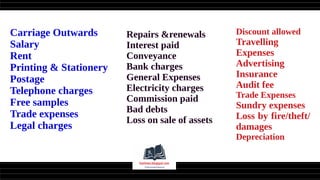
1.Indirect Expenses: Indirect expenses are those expenses
which are not directly associated with the manufacturing or
purchase of goods. They include administrative, selling and
distribution expenses. It includes
Carriage Outwards
Salary
Rent
Printing & Stationery
Postage
Telephone charges
Free samples
Trade expenses
Legal charges
Repairs &renewals
Interest paid
Conveyance
Bank charges
General Expenses
Electricity charges
Commission paid
Bad debts
Loss on sale of assets
Discount allowed
Travelling
Expenses
Advertising
Insurance
Audit fee
Trade Expenses
Sundry expenses
Loss by fire/theft/
damages
Depreciation
II) ON THE CREDIT SIDE:
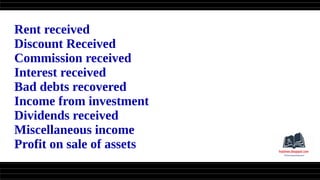
1.Indirect Income: Indirect incomes are those incomes
which are not directly associated with sale of goods such as
interest received, dividend received, profit on sale of fixed
assets etc. It includes-
Rent received
Discount Received
Commission received
Interest received
Bad debts recovered
Income from investment
Dividends received
Miscellaneous income
Profit on sale of assets
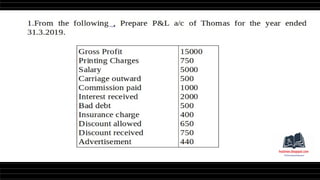
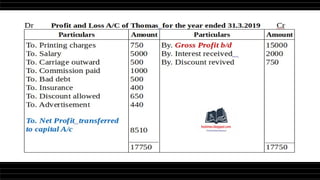
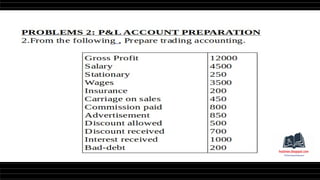
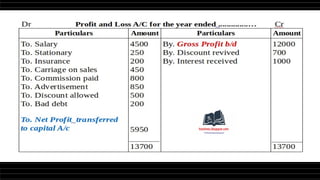
PROBLEMS
P&L ACCOUNT PREPARATION
PROBLEMS
P&L ACCOUNT PREPARATION
Closing Journal entries regarding
Profit and loss account:
പ്രോഫിറ്റ് & ലോസ്സ് അക്കൗണ്ട് പ്രിപ്പേർ ചെയ്യുമ്പോൾ
എന്തൊക്കെ ക്ലോസിങ് ജേർണൽ എൻട്രികൾ വേണം
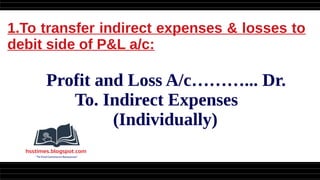
1.To transfer indirect expenses & losses to
debit side of P&L a/c:
Profit and Loss A/c………... Dr.
To. Indirect Expenses
(Individually)
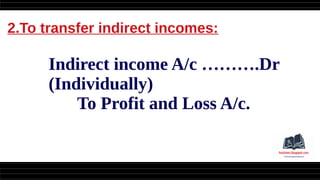
2.To transfer indirect incomes:
Indirect income A/c ……….Dr
(Individually)
To Profit and Loss A/c.
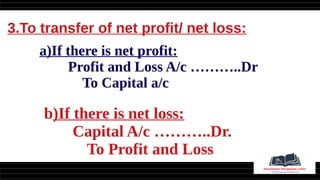
3.To transfer of net profit/ net loss:
a)If there is net profit:
Profit and Loss A/c ………..Dr
To Capital a/c
b)If there is net loss:
Capital A/c ………..Dr.
To Profit and Loss
Trading & Profit and Loss a/c
Preparation
Problems
Trading & Profit and Loss a/c
Preparation
Problems
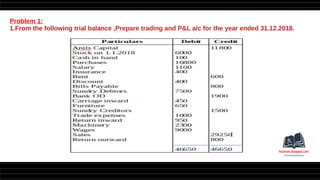
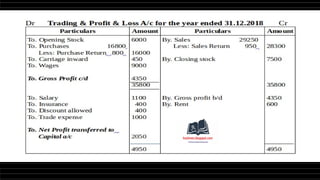
Problem 1:
1.From the following trial balance ,Prepare trading and P&L a/c for the year ended 31.12.2018.
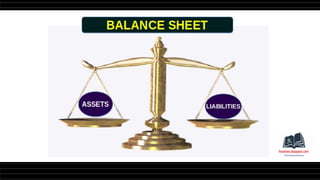
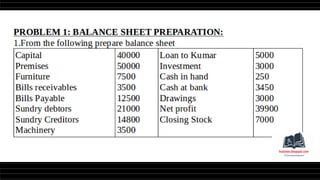
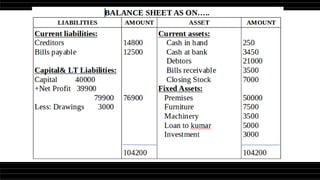
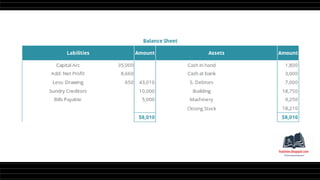
BALANCE SHEET
ASSETS
LIABILITIES
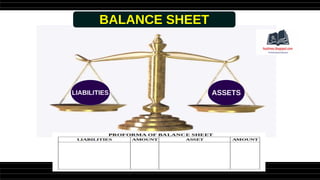
BALANCE SHEET
3.Balance Sheet:
Balance sheet is a statement prepared for showing the
financial position of the business by summarising its assets and
liabilities at a given date. It is prepared at the end of the
accounting period after the preparation of Trading and Profit
and Loss A/c.
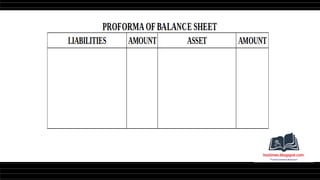
Capital and liabilities are shown on the left hand side
called Liabilities side. Assets and other accounts with debit
balances are shown on right hand side known as Asset side.
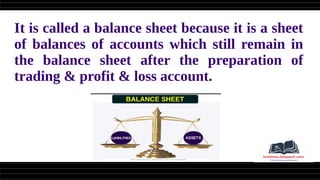
It is called a balance sheet because it is a sheet
of balances of accounts which still remain in
the balance sheet after the preparation of
trading & profit & loss account.
Features of Balance Sheet:
1. Balance Sheet is a statement and not an account.
2. It gives financial position of a business
3. The total of the two sides of the Balance Sheet
must be equal.
4. It helps to ascertain the value of assets owned.
5. It helps to ascertain the nature & value of
liabilities to outsiders.
Grouping and Marshalling of Assets and
Liabilities in Balance Sheet:
Grouping & Marshalling’ is the
arrangement of various assets and liabilities in
a particular order in the Balance Sheet. It can
be done in any of the following two ways -
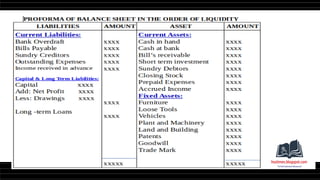
1. In the order of Liquidity
2.In the order of permanence
1.In the order of Liquidity:
Under this method assets which can be
converted into cash are shown first followed
by other assets which cannot be converted into
cash. According to this method cash is always
presented first, followed by cash at bank, bills
receivables, short term investments, sundry
debtors, inventory, and then fixed assets.
Goodwill is shown as the last item.
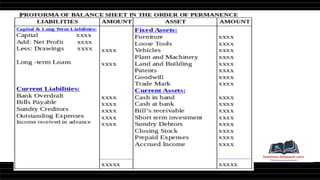
2.In the order of permanence:
Under this method permanent
assets are shown first followed by
current assets & liabilities.
Valuation of Assets:
The balance sheet to be accurate ,the
assets must be valued by following GAAP.
Accordingly fixed assets are valued at cost
less depreciation. Current assets are valued
at cost price or market price whichever is
less.
Balance Sheet Preparation
Problems
Balance Sheet Preparation
Problems
Trading & Profit and Loss a/c
And
balance sheet Preparation
Problems
Trading & Profit and Loss a/c
And
balance sheet Preparation
Problems
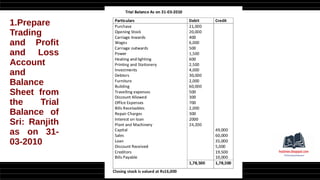
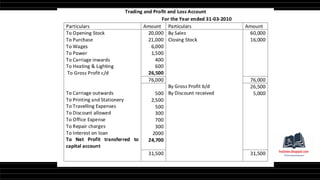
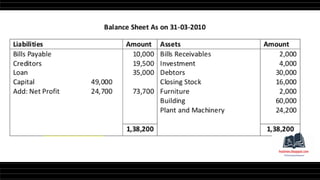
1.Prepare
Trading
and Profit
and Loss
Account
and
Balance
Sheet from
the Trial
Balance of
Sri: Ranjith
as on 31-
03-2010
PROBLEM 2
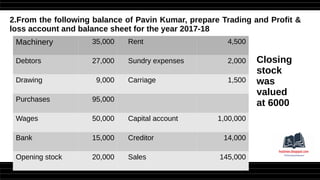
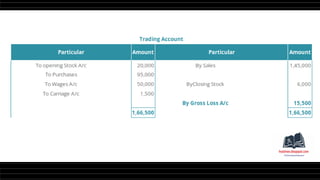
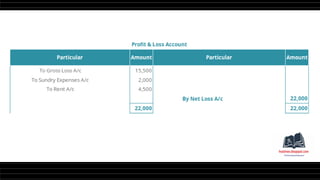
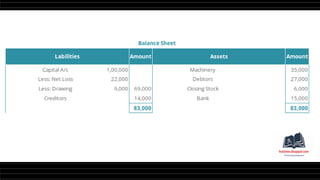
2.From the following balance of Pavin Kumar, prepare Trading and Profit &
loss account and balance sheet for the year 2017-18
Machinery 35,000 Rent 4,500
Debtors 27,000 Sundry expenses 2,000
Drawing 9,000 Carriage 1,500
Purchases 95,000
Wages 50,000 Capital account 1,00,000
Bank 15,000 Creditor 14,000
Opening stock 20,000 Sales 145,000
Closing
stock
was
valued
at 6000
PROBLEM 3
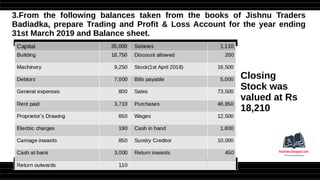
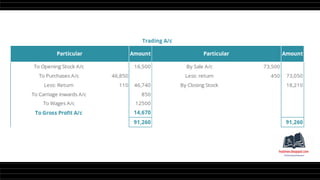
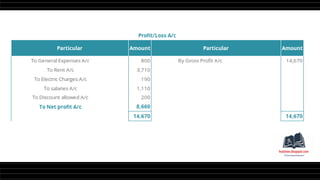
3.From the following balances taken from the books of Jishnu Traders
Badiadka, prepare Trading and Profit & Loss Account for the year ending
31st March 2019 and Balance sheet.
Closing
Stock was
valued at Rs
18,210
Prepared by:Sandeep Kumar N V
HSST Commerce,Katukukke HSS Kasaragod
Mob:9496357371,
E mail:sandeepneelian@gmail.com
Residence :PILICODE
Financial Statement power point presentation for class 11 students

Financial Statement power point presentation for class 11 students

  • 2.
    Chapter – 9 FINANCIAL STATEMENTS– I Prepared by:Sandeep Kumar N V HSST Commerce,Katukukke HSS Kasaragod Mob:9496357371, E mail:sandeepneelian@gmail.com Residence :PILICODE
  • 3.
  • 4.
  • 5.
    Introduction: Financial statements areformal records of the financial activities and financial position of a business. To find out financial result of the business trading and profit & loss account is prepared. To ascertain the financial position of the business balance sheet is prepared. Financial Statements include - 1.Trading Account: 2.Profit and Loss Account 3.Balance Sheet
  • 6.
    Objectives of preparing financialstatements: 1. To find out financial result of the business. 2. To ascertain the financial position of the business.
  • 7.
  • 8.
    1.Trading Account: Trading Accountis an account which is prepared to ascertain the trading(buying and selling or production and selling) result of a business. It includes all manufacturing level items. Profit arising out from trading alone is called gross profit. The object of preparing a trading account is to ascertain the Gross Profit earned or Gross Loss incurred.
  • 9.
    In trading account,two items are compared, i.e., sales (direct income) and cost of goods sold. If sale is more than cost of goods sold, there is a gross profit. Otherwise, a gross loss. Whatever it be the balance, which is transferred to profit and loss account. Trading account is debited with Opening Stock, Net Purchase and Direct Expenses . It is credited with Sales (direct income) and Closing Stock.
  • 10.
    CALCULATION OF GROSSPROFIT: Gross Profit = Net sales – cost of goods sold Net Sales = Sales – Sales returns Cost of goods sold = (Opening stock +Net Purchases + Direct Expenses) – Closing stock Net Purchase = Purchase – Purchase returns
  • 11.
    Example 1: The followinginformation relates to a business for the year 2020. Ascertain Gross Profit
  • 13.
    PREPARATION OF TRADING ACCOUNT CLOSINGJOURNAL ENTRIES +1 ACCOUNTANCY
  • 14.
  • 15.
    If the creditside total is more than debit side total ,the difference is gross profit. On the other hand if debit side total exceeds credit side total , it is gross loss.
  • 16.
    The above itemsare taken to trading account by following double entry principle. Journal entries which are passed to close the accounts for the purpose of transferring them to trading account are called closing entries. Following are the closing entries passed to prepare trial balance
  • 18.
    1. To closeOpening stock ,Purchase and Direct expenses & to transfer to the debit side of Trading A/c: Trading A/c………...Dr To. Opening stock A/c To. Purchases A/c To. Direct Expenses(Individually)
  • 19.
    2.To close Purchasereturn to Purchase A/c: Purchase Return A/c….....Dr To. Purchases A/c
  • 20.
    3.To close Salesreturn to Sales A/c: Sales A/c………...Dr To .Sales Returns A/c
  • 21.
    4. To closeSales by transferring to Trading A/c: Sales A/c…….....Dr To. Trading A/c
  • 22.
    5.Transferring Closing stockto Trading A/c: Closing Stock A/c……....Dr To. Trading A/c It is shown on the credit side of trading account as it reduces the cost of sales.
  • 23.
    6.Journal entry totransfer gross profit/ gross loss: a)For transfer of gross profit: Trading A/c ……..Dr To. Profit and Loss A/c (Reason: To cancel credit balance of trading account ,here debiting) b)For transfer of gross loss (if any): Profit and Loss A/c ………..Dr. To. Trading A/c (Reason: To cancel debit balance of trading account ,here crediting)
  • 24.
    RELEVANT ITEMS IN TRADINGACCOUNT ട്രേഡിങ്ങ് അക്കൗണ്ടിന്റെ ഡെബിറ്റ് സൈഡിലും ക്രെഡിറ്റ് സൈഡിലും എന്തൊക്കെ ഐറ്റംസ് ആണ് ഉള്ളത്
  • 25.
    Relevant terms/items inTrading Account DEBIT SIDE CREDIT SIDE 1.Opening Stock 2.Purchases 3.Direct expenses 1.Sales 2.Closing stock
  • 27.
    I)ON THE DEBITSIDE 1.Opening Stock: It is the balance of stock brought forward from the previous year. 2.Purchases: It refers to goods purchased for resale in business. Net purchase = Purchase – Purchase returns.
  • 28.
    3.Direct expenses: All expensesdirectly connected with purchasing or manufacturing the goods and making them ready for sale are called direct expense. It must be debited to trading account. It includes
  • 29.
    a) Wages: b)Carriage Inwards/carriage/carriage on purchase/Cartage/Freight: (transportation cost spent by the purchaser of the goods) c)Fuel/Power/Gas/Water: d)Royalty : Eg: Royalty paid on use of coal mines, quarries etc (It is the amount paid to the owner of an asset for using his right) e)Consumable stores:It includes lubricating oil,grease, cotton waste etc. f)Customs duty/Excise duty/ Octroi : g)Primary packing materials h)Dock dues and clearing charges
  • 30.
    I)ON THE CREDITSIDE 1.Sales : Sales less returns (net sales) is the direct income for any business and is credited to trading account. 2.Closing stock : It is the value of goods unsold at the end of accounting year. It is shown on the credit side of trading account as it reduces the cost of sales.
  • 31.
  • 32.
    1.From the following, Prepare trading account
  • 34.
    PROBLEMS 2: TRADINGACCOUNT PREPARATION 2.From the following , Prepare trading accounting
  • 36.
    PROBLEMS 2: TRADINGACCOUNT PREPARATION 3.From the following , Prepare trading account for the year ended 31.12.2017.
  • 38.
    Profit and LossAccount Profit and Loss Account
  • 39.
    2.Profit and Loss Account: Relevantitems in Profit and Loss Account: 2.Profit and Loss Account: Relevant items in Profit and Loss Account:
  • 40.
    2.Profit and LossAccount: This account is prepared to find out the net profit earned or net loss incurred by a business. Profit and Loss Account includes all office level items. Profit and Loss account starts with Gross Profit/Gross loss. All indirect expenses are transferred to the debit side of the profit and loss account. All revenues/gains other than sales are transferred to the credit side of the profit and loss account.
  • 41.
    The difference ofthe two sides of this account is net profit or net loss. If the total of the credit side of the profit and loss account is more than the debit side, the difference is net profit. If the total of the debit side is more than the total of the credit side, the difference is net loss. The amount of net profit or net loss is transferred to the capital account. Net profit increases the capital and net loss decrease it. The format of Profit and Loss account is as follows-
  • 43.
    Relevant items in Profitand Loss Account:
  • 44.
    I) ON THEDEBIT SIDE: 1.Indirect Expenses: Indirect expenses are those expenses which are not directly associated with the manufacturing or purchase of goods. They include administrative, selling and distribution expenses. It includes
  • 45.
    Carriage Outwards Salary Rent Printing &Stationery Postage Telephone charges Free samples Trade expenses Legal charges Repairs &renewals Interest paid Conveyance Bank charges General Expenses Electricity charges Commission paid Bad debts Loss on sale of assets Discount allowed Travelling Expenses Advertising Insurance Audit fee Trade Expenses Sundry expenses Loss by fire/theft/ damages Depreciation
  • 46.
    II) ON THECREDIT SIDE: 1.Indirect Income: Indirect incomes are those incomes which are not directly associated with sale of goods such as interest received, dividend received, profit on sale of fixed assets etc. It includes-
  • 47.
    Rent received Discount Received Commissionreceived Interest received Bad debts recovered Income from investment Dividends received Miscellaneous income Profit on sale of assets
  • 48.
  • 53.
    Closing Journal entriesregarding Profit and loss account: പ്രോഫിറ്റ് & ലോസ്സ് അക്കൗണ്ട് പ്രിപ്പേർ ചെയ്യുമ്പോൾ എന്തൊക്കെ ക്ലോസിങ് ജേർണൽ എൻട്രികൾ വേണം
  • 55.
    1.To transfer indirectexpenses & losses to debit side of P&L a/c: Profit and Loss A/c………... Dr. To. Indirect Expenses (Individually)
  • 56.
    2.To transfer indirectincomes: Indirect income A/c ……….Dr (Individually) To Profit and Loss A/c.
  • 57.
    3.To transfer ofnet profit/ net loss: a)If there is net profit: Profit and Loss A/c ………..Dr To Capital a/c b)If there is net loss: Capital A/c ………..Dr. To Profit and Loss
  • 58.
    Trading & Profitand Loss a/c Preparation Problems Trading & Profit and Loss a/c Preparation Problems
  • 59.
    Problem 1: 1.From thefollowing trial balance ,Prepare trading and P&L a/c for the year ended 31.12.2018.
  • 61.
  • 63.
  • 64.
    3.Balance Sheet: Balance sheetis a statement prepared for showing the financial position of the business by summarising its assets and liabilities at a given date. It is prepared at the end of the accounting period after the preparation of Trading and Profit and Loss A/c. Capital and liabilities are shown on the left hand side called Liabilities side. Assets and other accounts with debit balances are shown on right hand side known as Asset side.
  • 65.
    It is calleda balance sheet because it is a sheet of balances of accounts which still remain in the balance sheet after the preparation of trading & profit & loss account.
  • 66.
    Features of BalanceSheet: 1. Balance Sheet is a statement and not an account. 2. It gives financial position of a business 3. The total of the two sides of the Balance Sheet must be equal. 4. It helps to ascertain the value of assets owned. 5. It helps to ascertain the nature & value of liabilities to outsiders.
  • 68.
    Grouping and Marshallingof Assets and Liabilities in Balance Sheet: Grouping & Marshalling’ is the arrangement of various assets and liabilities in a particular order in the Balance Sheet. It can be done in any of the following two ways - 1. In the order of Liquidity 2.In the order of permanence
  • 69.
    1.In the orderof Liquidity: Under this method assets which can be converted into cash are shown first followed by other assets which cannot be converted into cash. According to this method cash is always presented first, followed by cash at bank, bills receivables, short term investments, sundry debtors, inventory, and then fixed assets. Goodwill is shown as the last item.
  • 71.
    2.In the orderof permanence: Under this method permanent assets are shown first followed by current assets & liabilities.
  • 73.
    Valuation of Assets: Thebalance sheet to be accurate ,the assets must be valued by following GAAP. Accordingly fixed assets are valued at cost less depreciation. Current assets are valued at cost price or market price whichever is less.
  • 74.
  • 77.
    Trading & Profitand Loss a/c And balance sheet Preparation Problems Trading & Profit and Loss a/c And balance sheet Preparation Problems
  • 78.
    1.Prepare Trading and Profit and Loss Account and Balance Sheetfrom the Trial Balance of Sri: Ranjith as on 31- 03-2010
  • 81.
  • 82.
    2.From the followingbalance of Pavin Kumar, prepare Trading and Profit & loss account and balance sheet for the year 2017-18 Machinery 35,000 Rent 4,500 Debtors 27,000 Sundry expenses 2,000 Drawing 9,000 Carriage 1,500 Purchases 95,000 Wages 50,000 Capital account 1,00,000 Bank 15,000 Creditor 14,000 Opening stock 20,000 Sales 145,000 Closing stock was valued at 6000
  • 86.
  • 87.
    3.From the followingbalances taken from the books of Jishnu Traders Badiadka, prepare Trading and Profit & Loss Account for the year ending 31st March 2019 and Balance sheet. Closing Stock was valued at Rs 18,210
  • 91.
    Prepared by:Sandeep KumarN V HSST Commerce,Katukukke HSS Kasaragod Mob:9496357371, E mail:sandeepneelian@gmail.com Residence :PILICODE