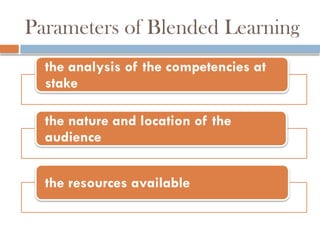
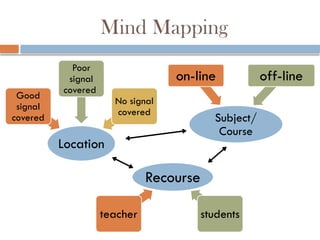
BLENDED LEARNING
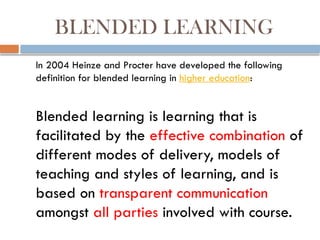
In 2004Heinze and Procter have developed the following
definition for blended learning in higher education:
Blended learning is learning that is
facilitated by the effective combination of
different modes of delivery, models of
teaching and styles of learning, and is
based on transparent communication
amongst all parties involved with course.
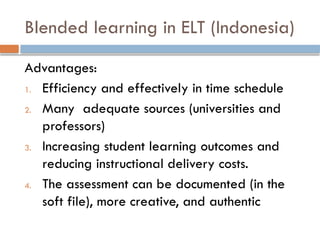
Blended learning inELT (Indonesia)
Advantages:
1. Efficiency and effectively in time schedule
2. Many adequate sources (universities and
professors)
3. Increasing student learning outcomes and
reducing instructional delivery costs.
4. The assessment can be documented (in the
soft file), more creative, and authentic
8.
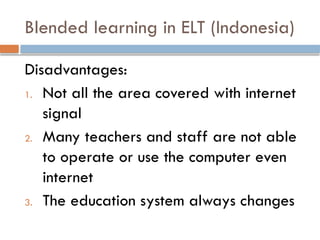
Blended learning inELT (Indonesia)
Disadvantages:
1. Not all the area covered with internet
signal
2. Many teachers and staff are not able
to operate or use the computer even
internet
3. The education system always changes
9.
Blended learning inELT (Indonesia)
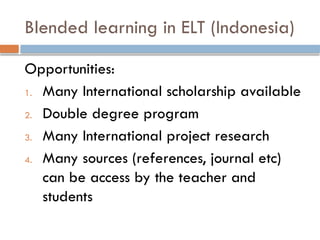
Opportunities:
1. Many International scholarship available
2. Double degree program
3. Many International project research
4. Many sources (references, journal etc)
can be access by the teacher and
students
10.
Blended learning inELT (Indonesia)
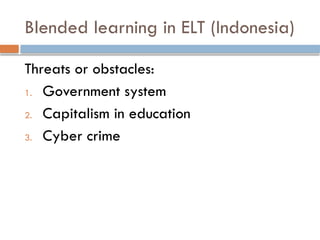
Threats or obstacles:
1. Government system
2. Capitalism in education
3. Cyber crime
11.
Blended learning inELT (Indonesia)
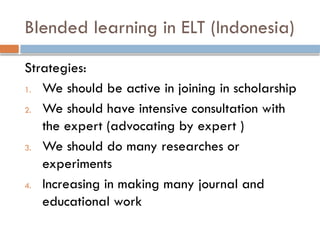
Strategies:
1. We should be active in joining in scholarship
2. We should have intensive consultation with
the expert (advocating by expert )
3. We should do many researches or
experiments
4. Increasing in making many journal and
educational work