Investing Fundamentals -arti pradhan
Learning Objectives Describe why you should establish an investment program Assess how safety, risk, income, growth and liquidity affect your investment decisions Explain how asset allocation and different investments alternatives affect your investment plan Recognize the importance of your role in a personal investment program Use various sources of financial information that can reduce risks and increase investment returns
Preparing for an Investment Program   Objective 1:  Describe why you should establish an investment program ESTABLISHING INVESTMENT GOALS -- accumulating retirement funds -- enhancing current income -- saving for major expenditures -- sheltering income from taxes
Preparing for an Investment Program Objective 1:  Describe why you should establish an investment program ESTABLISHING INVESTMENT GOALS Financial goals should be specific and measurable. To develop your goals ask yourself. . .  What will you use the money for? How much will you need for your goals? How will you obtain the money? How long will it take you to obtain the money? How much risk are you willing to assume in an investment program?
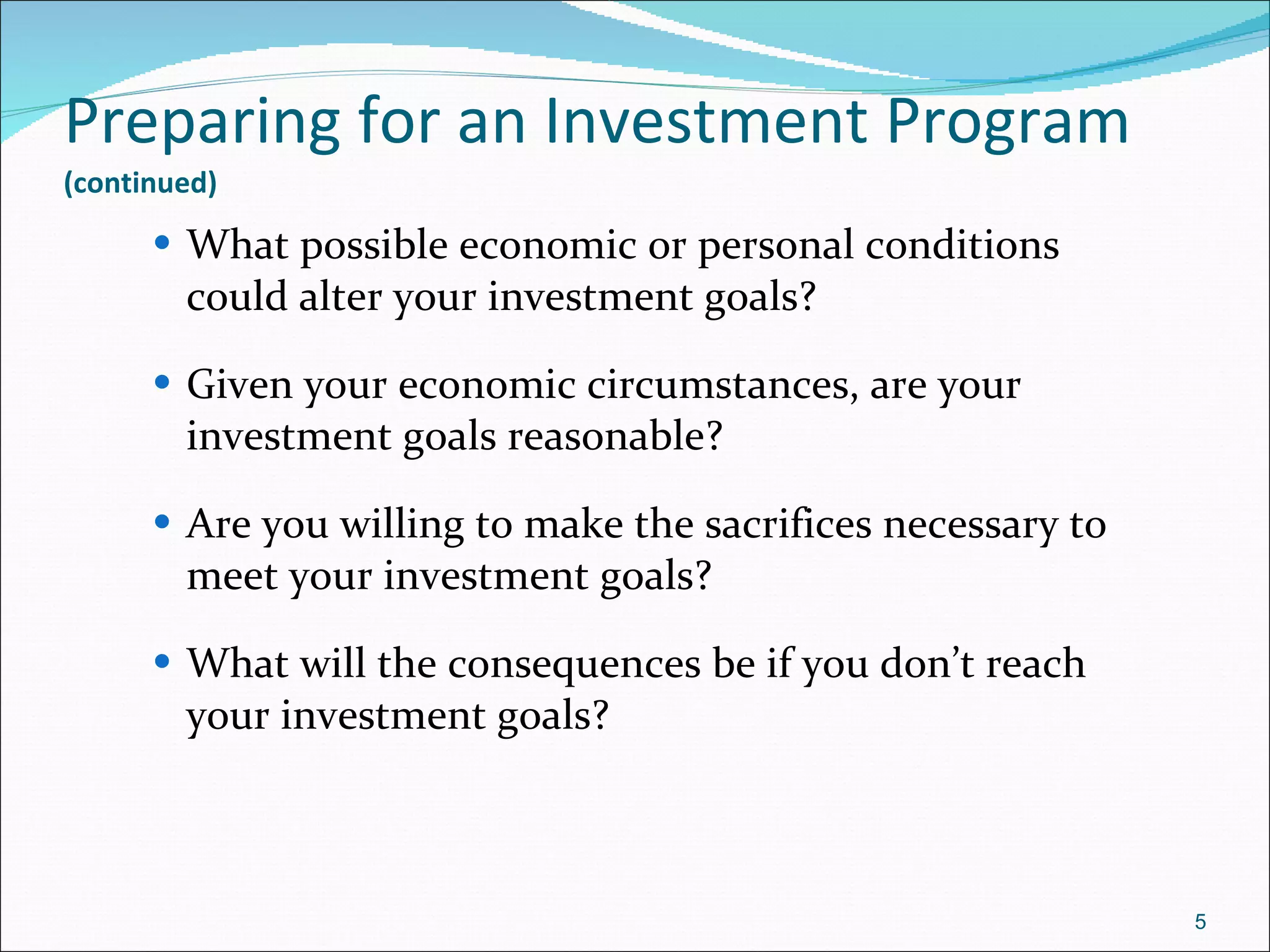
Preparing for an Investment Program   (continued) What possible economic or personal conditions could alter your investment goals? Given your economic circumstances, are your investment goals reasonable? Are you willing to make the sacrifices necessary to meet your investment goals? What will the consequences be if you don’t reach your investment goals?
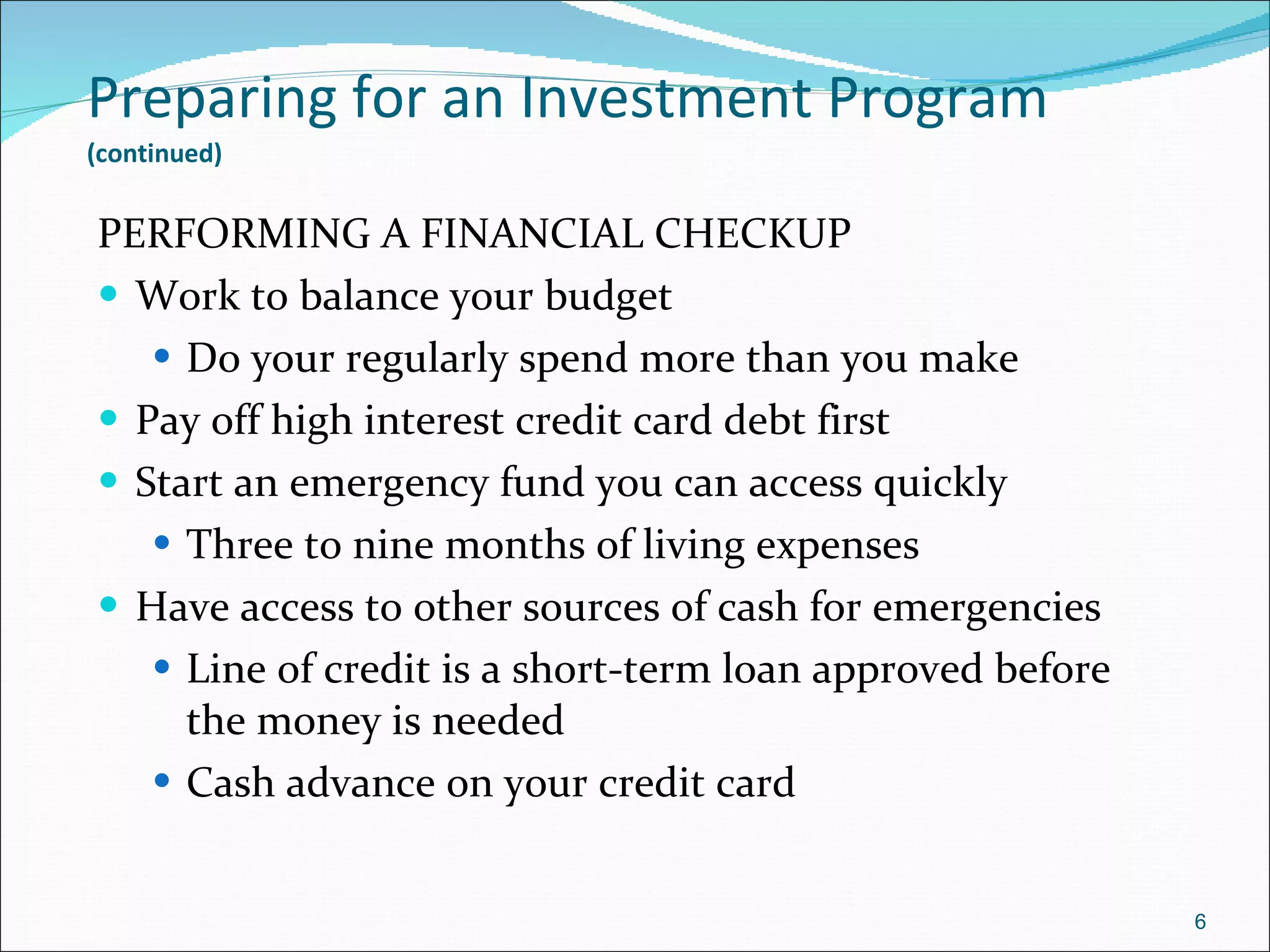
Preparing for an Investment Program   (continued)   PERFORMING A FINANCIAL CHECKUP Work to balance your budget Do your regularly spend more than you make Pay off high interest credit card debt first Start an emergency fund you can access quickly Three to nine months of living expenses Have access to other sources of cash for emergencies Line of credit is a short-term loan approved before the money is needed Cash advance on your credit card
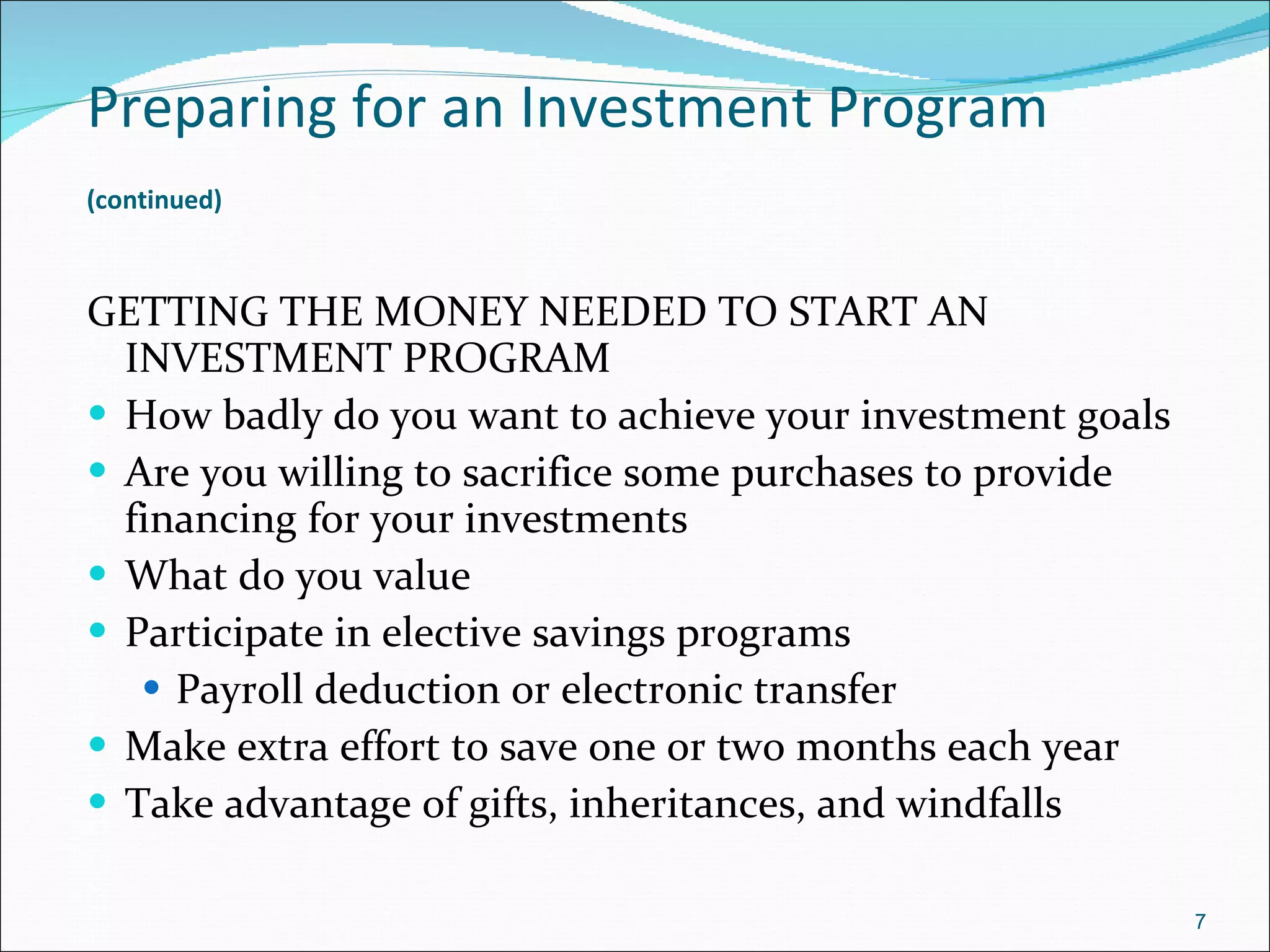
Preparing for an Investment Program   (continued)   GETTING THE MONEY NEEDED TO START AN INVESTMENT PROGRAM How badly do you want to achieve your investment goals Are you willing to sacrifice some purchases to provide financing for your investments What do you value Participate in elective savings programs Payroll deduction or electronic transfer Make extra effort to save one or two months each year Take advantage of gifts, inheritances, and windfalls
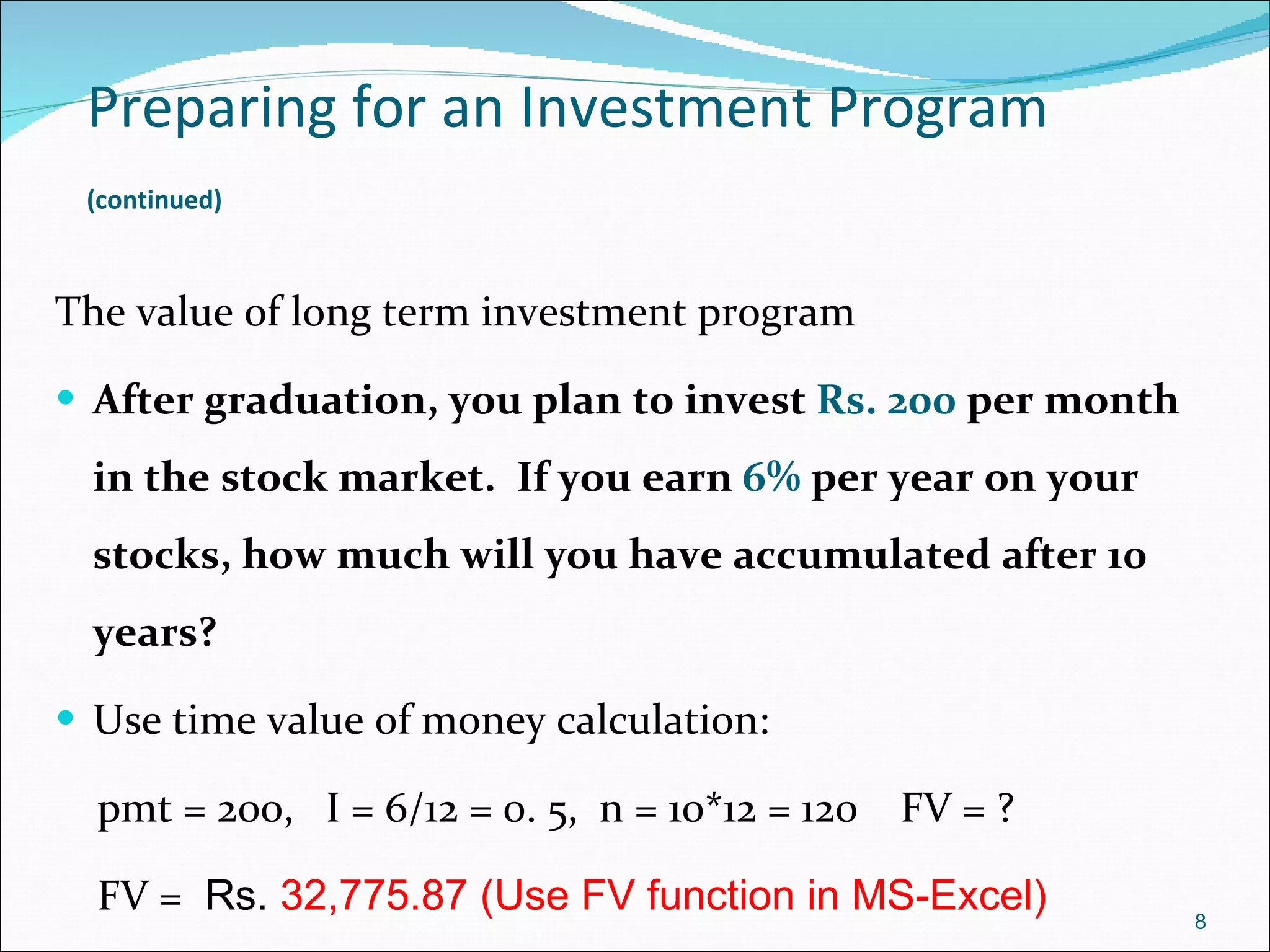
Preparing for an Investment Program   (continued)   The value of long term investment program After graduation, you plan to invest  Rs. 200  per month in the stock market.  If you earn  6%  per year on your stocks, how much will you have accumulated after 10 years? Use time value of money calculation: pmt = 200,  I = 6/12 = 0. 5,  n = 10*12 = 120  FV = ? FV =  Rs.  32,775.87 (Use FV function in MS-Excel)
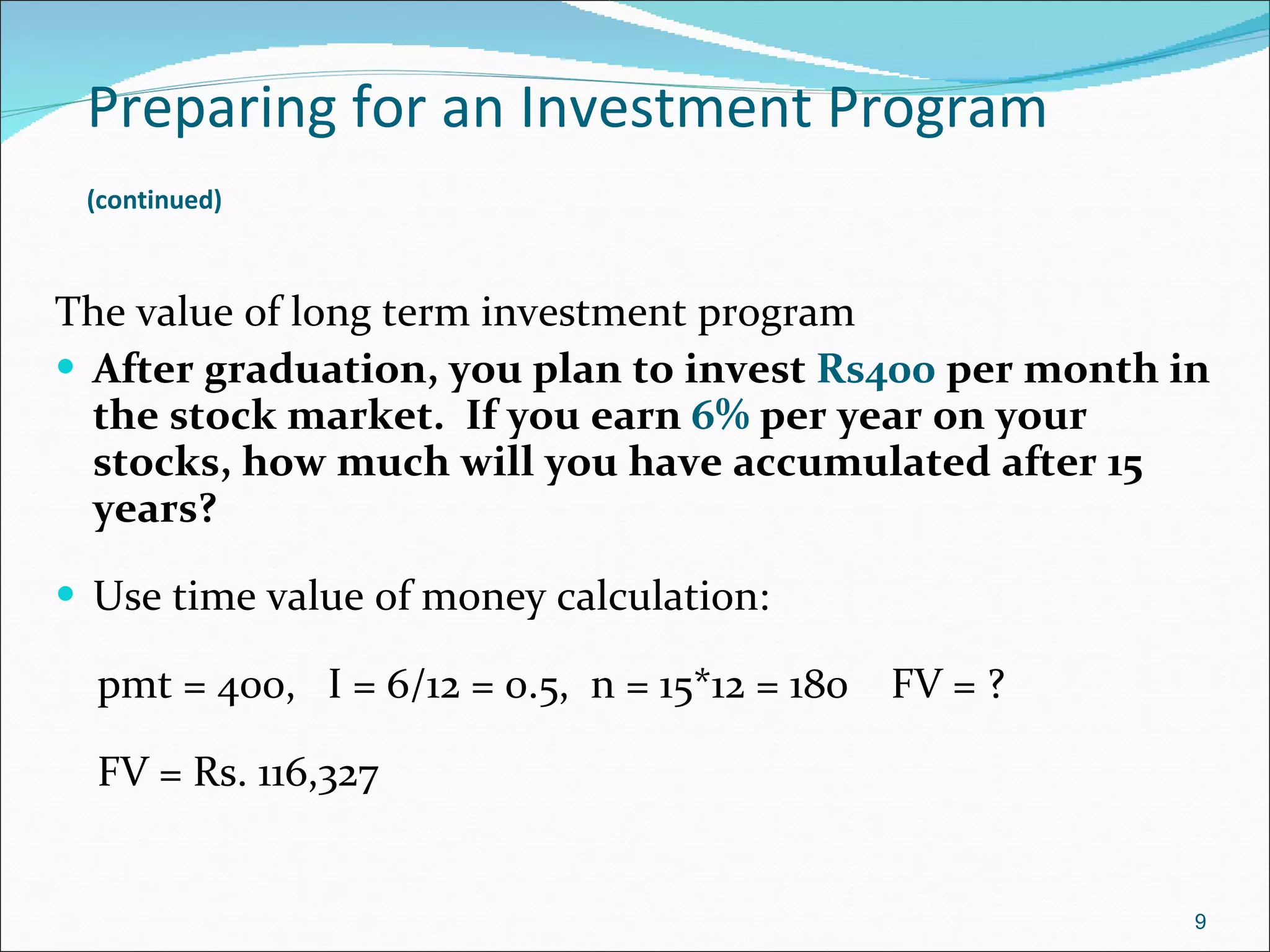
Preparing for an Investment Program   (continued)   The value of long term investment program After graduation, you plan to invest  Rs400  per month in the stock market.  If you earn  6%  per year on your stocks, how much will you have accumulated after 15 years? Use time value of money calculation: pmt = 400,  I = 6/12 = 0.5,  n = 15*12 = 180  FV = ? FV = Rs. 116,327
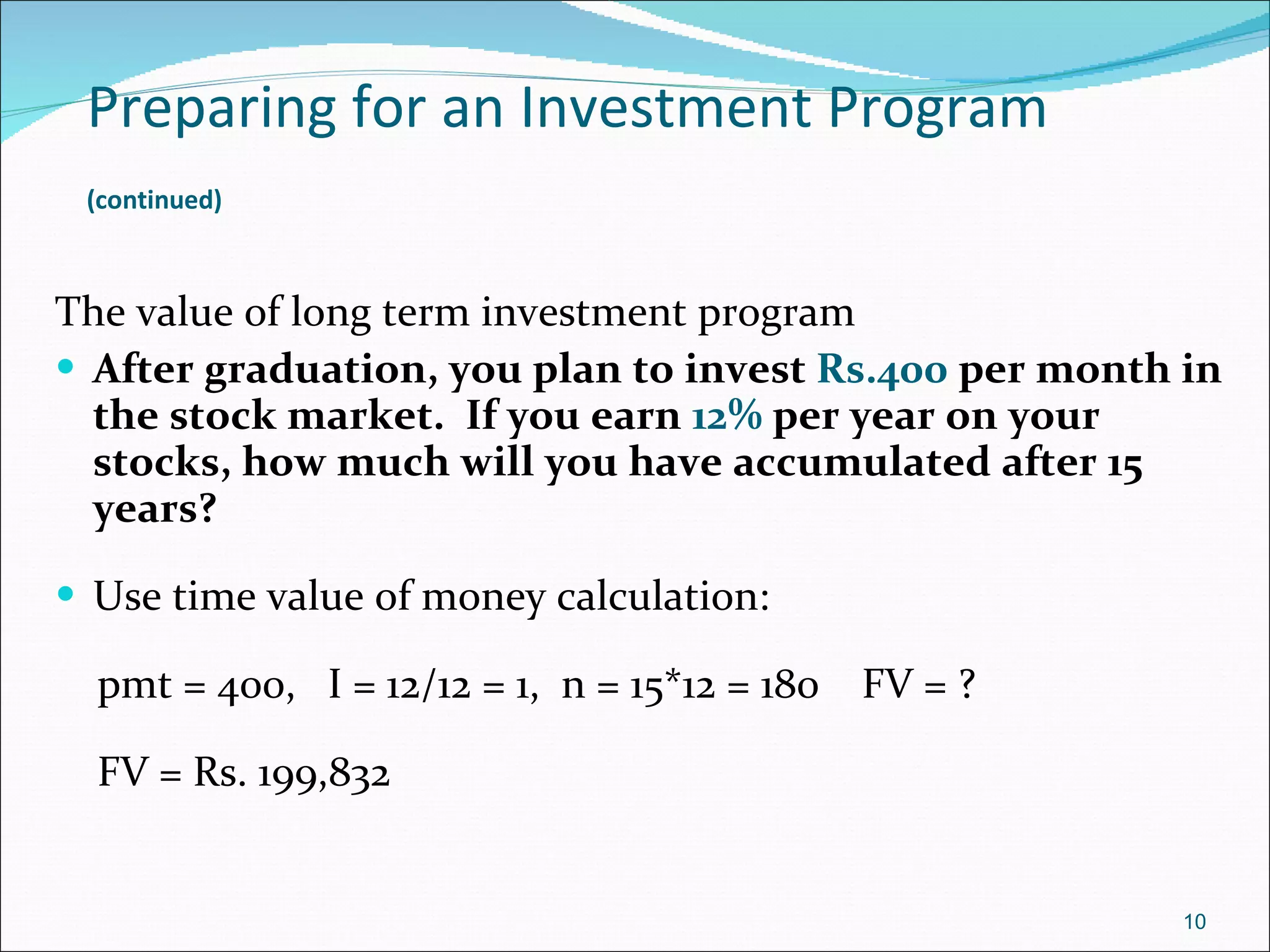
Preparing for an Investment Program   (continued)   The value of long term investment program After graduation, you plan to invest  Rs.400  per month in the stock market.  If you earn  12%  per year on your stocks, how much will you have accumulated after 15 years? Use time value of money calculation: pmt = 400,  I = 12/12 = 1,  n = 15*12 = 180  FV = ? FV = Rs. 199,832
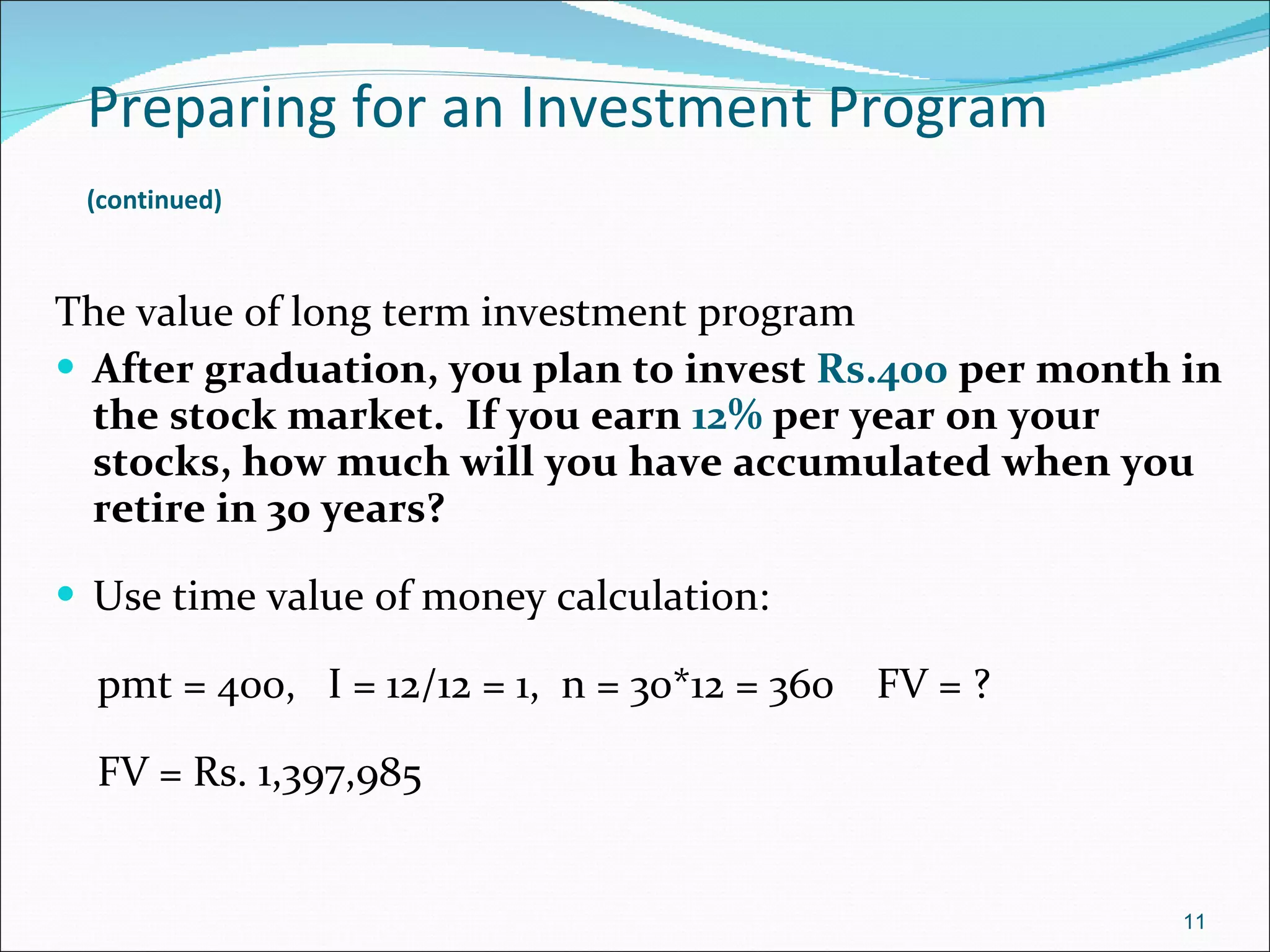
Preparing for an Investment Program   (continued)   The value of long term investment program After graduation, you plan to invest  Rs.400  per month in the stock market.  If you earn  12%  per year on your stocks, how much will you have accumulated when you retire in 30 years? Use time value of money calculation: pmt = 400,  I = 12/12 = 1,  n = 30*12 = 360  FV = ? FV = Rs. 1,397,985
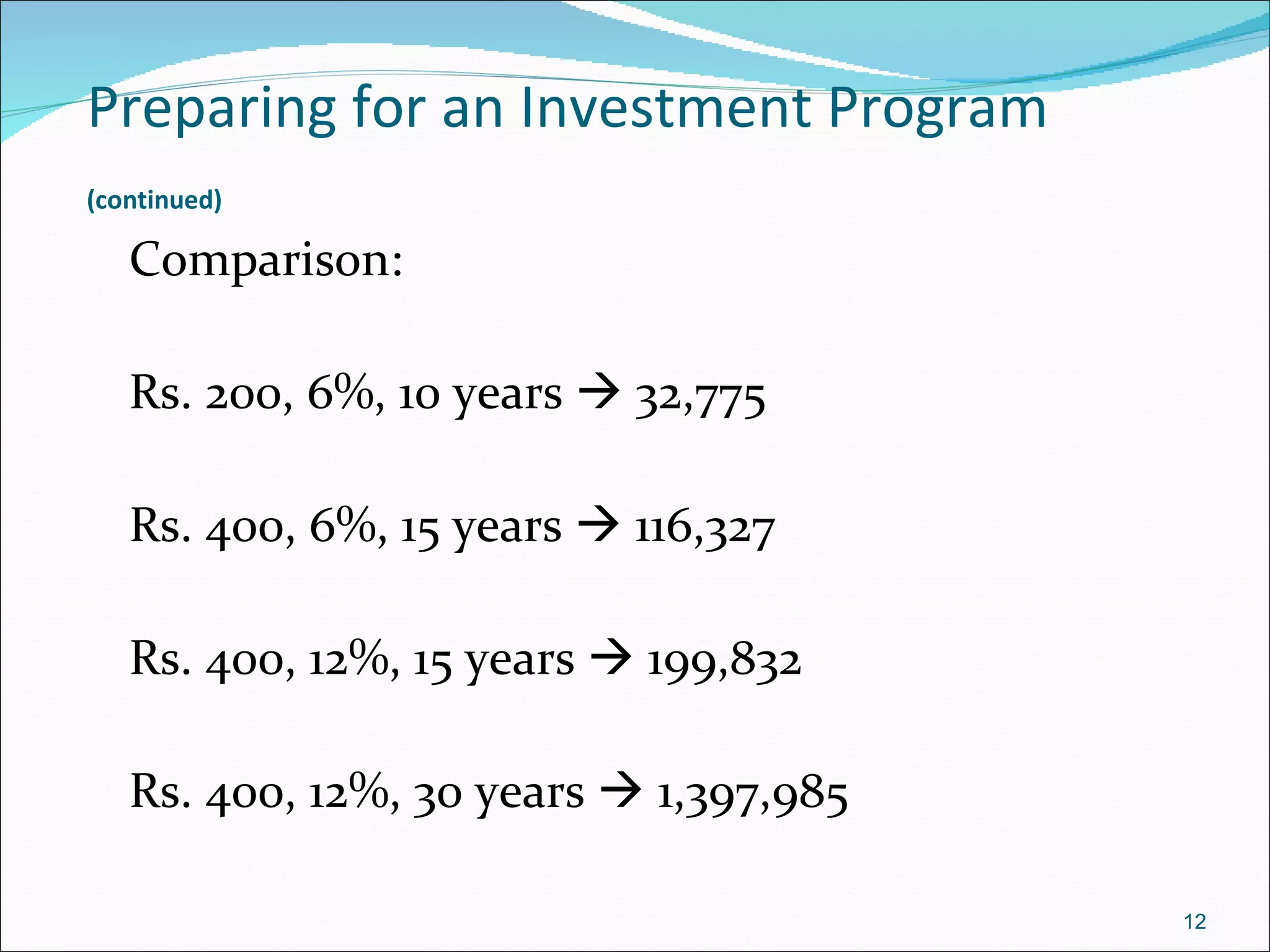
Preparing for an Investment Program   (continued)   Comparison: Rs. 200, 6%, 10 years    32,775 Rs. 400, 6%, 15 years    116,327 Rs. 400, 12%, 15 years    199,832 Rs. 400, 12%, 30 years    1,397,985
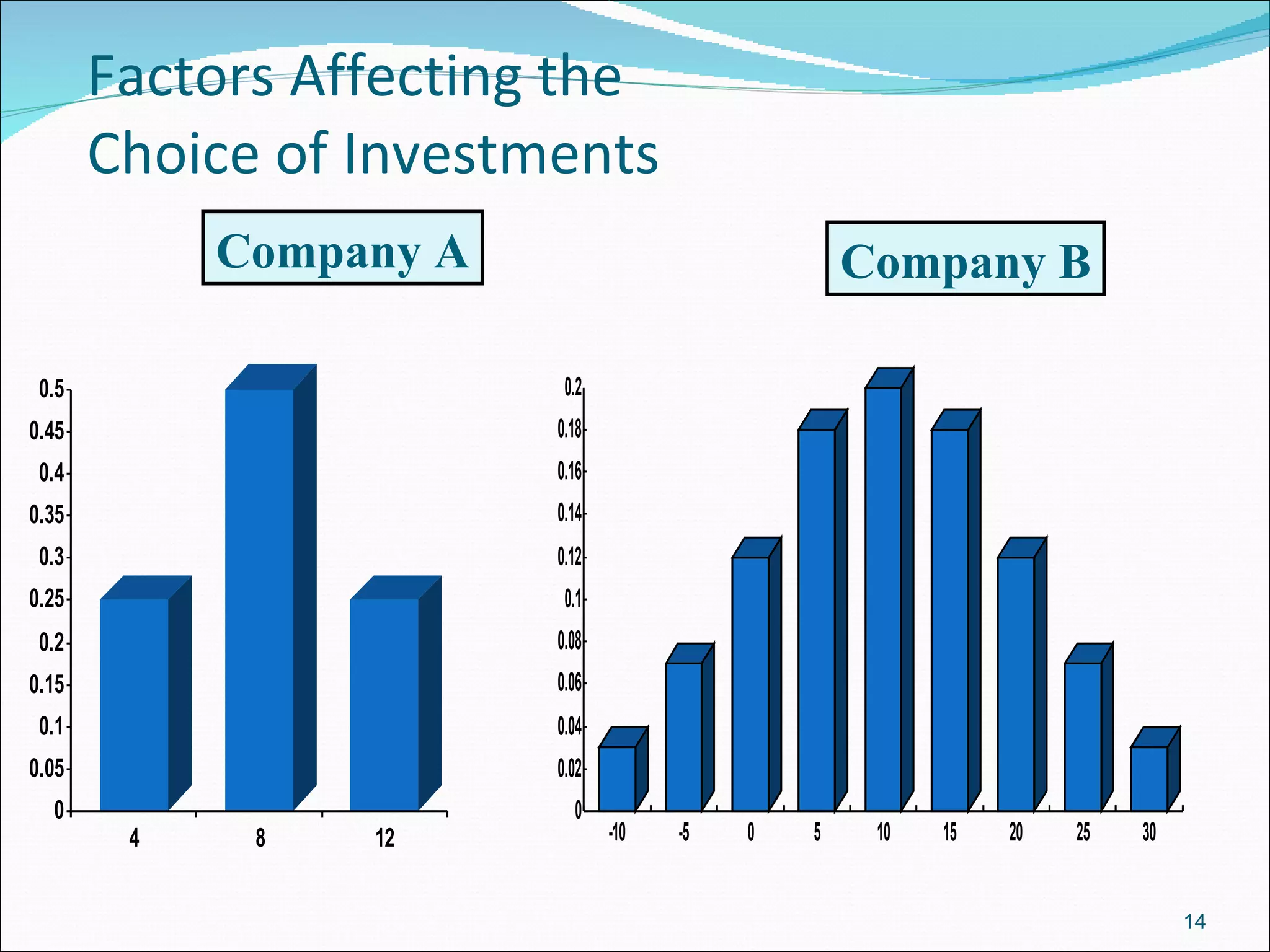
Factors Affecting the  Choice of Investments Objective 2:  Assess how safety, risk, income, growth, and liquidity affect your investment decisions Safety and risk Safety in any investment means minimal risk of loss Risk means a measure of uncertainty about the outcome
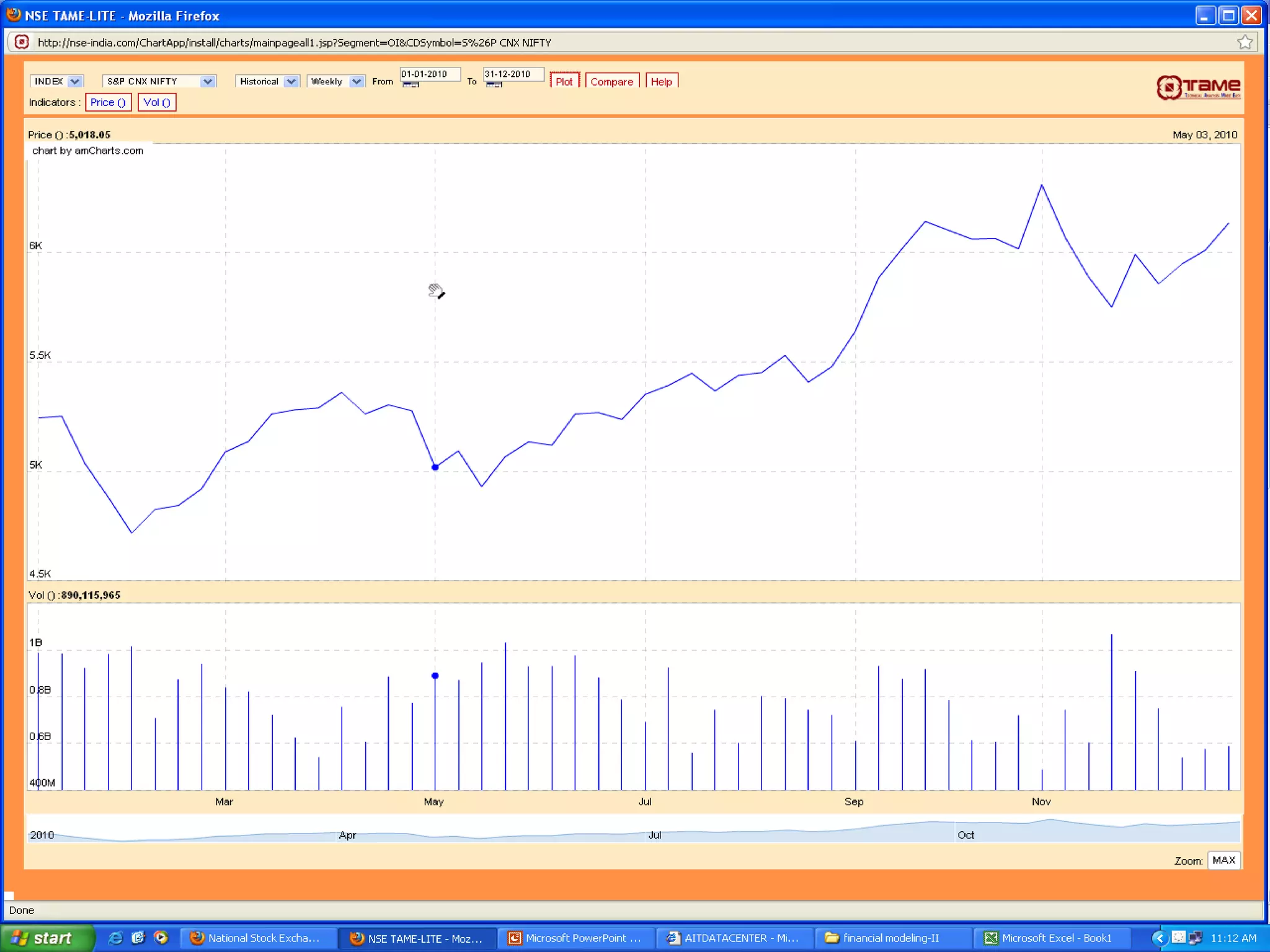
Factors Affecting the  Choice of Investments Company A Company B
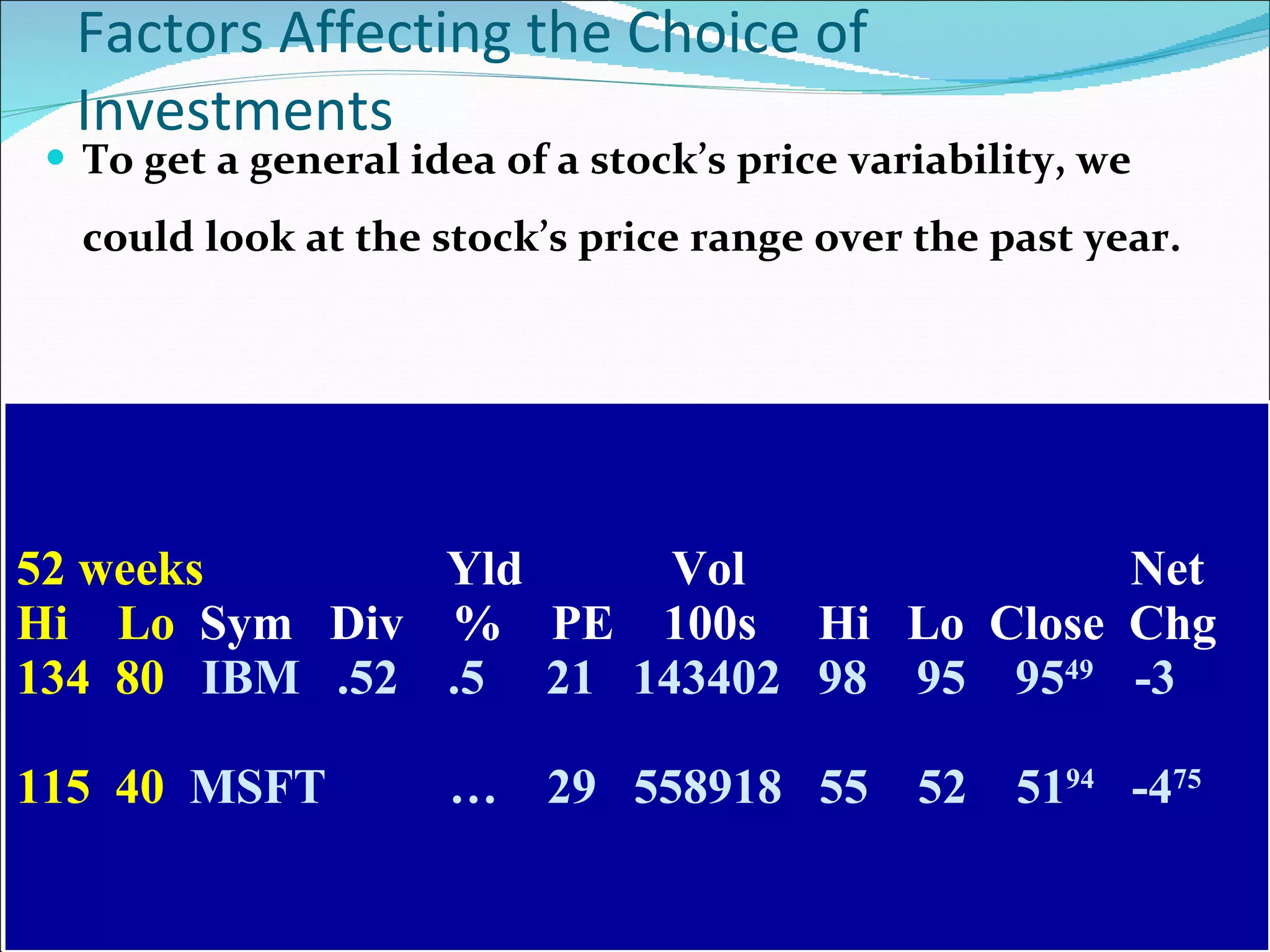
Factors Affecting the Choice of Investments To get a general idea of a stock’s price variability, we could look at the stock’s price range over the past year. 52 weeks     Yld   Vol   Net Hi  Lo   Sym  Div  %  PE  100s  Hi  Lo  Close  Chg 134  80   IBM  .52  .5  21  143402  98  95  95 49  -3 115  40   MSFT  …  29  558918  55  52  51 94   -4 75
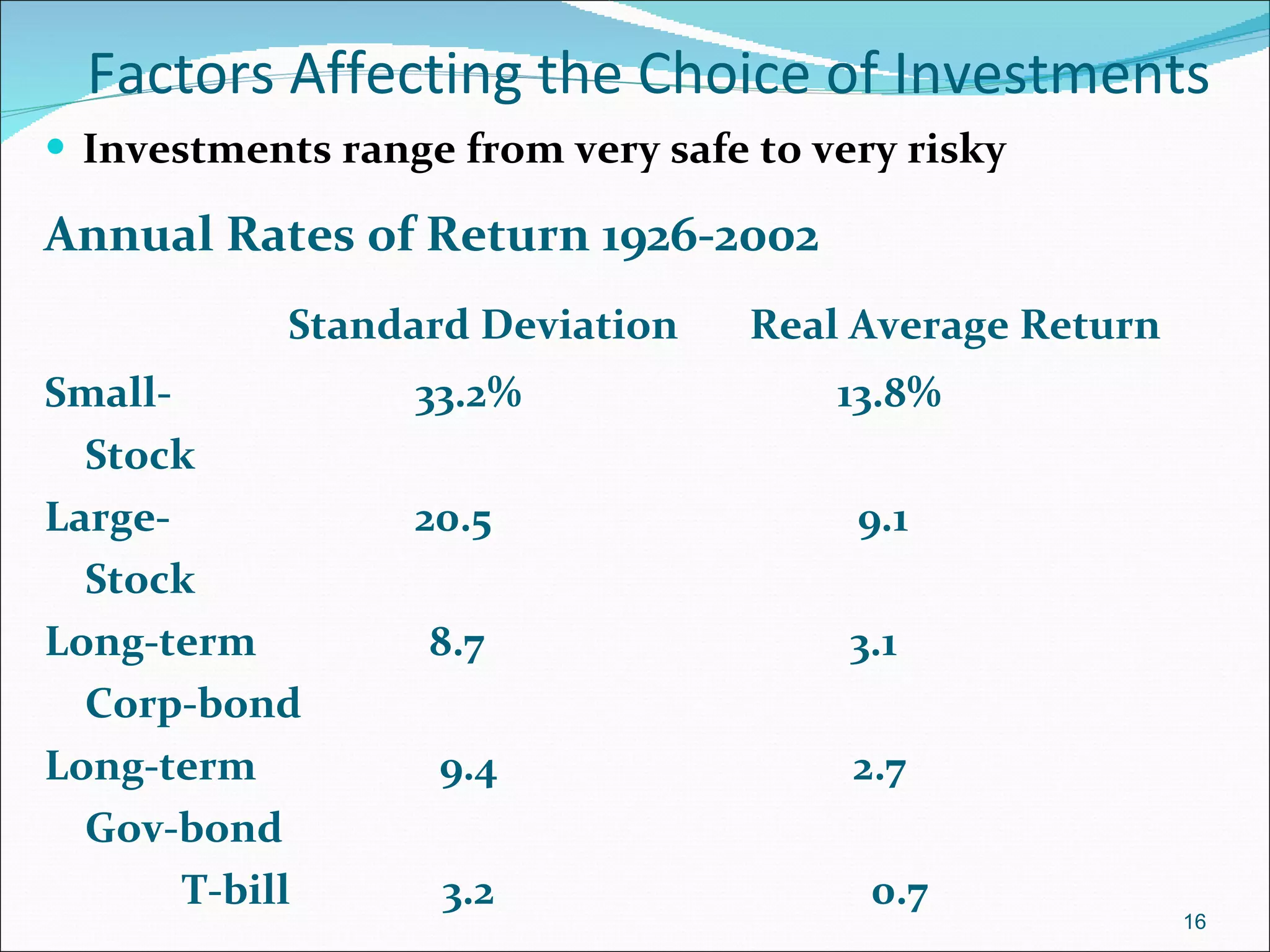
Factors Affecting the Choice of Investments Investments range from very safe to very risky Annual Rates of Return 1926-2002   Standard Deviation  Real Average Return Small-  33.2%  13.8% Stock  Large-  20.5  9.1 Stock Long-term  8.7  3.1 Corp-bond  Long-term  9.4  2.7 Gov-bond    T-bill  3.2  0.7
Factors Affecting the  Choice of Investments The potential return on any investment should be directly related to the risk the investor assumes  Speculative investments are high risk The Risk-Return Trade-Off
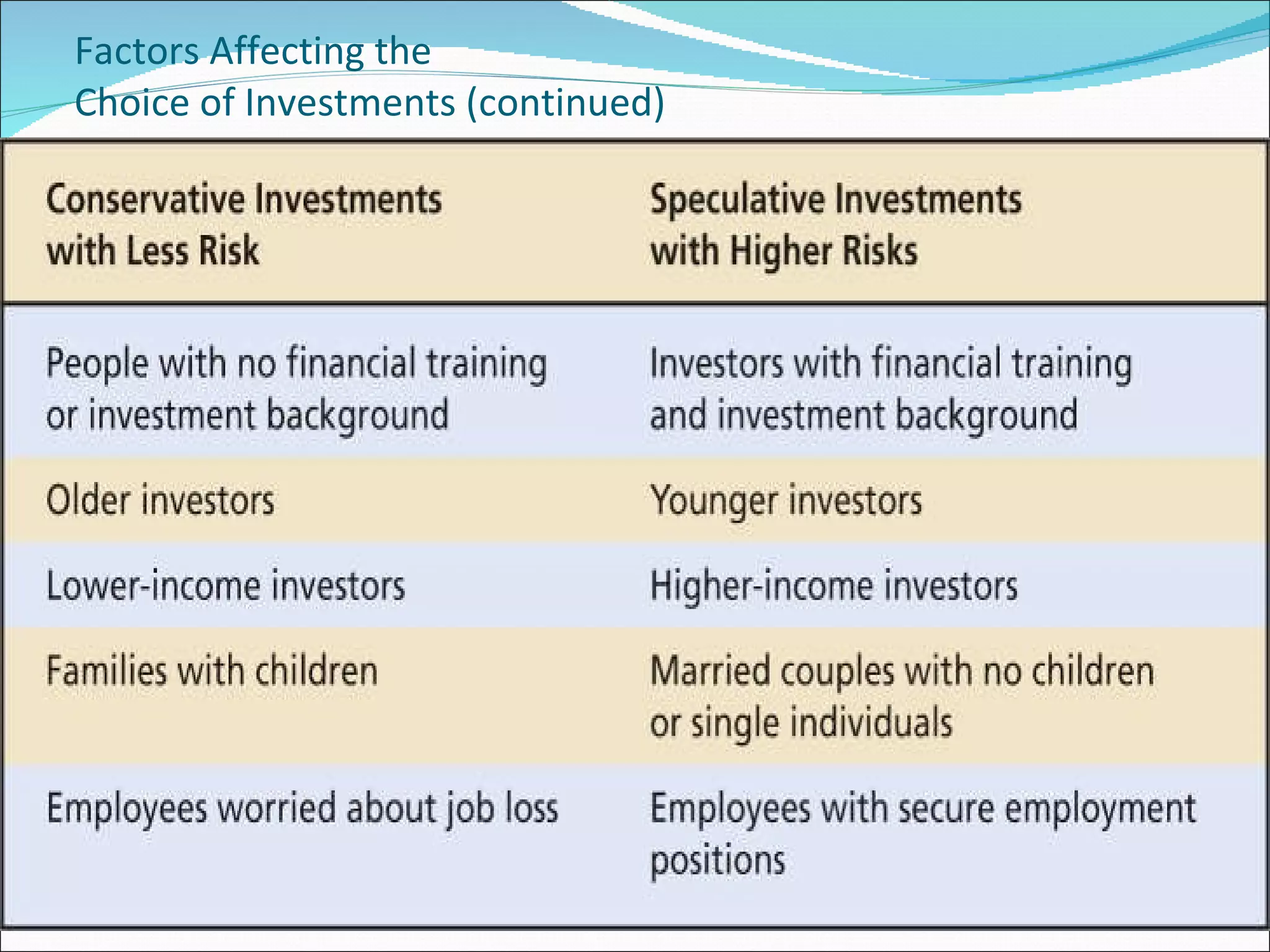
Factors Affecting the  Choice of Investments (continued)
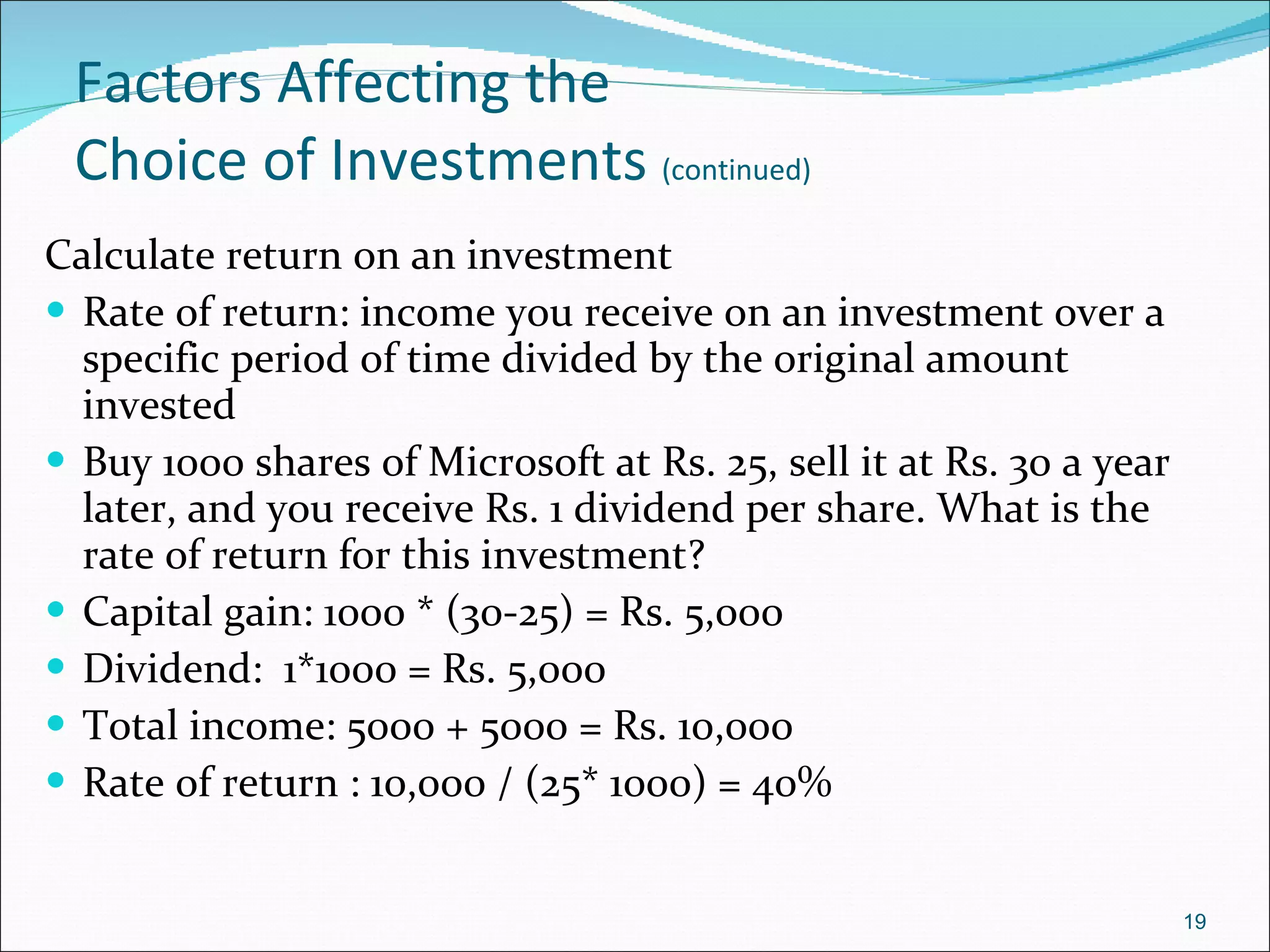
Factors Affecting the  Choice of Investments  (continued) Calculate return on an investment Rate of return: income you receive on an investment over a specific period of time divided by the original amount invested Buy 1000 shares of Microsoft at Rs. 25, sell it at Rs. 30 a year later, and you receive Rs. 1 dividend per share. What is the rate of return for this investment? Capital gain: 1000 * (30-25) = Rs. 5,000 Dividend:  1*1000 = Rs. 5,000 Total income: 5000 + 5000 = Rs. 10,000 Rate of return : 10,000 / (25* 1000) = 40%
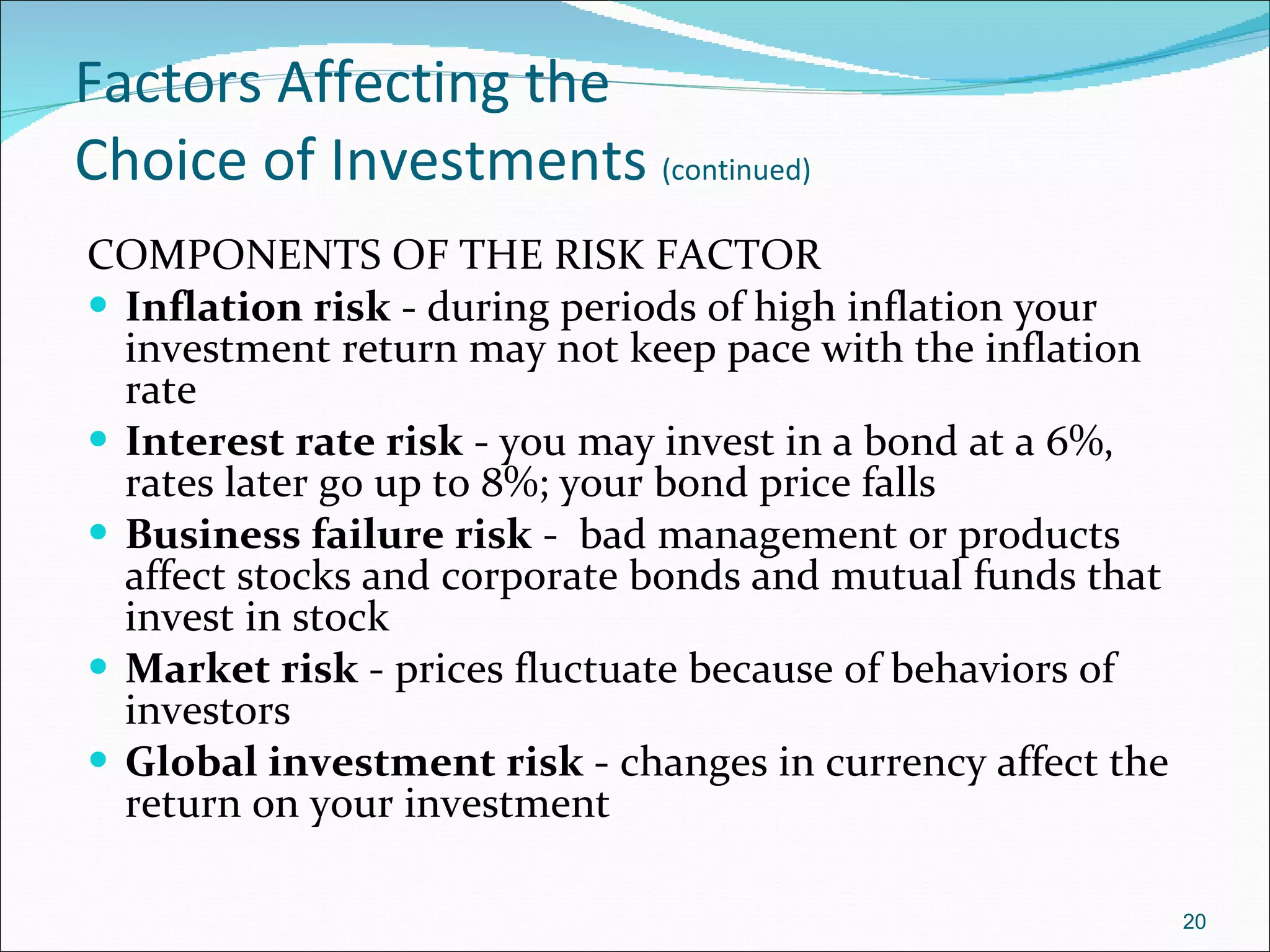
Factors Affecting the  Choice of Investments  (continued) COMPONENTS OF THE RISK FACTOR Inflation risk  - during periods of high inflation your investment return may not keep pace with the inflation rate Interest rate risk  - you may invest in a bond at a 6%, rates later go up to 8%; your bond price falls Business failure risk  -  bad management or products affect stocks and corporate bonds and mutual funds that invest in stock Market risk  - prices fluctuate because of behaviors of investors Global investment risk  - changes in currency affect the return on your investment
Factors Affecting the  Choice of Investments  (continued) INVESTMENT INCOME Safest investments – predictable income Savings accounts and certificates of deposit savings bonds treasury bills (if available) Higher potential income investments include… Corporate bonds Preferred stocks and income common stocks Income mutual funds Real estate rental property
Factors Affecting the  Choice of Investments  (continued) INVESTMENT GROWTH Growth means investment will increase in value Common stock Growth companies pay little or no dividends, but reinvest in the company  Mutual funds, government and corporate bonds,  and real estate offer growth potential Gemstones and collectibles - more speculative INVESTMENT LIQUIDITY Ability to buy or sell an investment quickly without substantially affecting the investment’s value; e.g. Real estate is not a very liquid investment
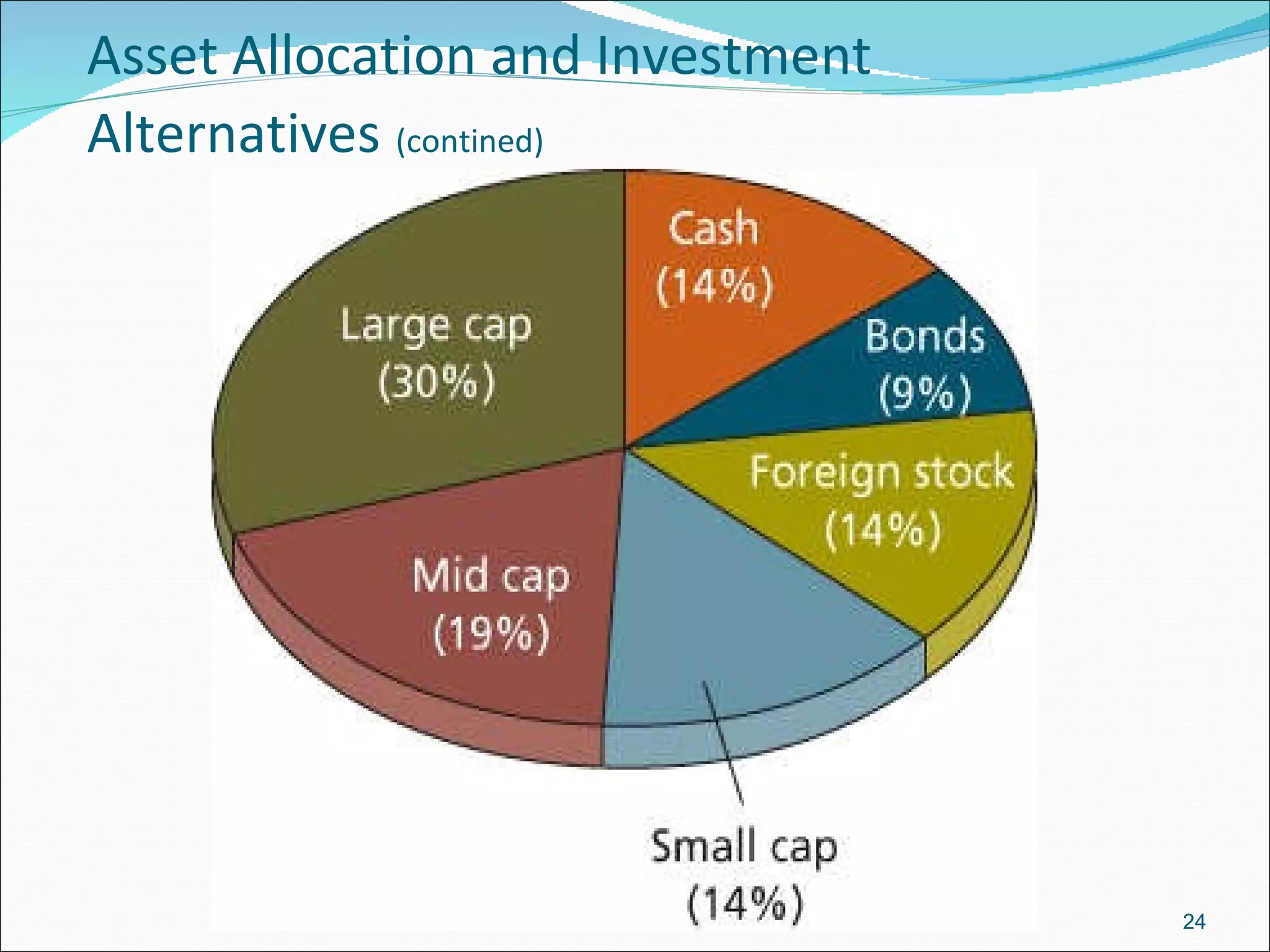
Asset Allocation and Investment Alternatives   Asset Allocation The process of placing your assets among several types of investments which lessens your investment risk Types of assets --  stocks of large corporations -- stocks of medium-sized corporations -- stocks of small companies -- foreign stocks -- bonds -- cash
Asset Allocation and Investment Alternatives   (contined)
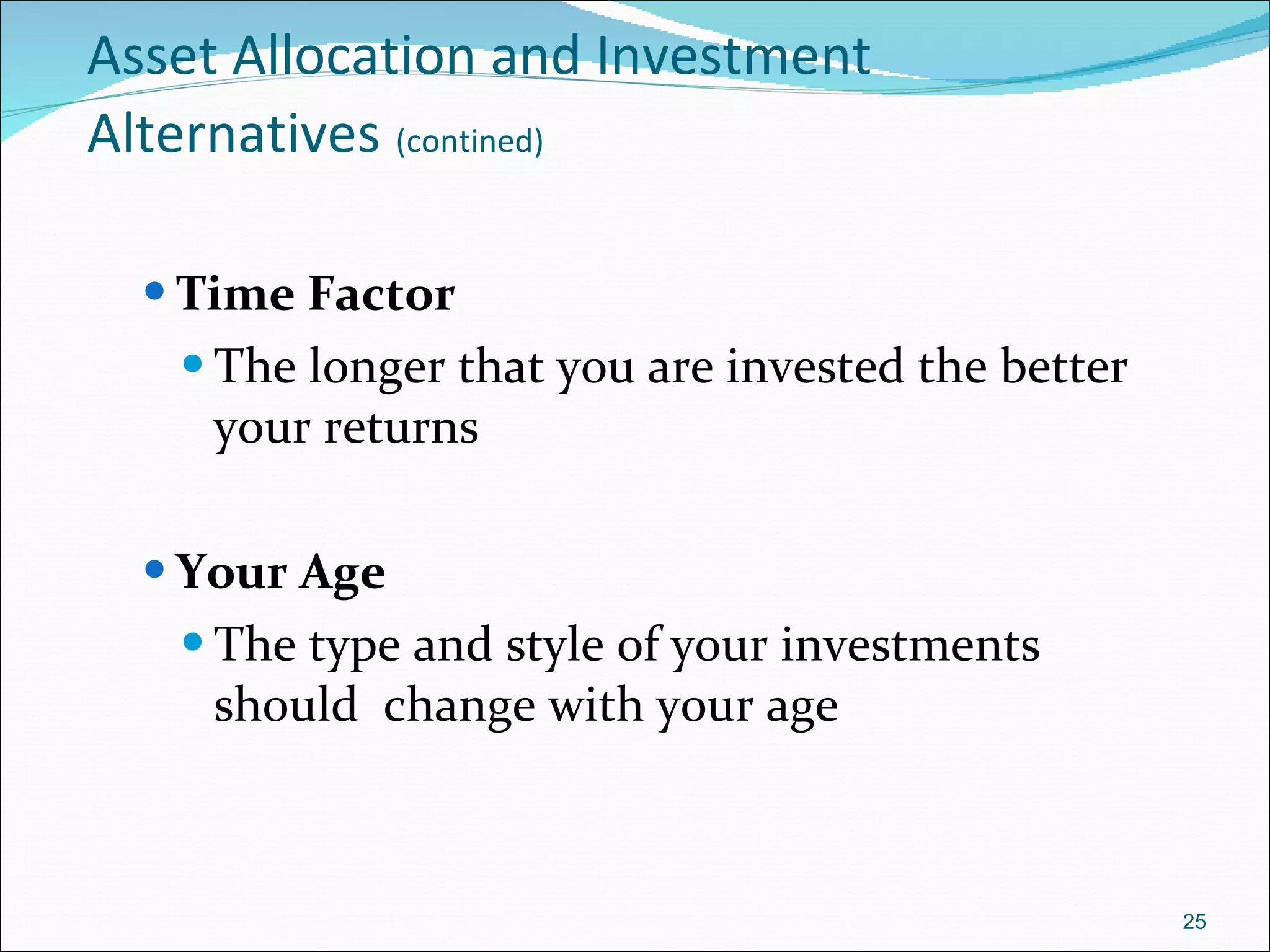
Asset Allocation and Investment Alternatives   (contined) Time Factor The longer that you are invested the better your returns  Your Age The type and style of your investments should  change with your age
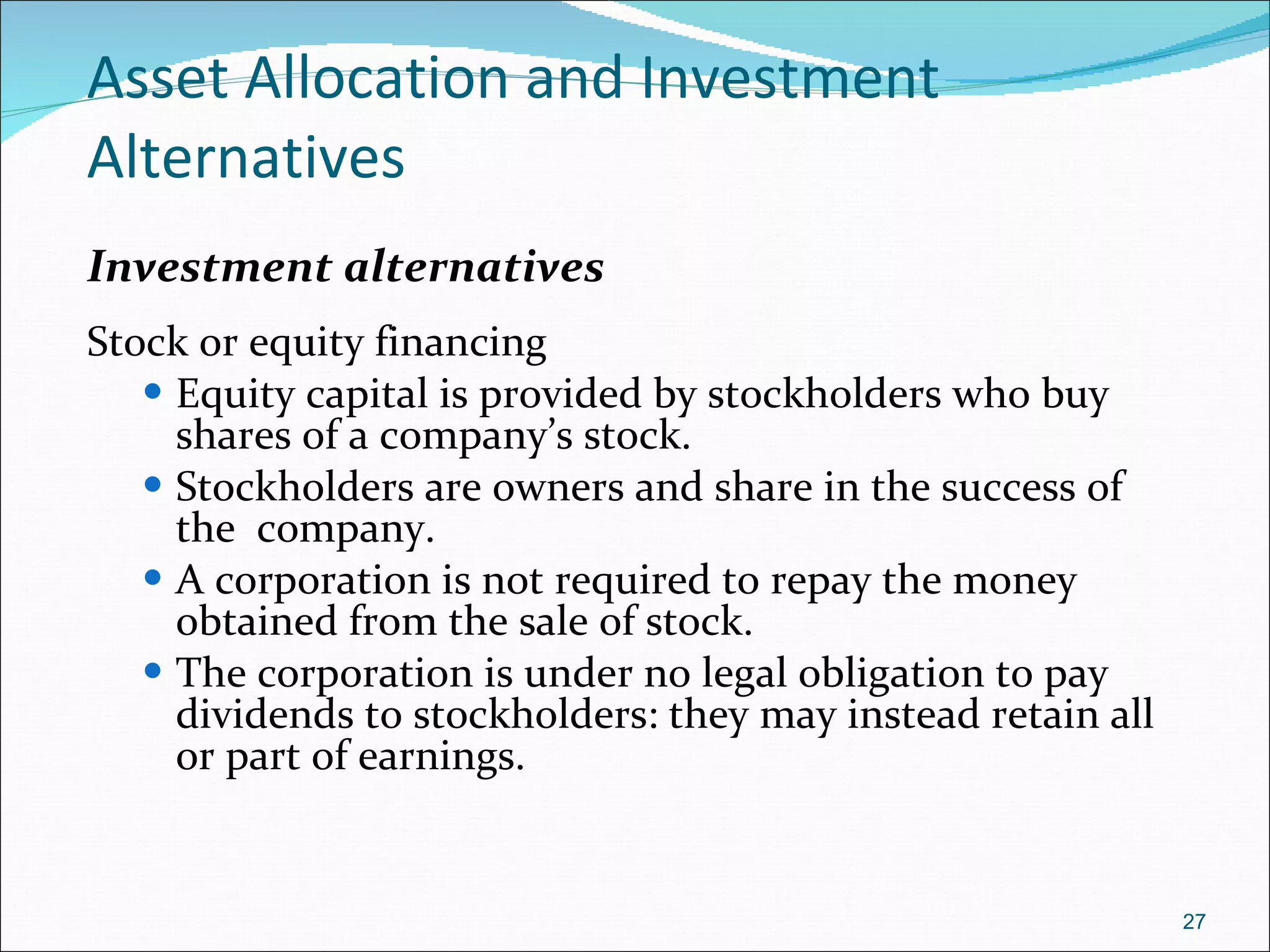
Asset Allocation and Investment Alternatives Investment alternatives Stock or equity financing Equity capital is provided by stockholders who buy shares of a company’s stock.  Stockholders are owners and share in the success of the  company. A corporation is not required to repay the money obtained from the sale of stock. The corporation is under no legal obligation to pay dividends to stockholders: they may instead retain all or part of earnings.
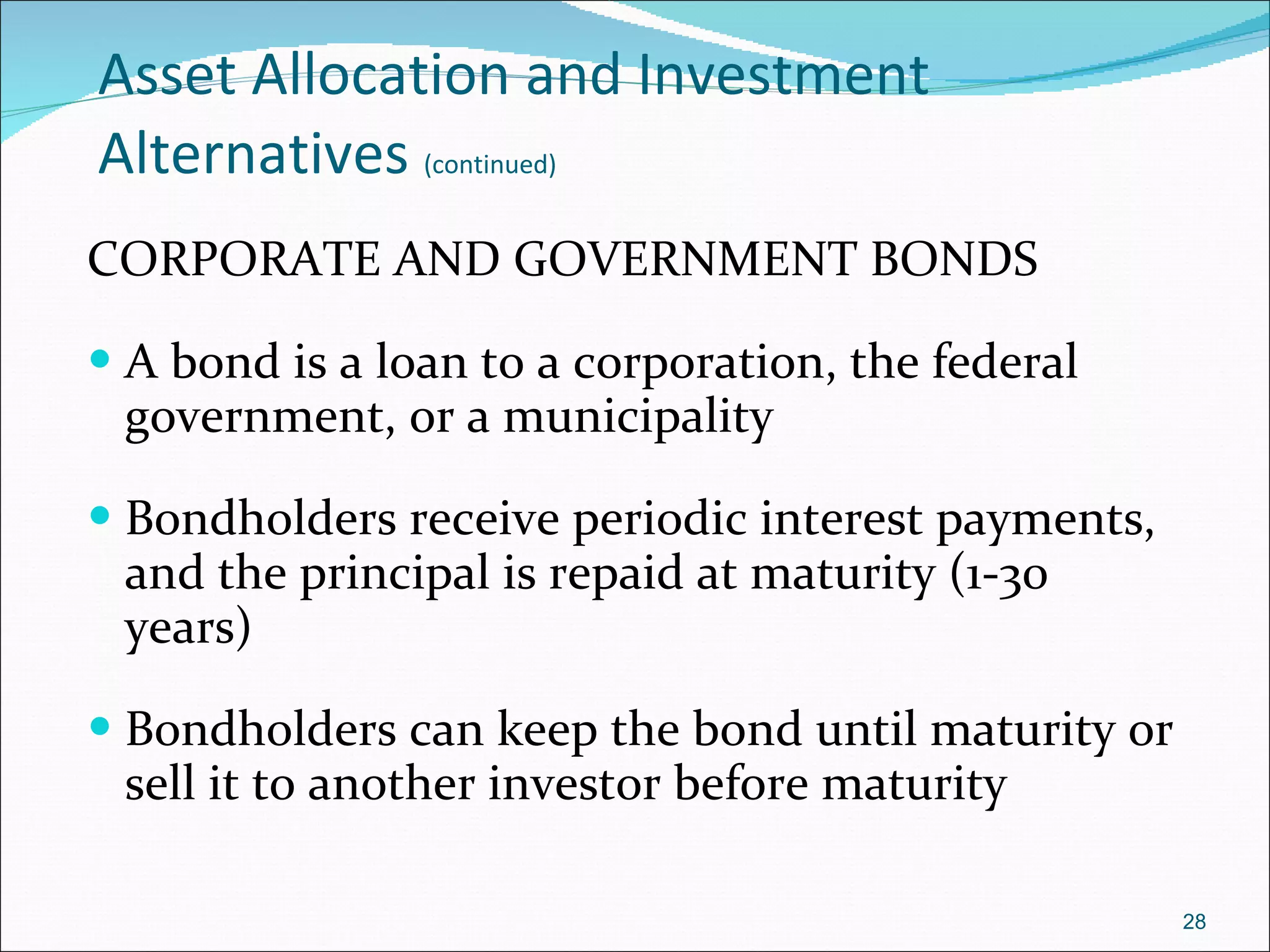
Asset Allocation and Investment Alternatives   (continued) CORPORATE AND GOVERNMENT BONDS A bond is a loan to a corporation, the federal government, or a municipality Bondholders receive periodic interest payments, and the principal is repaid at maturity (1-30 years) Bondholders can keep the bond until maturity or sell it to another investor before maturity
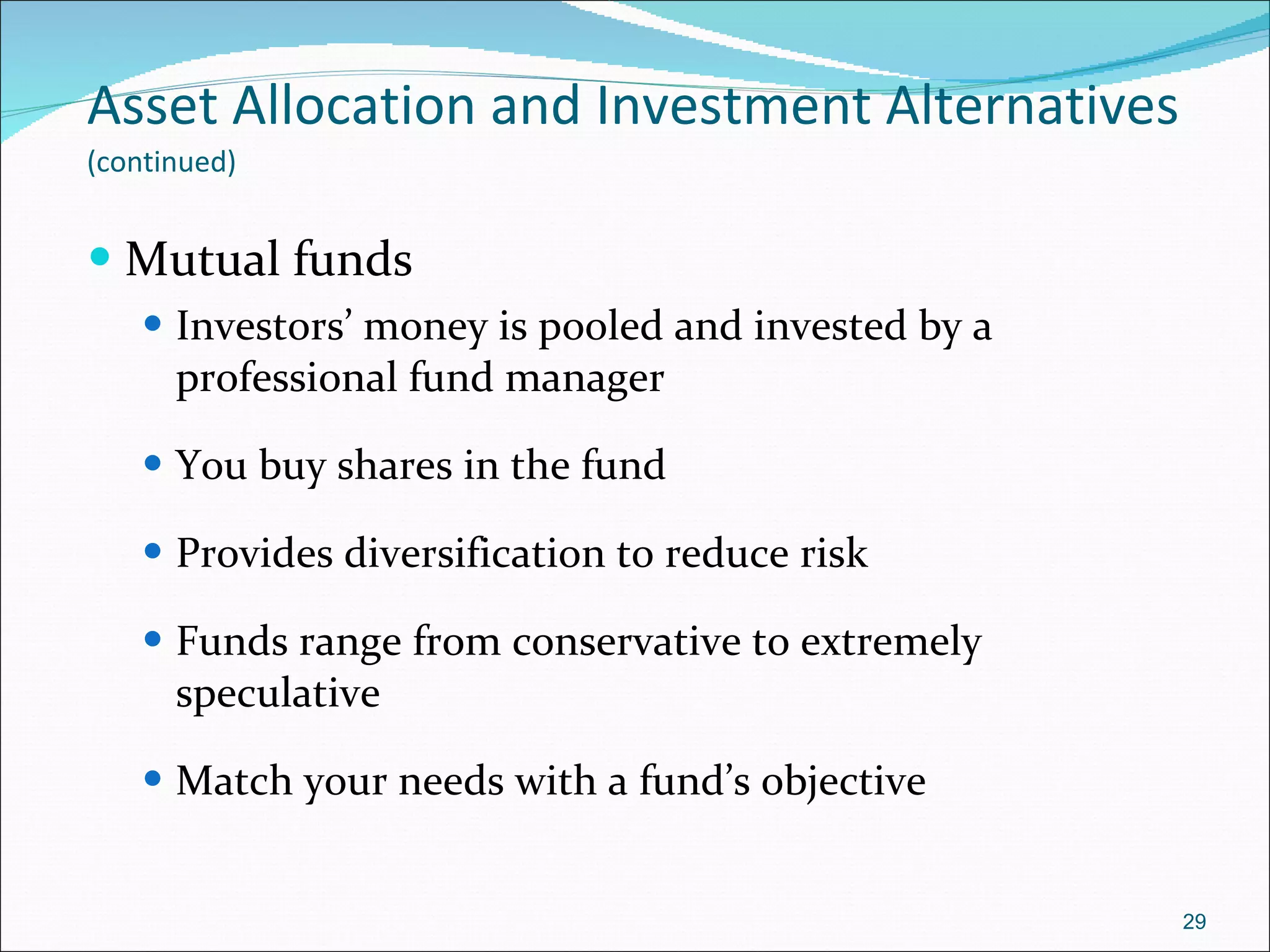
Asset Allocation and Investment Alternatives   (continued) Mutual funds Investors’ money is pooled and invested by a professional fund manager You buy shares in the fund Provides diversification to reduce risk Funds range from conservative to extremely speculative Match your needs with a fund’s objective
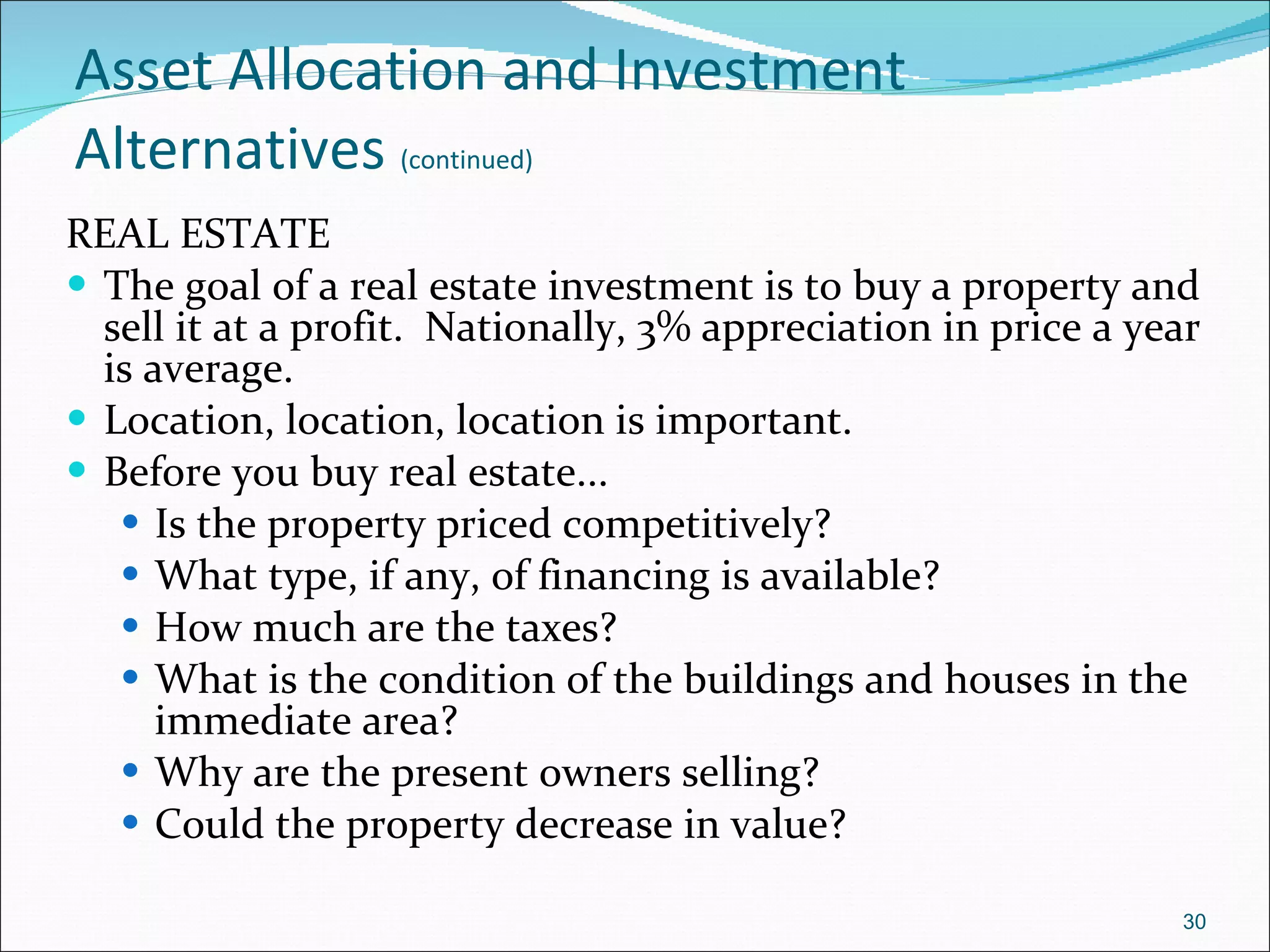
Asset Allocation and Investment Alternatives   (continued) REAL ESTATE The goal of a real estate investment is to buy a property and sell it at a profit.  Nationally, 3% appreciation in price a year is average. Location, location, location is important. Before you buy real estate... Is the property priced competitively? What type, if any, of financing is available? How much are the taxes? What is the condition of the buildings and houses in the immediate area? Why are the present owners selling? Could the property decrease in value?
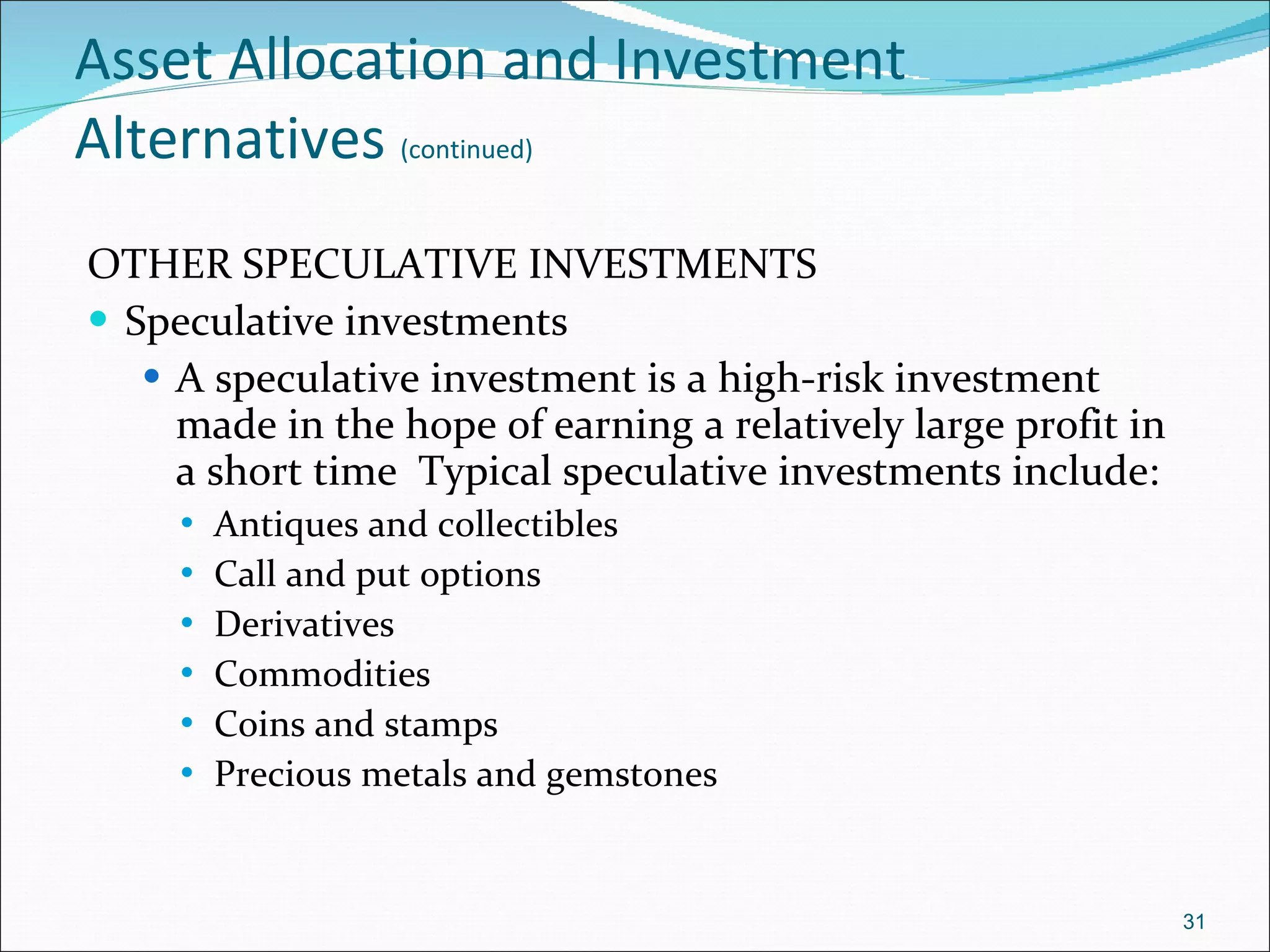
Asset Allocation and Investment Alternatives   (continued) OTHER SPECULATIVE INVESTMENTS Speculative investments A speculative investment is a high-risk investment made in the hope of earning a relatively large profit in a short time  Typical speculative investments include: Antiques and collectibles  Call and put options Derivatives Commodities Coins and stamps  Precious metals and gemstones
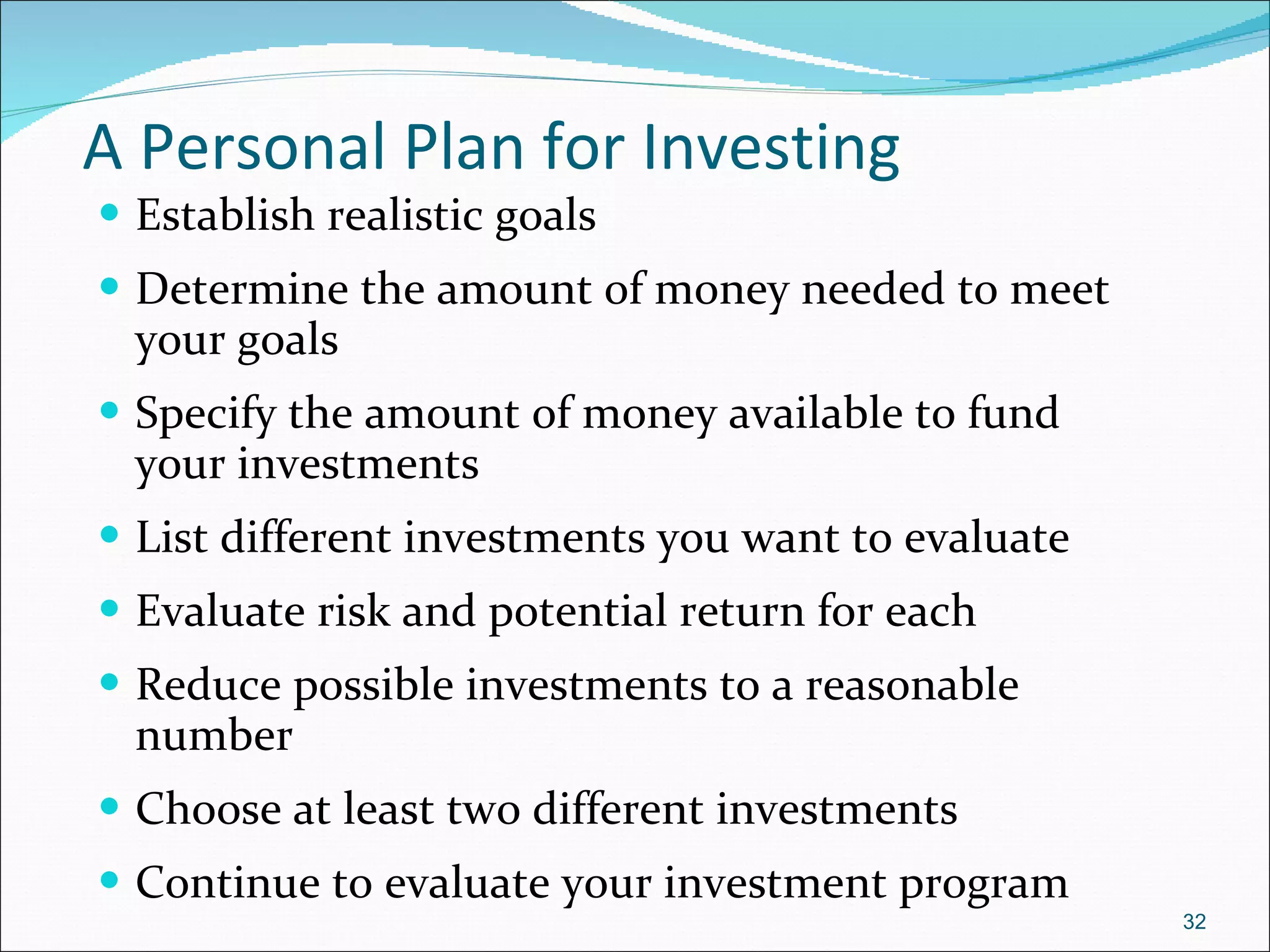
A Personal Plan for Investing   Establish realistic goals Determine the amount of money needed to meet your goals Specify the amount of money available to fund your investments List different investments you want to evaluate Evaluate risk and potential return for each Reduce possible investments to a reasonable number Choose at least two different investments Continue to evaluate your investment program
Factors that Reduce Investment Risk Objective 4:  Recognize the importance of your role in a personal investment program YOUR ROLE IN THE INVESTMENT PROCESS Evaluate potential investments Seek the assistance of a financial planner Monitor the value of your investments Keep accurate and current records Consider the tax consequences of selling your investments
Sources of Investment Information Objective 5:  Use the various sources of financial information that can reduce risks and increase the investment returns The Internet  A wealth of investment information is available View sites such as  www.money.cnn.com   Newspapers and news programs on CNN and UTV Bloomberg Watch business programs like debt to life and smart money Business periodicals such as  Smart Money  and government publications Corporate Reports Investor services and newsletters and financial calculators

Chapter ii extended

  • 1.
  • 2.
    Learning Objectives Describewhy you should establish an investment program Assess how safety, risk, income, growth and liquidity affect your investment decisions Explain how asset allocation and different investments alternatives affect your investment plan Recognize the importance of your role in a personal investment program Use various sources of financial information that can reduce risks and increase investment returns
  • 3.
    Preparing for anInvestment Program Objective 1: Describe why you should establish an investment program ESTABLISHING INVESTMENT GOALS -- accumulating retirement funds -- enhancing current income -- saving for major expenditures -- sheltering income from taxes
  • 4.
    Preparing for anInvestment Program Objective 1: Describe why you should establish an investment program ESTABLISHING INVESTMENT GOALS Financial goals should be specific and measurable. To develop your goals ask yourself. . . What will you use the money for? How much will you need for your goals? How will you obtain the money? How long will it take you to obtain the money? How much risk are you willing to assume in an investment program?
  • 5.
    Preparing for anInvestment Program (continued) What possible economic or personal conditions could alter your investment goals? Given your economic circumstances, are your investment goals reasonable? Are you willing to make the sacrifices necessary to meet your investment goals? What will the consequences be if you don’t reach your investment goals?
  • 6.
    Preparing for anInvestment Program (continued) PERFORMING A FINANCIAL CHECKUP Work to balance your budget Do your regularly spend more than you make Pay off high interest credit card debt first Start an emergency fund you can access quickly Three to nine months of living expenses Have access to other sources of cash for emergencies Line of credit is a short-term loan approved before the money is needed Cash advance on your credit card
  • 7.
    Preparing for anInvestment Program (continued) GETTING THE MONEY NEEDED TO START AN INVESTMENT PROGRAM How badly do you want to achieve your investment goals Are you willing to sacrifice some purchases to provide financing for your investments What do you value Participate in elective savings programs Payroll deduction or electronic transfer Make extra effort to save one or two months each year Take advantage of gifts, inheritances, and windfalls
  • 8.
    Preparing for anInvestment Program (continued) The value of long term investment program After graduation, you plan to invest Rs. 200 per month in the stock market. If you earn 6% per year on your stocks, how much will you have accumulated after 10 years? Use time value of money calculation: pmt = 200, I = 6/12 = 0. 5, n = 10*12 = 120 FV = ? FV = Rs. 32,775.87 (Use FV function in MS-Excel)
  • 9.
    Preparing for anInvestment Program (continued) The value of long term investment program After graduation, you plan to invest Rs400 per month in the stock market. If you earn 6% per year on your stocks, how much will you have accumulated after 15 years? Use time value of money calculation: pmt = 400, I = 6/12 = 0.5, n = 15*12 = 180 FV = ? FV = Rs. 116,327
  • 10.
    Preparing for anInvestment Program (continued) The value of long term investment program After graduation, you plan to invest Rs.400 per month in the stock market. If you earn 12% per year on your stocks, how much will you have accumulated after 15 years? Use time value of money calculation: pmt = 400, I = 12/12 = 1, n = 15*12 = 180 FV = ? FV = Rs. 199,832
  • 11.
    Preparing for anInvestment Program (continued) The value of long term investment program After graduation, you plan to invest Rs.400 per month in the stock market. If you earn 12% per year on your stocks, how much will you have accumulated when you retire in 30 years? Use time value of money calculation: pmt = 400, I = 12/12 = 1, n = 30*12 = 360 FV = ? FV = Rs. 1,397,985
  • 12.
    Preparing for anInvestment Program (continued) Comparison: Rs. 200, 6%, 10 years  32,775 Rs. 400, 6%, 15 years  116,327 Rs. 400, 12%, 15 years  199,832 Rs. 400, 12%, 30 years  1,397,985
  • 13.
    Factors Affecting the Choice of Investments Objective 2: Assess how safety, risk, income, growth, and liquidity affect your investment decisions Safety and risk Safety in any investment means minimal risk of loss Risk means a measure of uncertainty about the outcome
  • 14.
    Factors Affecting the Choice of Investments Company A Company B
  • 15.
    Factors Affecting theChoice of Investments To get a general idea of a stock’s price variability, we could look at the stock’s price range over the past year. 52 weeks Yld Vol Net Hi Lo Sym Div % PE 100s Hi Lo Close Chg 134 80 IBM .52 .5 21 143402 98 95 95 49 -3 115 40 MSFT … 29 558918 55 52 51 94 -4 75
  • 16.
    Factors Affecting theChoice of Investments Investments range from very safe to very risky Annual Rates of Return 1926-2002 Standard Deviation Real Average Return Small- 33.2% 13.8% Stock Large- 20.5 9.1 Stock Long-term 8.7 3.1 Corp-bond Long-term 9.4 2.7 Gov-bond T-bill 3.2 0.7
  • 17.
    Factors Affecting the Choice of Investments The potential return on any investment should be directly related to the risk the investor assumes Speculative investments are high risk The Risk-Return Trade-Off
  • 18.
    Factors Affecting the Choice of Investments (continued)
  • 19.
    Factors Affecting the Choice of Investments (continued) Calculate return on an investment Rate of return: income you receive on an investment over a specific period of time divided by the original amount invested Buy 1000 shares of Microsoft at Rs. 25, sell it at Rs. 30 a year later, and you receive Rs. 1 dividend per share. What is the rate of return for this investment? Capital gain: 1000 * (30-25) = Rs. 5,000 Dividend: 1*1000 = Rs. 5,000 Total income: 5000 + 5000 = Rs. 10,000 Rate of return : 10,000 / (25* 1000) = 40%
  • 20.
    Factors Affecting the Choice of Investments (continued) COMPONENTS OF THE RISK FACTOR Inflation risk - during periods of high inflation your investment return may not keep pace with the inflation rate Interest rate risk - you may invest in a bond at a 6%, rates later go up to 8%; your bond price falls Business failure risk - bad management or products affect stocks and corporate bonds and mutual funds that invest in stock Market risk - prices fluctuate because of behaviors of investors Global investment risk - changes in currency affect the return on your investment
  • 21.
    Factors Affecting the Choice of Investments (continued) INVESTMENT INCOME Safest investments – predictable income Savings accounts and certificates of deposit savings bonds treasury bills (if available) Higher potential income investments include… Corporate bonds Preferred stocks and income common stocks Income mutual funds Real estate rental property
  • 22.
    Factors Affecting the Choice of Investments (continued) INVESTMENT GROWTH Growth means investment will increase in value Common stock Growth companies pay little or no dividends, but reinvest in the company Mutual funds, government and corporate bonds, and real estate offer growth potential Gemstones and collectibles - more speculative INVESTMENT LIQUIDITY Ability to buy or sell an investment quickly without substantially affecting the investment’s value; e.g. Real estate is not a very liquid investment
  • 23.
    Asset Allocation andInvestment Alternatives Asset Allocation The process of placing your assets among several types of investments which lessens your investment risk Types of assets -- stocks of large corporations -- stocks of medium-sized corporations -- stocks of small companies -- foreign stocks -- bonds -- cash
  • 24.
    Asset Allocation andInvestment Alternatives (contined)
  • 25.
    Asset Allocation andInvestment Alternatives (contined) Time Factor The longer that you are invested the better your returns Your Age The type and style of your investments should change with your age
  • 27.
    Asset Allocation andInvestment Alternatives Investment alternatives Stock or equity financing Equity capital is provided by stockholders who buy shares of a company’s stock. Stockholders are owners and share in the success of the company. A corporation is not required to repay the money obtained from the sale of stock. The corporation is under no legal obligation to pay dividends to stockholders: they may instead retain all or part of earnings.
  • 28.
    Asset Allocation andInvestment Alternatives (continued) CORPORATE AND GOVERNMENT BONDS A bond is a loan to a corporation, the federal government, or a municipality Bondholders receive periodic interest payments, and the principal is repaid at maturity (1-30 years) Bondholders can keep the bond until maturity or sell it to another investor before maturity
  • 29.
    Asset Allocation andInvestment Alternatives (continued) Mutual funds Investors’ money is pooled and invested by a professional fund manager You buy shares in the fund Provides diversification to reduce risk Funds range from conservative to extremely speculative Match your needs with a fund’s objective
  • 30.
    Asset Allocation andInvestment Alternatives (continued) REAL ESTATE The goal of a real estate investment is to buy a property and sell it at a profit. Nationally, 3% appreciation in price a year is average. Location, location, location is important. Before you buy real estate... Is the property priced competitively? What type, if any, of financing is available? How much are the taxes? What is the condition of the buildings and houses in the immediate area? Why are the present owners selling? Could the property decrease in value?
  • 31.
    Asset Allocation andInvestment Alternatives (continued) OTHER SPECULATIVE INVESTMENTS Speculative investments A speculative investment is a high-risk investment made in the hope of earning a relatively large profit in a short time Typical speculative investments include: Antiques and collectibles Call and put options Derivatives Commodities Coins and stamps Precious metals and gemstones
  • 32.
    A Personal Planfor Investing Establish realistic goals Determine the amount of money needed to meet your goals Specify the amount of money available to fund your investments List different investments you want to evaluate Evaluate risk and potential return for each Reduce possible investments to a reasonable number Choose at least two different investments Continue to evaluate your investment program
  • 33.
    Factors that ReduceInvestment Risk Objective 4: Recognize the importance of your role in a personal investment program YOUR ROLE IN THE INVESTMENT PROCESS Evaluate potential investments Seek the assistance of a financial planner Monitor the value of your investments Keep accurate and current records Consider the tax consequences of selling your investments
  • 34.
    Sources of InvestmentInformation Objective 5: Use the various sources of financial information that can reduce risks and increase the investment returns The Internet A wealth of investment information is available View sites such as www.money.cnn.com Newspapers and news programs on CNN and UTV Bloomberg Watch business programs like debt to life and smart money Business periodicals such as Smart Money and government publications Corporate Reports Investor services and newsletters and financial calculators