Financial Management
Ratika Chawla
Asst Professor
KCMT,Bareilly
Definitions
• “Financial management is concerned with the managerial decisions
that result in the acquisition and financing of short term and long
term credits for the firm”
• “Financial Management deals with procurement of funds and their
effective utilization in the business”
In simple words,
• Financial Management is the study of all those tools and
techniques which are used for the procurement and investment
of funds.
• It also undertakes the ways of disposal of profits.
Financial Management involves two broad aspects:
Procurement of funds:
 Identification of sources of Finance
 Determination of Finance Mix
 Raising of funds
b) Effective Utilization of Funds:
.
To decide about where to invest the funds in a most effective way.
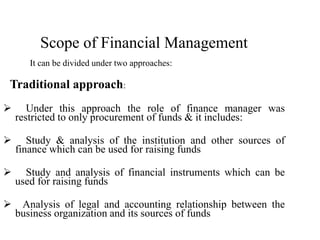
Scope of Financial Management
It can be divided under two approaches:
Traditional approach:
 Under this approach the role of finance manager was
restricted to only procurement of funds & it includes:
 Study & analysis of the institution and other sources of
finance which can be used for raising funds
 Study and analysis of financial instruments which can be
used for raising funds
 Analysis of legal and accounting relationship between the
business organization and its sources of funds
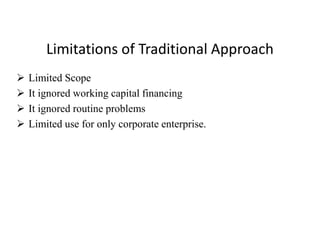
Limitations of Traditional Approach
 Limited Scope
 It ignored working capital financing
 It ignored routine problems
 Limited use for only corporate enterprise.
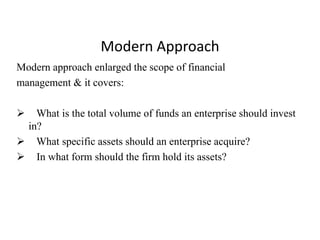
Modern Approach
Modern approach enlarged the scope of financial
management & it covers:
 What is the total volume of funds an enterprise should invest
in?
 What specific assets should an enterprise acquire?
 In what form should the firm hold its assets?
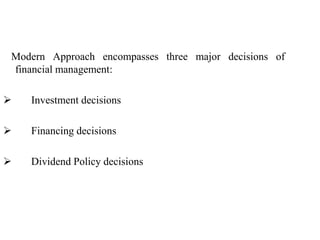
Modern Approach encompasses three major decisions of
financial management:
 Investment decisions
 Financing decisions
 Dividend Policy decisions
Functions of Finance Manager
 Formulation of Financial objectives
 Forecasting and estimating capital requirement
 Designing the capital structure
 Determining the suitable source of finance
 Procurement of funds
 Investment of funds
 Disposal of profits
 Maintaining the proper liquidity
 Maintaining relations with outside agencies
 Evaluating financial performance
 Keeping touch with stock exchange quotations and
behavior of share price
Tools & Techniques of Financial Management
 Capital budgeting techniques
 Cost of capital
 Leverage
 Cash Management
 Receivables Management
 Inventory Management
OBJECTIVE OF FINANCIAL MGMT.
Wealth maximization of Shareholders talks
about the value of the company generally
expressed in terms of the value of the shares .
Profit Maximization - refers to how much rupee
profit the company makes.
Although Profit maximization was the traditional
concept, all firms now look at maximizing wealth
for their shareholders
Profit Maximization
This implies that the finance manager has to make his
decisions in manner so that the profits of the concern are
maximized.
The operational efficiency of the firm is assessed from the
amount of return it generates on the capital employed by it.
Therefore it is very necessary for a firm to direct all its
decisions towards the goal of profit maximization.
This can be achieved by increasing sales turnover and
minimizing the manufacturing and financial cost
Profit Maximization
The process by which a firm determines the price and output levels
that give the maximum profits.
It suffers from the following limitations:
 Concept of Profit is not clear
 (It could mean PAT, PBT, EBIT , etc.)
 Profit in absolute terms cannot be used as an effective tool for
decision making , it has to be expressed in terms of EPS or with
respect to investments made
 It does not consider the risk factor.
 It has a short-term focus
 It ignores the magnitude and the timing of earnings. (Time Value
of Money)
Wealth Maximization
Wealth maximization means maximizing the wealth of the
shareholders in terms of market value of the share and value
of the firm. This involves increasing the Earning per share
of the shareholders.
Wealth maximization is regarded as operationally and
managerially the better objective because:
 Time value of money
 The risk or uncertainty of future earning
 Effect of dividend policy on the market price of the share
Steps for achieving the objective of wealth
maximization
The objectives of financial management are such that they should be
beneficial to owners, management, employees & customers.
These objectives can be accomplished only by maximizing the Value
of the firm through the following ways:
 Increase in profits
 Reduction in cost
 Sources of funds
 Minimize risk
 Long run value
 Good track record of dividend payment
“Wealth Maximization is superior criteria than profit maximization”
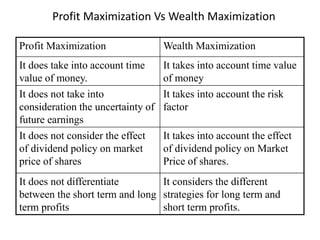
Profit Maximization Vs Wealth Maximization
Profit Maximization Wealth Maximization
It does take into account time
value of money.
It takes into account time value
of money
It does not take into
consideration the uncertainty of
future earnings
It takes into account the risk
factor
It does not consider the effect
of dividend policy on market
price of shares
It takes into account the effect
of dividend policy on Market
Price of shares.
It does not differentiate
between the short term and long
term profits
It considers the different
strategies for long term and
short term profits.
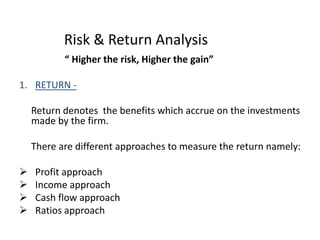
Risk & Return Analysis
“ Higher the risk, Higher the gain”
1. RETURN -
Return denotes the benefits which accrue on the investments
made by the firm.
There are different approaches to measure the return namely:
 Profit approach
 Income approach
 Cash flow approach
 Ratios approach
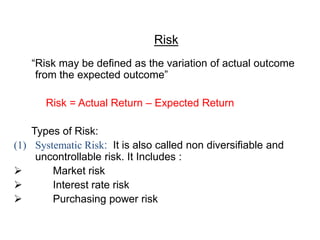
Risk
“Risk may be defined as the variation of actual outcome
from the expected outcome”
Risk = Actual Return – Expected Return
Types of Risk:
(1) Systematic Risk: It is also called non diversifiable and
uncontrollable risk. It Includes :
 Market risk
 Interest rate risk
 Purchasing power risk
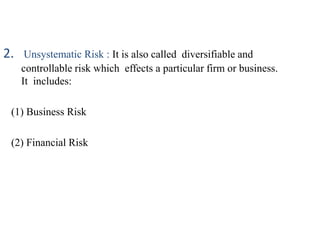
2. Unsystematic Risk : It is also called diversifiable and
controllable risk which effects a particular firm or business.
It includes:
(1) Business Risk
(2) Financial Risk
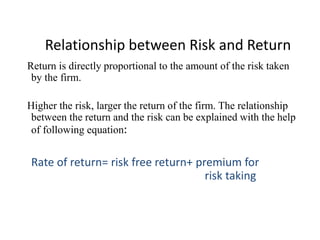
Relationship between Risk and Return
Return is directly proportional to the amount of the risk taken
by the firm.
Higher the risk, larger the return of the firm. The relationship
between the return and the risk can be explained with the help
of following equation:
Rate of return= risk free return+ premium for
risk taking
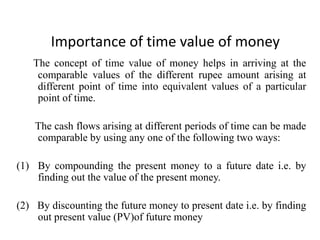
Importance of time value of money
The concept of time value of money helps in arriving at the
comparable values of the different rupee amount arising at
different point of time into equivalent values of a particular
point of time.
The cash flows arising at different periods of time can be made
comparable by using any one of the following two ways:
(1) By compounding the present money to a future date i.e. by
finding out the value of the present money.
(2) By discounting the future money to present date i.e. by finding
out present value (PV)of future money
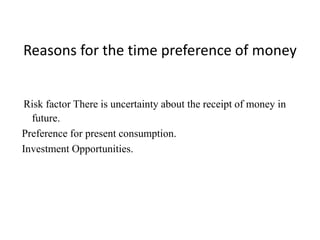
Reasons for the time preference of money
Risk factor There is uncertainty about the receipt of money in
future.
Preference for present consumption.
Investment Opportunities.

Financial management unit 1

  • 1.
  • 2.
    Definitions • “Financial managementis concerned with the managerial decisions that result in the acquisition and financing of short term and long term credits for the firm” • “Financial Management deals with procurement of funds and their effective utilization in the business”
  • 3.
    In simple words, •Financial Management is the study of all those tools and techniques which are used for the procurement and investment of funds. • It also undertakes the ways of disposal of profits.
  • 4.
    Financial Management involvestwo broad aspects: Procurement of funds:  Identification of sources of Finance  Determination of Finance Mix  Raising of funds b) Effective Utilization of Funds: . To decide about where to invest the funds in a most effective way.
  • 5.
    Scope of FinancialManagement It can be divided under two approaches: Traditional approach:  Under this approach the role of finance manager was restricted to only procurement of funds & it includes:  Study & analysis of the institution and other sources of finance which can be used for raising funds  Study and analysis of financial instruments which can be used for raising funds  Analysis of legal and accounting relationship between the business organization and its sources of funds
  • 6.
    Limitations of TraditionalApproach  Limited Scope  It ignored working capital financing  It ignored routine problems  Limited use for only corporate enterprise.
  • 7.
    Modern Approach Modern approachenlarged the scope of financial management & it covers:  What is the total volume of funds an enterprise should invest in?  What specific assets should an enterprise acquire?  In what form should the firm hold its assets?
  • 8.
    Modern Approach encompassesthree major decisions of financial management:  Investment decisions  Financing decisions  Dividend Policy decisions
  • 9.
    Functions of FinanceManager  Formulation of Financial objectives  Forecasting and estimating capital requirement  Designing the capital structure  Determining the suitable source of finance  Procurement of funds
  • 10.
     Investment offunds  Disposal of profits  Maintaining the proper liquidity  Maintaining relations with outside agencies  Evaluating financial performance  Keeping touch with stock exchange quotations and behavior of share price
  • 11.
    Tools & Techniquesof Financial Management  Capital budgeting techniques  Cost of capital  Leverage  Cash Management  Receivables Management  Inventory Management
  • 12.
    OBJECTIVE OF FINANCIALMGMT. Wealth maximization of Shareholders talks about the value of the company generally expressed in terms of the value of the shares . Profit Maximization - refers to how much rupee profit the company makes. Although Profit maximization was the traditional concept, all firms now look at maximizing wealth for their shareholders
  • 13.
    Profit Maximization This impliesthat the finance manager has to make his decisions in manner so that the profits of the concern are maximized. The operational efficiency of the firm is assessed from the amount of return it generates on the capital employed by it. Therefore it is very necessary for a firm to direct all its decisions towards the goal of profit maximization. This can be achieved by increasing sales turnover and minimizing the manufacturing and financial cost
  • 14.
    Profit Maximization The processby which a firm determines the price and output levels that give the maximum profits. It suffers from the following limitations:  Concept of Profit is not clear  (It could mean PAT, PBT, EBIT , etc.)  Profit in absolute terms cannot be used as an effective tool for decision making , it has to be expressed in terms of EPS or with respect to investments made  It does not consider the risk factor.  It has a short-term focus  It ignores the magnitude and the timing of earnings. (Time Value of Money)
  • 15.
    Wealth Maximization Wealth maximizationmeans maximizing the wealth of the shareholders in terms of market value of the share and value of the firm. This involves increasing the Earning per share of the shareholders. Wealth maximization is regarded as operationally and managerially the better objective because:  Time value of money  The risk or uncertainty of future earning  Effect of dividend policy on the market price of the share
  • 16.
    Steps for achievingthe objective of wealth maximization The objectives of financial management are such that they should be beneficial to owners, management, employees & customers. These objectives can be accomplished only by maximizing the Value of the firm through the following ways:  Increase in profits  Reduction in cost  Sources of funds  Minimize risk  Long run value  Good track record of dividend payment “Wealth Maximization is superior criteria than profit maximization”
  • 17.
    Profit Maximization VsWealth Maximization Profit Maximization Wealth Maximization It does take into account time value of money. It takes into account time value of money It does not take into consideration the uncertainty of future earnings It takes into account the risk factor It does not consider the effect of dividend policy on market price of shares It takes into account the effect of dividend policy on Market Price of shares. It does not differentiate between the short term and long term profits It considers the different strategies for long term and short term profits.
  • 18.
    Risk & ReturnAnalysis “ Higher the risk, Higher the gain” 1. RETURN - Return denotes the benefits which accrue on the investments made by the firm. There are different approaches to measure the return namely:  Profit approach  Income approach  Cash flow approach  Ratios approach
  • 19.
    Risk “Risk may bedefined as the variation of actual outcome from the expected outcome” Risk = Actual Return – Expected Return Types of Risk: (1) Systematic Risk: It is also called non diversifiable and uncontrollable risk. It Includes :  Market risk  Interest rate risk  Purchasing power risk
  • 20.
    2. Unsystematic Risk: It is also called diversifiable and controllable risk which effects a particular firm or business. It includes: (1) Business Risk (2) Financial Risk
  • 21.
    Relationship between Riskand Return Return is directly proportional to the amount of the risk taken by the firm. Higher the risk, larger the return of the firm. The relationship between the return and the risk can be explained with the help of following equation: Rate of return= risk free return+ premium for risk taking
  • 22.
    Importance of timevalue of money The concept of time value of money helps in arriving at the comparable values of the different rupee amount arising at different point of time into equivalent values of a particular point of time. The cash flows arising at different periods of time can be made comparable by using any one of the following two ways: (1) By compounding the present money to a future date i.e. by finding out the value of the present money. (2) By discounting the future money to present date i.e. by finding out present value (PV)of future money
  • 23.
    Reasons for thetime preference of money Risk factor There is uncertainty about the receipt of money in future. Preference for present consumption. Investment Opportunities.