Dr.M.VETRIVEL,
Associate Professor,
Department of Commerce
VELS University
 A financial environment is a part of an economy
with the major players being firms, investors, and
markets. Essentially, this sector can represent a
large part of a well-developed economy as
individuals who retain private property have the
ability to grow their capital. Firms are any
business that offer goods or services to
consumers. Investors are individuals or businesses
that place capital into businesses for financial
returns. Markets represent the financial
environment that makes this all possible.
 Financial environment of a company refers to
all the financial institutions and financial
market around the company that affects the
working of the company as a whole.
 The financial environment has a number of
factors. It includes the financial institutions,
government, individuals and firms around the
business. Firms use their financial markets to
keep their savings as property. It is extremely
important for the monetary markets.
 The financial environment is composed of three
key components:
(1) financial managers,
(2) financial markets,
(3) investors (including creditors).
 A market is a venue where goods and
services are exchanged.
 A financial market is a place where
individuals and organizations wanting
to borrow funds are brought together
with those having a surplus of funds.
Short term finance
 Razing money for a period of less than
one year is known as short term capital.
 The availability of short term funds is
essential.
 fund are required in a business after
established to meet its day today expenses.
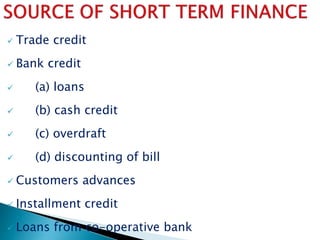
 Trade credit
 Bank credit
 (a) loans
 (b) cash credit
 (c) overdraft
 (d) discounting of bill
 Customers advances
 Installment credit
 Loans from co-operative bank
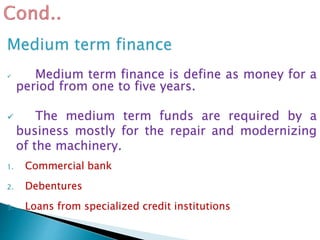
Medium term finance
 Medium term finance is define as money for a
period from one to five years.
 The medium term funds are required by a
business mostly for the repair and modernizing
of the machinery.
1. Commercial bank
2. Debentures
3. Loans from specialized credit institutions
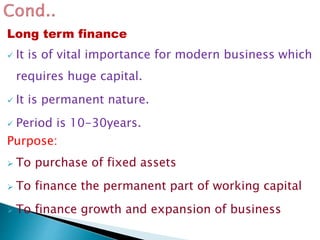
Long term finance
 It is of vital importance for modern business which
requires huge capital.
 It is permanent nature.
 Period is 10-30years.
Purpose:
 To purchase of fixed assets
 To finance the permanent part of working capital
 To finance growth and expansion of business
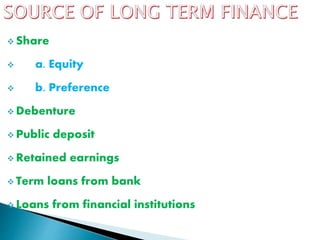
 Share
 a. Equity
 b. Preference
 Debenture
 Public deposit
 Retained earnings
 Term loans from bank
 Loans from financial institutions
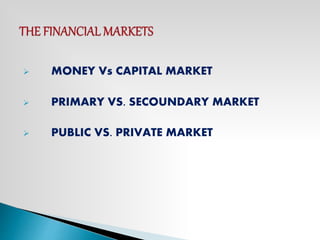
 MONEY Vs CAPITAL MARKET
 PRIMARY VS. SECOUNDARY MARKET
 PUBLIC VS. PRIVATE MARKET
Money Market:
The market concerned with buying and selling
of short term (less than one year original maturity)
government and corporate debt securities is called
money market. Highly liquid, minimal risk
1. Commercial paper
2. Bank certificate of deposits
3. Treasury bills.
Capital Market:
The market concerned with relatively
long term (greater than one year original
maturity) debt and equity instruments (e.g
bonds and stocks) is called capital market.
1. Stock market
2. Residential commercial mortgages
3. Corporate bond market
1. PRIMARY MARKET: Market for issuing a new
security and distribution to saver lenders.
(a) Initial public offering market (IPO)
(b) Investment bank – information and
marketing specialists for newly issue
securities.
Secondary market
 market where existing securities can be
exchanged.
(a) Bombay stock exchange
(b) American stock exchange
or
BSE
NSE- National stock exchange
1. Voluntary association
2. Control of the governing body
3. Rules and regulations
4. Listed securities
1. Ready and continuous market for
securities
2. Evaluation of securities
3. Safety of capital and fair dealing
4. Agency for capital formation
5. Proper canalization of capital
6. Regulation of company management
7. Facilities for speculation
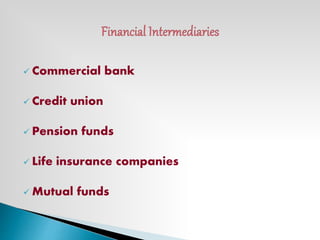
 Commercial bank
 Credit union
 Pension funds
 Life insurance companies
 Mutual funds
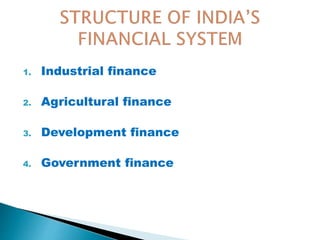
1. Industrial finance
2. Agricultural finance
3. Development finance
4. Government finance
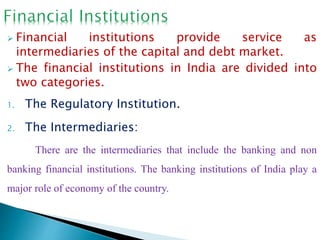
 Financial institutions provide service as
intermediaries of the capital and debt market.
 The financial institutions in India are divided into
two categories.
1. The Regulatory Institution.
2. The Intermediaries:
There are the intermediaries that include the banking and non
banking financial institutions. The banking institutions of India play a
major role of economy of the country.
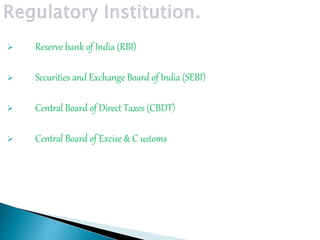
 Reserve bank of India (RBI)
 Securities and Exchange Board of India (SEBI)
 Central Board of Direct Taxes (CBDT)
 Central Board of Excise & C ustoms
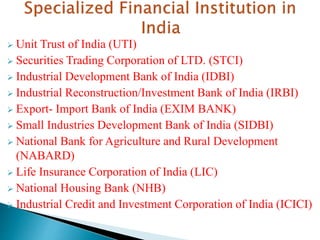
 Unit Trust of India (UTI)
 Securities Trading Corporation of LTD. (STCI)
 Industrial Development Bank of India (IDBI)
 Industrial Reconstruction/Investment Bank of India (IRBI)
 Export- Import Bank of India (EXIM BANK)
 Small Industries Development Bank of India (SIDBI)
 National Bank for Agriculture and Rural Development
(NABARD)
 Life Insurance Corporation of India (LIC)
 National Housing Bank (NHB)
 Industrial Credit and Investment Corporation of India (ICICI)
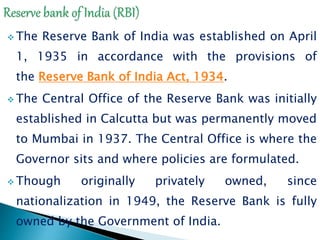
 The Reserve Bank of India was established on April
1, 1935 in accordance with the provisions of
the Reserve Bank of India Act, 1934.
 The Central Office of the Reserve Bank was initially
established in Calcutta but was permanently moved
to Mumbai in 1937. The Central Office is where the
Governor sits and where policies are formulated.
 Though originally privately owned, since
nationalization in 1949, the Reserve Bank is fully
owned by the Government of India.
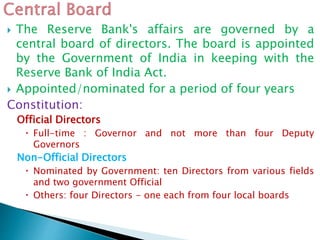
 The Reserve Bank's affairs are governed by a
central board of directors. The board is appointed
by the Government of India in keeping with the
Reserve Bank of India Act.
 Appointed/nominated for a period of four years
Constitution:
Official Directors
 Full-time : Governor and not more than four Deputy
Governors
Non-Official Directors
 Nominated by Government: ten Directors from various fields
and two government Official
 Others: four Directors - one each from four local boards
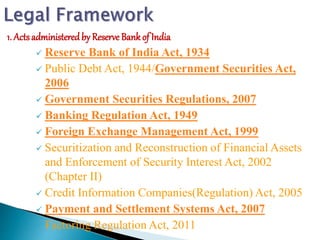
1. Actsadministered by Reserve Bank of India
 Reserve Bank of India Act, 1934
 Public Debt Act, 1944/Government Securities Act,
2006
 Government Securities Regulations, 2007
 Banking Regulation Act, 1949
 Foreign Exchange Management Act, 1999
 Securitization and Reconstruction of Financial Assets
and Enforcement of Security Interest Act, 2002
(Chapter II)
 Credit Information Companies(Regulation) Act, 2005
 Payment and Settlement Systems Act, 2007
 Factoring Regulation Act, 2011
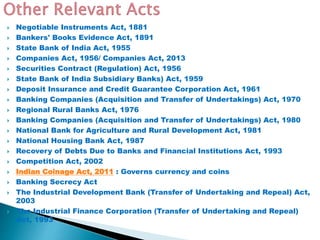
 Negotiable Instruments Act, 1881
 Bankers' Books Evidence Act, 1891
 State Bank of India Act, 1955
 Companies Act, 1956/ Companies Act, 2013
 Securities Contract (Regulation) Act, 1956
 State Bank of India Subsidiary Banks) Act, 1959
 Deposit Insurance and Credit Guarantee Corporation Act, 1961
 Banking Companies (Acquisition and Transfer of Undertakings) Act, 1970
 Regional Rural Banks Act, 1976
 Banking Companies (Acquisition and Transfer of Undertakings) Act, 1980
 National Bank for Agriculture and Rural Development Act, 1981
 National Housing Bank Act, 1987
 Recovery of Debts Due to Banks and Financial Institutions Act, 1993
 Competition Act, 2002
 Indian Coinage Act, 2011 : Governs currency and coins
 Banking Secrecy Act
 The Industrial Development Bank (Transfer of Undertaking and Repeal) Act,
2003
 The Industrial Finance Corporation (Transfer of Undertaking and Repeal)
Act, 1993
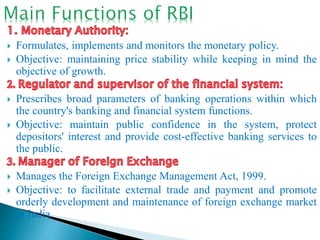
 Formulates, implements and monitors the monetary policy.
 Objective: maintaining price stability while keeping in mind the
objective of growth.
 Prescribes broad parameters of banking operations within which
the country's banking and financial system functions.
 Objective: maintain public confidence in the system, protect
depositors' interest and provide cost-effective banking services to
the public.
 Manages the Foreign Exchange Management Act, 1999.
 Objective: to facilitate external trade and payment and promote
orderly development and maintenance of foreign exchange market
in India.
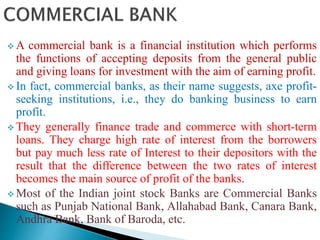
 A commercial bank is a financial institution which performs
the functions of accepting deposits from the general public
and giving loans for investment with the aim of earning profit.
 In fact, commercial banks, as their name suggests, axe profit-
seeking institutions, i.e., they do banking business to earn
profit.
 They generally finance trade and commerce with short-term
loans. They charge high rate of interest from the borrowers
but pay much less rate of Interest to their depositors with the
result that the difference between the two rates of interest
becomes the main source of profit of the banks.
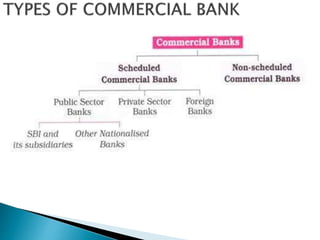
 Most of the Indian joint stock Banks are Commercial Banks
such as Punjab National Bank, Allahabad Bank, Canara Bank,
Andhra Bank, Bank of Baroda, etc.
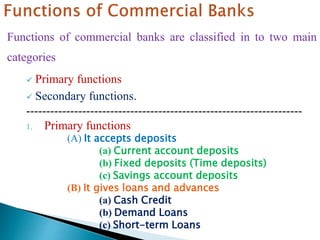
Functions of commercial banks are classified in to two main
categories
 Primary functions
 Secondary functions.
---------------------------------------------------------------------
1. Primary functions
(A) It accepts deposits
(a) Current account deposits
(b) Fixed deposits (Time deposits)
(c) Savings account deposits
(B) It gives loans and advances
(a) Cash Credit
(b) Demand Loans
(c) Short-term Loans
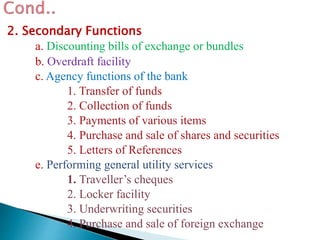
2. Secondary Functions
a. Discounting bills of exchange or bundles
b. Overdraft facility
c. Agency functions of the bank
1. Transfer of funds
2. Collection of funds
3. Payments of various items
4. Purchase and sale of shares and securities
5. Letters of References
e. Performing general utility services
1. Traveller’s cheques
2. Locker facility
3. Underwriting securities
4. Purchase and sale of foreign exchange
 They promote savings and accelerate the rate of capital formation.
 They are source of finance and credit for trade and industry.
 They promote balanced regional development by opening branches
in backward areas.
 Bank credit enables entrepreneurs to innovate and invest which
accelerates the process of economic development.
 They help in promoting large-scale production and growth of
priority sectors such as agriculture, small-scale industry, retail
trade and export.
 They create credit in the sense that they are able to give more loans
and advances than the cash position of the depositor’s permits.
 They help commerce and industry to expand their field of
operation.
 Thus, they make optimum utilization of resources possible.
 The creation of Industrial Credit and Investment Corporation
of India (ICICI) is another milestone in the growth of the
Indian Capital Market.
 It was incorporated in the year 1955, as a company registered
under the Companies Act.
 The ICICI was incorporated to finance small scale and
medium industries in the private sector.
 To encourage industrial development in the private sector, a
considerable provision of underwriting facility was considered
necessary to accelerate the phase of the industrialization. To
fill these gaps, the ICICI was established.
1) To assist in creation, growth and modernization of business
enterprises in the non-public sector.
2) To encourage and promote the involvement of internal and
external capital sources, in such enterprises.
3) To motivate private ownership of industrial investment and
to promote and assist in the expansion of markets.
4) To provide equipment finance.
5) To provide finance for rehabilitation of industrial units.
 Providing finance in the form of long-term or medium term
loans or equity participation.
 Sponsoring and underwriting new issues of shares and other
securities,
 Guaranteeing loans from other private investment sources.
 Making funds available for reinvestment by revolving
investment as rapidly as possible.
 Providing project advisory services i.e. offering advice
 Industrial Development Bank of India (IDBI) established under
Industrial Development Bank of India Act, 1964, is the principal
financial institution for providing credit and other facilities for
developing industries and assisting development institutions.
 Till 1976, IDBI was a subsidiary bank of RBI. In 1976 it was
separated from RBI and the ownership was transferred to
Government of India.
 IDBI is the tenth largest bank in the world in terms of
development.
 To provide financial assistance to industrial enterprises.
 To promote institutions engaged in industrial development.
 To provide technical and administrative assistance for promotion
management or expansion of industry.
 To undertake market and investment research and surveys in
connection with development of industry.
Developmental Activities of IDBI
 Promotional Activities
 Technical Consultancy Organizations
 Entrepreneurship Development Institute
 To provide financial assistance as well as to revive and
revitalize sick industrial units in public/private sectors, an
institution called the Industrial Reconstruction Corporation of
India (IRCI) was set up in 1971 with a share capital of Rs. 10
crores.
 In March 1985, it was converted into a statutory corporation
called the Industrial Reconstruction Bank of India (IRBI),
with an authorized capital of Rs. 200 crores and a paid-up
capital of Rs. 50 crores.
 To provide financial assistance to sick industrial units.
 To provide managerial and technical assistance to sick
industrial units
 To secure the assistance of other financial institutions and
government agencies for the revival and revitalization of
sick industrial units
 To provide merchant banking services for amalgamation,
merger, reconstruction, etc.,
 To provide consultancy services to the banks in the matter
of sick units, and
 To undertake leasing business.
 The Export-Import Bank of India, commonly known as the
EXIM bank, was set up on January 1, 1982 to take over the
operations of the international finance wing of the IDBI and to
provide financial assistance to exporters and importers to
promote India’s foreign trade.
 It also provides refinance facilities to the commercial banks
and financial institutions against their export-import financing
activities.
 Financing of export and import of goods and services both
of India and of outside India.
 Providing finance for joint ventures in foreign countries.
 Undertaking merchant banking functions of companies
engaged in foreign trade.
 Providing technical and administrative assistance to the
parties engaged in export and import business.
 Offering buyers’ credit and lines of credit to the foreign
governments and banks.
 Providing advance information and business advisory
services to Indian exports in respect of multilaterally funded
projects overseas.
 With a view to ensuring larger flow of financial and
non-financial assistance to the small-scale sector, the
Government of India set up the Small Industries
Development Bank of India (SIDBI) under a special Act
of the Parliament in October 1989 as wholly-owned
subsidiary of the IDBI.
 The bank commenced its operations from April 2, 1990
with its head office in Luck now. The SIDBI has taken
over the outstanding portfolio of the IDBI relating to
the small-scale sector.
 To initiate steps for technological up-gradation and
modernization of existing units.
 To expand the channels for marketing the products of SSI
sector in domestic and international markets.
 To promote employment oriented industries especially in
semi-urban areas to create more employment opportunities
and thereby checking migration of people to urban areas.
 The SIDBI’s financial assistance to small-scale industries is
channelized through the existing credit delivery system
comprising State Financial Corporation, State Industrial
Development Corporations, Commercial Banks, and
Regional Rural Banks.
 Reserve Bank of India (RBI), constituted a committee (Shivaraman
committee) to review the arrangements for institutional credit for
agriculture and rural development (CRAFICARD) on 30 March
1979, under the Chairmanship of Shri B.Sivaraman, former
member of Planning Commission, Government of India to review
the arrangements for institutional credit for agriculture and rural
development.
 NABARD was established with an initial capital of 100 cr., on 12
July 1982 by a special act of parliament 1981, by transferring the
agricultural credit functions of RBI and refinance functions of the
then Agricultural Refinance and Development Corporation
(ARDC).
 NABARD replaced the Agricultural Credit Department (ACD) and
Rural Planning and Credit Cell (RPCC) of Reserve Bank of India,
and Agricultural Refinance and Development Corporation (ARDC)
Credit Functions:
 Framing policy and guidelines for rural financial institutions.
 Providing credit facilities to issuing organizations
 Monitoring the flow of ground level rural credit.
 Preparation of credit plans annually for all districts for
identification of credit potential.
Development Functions:
 Help cooperative banks and Regional Rural Banks to prepare
development actions plans for themselves.
 Help Regional Rural Banks and the sponsor banks to enter into
MoUs with state governments and cooperative banks to improve
the affairs of the Regional Rural Banks.
 Monitor implementation of development action plans of banks.
 Provide financial support for the training institutes of cooperative
banks, commercial banks and Regional Rural Banks.
Supervisory Functions:
 Undertakes inspection of Regional Rural Banks (RRBs) and
Cooperative Banks (other than urban/primary cooperative banks)
under the provisions of Banking Regulation Act, 1949.
 Undertakes inspection of State Cooperative Agriculture and Rural
Development Banks (SCARDBs) and apex non- credit cooperative
societies on a voluntary basis.
 Provides recommendations to Reserve Bank of India on issue of
licenses to Cooperative Banks, opening of new branches by State
Cooperative Banks and Regional Rural Banks (RRBs).
 Undertakes portfolio inspections besides off-site surveillance of
Cooperative Banks and Regional Rural Banks (RRBs).
Financial environment 3

Financial environment 3

  • 1.
  • 2.
     A financialenvironment is a part of an economy with the major players being firms, investors, and markets. Essentially, this sector can represent a large part of a well-developed economy as individuals who retain private property have the ability to grow their capital. Firms are any business that offer goods or services to consumers. Investors are individuals or businesses that place capital into businesses for financial returns. Markets represent the financial environment that makes this all possible.
  • 3.
     Financial environmentof a company refers to all the financial institutions and financial market around the company that affects the working of the company as a whole.  The financial environment has a number of factors. It includes the financial institutions, government, individuals and firms around the business. Firms use their financial markets to keep their savings as property. It is extremely important for the monetary markets.
  • 4.
     The financialenvironment is composed of three key components: (1) financial managers, (2) financial markets, (3) investors (including creditors).
  • 5.
     A marketis a venue where goods and services are exchanged.  A financial market is a place where individuals and organizations wanting to borrow funds are brought together with those having a surplus of funds.
  • 6.
    Short term finance Razing money for a period of less than one year is known as short term capital.  The availability of short term funds is essential.  fund are required in a business after established to meet its day today expenses.
  • 7.
     Trade credit Bank credit  (a) loans  (b) cash credit  (c) overdraft  (d) discounting of bill  Customers advances  Installment credit  Loans from co-operative bank
  • 8.
    Medium term finance Medium term finance is define as money for a period from one to five years.  The medium term funds are required by a business mostly for the repair and modernizing of the machinery. 1. Commercial bank 2. Debentures 3. Loans from specialized credit institutions
  • 9.
    Long term finance It is of vital importance for modern business which requires huge capital.  It is permanent nature.  Period is 10-30years. Purpose:  To purchase of fixed assets  To finance the permanent part of working capital  To finance growth and expansion of business
  • 10.
     Share  a.Equity  b. Preference  Debenture  Public deposit  Retained earnings  Term loans from bank  Loans from financial institutions
  • 11.
     MONEY VsCAPITAL MARKET  PRIMARY VS. SECOUNDARY MARKET  PUBLIC VS. PRIVATE MARKET
  • 12.
    Money Market: The marketconcerned with buying and selling of short term (less than one year original maturity) government and corporate debt securities is called money market. Highly liquid, minimal risk 1. Commercial paper 2. Bank certificate of deposits 3. Treasury bills.
  • 13.
    Capital Market: The marketconcerned with relatively long term (greater than one year original maturity) debt and equity instruments (e.g bonds and stocks) is called capital market. 1. Stock market 2. Residential commercial mortgages 3. Corporate bond market
  • 14.
    1. PRIMARY MARKET:Market for issuing a new security and distribution to saver lenders. (a) Initial public offering market (IPO) (b) Investment bank – information and marketing specialists for newly issue securities.
  • 15.
    Secondary market  marketwhere existing securities can be exchanged. (a) Bombay stock exchange (b) American stock exchange or BSE NSE- National stock exchange
  • 16.
    1. Voluntary association 2.Control of the governing body 3. Rules and regulations 4. Listed securities
  • 17.
    1. Ready andcontinuous market for securities 2. Evaluation of securities 3. Safety of capital and fair dealing 4. Agency for capital formation 5. Proper canalization of capital 6. Regulation of company management 7. Facilities for speculation
  • 18.
     Commercial bank Credit union  Pension funds  Life insurance companies  Mutual funds
  • 19.
    1. Industrial finance 2.Agricultural finance 3. Development finance 4. Government finance
  • 20.
     Financial institutionsprovide service as intermediaries of the capital and debt market.  The financial institutions in India are divided into two categories. 1. The Regulatory Institution. 2. The Intermediaries: There are the intermediaries that include the banking and non banking financial institutions. The banking institutions of India play a major role of economy of the country.
  • 21.
     Reserve bankof India (RBI)  Securities and Exchange Board of India (SEBI)  Central Board of Direct Taxes (CBDT)  Central Board of Excise & C ustoms
  • 22.
     Unit Trustof India (UTI)  Securities Trading Corporation of LTD. (STCI)  Industrial Development Bank of India (IDBI)  Industrial Reconstruction/Investment Bank of India (IRBI)  Export- Import Bank of India (EXIM BANK)  Small Industries Development Bank of India (SIDBI)  National Bank for Agriculture and Rural Development (NABARD)  Life Insurance Corporation of India (LIC)  National Housing Bank (NHB)  Industrial Credit and Investment Corporation of India (ICICI)
  • 23.
     The ReserveBank of India was established on April 1, 1935 in accordance with the provisions of the Reserve Bank of India Act, 1934.  The Central Office of the Reserve Bank was initially established in Calcutta but was permanently moved to Mumbai in 1937. The Central Office is where the Governor sits and where policies are formulated.  Though originally privately owned, since nationalization in 1949, the Reserve Bank is fully owned by the Government of India.
  • 24.
     The ReserveBank's affairs are governed by a central board of directors. The board is appointed by the Government of India in keeping with the Reserve Bank of India Act.  Appointed/nominated for a period of four years Constitution: Official Directors  Full-time : Governor and not more than four Deputy Governors Non-Official Directors  Nominated by Government: ten Directors from various fields and two government Official  Others: four Directors - one each from four local boards
  • 25.
    1. Actsadministered byReserve Bank of India  Reserve Bank of India Act, 1934  Public Debt Act, 1944/Government Securities Act, 2006  Government Securities Regulations, 2007  Banking Regulation Act, 1949  Foreign Exchange Management Act, 1999  Securitization and Reconstruction of Financial Assets and Enforcement of Security Interest Act, 2002 (Chapter II)  Credit Information Companies(Regulation) Act, 2005  Payment and Settlement Systems Act, 2007  Factoring Regulation Act, 2011
  • 26.
     Negotiable InstrumentsAct, 1881  Bankers' Books Evidence Act, 1891  State Bank of India Act, 1955  Companies Act, 1956/ Companies Act, 2013  Securities Contract (Regulation) Act, 1956  State Bank of India Subsidiary Banks) Act, 1959  Deposit Insurance and Credit Guarantee Corporation Act, 1961  Banking Companies (Acquisition and Transfer of Undertakings) Act, 1970  Regional Rural Banks Act, 1976  Banking Companies (Acquisition and Transfer of Undertakings) Act, 1980  National Bank for Agriculture and Rural Development Act, 1981  National Housing Bank Act, 1987  Recovery of Debts Due to Banks and Financial Institutions Act, 1993  Competition Act, 2002  Indian Coinage Act, 2011 : Governs currency and coins  Banking Secrecy Act  The Industrial Development Bank (Transfer of Undertaking and Repeal) Act, 2003  The Industrial Finance Corporation (Transfer of Undertaking and Repeal) Act, 1993
  • 27.
     Formulates, implementsand monitors the monetary policy.  Objective: maintaining price stability while keeping in mind the objective of growth.  Prescribes broad parameters of banking operations within which the country's banking and financial system functions.  Objective: maintain public confidence in the system, protect depositors' interest and provide cost-effective banking services to the public.  Manages the Foreign Exchange Management Act, 1999.  Objective: to facilitate external trade and payment and promote orderly development and maintenance of foreign exchange market in India.
  • 29.
     A commercialbank is a financial institution which performs the functions of accepting deposits from the general public and giving loans for investment with the aim of earning profit.  In fact, commercial banks, as their name suggests, axe profit- seeking institutions, i.e., they do banking business to earn profit.  They generally finance trade and commerce with short-term loans. They charge high rate of interest from the borrowers but pay much less rate of Interest to their depositors with the result that the difference between the two rates of interest becomes the main source of profit of the banks.  Most of the Indian joint stock Banks are Commercial Banks such as Punjab National Bank, Allahabad Bank, Canara Bank, Andhra Bank, Bank of Baroda, etc.
  • 31.
    Functions of commercialbanks are classified in to two main categories  Primary functions  Secondary functions. --------------------------------------------------------------------- 1. Primary functions (A) It accepts deposits (a) Current account deposits (b) Fixed deposits (Time deposits) (c) Savings account deposits (B) It gives loans and advances (a) Cash Credit (b) Demand Loans (c) Short-term Loans
  • 32.
    2. Secondary Functions a.Discounting bills of exchange or bundles b. Overdraft facility c. Agency functions of the bank 1. Transfer of funds 2. Collection of funds 3. Payments of various items 4. Purchase and sale of shares and securities 5. Letters of References e. Performing general utility services 1. Traveller’s cheques 2. Locker facility 3. Underwriting securities 4. Purchase and sale of foreign exchange
  • 33.
     They promotesavings and accelerate the rate of capital formation.  They are source of finance and credit for trade and industry.  They promote balanced regional development by opening branches in backward areas.  Bank credit enables entrepreneurs to innovate and invest which accelerates the process of economic development.  They help in promoting large-scale production and growth of priority sectors such as agriculture, small-scale industry, retail trade and export.  They create credit in the sense that they are able to give more loans and advances than the cash position of the depositor’s permits.  They help commerce and industry to expand their field of operation.  Thus, they make optimum utilization of resources possible.
  • 34.
     The creationof Industrial Credit and Investment Corporation of India (ICICI) is another milestone in the growth of the Indian Capital Market.  It was incorporated in the year 1955, as a company registered under the Companies Act.  The ICICI was incorporated to finance small scale and medium industries in the private sector.  To encourage industrial development in the private sector, a considerable provision of underwriting facility was considered necessary to accelerate the phase of the industrialization. To fill these gaps, the ICICI was established.
  • 35.
    1) To assistin creation, growth and modernization of business enterprises in the non-public sector. 2) To encourage and promote the involvement of internal and external capital sources, in such enterprises. 3) To motivate private ownership of industrial investment and to promote and assist in the expansion of markets. 4) To provide equipment finance. 5) To provide finance for rehabilitation of industrial units.
  • 36.
     Providing financein the form of long-term or medium term loans or equity participation.  Sponsoring and underwriting new issues of shares and other securities,  Guaranteeing loans from other private investment sources.  Making funds available for reinvestment by revolving investment as rapidly as possible.  Providing project advisory services i.e. offering advice
  • 37.
     Industrial DevelopmentBank of India (IDBI) established under Industrial Development Bank of India Act, 1964, is the principal financial institution for providing credit and other facilities for developing industries and assisting development institutions.  Till 1976, IDBI was a subsidiary bank of RBI. In 1976 it was separated from RBI and the ownership was transferred to Government of India.  IDBI is the tenth largest bank in the world in terms of development.
  • 38.
     To providefinancial assistance to industrial enterprises.  To promote institutions engaged in industrial development.  To provide technical and administrative assistance for promotion management or expansion of industry.  To undertake market and investment research and surveys in connection with development of industry. Developmental Activities of IDBI  Promotional Activities  Technical Consultancy Organizations  Entrepreneurship Development Institute
  • 39.
     To providefinancial assistance as well as to revive and revitalize sick industrial units in public/private sectors, an institution called the Industrial Reconstruction Corporation of India (IRCI) was set up in 1971 with a share capital of Rs. 10 crores.  In March 1985, it was converted into a statutory corporation called the Industrial Reconstruction Bank of India (IRBI), with an authorized capital of Rs. 200 crores and a paid-up capital of Rs. 50 crores.
  • 40.
     To providefinancial assistance to sick industrial units.  To provide managerial and technical assistance to sick industrial units  To secure the assistance of other financial institutions and government agencies for the revival and revitalization of sick industrial units  To provide merchant banking services for amalgamation, merger, reconstruction, etc.,  To provide consultancy services to the banks in the matter of sick units, and  To undertake leasing business.
  • 41.
     The Export-ImportBank of India, commonly known as the EXIM bank, was set up on January 1, 1982 to take over the operations of the international finance wing of the IDBI and to provide financial assistance to exporters and importers to promote India’s foreign trade.  It also provides refinance facilities to the commercial banks and financial institutions against their export-import financing activities.
  • 42.
     Financing ofexport and import of goods and services both of India and of outside India.  Providing finance for joint ventures in foreign countries.  Undertaking merchant banking functions of companies engaged in foreign trade.  Providing technical and administrative assistance to the parties engaged in export and import business.  Offering buyers’ credit and lines of credit to the foreign governments and banks.  Providing advance information and business advisory services to Indian exports in respect of multilaterally funded projects overseas.
  • 43.
     With aview to ensuring larger flow of financial and non-financial assistance to the small-scale sector, the Government of India set up the Small Industries Development Bank of India (SIDBI) under a special Act of the Parliament in October 1989 as wholly-owned subsidiary of the IDBI.  The bank commenced its operations from April 2, 1990 with its head office in Luck now. The SIDBI has taken over the outstanding portfolio of the IDBI relating to the small-scale sector.
  • 44.
     To initiatesteps for technological up-gradation and modernization of existing units.  To expand the channels for marketing the products of SSI sector in domestic and international markets.  To promote employment oriented industries especially in semi-urban areas to create more employment opportunities and thereby checking migration of people to urban areas.  The SIDBI’s financial assistance to small-scale industries is channelized through the existing credit delivery system comprising State Financial Corporation, State Industrial Development Corporations, Commercial Banks, and Regional Rural Banks.
  • 45.
     Reserve Bankof India (RBI), constituted a committee (Shivaraman committee) to review the arrangements for institutional credit for agriculture and rural development (CRAFICARD) on 30 March 1979, under the Chairmanship of Shri B.Sivaraman, former member of Planning Commission, Government of India to review the arrangements for institutional credit for agriculture and rural development.  NABARD was established with an initial capital of 100 cr., on 12 July 1982 by a special act of parliament 1981, by transferring the agricultural credit functions of RBI and refinance functions of the then Agricultural Refinance and Development Corporation (ARDC).  NABARD replaced the Agricultural Credit Department (ACD) and Rural Planning and Credit Cell (RPCC) of Reserve Bank of India, and Agricultural Refinance and Development Corporation (ARDC)
  • 46.
    Credit Functions:  Framingpolicy and guidelines for rural financial institutions.  Providing credit facilities to issuing organizations  Monitoring the flow of ground level rural credit.  Preparation of credit plans annually for all districts for identification of credit potential. Development Functions:  Help cooperative banks and Regional Rural Banks to prepare development actions plans for themselves.  Help Regional Rural Banks and the sponsor banks to enter into MoUs with state governments and cooperative banks to improve the affairs of the Regional Rural Banks.  Monitor implementation of development action plans of banks.  Provide financial support for the training institutes of cooperative banks, commercial banks and Regional Rural Banks.
  • 47.
    Supervisory Functions:  Undertakesinspection of Regional Rural Banks (RRBs) and Cooperative Banks (other than urban/primary cooperative banks) under the provisions of Banking Regulation Act, 1949.  Undertakes inspection of State Cooperative Agriculture and Rural Development Banks (SCARDBs) and apex non- credit cooperative societies on a voluntary basis.  Provides recommendations to Reserve Bank of India on issue of licenses to Cooperative Banks, opening of new branches by State Cooperative Banks and Regional Rural Banks (RRBs).  Undertakes portfolio inspections besides off-site surveillance of Cooperative Banks and Regional Rural Banks (RRBs).